Monthly Archives: March 2013

Reforms in China in the International Review of Education

International Review of Education

International Review of Education

The latest issue of the International Review of Education includes an examination of what some may see as the surprising failure of many private institutions of higher education in China. In “Turning around low-performing private universities in China,” Xiaofan Li explains that while most private colleges and universities in China disappeared after the establishment of the People’s Republic of China in 1949, China’s marketization and privatization efforts included the re-opening of higher education to the private sector in the 1990’s. By 2009, statistics published by the Ministry of Education showed that there were 3,101 public universities in China as well as 812 private universities; however, Li reports that many of these “people-run” institutions are struggling, with approximately 500 of them shut down between 2000 and 2009 for financial, legal or other reasons. Of those private universities that have survived, the quality varies substantially, and they are not viewed as being on par with most public universities. Yet, in a country of more than a billion people, these institutions have opened up many new options for those who have been unable to get a place in public universities either because of their age, lack of qualifications, or the limited number of places. At the same time, quality assurance has been and will continue to be the most pronounced and crucial issue that private universities wrestle with. As Stephen Roche explains in the introduction to the issue, Li “considers several factors that contributed to poor performance, including insufficient resources, heavy government control, insufficient enrollments, lack of qualified teachers, limited programme breadth, and problems of scale,” and goes on to examine strategies for turning around low-performing private institutions and helping the government achieve its target of a 40% participation rate in higher education by 2020.

For more information:

2012 China Private University Rankings Announced (link in Chinese)
Boosting Migrants’ Education

Singapore

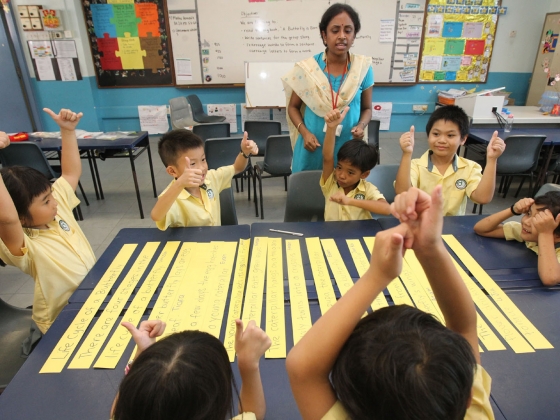
14295425_0The Singapore Ministry of Education has been surveying educators and parents about their concerns with the Singapore education system. The results reveal worries about a perceived over-emphasis on exams and grades that contribute to a high stress education system that overlooks non-academic talents. Additional concerns include anxiety about declining social mobility and rates of inclusion due to disparities in access to education that favors privileged children who can afford tuition.

In response to these kinds of concerns, the Ministry of Education has launched initiatives aimed at strengthening efforts to help every student succeed by:

  • building a strong foundation in literacy and numeracy, from the kindergarten level to secondary level. For the primary and secondary school levels, the existing Learning Suppport Programme for Primary 1 and Primary 2 students will be extended through all 6 years of primary education and even to secondary level.
  • providing teachers with professional development opportunities to learn clear research-based principles to reach out to “low-progress learners.” These measures will help ensure that all students benefit from the best opportunities in education regardless of their background and pace of development.
  • piloting 15 kindergartens in working class neighborhoods in Singapore and providing further support to the pre-school sector, which the MOE has traditionally not been overseeing.
  • expanding support for students with special needs by providing additional post-diagnosis services for parents, streamlining the application and enrollment process for special education schools, and increasing funding for low-income students with special needs.

For more information:

More help in Math, English for weaker students

Helping every student succeed (MOE)

Get back to basics of education: Heng Swee Keat

More support for students with special needs (MOE)

Exams and streaming: Recalibrating our education system (commentary)

Japan

Report on Problematic Behaviors of Public School Students

The Ministry of Education (March 13, 2013)


Ministry of Education, Culture, Sports, Science and Technology: Japan

Ministry of Education, Culture, Sports, Science and Technology: Japan

The Ministry of Education, Culture, Sports, Science and Technology (MEXT) in Japan published an updated version of a national survey, titled “Problematic Behaviors of Public School Students (1-12).”  According to the survey, violence against peers and teachers in schools decreased across all grade levels. The number of truant students decreased by 2,000 in elementary and junior high school compared to last year; however, the number of truant students increased by 600 at the high school level. In addition, the number of 1- 12 grade students who committed suicide was 202. This is a 29.5% increase compared to last year. The survey follows a report last month from the National Police Agency that revealed the number of bullying incidents reported in 2012 more than doubled to 260 from the year before. The report also showed that 511 students were arrested or taken into custody in 2012.  A special commission on education reform is expected to address these issues by recommending, among other things, that “moral education” be made a regular subject.

For more information:

Japanese City Takes on Bullies

Harumafuji saddened by bullying incidents

Australia

Support for Teacher Standards

Josephine Tovey and Amy McNeilage, The Sydney Morning Herald (March 12, 2013)

photo: Peter Rae

photo: Peter Rae

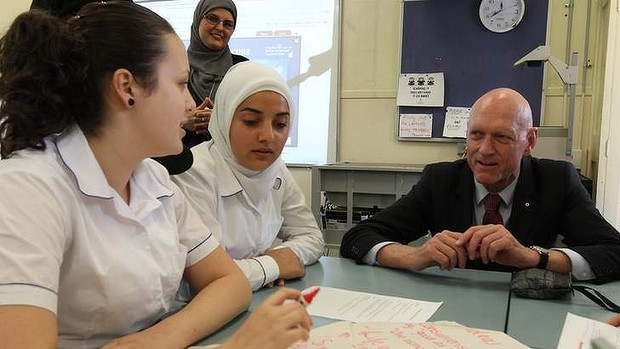
In an effort to raise the standard of teacher training in Australia, the federal government has announced plans for higher standards for teachers entering the profession. As part of the government’s National Plan for School Improvement, the new screening process for admission to teaching courses will include an interview process, demonstration of values and aptitude, and a written statement, thereby making the entry process comparable with existing models in the field of medicine. In addition, all future teachers will need to pass a literacy and numeracy test, demonstrating that their skills are equivalent to the top 30% of the population, before obtaining a teaching degree.

Education Minister Peter Garrett said, “I think that they (teachers) do an excellent job, but the fact is universities need to be sure that the people who are putting up their hand to come in and do teaching have got not only the right qualifications but also the additional temperament, commitment, enthusiasm and directed strengths and real desire to do that job.”

Australia’s plan comes on the heels of a recent, controversial New South Wales proposal, which sets minimum academic entry standards for teacher education students, tougher accreditation tests, and requires mentoring by veteran teachers.

For more information:

Proposed reforms to ensure ‘right’ people enter teaching

The new Rs needed for teaching: reading, writing and a bucketload of rapport

Piccoli firm over teaching benchmark

Austria

Poverty conference calls for a socio-economic index to support schools

Johann Bacher

Johann Bacher

derStandard.at (February 26, 2013)

Johann Bacher, sociologist at the University of Lintz, called for index-based resource funding for schools at this year’s Austrian Poverty Conference.  According to Bacher, this method of funding would focus on socioeconomic disparities and compensate for social segregation in Austrian schools. Four variables (parent level of education, occupation, migration background and language spoken at home) would inform decisions about which schools receive additional government funding; however, schools would have the power to decide independently how best to use the money. The index would support weak students and strengthen the attractiveness of these schools for parents with higher income. The Federal Ministry for Education, Arts, and Culture (BMUKK) has expressed concern over the implementation of the index and feels that they are already dealing with the issue.