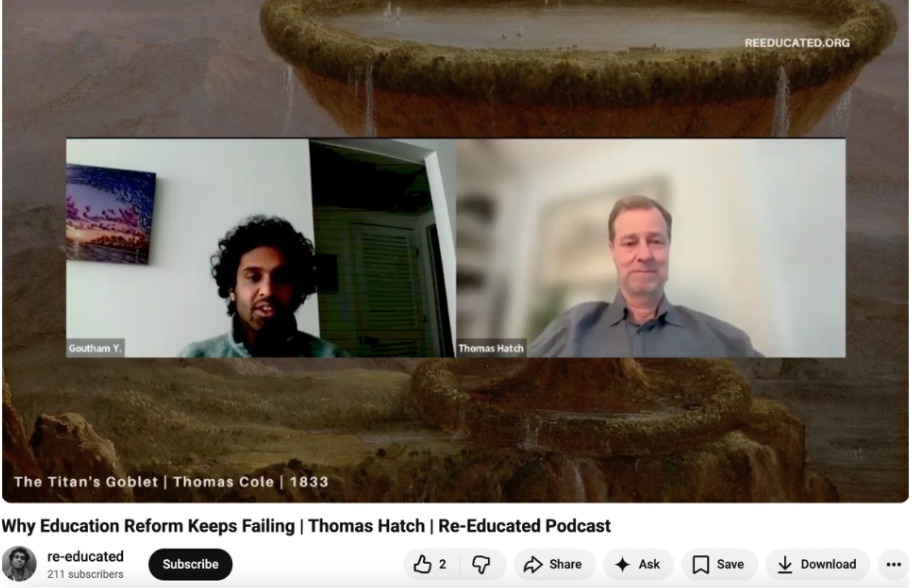
What if the most important part of education is learning how to live with uncertainty? That’s the question that Goutham Yegappan pursues in the 8th season of his Re-Educated Podcast. In the latest episode, he discusses these issues with IEN Editor Thomas Hatch, who highlights the multi-layered problems that make it so difficult to improve schools on a large-scale. For previous interviews, see “Thomas Hatch on The Education We Need and the Future We Can’t Predict” Getting Smart podcast (2021); “What Type of Education Do We Need for a Future We Can’t Predict?” The Getting Unstuck Podcast (2021); Mapping New York City’s ‘School Improvement Industry’ CPRE’s Research Minutes Podcast.
++++++++++++++++++
02:10 – Thomas Hatch’s Path into Education Research
06:45 – Understanding the History of Education Reform
12:30 – Why Promising Reforms Often Fail & The Complexity of Systemic Change
“The challenges in education are so profound and are so multi-layered and so intricate that it’s very difficult to pinpoint one thing that we can do… There’s no one thing that’s going to do it. We have to work on all of these things at once.” (12:08 – 13:27)”
18:40 – The Architecture of Education Systems
24:55 – The Challenge of Scaling Innovation
31:10 – Policy, Practice, and the Classroom Reality
37:20 – Accountability and Its Unintended Consequences
43:35 – Improvement Science and Systemic Change
“Incremental and transformational change can go together. And if I as a leader come in and I recognize… if I work with my peers, the generation that comes after me… then we can build a multi-generational effort that is incremental but leads to the kind of transformational change we want.” (46:43 – 47:46)
49:15 – Rethinking School Reform for the Future
“Humility and courage have to go together. Because if you as a leader know that you don’t have the answer, then you actually need a lot more courage than the leader that thinks they know.”(51:54)
55:10 – Lessons for Educators and Policymakers
58:30 – Closing Reflections
“What if the purpose of schooling wasn’t just focused on the education of an individual child or to enable them to go to college… but it was to make sure that all members of our community are healthy and able to live and to contribute to society?” (1:00:16 – 1:00:42)

 International Education News