In the concluding section of this week’s blog post, David Labaree succinctly sums up some of the key factors that explain why school reform efforts in the US often fail to achieve their ambitious goals. In part one, Labaree discussed why US schools are so often asked to pursue goals — like support economic productivity, foster social mobility, and reduce inequality — that they have never been equipped to achieve. Labaree is an Emeritus Professor at the Stanford University Graduate School of Education and one of the foremost experts on the history of education and educational reform in the US. As Labaree explains, this post was originally published in the Swiss journal Zeitschrift für Pädagogische Historiographie and his book, Someone Has to Fail. Labaree added an introduction (and cartoons) and posted this on his blog on July 9, 2026.
+++++++++++++++++++
Roots of the Failure of School Reform to Resolve Social Problems
In closing, let me summarize the reasons for the continuing failure of school reform in the U.S.
The Tensions Among School Goals: One reason for the failure of reform to realize the social goals expressed in it is that these goals reflect the core tensions within a liberal democracy, which push both school and society in conflicting directions. One of those tensions is between the demands of democratic politics and the demands of capitalist markets. A related issue is the requirement that society be able to meet its collective needs while simultaneously guaranteeing the liberty of individuals to pursue their own interests. As we have seen, these tensions cannot be resolved one way or the other if we are going to remain a liberal democracy, so schools will inevitably fail at maximizing any of these goals. The result is going to be a muddled compromise rather than a clear cut victory in meeting particular expectations. The apparently dysfunctional outcomes of the educational system, therefore, are not necessarily the result of bad planning, deception, or political cynicism; they are an institutional expression of the contradictions in the liberal democratic mind.
The Tendency Toward Organizational Conservatism: There is also another layer of impediment that lies between social goals and their fulfillment via education, and that is the tension between education’s social goals and its organizational practices. Schools gain their origins from social goals, which they dutifully express in an institutional form, as happened with the construction of the common school system. This results in the development of school organization, curriculums, pedagogies, professional roles, and a complex set of occupational and organizational interests. At this more advanced stage, schools and educators are no longer simply the media for realizing social aspirations; they become major actors in the story. As such, they shape what happens in education in light of their own needs and interests, organizational patterns, and professional norms and practices. And this then becomes a major issue in educational reform. Such reforms are what happens after schooling is already in motion organizationally, when society seeks to assign new ideals to education or revive old ones that have fallen into disuse, thus initiating an effort to transform the institution toward the pursuit of different ends. But at that point society is no longer able simply to project its values onto the institution it created to express these values; instead it must negotiate an interaction with an ongoing enterprise. As a result, reform has to change both the values embedded in education and the formal structure itself, which may well resist. As I have shown elsewhere, three characteristics of the American school system – loose coupling, weak instructional control, and teacher autonomy – have made this system remarkably effective at blocking reforms from reaching the classroom.
Reformer Arrogance: Another problem that leads to the failure of school reform is simple arrogance. School reformers spin out an abstract vision of what school and society should be, and then they try to bring reality in line with the vision. But this abstract reformist grid doesn’t map comfortably onto the parochial and idiosyncratic ecology of the individual classroom. Trying to push too hard to make the classroom fit the grid may destroy the ecology of learning there; and adapting the grid enough to make it workable in the classroom may change the reform to the point that its original aims are lost. Reformers are loath to give up their aims in the service of making the reform acceptable to teachers, so they tend to plow ahead in search of ways to get around the obstacles. If they can’t make change in cooperation with teachers, then they will have to so in spite of them. They see a crying need to fix a problem through school reform, and they have developed a theory for how to do this, which looks just great on paper. Standing in the state capital or the university, they are far from the practical realities of the classroom, and they tend to be impatient with demands that they should respect the complexity of the settings in which they are trying to intervene.
The Marginality of School Reform to School Change: Finally, we need to remind ourselves that school reform has always been only a small part of the broader process of school change. Reform movements are deliberate efforts by groups of people to change schools in a direction they value and to resolve a social problem that concerns them. We measure the success of these movements by the degree to which the outcomes match the intentions of the reformers. But there’s another player in the school change game, and that’s the market. By this I mean the accumulated actions of educational consumers who are pursuing their own interests through the schooling of their children. From the colonial days, when the expressed purpose of schooling was to support the one true faith, consumers were pursuing literacy and numeracy for reasons that had nothing to do with religion and a lot to do with enhancing their ability to function in a market society.
That very personal and practical dimension of education was there from the beginning, even though no one wanted to talk about it, much less launch a reform movement in its name. And this individual dimension of schooling has only expanded its scope over the years, becoming larger in the late 19th century and then dominant in the 20th century, as increasingly educational credentials became the ticket of admission for the better jobs. The fact that public schools have long been creatures of politics – established, funded, and governed through the medium of a democratic process – means that they have been under unrelenting pressure to meet consumer demand for the kind of schooling that will help individuals move up, stay up, or at least not drop down in their position in the social order. This pressure is exerted through individual consumer actions, such as by attending school or not, going to this school not that one, enrolling in this program not some other program. It is also exerted by political actions, such as by supporting expansion of educational opportunity and preserving educational advantage in the midst of wide access.
These actions by consumers and voters have brought about significant changes in the school system, even though these changes have not been the aim of any of the consumers themselves. They have not been acting as reformers with a social cause but as individuals pursuing their own interests through education, so the changes they have produced in schooling by and large have been inadvertent. Yet these unintended effects of consumer action have often derailed or redirected the intended effects of school reformers. They created the comprehensive high school, dethroned social efficiency, pushed vocational education to the margins, and blocked the attack on de facto segregation. Educational consumers may well keep the current school standards movement from meeting its goals if they feel that standards, testing, and accountability are threatening educational access and educational advantage. They may also pose an impediment to the school choice movement, even though it is being carried out explicitly in their name. For consumers may feel more comfortable tinkering with the system they know than in taking the chance that blowing up this system might produce something that is less suited to serving their needs. In the American system of education, it seems, the consumer – not the reformer – has long been king.
In this week’s post, David Labaree explores why schools are so often asked to pursue goals — like support economic productivity, foster social mobility, and reduce inequality — that they have never been equipped to achieve. Labaree is an Emeritus Professor at the Stanford University Graduate School of Education and one of the foremost experts on the history of education and educational reform in the US. As Labaree explains, this post was originally published in the Swiss journal Zeitschrift für Pädagogische Historiographie and his book, Someone Has to Fail. Labaree added an introduction (and cartoons) and posted this on his blog on July 9, 2026. Labaree’s conclusion to the post will be published next week.
+++++++++++++++++++
This post is the text of a lecture I gave in 2009 at the University of Berne. It was originally published in the Swiss journal Zeitschrift für Pädagogische Historiographie and then found its way into my 2010 book, Someone Has to Fail. Here is the link to the first published version.
It’s about a longstanding problem in American educational policy: We ask schools to pursue goals that are beyond their capabilities. Schools are simply not very good at a lot of things we ask them to do. They can’t promote equality, they can’t end poverty, they can’t create good jobs, they can’t drive economic growth, they can’t promote public health. Yet we expect them to do all this heavy lifting for us.
Part of the story is about why schools aren’t good at these things. Another is why we keep giving them such assignments anyway. The answer to the second, I suggest, is that we pass off on schools social problems that we are unwilling to accomplish through the political process, where the capability for success actually resides. Instead of addressing these problems directly through political action, we foist them off on schools and then blame them for continually falling short of the desired goal. Herein lies the reason why school reform has been such steady work. Read and weep.
Even if you’ve read this before, don’t miss the cartoons that I tucked into the text this time. They’re worth a post all by themselves.
Americans have a long history of pinning their hopes on education as the way to realize compelling social ideals and solve challenging social problems. We want schools to promote civic virtue, economic productivity, and social mobility; to alleviate inequalities in race, class, and gender; to improve health, reduce crime, and protect the environment. So we assign these social missions to schools, and educators gamely accept responsibility for carrying them out. When the school system inevitably falls far short of these goals, we initiate a wave of school reform to realign the institution with its social goals and ramp up its effectiveness in attaining them. The result, as one pair of scholars has put it, is that educational reform in the U.S. is “steady work.” In this lecture, I want to tell a story: What history tells us about what schools cannot do.
At its heart, this is a story grounded in paradox. On the one hand, American schooling has been an extraordinary success. It started as a small and peripheral enterprise in the 18th century and grew into a massive institution at the center of American society in the 21st, where it draws the lion’s share of the state budget and a quarter of the lives of citizens. Central to its institutional success has been its ability to embrace and embody the social goals that have been imposed upon it. Yet, in spite of continually recurring waves of school reform, education in the U.S. has been remarkably unsuccessful at implementing these goals in the classroom practices of education and at realizing these goals in the social outcomes of education.
America, I suggest, suffers from a school syndrome. We have set our school system up for failure by asking it to fix all of our most pressing social problems, which we are unwilling to address more directly through political action rather than educational gesture. Then we blame the system when it fails. Both as a society and as individuals, we vest our greatest hopes in an institution that is manifestly unsuited to realizing them. In part the system’s failure is the result of a tension between our shifting social aims for education and the system’s own organizational momentum. We created the system to solve a critical social problem in the early days of the American republic, and its success in dealing with this problem fooled us into thinking that we could redirect the system toward new problems as time passed. But the school system has a mind of its own, and trying to change its direction is like trying to do a U-turn with a battleship.
Today I will explore the failure of school reform to realize the central social goals that have driven it over the years. And at the end I explore the roots of schooling’s failure in its role as an agent of social reform.
The social missions of schooling in liberal democracies arise from the tensions that are inherent in such societies. One of these tensions is between the demands of democratic politics and the demands of capitalist markets. A related issue is the requirement that society be able to meet its collective needs while simultaneously guaranteeing the liberty of individuals to pursue their own interests. In the American setting, these tensions have played out through the politics of education in the form of a struggle among three major social goals for the educational system. One goal is democratic equality, which sees education as a mechanism for producing capable citizens. Another is social efficiency, which sees education as a mechanism for developing productive workers. A third is social mobility, which sees education as a mechanism for individuals to reinforce or enhance their social position.
Democratic equality represents the political side of our liberal democratic values, focusing on the role of education in building a nation, forming a republican community, and providing citizens with the wide range of capabilities required to take part in democratic decision-making. The other two goals represent the market side of liberal democracy. Social efficiency captures the perspective of employers and taxpayers, who are concerned about the role of education in producing the job skills (human capital) that are required by the modern economy and that are seen as essential for economic growth and social prosperity. From this angle the issue is for education to provide for the full range of productive skills and forms of knowledge required in the complex job structure of modern capitalism. Social mobility captures the perspective of educational consumers and prospective employees, who are concerned about the role of educational credentials in signaling to the market which individuals should get the jobs with the most power, money, and prestige.
The collectivist side of liberal democracy is expressed by a combination of democratic equality and social efficiency. Both aim at having education provide broad social benefits, with both conceiving of education as a public good. Investing in the political capital of the citizenry and the human capital of the workforce benefits everyone in society, including those families who do not have children in school. In contrast, the social mobility goal represents the individualist side of liberal democracy. From this perspective, education is a private good, which benefits only the student who receives educational services and owns the resulting diplomas. Its primary function is to provide educational consumers with privileged access to higher level jobs in the competition with other prospective employees.
So let me look at how well – or rather, how poorly – American schools have done at accomplishing these three social missions.
Democratic Equality
School systems around the world have been more effective at accomplishing their political mission than either their efficiency or mobility missions. At the formative stage in the construction of a nation state, virtually anywhere in the world, education seems to have an important role to play. The key contribution in this regard is that schooling helps form a national citizenry out of a collection of local identities. One country after another developed a system of universal education at the point when it was trying to transform itself into a modern state, populated by citizens rather than subjects, with a common culture and a shared national identity. For the U.S. in the early 19th century, the key problem during this transitional period was how to establish a modern social order based on exchange relations and democratic authority out of the remnants of a traditional social order based on patriarchal relations and feudal authority. A system of public education helps to make this transition possible primarily by bringing a disparate group of youths in the community together under one roof and exposing them to a common curriculum and a common set of social experiences. The result was to instill in students social norms that allowed them to emerge as self-regulating actors in the free market while still remaining good citizens and good Christians. Creating such cultural communities is one of the few things that schools can consistently do well.
So the evidence shows that at the formative stage, school systems in the U.S. and elsewhere have been remarkably effective in promoting citizenship and forming a new social order. This is quite an accomplishment, which more than justifies the huge investment in constructing these systems. And building on this capacity for forming community, schools have continued to play an important role as the agent for incorporating newcomers. This has been particularly important in an immigrant society like the United States, where – from the Irish and Germans in the mid-19th century to the Mexicans and South Asians in the early 21st century – schools have been the central mechanism for integrating foreigners into the American experience.
But the ability of schooling to promote democratic equality in the U.S. has had little to do with learning, it has faded over time, and it has been increasingly undermined by counter tendencies toward inequality. First, note that when schools have been effective at community building, this had little to with the content of the curriculum or the nature of classroom teaching. What was important was that schools provided a common experience for all students. What they actually learned in school was irrelevant as long as they all were exposed to the same material. It could have been anything. It was the form of schooling more than its content that helped establish and preserve the American republic.
Second, the importance of schooling in forming community has declined over time. The common school system was critically important in the formative days of the American republic; but once the country’s continued existence was no longer in doubt, the role of the system grew less critical. As a result, the more recent ways in which schools have come to promote citizenship have been more formalistic than substantive. This is now embedded in classes on American history, speeches at school assemblies, pilgrim pageants around Thanksgiving, presidential portraits on classroom walls, and playing the national anthem before football games. What had been the system’s foremost rationale for existence has now retreated into the background of a system more concerned with other issues.
Third, and most important, however, the role of schools in promoting democratic equality has declined because schools have simultaneously been aggressively promoting social inequality. One of the recurring themes of my book is that every move by American schools in the direction of equality has been countered by a strong move in the opposite direction. When we created a common school system in the early 19th century, we also created a high school system to distinguish middle class students from the rest. When we expanded access to the high school at the start of the 20th century, we also created a system for tracking students within the school and opened the gates for middle class enrollment in college. When we expanded access to college in the mid-20th century, we funneled new students into the lower tiers of the system and encouraged middle class students to pursue graduate study. The American school system is at least as much about social difference as about social equality. In fact, as the system has developed, the idea of equality has become more formalistic, focused primarily on the notion of broad access to education at a certain level, while the idea of inequality has become more substantive, embodied in starkly different educational and social trajectories.
Social Efficiency
In the current politics of education, the goal of social efficiency plays a prominent role. One of the central beliefs of contemporary economics, international development, and educational policy is that education is the key to economic development as a valuable investment in human capital. Today it is hard to find a political speech, reform document, or opinion piece about education that does not include a paean to the critical role that education plays in developing human capital and spurring economic growth – and the need to reform schools in order to fix what’s wrong with the economy.
Economists Claudia Goldin and Lawrence Katz have made a strong argument for the human capital vision of education in their recent book, The Race Between Education and Technology. They argue that the extraordinary expansion of the American economy in the 20th century was to a large degree the result of an equally extraordinary expansion in educational enrollments during this period. It is no coincidence, they say, that what turned out to be the American Century economically was also the Human Capital Century for the U.S.
The numbers are indeed staggering. In the United States education levels rose dramatically for most of the 20th century. For those born between 1876 and 1951, the average number of years of schooling rose a total of 6 years, which is an increase of 0.8 years per decade. This means that the average education level of the entire U.S. population rose from less than 8 years of grade school to two years of college in only 75 years. The authors estimate that the growth in education in the U.S. accounted for between 12 and 17 percent of the growth in economic productivity across the 20th century, with the average educational contribution at 13.5 percent. Put another way, they argue that increased education alone accounted for economic growth of about one-third of one percent per year from 1915-2005.
One problem with this claim, however, is that the size of the human capital effect they show is relatively small. On average they estimate that the growth in educational attainment accounted for less that 14 percent of the growth in economic productivity over the course of the 20th century. That’s not negligible but it’s also not overwhelming. This wouldn’t be a concern if education were a modest investment drawing a modest return, because every little bit helps when it comes to economic growth. But that’s clearly not the case. Education has long been the largest single expenditure of American state and local governments, which over the course of the 20th century devoured about 30 percent of their total budgets. In 1995 this came to almost $400 billion in direct payments for elementary, secondary, and higher education. In short, as costly as education is, it would seem that its economic benefits would need to be more substantial than they are in order to justify these expenses as a solid investment in the nation’s wealth instead of a large drain on this wealth.
Another problem is that it is hard to establish that in fact education was the cause and economy the effect in this story. The authors make clear that the growth in high school and college enrollments both exceeded and preceded demand for such workers from the economy. Employers were not begging high schools to produce more graduates in order to meet the needs for greater skill in the workplace; instead they were taking advantage of a situation in which large numbers of educated workers were available, and could be hired without a large wage premium, for positions that in the past had not required this level of education. So why not hire them? And once these high school graduates were on the job, the employers may have found them useful to have around (maybe they required less training), so employers began to express a preference for high school graduates in future hiring. But just because the workforce was becoming more educated didn’t mean that the presence of educated workers was the source of increases in economic productivity. It could just as easily have been the other way around.
Producing a large increase in high school graduates was enormously expensive, especially considering that the supply of these graduates was much greater than the economic demand for them. But strong economic growth provided enough of a fiscal surplus that state and local governments were able afford to do so. In short, it makes sense to think that it was economic growth that made educational growth possible. We expanded high school because we could afford to. And we wanted to do so not because we thought it would provide social benefits by improving the economy but instead because we hoped it would provide us with personal benefits. The authors point out that the growth of high school enrollments was not the result of a reform movement. Instead, the demand for high school came from educational consumers. Middle class families saw high school and college as a way to gain an edge – or keep their already existing edge – in the competition for good jobs. And working class families saw high school as a way to provide their children with the possibility of a better life than their own. The demand came from the bottom up not the top down. Administrative progressives later capitalized on the growth of the high school by trying to harness it for their own social efficiency agenda, as expressed in the 1918 Cardinal Principles report. But by then the process of high school expansion was already well under way, with little help from them.
The major accomplishment of the American school system was not necessarily that it provided education but that it provided access. The system may or may not have been effective at teaching students the kinds of skills and knowledge that would economically useful, but it was quite effective at inviting students into the schools and keeping them there for an extended period of time. Early in their book, Goldin and Katz identify what they consider to be the primary “virtues” of the American educational system as it developed before the civil war and continued into the 20th century. In effect, these virtues of the system all revolve around its broad accessibility. They include: “public provision by small, fiscally independent districts; public funding; secular control; gender neutrality; open access; and a forgiving system.”
Note that none of these virtues of the American school system speaks to learning the curriculum. Instead all have to do with the form of the system, in particular its accessibility and flexibility. I thoroughly agree. But for the human capital argument that Goldin and Katz are trying to make, these virtues of the system pose a problem. How was the system able to provide graduates with the skills needed to spur economic growth when the system’s primary claim to fame was that it invited everyone in and then was reluctant to penalize anyone for failing to learn? In effect, the system’s greatest strength was its low academic standards. If it had screened students more carefully on the way in and graded them more scrupulously on their academic achievement, high school and college enrollments and graduation rates never would have expanded so rapidly and we would all be worse off. This brings us to the third goal of education, social mobility.
Social Mobility
In liberal democracies in general, and in the United States in particular, hope springs eternal that expanding educational opportunity will increase social mobility and social equality. This has been a prime factor in the rhetoric of the American educational reform movements for desegregation, standards, and choice. But the evidence to support that hope simply doesn’t exist. The problem is this: In the way that education interacts with social mobility and social equality, both of these measures of social position are purely relative. Both are cases of what social scientists call a zero sum game: A + B = 0. If A goes up then B must go down in order to keep the sum at zero. If one person gets ahead of someone else on the social ladder, then that other person has fallen behind. And if the social differences between two people become more equal, then the increase in social advantage for one person means the decrease in social advantage for the other. Symmetry is built into both measures.
Although social equality is inherently relative, it is possible to think of social mobility in terms of absolute rather than relative position. During the 20th century in the U.S., the proportion of agricultural, manufacturing, and other blue collar workers declined while the proportion of clerical, managerial, professional, and other white collar workers rose. At the same time the proportion of people with a grade school education declined while the proportion with more advanced education rose. So large numbers of families had the experience in which parents were blue collar and their children white collar, parents had modest education and their children had more education. In absolute terms, therefore, social mobility from blue collar to white collar work during this period was substantial, as children not only moved up in job classification compared to their parents but also gained higher pay and a higher standard of living. And this social mobility was closely related to a substantial rise in education levels. This was a great success story, and it is understandable why those involved would attribute these social gains to education. For large numbers of Americans, it seemed to confirm the adage: to get a good job, get a good education. Schooling seemed to help people move up the ladder.
At the individual level, this perception was quite correct. In the 20th century, it became the norm for employers to set minimum educational qualifications for jobs, and in general the amount of education required rose as one moved up the occupational ladder. Youths overall had a strong incentive to pursue more education in order to reap social and economic rewards. Economic studies regularly demonstrate a varying but substantial return on a family’s investment in education for their children. For example, one estimate shows that males between 1914 and 2005 earned a premium in lifetime earnings for every year of college that ranged from 8 to 14 percent. That makes education a great investment for families – better than the stock market, which had an average annual return of about 8 percent during the same period.
What is true for some individuals, however, is not necessarily true for society as a whole. As I explained about social efficiency, it is not clear that increasing the number of college graduates leads to an increase in the number of higher-level jobs for these graduates to fill. To me it seems more plausible to look at the connection between education and jobs this way: The economy creates jobs, and education is the way we allocate people to those jobs. Candidates with more education qualify for better jobs. What this means is that social mobility becomes a relative thing, which depends on the number of individuals with a particular level of education at a given time and the number of positions requiring this level of education that are available at that same time. If there are more positions than candidates at that level, all of the qualified candidates get the jobs along with some who have lower qualifications; but if there are more candidates than positions, then some qualified applicants will end up in lower level positions. So the economic value of education varies according to the job market. An increase in education without a corresponding increase in higher level jobs in the economy will reduce the value of a degree in the market for educational credentials.
This poses a problem for the chances of social mobility between parents and children. After all, children are not competing with their parents for jobs; they’re competing with peers. And like themselves, their peers have a higher level of education than their parents do. In relative terms, they only have an advantage in the competition for jobs if they have gained even more education than their peers have. Educational gains relative to peers are what matter not gains relative to parents. As a result, rates of social mobility have not increased over time as educational opportunity has increased, and societies with more expansive educational systems do not have higher mobility rates.
Raymond Boudon and others have shown that the problem is that increases in access to education affect everyone, both those who are trying to get ahead and those who are already ahead. Early in the 20th century, working class parents had a grade school education and their children poured into high schools in order to get ahead; but at the same time, middle class parents had a high school education and their children were pouring into colleges. So both groups increased education and their relative position remained the same. The new high school graduates didn’t get ahead by getting more education; they were running just to stay in place. The new college graduates didn’t necessarily get ahead either, but they did manage to stay ahead.
So school reform in the U.S. has failed to increase social mobility or reduce social inequality. In fact, without abandoning our identity as a liberal democracy, there was simply no way that educational growth could have brought about these changes. School reform can only have a chance to equalize social differences if it can reduce the gap in educational attainment between middle class students and working class students. This is politically impossible in a liberal democracy, since it would mean restricting the ability of the middle class to pursue more and better education for their children. As long as both groups gain more education in parallel, then the advantages of the one over the other will not decline. And that is exactly the situation in the American school system. It’s the compromise that has emerged from the interaction between reform and market, between social planning and consumer action: we expand opportunity and preserve advantage, both at the same time. From this perspective, the defining moment in the history of American education was the construction of the tracked comprehensive high school, which was a joint creation of consumers and reformers in the progressive era. That set the pattern for everything that followed. It’s a system that is remarkably effective at allowing both access and advantage, but it’s not one that reformers tried to create. In fact, it works against the realization of central aims of reform, since it undermines social efficiency, blocks social mobility, and limits democratic equality.
These three goals, however, have gained expression in the American educational system in at least two significant ways. First, they have maintained a highly visible presence in educational rhetoric, as the politics of education continuously pushes these goals onto the schools and the schools themselves actively express their allegiance to these same goals. Second, schools have adopted the form of these goals into their structure and process. Democratic equality has persisted in the formalism of social studies classes, school assemblies, and the display of political symbols. Social efficiency has persisted in the formalism of vocational classes, career days, and standards-based testing. Social mobility has persisted in the formalism of grades, credits, and degrees, which students accumulate as they move through the school system.
Next Week: Roots of the Failure of School Reform to Resolve Social Problems: David Labaree on What Schools Can’t Do (Part 2)
In the fourth part of this month’s Lead the Change (LtC) interview, Daisy Salazar-Garza discusses her firsthand experience of the inequities in the public education system and the impact this has on students, families, and communities. Salazar-Garza is a Ph.D. student in the School of Educational Studies’ Urban Leadership Program at Claremont University. German is a recipient of the Student Travel Award from the Educational Change Special Interest Group (SIG) of the American Educational Research Association (AREA). The LtC series is produced by co-editors Dr. Soobin Choi and Dr. Jackie Pedota and their colleagues who lead the Ed Change SIG. A PDF of the fully formatted interview will be available on the LtC website.
Lead the Change (LtC): The 2026 AERA Annual Meeting theme is “Unforgetting Histories and Imagining Futures: Constructing a New Vision for Educational Research.” This theme calls us to consider how to leverage our diverse knowledge and experiences to engage in futuring for education and education research, involving looking back to remember our histories so that we can look forward to imagine better futures. What steps are you taking, or do you plan to take, to heed this call?
Daisy Salazar-Garza: The 2026 AERA theme, “Unforgetting Histories and Imagining Futures: Constructing a New Vision for Education Research,” calls us to draw upon our diverse knowledge and lived experiences to engage in meaningful “futuring” for education. For me, as a Chicana educator, scholar, and first-generation doctoral student, this theme feels deeply personal. It is a call that echoes the lessons my family instilled in me from an early age.
My family, especially my father, taught me about life’s harsh realities and the beauty of resilience through the power of storytelling. Around family meals, during long drives, or in quiet moments on the porch, I listened to stories of our history—stories of struggle, perseverance, and hope. These narratives shaped my understanding of who I am and filled me with a deep sense of pride. They taught me to honor the strength passed down from my ancestors and to recognize that storytelling is not only an act of remembrance but also a tool for transformation.
This foundation shapes how I approach educational research. To truly “unforget” our histories, we must center the voices and stories that have been pushed to the margins. Leveraging our collective knowledge requires valuing the lived experiences of those most impacted by educational inequities. By empowering communities with a vested interest in the future of education, we can imagine possibilities rooted in justice, equity, and collective empowerment.
As I continue to heed the 2026 AERA theme, I draw upon this legacy of storytelling and historical remembrance to inform my work. Understanding the social, economic, political, and racial contexts that have shaped communities is essential to serving them authentically—honoring both their strengths and the systemic injustice they have endured. Through remembering and honoring these histories, we can envision and build educational spaces that celebrate our roots and uplift our voices. In doing so, we can cultivate a just and hopeful future that directly confronts the inequities we must transform.
Source: Bank Street Graduate School of Education website
LtC: What are some key lessons that practitioners and scholars might take from your work to foster better educational systems for all students?
DSG: Recently, I had the privilege of working with Dr. Osworth to co-author “Outward Portrayals of Equity: An Examination of Diversity, Equity, and Inclusion in Los Angeles County School Districts.” In 2024, we collected data from 80 public school districts to assess the current state of DEI commitments in Los Angeles County districts.
From this work, several lessons emerge for practitioners and scholars in the field of Educational Change. First, our findings highlight the need to look beyond surface-level portrayals of equity and focus on how DEI policies are enacted in districts and schools. Value statements made toward DEI without creating infrastructure through policy to support the work does not address the racialized nature of the structures within school districts (Salazar-Garza & Osworth, 2026). Second, schools as organizational systems often reproduce existing inequities. Recognizing these structural patterns is the first step toward redesigning them. Ultimately, transformative change needs to occur at the systemic level to disrupt and dismantle entrenched systems of inequality (Salazar-Garza & Osworth, 2026). Finally, pairing enforcement mechanisms, such as culturally responsive teaching, with policy can contribute to conscious efforts to alter internal patterns of organizational inequity (Salazar-Garza & Osworth, 2026).
“Value statements made toward DEI without creating infrastructure through policy to support the work do not address the racialized nature of the structures within school districts.”
Together, these insights emphasize that fostering educational change requires both reflective practice and systemic change. Equity efforts translate into improved student experiences and outcomes when we can redesign structures enacting patterns of inequity.
LtC: What do you see the field of Educational Change heading, and where do you find hope for this field for the future?
DSG: As a scholar-practitioner, I believe the field of educational change is heading toward a deeper partnership with people who are the most affected by our current educational realities. By centering the voices of teachers, students, families, and communities, we can inspire real progress. Change comes when research and practice work go hand in hand to bridge the gap between theory and lived experience.
Given the current polycrisis world we’re navigating, where social, economic, and environmental challenges continually intersect, I find hope in collaboration within the field of education (Virella, 2025). Dr. Virella’s Crisis as Catalyst: Equity-Oriented School Leadership During Difficult Times reminds me that even in moments of uncertainty, there is great potential for transformation. As a school principal who was interviewed and whose narrative is present in this research alongside numerous other school leaders, it is a reminder that practitioners are engaging in powerful practices that are meeting the needs of our present moment. It is also a call to action that we can study practices from the field, derive key lessons, and create frameworks that empower and sustain more educators across the field.
What gives me hope is seeing more educators and researchers approach their work not just as inquiry, but as partnership with students, families, communities. When our research centers humanity and lived experience, educational change can lead us toward a more just and human-centered system for all students.
References
Salazar-Garza,D. and Osworth, D. (2026) Outward portrayals of equity: an examination of diversity, equity, and inclusion in Los Angeles County school districts. Leadership in Education Racial Equity and the Organization: An Educational Change Call to Action. Frontiers in Education. https://doi.org/10.3389/feduc.2026.1642675
Virella, P. M. (2025). Crisis as catalyst: Equity-oriented school leadership during difficult times. Harvard Education Press.
In the third part of this month’s Lead the Change (LtC) interview, Celina German discusses her experiences researching the intersection of community-based youth leadership, after-school club affinity programming, and student activism history. German is a Ph.D. student in the Learning, Literacies, and Technologies program at Arizona State University. German is a recipient of the Student Travel Award from the Educational Change Special Interest Group (SIG) of the American Educational Research Association (AREA). The LtC series is produced by co-editors Dr. Soobin Choi and Dr. Jackie Pedota and their colleagues who lead the Ed Change SIG. A PDF of the fully formatted interview will be available on the LtC website.
Lead the Change (LtC): The 2026 AERA Annual Meeting theme is “Unforgetting Histories and Imagining Futures: Constructing a New Vision for Educational Research.” This theme calls us to consider how to leverage our diverse knowledge and experiences to engage in futuring for education and education research, involving looking back to remember our histories so that we can look forward to imagine better futures. What steps are you taking, or do you plan to take, to heed this call?
Celina German: While working on my 2026 AERA submission, the notion of Sankofa (also visible in the conference logo) kept guiding me through the process. The Akan symbolism of a bird looking back and the word, literally translated as “go back and get,” made me think about what one returns to as part of the process of going forward. As a former high school English teacher and co-advisor of the Black Student Union, my heart also remembers all the great work that is part of the Summer Sankofa program at Arizona State University. My educational background informs the academics I want to participate in.
Source: Arizona State University website
I carry into this work my identity as my family’s first and only birthright citizen. As I navigated the U.S. education system (PK12) as a Romanian-American, gender-question young woman, I saw the unhealthy relationship between whiteness, patriarchal logics, and academic achievement. To engage in coalition work, I deeply reflected (and continue to reflect) on what my positionality and actions say about liberation. My identity hung in the balance of being the only American in a family of naturalized and permanent residents, while at school, I was learning in real time my racialized identity and how others interpreted it. Growing up in southcentral Indiana around very few Romanians, I learned very quickly the gradation of whiteness and how multicultural spaces, like my swim team, filled with mostly first-generation American kids like me, were more accepting of me than most of my educational leaders. However, I thrived in leadership roles despite what adults expected of me.
I bring this worldview to the interviews, research partnerships, and organizing efforts to 1) acknowledge how fraught multicultural coalitions’ history has been in America, and it is with the mindset to 2) recognize that futuring for education is rooted in trust and empathy. We don’t dream with abandon with those whom we are unsure of, and I try to speak with that honesty and humility in the liberation work I engage in. It is not always well-received, and I am constantly learning how to leverage the privilege I have to ensure that those I care about are heard. However, the first step I take is recognizing that all communities have tremendous privilege.
For those reasons, the critical race feminism and transnational frameworks I operate within were part of a journey of learning about my love for critical and real U.S. history (read: Black, Indigenous, Immigrant history). Still, I would not have gotten there alone without the multitude of college professors who engaged me with what I later learned was at the core of Black studies and Ethnic studies curricula. Therefore, the research I do, which I see as a labor of love, explores the history of antiracist educational activism. To better understand the problems we face today, I look back through high school yearbooks, archives, and oral histories to understand what the youth of the past did, attempted, and did not do to transform school structures.
LtC: What are some key lessons that practitioners and scholars might take from your work to foster better educational systems for all students?
CG: Part of my intellectual commitments towards educational change is writing alongside folks whose genius deserves to be heard and recognized, whether in the academic canon or in community outlets. The good fight is happening in the Black Student Unions (BSU), where advisors are engaging in fugitive mentorship and young people are demanding more of their school sites through an art-based YPAR inquiry (German, Smith, Berard, & Wilkerson, 2026; German, Nguyen, Joyner, & Johnson, 2026). To foster better educational systems, listening to practitioners and students for their insights into school system leadership is crucial.
In particular, young people in cultural affinity groups, such as BSU, M.E.Ch.A., or AAPISU, are extremely gifted in their critical consciousness of their leadership identities and in their understanding of the inner workings of school power dynamics. Expanding the definition of educational leaders to include student leaders of color, especially women of color, is the focus of my research. If young people are not part of that school-improvement feedback loop or act only as consultants, we are not engaging the school community that the administration aims to serve. Enacting changes because one is listening to young people in these elected roles is my vision of transformative school leadership.
“If young people are not part of that school-improvement feedback loop or act only as consultants, we are not engaging the school community that the administration aims to serve.”
Part of how I listen is understanding how young people are mentored in out-of-school or after-school programming. I aim to explore how adults co-conspire with youth to bring about educational change. Therefore, I had the opportunity to examine systemic designs for the equity director role through job descriptions. Dr. Ishmael Miller and I researched how institutional logics shape the role of equity directors. Miller’s work reflected on the lived realities of Equity Directors, either through reflexive accounts or historical inquiry (Miller, 2026a); (Miller, 2026b). His work is inspiring me as I explore leadership historically through a review of high school yearbooks illustrating BSU activism. Learning more about non-traditional educational leaders has broadened my perspective on organizational change in community partnerships and out-of-school-time youth organizations.
Lastly, I explore the limits of qualitative methods, such as interviewing, to see where dialogue about educational change can occur across differing, layered identities. Dr. Franklin-Phipps and I are using art to speculate Black educational futures (German and Franklin-Phipps, 2026). Our art inquiry is not to resolve or reach consensus, but to embrace the change needed to keep framing hope when we see sites of Black suffering (Dumas & Ross, 2016). Expanding my methods has inspired me to push the limits of positionality and reflexivity while doing coalition work in the academy.
LtC: What do you see the field of Educational Change heading, and where do you find hope for this field for the future?
CG: I find hope for educational change in young people’s responses to adult-led decisions. Whether a student responds in rage or profound patience, that hope compels me to muster the courage I have as an adult co-conspirator to reconcile what can be mended. I see how educational change is still addressing adultism and rewiring frameworks, so youth voice is not seen as performative. The roles of youth in elected leadership, such as school boards, serve as a weathervane of progress in some districts. I think seeing young people presenting at AERA is expanding the horizons of YPAR research.
I also derive hope from all the community youth work organizers who have been in this work longer than I have. Their creativity in structures that run counter to the leadership development of young people makes me refuse to see the tunnel vision with which academia portrays it. Seeing how strong, mutually beneficial research-practice partnerships engage communities of practice is a step in the right direction for the educational change scholarship.
References
Dumas, M. J., & Ross, K. M. (2016). “Be real black for me” imagining BlackCrit in education. Urban Education, 51(4), 415–442.
German, C., & Franklin-Phipps, A. (2026). Speculating Black Educational Futures: Wit(h)nessing Interviews Through Politics of Knowing. Special Issue. Reconceptualizing Educational Research Methodology (under review).
German, C., Smith, S. L., Berard, L., & Wilkerson, R. (2026). Fugitive Mentorship and Cultivating Expansive Futures: A Collaborative Autoethnography by Black Student Union Advisors. Current Issues in Education, 27(1). https://doi.org/10.14507/cie.vol27iss1.2384
German, C., Nguyen, L., Joyner, J., Samuel, C., Johnson, A. (2026). Creatively Investing in Today’s Changemakers: Setting a YPAR Precedent for Empowered Student Leadership in Our Black Student Union. Journal of Participatory Research Methods. (under review)
Miller, I. A. (2026b). Historicizing the Equity Director Position: Black Community Advocacy by an Intergroup Relations Specialist. Journal of School Leadership, 36(1), 21–45.
Reed, E., German, C., Geraghty, P., Brown, K., & Carmichael, J. (2025). Editorial Introduction: Reflecting on Our Shared Educational Futures: A Global Need to Belong for Transformative Learning. Current Issues in Education, 26(2). https://doi.org/10.14507/cie.vol26iss2.2475.
In the first part of this month’s Lead the Change (LtC) interview, Dr. Paul Campbell discusses his experiences researching educational change, leadership, and policy. Campbell is an Assistant Professor of Educational Administration and Leadership at The University of Hong Kong and President-Elect of the International Congress for School Effectiveness and Improvement (ICSEI). His research focuses on how diverse approaches to knowledge production and research engagement shape reform, and offer new ways for understanding what it means to lead, be a leader, and exercise leadership. Dr. Campbell is a recipient of the Emerging Scholar Award. The LtC series is produced by co-editors Dr. Soobin Choi and Dr. Jackie Pedotaand their colleagues at the Educational Change Special Interest Group of the American Educational Research Association. A PDF of the fully formatted interview will be available on the LtC website.
Lead the Change (LtC): The 2026 AERA Annual Meeting theme is “Unforgetting Histories and Imagining Futures: Constructing a New Vision for Educational Research.” This theme calls us to consider how to leverage our diverse knowledge and experiences to engage in futuring for education and education research, involving looking back to remember our histories so that we can look forward to imagine better futures. What steps are you taking, or do you plan to take, to heed this call?
Paul Campbell: The 2026 AERA theme invites us to remember the histories that have shaped our field while imagining futures that are more inclusive, equitable, and transformative. My scholarship begins with the belief that we cannot imagine new futures without first acknowledging the epistemic closures of the past. Educational leadership and change have long been dominated by Anglo-American traditions, privileging certain ways of knowing while marginalising others. To move forward, we must confront this history directly and commit to advancing epistemic diversity.
In my recent paper with Sefika Mertkan (Campbell & Mertkan, 2025), we argue that while geographical diversification of scholarship is a foundational step, it is insufficient on its own. What is more critical is epistemic diversity; the recognition and mobilisation of multiple epistemological traditions. This requires interrogating who produces knowledge, what epistemologies are applied, how knowledge is circulated and cited, and whose voices are solicited. As we wrote, “advancing epistemic diversity is more critical than geographical diversification in liberating the educational leadership knowledge base from the Anglo-American hegemony.” Remembering this history of epistemic dominance is essential if we are to imagine futures where pluriversal perspectives thrive. Only then can new possibilities emerge for how we understand the nature and purpose of leading educational change, and only then can more just realities for learners and communities thrive.
“Advancing epistemic diversity is more critical than geographical diversification in liberating the educational leadership knowledge base from the Anglo-American hegemony.”
My work also examines how supranational discourses shape our understanding of leaders, leading, and leadership in policy, research, and practice. In ‘Leadership for Learning: A Policy Analysis of the GEM Report 2024’ (Campbell & Sum, 2026), Nicola Sum and I show how global accountability frameworks often fail to take local realities into account. By applying a leadership-for-learning lens, we highlight pathways to reimagine futures where global frameworks are translated into contextually responsive practices. This reflects a desire to bridge histories of epistemic dominance with futures of inclusive, situated knowledge.
Taken together, this body of work reflects both optimism and frustration. Optimism, because there are genuine opportunities to rethink how educational change is understood and enacted. Frustration, because leaders are often positioned within policy-saturated environments that constrain their agency, and because knowledge production practices too often reproduce dominant paradigms rather than center the voices of educators and leaders themselves. The increasingly complex realities facing school leaders, shaped by global norms and demands, local contexts, and broader socio-political realities, require us to rethink not only what leadership and change are, but also how we study and support them.
Heeding the call of the 2026 AERA theme, therefore, means committing to a dual task: remembering the exclusions and closures of the past, while actively constructing futures that are plural, inclusive, and transformative. My scholarship seeks to contribute to this by interrogating the structures that sustain epistemic hegemony, amplifying diverse voices and thinking, and reimagining leadership and the leadership of educational change as a relational, educative, and contextually grounded practice. In doing so, I hope to support a field of educational change that is globally relevant and locally meaningful; one that ultimately serves the needs of students, educators, and communities in more just, equitable, and necessarily diverse ways.
LtC: What are some key lessons that practitioners and scholars might take from your work to foster better educational systems for all students?
PC: “I’m working on the margins in order to shake the core” was how one principal, in my study of principals’ life histories in relation to education reform, described the theme of their professional life and work. This articulation captures the complex realities of how leaders, their leadership, and change are positioned within systems, and the consequences this has for the enactment and possibilities of educational change. From this and related work, several lessons emerge for both scholars and practitioners.
Collaboration must be understood as socially and culturally situated. In ‘Leading Collaborative Educational Change: A Critical Policy Analysis of Leadership and Governance in Hong Kong Schools’ (Campbell & Kam, 2026), I show how hierarchical traditions, accountability demands, and conflict avoidance complicate the intentions and enactment of collaboration. Principals navigate tensions between policy ideals and lived realities, revealing that meaningful collaboration requires relational trust, cultural sensitivity, and reflexive leadership. This highlights the participatory dynamics of collaboration: who is involved, how power is exercised, and how goals are negotiated. Collaboration cannot, therefore, be reduced to structural arrangements or compliance mechanisms; it must be cultivated through participatory processes that respect cultural norms and empower diverse voices.
Agency is central to reimagining leadership in complex systems. In ‘“I’m Working on the Margins in Order to Shake the Core”: Educational Leadership, Agency, and the Reimagining of the Principalship’ (Campbell & Kam, 2026), principals describe how they enact agency through temporal, experiential, and relational dynamics. The agency framework articulated in this work, temporal (drawing on reform histories and aspirations), experiential (learning through practice and mentorship), and relational (building trust and mobilising communities) dynamics, offers a lens for understanding how leaders navigate, reinforce, or resist systemic constraints. For scholars, this challenges dominant conceptions of leaders’ positioning within and against system structures and constraints, and for leaders and educators in sites of practice, it underscores the need to support leaders in exercising agency within, with, and against systemic structures.
Organisational and socio-cultural dynamics must also be foregrounded. Accountability regimes, governance arrangements, and resource allocation shape the possibilities for collaboration and agency. At the same time, socio-cultural dynamics, comprised of hierarchical traditions, community expectations, and cultural dispositions toward conflict avoidance, mediate how leadership is enacted. Leaders must constantly negotiate these forces, balancing compliance with innovation and authority with relational trust. For educators, this means recognising that leadership is enacted within layered organisational and cultural contexts. For scholars, it calls for analyses that move beyond abstract models to examine how leadership is lived and contested in specific contexts.
Innovation in processes of change must also be conceptualised as situated and contested. In ‘Conceptualizing Innovation in Education: Implications for School Leadership and Change’ (Campbell et al., 2026), our editorial team and authors identified five themes requiring consideration for the leadership of innovation: innovation as relational, leadership as enabler or constraint, tensions between policy and practice, supportive cultures, and equity. Innovation is not a neutral construct; it reflects power relations and dominant epistemologies. For policymakers and professionals in sites of practice, this means developing organisational cultures of trust and inclusion. For scholars, it requires interrogating whose knowledge is valued and how innovation intersects with equity and justice.
Together, these insights highlight that educational change is shaped by participatory dynamics, organisational structures, socio-cultural contexts, and the agency of leaders. To reach better systems for all students, we must support leaders as active agents of change who navigate this dynamic complexity and are appropriately prepared and supported to do so.
LtC: What do you see the field of Educational Change heading, and where do you find hope for this field for the future?
PC: Despite persistent challenges, and what seems like a relentless intensification of complexity in education systems, I find hope in several directions.
First, epistemic diversity. Scholars are increasingly interrogating citational practices, editorial structures, and epistemic injustices, creating space for alternative epistemologies to shape the theoretical core of our fields. This movement holds promise for dismantling universalist narratives and cultivating pluriversal perspectives. It also signals a shift toward valuing multiple ways of knowing and being, and toward scholarship that is globally open but locally meaningful.
Second, leadership is reframed as educative, relational, and political. By moving beyond managerial and compliance-driven framings, we can reimagine school leaders as agents of justice, democratic ideals, and community empowerment. My work with school leaders in Hong Kong demonstrates that even within high-accountability systems, leaders exercise agency to sustain trust, adapt practices, and preserve professional identity. These acts of agency, often enacted “on the margins,” provide seeds of transformation that can “shake the core” of entrenched structures. They remind us that leadership is so much more than positional authority; it is a practice of agency, enacted through relationships and values.
Third, innovation as relational and inclusive. As our editorial in School Leadership & Management (Campbell, MacGregor & Sum, 2026) argued, innovation must be understood as a situated process of change rather than a discrete product. It is inherently political, reflecting epistemologies, power relations, and assumptions about whose knowledge counts. Equity and inclusion cannot be treated as add-ons; they must be central to how innovation is defined, led, and legitimised. When innovation is framed this way, it becomes a vehicle for addressing systemic inequities and fostering cultures of collaboration. This is where I see the field heading: toward a more nuanced, contextually grounded, and justice-oriented understanding of educational change.
Fourth, collective capacity. Ultimately, my hope lies in the collective capacity of scholars, policymakers, and professionals in sites of practice to remember histories of exclusion, interrogate present structures of dominance, and imagine futures of inclusivity and equity. The provocations we posed in the editorial mentioned earlier, innovation as process, leadership as dilemma space, and innovation as political, are invitations to debate, but also to act. They call for research and practice that is conceptually plural, empirically grounded, and ethically serious.
By centering agency, collaboration, and epistemic diversity, educational change can become truly transformative. The future of the field depends on our willingness to embrace complexity, to resist reductive framings, and to cultivate leadership and change that are relational, inclusive, and equity-oriented. In this, I find hope: that even amid constraints, leaders and scholars can work on the margins to shake the core and, in doing so, reimagine futures that are more just and humane.
References
Campbell, P. & Kam, Y. C. (2026). Leading Collaborative Educational Change: A Critical Policy Analysis of Leadership and Governance in Hong Kong Schools, Leadership and Policy in Schools, 1-21, https://doi.org/10.1080/15700763.2026.2636612
Campbell, P., Macgregor, S. & Sum, N. (2026). Editorial: Conceptualizing Innovation in Education: Implications for School Leadership and Change, School Leadership and Management, 1-5. https://doi.org/10.1080/13632434.2026.2631919
Campbell, P. & Sum, N. (2026). Leadership for Learning: A Policy Analysis of the Global Education Monitoring Report 2024 and Its Local Implications for School Leadership, Management in Education, 1-9. https://doi.org/10.1177/08920206261430580
Campbell, P. & Kam, Y. C. (2026). “I’m Working on the Margins in Order to Shake the Core”: Educational Leadership, Agency, and the Reimagining of the Principalship, Journal of Educational Administration, 1-26. https://doi.org/10.1108%2FJEA-06-2025-0246
Campbell, P. & Mertkan, S. (2025). Geographical Diversification of Educational Leadership Research: Gaps in Our Understanding, Management in Education, 1-7. https://doi.org/10.1177/08920206251407030
In the first part of this month’s Lead the Change (LtC) interview, Dr. David Osworth discusses his experiences researching the intersections of educational policy and leadership for equity. Osworth is an Assistant Professor of Educational and Cultural Foundations at the University of North Carolina at Greensboro. His research focuses on anti-LGBTQ+ policy, school discipline disparity, and neoliberal educational policy.The LtC series is produced by co-editors Dr. Soobin Choi and Dr. Jackie Pedotaand their colleagues at the Educational Change Special Interest Group of the American Educational Research Association. A PDF of the fully formatted interview will be available on the LtC website.
Lead the Change (LtC): The 2026 AERA Annual Meeting theme is “Unforgetting Histories and Imagining Futures: Constructing a New Vision for Educational Research.” This theme calls us to consider how to leverage our diverse knowledge and experiences to engage in futuring for education and education research, involving looking back to remember our histories so that we can look forward to imagine better futures. What steps are you taking, or do you plan to take, to heed this call?
David Osworth: My scholarship—both at AERA 2026 and beyond—critically examines oppressive structures in education through a historical lens with the express intent of supporting progressive reform that is humanizing and liberatory. I do this, for example, in my recent scholarship on the political hostility toward LGBTQ+ communities. In a critical policy analysis of anti-transgender legislation in North Carolina, I situate the present hostility toward transgender communities against the backdrop of the histories of LGBTQ+ communities within the United States over the 20th century (Osworth & Edlin, 2025). This focus on history not only allows us to understand the current political moment as form of retrenchment (see McQuillan et al., 2022) but also provides a road map to highlight resistance movements that have found purchase in the struggle for equity and how to learn from those strategies to inform present-day policies and politics.
Source: University of North Carolina at Greensboro website
While this is a throughline of my scholarship, it is exemplified by the work I am presenting at this year’s annual conference. Continuing my work surrounding LGBTQ+ issues in education, I am presenting from a larger study on LGBTQ+ educational leaders. This study examines the experiences of 23 LGBTQ+ educational leaders from across the United States as they navigate the current political climate. In this paper, I specifically examine how support—or a lack of support—plays a role in how LGBTQ+ leaders navigate their work. The findings of this paper are set against the history of LGBTQ+ educators in the United States. This paper concludes by outlining how leaders envision the future for other LGBTQ+ leaders and how schools can be made more supportive spaces for LGBTQ+ communities.
Another presentation at this year’s annual conference also engages with history to interrogate the present state of charter schools in New Jersey. Building from previous work that conceptualizes charter schools as a form of racialized enclosure that continues the neoliberal disinvest in public goods (Osworth & Tanner, 2025), my coauthors and I present a spatial analysis of charter schools using census data. We find that charter schools in New Jersey are almost exclusively located in geographies that are urban, lower-income, and predominantly serve non-white families. We situate this finding within the work of Marxist and racial capitalism scholars. We underscore that this exploitative pattern of charter proliferation in the state is directly ties to the history of federal redlining and opportunity hoarding of affluent, white communities (Cashin, 2021; Rothstein, 2017).
LtC:What are some key lessons that practitioners and scholars might take from your work to foster better educational systems for all students?
DO: My work aims to take a critical and interdisciplinary approach to educational research. I think that this is a major takeaway for the field as well as a commitment of the Educational Change SIG. In my recent work on school takeover in a rural school district, I interviewed Parents to better understand how they experienced the State’s intervention (Osworth, 2025, 2024). In this study, parents’ experiences illuminated counter-narratives about the takeover and complicated the State’s narrative about its progress. I think that these studies encapsulate a major takeaway from my scholarship as a whole. If we want to implement and enact change that meets the needs of the communities our schools serve, those communities must be included in the process. Too often, changes in our educational system relegate parents and communities to the periphery in the planning process while simultaneously relying on them to help implement the latest reforms. The findings from my scholarship point toward this reality. While the state education agency may say it includes parent feedback, parents’ experiences point in the opposite direction and demonstrate that trust and goodwill were destroyed in the process.
“Too often, changes in our educational system relegate parents and communities to the periphery in the planning process…”
Scholars and practitioners in educational change should therefore look toward centering community and family knowledge in the process of planning for change—not simply relegating them to be a tool to leverage in the journey for change. This moves from a more transactional view toward a more community-engaged and dialogic approach (see Freire, 1970/2018). My scholarship draws on the work of critical philosophers and thinkers, and I believe that those engaged in educational change need to prioritize the use of these theories, as bell hooks (1994) called for, making theory the cornerstone of liberatory practice.
LtC: What do you see the field of Educational Change heading, and where do you find hope for this field for the future?
DO: More than ever, the field of educational change must remain firmly grounded in a commitment to equity. Current resistance to diversity, equity, and inclusion efforts disproportionately affects individuals from non-dominant identity groups, including—but not limited to—those marginalized by ability, socioeconomic status, gender, language, race, and sexuality. This contemporary moment of retrenchment (see Crenshaw, 1988) poses significant obstacles to efforts aimed at fostering socially just learning environments for all students. I view both my own scholarly work and the broader field as continuing to advance a justice-centered agenda—one that prioritizes the well-being of children and works toward realizing the democratic ideals upon which public education is founded.
At the same time, I am energized by the possibilities for engaging in theoretically robust scholarship within educational change. Concerns are often raised about a perceived disconnect between theory and practice, or about theory-driven research that lacks practical applicability. Yet I see the field at an especially promising juncture for meaningful praxis. Critical theoretical frameworks that offer important analytical tools for addressing today’s equity challenges also explicitly call for action. What is particularly compelling is the opportunity to pursue intellectually rigorous work that simultaneously informs how we act upon research insights. As educators and scholars continue to confront the complex, “wicked” problems facing education, it will be essential to do so through collaborative, community-engaged approaches that integrate theory and practice in purposeful ways. As we respond to the current political moment, I hope to see the field of educational change to keep these commitments to diversity, equity, and inclusion as political pressure continues to mount for us to abandon these lines of inquiry and practice.
References
Cashin, S. (2021). White space, Black hood: Opportunity hoarding and segregation in the age of inequality. Beacon Press.
Crenshaw, K. (1988). Race, reform, and retrenchment: Transformation and legitimation in antidiscrimination law. Harvard Law Review, 101(7), 1331-1387.
hooks, b. (1993). Teaching to transgress: Education as the practice of freedom. Routledge.
Freire, P. (1970/2018). Pedagogy of the oppressed. Bloomsbury.
McQuillan, M. T., Eckes, S., Lewis, M. (2022). A solution in search of a problem: Justice demands more for trans student-athletes to fulfill the promise of Title IX. Marquette Sports Law Review, 33(1), 195-228.
Osworth, D. (2025). “Prepare yourself for the change”: Counternarratives of parents experiencing state takeover. International Journal of Qualitative Studies in Education. https://doi.org/10.1080/09518398.2025.2601552
Osworth, D. & Edlin, M. (2025). The Political Construction of Anti-Transgender Policy: A Critical Policy Analysis of North Carolina State Legislators’ Discursive Formations. Journal of Queer and Trans Studies in Education, 2(2). 1-11. https://doi.org/10.60808/ren9-ak07
Osworth, D. & Tanner, M.N. (2025). From public good to private gain: Charter schools and the racialized enclosure of public education. The Urban Review, 57(4), 833-854. https://doi.org/10.1007/s11256-025-00744-w
Rothstein, R. (2017). The color of law: A forgotten history of how our government segregated America. Liveright Publishing Company.
‘“In one year, the Trump Administration has ended business as usual in education,” said U.S. Secretary of Education Linda McMahon in a press release issued on the anniversary. “As we enter year two: buckle up, because our foot is on the gas.”’
Protesters demonstrated outside the U.S. Department of Education in March after the first round of layoffs affecting over 1,300 staff. (Bryan Dozier / Middle East Images / Middle East Images via AFP)
“The agency said it would continue to target DEI programs “with or without” a policy letter that set its interpretation of Title VI but was blocked in court.”
“The number of students using public funds to enroll in private school or pay for home-school expenses has been growing rapidly following a wave of state policies that have launched new private school choice programs or expanded existing ones.“
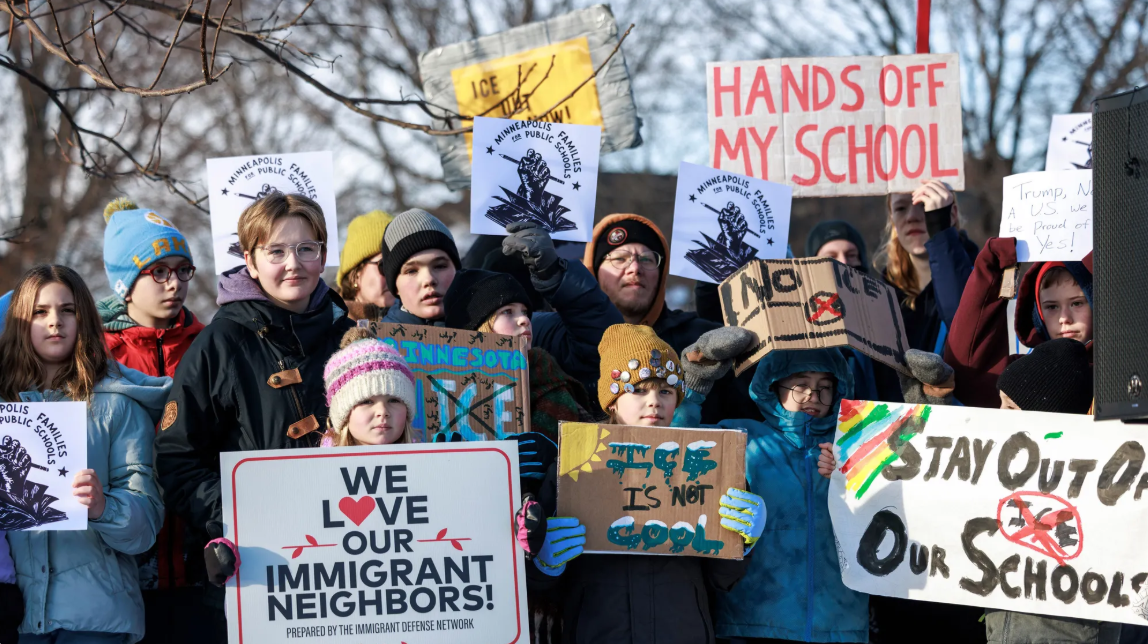
Minneapolis Public Schools community members demonstrate in Minneapolis, Minn., on Jan. 9, 2026, following reports of federal immigration agents on school grounds in the city..Kerem Yücel/Minnesota Public Radio/AP
“Districts nationwide are increasingly weighing virtual learning as families express concern about the growing presence of federal immigration agents in communities and near schools.”
U.S. Border Patrol agents detain a person on the ground near Roosevelt High School during dismissal time on Jan. 7 in Minneapolis. Kerem Yücel | MPR News
“More than 1,000 Denver teachers called out of work Friday, with some joining students to march around the Colorado Capitol on a day of nationwide protests.”
In December’s Lead the Change (LtC) interview Dr. Latrice Marianno argues that meaningful educational improvement must be historically grounded and explicitly centered on equity and justice, not treated as a side effort within school improvement. Despite current challenges, she calls for collective, systems-focused approaches that dismantle structural barriers and urges educators and scholars to continually act as if radical transformation in education is possible. The LtC series is produced by Elizabeth Zumpe and colleagues from the Educational Change Special Interest Group of the American Educational Research Association. A PDF of the fully formatted interview will be available on the LtC website.
Lead the Change (LtC): The 2026 AERA Annual Meeting theme is “Unforgetting Histories and Imagining Futures: Constructing a New Vision for Educational Research.” This theme calls us to consider how to leverage our diverse knowledge and experiences to engage in futuring for education and education research, involving looking back to remember our histories so that we can look forward to imagine better futures. What steps are you taking, or do you plan to take, to heed this call?
Dr. Latrice Marianno (LM): Recently, I had the opportunity to attend the Association for the Study of Higher Education’s (ASHE) annual conference in Denver. During my time there, I visited the Museum for Black Girls and encountered this quote from Angela Davis above one of the exhibits: “You have to act as if it were possible to radically transform the world. And you have to do it all the time.” For me, this quote embodies the work before all of us. To heed this year’s call, I am continuing to deepen my work around equitable school improvement in a few ways.
Latrice Marianno, Ph.D.
First, I am ensuring that my work is continually grounded in the historical context that has produced and/or maintained the inequities we continually see in education. Critical policy genealogy, which focuses on understanding the origin and evolution of policies (Brewer, 2014; Meadmore et al., 2000), is something I have been drawn toward and intend to engage with more deeply. I find it critically important to understand how policies came to be and the issues those policies were intended to address as that insight can shed light on how educational policies create or maintain inequities. One example that illustrates the importance of understanding the histories of educational policies is the history of state teacher certification policies. While characterized as a policy aimed to enhance the professionalization of teachers (e.g., Hutt et al., 2018), requirements for teachers to pass exams to become certified have long reinforced inequities in access to entering the teaching profession (e.g., Carver-Thomas, 2018). Understanding the history of these policies means an awareness that these certification policies were popularized as a way to justify lower pay for Black educators and later the displacement of Black educators (e.g., Fultz, 2004; Tillman, 2004). Remembering our histories is a necessary foundation if we are to reimagine educational systems.
Second, I will continue focusing on interrogating systems, policies, and practices in educational spaces both in my teaching and scholarship. My work focuses on examining how school improvement systems can be reimagined and redesigned to better support educational leaders to engage in meaningful and justice-centered improvement. For example, Marianno et al. (2024) focuses on state-influenced school improvement plan templates and the extent to which educational leaders are prompted to think about and address inequities. This work opens a conversation regarding how this tool (i.e., school improvement templates) might be redesigned to support educational leaders to center equity in the school improvement planning process. Currently, I teach in a principal preparation program which has allowed me to continually engage with educators and aspiring educational leaders around what this could look like in practice. My teaching allows opportunities for me to learn from and alongside my students as we collectively think about the supports, tools, and professional learning that support educational leaders to think critically about equitable school improvement and act on those commitments in sustainable ways. For example, in my course on data-driven school improvement, we use Bernhardt’s (2017) program and process evaluation tool to prompt them to think about ways school policies and practices create or maintain inequities – an activity they have found useful in prompting them to notice and reflect on inequities within their schools and districts.
Finally, I am committed to supporting and engaging in collective futuring in educational spaces. This commitment means sharing my work in practitioner-friendly formats (e.g., policy reports, and/or practitioner journals like Educational Leadership or Phi Delta Kappan), rather than solely academic journals. This commitment also means continuing to challenge assumptions about what it means to improve a school and supporting educators and educational leaders to think critically about school improvement and educational justice as intertwined endeavors. To envision beyond our current system and imagine what could be. To “act as if it were possible to radically transform the world” and “to do it all the time.”
LiC: What are some key lessons that practitioners and scholars might take from your work to foster better educational systems for all students?
LM: Recently, my work has focused on understanding school improvement planning (SIP) processes and how educational leaders think about and work toward redressing inequities through those processes (Marianno, 2024; additional work forthcoming). Through this research, I found that educational leaders viewed equity as either an implicit part of school improvement planning or absent from that process, and that school leaders were not prompted to think about equity within the SIP process. These views and approaches undermined the district’s expressed equity focus by creating a disconnect between their policy intent and implementation. In my work, I argue for the need to explicitly connect equity with school improvement and begin to identify opportunities to center equity within a process that can often be thought of as parallel to school improvement rather than an integral part of those efforts.
“I argue for the need to explicitly connect equity with school improvement.”
Ultimately, I hope my work inspires folks to be transgressive – to push against the boundaries of what is typically considered improvement within the current educational system (e.g., lack of explicit focus on redressing inequities within improvement efforts). To continually question the assumptions that undergird our collective work in improving education for all students, especially those from historically marginalized backgrounds. To believe in radical transformation and work toward it in our pursuit of educational justice. Toward this end, there are a few key lessons I hope folks can take from my work which collectively emphasizes the importance of being systems-focused, centering the knowledge and experiences of marginalized students and communities, and then leveraging that knowledge to design more just futures.
First, there can be no educational improvement without a focus on redressing inequities. Too often equity is treated or understood like a side project rather than integral to the work of educational improvement (Marianno, 2024). However, as scholars like Gloria Ladson-Billings and Michael Dumas have argued, substantively improving education requires explicitly attending to the racism and antiblackness that shape the current educational system (Dumas, 2016; Ladson-Billings, 2006).
“Too often equity is treated or understood like a side project rather than integral to the work of educational improvement.”
Second, we must focus on reimagining our systems, policies, and practices toward educational justice (Welton et al., 2018). There has been a popular illustration that people, particularly in education, have used to describe equity. This illustration shows three individuals of varying heights standing outside of a fence watching a baseball game. One individual is tall enough to see over the fence without additional support while the other two need additional and varied support. While this illustration has multiple iterations, there is often a comparison between equality and equity in which equality represents everyone getting the same number of boxes to stand on, and equity representing everyone getting what they need to, in fact, see over the fence. The version that most resonates with me includes a visual representation of liberation as the removal of the fence. For me, this representation highlights how education broadly and schools specifically have been designed with particular people in mind (in this case the individual tall enough to see without additional support) and how the removal of the fence would serve everyone. I firmly believe that to ensure marginalized students have equitable and just educational opportunities, experiences, and outcomes, it is critical that our collective work (practitioners and scholars alike) focuses on removing the fences (i.e., barriers) that marginalize students and lead to inequities. Engaging in educational improvement in this way centers the experiences of marginalized students, such that educational spaces are designed with them in mind.
Finally, we must recognize the value of collective knowledge and experiences. Brandi Hinnant-Crawford (2020) notes that we need to “intentionally harvest the collective wisdom of many” to “envision better and plot a course for how to get there” (p. 43). That is, futuring for education requires honoring and valuing the knowledge and expertise of diverse stakeholders – teachers, educational leaders, students, and caregivers. In particular, we need to view students and caregivers as valuable partners who can aid in both addressing the educational problems schools are facing and support imagining an otherwise.
LtC: What do you see the field of Educational Change heading, and where do you find hope for this field for the future?
LM: Honestly, I’m not sure where I see the field of educational change heading. The current climate makes that picture a bit hazy for me. We’re in such a significant period of retrenchment with attacks on academic freedom in higher education, undermining of public education through funding cuts and dismantling the Department of Education, and backlash for anything remotely equitable or inclusive. It is disheartening, though unsurprising. This moment in our history reflects longstanding patterns in American history where movements toward justice are met with resistance and retrenchment. As Decoteau Irby’s (2021) work and the Angela Davis quote shared earlier both remind us, the current moment is a reminder that systems of oppression are constantly at work. We have to act as if we can radically transform the world all the time because systems of oppression are constantly mutating and reinventing. With that in mind, I do have hopes for the field moving forward.
I hope we move toward deeper recognition that equity and justice must be central to educational improvement, not a side project or parallel effort. This is the work. There is no meaningful school improvement work divorced from a focus on educational justice. In my own work, I’ve seen how educational leaders are often unclear about how to integrate equity into improvement work or treat equity as an implied focus undergirding their improvement efforts but in ways that actually undermine those efforts (Marianno, 2024). Specifically, district leaders viewed equity as an implied focus and foundation of all of their school improvement efforts. However, this approach led school leaders in that district to believe that equity was absent from the process altogether and left them unsure of where and how to integrate equity in their improvement efforts because it was not explicitly discussed. Moving forward, I hope we regard equity and justice as non-negotiables that guide how we define problems, reorganize educational systems, and measure the success of educational improvement efforts.
I hope we move toward a more historically grounded approach to school and systems improvement. To meaningfully redress inequities, we must understand how past policies and practices created the systems we currently have. Tracing policy histories, such as the racialized roots of teacher certification requirements or gifted education (e.g., Mansfield, 2016), reveal that many present-day inequities are not accidental, and reinforces the understanding that policies are not neutral. I hope the field continues to deepen its engagement with historical analysis, recognizing that remembering the past is essential for imagining futures that depart from it.
I hope the field continues to shift toward more systemic and collective approaches to educational improvement. When working with aspiring educational leaders in my course on data-driven school improvement and building on the work of scholars like Brandi Hinnant-Crawford (2020), I find they often leave the course with a better understanding of how school systems, policies, and practices shape disparities within their schools and districts and the importance and value of collective approaches to their improvement work. This is my hope for the field – that we engage these ideas not just intellectually but as part of our praxis.
Despite the current moment we’re in, I hope that both scholars and practitioners act as if radically transforming education is possible – and that they do it all the time.
This second part of IEN’s annual scan of the back-to-school stories brings together some of the headlines that focused on the effects of a flurry of executive orders and policy changes from Washington. The first part of the scan shared stories from outside the US, and, next week, we’ll review some of the other back-to-school headlines in the national and local press in the US.
“As 47 million students return to school in the coming weeks, district leaders say they’re experiencing an uncertainty they haven’t felt since the pandemic. It’s “the amount of information that’s coming to you all at once,” said Jeremy Vidito of the Detroit schools. He laid out a litany of hardships, including figuring out “what’s true, what’s not. Emergency orders. Budget cuts.” But this time, the federal government is the source of the unease, as the Trump administration seeks to reduce more spending.” — The74
“Department of Education sends guidance on private school kids obtaining federally-funded benefits, including one-on-one tutoring, counseling,” Fox News
“While the Trump administration has vowed to preserve NAEP, it has overseen major cuts to staff who work on it and the elimination of more than a dozen tests” — Hechinger Report
“The Trump administration wants to roll back rules for collecting data on state career and technical education programs instituted in the final days of the Biden administration and align the largest federal CTE program with the president’s first-day executive order making it federal policy to recognize only two sexes.” — Education Week
“The Trump administration has launched investigations into school districts in Chicago and Evanston over programs aimed at supporting Black students, saying that efforts such as hiring Black teachers, expanding Black history and antiracism training may violate civil rights law. Supporters say the initiatives address systemic inequities and improve student outcomes, while critics warn they could be dismantled in court battles likely to reach the Supreme Court.” —NYT
“Posters are displayed in a Los Angeles Unified high school health education classroom in 2018. The Trump administration told 40 states to remove references to gender identity from a federally funded sex ed program and stripped California of its funding when it refused to do so.” Source: ChalkBeat
This week, Mel Ainscow discusses some of the key insights from his new book Reforming Education Systems for Inclusion and Equity. Ainscow is Emeritus Professor, University of Manchester, Professor of Education, University of Glasgow, and Adjunct Professor at Queensland University of Technology.
What’s the greatest challenge facing education systems around the world? Finding ways of including and ensuring the progress of all children in schools. In economically poorer countries this is mainly about the millions of children who are not able to attend formal education. Meanwhile, in wealthier countries many young people leave school with no worthwhile qualifications, whilst others are placed in special provision away from mainstream education and some choose to drop out since the lessons seem irrelevant. Faced with these challenges, there is evidence of an increased interest internationally in the idea of making education more inclusive and equitable. However, the field remains confused as to the actions needed in order to move policy and practice forward.
What’s the greatest challenge facing education systems around the world? Finding ways of including and ensuring the progress of all children in schools.
Reforming education systems
Over the last thirty years or so I have had the privilege of working on projects aimed at the promotion of inclusion and equity within education systems, in my own country and internationally. This leads me to propose a radical way of addressing this important policy challenge. This thinking calls for coordinated and sustained efforts within schools and across education systems, recognising that improving outcomes for vulnerable learners is unlikely to be achieved unless there are changes in the attitudes, beliefs and actions of adults. All of this echoes the views of Michael Fullan, an internationally recognised expert on educational change, who argues: “If you want system change you have to change the system!”
“If you want system change you have to change the system!”
Inclusion and equity should be seen as principles that inform educational policies. These principles should influence all educational policies, particularly those that are concerned with the curriculum, assessment processes, teacher education, accountability and funding.
Barriers to the presence, participation and achievement of learners should be identified and addressed. Progress in relation to inclusion and equity requires a move away from explanations of educational failure that focus on the characteristics of individual children and their families, towards an analysis of contextual barriers to participation and learning experienced by learners within schools. In this way, those students who do not respond to existing arrangements come to be regarded as ‘hidden voices’ who can encourage the improvement of schools.
Schools should become learning communities where the development of all members is encouraged and supported. Reforming education systems in relation to inclusion and equity requires coordinated and sustained efforts within schools. Therefore, the starting point must be with practitioners: enlarging their capacity to imagine what might be achieved and increasing their sense of accountability for bringing this about. The role of school leaders is to create the organisational conditions where all of this can happen.
Partnerships between schools should be developed in order to provide mutual challenge and support. School-to-school collaboration can strengthen improvement processes by adding to the range of expertise made available. In particular, partnerships between schools have an enormous potential for fostering the capacity of education systems to respond to learner diversity. More specifically, they can help to reduce the polarisation of schools, to the particular benefit of those students who are marginalised at the edges of the system, and whose progress and attitudes are a cause for concern.
Families and other community partners should be encouraged to support the work of schools. The development of education systems that are effective for all children will only happen when what happens outside as well as inside a school changes. Area-based partnerships are a means of facilitating these forms of cooperation. School leaders have a crucial role in coordinating such arrangements, although other agencies can have important leadership roles.
Locally coordinated support and challenge should be provided based on the principles of inclusion and equity. The presence of experienced advisers who can support and challenge school-led improvement is crucial. There is an important role for governments in creating the conditions for making such locally led improvements happen and providing the political mandate for ensuring their implementation. This also means that those who administer local education systems have to adjust their priorities and ways of working in response to improvement efforts that are led from within schools.
Evidenceis the life-blood of inclusive educational development. Therefore, deciding what kinds of evidence to collect and how to use it requires considerable care, since, within education systems, what gets measured gets done. This trend is widely recognised as a double-edged sword precisely because it is such a potent lever for change. On the one hand, data are required in order to monitor the progress of children, evaluate the impact of interventions, review the effectiveness of policies, plan new initiatives, and so on. On the other hand, if effectiveness is evaluated on the basis of narrow, even inappropriate, performance indicators, then the impact can be deeply damaging.
The challenge, therefore, is to harness the potential of evidence as a lever for change, whilst avoiding these potential problems. This means that the starting point for making decisions about the evidence to collect should be with agreed definitions of inclusion and equity. In other words, we must measure what we value, rather than valuing what can more easily be measured. Therefore, evidence collected within the education system needs to relate to the presence, participation and achievement of all students.
“[I]nclusion and equity should not be seen as a separate policy. Rather, they should be viewed as principles that inform all national policies”
Implications
These ideas are guided by a belief thatinclusion and equity should not be seen as a separate policy. Rather, they should be viewed as principles that inform all national policies, particularly those that deal with the curriculum, assessment, school evaluation, teacher education and budgets. They must also inform all stages of education, from early years through to higher education. In this way inclusion and equity must not be seen as somebody’s job. Rather, it is reform agenda that must be the responsibility of everyone involved in providing education.