How have the pathways into higher education and the workforce changed in the US since the school closures of the COVID-19 pandemic? In the first part of this two-part post, RJ Wicks scans recent news and research to summarize some of the current conditions students in the US face as they try to find their way into adulthood. The second post explores some of the “micro-innovations” that educators are developing to help eliminate some of the barriers that limit access to learning opportunities and good jobs after high school. These posts are part of IEN’s ongoing coverage of what is and is not changing in schools and education following the school closures of the pandemic. For more on the series, see “What can change in schools after the pandemic?” For examples of micro-innovations in other areas see IEN’s coverage of the emergence of tutoring programs after the school closures: Tutoring takes off and Predictable challenges and possibilities for effective tutoring at scale.
“A college degree is the surest ticket to the middle class.”
—President Barack Obama, 2015
Despite the continuing hope that college can be a gateway to economic mobility, the COVID-19 pandemic contributed to the already considerable challenges that many students face in getting into college and finding their way into the workforce. Illustrating the depths of the problem around the world, OECD’s analysis of survey responses from 690,000 15- and 16-year-old students from more than 80 countries concluded that “students are now expressing very high levels of career uncertainty and confusion. Job expectations have changed little since 2000 and bear little relationship to actual patterns of labour market demand.”
“[S]tudents are now expressing very high levels of career uncertainty and confusion. Job expectations have changed little since 2000 and bear little relationship to actual patterns of labour market demand.”
The report, comparing survey results from each of the PISA assessments shows that almost 40% of the students participating in the survey in 2022 are “career uncertain,” up from about 12% in 2000. In addition, almost 50% of all participates agreed or strongly agreed with the statement that “school has done little to prepare me for adult life” and almost 25% agreeing that “school has been a waste of time.”
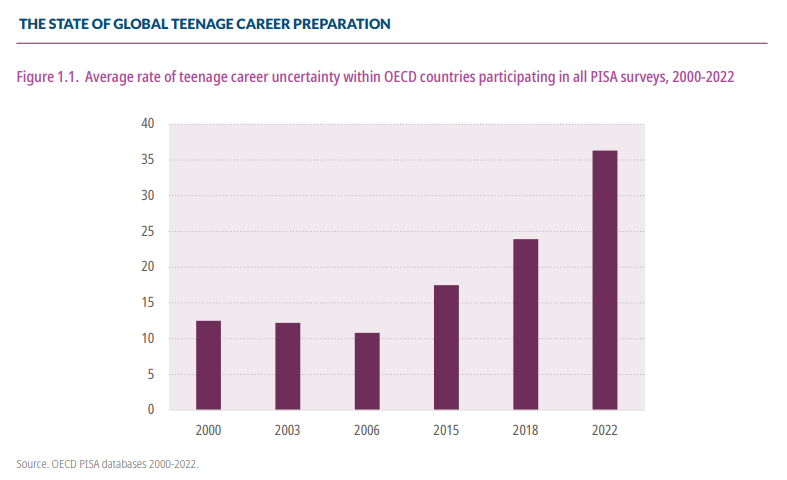
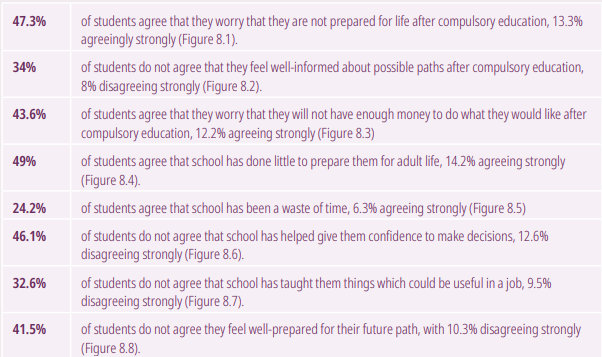
The State of Global Teenage Career Preparation, OECD
In the US, concerns about getting in to the workforce combine with challenges that can limit access to college and other post-secondary options. Although recent enrollments in college in the US have begun to increase again, students’ opportunities remain restricted by growing financial barriers, expanding inequities, and a lack of alignment between what students learn in school and what the workforce demands. Additionally, a lack of career pathways for students who may not pursue traditional four-year degrees, limited information about the existing possibilities, and lack of personalized support make it particularly difficult for first-generation college students and other historically disadvantaged groups to navigate both conventional and new post-secondary opportunities. Addressing any of these challenges is likely to get even more difficult in a context where some now question the value of a college education and where the current US administration has attacked many institutions of higher education and the funding streams that support them.
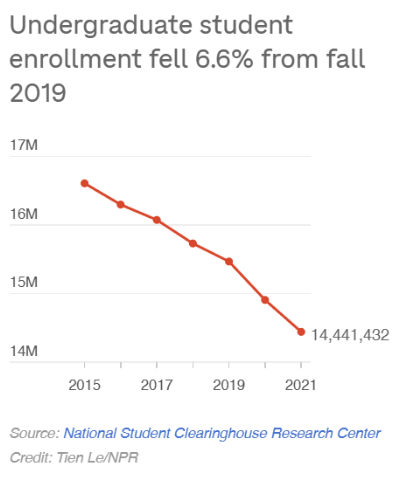
Enrollment dropped—especially at community colleges—though enrollment rates appear to be rising again
Between 2019 and 2021, undergraduate enrollment in the US fell by nearly 1 million students, the largest two-year decrease in more than 50 years. As Doug Shapiro, from National Student Clearinghouse explained in 2022, “enrollment in undergraduate and graduate programs has been trending downward since around 2012, but the pandemic turbocharged the declines at the undergrad level.”
In community colleges, in particular, 90% of those responding to a national survey reported enrollment declines in the first year of the pandemic, with 50% reporting declines of more than 10%. Those declines at community colleges continued, amounting to about a 13% enrollment drop over the course of the pandemic. By 2022, entry into two-year colleges was more than 20% lower than it was before the pandemic, with larger drops in Black- and Hispanic-majority colleges. In contrast, entry into four-year colleges declined by about 6%.
Sparking some hope that the enrollment declines are only temporary, more recent figures show that enrollments have begun to rise again. Fall enrollments in 2024 grew by almost 5% in comparison to fall 2023 and slightly exceeded fall enrollments in 2019 before the pandemic began. Enrollment gains were particularly strong in associate programs (up 6.3 percent), bachelor’s programs (up 2.9 percent), master’s programs (up 3.3 percent), and doctoral programs (up 2.0 percent).
College is unaffordable for most low-income students
The recent rise in college enrollments provides some hope that more students will take advantage of post-secondary education, but access to college remains limited by substantial financial barriers, particularly for students from historically disadvantaged communities. The average federal student loan debt in the U.S. is approximately $37,850, contributing to a national student loan debt total exceeding $1.6 trillion. This substantial debt burden influences life choices, with one-third of borrowers indicating it has impacted their ability to continue education, and 14% reporting it has affected decisions such as starting a family. Such financial constraints force many students to forgo higher education or work excessive hours, diminishing their focus on academic and career readiness.
Beyond tuition, textbooks, transportation, housing, and emergency expenses often make higher education inaccessible, even with financial aid. The National College Attainment Network (NCAN) defines an institution as affordable if its total cost —including tuition, fees, and $300 for emergency expenses — can be covered by the sum of grants, loans, Federal Work Study, a proxy for expected family contribution (EFC), and estimated summer wages. When the cost exceeds these combined resources, there is an “affordability gap.”

According to the National College Attainment Network (NCAN) Affordability Report:
- Only 12 states had affordable public four-year institutions in 2024.
- In only 10 states were more than 50% of public BA programs affordable (AK, AR, FL, IL, ME, NM, OK, WA, WV, and WY)
- On average, community colleges were unaffordable in 28 states, and four states had no affordable community colleges (HI, NH, RI, and UT)
- All community colleges were affordable in only three states (IN, ME, VT) and at least 75% of community colleges were affordable in only ten states.
Equity gaps continue to shape enrollment and completion of higher education
Students from higher-income families remain significantly more likely to attend college. Reflecting the challenges for those from lower-income backgrounds, as the Institute for Higher Education Policy puts it: “Students with unmet need take out more loans, work more hours, face higher degrees of food and housing insecurity, and are at greater risk of forgoing higher education or leaving school without a credential.”
“Students with unmet need take out more loans, work more hours, face higher degrees of food and housing insecurity, and are at greater risk of forgoing higher education or leaving school without a credential.”
Furthermore, students from the lowest-income backgrounds would need to contribute almost 150% of their household income to cover the full-time cost of a four-year college, even after accounting for grant and scholarship aid. As one illustration of the disproportionate financial burden on low-income families, the share of household income required to pay for college increases dramatically from the highest- to the lowest-income households.
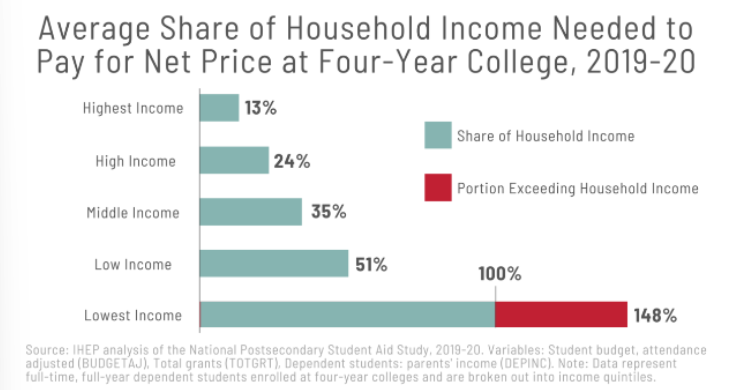
Illustrating the depth of the equity issues, first-generation college students, English learners, and students with disabilities face barriers that make it much more likely that they will drop out before getting a degree. Nationally, 89 percent of low-income first-generation students leave college within six years without a degree. More than a quarter leave after their first year — four times the dropout rate of higher-income second-generation students. Furthermore, the six-year graduation rate of students with disabilities at four-year colleges is 49.5%, compared to roughly 68% for students without disabilities.
Students are unprepared for college and careers
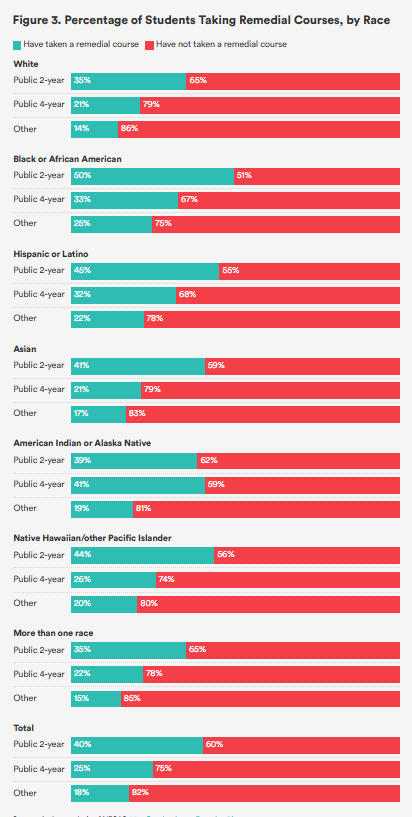
Contributing to the enrollment challenges, high school curricula often fail to align with postsecondary expectations, resulting in high rates of remedial courses particularly for students of color:
- According to New America and the National Postsecondary Student Aid Study (NPSAS) 2020 Undergraduate data (NPSAS:20), 40% of students attending a public 2-year college and one-quarter of students from public 4-year colleges took a remedial course at some point.
- Students of color and low-income students continue to be placed into remedial courses at higher rates than their more advantaged peers, and almost half of Black and Latinx students attending public 2-year colleges, and 30% at 4-year institutions have enrolled in at least one remedial course.
The focus on four-year college degrees also overlooks the value of Career and Technical Education (CTE) and other pathways that align with workforce needs.
Black and Hispanic learners also tend to be overrepresented in service-oriented professions such as health sciences or education and training; these professions tend to have lower wages, in contrast to higher wage STEM fields where they are underrepresented.
Next Week: New Pathways into Higher Education and the Working World? Scanning the Post-COVID Challenges and Possibilities for Access to Colleges and Careers in the US (Part 2)

 International Education News