This week, IEN scans the headlines of stories reporting on OECD’s Education at a Glance for 2023. Trends in high quality Vocational Education and Training (VET) programs were in focus for this year’s report. OECD’s Education at a Glance provides an annual overview of comparative education statistics. The headlines shared below reflect aspects of the report emphasized by media outlets around the world. See IEN’s Education at a Glance 2022 Scan, Education at a Glance 2021 Scan, Education at a Glance 2019 Scan for comparison.
44% of upper school students are enrolled in VET programs across countries, yet work-based programs–in which students can gain practical skills during vocational programs–remain rare. Less than half of students within VET programs (45%) participate in this type of work-based learning, that’s the conclusion of OECD’s latest Education at a Glance report. Other topics featured in the 2023 report include trends in early childhood education and care enrollment, declines in teacher wages and professionalism, and notable variation in spending per student among OECD countries. Continued learning for Ukrainian refugees forcibly displaced around the world was also featured as a special issue.
Corresponding to this year’s theme, many of the headlines from articles discussing the report highlighted VET trends within specific countries. Shares of domestic spending on education, as well as issues related to teacher payment and retention, were also featured in this year’s headlines. In-line with past years, nearly all of the headlines focused on problems revealed in the report (Australia, Brazil, Ireland, Israel, Italy, New Zealand, Portugal, South Korea, Turkey), while only a few emphasized the report’s positive findings (Finland, Hungary, Spain).
Global

The Launch of Education at a Glance 2023: OECD Indicators, OECD
“Andreas Schleicher, OECD Director of Education and Skills, presents data and reveals insights from the 2023 Education at a Glance report, which includes a special feature on Vocational Education and Training, with the aim of empowering educators, policymakers, and stakeholders with the data and analysis to shape their education systems.”
Expand vocational education and training, demands OECD, University World News
“OECD analyst Viktoria Kis told University World News their data clearly shows that ‘young people who benefited from work-based learning while pursuing VET have better employment outcomes’ and that ‘apprenticeships or internships are a powerful way of connecting VET to labor market needs.’ She said: ‘Some countries have a strong tradition of extensive use of apprenticeships, like Germany and Switzerland. The Norwegian VET system is mostly composed of ‘2+2’ apprenticeships: two years spent at school, followed by two years in workplaces.’”
Australia
OECD report amplifies calls to boost public school funding, The Educator Australia
“The OECD’s latest ‘Education at a Glance’ report, released on Wednesday 13 September 2023, found Australia spends just 1.5% of total government expenditure on upper secondary school education, 28.6% lower than the OECD average of 2.1%. This is despite spending more than twice as much as the OECD average on funding private schools.”
Brazil

Brazil invests less in education than OECD countries, Agência Brasil
“Investment in Brazil fell between 2019 and 2020. In the OECD, total government spending on schooling grew 2.1 percent between 2019 and 2020 on average, at a slower rate than total government spending on services, which was up 9.5 percent. In Brazil, total government spending on instruction went down 10.5 percent, while spending on all services increased 8.9 percent. According to the study, this may have been due to the COVID-19 pandemic.”
European Union
OECD Education at a Glance 2023 – How Europe’s Business Leaders Can Help Widen Access to Education for Europe’s Underserved Youth, EU News – Business
“The OECD report found that 44 per cent of all upper secondary students are enrolled in vocational education and training across the OECD; they also note that these programmes are still seen as a “last resort” to many countries. European policymakers have a role to play in shifting this narrative and highlighting the unique benefits of vocational learning to bridge the gap between privilege and potential. Vocational training is also a viable way to attract underserved youth, who may feel rejected or discouraged from mainstream education.”
Finland
Education at a Glance: Vocational education and training is more popular in Finland than in other OECD countries, Finnish Government
“In Finland, 68% of all those in upper secondary education are enrolled in vocational education and training, whereas in OECD countries the corresponding figure is 44% on average. The high figure in Finland is explained by the number of adult students. A total of 44.8% of 15-19-year-old upper secondary school students in Finland are enrolled in vocational education and training, which is slightly higher than the OECD average (37.4%).”
Hungary
Hungarian vocational training 3rd in OECD rankings, The Budapest Times
“38% of 24-34 year-olds obtain a vocational diploma and are less exposed to the risk of unemployment than those with general secondary education, and can expect a 31% higher salary, the ministry said in a statement.”
Ireland
Ireland ranks last in spending on education ‘as a percentage of GDP’, study finds, The Irish Times
“Ireland ranked last in a league table of 38 countries based on education expenditure as a percentage of GDP with 3.2 per cent in 2020. It compared to an average of almost 5 per cent for OECD countries.”
Israel
OECD education report shows Israel’s investment in public education lower than average, Y Net News
“According to the report, which refers to data from 2020-2022, the total government expenditure on public education in Israel (excluding higher education institutions) was significantly lower than the OECD average in 2020 – $8,865 per year compared to $10,949.”
New Zealand
How does New Zealand’s education system compare? OECD’s Education at a Glance 2023, Education Counts
How Aotearoa’s education compares with other OECD countries, The Post
“While the share has declined, the actual increase in government education expenditure in 2020 was significant, amongst the top five, in percentage terms, across OECD countries.”
Portugal

Portugal spending less on students, The Portugal News
“Portugal spent an amount similar to the average of OECD countries on Education, but expenditure per student is 14% lower in Portugal, at around €10,000 compared to the OECD average of €11,700.”
South Korea
Entry-level teachers’ wages below OECD average, The Korea Herald
“Korea had the highest percentage of people aged 25-34 who had completed higher or tertiary education — at 69.6 percent in 2022 — among the OECD member countries and 11 others, ranking No. 1 for four consecutive years.”
Spain
Almost 88% of Spaniards aged 15-19 years are in school, six points more than a decade ago, La Moncloa
“In the case of the adult population aged 25-64 years, 41.1% have tertiary education (40.4% in OECD and 37.7% in EU25), 8.5 points more than a decade ago. At the other extreme, the percentage with less than upper secondary education has reduced by 9.5 percentage points, from 45.3% in 2012 to 35.8% in 2022.”
Turkey

Turkey spent less money on education than the OECD average in 2020: report, Turkish Minute
“The report further revealed that the cumulative spending on each student between the ages of six and 15 adds up to a total of around $112,000 on average across OECD countries, while the figure is less than $50,000 in Colombia, Romania and Turkey.”
United States
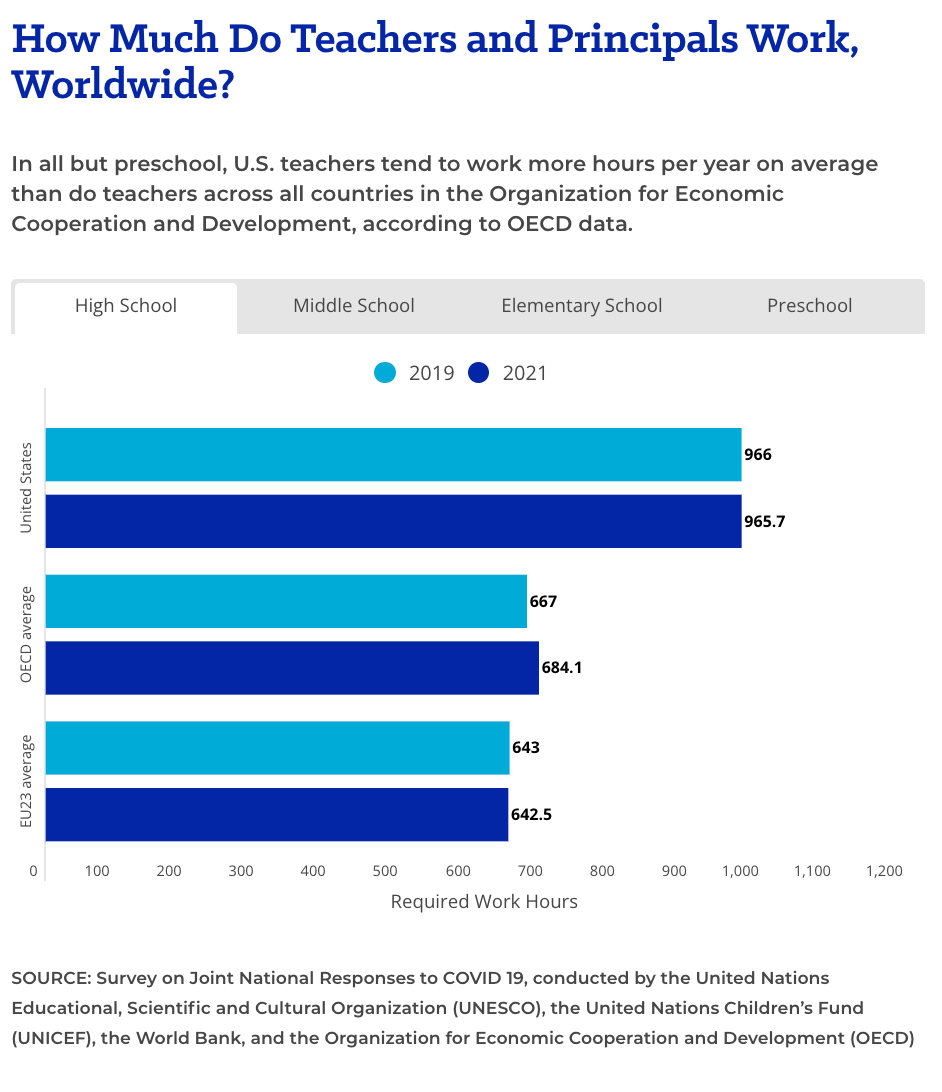
From Education Week
U.S. Teachers Work More Hours Than Their Global Peers. Other Countries Are Catching Up, Education Week
“U.S. elementary school teachers’ work hours haven’t changed much since 2019, but at more than 1,000 a year on average, American educators work more than 200 more hours than their peers worldwide. U.S. elementary and high school teachers work more hours than those in any OECD country but Costa Rica, and middle school teachers work more hours than their peers everywhere but Costa Rica and Mexico.”

 International Education News