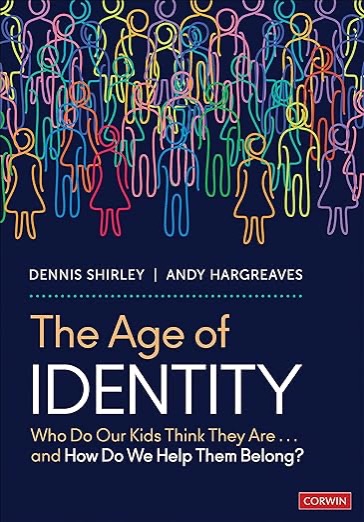
This week, IEN features a conversation with Dennis Shirley and Andy Hargreaves about their new book: The Age of Identity: Who Do Our Kids Think They Are . . . and How Do We Help Them Belong?. Shirley is a Professor recently retired from Boston College and a scholar of educational change who helps schools around the world to improve teaching and learning. Hargreaves is a Visiting Professor at the University of Ottawa in Canada and Research Professor at Boston College in the US, he advocates for equitable and inclusive education, a strong teaching profession, and positive educational change worldwide. For previous conversations with Dennis Shirley and Andy Hargreaves see Five Paths of Student Engagement: An Interview with Dennis Shirley and Andy Hargreaves on “Moving: A Memoir of Education and Social Mobility.”
IEN: Why this book, why now?
Dennis Shirley & Andy Hargreaves (DS/AH): Our book started with collaborative research we conducted in the Canadian province of Ontario when the Ministry of Education had for the first time made student well-being and inclusion a policy priority. We were surprised by how frequently educators brought up the topic of students’ identities as part of the way they were promoting well-being. Educators told us that they were transforming their pedagogies and curricula to address the needs of their Indigenous, learning disabled, and LGBTQ+ students, in particular. As we were in the throes of starting to write the book, there was then an outbreak of culture wars and identity politics. We had been studying something inclusive that, in some ways, had become divisive and we now realized that our research had something of value to say about all this. We hope that our book will help us get beyond the polarized time of outrage and indignation in which we now find ourselves.
IEN: What did you learn in working on this book that you didn’t know before?
DS/AH: We already knew that it always matters to engage with those who are different from us. What we weren’t entirely clear about is just how complex identity issues are for young people now. It’s inevitable that when dealing with issues of representation, there will be some box ticking, or homi\ng in only on the oppressed aspects of people’s identities. However, that just scratches the surface of identity matters today.
For instance, in a recent Canadian presentation that one of us made, there was one black person in a room of white people. Having his racial identity affirmed mattered to him, but he is also a gay American photographer living in Canada who restores old Lambretta scooters with his partner. In circumstances like this it is essential to create openings where people can reveal and share their identities on their own terms.The Age of Identity adds to the literature on intersectionality with the idea of “conflicting intersectionality.” This refers to the ways one can be an oppressor in some respects and oppressed in others. It means that dividing groups rather than actions into mutually exclusive categories of oppressors and oppressed can be misleading and often provokes a backlash.
[D]ividing groups rather than actions into mutually exclusive categories of oppressors and oppressed can be misleading and often provokes a backlash.
IEN: What’s happened since you completed the book?
DS/AH: A lot. The October 7 terrorist attack in Israel, the ensuing war in Gaza, and the horrific casualties have polarized educators and pushed yet more identity issues onto the front pages. It’s easy to reduce the conflict to simple binaries: Jews versus Arabs, Judaism against Islam, Israelis versus Hamas, colonizers versus the colonized, and so on. This has led to all kinds of demonization, reciprocal name-calling, and silencing in our schools and higher education institutions.
At the same time, reason and reconciliation show some signs of breaking out in other parts of the world. Following the advocacy of a Conservative politician who lost her son to suicide, the Canadian province of Ontario, has made mental health a compulsory subject in the high school curriculum. Meanwhile, the Conservative government in England has issued Draft Guidance on Gender Questioning Children for schools that is being broadly received as promising and practical, if not yet perfect, because it makes determined efforts to reconcile the rights and concerns of different groups. These efforts include the security and integrity of transgender students, the protection of safe spaces for cisgender girls, and parents’ rights to know about their children’s movements towards transition and self-identification in school. The guidance also supports educators’ professional judgments about when and how best to inform parents, while alerting school staff to circumstances where parents and other caregivers may be abusive, neglectful, or transphobic.
Our challenge in these times is to try to see past the simplifications and the caricatures that have spread intolerance in our school and college campuses, to acknowledge the full humanity of others. There’s more to everyone than meets the eye. Education has a key role to play because it should assist us all to open our minds and our hearts to one another. We hope that our book makes a contribution to this effort.
Our challenge in these times is to try to see past the simplifications and the caricatures that have spread intolerance in our school and college campuses, to acknowledge the full humanity of others.
IEN: What are a few of the key implications for policy/practice?
DS/AH: We need new narratives of inclusion and new tools that create a sense of belonging. Many approaches focus too much on who or what is responsive to this group or that group and not enough on the idea that what is essential for some kids is often good for all of them. Likewise, a lot of culturally responsive teaching can devolve into promotion of particular identities, rather than adopting the larger principle of embracing the whole child in a whole school. In general, we advocate much more self-determined learning, in which students can discover for themselves what’s important to their own and each other’s identity. In the book, we provide strategies and tools that will help educators understand colleagues, parents, and students who are different from them more effectively. It’s essential today to manage debates and differences about identity issues with civility and dignity.
IEN: What’s next — what are you working on now?
DS/AH: We are working with groups and systems to help them address identity issues and to increase students’ sense of belonging in their schools. There’s a lot of good work going on by dedicated professionals, even in those US states where educators’ freedom to teach about racism and sexism is circumscribed. We hope that by opening up space to talk about the full scope of what it means to be fully human that we can find ways of addressing controversial topics and promoting students’ identities at one and the same time.
We hope that by opening up space to talk about the full scope of what it means to be fully human that we can find ways of addressing controversial topics and promoting students’ identities at one and the same time.
We also have other projects that we’re working on. Dennis is writing up research on the interaction of educational change, technological innovation, and the future of work that he conducted as a Richard von Weizsäcker Fellow of the Robert Bosch Academy in Berlin. Andy is starting on a second edition of Professional Capital, with Michael Fullan, and is continuing to lead the Atlantic Rim Collaboratory, an international network of policy makers, educators, and researchers committed to advancing human rights in education.
In spite of the many challenges, we find this to be an exciting time to be in education. We continue to draw inspiration from the many colleagues and students around the world who are drawn to our indispensable profession.

 International Education News