What are the possibilities for innovation in professional learning post-COVID? The COVID-19 pandemic exacerbated many of the long-standing challenges within the teaching profession but simultaneously created opportunities for improvement by accelerating the use of education technology (EdTech) and encouraging stakeholders to reimagine what teacher professional development (TPD), staffing, and teaching could look like. Over the next two weeks, IEN managing editor Sarah Etzel explores the possibilities for innovations in professional learning in this two-part post. The first part of this post describes some remote and hybrid approaches to professional development in use in refugee and crisis contexts even before the pandemic. It also includes an overview of recent news reports on new approaches to professional learning that involve efforts to use AI to provide feedback to teachers. Part 2 summarizes recent articles that discuss how blended and remote delivery models for students might shift the roles of teachers and introduce new avenues for teachers to manage their time and workloads.
Remote and hybrid professional development in refugee and crisis contexts
Even before the pandemic, educators in refugee and crisis contexts with limited access to resources and qualified staff were already exploring how fully remote and blended learning models might support teacher professional development. These efforts included programs that sought to deliver professional development programs via radio or mobile phones (primarily WhatsApp). In Uganda, STiR Education implemented a fully-remote, radio-based professional development program that took place over the course of two weeks and featured 30-minute radio lessons consisting of evidence-based instructional practices. The program combined these lessons with weekly support calls from district officials and follow-up materials for school leaders to support teachers. The radio programs were also shared via WhatsApp channels so that participating teachers could go back and access the lessons at any time. The project implementers found that these approaches helped to motivate teachers and supported their resilience, while also providing them with a sense of community through WhatsApp groups where they could discuss questions related to their specific classroom situations. Challenges included limited follow up, poor network connectivity, and varied levels of program accessibility across districts. Lessons learned pointed to the need to combine different approaches (radio coupled with the interactive WhatsApp component) and to engage stakeholders like school leaders to encourage them to support the programs.
Countries like Malawi, Botswana, and Tanzania as well as in the Caribbean have also utilized programs relying on mobile phone messaging for professional development. One study of a sample of teachers involved in these programs found that the use of mobile phones “could be a scalable solution with rapid positive outcomes on teaching practices worth investing in,” and highlighted the benefits of community building through WhatsApp channels. At the same time, despite the widespread availability of WhatsApp, many teachers in these countries still don’t have mobile phones and network connectivity remains limited in some areas.
MOOC’s (Massive Open Online Courses) have provided another opportunity for either fully remote or blended learning for professional development. In Lebanon, teams from University College London and Lebanese American University worked with stakeholders in the community to identify key needs and priorities and then co-designed a MOOC, which incorporated local content by filming lessons of teachers working in area refugee camps. The completed course also included a blended component so that some teachers could receive two days of face-to-face training before they started the MOOC; two days of training during the course; and two days of training at the end. Participants were also given access to supplemental materials that they could download, such as lesson plans and models of good practice. Given that the teachers were not able to regularly travel to the university campus, having the virtual component made the course much more accessible to a wide range of teachers. At the same time, the face-to-face component turned out to be particularly helpful in clarifying teachers’ misconceptions around the digital tools, while the digital component allowed for greater flexibility and enabled them to learn from their peers who were undergoing similar challenges.

Excerpts of MOOC from A Co-designed Blended Approach for Teacher Professional Development in Contexts of Mass Displacement
In Rwanda, teachers have been able to deepen their understanding of their subjects and related instructional practices through self-paced online learning modules and tailored in-person sessions that build upon teachers’ performance in the online components. The program includes an in-person orientation; online modules, with school-based mentors reviewing teachers progress through the modules; a bridging activity where teachers and school-based mentors complete a professional development needs assessment for their school; and a final in-person session where teachers come together with their peers and school-based mentors to build a professional development plan for their schools. In what the partners from the University of Rwanda and Education for Development (VVOB) describe as a staggered, flipped classroom model, in-person meetings help to cultivate community among participants and provide opportunities for practice. The flexibility of the virtual approach also allowed participants to focus more on the specific context of their own schools.
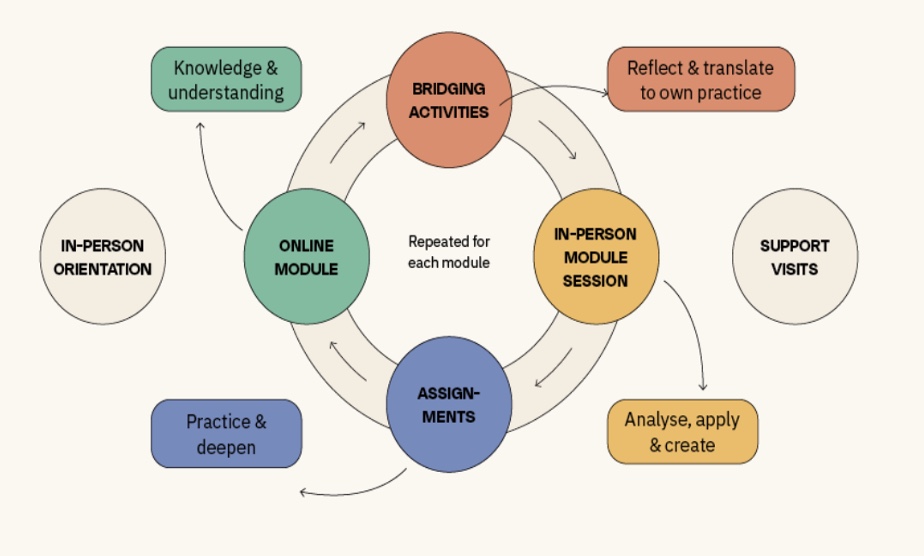
Figure 1: Model for Blended Learning CPD Program in Rwanda
Innovations in professional learning? The role of AI in coaching and feedback for teachers
In addition to trying to take advantage of the possibilities for mobile and online learning that have emerged, several more recent initiatives are attempting to harness AI to provide feedback for teachers as districts seek alternatives to traditional coaching models (for previous IEN coverage of AI, see: ChatGPT on ChatGPT in education: Clear summaries and fake citations, Ban It or Use It? Scanning the Headlines: The Chat GPT six month anniversary edition, Scanning the headlines for international perspectives on ChatGPT in schools, What difference will AI make in schools?). Among those, TeachFX, is developing an AI platform where teachers can upload lesson recordings and receive quantified reports on their classroom interaction. In South Portland Maine, the platform provided teachers with personalized feedback on how often they talked, how many times they called on certain students, and how many times they used certain questioning techniques. For some teachers, the platform helped them to realize their implicit biases — for example, if they were disproportionately calling on white students who were fluent in English. Meanwhile, Urban Assembly, a network of 21 schools in NYC is working to develop AI coaching tools for its teachers. Similar to the TeachFX technology, these tools are expected to use natural language processing to identify trends in classroom interactions, including “positive,” “respectful” or “insulting” language. According to Urban Assembly CEO David Adams, the benefits of this kind of approach are clear: “It can take the instructional coaches hours to review a single video. That means teachers aren’t getting enough feedback, and they’re getting it less often than they should be.”
Recent research on AI coaching models (also referred to as M-Powered Learning or machine-powered learning) includes two randomized controlled trials with tutoring programs. Results suggested that “students taught by instructors or tutors who accessed the feedback more frequently had more favorable perceptions of their learning experience” compared to students taught by those who did not engage with machine powered feedback.
Concerns about the uses of AI for feedback for teachers often revolve around worries that it will replace in-person coaching, but AI proponents argue that this kind of technology could work in tandem with human coaches, allowing them to evaluate videos more efficiently. Other critiques center around the level of nuance these platforms will be able to provide and some question whether teachers will really take advantage of these services. Julie York, a teacher who uses TeachFX, shared the sign-up link with 80 of her colleagues and received zero interest. York believes that teachers may not want feedback on their instruction or may fear that districts could use the recordings punitively. Furthermore, the new technology raises concerns around data privacy and how the audio transcripts will be used beyond the coaching programs.
Next week: Reimaging Coaching and Teachers’ Time: Scanning the News for Innovations in Teachers’ Professional Learning and Management (Part 2)

 International Education News
Pingback: Reimagining Coaching and Teachers’ Time: Scanning the News for Innovations in Teachers’ Professional Learning (Part 2) | International Education News