90% of teachers around the world say they are satisfied with their jobs, but many also face an increased workload that challenges their work life balance. In this two part post, IEN explores these and other findings from OECD’s Teaching and Learning International Survey (TALIS) 2024. Part 1 provides a summary of OECD’s results, and Part 2 will round up some of the headlines that highlight the results from different countries. For comparison, see previous coverage of the release of the results of TALIS 20218 (Volume 1; Volume 2).
“Most teachers are happy in their jobs,” declared the OECD, but demographic and technological changes contribute to increasing demands on teachers around the world. Those are two of the take-aways from the report on the results of the 2024 TALIS survey. Launched first in 2008 with a survey of 23 countries, OECD has also carried out the survey of teachers and school leaders in 2013 and 2018 to compare educator’s perceptions, working conditions, and learning environments. In 2024, around 280,000 educators from 55 education systems participated in the survey. Among the other key findings in 2024:
Job satisfaction
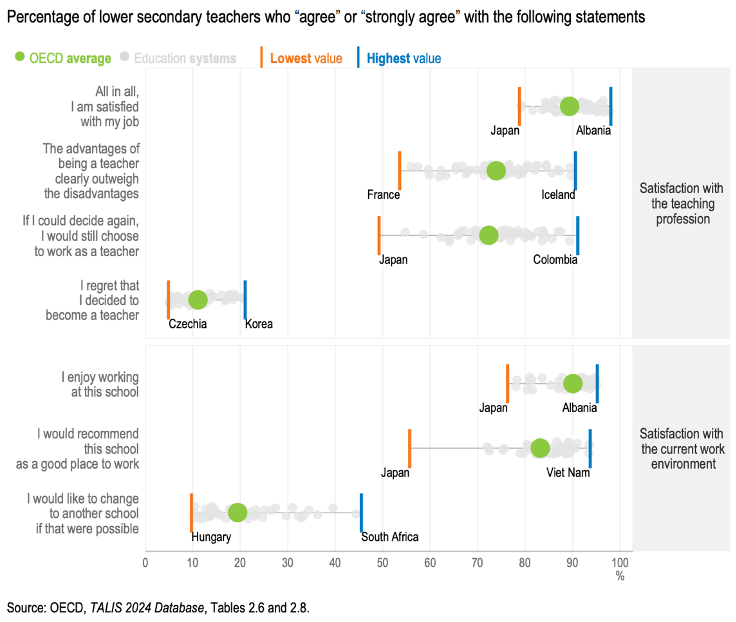
On average, almost 9 out of 10 teachers report that they are satisfied with their jobs.
- In South Africa, teacher satisfaction has risen by 8% since 2018
- In Colombia, 90% of teachers say they would become a teacher again.
Value of the teaching profession
Around 2 out of 3 teachers say they are valued by parents and guardians, but with significant variations:
- Over 90% of teachers feel valued in Vietnam Saudi Arabia, United Arab Emirates, Uzbekistan
- Less than 50% of teachers feel valued in French-speaking Belgium, Croatia, France, and Japan
- Saudi Arabia, Bulgaria and Denmark have increased the share of teachers who feel valued by almost 20%
Age
The average age of teachers across the OECD is 45 years-old, but:
- More than half of teachers are 50 or older in Estonia, Hungary, Latvia, Lithuania
- The average age of teachers is 38 or 39 in Türkiye, Morocco, the United Arab Emirates and Uzbekistan
Workload and stress
Roughly half of teachers report excessive administrative work as a source of work-related stress
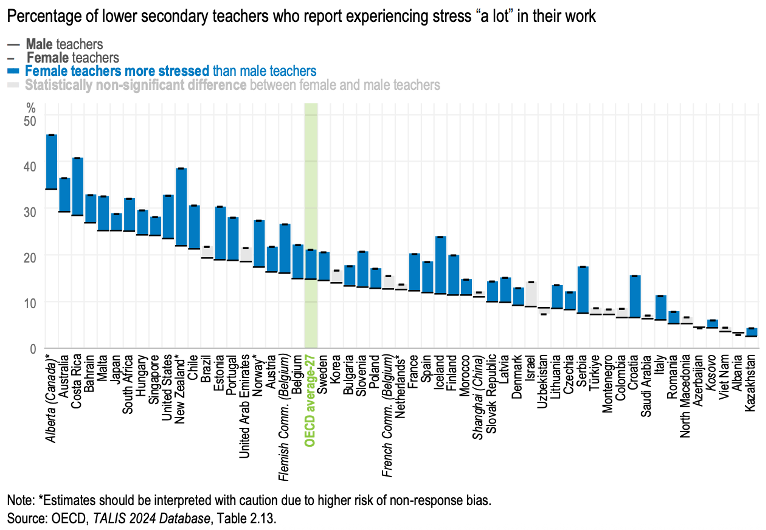
- The share of female teachers reporting stress “a lot” in their work is 21% compared to 15% for male teachers.
- Japanese teachers work almost 55 hours a week (down from 60 hours a week in 2018, the highest in the world).
- Teachers’ sources of stress are more closely linked to constant, unsupported change than to resource shortages
The amount of time spent maintaining discipline has increased in almost all education systems since 2018
- About 1 in 5 five teachers, on average, report significant disruptive noise and disorder in their classrooms.
- More than half of teachers in Brazil report such disruptions, compared to about a third of teachers in Chile, Finland, Portugal and South Africa
- Less than 5% of teachers in in Albania, Japan and Shanghai (China) report facing such disruptions
Preparation
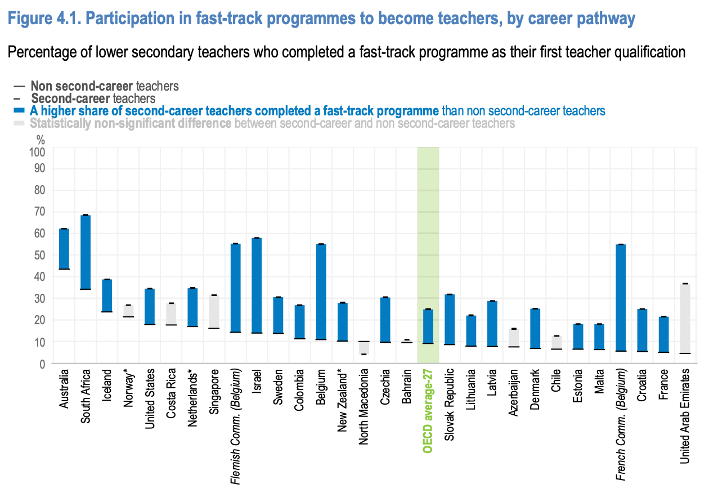
Almost 4 out of 5 teachers participated in regular teacher preparation programs to obtain their initial qualification, but:
- More than half of teachers in Australia, Costa Rica, Kazakhstan, Romania, Saudi Arabia and South Africa, do not follow the regular path through teacher education
- Almost half of teachers in Australia and almost a third of teachers in Iceland completed “fast-track” or specialized teacher education program
Teacher evaluation and support
Almost 90% of teachers work in schools where they are formally evaluated at least once a year by school leaders, and:
- 65% of teachers are engaged in post-evaluations discussions about how to improve their teaching.
- Slightly less than half of teachers are offered “development or training” plans, ranging from over 90% of teachers in Bahrain and Kazakhstan to under 15% in Iceland.
- A little over 10% of teachers participate in programs where they are offered financial incentives and less than 5% participate in programs that include potential sanctions.
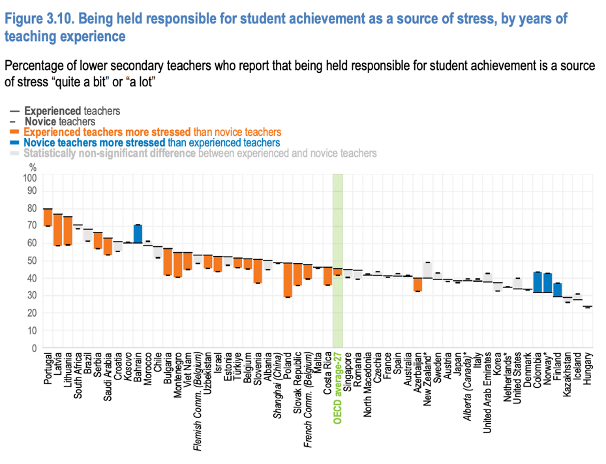
Almost half of teachers’ report that being held responsible for students’ achievement is a source of significant stress:
- Over 70% of teachers in Latvia, Lithuania, Portugal and South Africa report such stress
- Less than a third of teachers in Finland, Hungary, Iceland and Kazakhstan report this stress
Roughly 20% of teachers, on average, participate in mentorship programs:
- Almost 80% of teachers in Shanghai (China) report having an assigned mentor and over 60% of teachers with high self-efficacy report exchanging materials with peers, more than double the percentage of teachers with low
- In systems like Uzbekistan over two-thirds of teachers with high self-efficacy report observing other teachers’ classes and providing feedback
AI and online learning
1 in 3 teachers, on average, report using AI in their work:
- Roughly three-quarters of teachers in Singapore and the United Arab Emirates (UAE) use AI
- Fewer than 20% of teachers in France and Japan use AI
Over 15% of teachers, on average, work in schools where at least one class was taught hybrid, but:
- Over 80% of teachers in Singapore, and over 45% of teachers in Israel and the UAE report working schools where at least one class was taught hybrid or online
Next week: High satisfaction, high demands, and changing demographics: Scanning the headlines on the results of the TALIS 2024 (Part 2)

 International Education News