What effect will AI and other new technologies have on testing and assessment? In the first part of this four-part series, Adelaida Kim and Thomas Hatch provide an overview of how both large-scale tests and classroom-based assessments are changing as AI and new technologies continue to develop. Part two will describe some of the new platforms, apps, and tools that teachers can use to create, analyze, and score assessments, particularly those that support more student-centered learning. Part three will provide a deeper look at and a comparison of the strengths and weaknesses of the assessment capabilities of selected AI platforms, EdTech tools, and AI “assistants”. Part 4 will share examples of “micro-innovations” that are already demonstrating how AI and new technologies can assess and support the development of specific skills and abilities across different subjects and at different levels. For related stories on AI and education, see: Can AI “ignite the mind and heart”? Stability & change in the education system in China (Part 3); Scanning the global headlines for recent news on AI, schools, and education; AI, Cellphones, Literacy, Students’ Mental Health, Political Turmoil and More: Scanning the Headlines for the Top Education Stories for 2025.
++++++++
Almost every aspect of assessment is already being affected by AI and new technologies. These new technological developments intersect with long-standing debates about the role that testing and assessment should play in improving learning, teaching, quality assurance, and accountability, contributing to both hopes and fears for the future. For some, the hopes revolve around making standardized tests more efficient, while others envision a future where conventional standardized testing is obsolete and gives way for the assessment and development of a much wider range of competencies. As Ulrich Boser, co-author of a series of articles about the future of testing, predicted in 2021: “AI is going to eat assessments for lunch.” Of course, those hopes come along with widespread concerns about excessive screen time, cheating, surveillance, privacy, safety, bias, and equity. Although it’s impossible to take stock of every possibility and concern, scanning the headlines for articles about AI and assessment over the past year provides a sense of some of the latest developments in the use of AI for both large-scale standardized testing and classroom assessments.
“AI is going to eat assessments for lunch.” – Ulrich Boser
How might AI affect large-scale testing?
Many policymakers and researchers argue that standardized testing is an essential tool for accountability and for promoting equity in consequential decisions like college admissions. But critics raise significant concerns, including delays in reporting, which make it difficult, if not impossible, to use the results of these tests to inform instruction and support learning. Chad Aldeman has done the math to show that in 2025, only 6 states released their annual test results by July, while 16 states reported theirs only after October. As he explained, “states have gone from paper-and-pencil tests to computers and somehow gotten slower.”
“[S]tates have gone from paper-and-pencil tests to computers and somehow gotten slower.” – Chad Aldeman
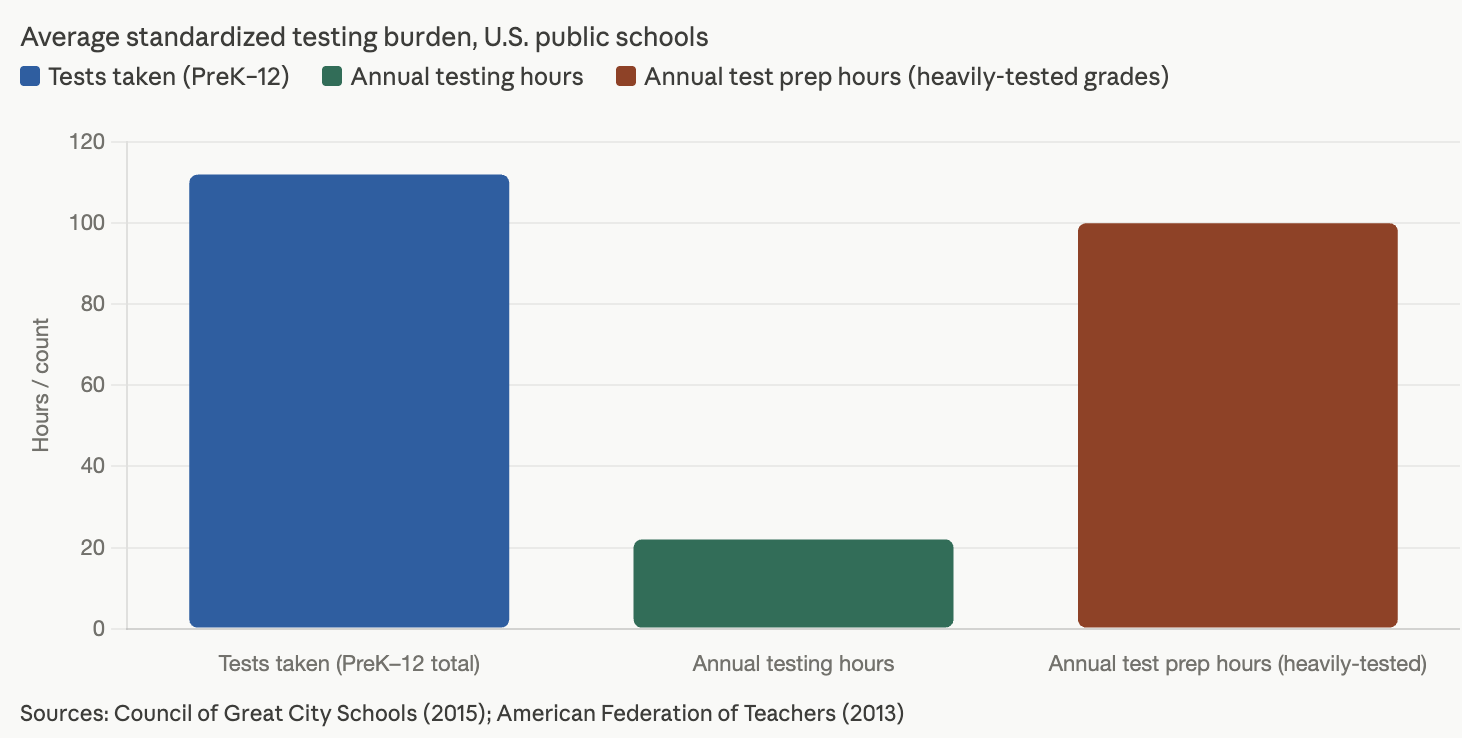
The extent of testing also interferes with the time students and teachers have to spend on teaching and learning. A 2015 study from the Council of Great City Schools showed that in large urban districts, U.S. public school students take an average of 112 standardized tests between pre-K and 12th grade. Annually, this testing can take up 20-25 hours of class time. In 2013, a study from the American Federation of Teachers reported that in heavily tested grades, testing might take about 50 hours a year, with over 100 hours of test prep, together consuming almost 15 percent of instructional time. Accountability measures in some states contribute to this problem by instituting year-round testing that requires administering multiple tests over the course of the year, in the hope that the resulting data will help teachers improve student performance.
Compounding these concerns, the pressure to perform well on all these tests can contribute to a narrowing of the curriculum and a hyper-focus on a limited set of academic skills, making it difficult to support the development of a wider range of abilities and student wellbeing. This disconnect between what’s tested and what’s valued creates considerable frustration among educators. According to a survey by the EdWeek Research Center, almost 60% of educators do not believe that current state standardized tests appropriately measure what students need to know and be able to do.
Regardless of how one views standardized tests, it’s clear that AI is already changing almost every aspect of large-scale testing. Among other things, generative AI can:
- Produce test items
- Generate sample responses
- Create automated feedback
- Write reports
- Adjust item “delivery” to accommodate learning differences
- Analyze responses to suggest revisions to test items
With these new developments, AI is already being used to grade most writing on New Jersey’s standardized tests; platforms like Classtime give students and teachers almost instant feedback designed to make test-prep more efficient; and test-makers are struggling to keep up with the new developments that enable some students to game the system and cheat on the newest online tests. If the past is any indication, these new developments in testing are likely to both foster long-needed improvements at the same time that they exacerbate some of the most critical problems of over-testing, disengagement, and inequity that continue to plague education.
If the past is any indication, these new developments in testing are likely to both foster long-needed improvements at the same time that they exacerbate some of the most critical problems of over-testing, disengagement, and inequity that continue to plague education.
Can AI contribute to the development of more powerful classroom assessments?
AI and new technologies are already changing key aspects of the classroom assessments teachers use day to day. It is far from clear how effective some of these changes will be, but developments may help teachers to measure greater skills, provide more useful feedback, and make assessments more relevant, useful, and personalized.
Measuring deeper understanding and complex skills. AI technologies, such as natural language processing, can support the development and analysis of alternative assessments, such as performance tasks and portfolios. In particular, teachers may be able to take advantage of AI to help them create tasks such as interactive scenarios in which students interview virtual experts to decide whether a historical artifact belongs in a museum or use a chatbot to research a topic. These kinds of tasks can be difficult for teachers to design and grade, but they give students opportunities to develop and demonstrate skills such as critical thinking, creativity, communication, and problem-solving that are not easily measured by simpler conventional tests. As a UNESCO think piece on the future of assessment argues, AI’s challenge to traditional testing is also “an opportunity to fundamentally realign educational evaluation with more authentic demonstrations of human learning, thinking, and creation.”
AI’s challenge to traditional testing is also “an opportunity to fundamentally realign educational evaluation with more authentic demonstrations of human learning, thinking, and creation.” – UNESCO
Providing Actionable Feedback. Beyond providing final scores, AI can analyze student responses to identify patterns in individual, group, and whole-class answers. These analyses give teachers immediate, concrete data they can use to adjust their instruction and help students right away. As Lauren Katzman points out, providing feedback can be an “unmanageable” task, since spending just 10 minutes reading each student’s draft in a class of 20 can take almost 2 hours. For a high school teacher with 100 students in different classes, reading that one draft can take almost 16 hours. To relieve that workload, initiatives are underway to train AI to provide teachers with information on students’ errors when explaining their reasoning for math problems, enabling teachers to correct student misconceptions in real time.
Automated writing evaluation (AWE) systems also provide AI-powered scores and feedback on writing directly to students. One meta-analysis found that this automatic feedback had a “moderate” effect size with larger effects for multilingual learners. However, wide variation in results led the researchers to warn that “automated feedback should be combined with other forms of support, such as teacher feedback and individualized learning opportunities, to ensure its effectiveness.” Correspondingly, research reveals that students who write without AI assistance but then use AI to revise their writing show the strongest learning-related brain activity. In contrast, students who use AI to help them write from the beginning show lower brain activity and “lower satisfaction and ownership over their work.”
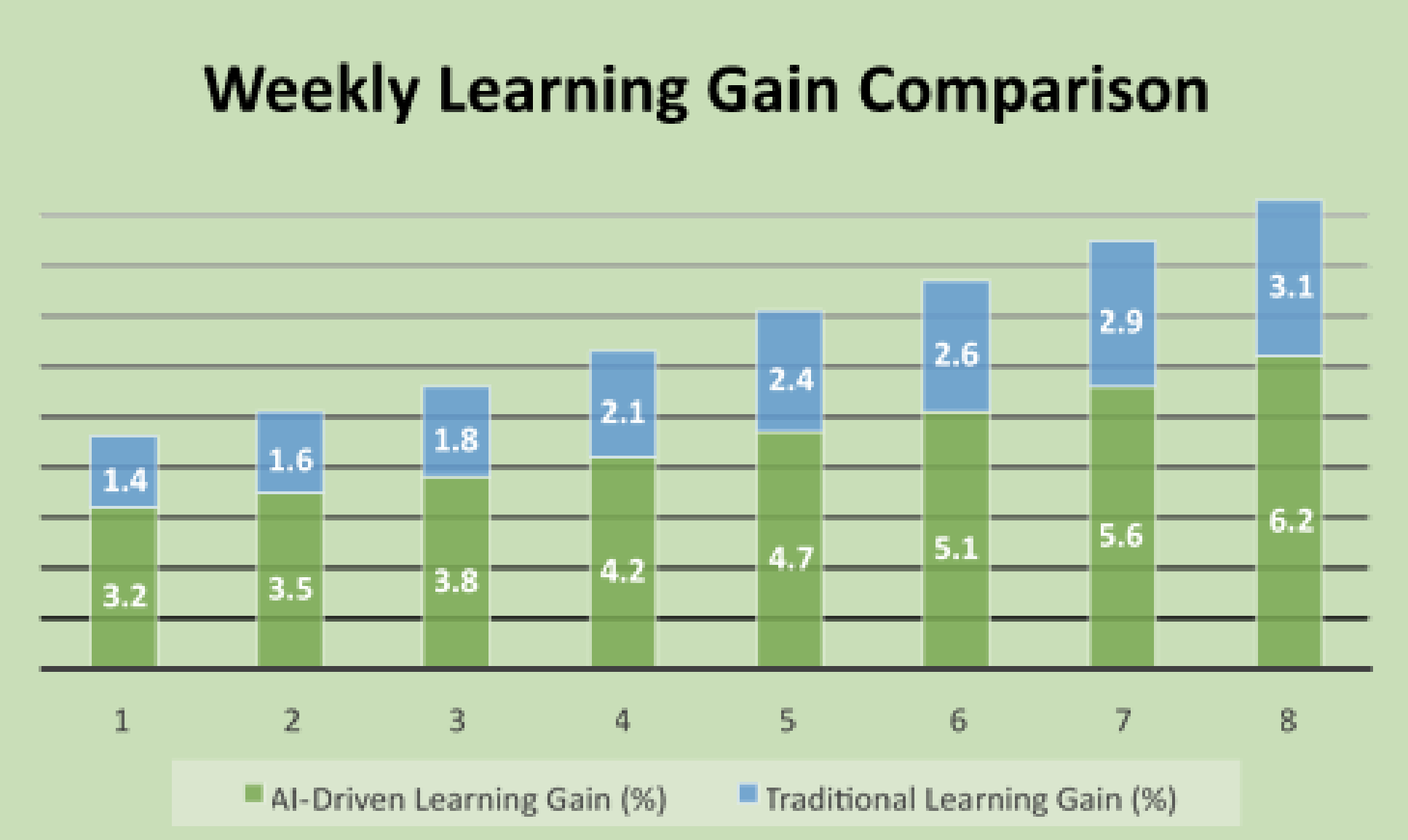
“Personalized” and adaptive assessment and instruction. Numerous educational programs, particularly tutoring programs, are already using AI to “personalize” or individualize assessment and instruction in various ways. Among recent developments, educators can use AI to adapt assignments and tests to student learning differences by translating assessments into different languages; taking advantage of chatbots designed to respond to the behavioral cues of students with autism; and employing computer-assisted environments designed specifically for voice and gesture recognition.
AI can also generate test items that measure core skills but are tailored to a student’s individual interests. At the simplest level, that might include testing fractions by providing a student who loves baking with questions based on a cookie recipe or a student who loves sports might get questions based on the dimensions of a football field. AI can also help educators to generate more complex questions that draw on students’ experiences and local knowledge. For example, questions about physical phenomena that students have observed can replace more generic physics problems. Conceivably, more personalized testing can be more engaging for students, potentially reducing test-taking anxiety and increasing motivation and providing a more accurate representation of their knowledge and abilities. For the most part, however, these claims still need to be tested and verified.
Beyond tailoring content to student interests, many educators and researchers are exploring adaptive assessment — a form of personalization in which AI analyzes each student’s responses in real time and adjusts subsequent questions and tasks. This is the underlying logic of AI-powered many tutoring tools like Khan Academy’s Khanmigo, which guides students through problems by responding to their specific answers rather than simply providing correct ones, and platforms like Squirrel AI, which has been named one of TIME’s Best Inventions of 2025 for its ability to break subjects down into granular knowledge points and continuously adjust a student’s learning path based on their interactions. A systematic review of AI-driven intelligent tutoring systems in K-12 education finds that these systems can “monitor student progress, identify difficulties and errors, navigate structured subject content to offer and tailor the difficulty level, thus developing an optimal path for learning.” Researchers at the University of Michigan are developing adaptive chatbots that go further still, carrying out dialogue with students and providing scaffolding based on both the accuracy and the sentiment of their responses, with teachers able to customize the question sequences to match their own instructional goals. With new AI-based adaptive approaches far outpacing research on their effectiveness, how quickly and equitably these approaches can be implemented across schools remains an open question.
The future for AI and assessment?
New possibilities and challenges for AI and assessment will continue to emerge as AI and other technologies develop, making it difficult to predict exactly what might happen next. Regardless, some of the benefits and challenges are already clear. With these challenges in mind, some experts believe that smaller shifts in assessments and instruction are more likely in the next few years rather than a dramatic revolution. As Matt Johnson, a principal research director at Educational Testing Service (ETS), puts it: “My opinion is that there will be a slow creep of new stuff.” So far, some of the developments most likely to be a part of that “slow creep” include the use of AI by test makers and teachers to generate test items and tests. But Janet Garcia, CEO of PSI and President of the ETS, sees even bigger changes ahead: “One of the clearest trends I see emerging is the movement away from single-point, multiple-choice exams toward more continuous, real-time demonstrations of competence.”
“One of the clearest trends I see emerging is the movement away from single-point, multiple-choice exams toward more continuous, real-time demonstrations of competence.” – Janet Garcia
It remains to be seen how quickly these kinds of developments in large-scale testing and the assessment of a wider range of competencies might take hold, but, more concerning, it’s far from clear whether changes like these will make things better or worse for students and teachers
Next week: Can Online Platforms and Digital Tools Support More Student-Centered Learning? AI, New Technologies and the Future of Assessment (Part 2)


