Category Archives: About K-12 International Education News

Lead the Change interview with Trond Eiliv Hauge

Trond Eiliv Hauge

Trond Eiliv Hauge is Professor Emeritus of Education at the University of Oslo, Department of Teacher Education and School Research, Norway. His publications include numerous books, chapters, and journal articles in the fields of learning and new technologies, teacher education, school leadership and improvement. For many years he was working in the Norwegian Ministry of Education as a curriculum consultant. Since 1991 his main professional work has been in teacher education and in-service training of teachers and school leaders. He was the director of the National Centre of Excellence in Teacher Education until 2013.

In this interview, which is part of the Lead the Change Series of the American Educational Research Association Educational Change Special Interest Group, Hauge shares what excites him about the educational change field today:

Today, digital competency is one of the most important requirements to participate in education and work, as well as to be an active member of society….However, the use of ICT in education is still in its infancy or awaiting acceptance and legitimation as a tool for learning and a way of education. A variety of contradictions between old and new designs of teaching and learning hinder people from taking advantage of the potential of ICT in schools. For example, the test and exam system has a tremendous impact on the manner of learning and assessment of student competencies, and adjusting them to fit new digital practices is difficult. At the same time, ICT in education requires further research and development on a critical basis of what schools are designed for or ought to be.

This Lead the Change interview appears as part of a series that features experts from around the globe, highlights promising research and practice, and offers expert insight on small- and large-scale educational change. Recently Lead the Change has also published interviews with Diane Ravitch, and the contributors to Leading Educational Change: Global Issues, Challenges, and Lessons on Whole-System Reform (Teachers College Press, 2013) edited by Helen Janc Malone, have participated in a series of blogs from Education Week.

Teacher and teaching quality in the world’s top-performing education systems

The National Center on Education and the Economy’s (NCEE) Center on International Education Benchmarking (CIEB) has recently published Empowered Educators: How High-Performing Systems Shape Teaching Quality Around the World—an international comparative study of teacher and teaching quality in the world’s top-performing education systems. To explore and share the findings of this research, the NCEE held a conference featuring presentations and panel conversations with several of the authors of the study, including Linda Darling-Hammond, A. Lin Goodwin, Karen Hammerness, Misty Sato, Dion Burns, and Ann McIntyre.

Marc Tucker, president and CEO of NCEE moderated the event, and Andreas Schleicher from OECD and policymakers and educators from the US also provided their perspective. The conference was also streamed live and can be viewed online.

Linda Darling-Hammond launched this three-year study from the Stanford Center for Opportunity Policy in Education (SCOPE) at Stanford University with a team of education researchers from several different parts of the world. The study focused on the policies related to teachers and teaching quality in seven jurisdictions across four continents including Shanghai, Finland, Singapore, and Australia.  According to the study, these seven jurisdictions that have demonstrated higher achievement and greater equity than the U.S. have focused on building effective systems, rather than on narrow solutions and have made a commitment to professionalizing teaching as an occupation.

During the conference, researchers expanded on how these countries have achieved their success.  While each jurisdiction takes a somewhat different approach, the conversation highlighted that:

  • Recruitment and selection processes help to identify teacher candidates who are both talented academically and have a passion for teaching
  • Teacher education takes place in research universities, combining rigorous coursework and substantial practical experience in schools
  • Standards support professional development and career ladders create new options for expert teachers

Notably, in most of these countries teacher education is free and new teachers start their jobs with no burden of student loans.

When asked about the potential of and challenges for the U.S., Andreas Schleicher remarked that the U.S. has invested heavily in education, but that teacher pay, professional development and career structures have not received as much financial support as other issues like class size. Schleicher also argued that in higher performing countries it’s not just about giving teachers a higher salary; it’s about making teaching an intellectual profession, accompanied by a sense of agency and autonomy, that offers opportunities for learning and growth over time.

In subsequent conversations, questions were raised about the ability of states to take the same systemic approach and make the same significant investment that these jurisdictions have made in teacher education and teaching.  In response, panelists pointed to examples of states like Connecticut and Massachusetts that have invested heavily in teacher preparation and professional development and have high levels of student achievement.  Ryan Wise, Director of the Iowa Department of Education, also described how Iowa has already set aside 50 million a year for planning grants for schools and districts to develop teacher learning and leadership opportunities.

Beyond the event itself, discussions took place on Twitter (#empowerededucators) and Checker Finn, President Emeritus of the Thomas B. Fordham Foundation, has already published a critique of the study, with Marc Tucker posting a response on his EdWeek blog.

Leading Futures – Unions: The Last Bastions of Progressive School Improvement

In this latest post in the Leading Futures Series, edited by Alma Harris and Michelle Jones, Dean Fink argues that unions play an important role in maintaining and enhancing the professionalism of teachers and principals and as a result improve the quality of education. Fink is an international educational development consultant.  He is a former superintendent and principal with the Halton Board of Education in Ontario Canada. Fink has published numerous book chapters and articles on topics related to organizational effectiveness, leadership and change.

Recently, with considerable help from colleagues from seven nations, Australia, Canada, Finland, Lithuania, Sweden, the United Kingdom (England) and the United States, I wrote and edited a book that examined the relationship between institutional, relational and self-trust among the professional staff in schools and student achievement. What motivated the book was an interesting correlation between national measures of trust, and student achievement as measured by PISA (Program for International School Achievement).  For example, the World Values Survey  asked people in many countries around the world the following question: “Generally speaking, would you say that most people can be trusted or that you need to be very careful in dealing with people?” Possible answers included (a) most people can be trusted, and (b) you can never be too careful when dealing with others.

The first question reflected people’s trusting nature and the second their cautious or distrusting nature.  Of the seven nations in our study, Finland and Sweden scored highest on the trust measures, Canada and Australia followed closely, and the United States next in that order, then England, and well behind, the post-Soviet nation of Lithuania.  A second trust measure The Corruption Perception Index measured the perceived trustworthiness of a nation’s public sector on a scale from 0 to 100. The pattern was similar to the World Values Survey – Finland and Sweden scored at 89 %, Canada and Australia at 81%, the United Kingdom at 76%, the United States at 73% and Lithuania at 53%.

These rankings correlate closely with the 2009 and 2012 PISA scores. These results have now become the ‘gold standard’ by which politicians, academics and educational officials rate school systems. When one averages the reading, mathematics and science scores from the 2012 PISA as one measure of quality, the results follow a familiar order – Finland (529), Canada (522), Australia, (512), the United Kingdom (502), the United States, (492), Lithuania (484).  Sweden is an anomaly (482) when compared to its high trust scores. While scores in general for western countries are down from the 2009 PISA, with Lithuania as a significant exception, the rankings in 2012 were similar.

This suggests that there is a clear pattern, on admittedly flawed measures, that suggests that high trust countries produce higher student achievement. To prove this conclusively was beyond our resources but we were sufficiently intrigued to try in each of our countries to understand the trust dynamic and how it affected student and teacher performance at a much deeper level. To do this each member of our team surveyed samples of principals and teachers using the same 30 item five scale survey developed jointly and translated for non-English speaking nations. With these results, each country’s researcher(s) conducted interviews and focus groups with teachers and principals using a few generic questions on trust and distrust and then more specific questions arising from their survey results with specific reference to their trust in institutions like government and unions, relational trust among individuals in and outside of schools, and individuals’ trust in themselves in the current political climate.


Context Counts

The first and most obvious conclusion from our study is that each nation’s educational system is unique and levels of trust in each are dependent on local conditions. For example, Australia, Canada and the United States have federal systems of government with potentially three levels of government having involvement in education, national, provincial or state, and local. The national governments in Australia and the United States play an increasingly activist role in education, whereas the Canadian federal government has very limited involvement. The other four nations in our study have unitary systems of government that usually involve only a national and local government in education. While local governments are deeply involved in education in Finland, Sweden and Lithuania, the national government in England has severely undermined the involvement in education of local authorities. As a generalization, levels of trust among policy makers and policy implementers are directly related to their proximity to each other.  A teacher for example would have more trust in a local school board or local authority member than she might have in a member of the national government.  Conversely national politicians seem to have less trust in educational professionals than more local policy makers who actually meet teachers and principals in their daily activities and can learn from personal experience how their policies play out in practice. Recognizing the uniqueness of each education system and its patterns of trust well known Finnish educator Pasi Sahlberg offer this caution:

…politicians and policy makers should be careful when borrowing ideas from other countries, be they Singapore, Canada, or Finland. What has made an education system work well in one country won’t necessarily work in another. Policy makers should also be aware of the myths about these systems and what made them successful.


Unions and School Improvement

A second and somewhat unanticipated revelation of our study related to teacher unions and levels of trust.  If one accepts the widely-held view that the most significant factor in the educational achievement of students is the quality of their teachers, then it follows that trust in institutions that impact positively on the lives and efficacy of teachers are vital ingredients of school improvement.  While a highly debated concept, especially in the United States, our data suggests that strong teacher unions contribute to better student results.  Unions appear to enhance the status and well-being of teachers in nations like Canada and Finland by providing professional push back against the forces of privatization and New Public Management, and by demanding reasonable wages and working conditions for teachers which in turn make the profession more attractive to younger people.  Both of these ‘high trust’ nations attract high quality university graduates into the profession and neither nation has had to resort to ‘quick recruitment fixes’ like Teach for America in the United States or Teach First in England.  Conversely underachieving nations, such as the United States, have undermined unions’ efficacy through right to work legislation which bans mandatory union membership (closed shop) and the payment of union dues which allows individual teachers to avoid financial obligations while still receiving the collective bargaining benefits of unions. In this way, governments have sought to erode the financial support for unions and weaken their ability to provide a counter narrative to the privatization agenda of many governments and to bargain for increased wages and improved working conditions.

A major motivating factor for such legislation is the widely-held belief that unions distort the natural process of labour markets by protecting inferior teachers and artificially driving up salaries for incompetents. In fact, the opposite happens.  For example, in the United States where unions are under extreme pressure, teachers experience 17% lower wage levels when compared to comparable workers. Unionized teachers have a 6% less wage gap when compared to nonunionized teachers but still below comparable workers.  Is it any wonder that most American states have teacher recruitment problems?

Dr. Eunice Han’s exhaustive study on the relationship between unions and teacher efficacy provides further evidence that unionization is in fact good for teachers and students alike and does indeed improve students’ performance. Han says that highly unionized districts actually fire more bad teachers.  She argues that by demanding higher salaries for teachers, unions give school districts a strong incentive to dismiss ineffective teachers before they get tenure. Highly unionized districts dismiss more bad teachers because it costs more to keep them.  In 2010-2011, Indiana, Idaho, Tennessee and Wisconsin changed their laws to dramatically restrict the collective bargaining power of public school teachers. Han compared these states to States where no change had occurred.  If teachers’ unions protect bad teachers, then teacher quality should have risen in the ‘reforming’ states, instead she found that the opposite happened. The new laws restricting bargaining rights in those four states reduced teacher salaries by about 9%. With lower salaries, school districts had less motivation to dismiss underperforming teachers which resulted in the ‘right to work’ states. Lower salaries also encouraged high-quality teachers to leave the teaching sector, which contributed to a decrease of teacher quality and a related fall in student’s achievement. Since teacher unions or some kind of teachers’ organizations will continue to play a part in every school jurisdiction it seems to make sense for governments that want to improve schools must work collaboratively with these organizations rather than to constantly confront, demean and ignore.


Principals and unions

A third and not unexpected result of our discussions with principals internationally is that principals find themselves in the crosshairs between big governments and more militant teachers’ associations and unions.  Strong unions complicate life for on-site school leaders.  On one hand Principals are mandated to implement policies that reflect policy makers distrust of teachers’ professionalism such as standardized testing and school inspections, and in which they themselves often have profound doubts as to their educational soundness.  In response teacher unions in some countries have grown more militant as the values of a market driven, production model of educational delivery become more established and ‘right to work’ legislation and other means to curb the power of unions including workplace agreements, becomes more popular among right-leaning politicians. This is especially so in countries such as Canada, where, in some provincesteachers and principals are represented by different associations.

Our survey of principals and teachers included this item – “Unions are an agency for school improvement in school systems and schools” – among the 30 items on our survey.  It is interesting therefore to consider how principals responded to our survey item on trust in unions.   Those principals who were not part of the teachers’ bargaining unit in Canada, such as in Ontario and British Columbia were very negative on the item.  Of our seven nations on the five-point scale, Canada scored lowest at 2.41. This low score probably reflects job (industrial) actions at the time of the survey’s administration in both large provinces as well as the legislated exclusion of principals from the teachers’ unions by production leaning governments that believed that education should be run like a business and principals as managers must be separated from their workers – the teachers.

These political decisions removed the moderating effect on unions of principals who generally see the larger picture and, as a result, unions in British Columbia and Ontario particularly, over the past 20 years, have become more strident and militant. Principals are now in the uncomfortable and often contradictory position of representing their school districts’ and provincial policies while trying to bring about school improvement with a staff that follows the lead of their unions.  Building collaborative cultures is difficult enough for principals without the added burden of negotiating these political waters.   Once again, education politics and policies that are designed to drive a wedge between principals and their staff on industrial matters cannot be seen to be conducive to developing high-trust relationships at the individual school level.  Ironically, Canadian school achievement is among the highest of our seven nations, and as stated previously, in general teachers are well paid and enjoy decent working conditions. There is no shortage of teachers in most Canadian jurisdictions with the exception of more remote and isolated areas. This is not the result of more benevolent political decision makers but rather the strength of teacher unions that are well financed and willing to push back. Principals, caught in the middle on a daily basis and excluded from unions tend to perceive only the short-term challenges presented by unions and not the long-term benefits.

Except for Canada in our seven nation study, there is no discernible pattern concerning principals’ support for and trust in teachers’ unions or their degree of influence on government policies.  Finland which includes principals in the teachers’ bargaining unit scored highest on our five point scale at 3.1.  Australian principals who are part of teachers’ unions in each state and nationally scored 2.68, and do play a high-profile role in influencing government policies.  Sweden scored 2.73 on our five-point scale.  Its secondary principals, who appear to be quite influential in an advisory position to government, operate outside the teachers’ union whereas most of their elementary colleagues are within the teachers’ union.   The two lowest achieving nations on PISA in our sample, the United Kingdom and the United States scored 2.92 on this item.   The United Kingdom’s two major principals’ organizations and three large teachers’ unions appear to have little impact on policy. The United States, that has a mixture of union and non-union States and separate principals’ organizations in most states, has had only modest success holding back the forces of privatization.

Lithuania at 2.59 on our measures, with its four teachers’ unions that include some principals and a rather ineffective principals’ association[i], tend to weaken their influence on policy by competing among themselves.  Where governments face multiple unions and principals’ associations, such as in Lithuania and the United Kingdom, governments often overcome opposition by playing one organization off against another. These large-scale dramas often add to the political challenges of principals in schools. Our study has suggested that, with the directions and destiny of the teaching profession controlled by the political process in each of the jurisdictions, and with principals called upon increasingly to be policy advocates and implementers, not designers, or at best recognized as having a limited voice among many in the policy-making process, it has been teacher unions more than any other group that have had the power to act as a voice on behalf of the teaching profession.

Conclusion

In our book, we portrayed the educational landscape internationally as a contest between two visions of educational change – a production model based on trust in the efficacy of markets, standardized test, privatized schools and invasive verification schemes and a progressive model that places its trust in well qualified, well paid, well treated, well-regulated professional educators. In this paper, I have tried to argue that unions play an important role in maintaining and indeed enhancing the professionalism of teacher and principals, although at times it may not seem like it, and as a result improve the quality of education.

Since unions were only a small and serendipitous part of our study this paper can only talk in terms of correlations not causes. What is needed is rigorous research to examine the relationship of unions and student achievement and to address such questions as:

  • what kind of unions are most effective – single interest unions such as the Ontario Secondary Schools Federation or inclusive teacher unions such as the Alberta Teachers Association;
  • what kind of legislation is needed to protect unionism while caring for the interests of taxpayers and students;
  • what are the most successful union configurations;
  • should principals be considered management and separate from teacher unions or as head teachers and part of a collaborative teaching unit included in Teacher unions?

As the foregoing discussion suggest, the field of unions and school improvement is wide open for bright young scholars to explore deeply.

 

Low-fee Private Schools in India

In “Low-Fee Private Schools in India: The Emerging Fault Lines,” a new report shared by the National Center for the Study of the Privatization in Education (NCSPE), Tamo Chattopadhay and Maya Roy explore controversial low-fee private schools in India. These schools have generated controversy, with proponents contending that private schools fill a void created by state failure, and critics pointing out that private schools don’t meet the needs of all students.

The authors investigate by focusing on India, where Chattopadhay and Roy see the following challenges before low-fee private schools:

  1. Higher standards for school infrastructure, services, and teacher capacity mandated by the country’s Right to Education Act of 2009, mean that low-fee private schools are hard pressed to meet government metrics and keep tuition affordable;
  2. Low-fee private schools hold instruction in English, though the command of the language by many teachers is weak;
  3. Teachers across the country boost their income by getting parents to enroll their children in after-school tutoring, a practice, the authors posit, that is more widespread at low-fee private schools than elsewhere because of the lower pay of teachers at these schools.


This report provides historical context, relies on government reports, and draws from classroom visits in Kolkata and interviews with teachers in West Bengal. As Samuel Abrams, Director of the NCSPE, shares, “Chattopadhay and Roy provide a concise, textured case study of an issue central to debate about educational governance in the developing world.”

Improving education in and out of school in South Africa (Part 3)

This post was written by Thomas Hatch and originally published on https://thomashatch.org/

My latest blog posts include a series of reflections on recent visits to a number of educational organizations in South Africa including IkamvaYouth, Wordworks, FunDza, Olico, the Kliptown Youth Program, and The Learning Trust.  The first post discusses both the considerable challenges and real possibilities for growth; the second post describes the efforts of several organizations to respond to the demand for basic learning materials and the challenges in building a capable teacher force; this final post considers some of the unique aspects and possibilities for work in South Africa moving forward.

Opportunities from challenges

While the programs I visited, like those in other developing countries, confront both the enormous needs and the limited resources and capacity of the education system, the challenges may also come with opportunities.  The difficulties of finding and training teachers means these programs have to take advantage of the possibilities that come with working with parents, other volunteers, and peers.  However, as both Madondo at KYP and Patrick Mashanda at IkamvaYouth suggested, working with volunteers and peers means that the students themselves may have more opportunities to take charge of their own learning and develop a sense of agency.  As Madondo recounted, “the issue we’ve picked up is that when you work with teachers they are used to the teaching system of standing in front of the class, and even when it’s time to do a one-on-one mentoring with the students, the teachers often struggle.” Unable to rely on a ready pool of teachers, these programs are developing and demonstrating ways that educational support can be provided when it is simply not possible to ensure that there is a “qualified teacher for every child” – the focus of many policies in the US.

These difficult conditions also make it very hard for programs like these to expand and “scale-up” across communities and into different regions.  “If we provide a lot of training for volunteers,” Mignon Hardie of Fundza explains, “that’s not scalable.  At the same time, if you’re looking at online and training videos for going into rural areas, that’s not practical either.” Nonetheless, along with the pressure to make their programs as cost-effective as possible, the tremendous need also creates a demand for successful programs that can help them to attract funders and investments that can enable them to scale.  For example Fundza, IkamvaYouth, and Olico, have all been invited to expand their programs as part of the Western Cape government’s Year Beyond initiative.  In the process, they are all experimenting with “light” versions of their programs to determine the most efficient approaches in a context of extremely limited resources. The Dell Foundation, for its part, is also testing a version of their scholars program that does not hire their own counselors, but instead refers scholars to counselors and other forms of support available in the local universities.

Many of those I talked to also cannot get reliable data from government schools about student learning outcomes.  With inconsistent grading and spotty implementation of government assessment initiatives in schools, most programs have not yet been able to gauge their impact on the kinds of standardized test outcomes that are used to measure year-to-year performance of programs in the US and other developed education systems.  Although many programs are working to establish their own data systems, in the meantime, they have had to rely on basic data like attendance rates, numbers of students, teachers, and schools served, and high school and university graduation rates. In many cases, that data demonstrates the growing reach and considerable potential of these programs, and these conditions also provide an opportunity for these programs to develop and mature before they have to demonstrate impact on the kinds of performance indicators that even those working in developed systems have struggled to achieve.

While my research focused primarily on those programs that are aimed specifically and supporting students’ academic development, there is widespread recognition of a tremendous need to support children’s physical, social and emotional development as well.  For example, programs like Waves for Change (offering what they refer to as “surf therapy”) are demonstrating effective ways to work with youth who have experienced significant trauma in their lives.  Just like academic programs, these programs are searching for appropriate and meaningful ways to measure their impact.  In the US, too often these programs are still judged on whether or not, and how much, they contribute to academic gains, and efforts to develop a broader set of indicators (though efforts are underway) have never taken off.  Conceivably, the recognition in South Africa that academic development cannot also take place without social, emotional, and human development and the lack of reliable academic indicators creates a context where real innovations in individual assessment and program evaluation are possible.

Thomas Hatch

Improving education in and out of school in South Africa (Part 2)

This post was written by Thomas Hatch and originally published on https://thomashatch.org/

My latest blog posts include a series of reflections on recent visits to a number of educational organizations in South Africa including IkamvaYouth, Wordworks, FunDza, Olico, the Kliptown Youth Program, and The Learning Trust.  The first post discusses both the considerable challenges and real possibilities for growth; this second post describes the efforts of several organizations to respond to the demand for basic learning materials and the challenges in building a capable teacher force; the final post considers some of the unique aspects and possibilities for work in South Africa moving forward. . These reflections build on earlier posts about visits to Singapore and Malaysia, and are all part of an ongoing study of improvement and innovation inside and outside schools in developed and developing education systems.

Improving education in and out of school in South Africa (Part 2)

A demand for basic materials

While the programs I learned about all take somewhat different approaches, as I talked to the leaders of programs like Wordworks, FunDza, and Olico, I noted a heavy emphasis on developing and sharing materials for literacy and maths. Wordworks, for example, has developed a series of materials and resources, many of which are offered for free.  Those materials can be used by anyone – including parents as well as teachers – to help young children learn to read and write. FunDza also seeks to support literacy development and a love of reading, but for those in high school and beyond.  Their work began in 2010 when Dorothy Dyer, a high school teacher sought to find and create books and other reading material that reflected the lives of her students, who primarily lived in one of Cape Town’s Black townships.  Dyer’s students were so enthusiastic about the initial drafts of a novel that she and a friend started to write for them that she and colleagues including Mignon Hardie started a small publishing company, Cover2Cover. Cover2Cover published works geared for young adults growing up in South Africa. Those works have included a series focused on a group of teenagers at a fictional township high school and another series set in a youth soccer club.  Many of their books also focus on social issues including xenophobia, homophobia, and teenage pregnancy.  In addition to Cover2Cover, which remains a for-profit publisher, they also established the FunDza Literacy Trust. FunDza provides these books and other reading materials in print and through a mobile app to schools, libraries, youth development groups, and other reading groups.  To meet the constant demand for texts that connect directly to the lives of youth South Africans, FunDza has also gone on to create a program to support the development of young writers and is currently piloting an online reading curriculum using their materials as well.

Olico grew out of Andrew Barrett’s initial work establishing a branch of IkamvaYouth outside of Johannesburg. After he left IkamvaYouth, he wanted to explore how to use technology to help ease the intense demand for the tutors that programs like IkamvaYouth and the Kliptown Youth Program rely on. Barrett’s work with Olico began by using the videos of Salman Khan and Khan Academy to help eighth grade students in an afterschool program in one South African township to learn math.  But from their work in that one Township, Barrett and colleagues like Lynn Bowie have now created a whole series of math videos and support materials that students from South Africa (and anyone else with an internet connection) can freely access online; partners like IkamvaYouth and the Kliptown Youth Program are now using those materials to enhance their own tutoring programs.

These three programs are just a sample, however, as the development and distribution of educational materials has taken off.  In 2002, for example, Siyavula, started with a group of students who developed free online texts in high school chemistry, maths, and physics. Syavula’s work has now expanded into a technology company that produces open source textbooks  at both the primary and high school level as well as tools and technologies to support personalized learning.  The government as well has gotten into the act, with provinces like Guateng producing scripted materials that primary school teachers can use to teach reading and maths.

All of these programs have developed in a system where there are still large swaths of schools, concentrated in the poorest townships and rural areas, where students and teachers have virtually no materials or a small set of books and resources they have to share.  Furthermore, the delivery of these materials – increasingly through online sources – can reach many more people and places at substantially lower costs than most training workshops and programs. In contrast, in the United States, textbooks and curriculum materials do not seem to get as much attention as many other reform strategies even though there is some evidence that they can make a difference in student outcomes (see “Big bang for just a few bucks” for example). A few programs that focus on content and materials development have found a niche (and Khan Academy and programs like Jump Math are good examples), but providers may feel that the market is already flooded with materials from major publishers and by those produced by states and districts themselves.

Limited teaching a capacity and a reliance on peer and volunteers

Even good materials, however, cannot teach themselves.  Effective use of materials depends on capable people and usually at least some training and targeted support.  In South Africa, the demand for training and support are evident from the low-level of preparation and limited content knowledge of some of South Africa’s teachers.  As Nic Spaull has pointed out, large percentages of teachers lack the content knowledge they need to pass the mathematics tests their students are expected to pass. In fact, in some of the poorest and most rural provinces communities, more than 70% of teachers can’t pass these tests.  To illustrate the depth of the problem, Spaull provides the example that on an international test, only 33% of South African Grade 6 maths teachers could correctly answer one of the items aimed at a sixth grade level. “This is only marginally above what teachers would get,” Spaull notes “if they just guessed the answer, since they would get it right 25 per cent of the time on a four-choice test item.”  Even the materials designed to support teachers show the inadequacies of current teacher preparation.  As stated in the introduction to a government sponsored booklet intended to help Intermediate Phase (middle school) teachers implement a literacy curriculum “as Intermediate Phase teachers, it is unlikely that you know how to teach learners to read, or how to remediate their reading.”

These findings have contributed to calls for substantial improvements in teacher preparation and professional development in South Africa, but those improvements are likely to take a generation at least and at a tremendously high cost.  In the meantime, O’Carroll of Wordworks, laments, “years go by and kids are lost.” As a consequence, Wordworks’ approach relies on both an extensive set of materials to teach reading as well as short workshops to equip volunteers, primarily parents, to use those materials effectively. While Wordworks uses approaches to teaching reading reflected in programs in the US like Reading Recovery, South African schools don’t not have the capacity to provide the intensive daily support required in Reading Recovery programs in other countries.  As O’Carroll explains “the very high level training of the tutors was not an option here. So it was going to have to be a program that could be delivered by parents or community workers rather than  a trained teacher and with minimal training and with minimal ongoing support.  It had to be done in a sustainable way by people who aren’t necessarily going to be paid, and who aren’t going to be getting ongoing coaching support.”

Finding capable volunteers and the “right” amount of training and support, however, is far from simple.  For example, even though Olico began by experimenting with the possibilities for students to use Khan’s self-paced videos on their own, Barrett, Bowie and their colleagues quickly realized that their students needed some support and their tutors also needed some relevant math expertise to provide appropriate guidance. For one thing, some aspects of the Khan videos – made originally by Salman Khan for his relatives in the US – were confusing to students in South Africa and needed to be explained. Even something as simple as the fact that in the US (and in the Khan videos) decimal points are represented by periods while in South Africa a comma is used could confuse the students.  Similarly, as Lynn Bowie explained, “if you write a 1000 in South Africa you write 1 space 000 (1 000), but in the US you write 1 comma 000 (1,000) now for us that would mean 1 point 000 not one thousand.”  Beyond these “translation problems”, however, Bowie pointed out that Olico’s students also struggled with the extent of metacognitive work the videos required in order to monitor and pace their own learning.  While the Khan videos at that time allowed students to go almost anywhere, Olico’s students didn’t have “a sense of when they weren’t learning.” Bowie added, “we’d find kids either spending endless amounts of time on inappropriate questions or alternatively finding the easiest sections and staying on that because it was giving them lots of lovely validation.”  In order to address these challenges, they have ended up creating their own videos that are geared specifically to students in South Africa and they have developed support materials for the students and the tutors that allow a balance between student self-direction and tutor-direction.

The challenges of finding skilled teachers are also among the factors that have encouraged many of these programs to embrace peer tutoring.  Peer tutoring can take many different forms, but it has been used in a number of approaches that have experienced considerable success at significant scale in countries like Mexico and Columbia.  In South Africa, the versions I saw generally involved small groups of students (roughly four or five) who work together on their schoolwork.  At the Kliptown Youth Program (KYP), for example, they group high school students according to whether they are in vocational or academic “stream”, then by school, and then by the subject they are working on.  Then the tutors let the students decide what to focus on, but encourage different students to take the lead.  For Thulani Madondo, Executive Director and one of the founders of KYP, adopting a peer learning approach has had a number of benefits including distinguishing their afterschool activities from “regular” school and enabling the program to meet students needs more effectively and efficiently.  “In the past,” Madondo explained, “we used to do it like ‘kids this is our lesson plan, and as we were doing that, we were chasing a lot of kids away because they had homework already and we were giving them new lessons and lessons that weren’t always aligned to what they were doing in school.”  The peer tutoring arrangements I learned about at IkamvaYouth and KYP were also strikingly similar to those I learned about in Malaysia.  All of these programs are also exploring ways to provide educational support while combatting the high cost, intensive time for training and preparation, and the challenges of staffing that come with approaches that rely on teachers.

But in the end even volunteers are a scarce resource, and finding enough, from Madondo’s perspective “is the big issue many non-profits face.”  As Olivier from IkamvaYouth points out, that means that the programs need to take into account the fact that they are likely to find it easier to get volunteers, if they are located near a university.  Furthermore, the programs have to find ways to defray the costs that volunteers often incur in transportation, mobile phone usage, and printing of materials and activities.  If they can’t offset these costs, Olivier worries, they may lose the help of many of those who have little if any source of income while they are in university but are committed to giving back to their communities.


Improving education in and out of school in South Africa (Part 1)

This post was written by Thomas Hatch and originally published on https://thomashatch.org/

My latest blog posts include a series of reflections on my visit to South Africa in February.  This first post discusses both the considerable challenges and real possibilities for growth; the second will describe the efforts of several organizations to respond to the demand for basic learning materials and the challenges in building a capable teacher force; the final post considers some of the unique aspects and possibilities for work in South Africa moving forward. These reflections build on earlier posts about visits to Singapore and Malaysia, and are all part of an ongoing study of improvement and innovation inside and outside schools in developed and developing education systems.

Improving education in and out of school in South Africa (Part 1)

When I left for South Africa at the beginning of February, I was interested in seeing to what extent the educational improvement efforts I found there might be similar or different from those I’ve studied in other countries.  Conceivably, the significant challenges of the education system (described recently as “the worst in the world” in the Economist) might give rise to different strategies and initiatives both inside and outside of school than those I’ve encountered in more developed systems like Finland, Singapore and the US.  To explore this possibility, I visited government schools as well as private schools and talked with the leaders of a number of organizations including IkamvaYouth, Wordworks, FunDza, Olico, the Kliptown Youth Program, and The Learning Trust, all known for creating programs to support students from some of the most disadvantaged townships near Johannesburg and Cape Town.

In these conversations, I heard about concerns with some of the same issues I’ve seen in more developed systems, particularly the need for better preparation and professional development for teachers and leaders. I also heard concerns about the number of improvement efforts (almost 8000 according to a recent report) and the ways in which those programs might conflict with each other, (something I wrote about in the US almost twenty years ago in When improvement programs collide). But over the course of my visit, the extent of disadvantage that many poor students and many black students face in South African schools became more and more apparent.  Further, I heard again and again about the widespread need for books, textbooks curricula, and other basic materials and about the need to rely on volunteers, parents, community members and students themselves because well-trained teachers were not available.  But along with these significant demands, I was struck as well by the tremendous opportunities for growth and the positive outcomes that many of these programs are already achieving.

Overwhelming need coupled with real possibilities for growth

During my visit, it was impossible not to be inspired by the many stories of students from poor townships and rural areas who manage to succeed despite an almost complete lack of access to the materials, people, and opportunities they need to succeed.  As researchers like Brahm Fleisch have reported these students can spend years in school, exposed to only a smattering of content in no sensible sequence.  As a consequence, while most children do attend primary schools in South Africa, 27% of students who have attended school for six years cannot read; while the percentage of students who can’t do basic math has decreased substantially in recent years, 34% of 9th grad students still can’t do basic computations and have not acquired a basic understanding of whole numbers, decimals, operations or basic graphs.

Despite the accomplishments of those who have managed to succeed despite this system, a host of minor issues can throw even the most resilient students off track. As Dean Villet at the Michael and Susan Dell Foundation described it, “People assume that, wow, these children have come through the worst school system in the world, or close to it, and they’ve somehow managed to get into university and therefore, they must be super resilient and super tough, but that’s not the case. Our learning is that the smallest thing that goes wrong really knocks these kids down. They’re very fragile. As much as yes, they have come through this system you can’t underestimate the trauma and the toll that it’s taken.”

The flipside, or as Villet says “the corollary” is that it doesn’t take a lot to eliminate some of those stumbling blocks and get and help many of those students stay on a successful path. Villet offers the example of the Dell Foundation’s Young Leaders Program, which provides scholarships to help 500 students to succeed in college. In the early years, program staff found that some of their students weren’t going to class.  When asked why, Villet reported, “the typical answers were ‘I’m too hungry or I’m too embarrassed’ because of personal hygiene issues, and they didn’t have the money to solve either of those two problems.” In response, the Foundation developed a “swipe card” that provides a relatively small amount of funding (about $200 a year) and enables students to buy items for food and hygiene.  Along with other changes including requiring universities to find on-campus housing for the scholars (and thereby eliminating long commutes and other transportation problems), success rates for the students rocketed from about 30% to over 90%.

“You just need a few things that give the students a sense of security and a sense of belonging in this really challenging and different environment from what they’re used to,” Villet related, “and success rates jump.”

Shelley O’Carroll made a similar point, but about the much younger students she works with through Wordworks. O’Carroll founded Wordworks in a few schools in Cape Town over ten years ago.  Since then, she and her colleagues have developed several different programs that help teachers, parents, caregivers, home visitors and volunteers to support the early language and literacy development of children during early childhood and primary school.  O’Carroll explained that these programs work with students who are often way behind their advantaged peers. When Wordworks began, O’Carroll found that a few of the first graders she worked with “knew a few letters and the rest knew hardly any.” It was also clear that their language was significantly less well developed than would be expected for their age. At the same time, while the challenges from lack of exposure were profound, it was, as O’Carroll put it “pure disadvantage” and “a complete lack of exposure to anything like books or letters and limited language learning opportunities” rather than learning difficulties or second language issues.  In turn, by targeting their programs to compensate for that disadvantage, O’Carroll points to their research and argues, “with a weekly lesson for an hour you can make good gains.”

When Joy Olivier described the origins of IkamvaYouth, she also emphasized the extent of the problems that she and her co-founder, Makhosi Gogwana, uncovered. Olivier explained that she and Gogwana were working together on a research project in 2002-2003 to try to identify where the next generation of scientists in South Africa might come from. That project led them to review the results that Black students had achieved on the science and math portions of South Africa’s twelfth grade matriculation exams.  As Olivier explained, “back then in 2002-2003, the education crisis and the massive inequalities between races just wasn’t as widely known.  For some weird reason, education just didn’t feature, it was all rainbow nation, rah, rah, without the nuts and bolts of what was perpetuating the inequalities.” So when Olivier and Gogwana looked at the results, they were so shocked by what they found that they thought there was something wrong with the data: “the number of Black students in the entire Western Cape Province with scores eligible to go into studying maths or engineering or anything that requires a decent math result,” Olivier lamented, “the number that came out of a whole province, was what should have come out of about five schools.” When Olivier and Gogwana compared their own school experiences, the results were even more striking. “Makhosi and I had gone to extremely opposite types of schools,” Olivier said. “I went to a school where everybody went on to university, and Makhosi didn’t know anyone else in his school who went university. And after he got into university he experienced this weird situation where he got a scholarship to study, but no one had told him what a Bachelor’s of Arts was, and he was trying to navigate the use of the scholarship and to access tertiary education but without any help and totally in the dark. And because he was tenacious and didn’t let it go, he managed to get into what he thought was a Fine Arts Degree program even though his specialty was geography and environmental sciences.” Together Olivier and Gogwana concluded that the missing ingredients for the students at his school were “information, support and the expectation that they will go on to study further.” With that as their inspiration, Gogwana called up the principal of his old school and told the principal that they wanted to come to tutor kids on Saturdays; he and Olivier gathered a bunch of friends, started going to the school every week, and worked with whoever showed up.

While Olivier doesn’t discount the amount of work they put into IkamvaYouth and developing the program, she was also amazed at the results they got even though as she put it, in the early days it was “just Saturdays, just one site, everybody volunteering, with absolutely zero money.” The initial afterschool model they developed focused primarily on helping students with their school work and consisted largely of students working together on homework in small groups of five with a tutor.  However, they quickly established a mentoring program that matched tutors with 12 grade students who were getting ready to take the matriculation exam at the end of 12 grade.  “Our first cohort (who matriculated in 2005) got some amazing results,” Olivier marveled. “100% matriculation pass rate (for 60 students who took the exams), 60% got into university, which we weren’t really expecting. It was radical. We got some kids into top programs at top institutions.”  All at a school that only a few years before had only one student out of the entire student body who went on to University.

Headlines around the world: PISA (2015) Well-Being Report

This week, we provide a quick scan of headlines related to the release of OECD’s first global study on the well-being of students,  OECD’s analysis of PISA 2015 results focuses for the first time on students’ motivation to perform well in school, their relationships with peers and teachers, their home life, and how they spend their time outside of school. As the OECD shares on its website, “the findings are based on a survey of 540,000 students in 72 participating countries and economies who also completed the main OECD PISA 2015 test on science, mathematics and reading.”

The results show that many students are very anxious about school work and tests and the analysis reveals this is related with how supportive they feel their teachers and schools to be. On average, 59% of students reported worrying that taking a test will be difficult and 66% reported feeling stressed about poor grades. As reported on the OECD website:

Teachers play a big role in creating the conditions for students’ well-being at school and governments should not define the role of teachers solely through the number of instruction hours. Happier students tend to report positive relations with their teachers. Students in schools where life satisfaction is above the national average reported a higher level of support from their teacher than students in schools where life satisfaction is below average.

To read the full report, go to http://www.oecd.org/pisa/


PISA (2015) Well-Being Report headlines::

Competitiveness at school may not yield the best exam results, The Economist

AUSTRALIA

The three measures by which Australian students are ahead of Finnish ones, The Sydney Morning Herland

Teacher flaws stifle students, The Australian

FINLAND

PISA study: Finnish youth – especially boys – content with life, yle.fi

GERMANY

Pisa-Studie zum Wohlbefinden: Wie ein Abendessen am Familientisch die Leistung der Schüler verbessern kann. Spiegel Online

Mobbing – ein großes Problem an deutschen Schulen, tagesschau.de

Neue Pisa-Auswertung: Sportliche Schüler sind glücklicher, ispo.com

UK

UK Teens ‘Among The Most Miserable In The World,’ Huffpost

New Pisa happiness table: see where UK pupils rank, tes.com

IRELAND

Report reveals how Irish teenagers feel and perform as compared to peers across the world, Irish Examiner

UNITED STATES

It May Surprise You To Learn Where The World’s Happiest Students Live, Forbes

JAPAN

Japan’s 15-year-olds struggle with life satisfaction, OECD survey finds, The Japan Times

NEW ZEALAND

Kiwi students report second-highest rate of bullying in international study, stuff.co.nz

SWEDEN

More than one in six schoolkids get bullied in Sweden: study, The Local

SOUTH KOREA

Korean Teenagers Study Hard But Feel Unhappy, English.chosen.com

TURKEY

OECD PISA 2015 ‘Student Welfare’ report: First time in misery, Hurriyet

ITALY

Italian schoolkids make friends easily but suffer high anxiety, The Local

LUXEMBOURG

Lux. teens report low levels of study anxiety, Delano

MEXICO

Most Mexican Students Say They’re Happy, But Harassment Is Alarming Problem, Latin American Herald Tribune

Deirdre Faughey

School success in the Netherlands

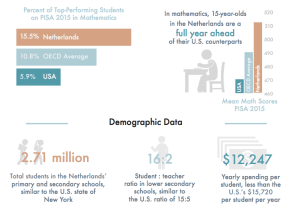
This month, the National Center on Education and the Economy (NCEE) is focusing on the Dutch education system. In one post, Jennifer Craw shares statistics that show the Dutch system is one of the top performing education systems worldwide. For example, Dutch 15-year-olds are a full year ahead of their U.S. counterparts in mathematics. In a recent blog post, Marc Tucker points to the country’s powerful math curriculum called Realistic Mathematics.

NCEE

Tucker shares his reflections on a recent conversation he had with Sander Dekker, the Netherlands’ State Secretary for Education, Culture and Science. In this and another post, written by David Loewenberg, both authors highlight  aspects of the Dutch system that might contribute to the country’s success. According to Loewenberg, the success of the Dutch system can be attributed to the country’s commitment to building a coherent system that:

  1. supports children and families from a very young age;
  2. allocates extra resources for disadvantaged students;
  3. continually strives to improve the quality of its teachers;
  4. maintains a system of school accountability; and
  5. includes a robust system of career and technical education.

Here at IEN, we published a Leading Futures post focusing on the Dutch education system last May. Written by Alma Harris, Michelle Jones, Jan Heijmans and Job Christians, the authors argue that in addition to identifying structural features of successful education systems, it is also important to understand that education systems are complex and often there are multiple reasons for improved outcomes that interact and intersect. In this post, the authors argue that “the Dutch system provides an example of ‘principled educational performance,’ combining a focus on democratic values with an approach to policymaking that relies on both collaboration and autonomy.”

A quick scan of recent education news from the Netherlands found the following articles, which provide additional context. 

Teachers strike could shut Dutch primary schools for days http://buff.ly/2pKCJ7g

Dutch Members of Parliament Want to Mandate ‘Inclusiveness’ Education http://buff.ly/2pM7xrf

Dutch Kids Aren’t Stressed Out: What Americans Can Learn From How the Netherlands Raises Children http://buff.ly/2pKEzVA

PISA study: Finnish youth – especially boys – content with life http://buff.ly/2pKCuZU

Working together is a key part of the Dutch psyche – DutchNews.nl http://buff.ly/2oYmMKF

Leading Futures: Making Change Make a Difference, Scotland

In this latest post in the Leading Futures Series, edited by Alma Harris and Michelle Jones, George Gilchrist applies some of the ideas presented in Andrea Stringer’s post, which focused on Australia, to the Scottish context. Gilchrist is Headteacher of two primary schools in the Scottish Borders, where he has lived for the last 25 years. In 2015 he became a Fellow of the Scottish College for Educational Leadership. He has spoken regularly on leadership and learning at events within Scotland, and further afield. He has his own blog entitled ‘School Leadership – A Scottish Perspective‘ and uses this for thought pieces and collaboration with educators across different systems.

Making Change Make A difference, Scotland

The issues around educational change and reform faced by educationalists in Australia, Scotland, and across other systems are all too familiar and often the same. Pasi Sahlberg, has pointed out characteristics and issues with what he termed the General Educational Reform Movement (GERM) for a number of years now. Sahlberg cautioned against GERM and its negative impacts for pupil learning, but it would seem that many Governments have still decided that ‘they know best’ and have determined to still introduce such ‘reforms.’ The fact that there is little evidential basis as to their efficacy, but a lot of evidence and research shows that they have the opposite effects to those envisioned, seems to count for little in the face of strong political will and ideology.

In Scotland we have been taking a different approach to curriculum design within education for many years now. Our Curriculum for Excellence (CfE) came out of a national discourse around education completed in 2002. From this emerged a new curriculum (CfE) in our Primary (Elementary) schools, and early years of Secondary education.  This envisioned a learning experience that was broadly based, and which placed value on skills development, as well as the development of positive attitudes and aptitudes for learning, not just knowledge acquisition. Four key capacities were to underpin learning. These were for our learners to be: Successful Learners, Effective Contributors, Responsible Citizens and Confident Individuals. The original vision and principles for CfE were contained on a few sheets of A4 paper and there was much to be admired about the approach. That is not to say it was without its critics or faults, what system is? Perhaps the two biggest failings at the outset were firstly, in not carrying out any sort of meaningful baseline assessment to see where we really were, and which would allow us to demonstrate improvement in performance. The second, was to not pay enough attention from the outset to the exam structure, and changes, that would be required in secondary education. Both of these failings, combined with others, have caused lots of problems for teachers and schools trying to implement CfE and to demonstrate its impact to various audiences. You could read more of the work of Mark Priestley and Walter Humes to explore this further.

Like Andrea identifies, there are numerous ‘voices’ that need to be heard in any discourse around education, but unfortunately the one that is still heard loudest is political. So much so, that others are drowned out and often not heard at all. The Scottish government have stated their aim to deliver an educational experience that is based on ‘Equity and Excellence’ for all. They want to raise attainment and reduce the gaps for those from our most disadvantaged backgrounds. This is all encapsulated in the latest policy documents, the National Improvement Framework (NIF) and ‘Getting It Right For every Child’ (GIRFEC). There is no one within the Scottish system that would argue much with the laudable aims and vision found in these two documents. Where we get most divergence is in how we go about achieving this vision for Scotland and its children. The NIF promotes a ’top-down’ high-stakes accountability and standardised agenda with all the attendant issues.

Andrea asks ‘Whose voice represents Australia’s education?’ A question we should ask of our own systems. Hopefully, our conclusions will be the same, that this should be a collective ‘voice’, authentic and with agency for all. Speaking as a practitioner, I could make the case that the true authentic voice of the profession is rarely heard or listened to in the Scottish system. There is a plethora of ‘consultation’, but this is often blighted by the timings of when this occurs, but more so by the fact that decisions have clearly already been made. Faux consultation is no consultation at all. The listening skill that Andrea refers to is crucial. Do we listen to understand and empathise, or do we listen to reply?

Andrea suggests some possible solutions to the issues facing education in Australia and to ask some pertinent questions of all the stakeholders in the system. All of these could be quite easily transposed into the Scottish system, where they should be easier to answer and implement, as Scotland is smaller than Australia. We need only look across the sea to Finland to see what smaller systems can achieve with collective and cultural agreement, augmented by high degrees of trust. Change is a constant in all schools and systems, and hopefully in all classrooms. But change for change sake makes little difference that is meaningful and sustainable. Change needs to be managed, informed by evidence and research, adapted to context, and should produce positive impacts for learning. The following are my suggestions to help us make the right changes, for the right reasons and to make a difference for every learner in our schools.

  • Invest time and support into our Early Years programmes. We need to get the base right. This does not mean starting formal learning earlier, but it does mean working with families and children before they arrive in our schools. Research by Sue Ellis and Edward Sosu for the Joseph Rowntree Foundation in 2014 showed that equity gaps are established before children reach our schools. We need to have more play-based learning in early years and to work with parents to help them develop their children’s learning, creativity and problem solving.
  • Andrea identifies ‘Collective Networks’ in order to encourage collaborative and problem solving at all levels. This is System Leadership, wherein all see their role as bigger than just the one in their own classroom, school or cluster. We have a responsibility to consider how we impact positively for all learners in our schools, area and system. We do this by sharing expertise, coaching, mentoring and supporting everyone to develop practice and their ‘voice’. This is a collective responsibility.
  • Linked to this, is the development and support of true teacher agency. Our best teachers are trained, professional and reflective practitioners; they are not mere ‘deliverers’. They have adaptive expertise and know their learners well. Individually and collectively, ‘teachers are not the problem, they are the solution,’ as Alma Harris commented on Twitter last year. We spend a lot of money and time preparing and training teachers, we should trust them more and support them in what they do.
  • From my own experience and research, I would recommend the adoption of practitioner enquiry, or other enquiry approaches, so that we situate professional development in our daily practice and our context. Career-long professional development, focused on impacts for learners, needs to be a disposition for all educators, and seen as something done by you, not to you. The aspect of school systems that has the greatest impact on attainment is teacher expertise, we all need to commit to keep improving and supporting the development of this. ‘Not because we are not good, but because we can be better,’ as Dylan Wiliam would say.

I believe the time is right for another ‘conversation’ around what we understand by education and curriculum in Scotland. When we have explored those issues again, we would be in a better position to identify a way forward, instead of repeating the mistakes of others. We still spend too much time on systems and structures and not enough on improving learning and teaching.

I remain optimistic for education in Scotland and elsewhere. But practitioners and researchers need to be working closer together to support each other and to fight the neo-liberal driven agendas that many of us face across our systems. We owe it to all our learners, and our profession.