Category Archives: About K-12 International Education News

Draining The Semantic Swamp of “Personalized Learning”–A View from Silicon Valley (Part 1)

larrycuban's avatarLarry Cuban on School Reform and Classroom Practice

No surprise that a catch-phrase like “personalized learning,” using technology to upend traditional whole group  lessons, has birthed a gaggle of different meanings. Is it  updated “competency-based learning?” Or “differentiated learning” in new clothes or “individualized learning” redecorated?  (see here, here and here). Such proliferation of school reforms into slogans is as familiar as photos of sunsets. “Blended learning,” “project-based teaching,” and “21st Century skills” are a few recent bumper stickers–how about “flipped classrooms?”– that have generated many meanings as they get converted by policymakers, marketeers, researchers, wannabe reformers, and, yes, teachers into daily lessons.

For decades, I have seen such phrases become semantic swamps where educational progressives and conservatives argue for their version of the “true” meaning of the words. As a researcher trained in history, since the early 1980s, I have tracked policies as they get put into practice in schools and classrooms.  After all, the…

View original post 1,328 more words

An Event of Latin American Education: Discussing the Education in the Americas Conference with Daniel Friedrich

Is there such a thing as a distinctly Latin American education or Latin American curriculum? What might such a curriculum look like and who might be able to participate in such an education? With the recent Education in the Americas: Knowledges and Perspectives conference at Teachers College, a number of scholars were able to pursue these and other questions.

This year, the Latin American Studies Association (LASA) conference, where scholars across disciplines gather to share research on and from Latin America, took place in New York City. Having attended the conference in the past, Dr. Daniel Friedrich, Associate Professor of Curriculum and Teaching at Teachers College, Columbia University, had observed that the conference’s education section was limited in both scope and size. With the conference’s 50th anniversary taking place in New York, Friedrich considered the setting a unique opportunity to develop an event in relation to the conference that could offer a more robust examination of the topics of education and Latin America. With an organizing committee that included Professors Regina Cortina, Maria Paula Ghiso, Hank Levin, Nicholas Limerick, and Jackie Simmons. and doctoral student Natalie Flores, he began building the general structure of a conference to be held at Teachers College.

A basic concept organizing the conference would be to offer a venue in which people might gain access to frameworks and perspectives to which they might not typically be exposed. Friedrich suggests that the organizing committee did not simply want to hear people working in Latin America sharing how they were using the same tools with which faculty and students at Teachers College would likely be familiar. Instead, the conference aimed to present ideas about education that might appear unfamiliar to many in attendance. For example, keynote speaker Elsie Rockwell explored the shifting logics of schooling, both for rural and popular education. Her examination of the very question of what school is and how “schooling for the people” and “schooling of the people” converges and conflicts presented something that was both distinctly produced through empirical research based in Mexico but explored around the world, and something that could relate to those in education with little experience in Latin America. At the same time, these objectives meant that the conference had to make several concessions. Nearly half of the panels were held in Spanish, something that Friedrich recognizes excluded some who may have otherwise attended panels save the language barrier. Yet, he contends that as a way to offer alternative voices, this concession was necessary and acceptable.

To build panels and speakers that would satisfy the ambition of presenting new and alternative voices (at least to many attendees) the organizing committee did not open a call for papers. Instead, they invited individuals and groups to present. A kind of dialogic construction of the conference ensued. Organizing members invited those whose work they admired and also observed what disciplines or places might not yet be represented at either LASA or in their own conference. Hank Levin, for example, organized a panel around the experiences of the African diaspora in Latin America.

With a two-day conference program established, participants from many geographies and disciplines came to Teachers College to participate on May 31st and June 1st. Panels ranged from ethnographic studies of migration and education to a documentary on Cuba’s national literacy program. The conferenced helped to solidify networks of scholars who, according to Friedrich, “now know each other and share with each other…which can maybe lead to creating some projects with each other.” Though the organizers had established a number of objectives and many compelling debates occurred, Friedrich believes that much of the success of the conference is the surprising, emergent nature of what came out of the conference and the unresolved or unresolvable nature of these debates. Participants in a revolutionary pedagogies panel debated what specific characteristics about their research were distinctly Latin American. Similarly, a panel on education and violence in Central America explored the possibility of scholars evading their own thinking when thinking of other ways of knowing. In other words, the conversation asked if it is possible to present alternative voices without imposing existing scholarly frameworks onto what is shared. Yet, these debates ultimately provoked further thinking and conversation rather than definitively offering or imposing solutions.

Sameer Sampat on the context of leadership & the evolution of the India School Leadership Institute

In a recent interview, Sameer Sampat, CEO of the India School Leadership Institute (ISLI) talked about the early stages of the Institute’s development. Founded in 2013, ISLI seeks to help school leaders take their schools from “good to great” by enabling them to develop and improve their leadership skills.

When Sameer Sampat headed to India in 2013, he was already convinced that improving school leadership serves as a key lever in improving student learning. As a consequence, the opportunity to work at a new organization – launched by the Akanksha Foundation, Central Square Foundation, and Teach For India – designed expressly to develop the skills of schools leaders in India was a perfect fit. Sampat was equipped for the job through experience teaching in both the US and India and through work he had done with Roland Fryer to identify and support effective schools. In order to build on those experiences, Sampat and his founding colleagues faced the challenge of developing a program that recognizes and responds to the realities of leadership in the context of education in India.

The emergence of ISLI: Expanding the focus from teaching to leading

ISLI’s work began at a time when conversations in India were just beginning to turn from ensuring access to education for all students (through initiatives like the Right To Education Act) to creating a high quality education for all students. But, as Sampat explained “there was a lot of conversation about teacher quality, but the conversation about school leadership quality was much more limited.” Furthermore, organizations dedicated to creating new schools in India like the Akanksha Foundation encountered a similar problem that school networks in the US (like KIPP and Uncommon Schools) had faced: they were having trouble finding leaders with the skills and experience needed to develop and sustain their schools. ISLI was created to fill this need and to develop a national leadership development program that would build on the example of programs in the US like KIPP’s Fischer Fellowship Program and adapt them for the Indian context.

One of the first accommodations ISLI made was to recognize that the leadership pipeline in India is entirely different than it is in the US and many other countries. In contrast to the US, where principals usually first spend at least a few years teaching, some school leaders in India do not have extensive teaching experience. In fact, school leadership in India is often a largely managerial position. Furthermore, relatively little training or certification is required in order to become a principal. Therefore, rather than try to create an entirely new pipeline from teaching into leadership through a “pre-service” program for new leaders, ISLI chose to try to respond to the needs of existing school leaders by creating a program that could also provide “in-service” support for those already in leadership positions.

In their first year, after receiving about 100 applications, ISLI selected 7 initial fellows for a one year, highly flexible and individualized program. At that time, the framework for the program focused on six strands of competencies that they identified based on their own distillation of the common traits and practices of effective school leaders: leadership for equity; leadership for results; people leadership; personal leadership; instructional leadership; and operational leadership.

ISLI’s 2nd Year: From a national to a “local” model

While ISLI considered that first year a success, Sampat noted that they realized that “a lot of the components of the model were not contextualized enough for India.” In particular, they found that they had to put even more emphasis on leading for learning and shared leadership than they had anticipated. “We needed leaders who themselves might not have experience as excellent teachers,” Sampat explained, “but can they identify what good teaching looks like? And then can they have the humility and the shared leadership skills to allow the people on their staffs to promote those skills on their teams?” Sampat and his colleagues also found that there was too much choice and flexibility in the US models. In fact, the Fischer Fellows model originally enabled leaders to explore some 90 different competencies; but ISLI ultimately honed their model to focus on three strands, covering eight competences in total, that they deemed central to the success of all their leaders.

Lastly, while ISLI wanted to take advantage of the knowledge and expertise of experienced and effective leaders by recruiting retired school leaders as coaches, they found that it was not easy to find principals who were aligned to ISLI’s vision of leadership. As Sampat put it, “because the culture and what it means to be a school leader is so engrained in India you almost have to have your coaches unlearn and then relearn how to do coaching conversations.” Furthermore, those principals that were most effective were already fully committed leading their own schools, with limited time to provide the extensive support ISLI envisioned. Instead of trying to turn existing leaders into coaches, ISLI decided to change to a model of on-site support that included very specific, targeted instruction for ISLI principals focused on high-leverage practices like school walkthroughs, lesson observations, and school improvement planning. In order to staff this approach, they brought in educators who had expertise in a particular area, but generally were not themselves leaders.

Recognizing the difficulties that the ISLI leaders faced in trying to implement what they were learning in their own schools, however, ISLI still wanted to find a way to tap into the experience and expertise of the most effective school leaders in India. Therefore, ISLI decided to establish what they called the “Leaders Network.” Drawing particularly on the National Leaders of Education Program in the UK, the Leaders Network pairs each ISLI participant with a leader from a local high performing school for a “thought partnership” that includes ongoing conversations and consultations. “It’s a way for them to share their experiences,” Sampat explained, “and it’s good professional development for all of them.”

In order to accommodate many of these changes, in their second year, ISLI chose to pilot two different programs at the same time: they continued the one year program, but they also developed a second, two-year version of the program – with the “thought partnerships” a focus of the second year. They considered the two-year program a more “localized” model as the participants and their thought partners were all drawn from one metropolitan area – Delhi.

The second time around, ISLI had roughly one hundred applicants and selected ten participants each for the 1-year and the 2-year program. While the ISLI designers again felt that the one-year program was successful, they ultimately concluded that the two-year, localized, model had the best opportunity to make the biggest impact. From Sampat’s perspective, the development of the thought partnerships in the second year was a particularly crucial factor. Without that, Sampat declared, “I don’t think we would have been able to ramp up operations the way that we have.” As he explained, with the local model, staff can be concentrated in a city, with many more “touchpoints” in a given year.

The 3rd year: Strengthening the organization and expanding the model

In the third year, ISLI concentrated on honing the two-year model, firming up the curriculum and establishing systems and structures to tighten their support and efficiency. At the same time, ISLI made a concerted effort to ramp up the scale of the program to 200 new leaders, with groups of fifty leaders in four different cities. “We felt like fifty schools was the right number to have in a city,” Sampat explained. “You have enough variety, where the schools can learn a lot from each other, but you can provide good support without getting overwhelmed.” Further, the expansion to four different metropolitan contexts allowed them to begin to learn how the model in Delhi that they had adapted from the US and the UK might need to be further localized to worked in other Indian regions. As Sampat put it, “Because doing the program in Delhi is very different from doing it in Hyderabad, which is very different from doing it in Pune.”

Sampat pointed to three ways that the program had to adapt as it expanded into different regions in the third year:

  • Logistical differences including differences in languages, holidays, and schedules
  • Organizational differences in the ways that schools are structured in terms of their governance and operations and in terms of the backgrounds of school leaders
  • Cultural differences in the approaches to school leaders and the relationships between school leaders and the other members of the schools and the community

In terms of school structures, in Bombay and Pune private schools there’s usually a management committee that hires a principal, but in Delhi and Hyderabad the private school owner often also serves as the leader of the school. Culturally, in Hyderabad, the school leaders tend to be slightly older, and, as a result, there is a certain respect that comes with being an elder in the community that needs to be taken into account. In simple terms, that means being very conscious in Hyderabad of making appointments with the school leader before coming to visit; in contrast in cities like Delhi unannounced visits to schools and school leaders are not seen as impolite and are much more common.

While 200 new leaders started in the program, about sixty had left by the end of the third year. In part, the departures reflected attrition in the form of transfers and retirements (particularly among government schools); but some leaders left as the recognized that program did not offer what they were looking for (such as help with infrastructure rather than with curriculum). However, many of the departures also resulted from ISLI’s development of fairly strict policies around who can continue. As Sampat reported, “if you come to the workshops but aren’t attempting to implement in your schools, after we think we’ve done everything we can, we begin conversations that could lead to you being asked to leave the program.” In order to inform those decisions, ISLI has developed a number of benchmarks of progress that include basic measures of engagement including attendance at events and appointments. ISLI staff members assigned to each school also produce monthly monitoring reports looking for evidence of any efforts to implement what the leaders have been learning.

Lastly, ISLI has also established several non-negotiables around student safety. “One big thing,” Sampat noted, “is corporal punishment. By law in India there should be no corporal punishment in schools, but if you look at most of the schools, there is rampant corporal punishment when we start.” Therefore, ISLI works closely with participants to abolish corporal punishment, but a lack of evidence of quick progress in the first year also leads ISLI to ask participants to leave the program. “While we have a pretty rigorous bar for what you have to cross, we also provide a lot of support and time for you to get to that point…It takes some leaders three or four months just to be intellectually convinced that they need to make some change in their school.”

The 4th year and beyond?

Currently, ISLI is in the midst of a “demonstration phase” with the goal of training 1000 leaders in six cities over the next three years. In the process, ISLI hopes to see if the program can both have an impact on these 1000 schools and can do so in a cost effective way, and then to expand beyond that. If the demonstration phase proves successful, ISLI will have to face the key strategic question of how to have an even broader impact on a system of 1.2 million schools and 200 million school-going children. Sampat speculated on several approaches that ISLI could pursue singly or in combination to expand their reach and impact:

  • Develop tools and resources and make them available to all schools
  • Engage more deeply in government schools by embedding ISLI training program within the existing infrastructure
  • Focus on the budget private school system and “productize” ISLI’s services so that a large percentage of school leaders want to achieve the kind of training and certification that ISLI offers

“We don’t want to jump too far ahead, though” Sampat cautioned. “We don’t want to start thinking about 10,000 schools, until we sure we have had a signifincat, positive impact on 1000 schools.” Notably, the 1000 schools figure would be substantially larger than most school networks in the US. While Success for All has grown to include over 1000 schools since its launch in 1987, most other school networks are much smaller. KIPP, which provided one of the leadership program models for ISLI, has about 180 schools in its current network.

For Sampat, with his experiences in both the US and India, questions of expansion stretch even further. As he puts it, “can we take what we’ve learned in India and apply it in productive ways in other aspects of the developing world?” While he expects that many adjustments will need to be made, he notes that most of the models that ISLI built on came from the US and UK, but ISLI’s model may be more relevant to other developing contexts in sub-Saharan Africa, Southeast Asia or even Latin America. Nonetheless, he expects that more adaptations will always be required. “We would have to rely on people that are in-country and on empowering them to make the changes and to make the adaptations that make sense for their context.”

Thomas Hatch


Learning through play: A conversation about Quest to Learn

As part of a series focused on the evolution of schools and organizations working to improve education, this post explores the work of the Institute of Play and of Quest to Learn, a public 6-12 school opened by the Institute in collaboration with the NYC Department of Education in 2009. To learn more about how their work has evolved we talked with Arana Shapiro, Director of Programs, Schools, and Partnership at the Institute of Play and an original member of the Quest to Learn design team.

Can schools be reimagined to incorporate the highly engaging and effective aspects of gaming in order to help students learn? The Institute of Play was created in 2007 in order develop a school model that incorporated the gaming approach to the classroom setting. In 2009, the Institute opened Quest to Learn in collaboration with the New York City Department of Education. As the school puts it on its website, “Quest to Learn re-imagines school as one node in an ecology of learning that extends beyond the four walls of an institution and engages kids in ways that are exciting, empowering and culturally relevant.” Central to that “re-imagining” is the idea that with curricula organized more like games, student engagement would improve. As the school describes it, “games are designed to create a compelling complex problem space or world, which players come to understand through self-directed exploration. They are scaffolded to deliver just-in-time learning and to use data to help players understand how they are doing, what they need to work on and where to go next.”

The focus on games grew out of a concern with research showing a link between increases in high school drop out rates and declines in engagement as students transition between elementary and middle school. “Our question was,” Shapiro explained, “can we take the principles that make games engaging spaces and turn them into a school space, therefore engaging kids in school in a way they haven’t in the past?” The Institute of Play’s design team then began exploring the elements of games that make them so appealing. The team noted that games present a complex challenge or problem to solve and were focused on a single goal. Then, they saw that feedback to the participant was ongoing and immediate. Also, participants step into an immersive space and take on a role. Learning happens because participants are required to apply what they know to whatever problem they are trying to solve or whatever role they have taken on. According to Shapiro, “Our learning model is presenting students with complex and challenging problems that they don’t know how they’re going to solve, and then developing curriculum that leads students through a series of experiences that help them develop the skills and expertise that help them solve the problems.” Students are expected to move through the curriculum as they would move through a game.

The team also believed that in addition to preparing students to meet required standards, their gaming approach could foster skills that students need in order to succeed in life but that aren’t usually addressed in school. “At Quest, we outlined a set of competencies that we want kids to know in order to compete, but more importantly we believe there are skills that kids can learn, like complex problem solving, communication, systems thinking, and digital media tool use, that are equally important.”

The school’s experiences in the 7 years since it opened makes clear both the intense interest in gaming as a form of learning as well as the challenges of focusing an entire school on such a new approach. On the one hand, the school has been the subject of a number of stories and articles and gets frequent requests for visitors. On the other hand, the school has faced a number of challenges that new schools often face.  For example, the school is trying to re-imagine learning while occupying the same kinds of classrooms that have been around for years. In Quest to Learn’s case, flexibility is further limited by the fact that the school occupies one floor of a public school with six other schools operating in it as well.

Furthermore, despite the interest in games, students, parents, and educators all have different ideas about what the games should be and how they should be used for learning. For example, one misconception has been that the school would be high-tech and focus on video games. In fact, the school doesn’t use technology any more than a normal school would. In short, in order to be successful, all stakeholders need to be engaged and that requires an emphasis on helping all members come to a common understanding of what the school is trying to do.

Teacher education has presented another challenge, as most schools of education are not focused on the Institute’s vision of progressive education. In many ways, the Institute’s philosophy is more consistent with play-based models for early education, but it is less familiar for many teachers at the middle and high school levels. As a consequence, the team at the Institute of Play found that teachers often needed to be introduced to an entirely different model for education and considerable focus on professional development was required.

At the same time, the experiences of the Institute and the school have contributed to a robust professional development program. The school’s unique approach to learning has attracted the interest of teachers and leaders who want to know more about how to bring this approach to learning to their own schools. As a result, the Institute has developed a professional development program that stands alone from the school. That program includes 3-day workshops for teachers and an online community to help keep participants connected. These workshops are now in schools on Long Island, Westchester, Pittsburgh, Los Angeles, Chicago, North Carolina, and Michigan. In short, rather than trying to scale a gaming approach to learning by developing a network of Quest to Learn Schools, the team has found that working directly with teachers may provide a better avenue for expanding their approach.


Finland Education in the News

Our recent scan of education news in the Nordic countries reveals that the quality of Finnish education has been in the news again. This time, however, articles are both praising and raising questions about recent performance.

William Doyle, reporting in The Washington Post on a recent stay in Finland, highlighted his son’s experience in school and the benefits he sees in the system. From his perspective, the Finnish school system is a “beacon of hope in a world that is struggling, and often failing, to figure out how to best educate our children.” The Globe and Mail also described ways in which Finland’s education system may be helping to address issues of inequality. They argued, “The Finnish obsession is not with education per se, but with making sure that kids…get the maximum possible school experience.” The article goes further, suggesting that the odds of a child born below the poverty line “becoming a middle-class adult are better in Finland than in almost any other country. More important, those odds are measurably better than they were 20 years ago. And it’s almost all because of the way the Finns changed their schools.”

But the Helsingen also reported on a recent doctoral dissertation Education as Finland’s Hottest Export?: A Multi-Faceted Case Study is the Finnish National Education Export Policies. This research raises questions about the extent to which Finland has been able to capitalize on the perceived strength of its education system. The Economist also weighs in with “Europe’s top-performing school system rethinks its approach,” a story on the concerns in Finland about recent declines in performance among Finnish 15-year-olds on the PISA tests. As the article explains, “PISA scores fell in 2009 and 2012 (the next results will be published in December). Data suggest the slide began around the turn of the century. Children of immigrants tend to score worse, but native Finns’ scores have dipped, too.” 

At the same time, as we reported earlier, Samuel Abrams, author of Education and the Commercial Mindset, has also stirred up some controversy in Finland with recent comments that the declines are an artifact of the improving scores of other top performers rather than an indicator of a meaningful decline in Finland’s educational performance.


What Works: The Scottish Attainment Challenge, Learning Partnerships, and “Policy Borrowing” on Both Sides of the Atlantic

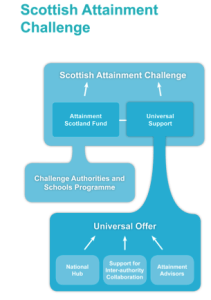
In a fascinating example of the interconnections among educational improvement efforts around the world, Chris Chapman, Chair of Educational policy and Practice at the University of Glasgow, recently visited New York City to investigate efforts to establish learning partnerships among local public schools. Ironically, New York City’s approach draws on the partnerships established in England as part of the City Challenges that began in London in 2004. Those City Challenges have, in turn, helped to inspire the Scottish Attainment Challenge launched in 2015 to “raise the attainment of children and young people living in deprived areas in order to close the equity gap.”

Screen Shot 2016-05-10 at 7.46.16 PMAs Chapman explained, “the Scottish Attainment Challenge focuses on improving outcomes in literacy, numeracy and health and wellbeing by enhancing the quality of learning and teaching and leadership within the education system and working with families and communities to support the holistic development of children.”

The Attainment Challenge also draws on the lessons from Scotland’s own School Improvement Partnership Programme. The Scottish partnerships seek to create links between government authorities, local schools, and university researchers to develop a shared commitment to improving outcomes for all children and young people. The partnerships are intended to:

  • Develop a clearer understanding of their local area, local needs, what is and isn’t working
  • Establish mechanisms for utilizing the best evidence to inform planning and service delivery
  • Increase capacity to generate, use and interpret evidence
  • Foster a better understanding of the barriers and enablers of delivering effective services to meet local needs

The Scottish system is also exploring the potential of creating local, community-based and cross-sector improvement strategies like the Strive Partnership, Harlem Children’s Zone and the Promise Neighborhoods initiative in the US. Along with these approaches to what is often referred as “collective impact”, Scotland is also making a significant investment in supporting the development of evidence-based practices in education as well as in other sectors.

This interest links to the broader public services focused work of WhatWorksScotland, part of a UK network of Government funded What Works Research Centre’s in the UK. Distinguishing the Scottish and UK “What Works” efforts from those of the What Works Clearinghouse in the US.), Chapman explained that WhatWorksScotland is an approach to public service reform that uses collaborative action research to facilitate change in Community Planning Partnerships in four sites:

  • Aberdeenshire — with a focus on the development of community planning and health and social care integration
  • Fife — where they are exploring a school intervention initiative, the development of a community welfare hub, and collaborative approaches to support families
  • Glasgow —with an emphasis on using evidence to inform a ten-year place-based initiative called Thriving Places, and on participatory budgeting
  • West Dunbartonshire — where the work centers on public service reform at the neighborhood level and community-led action planning

This “case study” approach is combined with a wider program of research exploring key issues in public service reform: including leadership, governance and partnership “evaluability,” the effective translation of knowledge into action.

As an academic at Nottingham, Warwick, Manchester and now Glasgow, Chapman is intimately familiar with both the City Challenges in England and the most recent developments in Scotland. Currently, he’s involved with a number of aspects of the work both as an advisor to the Scottish government and the Director of the Robert Owen Centre for Educational Change, which supports and studies the partnerships. Chapman’s previous work includes articles on school networking and scale-up, school effectiveness and improvement, with forthcoming pieces on professional capital and collaborative inquiry to appear in the Journal of Professional Capital and Community. Chapman came to New York to learn more about the evidence base underlying the partnership work in the US as well as to see what it looked like in practice. In New York, Chapman saw “opportunities for teachers to systematically inquire into each other’s practice and develop meaningful professional conversations about how to improve the quality of learning in classrooms” – both of which he considers to be key dimensions of partnerships.

Lead the Change interview with Santiago Rincón Gallardo

Dr. Santiago Garcia Rincon

Dr. Santiago Rincón Gallardo

Dr. Santiago Rincón Gallardo is a Banting Postoctoral Fellow at the Ontario Institute for Studies in Education, University of Toronto, and Chief Research Officer at Michael Fullan’s international education consulting team. His academic work explores how effective pedagogies for deep learning can spread at scale. These ideas have been published in the Harvard Educational Review, the Journal of Professional Capital and Community, the Journal of Educational Change, the Education Policy Analysis Archives, the Multidisciplinary Journal of Educational Research, and in three books in Spanish. Beyond his academic work, he conducts research and advises leaders and educators interested in advancing whole system reform for instructional improvement in educational systems. As an educator and organizer, Santiago worked for over a decade to promote grassroots educational change initiatives in Mexican Public Schools serving historically marginalized communities. Santiago holds an Ed. M in International Education Policy and Ed.D. on Education Policy, Leadership and Instructional Practice from Harvard University.

In this interview, which is part of the Lead the Change Series of the American Educational Research Association Educational Change Special Interest Group, Santiago shares his thoughts on educational change:

In my view, the challenge of radically transforming the instructional core and creating the systems to do so at scale is one of the most important, exciting, and even daunting issues for educational change today. As they currently exist, schooling and school systems won’t take us much farther in the direction of nurturing deep learning, change agency, and deep democratic values among our younger generations (they have arguably taken us in the opposite direction).

This Lead the Change interview appears as part of a series that features experts from around the globe, highlights promising research and practice, and offers expert insight on small- and large-scale educational change. Recently Lead the Change has also published interviews with Diane Ravitch, and the contributors to Leading Educational Change: Global Issues, Challenges, and Lessons on Whole-System Reform (Teachers College Press, 2013) edited by Helen Janc Malone, have participated in a series of blogs from Education Week.

Samuel Abrams on Education and the Commercial Mindset

Samuel Abrams, director of the National Center for the Study of Privatization in Education at Teachers College, Columbia University, is the author of the newly published Education and the Commercial Mindset (Harvard University Press, 2016). In a recent conversation, we spoke with Abrams about the book, particularly his chapters on Finland and Sweden. Abrams also discussed with us a recent controversy in Finland sparked by some of his comments in an interview printed in the Helsingin Sanomat, Finland’s major daily. Abrams and colleagues, Jeffrey Henig and Henry Levin among them, will discuss the book at Teachers College on Monday, May 2.

Twenty years ago, Wall Street forecasters in the United States estimated that by 2010 approximately 10,000 to 20,000 of the nation’s 100,000 K-12 public schools would be run by for-profit firms. As Abrams details in his new book, those predictions were wrong. In reality, the tally was about 750. Disappointing academic and financial outcomes had pushed this sector to the margins, Abrams noted.

At the same time, Abrams said, those same analysts were correct that federal policymakers would embrace a bottom-line approach to assessing school effectiveness with a focus on student performance on standardized tests in reading and math. The high-stakes testing prescribed by No Child Left Behind in 2001 and the Race to the Top initiative in 2009, Abrams said, has constricted curricula, crowding out time for history, science, art, music, crafts, physical education, and play. Such testing, he added, has also generated unnecessary stress for students and teachers alike.

To deepen his analysis of the rise of market forces in U.S. education, Abrams analyzes in his book the divergent paths taken by Sweden and Finland. As Abrams puts it, Sweden and Finland provide a study in contrasts. He writes that Finland’s relatively high performance on the Program for International Student Assessment (PISA) cannot be dismissed because Finland is small, homogeneous, and egalitarian. Abrams explains that Finland’s Nordic neighbors—Denmark, Norway, and Sweden—are also small, homogeneous, and egalitarian; however, these nations have repeatedly posted PISA results indistinguishable from those posted by the United States.

According to Abrams, the difference between Finland and its Nordic neighbors has been deliberate steps taken by Finnish policymakers to improve school curricula as well as the preparation, pay, and treatment of teachers. Abrams writes that Finnish policymakers had concluded in the 1960s that because the nation was young (having only declared independence in 1917) and poor in natural resources (with little more than timber), they had to invest significantly in schooling to develop the nation’s human capital. Economic necessity and national pride together forged education policy, he said. By contrast, Sweden, Abrams writes, was long a regional power, benefitted from its wealth in mineral resources, and prospered from its highly developed industrial and banking sectors; Denmark, too, was long a regional power, with strong agricultural and industrial sectors; and Norway benefitted from not only oil discovered in the North Sea in 1969 but also abundant fisheries and hydroelectric power.

The divergence of Finland and Sweden, in particular, may be seen at two points, Abrams explained. First, in 1962, Swedish authorities introduced a comprehensive school program (grundskola), merging students with different aptitudes in grades one through nine with the plan to reform teacher education so teachers would be better prepared to differentiate instruction. But such reform of teacher education never took place. Finnish authorities introduced their own comprehensive school program (peruskoulu) for students in the same grades in 1972 with a similar plan to reform teacher education. And the Finns followed through, requiring that all teachers from 1979 forward earn a master’s degree in pedagogy. Thirty-seven years later, Finland remains the only Nordic country with this requirement.

Second, Swedish authorities in 1992 embraced privatization while their Finnish counterparts never did so. For the Finns, Abrams said, schooling has been an instrument for nation building. Outsourcing school management to private providers, he said, did not comport with that purpose. For the Swedes, schooling was not about nation building. Outsourcing school management accordingly didn’t pose the same problem.

In addition, Abrams said, the Swedes had been under the Social Democratic Party from 1932 to 1976 and again from 1984 to 1991. He suggests the desire for change and, specifically, school choice was accordingly understandable. In 1991, only 1 percent of the nation’s primary and secondary schools were under private management, Abrams writes in his book. By 2010, the portion of primary and secondary schools in Sweden under private management had grown to 22 percent; and of that portion, 76 percent, or 17 percent of the country’s primary and secondary schools in total, were run by for-profit operators.

To Abrams, the problem with for-profit operation of schools is not that businessmen are making money off the provision of a public service such as education. Textbook publishers, software developers, and bus operators all make money from schools and should, he said, but they are all providing a discrete good or service that can be easily evaluated. “School management, on the other hand, is a complex service that does not afford the transparency necessary for proper contract enforcement,” he said. “Without such transparency, there’s client distrust: parents, taxpayers, and legislators can never be sure the provider is doing what was promised; and the child as the immediate consumer cannot be in a position to judge the quality of service. Regular testing has been promoted as a check on quality. But teachers can teach to the test. And worse, as we know from cheating scandals in Atlanta and many other cities, teachers can change wrong answers to right answers on bubble sheets once students are done.”

In sum, Abrams said, the idea that schools could and should be run like businesses resulted from “a blinkered laissez-faire triumphalism prevailing in the wake of the rise of Ronald Reagan and Margaret Thatcher and the fall of the Berlin Wall.” According to Abrams, the economist Arthur Okun, whom he quotes in his prologue, got it right: “The market needs a place, and the market needs to be kept in place.”

Ironically, at the same time that Abrams highlights in his book what he sees as numerous strengths of the Finnish approach, he generated controversy in Finland with comments in an interview published by Helsingin Sanomat. Shortly after his book was released, Abrams was asked in the interview about growing concerns over declines in Finland’s most recent scores on the PISA test. Abrams contended that the concerns were groundless, as the decline reflected the improvement of other countries, primarily Asian countries and jurisdictions like Shanghai, that have focused explicitly on improving PISA performance. Under these circumstances, on a normed test like PISA, Finland’s scores would be expected to go down, Abrams said, but would not necessarily suggest any real decline in the quality of education. Finnish scholars nevertheless subsequently argued in one article after another in the same newspaper that the performance of Finnish students had indeed declined, particularly in mathematics. According to Abrams, this decline is a modern problem, echoed in similar nations, not a Finnish problem.

Are ed tech financiers beginning to listen to teachers?

This post was originally posted on The Hechinger Report and was written by Nichole Dobo.

Expect changes at this year’s ASU+GSV Summit, an annual education technology gathering with a reputation as a bustling conference for high-rolling financiers and hoodie-wearing start-up founders.

There were new faces – and perspectives – in the mix at the three-day conference in San Diego this week, and they could break the stranglehold of deal-making that has often been seen as the dominating feature of the event.

An influx of public school educators at this year’s conference could help change the tone. Digital Promise, a Washington, D.C.-based nonprofit organization that advocates for effective use of education technology, sent 150 educators to the conference, giving members of the organization’s League of Innovative Schools scholarships to attend the (pricey) event. That’s just one example, so the final tally of educators at this year’s conference is likely to be higher – some estimate that at least 1,000 will be there. And for those who could not attend get to San Diego, the conference featured a “conference cam” livestream.

Condoleezza Rice, the former U.S. secretary of state and a professor at the Stanford Graduate School of Business, gave one of the keynote speeches, and used it to challenge the elite attendees to consider immigrants, out-of-work blue collar workers and the poor when it comes to education technology.

“I want to encourage us to think about how innovation in the private sector can help in the most public of goods … education,” Rice said.

So will teachers, superintendents and charter school leaders get any attention from the bankers, techies and so-called thought leaders at this conference?

The “leading educators” sessions at the conference were among the most anticipated, according to an online poll ahead of time. That series included trips away from the conference to visit schools such as High Tech High.

The changes to give educators a more prominent position at this conference weren’t accidental. That reputation as an event only for people interested in making deals?  “I’m not so sure we’re happy about [that label],” Deborah Quazzo, co-host of the conference and a managing partner at GSV Advisors, said recently in an interview with Ed Surge, an online publication that reports on the business side of education technology.

Quazzo said she wanted the conference to include people who wouldn’t normally hang out together in the same room.

Meanwhile, spending on education technology continues to grow. Globally, spending on education hardware increased by an estimated 7 percent in 2015, according to a new report from Future Source Consulting. The report pegs this technology spending at $15 billion, up by $4.5 billion since 2012.

Those new conference attendees may hope that someone will ask teachers, students and parents – the people who have to make use of that stuff – before spending that money.


Edtech startups in Southeast Asia

This week, we share an article by Nadine Freischlad that appeared in techinasia.com.  As the article explains, there are a number of startups in Southeast Asia that provide online education services. These small companies tend to have little funding and as a result they tend to remain frugal and focus on local issues. Freischlad argues that an influx of venture capital will shake up the current landscape, pushing founders to think about scaling up and profitability.

The edtech startups that have captured attention range from Indonesia’s Bulletinboard, a mobile app and online tool for teachers to post homework assignments and reports to the entire community, to Malaysia’s Classruum, an online learning environment that helps school kids learn at home and in study groups.

To learn more about the 29 most interesting edtech startups in Southeast Asia, read the complete article here.