Category Archives: Teachers

Can Vietnam transform the conventional model of schooling? Educational improvement at scale (Part 1)

Could the developments of the education system in Vietnam show one pathway to establishing – and then transforming – conventional schooling? Drawing on a series of interviews as well as a trip to Vietnam, the first post in this 4-part series from Thomas Hatch discusses how Vietnam has achieved near universal education at a relatively high level of quality. Subsequent posts will examine the efforts to shift the Vietnamese educational system to a focus on competencies and some of the critical issues that have to be addressed in the process. For other posts related to Vietnam, see Achieving Education for All for 100 Million People: A Conversation about the Evolution of the Vietnamese School System with Phương Minh Lương and Lân Đỗ Đức (Part 1); Looking toward the future and the implementation of a new competency-based curriculum in Vietnam: A Conversation about the Evolution of the Vietnamese School System with Phương Lương Minh and Lân Đỗ Đức (Part 2); Then Evolution of an Alternative Educational Approach in Vietnam: The Olympia School Story Part 1 and Part 2; and Engagement, Wellbeing, and Innovation in the Wake of the School Closures in Vietnam:  A Conversation with Chi Hieu Nguyen (Part 1 and Part 2).

What’s surprising about Vietnam’s educational system? For many, it’s Vietnam’s high performance on the PISA tests often used to gauge educational quality. Since 2012, Vietnam’s 15-year-olds have had some of the highest average PISA scores in reading, math, and science in comparison to other developing economies. Average math scores, in particular, are comparable to or better than the average scores of some of the richest economies in the world, including the United States. In addition, according to the OECD, 34% of Vietnamese students were “among the most disadvantaged students who took the PISA test in 2022,” yet their average score in mathematics was one of the highest for students of similar socio-economic backgrounds, and the gap between the students in the highest and lowest socio-economic categories was smaller than the OECD average.

As surprising as those results might be, as someone who has been studying “higher“ and “lower“ performing education systems such as Finland and Singapore, several other aspects of Vietnam’s educational system stand out as well:  

  • Vietnam has achieved near universal education at a relatively high level of quality in a country with almost 100 million people – roughly 10 times the populations of Finland and Singapore combined.
  • Despite these differences, some, though not all, of the key factors that support high system performance in Finland and Singapore seem to apply in Vietnam.
  • Vietnam has already launched major initiatives to shift the entire education system to focus on competency-based goals and more student-centered instruction, a move that “high performing” systems like Finland and Singapore are still trying to figure out how to make.

All of this has been achieved in a country with 54 different ethnic groups, where the city of Hanoi, on its own, has a larger population than all of Singapore and where the budget is about 22 Billion USD, compared to about 95 Billion USD in Finland.   

In another 20 years, will Vietnam be leading the way in transforming the conventional model of schooling that has dominated education for more than 100 years?  To explore this question, in the first part of this series of posts, I share some of my observations about the key developments in the Vietnamese education system over the past thirty years.

Improvements in enrollment and access to schooling for all students

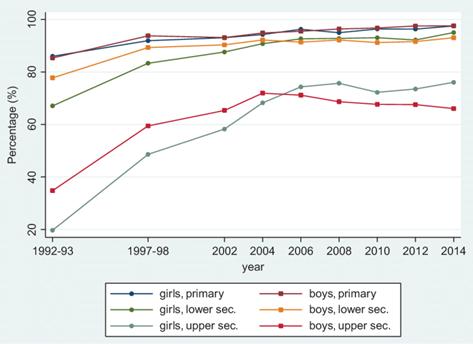
As many countries with developing education systems continue to try to provide access to education for all students, Vietnam has achieved school enrollment rates near 100% in kindergarten, primary, and lower secondary schools. A significant amount of that growth took place in less than 20 years, between 1990 and 2012. Enrollment in secondary schools in particular tripled in only 14 years, rising from about 23% in 1992 to almost 75% by 2006. Although secondary school enrollment remains a concern, as there has been only a slight increase since then, the mean years of schooling for adults in Vietnam is still higher than expected, given its per capita income.
Evidence of Educational Quality & Equity: PISA and beyond

Although many countries are working to expand access to schooling, educational quality remains a critical concern around the world. But the results of the 2012 PISA tests suggests that Vietnam has been able to increase both access and quality significantly. Those results showed that by 2014, Vietnam’s 15-year-olds were 17th in math and 19th in reading out of 65 countries. More astoundingly, that performance made Vietnam an outlier – performing significantly higher in both reading and math than other education systems with a comparable GDP.
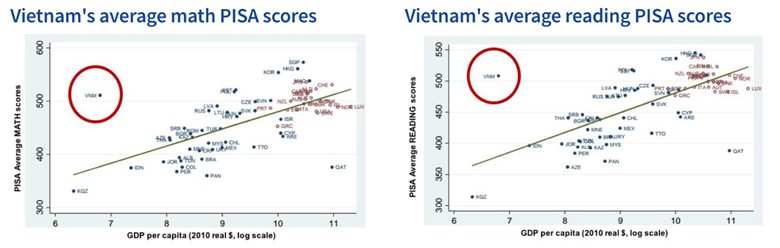
These striking outcomes garnered considerable attention and generated a number of critiques that have raised legitimate concerns about the accuracy of the results. Notably, students who drop out of school in Vietnam after 9th grade are not included in the sample taking the PISA test, inflating the average PISA scores. In addition, one report suggests that some Vietnamese students participating in the PISA tests have been encouraged to do their best to “bring Vietnam honor,” and in one case, students received t-shirts identifying them as PISA participants. At the same time, this report concludes that, although these problems could have had some effect on Vietnam’s scores, statistical adjustments for those issues “do not change the overall finding that Vietnam’s PISA performance was exceptional” and that it substantially outperformed other countries of similar income levels.  

Several other sources of data confirm the significant growth in Vietnamese students’ educational performance. First of all, by 2019, 96% of the population over 15 could read and write. Vietnam’s own tests of mathematics and language in 2001 and 2007 also show what analysts describe as “very large increases over six years.” Comparisons with other developing education systems in India, Peru, and Ethiopia carried out by the Young Lives project show that the scores of the Vietnamese students continue to grow significantly over time, leading to the conclusion that a year of primary school in Vietnam is “considerably more productive in terms of quantitative skill acquisition” than a year of schooling in the other countries. As a consequence, in Vietnam, almost 19 out of every 20 10-year-olds can add four-digit numbers, and 85% can subtract fractions – proportions of correct answers similar to many OECD countries and substantially higher than those in other countries with similar GDP.

Although there are still some differences in the enrollments and performance of students from different ethnic minority groups, particularly at the upper secondary level, Vietnamese education policy and funding explicitly recognize the rights of all students to learn their own language and preserve their cultures. Article 11 of the Vietnamese Constitution states: “Every ethnic group has the right to use its own language and system of writing, to preserve its national identity, to promote its fine customs, habits, traditions and culture.” In addition, Phuong Luong, a researcher from Vietnam National University and the Vietnam National Institute of Educational Sciences estimates that the Vietnamese government has over 130 different policies to support ethnic minorities, including 10 key policies on introduction of ethnic minority languages and cultures into curriculum; more than 20 policies for financial support/scholarships, exemption or reduction of tuition fees, housing and accommodations for ethnic minority students; and five different policies for recruiting ethnic minority teachers. Most recently, the Vietnamese government has implemented regulations abolishing school fees for public education from preschool to high school. Previously, even public schools charged families fees for things like uniforms, textbooks, and other purposes. Although estimated to cost the government about 1.3 billion USD, these new regulations, along with new limits on costly supplementary tutoring sessions, are designed to ease the financial burdens of education for all students, particularly those from disadvantaged backgrounds.

Next week: Building the capacity for high quality education at scale: Can Vietnam transform the conventional model of schooling (Part 2)
Critical Consciousness, Digital Equity, and Critical Unschooling in the United States: Lead the Change Interviews (Part 6)

This week’s post includes excerpts from interviews with presenters discussing “Redefining leadership and equity in evolving educational spaces” at the Annual Conference of the American Educational Research Association next week. For previous posts featuring presentions at this year’s AERA conference see Part 1 “Leveraging Partnerships, Networks and Teacher Collaboration for Educational Change,” Part 2 “Leaders, Leadership Practices, and Educational Change in the US, Korea, and Hong Kong: Lead the Change Interviews (Part 2),” Part 3 “Educational Transformation in Schools and Colleges in the US and South Africa: Lead the Change Interviews (Part 3),” Part 4 Teacher Education, Teacher Certification, and Teacher Meetings in Israel, Korea, Switzerland and the US: Lead the Change Interviews (Part 4), and Part 5 “Anti-discrimination policies in Massachusetts and socioeconomic education reform in Türkiye.” The Lead the Change interviews are  produced by Elizabeth Zumpe and colleagues from AERA’s Educational Change Special Interest Group. The full interviews can be found on the LtC website


Action spaces to support teaching critical consciousness: Risk-taking within professional learning communities – Christina L. Dobbs, Boston University – Madora Soutter, Villanova University – Daren Graves, Simmons University – Elianny C. Edwards, College of the Holy Cross – Scott Seider, Brianna C. Diaz, Babatunde Alford, Kaila Daza, Sarah E. Fogelman, Trang U. Le, Alexandra Honeck, Hannah Choi, Yuwen Shen, & Hehua Xu, Boston College.

Lead the Change (LtC): What are some of the ideas you hope the field of Educational Change and the audience at American Education Research Association (AERA) can learn from your work related to practice, policy, and scholarship?

CD, MS, DG, EE, SS, BD, BA, KD, SF, TL, AH, HC, YS, & HX: We will present a project from the past several years called the Critical Crew Project. This project sought to teach middle grade students about critical consciousness (Freire, 1973), the ability to challenge and navigate oppressive forces, and to document how those schools used professional learning community (PLC) spaces to learn and teach critical consciousness with students during advisory meetings….We learned a great deal across this project about systems of multi-level change to build support for learning at a range of levels. Teachers needed space and support to learn about teaching critical consciousness that had structure without prescription. Our approach of having flexible tools with lots of space for specialization for contexts and particular students seemed to resonate with teachers. We found also that, as university partners, we served as conduits to research and other materials for PLCs and to use their feedback for refining the work, without being overly directive about the project. We also learned about producing a range of work products as a result of the project – academic papers, curricular materials, videos from classrooms, etc. – which has helped us push different levers, such as publishing research or presenting teacher workshops or building curriculum and participate in different conversations as a result of the work.

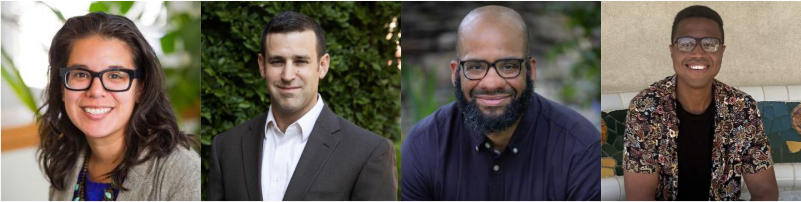
From Left to Right: Dr Christina Dobbs, Dr Scott Seider, Dr Daren Graves, Babatunde Alford

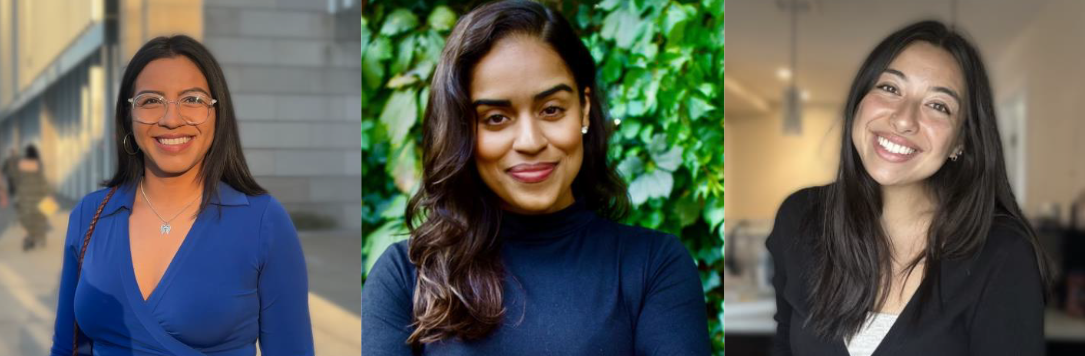
From Left to Right: Brianna Diaz, Dr Elianny Edwards, Kaila Daza

From Left to Right: Dr Trang Le, Alexandra Honeck, Hannah Choi
From Left to Right: Sarah Fogelman, Hehua Xu, and Dr Madora Soutter

Digital Equity and Inclusion: Insights into Educational Change and School Initiated Improvements – Christopher Sanderson, University of Arizona 

Lead the Change (LtC): What are some of the ideas you hope the field of Educational Change and the audience at American Education Research Association (AERA) can learn from your work related to practice, policy, and scholarship?

CS: My research offers insights into the challenges and strategies facing K-12 school districts in their efforts to promote digital equity and inclusion, providing valuable lessons for practice, policy, and scholarship. My work emphasizes the importance of integrating digital tools and providing professional development for educators to address disparities effectively. For example, I highlight the need for further training to bridge digital literacy fissures. From a policy perspective, I encourage sustained district-level planning and collaboration to tackle systemic barriers, such as the expiration of temporary programs like the CARES Act and ACP (Federal Communications Commission, n.d.; US Department of Education, 2024). Digital equity must be treated as a long-term priority rather than a short-term response to crises like the COVID-19 pandemic (Petersen, 2024).  

I also emphasize holistic definitions of digital equity and inclusion, which include access to affordable internet, devices, and the necessary digital skills. Collaborative approaches are essential, and I focus on engaging administrators, teachers, parents, and community members in co-creating solutions to foster a shared vision of digital equity and inclusion. My research highlights the importance of addressing systemic inequities and recognizing biases in policy and practice. For instance, I noted that federal programs often exclude K-12 schools, advocating for tailored, inclusive, sustainable, district-level strategies (National Telecommunications and Information Administration, 2024).  

My work offers frameworks to explore the intersections of digital inclusion, systemic inequities, and community collaboration in educational change. It contributes to the growing body of literature on digital equity by providing insights into how schools can navigate barriers to ensure every student has the tools for success. Focusing on localized, context-driven solutions and collaborative efforts, this research aims to inform and create more equitable learning environments that address both immediate needs and long-term goals. This study may support school districts in assessing their progress toward digital equity and inclusion, offering recommended actions for transformative change. Through the collection and analysis of data, districts can identify patterns and make informed decisions on future steps.  

The findings from this study can serve as a catalyst for action-oriented planning beyond its conclusion. The ultimate goal is to develop actionable strategies that help school districts achieve equitable student access. While an outsider can only begin to grasp the challenges students, communities, and schools face regarding technology access, internet connectivity, and digital skills development, addressing these barriers requires strategic, locally driven planning. Schools are complex and diverse, with digital equity and inclusion needs varying from one site to another. For example, one school might require more digital literacy training for caregivers, while another may need additional internet hotspots to ensure students can access devices outside school hours. 

Dr Christopher Sanderson

Achieving Excellence Academy: Critical  Unschooling and the Promise of a  Humanizing Education – Dr. María del Carmen Salazar & Nadia Saldaña-Spiegle, University of Denver, Ashlea Skiles, Denver Public Schools

Lead the Change (LtC): What are some of the ideas you hope the field of Educational Change and the audience at American Education Research Association (AERA) can learn from your work related to practice, policy, and scholarship?

MS, NS, AS: One of the central contributions of this research is the expansion of the concept of critical unschooling. We, the researchers, extend this concept by conceptualizing “home-based” as one’s sense of “home” which is inclusive of home culture, community, native language, intersectional identities, history, heritage, ancestors, and ultimately, of one’s full humanity. We, the researchers, put the concept of critical unschooling on the ground and bring to live a real-world example in an educational setting with secondary students and teachers of color. This is an important contribution to the field because it extends theory into practice.

Another important contribution of this research is that student voices are centered and the concept of critical unschooling is shaped by their experiences and insights. One of the most impactful findings is how students redefine excellence as a result of the Achieving Excellence Academy (AEA). As an example, one student stated, “Excellence is not just holding onto your goals, it’s going after and representing yourself, and reflecting yourself in your goals.” Another student emphasized, “Before, I only thought about excellence athletically and academically, but after this program, I think it’s cultural too…pride in your own culture, accepting other people’s cultures, and being woke.” The AEA expanded students’ perceptions of excellence to include a focus on their well-being and cultural pride. Moreover, teachers of color extended this concept into teaching and learning by sharing how they enacted critical unschooling.

Dr María del Carmen Salazar
Nadia Saldaña-Spiegle
Ashlea Skiles

Teacher Education, Teacher Certification, and Teacher Meetings in Israel, Korea, Switzerland and the US: Lead the Change Interviews (Part 4)

This week IEN shares Part 4 of the Lead the Change (LtC) series interviewing presenters participating in the Educational Change Special Interest Group sessions at the upcoming Annual Conference of the American Educational Research Association. This post includes presenters from the session titled: “Equity-minded leaders transforming the global educational landscape.” For Part 1 see “Leveraging Partnerships, Networks and Teacher Collaboration for Educational Change,” Part 2 “Leaders, Leadership Practices, and Educational Change in the US, Korea, and Hong Kong: Lead the Change Interviews (Part 2)” and Part 3 “Educational Transformation in Schools and Colleges in the US and South Africa: Lead the Change Interviews (Part 3).” These interviews are part of the Lead the Change series produced by Elizabeth Zumpe and colleagues from AERA’s Educational Change Special Interest Group. The full interviews can be found on the LtC website


Historical changes in teacher education in Israel: An analysis of professional perceptions from 1960 to 2020 – Ayelet Becher (AB) & Izhak Berkovich (IB), The Open University of Israel

Lead the Change (LtC): What are some of the ideas you hope the field of Educational Change and the audience at American Education Research Association (AERA) can learn from your work related to practice, policy, and scholarship?

AB & IB: Our work offers valuable contributions to the practice of teacher education. Teacher education curricula should respond to the cyclical nature of educational change, preparing teachers for shifts in pedagogical trends and the potential return of seemingly outdated practices. Instead of presenting a singular “best-practice” model, teacher education programs should equip pre-service teachers with the adaptability and critical thinking skills to navigate fluctuating pedagogical paradigms. For example, this could involve teaching both content-centered and student-centered methods and conducting simulations to help teachers practice adjusting their approach based on different classroom scenarios. This also necessitates supporting prospective teachers in forming a strong professional identity and developing reflexive skills. Curricula could integrate historical analysis and context-awareness practices, enabling teachers to understand the deeper social and political forces that shape educational policy and practices in their local context. Our study’s [Historical changes in teacher education in Israel: An analysis of professional perceptions from 1960 to 2020] findings underscore the importance of teachers’ adaptive expertise in responding to changing societal conditions and emerging needs. Teacher training should equip prospective teachers with versatile knowledge and skills to adapt to various contexts and specific learners while preserving their established pedagogic creed. 

The study also contributes to educational policymaking. Given the cyclical nature of educational reform, it is crucial to focus education policy on incremental, sustainable improvements rather than rapid, radical shifts that may prove unsustainable. This requires developing adaptable teacher education policies that respond to shifts in societal values and priorities without abandoning fundamental principles of educational equity and justice. A “one-size-fits-all” approach is unlikely to succeed; effective policy requires adapting to specific contexts and addressing the unique needs and challenges of national systems. The long-term perspective necessary to address cyclical patterns demands a shift from short-term policy cycles to long-term planning horizons. Policymakers must avoid pursuing quick fixes and instead focus on fostering sustained, systemic changes that can withstand shifts in ideology and priorities. This might involve establishing broader cross-sectoral collaborations that include policymakers, teacher educators, researchers, and community stakeholders. 

Lastly, our work contributes to the relatively limited body of scholarship that explores the historical path dynamics of educational change (e.g., Berkovich, 2019; Hargreaves & Goodson, 2006), shedding light on the interplay between past trends and present educational challenges. Our 60-year study highlights the significance of adopting a long-term perspective to understand educational shifts. Researchers would also benefit from examining the nuanced sociopolitical circumstances that mobilize, stabilize, and destabilize educational changes within specific contexts. We encourage a comparative analysis of long-term cyclical patterns in other national contexts to determine the scope and applicability of the cyclical model in diverse settings.

Ayelet Becher, PhD
Izhak Berkovich, PhD

Developing the Korean version of the equity scenario survey: Pilot study – Sojung Park (SP), Nicholas S. Bell (NB), Elizabeth Slusarz (ES), University at Albany, State University of New York

Lead the Change (LtC): What are some of the ideas you hope the field of Educational Change and the audience at American Education Research Association (AERA) can learn from your work related to practice, policy, and scholarship?

SP, NB, & ES: Our study [Developing the Korean version of the Equity Scenario Response Survey] highlights a critical gap between teacher candidates’ self-perceived readiness to address racism and ableism in the classroom (as seen in quantitative data) and their actual preparedness (as revealed by scenario-based responses). To examine these discrepancies, we employed the Korean-adapted Equity Scenario Response Survey (ESRS-K)—a scenario-based tool derived from the ESRS (Bell & Codding, 2021)—which we translated and culturally tailored to capture equity-related dilemmas specific to Korean classrooms.

From a policy perspective, our results offer a roadmap for educational leaders in South Korea and other societies facing similar demographic shifts. Policymakers should leverage these findings to set clearer teacher certification requirements or require mandatory equity modules in teacher education curricula. By explicitly targeting racism, ableism, and related forms of discrimination, policy reforms can foster inclusive practices throughout national teaching standards.

In terms of scholarly contributions, our research applies QuantCrit [a theory that uses quantitative methods in ways consistent with the tenets of Critical Race Theory] in a novel way, both theoretically and methodologically. Adapting the ESRS for a Korean setting not only refines its cultural relevance but also expands the global discourse on equity assessment tools. This contextualized application of QuantCrit can guide teacher education in other rapidly diversifying contexts, offering a model for how researchers and practitioners might evaluate teacher readiness in settings undergoing similar demographic changes.

Taken together, our work bridges theory—Critical Race Theory (CRT) through QuantCrit—and practice in the form of teacher training and classroom realities. We invite the AERA community to critically examine how traditional self-report measures can be supplemented with tools like scenario-based assessments. These tools uncover the complexities of equity education, moving beyond surface-level self-perceptions to provide deeper insights into candidates’ readiness to enact equitable practices.

Nicholas Bell, PhD
Elizabeth Slusarz, PhD student
Sojung Park, PhD

Are team meetings a place for teacher learning? An ‘in situ’ analysis of meeting practices – Enikö Zala-Mezö (EZ), Zurich University of Teacher Education, & Amanda Datnow (AD) University of California San Diego

Lead the Change (LtC): What are some of the ideas you hope the field of Educational Change and the audience at American Education Research Association (AERA) can learn from your work related to practice, policy, and scholarship?

EZ & AD: In our paper, we address the question: How does professional learning—which is similar to “collective trial and error” in Haslanger’s (2023, p. 169) wording—unfold in team meetings in schools? We describe meeting practices ‘in situ’. Driven by practice theory (Reckwitz, 2002), ‘in situ’ means we focus on daily practices in schools as the unit of analysis. We analyze detailed audio-recorded data gathered in team meetings in three Swiss schools and two different teams within each school. We attend to discourse sequences with potential for knowledge generation, where future practices or new insights are produced. We build on the definition of generative sequences from Beech et al. (2010): “engagement between two or more people that goes beyond the trivial, which changes some meanings or processes and/or creates some new knowledge” (p. 1342). In other words, we are looking for instances in which educators engage in deeper discussions that are characterized by inquiry and problem solving. 

A non-generative discussion would be one in which the team does not engage issues of teaching and learning in much depth and jumps to quick solutions, such as blaming students for their underachievement.  

Our analysis reveals that, in the Swiss schools we studied, educators often organize highly structured meetings with full agendas that last around an hour (with some exceptions). These meetings tend to have very short sequences discussing up to 12 topics, which limits opportunities for deeper understanding, and joint learning. The generative aspect of the discourse was found to be low in many cases, yielding few opportunities for teacher learning. Additionally, the high level of structuring activities (introducing, summarizing, coordinating the discussion), along with the dominant role of the meeting leaders (who often have the lion’s share of speech time) and full agendas, suggests an underlying bureaucratic approach to team meetings. Managing organizational tasks tends to overshadow the learning opportunities for teachers, emphasizing administrative concerns over collaborative learning or reflective discussions. This structure implies that the primary focus of the meetings is on fulfilling organizational needs rather than fostering meaningful, collaborative learning experiences for the educators involved.  

We believe these findings have important implications for research and practice. Our hope is to raise the consciousness of educational leaders, teachers, and external partners about the discourse in team meetings. Teacher collaboration meetings are expected to be a vehicle of educational improvement (Vescio et al., 2008; Lefstein et al., 2020), and our analysis suggests they could be much more generative of learning than they presently are. There is of course no recipe for changing practices; rather, shifts happen through continuous inquiry, a trial-and-error process drawn on educators’ deep professional knowledge. The research community could also play a role through gathering and sharing micro-analytic data of meeting practices and conditions and partnering with educators in an inquiry process.  

Amanda Datnow, PhD
Enikö Zala-Mezö, PhD

Reimagining Coaching and Teachers’ Time: Scanning the News for Innovations in Teachers’ Professional Learning (Part 2)

This week, IEN’s managing editor Sarah Etzel continues a scan of recent news articles and research on post-pandemic developments in the teaching profession. In part two of the post, Etzel describes some of the initiatives to use technology to help to free-up time for teachers by reorganizing staffing and scheduling. Part one explored innovations in blended and remote teacher professional development models and the use of AI to provide feedback to teachers. 

What’s happened to teachers in the wake of the COVID-19 pandemic? On the one hand, in the US teacher vacancies appear to have grown substantially. One report released in the fall of 2023 showed 55,000 vacant teaching positions, an increase from 36,000 the previous year. On top of that, the report found that 270,000 teachers – almost 9% of the entire teaching force – are “underqualified,” either lacking full certification or teaching in a subject in which they are not certified. The National Center for Education Statistics also revealed that 86% of K-12 schools reported problems hiring new teachers in advance of the 2023-24 school year, and almost half of all public schools describing themselves as “understaffed.” On the other hand, the pandemic helped to stimulate experiments with new models for staffing and with virtual teachers that might help to address teacher shortages. 

Staffing Changes: Unconventional Teaching Roles

            Whether in-person or virtual, a small set of schools and organizations around the US are exploring what alternative teaching and staffing models for schools could look like. A report from FutureEd focusing on pandemic-inspired staffing strategies, for example, highlights the benefits of some co-teaching, team teaching, and mentor teaching models. Public Impact, working with a network of over 300 schools, has pioneered models designed to use teacher teams to enable teachers who have shown their effectiveness to reach more students. These “multi-classroom” leaders teach part-time and also lead small, collaborative teams of other teachers, paraprofessionals, and intern teachers in the same grade or subject. Cadence extends the reach of effective teachers by developing a national team of mentor teachers who deliver online lessons for a group of partner schools across the US. The teachers in the partner schools both learn from the mentor models and they can incorporate the lessons into the work with their own students. As Steven Wilson, a co-founder of Cadence, puts it: “It’s like being able to sit in the back of the room of the best teacher in the building for weeks at a time and see his or her moves and adapt them and make them your own.”

The FutureED report also emphasizes the potential of flexible class sizes, time blocks, and instructional cycles that allow for teachers to work with smaller groups of students outside of traditional grade-level and schedule constraints. As an example, the report highlights a particularly unusual approach from Kairos Academies in St. Louis that developed a seven-week schedule in which students attend school for five weeks, followed by two weeks off; staff have one week off, but use the other week to review data and plan for the next cycle. The report quotes, Gavin Schiffres, Kairos founder and CEO, describing what he sees as the advantages of the cycles; “With the cycle model, we operate in sprints, much like the technology industry. In a traditional calendar, you have kids in the building for such long stretches that as soon as there’s a break, everyone just wants to crash.” 

Drawing on interviews with a small group of leaders from six districts involved in staffing experiments, the Center on Reinventing Public Education issued a report on how unconventional teaching roles could help to make the profession more sustainable and increase teacher satisfaction in the process. Some of these roles include: 

  • Lead teacher: An individual who mentors a team of teachers (across content areas or grade levels) by developing curricula and co-teaching as necessary 
  • Empowered teacher: An individual who supports with school-level policies and sets learning targets 
  • Team teacher: An individual who teaches a large group of students (50-80) in collaboration with two to four other teachers 
  • Community learning guide: An individual who works with a group of educators and their students to create experiences grounded in students’ wider environment, community, or culture. 
  • Solo learning guide: An individual who independently teaches a small group students (5-15) in school or home contexts
  • Technical guide: An individual who leverages subject area expertise (e.g. robotics, architecture) to provide curriculum support and work with small groups of students 

According to the report, teachers in these roles shared that they experienced less stress and felt more motivated; working in diverse or team settings, teachers were able to share responsibilities, learn from each other, and feel connected to the purpose of teaching. Despite the potential, a review of the CRPE report from the National Education Policy Center cautions that it is too early to tell whether these kinds of staffing changes could be scaled effectively or whether they would have the desired impact. 

In order to address the shortage of teachers and support those that are in place, some schools in the US have also introduced models to support paraprofessionals to gain teaching credentials and become licensed teachers, while others have created pipelines for substitute teachers to gain teacher certifications. Beyond the US, organizations such as GPE KIX and UNICEF have been pioneering child-to-child teaching models, in which older students support the education of pre-primary learners, in areas where there are not enough teachers available (for past IEN coverage of peer-to-peer tutoring approaches, see: Education reform in MexicoAn interview with Dr. Santiago Rincón-Gallardo, and Bringing Effective Instructional Innovation to Scale through Social Movement in Mexico and Colombia).

Virtual teachers for in-person students

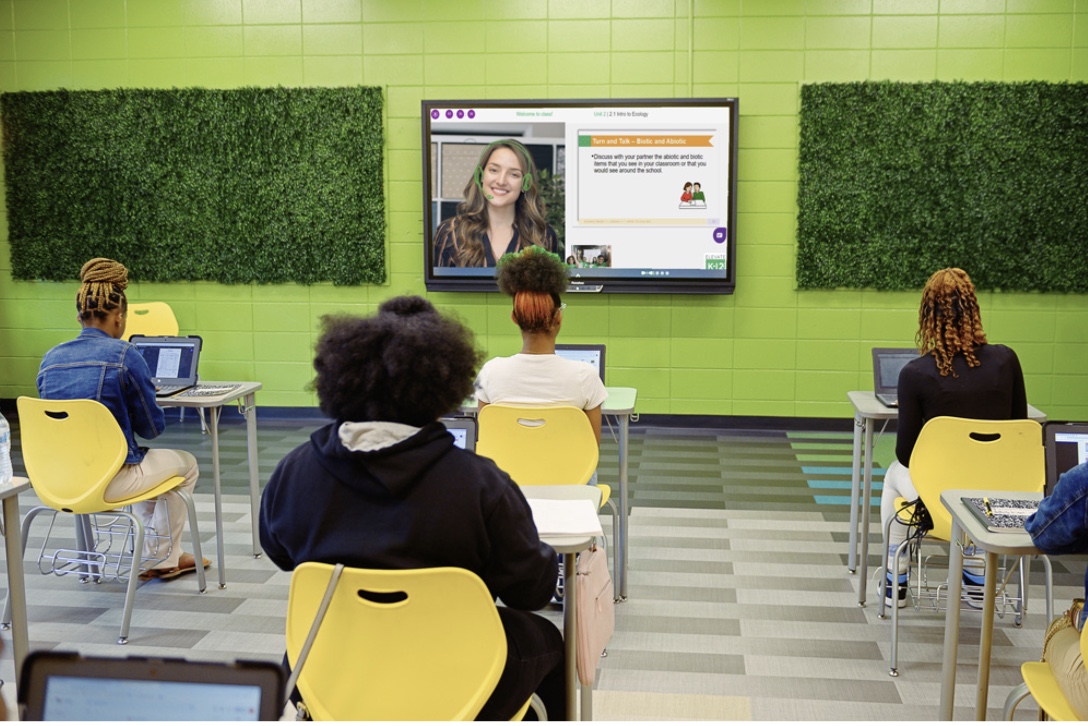
Along with developing new virtual and hybrid approaches for students to learn, during and after the pandemic, reports also note that some districts are spending millions of dollars on virtual teachers to fill-in when they can’t find the personnel they need in their local area. Among these, districts in Little Rock, ArkansasCharleston County, South CarolinaSan Jose, California, and Milwaukee Wisconsin have contracted with companies such as Elevate K-12Coursemojo, and Proximity Learning to address their teacher vacancies and to provide virtual instructors who zoom into their classes. These companies employ fully certified virtual teachers who provide “synchronized learning services” in a range of subjects. The virtual teachers interact with students completely through the online platforms, with, in some cases, in-person supervision provided by paraprofessionals or long-term substitute teachers. 

"live teaching" model

Elevate-K12’s model of “live teaching”, The 74

The benefits and drawbacks of these approaches are also being debated in the press. For some, these virtual options provide an alternative to other “quick fix” solutions that have been used to fill empty classrooms in the past, including hiring uncertified teachers, incentivizing military veterans to join the teaching force, or removing some degree requirementsAccording to the CEO of a San Jose charter school network that contracts with Coursemojo, this situation is not ideal, “but until we really, radically change the education profession here in the United States, we’re going to be looking at solutions like this.” Catherine Schumacher, Executive Director of Public Education Partners stated the importance of not shaming “districts for doing the absolute best they can do to get qualified teachers,” especially in a climate where “we have systematically underpaid…educators for years.”  

Other advocates argue that the subjects virtual teachers are teaching have historically been hard to fill, meaning many students did not have access to these educational opportunities, particularly in low-resource school districts. As the Milwaukee Public Schools talent management director put it: “when we talk equity and access, I want to ensure that if my students want to take pre-calc, if they want chemistry, if they want physics, that they have the opportunity to do so.” 

The cost-effectiveness of the virtual models also remains in question. For one school district in Milwaukee, Wisconsin, a contract with Elevate-K12 helped them fill 55 open positions at a cost of about $3.9 million, a savings from the $5 million it would have cost to hire that many in-person teachers. A district representative reported that they were able to save the $1.1 million because they did not have to provide benefits for Elevate K-12 teachers. In contrast, a school district in Charleston County, South Carolina that has used the virtual learning platform, Proximity found that these models were more expensive, as the schools needed to hire paraprofessionals to watch the students during the virtual classes. 

Critics point to the fact that there is not yet enough evidence to show that students are achieving positive learning outcomes under these models, but proponents such as Elevate K-12 founder Shaily Baranwal, argue that virtual teaching during Covid-19 took place under emergency circumstances and, with more time to prepare and focus on delivery methods, post-pandemic virtual teaching could be particularly effective. Critics also question whether students’ social experiences and sense of belonging will suffer when they have virtual teachers, and some wonder who will be held accountable for student learning under blended learning models (i.e. the paraprofessionals who are in class every day with the students, or the virtual teachers?). With all these uncertainties, many parents remain skeptical of this virtual  solution and question whether virtual teaching will be the best fit for their children. 

The bottom line? Freeing up time to teach? 

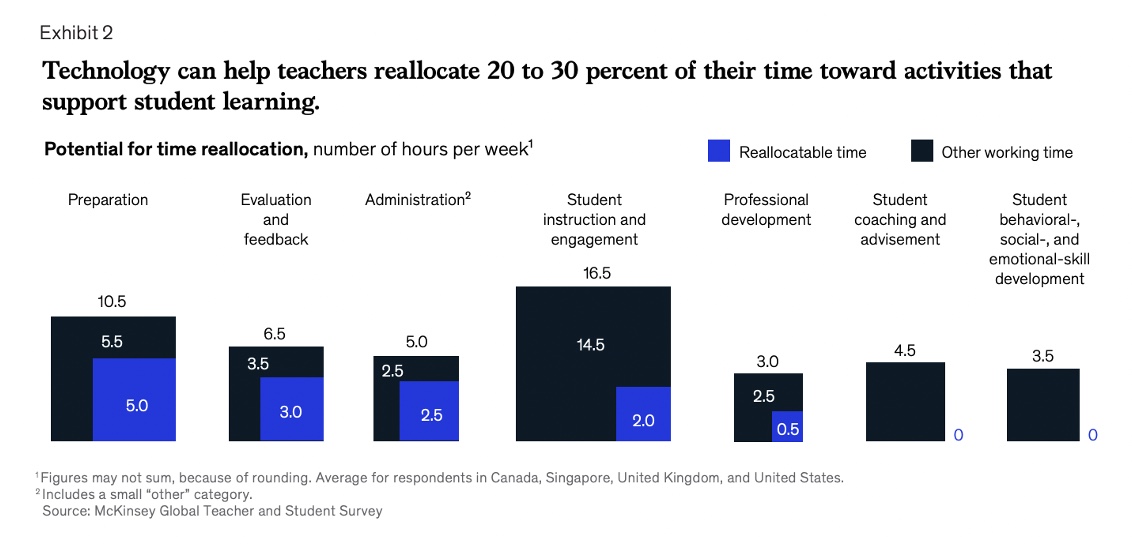
At the end of the day, the success of any of these “innovations” in professional learning depends on whether they can be put in place without adding to teachers already overloaded schedules and extensive set of responsibilities. Post-pandemic articles continue to highlight challenges like a lack of planning time for teachers and excessive time spent in staff meetings as well as hopes that AI may help address these issues by freeing up teachers’ teachers time from administrative tasks and helping teachers create differentiated assignmentsThrough a survey of 368 school-based employees across the U.S., AI-Equity found that 84% of those who used AI in the Daily/Weekly category reported they were “more excited about continuing education sector work because of AI,” compared to 52% of all respondents, while 94% of Daily/Weekly AI users shared that it made them more productive. According to research from MIT, AI can improve the performance of skilled workers in fields such as consulting by approximately 40%. A report from McKinsey and Co. estimates that teachers could free up 20-30% of their time by using AI and other technologies to support activities such as preparation, conducting evaluations and giving feedback, administrative duties, and professional development. The Christensen Institute argues that teachers may not use their reallocated time for increased student engagement without proper incentives, but freeing up teachers’ time could help to alleviate burnout and increase the attractiveness of the profession. 

How artificial intelligence will impact K-12 teachersMcKinsey

However, sources also caution that AI should not be viewed as a panacea for solving these issues, and in fact, may exacerbate some of the challenges that teachers face. As one teacher explained, the expectations developing lessons incorporating AI and other forms of technology “takes extreme planning, and that, we don’t have time for anymore.” Moreover, the increasing use of AI raises numerous questions about the potential impact on students’ learning and development. In particular, as Julia Freeland Fisher cautions, the education market doesn’t prioritize relationship building within its attainment metrics and so may fail to take into account AI’s impact on those relationships. Under those conditions, as Freeland Fisher put it, “the more commonplace that AI companions, coaches, and anthropomorphized bots in learning and support models are, the more fragile students’ social connectedness may become.”