What does it take to expand support for learning in and across communities? In the second part of this 2-part interview, Gregg Behr talks about the development of the first Remake Learning Days in Pittsburgh, Pennsylvania and how they spread to community-wide efforts in 15 different regions in 4 countries. In 2007, Behr, the executive director of The Grable Foundation, founded Remake Learning as a network of educators, scientists, artists, and makers supporting future-driven opportunities for children and youth in Pittsburgh. Celebrating its 10th edition this month. Remake Learning Days began in 2016 as a local learning festival with hands-on learning events for children of all ages at libraries, schools, parks, museums, and other community spaces. Behr is also the author with Ryan Rydzewski of When You Wonder, You’re Learning, sharing the science behind the work and words of Fred Rogers and Mister Rogers Neighborhood, a well-known television show that ran for over thirty years. This interview has been edited for length and clarity.
TH: Let’s turn to one of the activities that I think has become a signature of your work – Remake Learning Days. What were some of the critical “aha’s” in their development?
GB: The first “aha” happened in one of the human centered design sessions. In Pittsburgh, we had a firm called Maya Design, and they had a retreat room surrounded by whiteboards where they would facilitate these amazing sessions. In 2015, we convened about 30 people, including folks who came from the White House Office of Science and Technology Policy. We were asking these big questions about how far Remake Learning had come and where we might go – asking, essentially, how do you build out a learning ecosystem? What would that look like? It was during that session that it became clear that the network was serving professionals like teachers and afterschool directors, librarians, and designers really well, but that we weren’t really designed to serve parents, families and caregivers. There was a clear “aha” that if we didn’t seriously engage with these members of our community, we’d risk being incredibly faddish, and we started wrestling with what we could do to engage this group. There wasn’t an obvious way to just plug parents and families into our different programs and activities, but through this user design process two things came to light. One was that someone talked about how open houses were one of the singular moments when parents, families and caregivers really come to schools and engage with educators, as surface level as it might be. Then totally separately, someone talked about how, at least in Pittsburgh, we have lots of neighborhood festivals like the Pickle Festival, the Perogie Festival, etc. I can’t even remember who it was, but someone said “Hey, what if we put these two ideas together? This idea of neighborhood festivals with the idea of an open house?” And so we started to talk about having a kind of festival of open houses of all of these places for kids and learning that had been built over the past couple of years. At that point, we had dozens, if not hundreds of makerspaces. We had STEM labs. We began to wonder what might happen if there was a chance for parents, families and caregivers together with their kids to get into all of these spaces and to get beyond their schools and to go into into the Carnegie Museum of Art or whatever it might be. That was the germ of the idea of what became Remake Learning Days, but I can’t even recall what it was called initially.

Within a year, we had the first Remake Learning Days in 2016 because all sorts of organizations said they wanted to participate. There were more 250 events over the course of about nine days. 25,000 people came out in that very first year! That was the second aha – seeing all of those people come out and realizing “Oh, there’s something here!” The other big realization was that there were 250 events that were self-organized: they did it and they weren’t paid to do it. Clearly something had traction, in 2025 in Pittsburgh, we’ll celebrate 10th edition of Remake Learning Days.
TH: That’s an incredible story. In 2019, other cities in the US and in other countries started hosting their own Remake Learning Days: How did they start to spread?
GB: The same people from the White House Office of Science and Technology Policy challenged Remake Learning to document its work in what became the Playbook. In fact, someone from that Office left the White House to work with the Sprout Fund in designing the Playbook. The basic idea behind the Playbook was to create something that would be as helpful to people and organizations in Pittsburgh as it would be to Flint, Michigan or Oklahoma City. After seeing how the Remake Learning Days had taken hold in Pittsburgh, we started looking for financial support to develop the Playbook. We got some funding primarily from the Carnegie Corporation of New York, and created what we initially called a toolkit that communities could use to host their own Remake Learning Days. At the time, Remake Learning was deeply involved with other national organizations and associations that were involved with STEM, the maker movement, and other things like that. We just put the toolkit out there to say, “Who else might want to host Remake Learning Days?” And that’s how they began to spread.

TH: As I understand it, you’ve tried to let these Remake Learning Days grow and spread more or less on their own? Are there any particular lessons you’ve learned, either any lessons you’ve learned, either vicariously or from your interactions with those in other communities?
GB: In terms of letting them spread, yes and no. We’ve tried to provide just enough guardrails so that, if a Martian comes down and goes to Remake Learning Days in Pittsburgh and then Doncaster, England and then southern Wisconsin, it would seem like these things are connected. If Remake Learning Days are going to be successful, you have to have that connection, but they also have to feel contextualized in these different places.
“We’ve tried to provide just enough guardrails so that, if a Martian comes down and goes to Remake Learning Days in Pittsburgh and then Doncaster, England and then southern Wisconsin, it would seem like these things are connected.”
Along the way, the team has learned a thousand lessons. They’re going to continue to iterate as they look ahead to years 11 and 12, but like so many other community-based initiatives, you need to have that “backbone” organization; you have to have that clear champion who’s going to lead the work. In one instance, there was an amazing woman who made Remake Learning Days happen where she lived. But after she left, it hasn’t been the same thing. It was so tied to one person and one organization that it just didn’t stick; so we’ve learned that lesson. We’ve also learned the lesson that sometimes things have beginnings and ends. Chattanooga and Chicago hosted phenomenal Remake Learning Days, and they met the needs of the Public Education Foundation in Chattanooga and the Chicago Learning Exchange. But they plateaued in their utility, and both said, essentially, “We’ve loved this, but we’re not going to continue with this,” and we’ve learned that’s totally fine. We’ve seen places like Sarasota and Doncaster completely adopt this approach; raise lots of local money; and Remake Learning Days are now integral to their local efforts. If we were to shut down Remake Learning here in Pittsburgh, they would continue on in some of these other places. We’ve learned all sorts of lessons about leadership, about local financing, about making it local so people feel connected to it. It’s not just a franchise that someone imports; the Remake Learning team has worked hard in terms of monthly meetings and all sorts of things to make sure there’s quality control for successful festivals.

TH: I didn’t realize how much work the Remake Learning team is putting into these. I thought you put the Playbook out there, and then just let people use it. But you actually have a team that coordinates with these other places, and in a sense sanctions these other events, and says, “Yes, these are Remake Learning Days. This is one of our partner events”?
GB: Again, the answer is yes and no. Everything that Remake Learning has done, maybe to its detriment, is through Creative Commons licensing, so people have used the Remake Learning Network playbook and also the Remake Learning Days toolkit to their own effect. In New Hampshire, they have used the playbook to support the development of their local learning networks but never with any formal coordination with Remake Learning— – and that’s okay. Places like Qatar have had “Doha Learning Days” and have used the Remake Learning Days playbook. I’d say it’s a loosely sanctioned process. But then there are two producers of Remake Learning Days, and they in turn work with the team in Sarasota or the team in Doncaster, or wherever it may be.
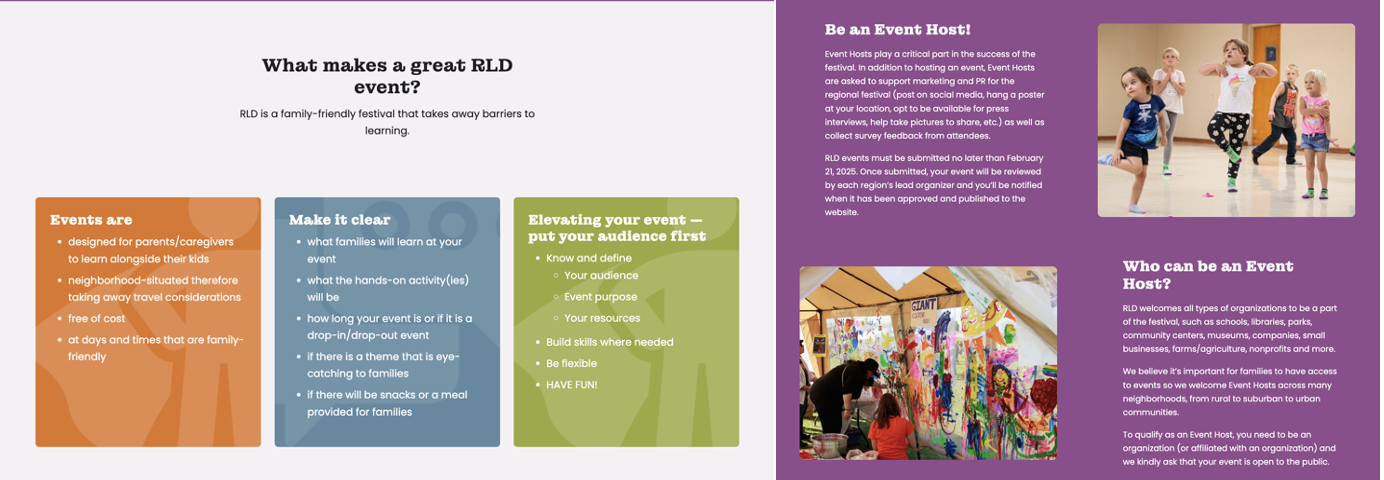
TH: How does that work? Does Sarasota have to pay the producers or are they providing pro bono services to the places that want to do it?
GB: Yes, they have a remarkable team supported by The Patterson Foundation in Sarasota; and, for Sarasota and elsewhere, Remake Learning has borne the costs for some of the regional and national marketing, because with an event like this, the most significant costs are marketing.
TH: Have you run into challenges where you wish that some place wouldn’t call their events Remake Learning Days?
GB: There have been some challenges along the way, with some places that want to call it something else like “STEM Days,” and the team has had some tough conversations with some cities, saying if we’re going to be part of this, then there are a few things you need to do. Some cities have just said, “We’re going to have our own thing.” There are also challenges around quality control and questions about what kinds of events to connect with. There are now some pop-up festivals which have been hugely successful. People have staged events in Tel Aviv and Antarctica, but sometimes these are singular events on a particular day, and they’re branded and connected to Remake Learning Days, and they’re on the website, but it’s not a multi-day festival the way it is in Sarasota or southern Wisconsin or Kansas City.
Dates are also difficult. Even with the pop-up events, Remake Learning Days have had a set date range, something like April 23rd through May 23rd. For example, the six regions in Pennsylvania that now host Remake Learning days, they all happen at the same time. That is very deliberate, and they are coordinated statewide. But in
Tennessee, they valued Remake Learning Days, but May didn’t work for them because of state testing, and it turns out that May is not a great time for Remake Learning Days in Uruguay. That raises the question: does it have to be around the same dates around the world for it to be called Remake Learning Days? The team is wrestling with a whole bunch of questions like this as they go forward. They’re trying to provide greater flexibility while maintaining quality control.
TH: Can you say anything more about the next steps or the challenges ahead for Remake Learning Days and Remake Learning?
GB: In terms of challenges, like a lot of these things, no one ever imagined there being a 10th edition. But even with that, ongoing fundraising is a challenge. Yet, for corporate funders, sponsoring an event like Remake Learning Days is a lot easier than sponsoring a network. For fundraising, it certainly helps that they have built up a body of data, including qualitative evidence – write-ups and videos – to support it. Quantitative data, too! For example, they worked with Heather Weiss, who led the Harvard Family Research Project to document their impact on parents. Their goals included helping parents understand how learning is being remade; helping parents understand how they can support their own kids if they find their kids are lit up by art and design or coding or maker-centered programs; and building up demand among parents so they might go to school board meetings, parent-teacher conferences, or their local library to ask questions about these approaches to learning that are clearly lighting up their kids. Heather’s work demonstrated that parents were gaining familiarity with STEAM and new approaches to learning and building their interest and support for those approaches.
“Ongoing fundraising is a challenge. Yet, for corporate funders, sponsoring an event like Remake Learning Days is a lot easier than sponsoring a network.”
Looking toward the future, I think we’ll see fewer sites that host Remake Learning Days, but they will be more embraced by their region, with significant regional funding. In addition to seeing that in southern Wisconsin, on the west coast of Florida, and Doncaster, the Pennsylvania Department of Education has invested significantly in Remake Learning Days and different units from the state government are also providing in-kind support. I think we may see more changes like that where public funding also helps to drive further engagement and support from local and state governments.
TH: Looking to the future, let’s return to Remake Learning in Pittsburgh. What do you think it will take to sustain and deepen this work overall? Are there particular problems that have to be addressed or changes that have been made?
GB: There are always lots of answers to a question like that! One thing we have to address is leadership. The leadership has evolved over the years. When it was time for the Sprout Fund to sunset, and they wrapped up their work, we hired what amounted to a director for Remake Learning, and there have been a number of directors since that time, each of whom has held the position for at least two or three years. But incredibly, it wasn’t until around 2014 or 2015 that we convened what we call the Remake Learning Council. This is a council of CEOs, learning scientists, leaders of cultural institutions and others who meet regularly with the director and the Remake Learning team and provide advice and support. Of course, the people in these roles change positions all the time. There are new museum directors, new superintendents and so on. We have to pay attention to that churn and make sure we have the right people and the right support, and that’s a great leadership challenge. It’s also what makes Remake Learning sustainable – it’s crucial to have a large number of leaders across the community who value this work, who are contributing to the design of it and advancing it.
Relatedly, Remake Learning, if you can believe it, has never been its own separate 501 (c) (3) [which would allow it to be a charitable organization collecting tax exempt donations]. That’s because part of the strategy in the beginning was to demonstrate that this was not going to be something that competed for funding with other charitable organizations, like museums and some of our other charitable partners. Instead, Remake Learning has been fiscally sponsored by other organizations, and I think that’s been a real benefit – so that the focus could be the work itself. Initially, Remake Learning was fiscally sponsored by the Sprout Fund; then it was fiscally sponsored by our regional association of grantmakers called Grantmakers of Western Pennsylvania. It’s currently fiscally sponsored by the Allegheny Intermediate Unit, our region’s educational service agency. But we always have to check in on our structure: Do we have the right home? Do we have the right governance? That’s an ongoing challenge for the network.
“Part of the strategy in the beginning was to demonstrate that this was not going to be something that competed for funding with other charitable organizations, like museums and some of our other charitable partners.”
Another challenge with any organization that reaches 20 years is that you’ve got people who’ve been involved for nearly 20 years, and there are people who just joined two weeks ago. We have to keep the work fresh and relevant for the newcomers as much as for the veterans. This is a programmatic challenge. It’s hard to keep things fresh for most everyone involved. As one example of “keeping things fresh,” Remake Learning started in the past few years to distribute what they call Moonshot Grants. Regionally, I think they’ve spent about three or four million dollars in grants to local organizations and schools that are really trying to push the edge of what constitutes great learning, especially as such much around us is changing. That’s one example that’s kept the work really fresh.

Remake Learning has also really leaned into some of its national and international partnerships, which has pushed its work forward. Just last week Remake Learning announced ten national moonshot grants, which came out of the Forge Futures Summit, which brought together organizations involved in learning ecosystems from around the US, and even a few other places worldwide. This speaks to the spread and the tension: Remake Learning is committed to being a regional organization and it has to continue to do basic things brilliantly at the regional level. It’s not a national or international organization, but it sometimes has – or could have – a national and international role to play. That’s what Remake Learning Days have done, and Remake Learning is figuring out how to do that as a network while not distracting ourselves from our core mission regionally.
TH: Can you say a bit more about what Remake Learning has done internationally?
GB: Remake Learning has partnerships with a number of international organizations including HundrED in Finland, Big Change out of London, OECD, and the Global Education Leadership Partnership. Just as an example, Remake Learning got connected to Big Change pre-pandemic because they had done a report and Remake Learning ended up being one of their case studies. Now Remake Learning and Big Change are funding a loose federation of international organizations that meet almost monthly. Along with Remake Learning and Big Change, it includes Learning First out of Bermuda, People for Education in Canada, Learning Creates Australia, Innovation Unit, Zizi Afrique in Kenya, Fundacio Bonfill in Spain, Educate! in Uganda, and Dream a Dream out of India. You’ve got people who represent different geographies. In some cases, they are more metropolitan like Remake Learning, but in others are more nationwide, like Uganda Educate! The first meeting focused on Bermuda’s transforming education system. The second one was a showcase of some of the work in Australia. It’s become a global learning community.

 International Education News