Tag Archives: China

China

The Education System That Pulled China Up May Now Be Holding It Back
Gao, H.  The Atlantic (25 June 2012)

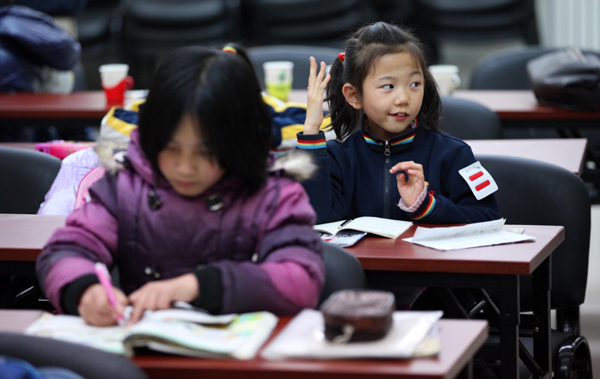
Although gaokao, the annual nationwide college entrance exam in China that seated 9.33 million students in early June, “has been great at imparting math and engineering, as well as the rigorous work ethic that has been so integral to China’s rise so far…state economists know they need to encourage entrepreneurship and creativity, neither of which is tested for on this life-determining exam.”  Students have mixed feelings about the test, although many seem acclimated to the concreteness that a test result provides.  A problem arises, though, with extracurricular activities as well as fostering innovative thinking.  Instead of being seen as intangibles that help students with college acceptances, as in the U.S., many Chinese students see extracurricular activities, which have little-to-no value for the Chinese college admissions process, as “distractions.”  As for innovation and creativity: “Whatever your formula for innovation — diversity of thought, collaboration, risk-taking — you’re not likely to find it in abundance in Chinese schools, where high-stake tests pit students against one [another] in a zero-sum competition that can feel a little more Hunger Games than think tank.”

The following video highlights the stress involved in taking the high-stakes examination:

China

College Entrance Examination Changes: Evaluator will utilize computers during marking (in Chinese)
Li, L.X.  Shanxi Daily News (12 April 2012)

Shanxi Province will be introducing a new platform for teachers to evaluate students’ College Entrance Examination scripts. All answer scripts will be scanned and teachers will evaluate the scripts via computer. The Chinese College Entrance Examination has always been a hot topic in education reform discussions. Refer to the special issue of Chinese Education and Society (45:1) for more context on the processes, challenges, and opportunities for education reform in China over the past 30 years.

China

Heated debate on “examination” and “educating people” problem at China’s Leading Policy Forum
Main China (4 April 2012)

The “one shot, one kill” kind of college entrance exam–known as the “gaokao”–is at the center of the exam-oriented Chinese education system. Education in China teaches to tests and yearns for higher scores, with some labelling these examinations an “obsession” and others pointing to the stress that such high-stakes testing has imposed on students. Besides the very strict once-a-year schedule of the exam, there are also other policy aspects, such as suggesting that students should return to their household-registration city to take the exam, even if they have migrated to and attended school in another city for many years. Universities treat students with the same scores from different regions differently so the “hometown exam-taking” requirement has been causing a tremendous amount of inequality.  Educators and policy makers continued the dialogue on the reform of college entrance exams at Boao Forum, one of China’s leading policy forums.  Some individuals have proposed less stringent guidelines, even favoring more elective options for students.

China

China raises education spending, but more needs to be done
Oulin, ed.  People’s Daily Online (posted on the National People’s Congress of the People’s Republic of China website) (14 March 2012)

For the past twenty years, China has pursued a public investment in education at a rate of 4 percent of its GDP.  In the People’s Congress Convention that closed last week, China finally passed a budget that achieves this goal. This article on the National People’s Congress website asks, “Why did it take the country 19 years to increase education spending to 4% of GDP?”  The answer:  China has been focused on economic development (GDP growth).  China’s rapid economic growth has also made it difficult to increase public spending on education to the 4 percent goal.  But, the article also calls for a higher percentage of the GDP to be focused on education.  “It is also clear that when we [the People’s Republic of China] are about to eat this ‘apple’ of ‘4%,’ others have picked a greater and sweeter ‘apple.’ The investment in education of the United States had reached 7% of GDP in 1999, and the percentage had reached 5% in India in 2003. Although we are pleased about the achievement we have made, we also have to speed up cultivating the next ‘apple.’” (For more on the expenditure of educational institutions as percentage of GDP see an OECD comparison).