How have the pathways into higher education and the workforce changed in the US since the school closures of the COVID-19 pandemic? In the first part of this two-part post, RJ Wicks scans recent news and research to summarize some of the current conditions students in the US face as they try to find their way into adulthood. The second post explores some of the “micro-innovations” that educators are developing to help eliminate some of the barriers that limit access to learning opportunities and good jobs after high school. These posts are part of IEN’s ongoing coverage of what is and is not changing in schools and education following the school closures of the pandemic. For more on the series, see “What can change in schools after the pandemic?” For examples of micro-innovations in other areas see IEN’s coverage of the emergence of tutoring programs after the school closures: Tutoring takes off and Predictable challenges and possibilities for effective tutoring at scale.
“A college degree is the surest ticket to the middle class.” —President Barack Obama, 2015
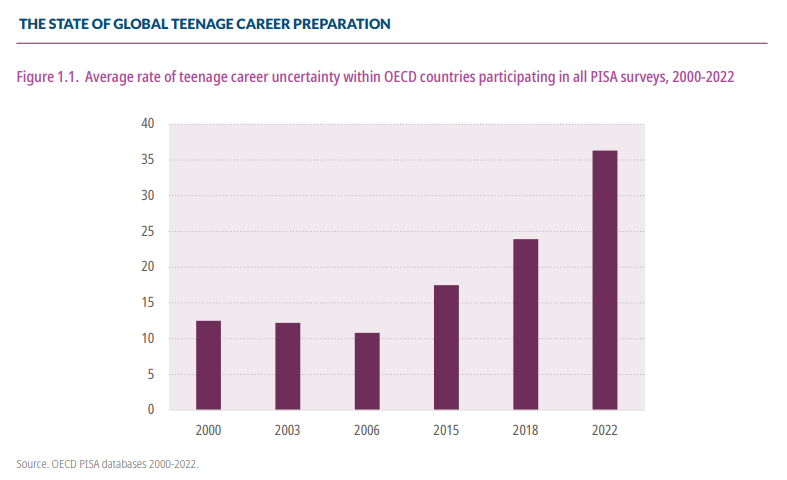
Despite the continuing hope that college can be a gateway to economic mobility, the COVID-19 pandemic contributed to the already considerable challenges that many students face in getting into college and finding their way into the workforce. Illustrating the depths of the problem around the world, OECD’s analysis of survey responses from 690,000 15- and 16-year-old students from more than 80 countries concluded that “students are now expressing very high levels of career uncertainty and confusion. Job expectations have changed little since 2000 and bear little relationship to actual patterns of labour market demand.”
“[S]tudents are now expressing very high levels of career uncertainty and confusion. Job expectations have changed little since 2000 and bear little relationship to actual patterns of labour market demand.”
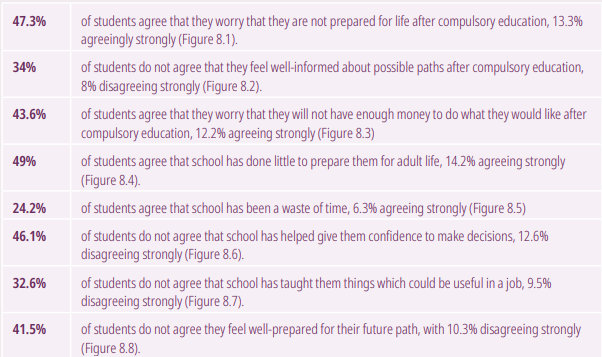
The report, comparing survey results from each of the PISA assessments shows that almost 40% of the students participating in the survey in 2022 are “career uncertain,” up from about 12% in 2000. In addition, almost 50% of all participates agreed or strongly agreed with the statement that “school has done little to prepare me for adult life” and almost 25% agreeing that “school has been a waste of time.”
In the US, concerns about getting in to the workforce combine with challenges that can limit access to college and other post-secondary options. Although recent enrollments in college in the US have begun to increase again, students’ opportunities remain restricted by growing financial barriers, expanding inequities, and a lack of alignment between what students learn in school and what the workforce demands. Additionally, a lack of career pathways for students who may not pursue traditional four-year degrees, limited information about the existing possibilities, and lack of personalized support make it particularly difficult for first-generation college students and other historically disadvantaged groups to navigate both conventional and new post-secondary opportunities. Addressing any of these challenges is likely to get even more difficult in a context where some now question the value of a college education and where the current US administration has attacked many institutions of higher education and the funding streams that support them.
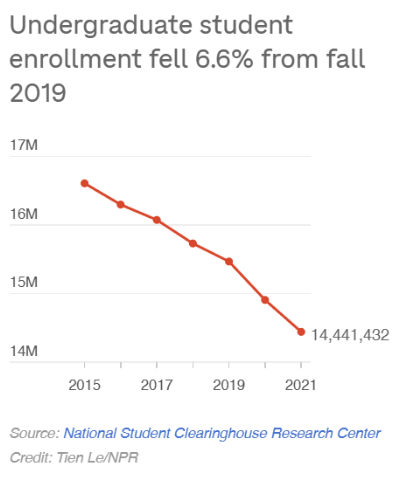
Enrollment dropped—especially at community colleges—though enrollment rates appear to be rising again Between 2019 and 2021, undergraduate enrollment in the US fell by nearly 1 million students, the largest two-year decrease in more than 50 years. As Doug Shapiro, from National Student Clearinghouse explained in 2022, “enrollment in undergraduate and graduate programs has been trending downward since around 2012, but the pandemic turbocharged the declines at the undergrad level.”
In community colleges, in particular, 90% of those responding to a national survey reported enrollment declines in the first year of the pandemic, with 50% reporting declines of more than 10%. Those declines at community colleges continued, amounting to about a 13% enrollment drop over the course of the pandemic. By 2022, entry into two-year colleges was more than 20% lower than it was before the pandemic, with larger drops in Black- and Hispanic-majority colleges. In contrast, entry into four-year colleges declined by about 6%.
Sparking some hope that the enrollment declines are only temporary, more recent figures show that enrollments have begun to rise again. Fall enrollments in 2024 grew by almost 5% in comparison to fall 2023 and slightly exceeded fall enrollments in 2019 before the pandemic began. Enrollment gains were particularly strong in associate programs (up 6.3 percent), bachelor’s programs (up 2.9 percent), master’s programs (up 3.3 percent), and doctoral programs (up 2.0 percent).
College is unaffordable for most low-income students
The recent rise in college enrollments provides some hope that more students will take advantage of post-secondary education, but access to college remains limited by substantial financial barriers, particularly for students from historically disadvantaged communities. The average federal student loan debt in the U.S. is approximately $37,850, contributing to a national student loan debt total exceeding $1.6 trillion. This substantial debt burden influences life choices, with one-third of borrowers indicating it has impacted their ability to continue education, and 14% reporting it has affected decisions such as starting a family. Such financial constraints force many students to forgo higher education or work excessive hours, diminishing their focus on academic and career readiness.
Beyond tuition, textbooks, transportation, housing, and emergency expenses often make higher education inaccessible, even with financial aid. The National College Attainment Network (NCAN) defines an institution as affordable if its total cost —including tuition, fees, and $300 for emergency expenses — can be covered by the sum of grants, loans, Federal Work Study, a proxy for expected family contribution (EFC), and estimated summer wages. When the cost exceeds these combined resources, there is an “affordability gap.”
“Students with unmet need take out more loans, work more hours, face higher degrees of food and housing insecurity, and are at greater risk of forgoing higher education or leaving school without a credential.”
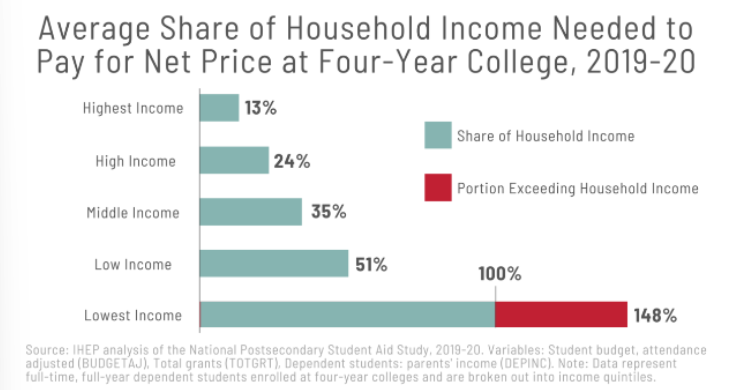
Furthermore, students from the lowest-income backgrounds would need to contribute almost 150% of their household income to cover the full-time cost of a four-year college, even after accounting for grant and scholarship aid. As one illustration of the disproportionate financial burden on low-income families, the share of household income required to pay for college increases dramatically from the highest- to the lowest-income households.
Illustrating the depth of the equity issues, first-generation college students, English learners, and students with disabilities face barriers that make it much more likely that they will drop out before getting a degree. Nationally, 89 percent of low-income first-generation students leave college within six years without a degree. More than a quarter leave after their first year — four times the dropout rate of higher-income second-generation students. Furthermore, the six-year graduation rate of students with disabilities at four-year colleges is 49.5%, compared to roughly 68% for students without disabilities.
Students are unprepared for college and careers
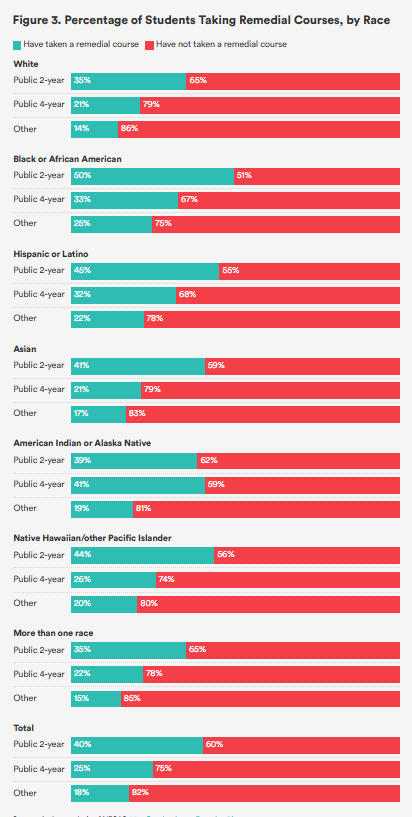
Contributing to the enrollment challenges, high school curricula often fail to align with postsecondary expectations, resulting in high rates of remedial courses particularly for students of color:
Students of color and low-income students continue to be placed into remedial courses at higher rates than their more advantaged peers, and almost half of Black and Latinx students attending public 2-year colleges, and 30% at 4-year institutions have enrolled in at least one remedial course.
The focus on four-year college degrees also overlooks the value of Career and Technical Education (CTE) and other pathways that align with workforce needs.
Next Week: New Pathways into Higher Education and the Working World? Scanning the Post-COVID Challenges and Possibilities for Access to Colleges and Careers in the US (Part 2)
“It’s not always about college”: Teachers’ sense-making around the shifting purpose of high school —Aaron Leo (AL) & Kristen Wilcox (KW), University at Albany (SUNY)
Lead the Change (LtC): What are some of the ideas you hope the field of Educational Change and the audience at American Education Research Association (AERA) can learn from your work related to practice, policy, and scholarship?
AL & KW:NYKids’ research offers a unique contribution to the field of Educational Change considering we are investigating schools which have sustained above-predicted outcomes for an extended time. As all schools are unique, our findings are not meant to be copied and pasted onto every location; instead, we view the lessons learned from positive outlier schools as a partial roadmap which can inspire and inform educators grappling with challenges in their own particular school-community contexts. Moreover, our qualitative approach provides a way to hear directly from educators as they describe, in their own words, their unique school and community ecologies, the obstacles they have encountered, and the particular policies, practices, and programs they have designed to overcome them. Our full dataset from the seven participating schools include: 70 interviews, 43 focus groups, 361 collected documents, and field notes taken during four school tours.
“As all schools are unique, our findings are not meant to be copied and pasted onto every location.”
One aspect common to the positive outlier schools we studied was an effort to make curriculum relevant, engaging, and responsive – especially in the wake of the COVID-19 pandemic and related school closures. For instance, at Lafayette Jr.-Sr. High School, educators have worked to ensure that the sizeable population of students from the Native American Onondaga Nation were provided culturally relevant activities and were represented in the school’s activities, appearance, and values. This process took many forms such as flying the Onondaga flag outside the school, creating a section in the school library featuring Native American authors, and working with a Native American liaison and My Brothers’ Keeper Coordinator to foster positive connections between the school and Onondaga community. At Fillmore, educators also developed culturally responsive approaches, but these looked different in a rural locale with a long history of agriculture. In this context, educators reinstated the Future Farmers of America program and provided hands-on opportunities for students to care for plants and animals on school grounds. To engage their students, Fillmore teachers worked together to create cross-disciplinary lessons and project-based learning opportunities.
We feel that these findings are of high value to the field of Educational Change as they provide examples of educators working to identify and address challenges in varied contexts. As our improvement hub has been supported by the state for over two decades, our research, and research-based tools have attracted the attention of the New York State Department of Education and have been highlighted by our advisory board member organizations including the New York State Council of School Superintendents, The New York State School Boards Association and several others that in turn influence policy in our state.
Kristen Campbell Wilcox, PhD
Aaron Leo, PhD
Call for efficacy: Changes in prior learning assessment (PLA) measures in the Florida college system — Giang-Nguyen T. Nguyen (GN) & Carla Thompson (CT), University of West Florida, Rashmi Sharma (RS), Western Illinois University
Lead the Change (LtC): What are some of the ideas you hope the field of Educational Change and the audience at American Education Research Association (AERA) can learn from your work related to practice, policy, and scholarship?
GN, CT, & RS: The researchers hope that AERA and the field of educational change could be the space to share research that directly impacts the students of the underserved community. The audience at AERA could learn about the current landscape of prior learning assessment (PLA) in Florida. This one segment of research from Florida has far-reaching implications beyond the US. By shedding light on PLA, the researchers hope that the participants from other states and internationally can advocate for transparency and support the community college students. Moreover, the audience at AERA could make the change by being the change they want to see in practice.
“The audience at AERA could make the change by being the change they want to see in practice.”
The researchers are advocating for uniform and sustainable policies at the state level guided by federal guidelines as a critical step in ensuring equitable access to PLA opportunities for community college students. The researchers are hoping that the participants will engage in scholarly discussion about the following implications of the research and provide their insights and actionable suggestions:
Sustainability in Education Systems. Researchers hope to see a shift in thinking about the sustainability of educational reforms related to educational practices and policies. We are advocating for creating a system for continuous improvement on PLA for community college students, where changes could be implemented and evaluated regularly to take into account the needs of different groups of students.
Bridging research to practice. Research shows that students have limited access to PLA information so it is important to provide multiple avenues of information for easy access. Using evidence from the research to inform the practice, the researchers propose changes at the state and federal level policies that involve multiple stakeholder groups.
State-Level Uniformity. Advocate for state-level uniform policies that ensure consistency across institutions, making it easier for students to understand and access PLA opportunities. Such policies can standardize some processes like credit evaluation, eligibility criteria, and application procedures. State mandates can require institutions to make PLA information readily available through multiple channels, such as websites, orientation sessions, social media, and advising services.
Federal Guidelines as a Framework. Federal guidelines can establish minimum standards to ensure that PLA policies promote equity, inclusion, and access for all students, particularly those from underserved communities. The federal government can incentivize states to adopt uniform PLA policies by tying funding or grants to comply with these guidelines. Federal guidelines can encourage states to adopt reciprocity agreements, ensuring that PLA credits earned in one state are recognized in others, thereby supporting student mobility.
Collaboration Across Stakeholders.Encourage collaboration among educators, policymakers, and advocacy organizations to align state policies with federal guidelines. There is a need to consider local needs and provide professional development opportunities to ensure administrators and faculty are well-equipped to implement uniform PLA policies effectively.
Carla Thompson, PhD
Rashmi Sharma, PhD
Giang-Nguyen Nguyen, PhD
Youth and institutional change: The impact of student protests on curricula transformation in higher education — Tafadzwa Tivaringe (TT), Spencer Foundation
Lead the Change (LtC): What are some of the ideas you hope the field of Educational Change and the audience at American Education Research Association (AERA) can learn from your work related to practice, policy, and scholarship?
TT: A key insight from this work [with students in higher education in South Africa and the US] is that practical efforts to facilitate institutional change that are rooted in research stand a better chance of delivering on the promise of transformation. For example, my work finds that while there was a statistically significant increase in course offerings that aligned with students’ demands for more social justice curricula, sentiment analysis of the syllabi of those classes in both country’s colleges demonstrated that a significant proportion adopted neutral framings on the subject. Furthermore, while colleges in both countries adopted courses that had titles and/or course descriptions that referenced social justice, most of the goals of those courses did not involve pedagogical outcomes that explicitly involve addressing injustice. This was despite explicit student demands for curricula transformation that includes ethical commitments to social justice during the #FeesMustFall and #BlackLiveMatter protests (Nyamnjoh, 2016; Taylor, 2016; Tivaringe & Kirshner, 2024). These findings show that there is a gap between students’ input and institutional responses that, if not fully understood, undermines our collective capacity to deepen equity within higher education institutions.
My research underscores a growing call by many educational change scholars on the importance of centering the experiences of those most affected in the policy process (Furlong & Cartmel, 2006; Henry et al., 2013). Too often, policies and programs designed to support people marginalized in the policy making process fail to take their input seriously. This can lead to a false sense of redress and repair. Even more, it can erroneously shift attribution of bad outcomes to individuals, rather than a proper interrogation of the inadequacies of said policies in achieving desired outcomes.
Lastly, there is often a discomfort with the use of quantitative and computational methods in educational change. I must admit that this skepticism is not without cause: those tools have historically been used to stall and/or attack efforts to advance social justice in education (DiGarcia et al., 2018; Dixon-Román, 2017). However, by leveraging a combination of text-mining machine learning algorithms and longitudinal structural equation models to examine the impact of student protests in South Africa and the United States, I join a growing group of critical scholars (e.g., de Freitas & Dixon-Román, 2016; Lukito & Pruden, 2023) who believe and indeed demonstrate that sustainable and effective research on educational change ought to include such tools in its repertoire. Additionally, given the global nature of inequities, it is imperative that reparative efforts learn across contexts. Yet, as we have argued in our work (Kirshner et al., 2021; Tivaringe & Kirshner, 2021) insights in the field of education are disproportionately drawn from the global North. As such, insights that could be critical in learning how to deepen social justice are marginalized. My conference paper offers one instantiation of a comparative approach that, while neither perfect nor exhaustive, ensures that change efforts are informed by both local and global insights.
In this month’s Lead the Change (LtC) interview, Jackie Pelota discusses the role of research in remdying education inequality. Pelota is a Postdoctoral Associate in the Educational Leadership and policy department at the University of Texas at Austin. The LtC series is produced by Elizabeth Zumpe and colleagues from the Educational Change Special Interest Group of the American Educational Research Association. A pdf of the full interview will be available on the LtC website.
Lead the Change (LtC): The 2025 AERA theme is “Research, Remedy, and Repair: Toward Just Education Renewal.” This theme urges scholars to consider the role that research can play in remedying educational inequality, repairing harm to communities and institutions, and contributing to a more just future in education. What steps are you taking, or do you plan to take, to heed this call?
Jackie Pedota (JP): At this pivotal moment, it is more crucial than ever to align our research with action and reflection, bridging the gap between theory and practice. Since Hamas’ attack on Israel on October 7th, 2023, Israel’s counterattack and invasion of Gaza has led to the death of over 30,000 mostly civilian Palestinians, including young children. Students, faculty, and others across campuses have shown their support for the Palestinian people in the aftermath. These overwhelmingly peaceful campus protests took a turn for the worse in April 2024 when they were met with aggressive tactics, retaliation by administrators (e.g., withholding degrees), and police violence. On April 24th, 2024, I witnessed this police violence against students and faculty first-hand at my own campus of the University of Texas at Austin, and it was horrifying.
Students, primarily Arab, Muslim, Jewish, and other minoritized students, bravely stand at the forefront of ongoing protests, actively participating in democratic processes and demanding justice for the Palestinian people. These students work tirelessly to posit alternative futures, repair harm, and alleviate suffering. Yet, they have been met with unprecedented violence and harsh resistance from the very leaders and administrators who promised to support them–and who likely urged them to “change the world” in speeches when they first stepped onto campus at orientation. As an early career scholar and someone who aspires to hold a faculty position one day, it has been disheartening to witness this decoupling of academic researchers’ ideas from their everyday actions.
We in the Educational Change field can learn so much from these students if we listen to them. They are applying what they have learned. They are putting theory into practice to push for substantive change.
Thus, we must ask ourselves: How can we, as scholars, produce research that creates more just, equitable, and liberatory educational systems? To better align these research aims with everyday actions, I think the bare minimum we all can do is to hold space to hear from these students, taking their concerns seriously and advocating via our institutional channels for leaders to drop disciplinary charges. I also believe it is important for me to use my privilege as a scholar to uplift these students’ experiences and, in my research, draw attention to the underlying driving force behind these institutional actions—the well-funded right-wing political infrastructure that is increasingly shaping policies and practices within higher education.
“There is an urgent need to affirm, support, and empower faculty, especially faculty of color, to uphold principles of academic freedom and racial inclusion.”
In the months leading up to the 2025 AERA annual meeting, I hope to see more students, faculty, scholars, and leaders stand in solidarity. If we truly believe in higher education’s role in sustaining a multi-racial democracy, we all should be finding ways to support these students—working with, not against them. We will be working for decades to repair the trust that has been shattered for so many students at colleges and universities across the country. However, we can start this work now. At AERA and beyond, there is hope that we, as Educational Change scholars, will answer the call to produce research while actively repairing our educational systems for those who have been most marginalized by these very systems.
LtC:Your work has involved examining increasing pressures from state legislation restricting teaching and scholarship focused on race and racial inclusion in higher education. What are some of the major lessons that practitioners and scholars of Educational Change can learn from your work and experience?
JP: Currently, I am studying how faculty are changing their practices in response to a wave of legislative efforts to curtail the curriculum, research, policies, and practices focused on diversity, equity, and inclusion (DEI) in higher education. As of May 24th, 2024, 85 bills have been introduced to state legislatures across the country, with 14 successfully passing into law, limiting racial inclusion efforts, free expression, and academic freedom (Lu et al., 2024). Ongoing efforts spearheaded by external right-wing organizations and think tanks, like the Manhattan Institute, represent a coordinated campaign to roll back long-fought civil rights advancements within higher education via the erosion of academic freedom (Kamola, 2024).
Through interviews and observations over the last three years, my colleagues and I have found that, without adequate institutional support, many faculty change their teaching and research on race to protect themselves even when laws are not yet in effect (Pedota, 2023). In response to political and legal threats, faculty, particularly faculty of color, find themselves navigating a complex and shifting landscape with little to no guidance from senior leaders and department-level administrators (Pedota, 2023). Moreover, the communication and guidance faculty receive from higher education administration often reflect an overinterpretation of vague bill language (Reilly, 2024). This results in guidance that is more restrictive than necessary, a dynamic called repressive legalism (Garces et al., 2021). These overly cautious responses are partly driven by public university leaders fearing political backlash and funding cuts (Moody, 2023).
“Without adequate institutional support, many faculty change their teaching and research on race to protect themselves even when laws are not yet in effect.”
When faculty are left alone to interpret and respond to these legal pressures, many act from a place of self-preservation and safety to ultimately suppress racial inclusion work otherwise protected under academic freedom (Pedota, 2023). As faculty of color are the most visible of targets for potential disciplinary action or professional attacks, they feel even more pressure to change their teaching approaches, cancel courses, remove course content, and pause research (Golden, 2023). Ultimately, proposed bills targeting race scholarship and DEI work, even when not enacted into laws, are taking a psychological toll, resulting in poor working environments and the loss of faculty from impacted states (Melhado, 2023; Pedota, 2023). These curricular impacts and departures substantially threaten higher education and democracy, as faculty of color play a vital role in cultivating critical thinking, innovation, and democratic participation (Milem et al., 2005).
Thus, there is an urgent need to affirm, support, and empower faculty, especially faculty of color, to uphold principles of academic freedom and racial inclusion. It is imperative for all faculty to be in solidarity and work as a collective to leverage and uphold academic freedom. My work thus offers timely insights that will benefit faculty as they navigate the current sociopolitical context. Notably, my prior and ongoing work demonstrates the need to create long-term ongoing structures and processes to better educate not just faculty but also college-level administrators on their rights and protections under academic freedom (Pedota, 2023). Previous studies confirm faculty’s uncertainties around academic freedom, highlighting the need to specifically bolster faculty of color’s understandings and access to its rights and protections (Hutchens & Miller, 2023; Kateeb et al., 2012; Rangel, 2020).
The research also illuminates how external actors (e.g., advocacy organizations, civil rights groups, professional associations) are essential for bolstering faculty’s work. However, many faculty are unsure how to begin cultivating these connections, and faculty of color largely feel unsupported and unacknowledged by external actors’ efforts (Pedota, 2023). These external organizations should proactively work with faculty on the ground in impacted states to share information and build organizing capacity.
LtC: Your research has used participatory methods, including oral history, to examine dynamics of organizational change focused on racial equity in higher education institutions. What might practitioners and scholars take from this work to foster better school systems for all students?
JP: I have long been drawn to oral history as a methodology for transformational change. Oral history is the practice of gathering, preserving, and interpreting the unique, first-hand experiences and memories of individual people and communities involved in past events (Oral History Association, n.d.). Many organizations, like Voice of Witness, have pushed the field of oral history further with the goal to democratize storytelling, allowing communities to share their stories in their own words, illuminating contemporary issues in a deeply personal and impactful manner. This approach to oral history, which aligns most with my own, challenges harmful stereotypes, showcases the diversity of experiences, and positions those with lived experiences as experts on racial equity issues, fostering a greater understanding and empathy among listeners.
I have been involved with many local and national oral history projects over the past six years that mostly focused on the experiences of Latino/a/x individuals and communities. For instance, when the Black and Latino cultural centers at my undergraduate institution were at risk of being consolidated into one multicultural center, folks within the Samuel Proctor Oral History Program sprang into action to document and archive the rich and important histories of these spaces to combat this proposed erasure. These efforts amplified the voices of those who had experienced injustice firsthand at a predominantly white institution and underscored the essential role of these cultural centers in ensuring their histories and communities ultimately survive and thrive. In this way, deeply personal narratives, like those gathered through oral history, can be effective in highlighting and humanizing systemic issues within education.
Through my work, I have seen how oral history can promote racial equity by demonstrating storytelling as a powerful tool for social change. This approach to research promotes deeply listening to and learning from marginalized communities—communities that have been deliberately silenced or remain unheard. From my experience with the Voces of a Pandemic Oral History project through the Voces Oral History Center at the University of Texas at Austin, I learned that oral history requires an ethics-driven approach to storytelling to ensure narrators have power and choice in the storytelling process, viewing them as collaborators rather than subjects.
In this oral history project, many narrators were still processing the hardship and trauma experienced during the COVID-19 global pandemic. Listening and learning from communities in this context required me to create and maintain a safe and brave space for folks and employ a trauma-informed approach to interviewing. For instance, interviewers must be cognizant of how trauma can manifest and be vigilant as they interview narrators, providing moments to breathe and be attentive to what that person needs at that moment. Voice of Witness’s Ethical Storytelling Principles and other resources like “Say It Forward: A Guide to Social Justice Storytelling” can provide guidance on these issues, ensuring that stories are told responsibly and respectfully.
Ultimately, by using oral history to document and share powerful first-person testimonies, we can foster a more inclusive and equitable society, where the experiences and insights of those impacted by injustice are not only heard but valued and acted upon to promote change within education. As such, I believe that the many principles that undergird oral history have much to offer practitioners and scholars.
LtC:Educational Change expects those engaged in and with schools, schooling, and school systems to spearhead deep and often difficult transformation. How might those in the field of Educational Change best support these individuals and groups through these processes?
JP: Through my work with student affairs practitioners, college students, alumni, and advocacy organizations, I have learned that disrupting and transforming historically inequitable educational systems requires broad collaborative networks. It is not enough to solely work with people inside of P-20 educational systems, like students and administrators. Transformational work requires coalition building, brave leadership, and redistribution of resources to minoritized groups who remain disadvantaged by current organizational arrangements. To organize for transformational work, scholars must develop and leverage the influence and expertise of those within the broader community, such as families, community leaders, local non-profits, faith-based organizations, and national advocacy and civil rights groups.
On January 1st, 2024, both HB 1 and SB 17 went into effect in Texas, banning the use of state funds for DEI-related efforts, including designated offices, trainings, and diversity statements in faculty hiring. Within this current restrictive context, I have seen the power that the broader community can have to pressure and influence policymakers and institutional leaders. I am part of a coalition of students, alums, faculty, unions, civil rights groups, advocacy organizations, professional associations, and grassroots collectives who work across Texas to combat the legislative efforts by state policymakers to undo decades of racial progress in an increasingly diverse state. In this work, I have witnessed how establishing networks and coalitions outside of formal educational spaces allows those working within these constrained and often oppressive systems to more freely exchange ideas, share experiences, and provide mutual support. Such spaces are especially important during a time when many students, staff, and faculty are receiving little to no information. This coalition has also fostered a sense of community and collective responsibility, making advocating for educational change less challenging and more empowering by knowing you have a group of committed folks behind you.
I believe that scholars within the field of Educational Change should be seeking out and engaging in these kinds of civil rights coalitions and other similar community-based grassroots collectives. Scholars have an important role to play in such coalitions, sharing insights from their scholarship that could inform strategies and approaches for systems change. Transforming educational systems in our deeply divided and inequitable society is a long-term and ongoing process that will require fervent research-informed advocacy and activism for years to come. Ultimately, such change depends upon building a community and a critical mass of stakeholders invested in racial equity.
LtC: Where do you find hope and inspiration for the possibilities of Educational Change going forward?
JP: As someone who studies DEI efforts at this moment, I often feel like my work is a continual uphill battle just to end up in the same place I started. It requires constant effort just to hold our ground, leaving less time and energy for transformational advancements. Those who have been engaged in Educational Change work for a while likely understand these sentiments and can relate. And yet, there is always hope.
During times when Educational Change work feels particularly daunting and almost impossible, I draw hope and inspiration for grassroots activists in the South. I was born and raised in Miami and have lived in South and North Florida for most of my life. I have seen how media outlets and those on social media have characterized politics and policies in the state of Florida with little to no attention to the brave grassroots activism historically led by People of Color.
In the most difficult and dehumanizing of conditions, grassroots organizations like Dream Defenders have persevered to fight for change across Florida. Despite passed anti-DEI legislation, the folks at Dream Defenders remain steadfast in their #Cantbanus campaign, organizing school walkouts and legislative advocacy days to fight against political attacks on public education. Even within the current environment, the Dream Defenders believe change is possible. If they can believe this in the most challenging of environments, then so can I. Their efforts help me see change as a long-term project—where the movement for racial equity is about both the short and long game. The unwavering commitment of Southern activists reminds me that, despite the difficulties, our collective efforts in DEI and educational change can and will pave the way for a more equitable future.
References
Garces, L. M., Johnson, B., Ambriz, E., & Bradley, D. (2021). Repressive legalism: How postsecondary administrators’ responses to on-campus hate speech undermine a focus on inclusion. American Educational Research Journal, 58(5), 10321069.https://doi.org/10.3102/00028312211027586
Hutchens, N. H., & Miller, V. (2023). Florida’s stop WOKE act: A wake-up call for faculty academic freedom. Journal of College and University Law, 48(1).
Milem, J. F., Chang, M. J., & Antonio, A. L. (2005). Making diversity work on campus: A research-based perspective (pp.1–39). Association American Colleges and University.
Rangel, N. (2020). The stratification of freedom: An intersectional analysis of activist-scholars and academic freedom at U.S. public universities. Equity & Excellence in Education, 53(3), 365–381. https://doi.org/10.1080/10665684.2020.1775158
This week, IEN scans the headlines of stories reporting on OECD’s Education at a Glance for 2022. OECD’s Education at a Glance 2022 provides an annual overview of comparative education statistics. The scan includes aspects of the report emphasized by media outlets around the world. See IEN’s Education at a Glance 2021 Scan and Education at a Glance 2019 Scan for comparison.
The unparalleled growth in tertiary education was the focal point of this year’s Education at a Glance report. The OECD notes women now make up the majority of young adults with a tertiary degree, at 57% compared to 43% for males. Across all 25-34 year olds, tertiary education has become the most common educational attainment level, which the OECD attributes to the labor-market advantages tertiary degrees provide. The indicators in the report included student participation, progress, and outcomes, as well as the resources countries invested in tertiary education. Additionally, the report explored educational outcomes from the second year of the COVID-19 pandemic, described by OECD as “a return to normalcy.” Correspondingly, many of the headlines, both those discussing the report in general and highlighting results from particular countries, focused on the results related to tertiary education. As in the past, a number of headlines emphasized problems that the report revealed (Australia; Finland; Ireland; Israel; Italy; Japan) with only a few highlighting more positive findings (Portugal; Spain).
“We must grow multiple pathways to success through an array of post-secondary options, including, of course, the rich array of some baccalaureate options and apprenticeships. ” – Amy Loyd, President of the Kentucky Council on Postsecondary Education
“The share of young adults with advanced qualifications across the OECD, driven by the growing need for advanced skills in labor markets, reached a record 48% of 25-34 year-olds in 2021, compared to just 27% in 2000. Shares of tertiary educated 25-34 year olds are highest in Korea (69.3%) and Canada (66.4%), according to a new OECD report.”
“We have large shares of young people choosing degrees that actually may not exist when they graduate.” – Andreas Schleicher, OECD director for Education and Skills
“Only three countries reported mainstreaming all four aspects of the SDG 4.7.1 on Global Citizenship Education and Education for Sustainable Development which includes policies, curricula, teacher education, and assessment, (Brazil, France, and Spain).”
“The latest OECD Education at a Glance report shows Australian public education expenditure was cut by nearly 2 per cent from 2019 to 2020, by comparison the OECD average rose by around 1.5 per cent.”
“In 2000, the proportion of highly educated younger adults in Finland was among the highest in the OECD countries, in the same league as the United States and South Korea. In 2021, instead, Finland’s position had dropped well below the OECD average, ranking at the level of Chile and Turkey.”
“According to the report, the rate of young people neither working nor in school (NEET) is considered quite high in Israel, standing at 22%, compared to 16% in the OECD average.”
“The proportion of young people in Italy who are not in education, employment or training (NEET) has increased significantly since the start of the COVID-19 pandemic… the proportion of 25-to-29-year-olds who are NEETS climbed to 31.7% in 2020 and then rose further to 34.6% in 2021.”
“Japan had the lowest share of female staff in tertiary education in 2020 among 32 comparable member countries of the Organization for Economic Cooperation and Development, at 30%…Women represent 45% of academic professionals across OECD countries on average.”
“The number of young New Zealanders with tertiary qualifications had grown in the past 10 years, but not as much as in most other OECD nations… In New Zealand the percentage of 25 to 34-year-olds with tertiary qualifications rose 16 percentage points from 29 percent in 2000 to 45 percent in 2021.”
“The findings appear to show that graduates everywhere receive higher salaries in the workplace than colleagues without degrees – particularly in Portugal where they can end up earning double the salaries of less qualified counterparts. The report cites Information Technology and Communication as the sector in Portugal paying the highest salaries.”
“Scottish head teachers tend to be paid more than the average earned by their counterparts in countries such as Finland, New Zealand and France – but they lag behind heads in England, new figures show.”
“This was an increase of 8.4 points more than in 2011 and nearly 15 points or 34 percent compared to 2000. Moreover, the figure is above the average for the OECD countries, where the percentage is 46.9 percent, and also above the average for 22 EU countries (45.9 percent), Erudera.com reports.”
Switzerland
Vocational training drives tertiary qualification rise in Switzerland “The proportion of 25- to 34-year-olds with a tertiary qualification has doubled in Switzerland within 20 years, and at a faster pace than many other countries, according to an OECD study. A key factor in this: Swiss-style higher vocational training and degrees for apprentices.”
“U.S. elementary school teachers’ work hours haven’t changed much since 2019, but at more than 1,000 a year on average, American educators work more than 200 more hours than their peers worldwide.”
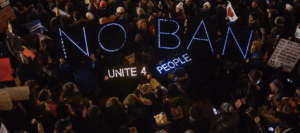
On January 27, 2017, United States President Donald Trump issued an Executive Order temporarily withholding entry to the U.S. to individuals from seven predominantly Muslim countries. In addition, aspects of the current visa and refugee program were suspended. The order has affected many people and caused confusion worldwide. Since it was established, news reports show that the order is also having an impact on higher education institutions around the world. Therefore, we decided to conduct a brief scan of reports that share information on how the ban will effect higher education, and how school leaders in the U.S. and around the world are responding.
Image: Getty
Universities and scholars are grappling with what the restrictions of the travel ban means for students and scholarship. One primary concern is for international students and faculty who are studying and working in U.S. institutions, but who happened to be outside of the country when the order was signed and are now unable to return. Additional concerns have been raised about the future of longstanding partnerships between universities in the US and in affected countries, such as Iran. Terry W. Hartle, senior vice president at the American Council on Education, was quoted in the Times Higher Education: “What we have is, frankly, a matter of significant concern and a great deal of confusion and very little clarity.”
According to Business Insider, tens of thousands of students across the country could be affected. Dallas News detailed how the ban will impact students in colleges and universities in Texas. Southern Methodist University has 49 students from the seven affected countries; The University of North Texas has 85 students; the Dallas County Community College District has 47; UT-Dallas has 127; Texas Tech University has 149; UT-Austin has 110; and the University of Houston has 280. Students and staff are being warned not to travel and to avoid the Texas-Mexico border checkpoints.
A coalition of 598 college and university presidents signed a letter to President Trump urging that the travel ban be rescinded. As reported by The Hill, this letter was sent to Homeland Security Secretary John Kelly through the American Council on Education (ACE). As reported in The Boston Globeand in Time Magazine, these higher education leaders said that the order “specifically prevents talented, law-abiding students and scholars from the affected regions from reaching our campuses. American higher education has benefitted tremendously from this country’s long history of embracing immigrants from around the world.”
Since the implementation of the Executive Order, there has been some speculation that the travel ban could benefit countries wiling to take the displaced students and faculty—such as Canada, Australia, and Ireland. For example, Memorial University of Newfoundland, in Canada, has offered to waive the application fees of students applying from the seven countries named in the Executive Order—hoping to attract new talent to the school. In an article just published in the New England Journal of Medicine, two physicians at the University of Pittsburgh Medical Center explore the consequences of the travel ban and point out that international medical graduates currently fill gaps in the American healthcare system, particularly in rural areas.
Meanwhile, protests and demonstrations continue. Yesterday, hundreds of New York City high school students walked out of school in protest of the ban. As reported in Chalkbeat, students filled Manhattan’s Foley Square, chanting “No hate! No fear! Refugees are welcome here!” College students have also been protesting in many states, including Vermont, Maine, Illinois, California, Massachusetts, and even in the UK.
OSLO—There’s a saying in famously egalitarian Norway that Curt Rice, the American-born incoming president of the country’s third-biggest university, likes to rattle off: “We’re all sitting in the same boat.”
What it means, said Rice, is that, “To single out anyone, we’re against that. That just does not sit well in the Norwegian soul.”
So all Norwegians have the same tuition-free access to college, no matter what their backgrounds. Every student gets the same allowance for living expenses.
But something surprising is happening in Norway, which explains a similar phenomenon in the United States that has been thwarting efforts to increase the number of Americans pursuing higher education.
Even though tuition is almost completely free here, Norwegians whose parents did not go to college are just as unlikely to go themselves as Americans whose parents did not go to college.
This conundrum demonstrates a critical point that’s widely misunderstood, according to higher-education experts: money is not the only thing keeping first-generation students from seeking degrees.
Even though it’s essentially free, only 14 percent of children from the least-educated families in Norway go to college, compared to 58 percent of children from the most-educated families.
“This is almost a laboratory case, where we get to control one factor — namely, cost — and see what happens,” said Rice, who in August will take over as head of Norway’s Oslo and Akershus University College.
And what happens is that — even though it’s essentially free — only 14 percent of children from the least-educated families in Norway go to college, compared to 58 percent of children from the most-educated families, according to an analysis by a Norwegian education researcher, Elisabeth Hovdhaugen.
That’s almost exactly the same proportion as in the United States, where the cost of college is borne largely by students and their families, and where the Organization for Economic Development and Cooperation reports that only 13 percent of children of parents without higher educations end up getting degrees themselves.
“I don’t think that people do understand it’s not about money,” said John Gomperts, president and CEO of America’s Promise Alliance, a coalition of organizations trying to steer more young people to and through college in the U.S.
It’s a huge issue, considering that fully one-third of five- to 17-year-olds in the United States have parents who did not go to college, the College Board reports, at a time when policymakers are trying to increase the number of Americans with degrees. They’ll be needed to fill the 65 percent of jobs by 2020 that will require some sort of college or university training, according to the Georgetown University Center for Education in the Workforce.
“Norway is an interesting window into this,” Gomperts said. “If you come from a background where everyone goes to college, there’s no question that you’ll go to college. But if you grew up in a challenging community where nobody went to or succeeded in college, there’s no one at home who is going to know how to navigate the system. It takes the right amount of social preparation and support. That’s the magic.”
The Norwegian system eliminates some obstacles in addition to cost. Except for kindergarten, primary and secondary schools are funded nationally, not locally, for example, so there’s ostensibly no difference in education quality between higher- and lower-income towns and cities, as there might be between wealthy suburban and poor urban districts in the United States. And the Norwegian funding system is very easy to understand, while the American system of grants and loans is complex and often confusing, even to families with college-going experience.
But the principle of social equality in Norway also means that there are no programs providing academic support to first-generation or low-income students in college, although there are a few for immigrants and women in fields in which they are underrepresented.
“Helping students from low socioeconomic status does not happen at all,” Hovdhaugen said in her office at the Nordic Institute for Studies in Innovation, Research and Education, across the street from the royal palace in Oslo. “It’s the idea of the equitable society, and that students are considered adults, independent of their parents. You could almost turn it around and say that if the students whose parents with high income were not eligible for support, that would be judged as very unfair.”
Also, because wages remain high for blue-collar occupations, she said, there’s less of a financial incentive for some Norwegians to bother with college, since they can get jobs more quickly, and earn almost as much money, working as plumbers or electricians. American advocates for higher education worry that a similar thing might be happening in the U.S., as people increasingly question the return on investment for degrees; a new federal report shows that the average annual earnings of 25- to 34-year-olds with bachelor’s degrees actually fell from $53,210 in 2000 to $46,900 in 2012, even as tuition continued to rise.
“A bachelor’s degree in the U.S. has been seen as one serious option for getting into the middle class, whereas in Norway everything is a ticket into the middle class, because everyone is in the middle class,” Rice said. “It’s now less clear that it really is a ticket into the middle class in the U.S.”
American students’ scores on the SAT and other college entrance exams also correlate with the level of their parents’ educations; the better-educated a student’s parents, the higher he or she scores on the tests, according to the College Board, which administers the SAT.
Since education affects income, children whose parents didn’t go to college are also unlikely to be well off, said Margaret Cahalan, vice president for research at the Pell Institute for the Study of Opportunity in Higher Education. And families that are less well off are statistically more likely to face health problems, problems with the law and unplanned pregnancies, among other challenges.
Students from such backgrounds “are going to be on average facing more obstacles than a student who comes from a more advantaged background,” including nonfinancial ones, Cahalan said.
With a third of U.S. primary and secondary school students now coming from families without higher educations, the most important lesson is that cultural, and not just economic, considerations may keep many of them from going on to college.
Young people from backgrounds such as these, when considering whether or not to go to college, often “don’t even really know that they can go to the library and borrow books” instead of buying them, said Gomperts.
“How do you know that? You’re not born knowing such a thing. And who’s going to tell you? Stripping away the money piece shows how complicated this is.”
In 2013, Karen Hammerness and Kirsti Klette reported on the efforts to improve teacher education in Norway. In this post, following recent conversations with members of the Ministry of Education in Norway, Hammerness puts the work on teacher education in historical perspective and describes some of the latest developments.
Norway is a particularly interesting country to follow in terms of teacher education policy. Questions about the quality of education came to the forefront in 2000, with the publication of the first PISA results (what some Norwegians refer to as “the PISA-shock”). Those results showed that Norwegian students had not performed as well as many had hoped or expected. In fact, along with students in the United States, Norwegian students’ outcomes, were slightly lower than the average of the OECD countries measured. Concerns continued to mount when the second round of PISA revealed Norwegian students’ performance declining further.
A weak system of teacher education was considered to be one of the key problems. Policy makers and educators pointed to several key challenges. First, teacher preparation was organized around a ‘generalist’ conception of teaching. At the time, the Norwegian system of teacher certification allowed teachers to teach all subjects at all grade levels—a conception captured by the term allmenlærer—roughly translated as “teacher of all.” Next, the quality—and size—of teacher preparation programs varied considerably throughout the country. Furthermore, teacher education coursework in the programs seemed disconnected from teaching practice and was not tightly tied to current research on teaching and learning. Finally, reports suggested a steady decline in applications to teacher education institutions, amplifying concerns about a lack of qualified teachers in the near future.
Teacher education reforms
In response, over the last five years, Norway has invested heavily in funding for work on teacher education and teaching and made a number of important policy changes. In 2010, building upon a white paper that had summarized key concerns about preparation of teachers, Norway transformed their system of certification and established two ‘lines’ or ‘streams’ of certification—a stream that prepares teachers for grades 1-7 (somewhat similar to a primary school certification in the US), and another that prepares teachers to teach grades 5-10 (when lower secondary school ends in Norway). A new national curriculum framework for teacher education was also developed and came into effect in 2010. The framework required more coursework on pedagogy and learner knowledge, including an emphasis upon research-based subject-specific methods, learners’ development, and classroom management. The new framework also created new graduation requirements including the completion of a bachelors’ thesis, related to teaching and learning. In addition, new regulations stipulated that teacher education programs would need to increase the percentage of faculty who have completed doctoral studies—ultimately, requiring programs to ensure that 50% of faculty have PhDs.
A proposal was also made to address some larger ‘structural’ issues that affected the quality of higher education. In particular, in 2008, the government released a report calling for a reduction in programs in higher education, including teacher education. Correspondingly, some policymakers expected that the new requirements might lead to significant restructuring, particularly among smaller and more remote teacher education programs. Conceivably, such programs might decide to focus upon one degree; they might start to share students, collaborate or even merge with other local institutions; or the programs might determine that they could not meet the new demands and might voluntarily choose to close.
Responses to the reforms
These moves to streamline programs are not easy in a country like Norway. Teacher preparation has been central to the identity of many of the smaller institutions throughout the country—reflecting a social policy that has been supportive of small institutions in a country in which the population has been somewhat ‘spread out’ across a wide geographical area. The existence of such small, local academic institutions (and teacher preparation programs) reflects a national investment and policy support for the deeply held value of living and working locally. This support for living in in widely-dispersed regions throughout the country in fact has been a historical Norwegian value–and it seems understandable, given that Norway spans about 2,500 miles from north to south (and, with 25,000 miles of rugged coastline, it is among the ten countries with the longest coastlines).
Norwegian educators point out that teacher education programs have been central to supporting and financially maintaining smaller regional institutions of higher education. As Øyvind Johnson, a Senior Advisor at the Ministry, noted, “Teacher education is the pillar of many of these small institutions.” Many of these institutions prepare only a very few teachers every year (although of course, they also are intended to prepare teachers who are committed to remaining local). For instance, reflective of the small scale of some of these institutions: a recent report found that of the twenty programs in Norway that prepare teachers for teaching in grades 1-7, as many as twelve institutions have fewer than 50 student-teachers, and two have as few as nine students.
The new requirements have put considerable strain on some of the smaller institutions throughout Norway to redesign, develop new curriculum, and to change program expectations. However, Ministry representatives reported that none of the programs thus far had chosen to focus only upon one certification ‘stream’ nor had any programs voluntarily closed entirely. At one point, the Ministry considered requiring programs to have a minimum of twenty students in order to remain open, but never put such a requirement in place. As Johnson noted, “If programs had under twenty applicants, what would you do?” In short, policymakers have been trying to develop policies that both strengthen programs and continue to provide support for small, local institutions (and local communities) all the while, maximizing flexibility and equity of participation. Not surprisingly, under these conditions, the number of teacher education programs that offered the allmenlærer degree has not changed since the reform: there were twenty programs prior to the latest reforms, and twenty remain.
What’s Next: A continued focus on “existing programs”
In considering future steps to continue to improve teacher education, the ministry has also just released a new strategy, Lærerløftet (or, raising teachers), which has set forth a set of key themes for continued improvement of teacher education. Top among them is the requirement that teachers in both streams will have to obtain a master’s degree. By 2017, all teacher education programs must be structured as 5-year programs. Senior advisors from the Ministry reported that several reasons underlay that decision: the desire to ensure that teachers are substantially well-prepared and the belief that an additional year beyond a Bachelor’s degree provides more depth of training; more support for teachers to use research in their teaching and to draw upon scientific knowledge in their work; and an opportunity for teachers to develop an understanding of the research base of teaching and learning through their work on a Master’s thesis. As Dalen Tennøe explained, “We looked to Finland, that teacher education should be research-based.” The latest strategy also calls for tightening requirements for entry into teacher education—Norwegian students are graded on a scale of 1-6 (1 being lowest and 6 highest), and currently the requirement has been that to enter teacher preparation one needed a three average in mathematics and Norwegian. Now, prospective teachers will need at least a four in mathematics to enter teacher education. Illustrating the challenges however, at the same time that the policy makers use the example of Finland to support the strengthening of these requirements, a recent newspaper article with the headline “Yrket som falt fra statustoppen” (the profession fallen from high status), shows that critics of these policies also use Finland as an example to argue that teachers should be granted greater autonomy without policy makers’ intrusions.
However the debate develops, Norwegian policymakers are not considering the development of alternative routes into teaching as a policy lever for improving teacher preparation. (For a related argument on why policy makers might not consider alternative pathways into teacher education, see Pasi Sahlberg’s post on why there is no Teach for Finland.) Senior Advisors in Norway were quite clear that the focus of policy was improvement of current programs, not on adding new or alternative pathways. Although Norway does have a “Teach First” program, it is the only alternative program in the country—it is offered at the University of Oslo and has only 20 students. As Fredrik Dalen Tennøe, Deputy Director General, Norwegian Ministry of Education and Research, noted, “The main focus has been improving the teacher education programs which are there already, not introducing new [pathways] into the schools.”







 International Education News