Tag Archives: OECD

High satisfaction, high demands, and changing demographics: Scanning the headlines on the results of the TALIS 2024 (Part 2)

Teachers’ workloads, AI use, and the status of the teaching profession overall are among the key issues highlighted by the media sources that covered the recent release of OECD’s Teaching and Learning International Survey (TALIS) 2024. In this second part of a two-part post, IEN rounds up some of the headlines that discuss the results for different countries. Part 1 provided a summary of OECD’s results, and Part 2 will For comparison, see previous coverage of the release of the results of TALIS 20218 (Volume 1; Volume 2).

Headlines around the world

Albania

Albania among top OECD countries in international teachers’ survey results, Albanian Telegraphic Agency

“…98% of Albanian teachers are satisfied with their profession, while only 3% experience high levels of stress—the lowest rate compared to the OECD average of 19%.”

Australia

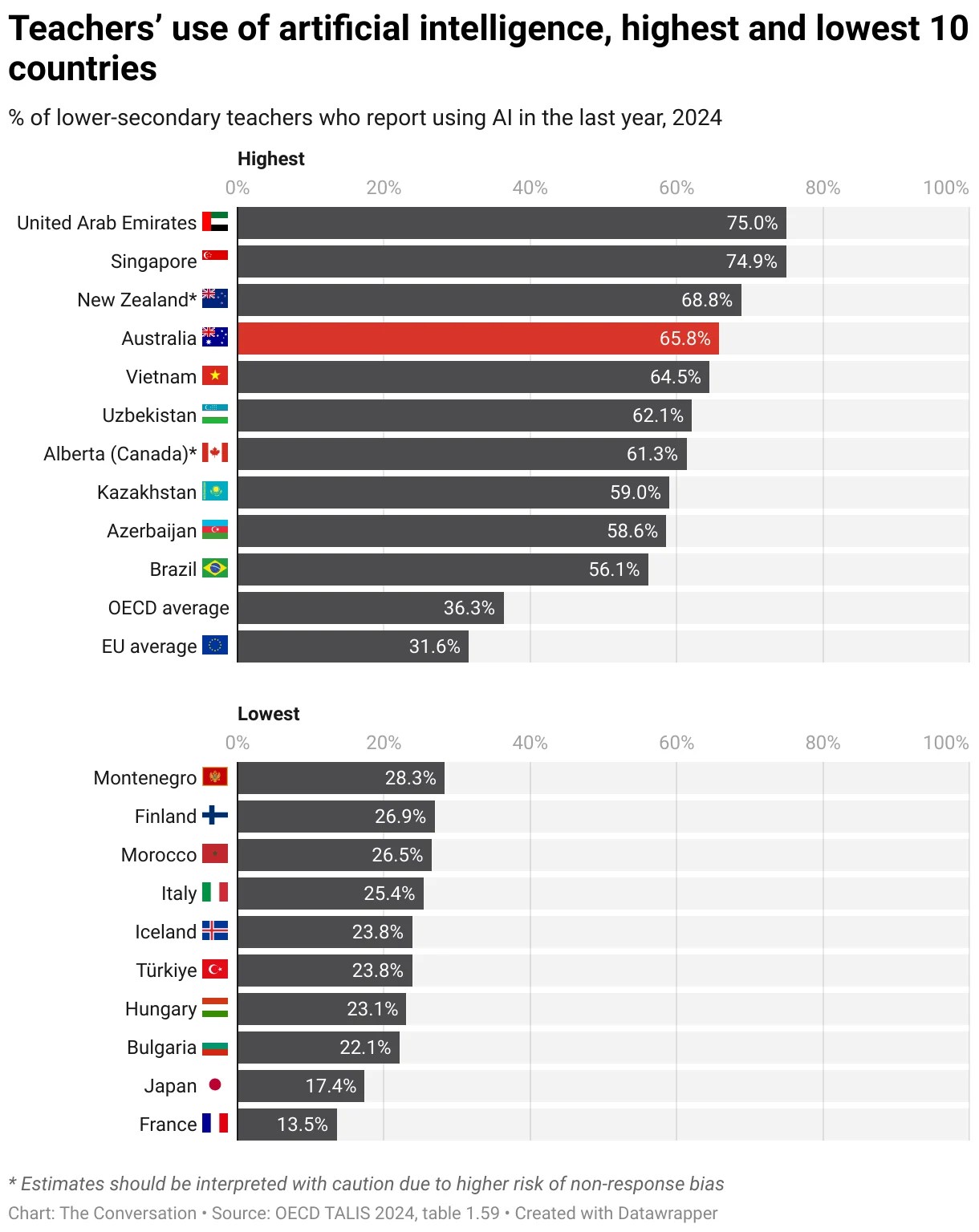
Australian teachers are some of the highest users of AI in classrooms around the world, Yahoo News Australia

Australian teachers are among the world’s most stressed – despite low class time, The Advertiser

Australian teacher shortage among worst in the OECED, SchoolNews.com

“Australia is now among the top three OECD countries for teacher shortages in public schools. That is unacceptable for a wealthy, developed nation.”

Austria

New teachers hardly feel prepared for everyday school, Vol.at

Belgium

Teachers report high stress due to administrative burden, Belganewsagency.eu

“A striking 70 percent of lower secondary school teachers in Belgium report stress from too much administrative work, far above the OECD average.”

Canada – Alberta

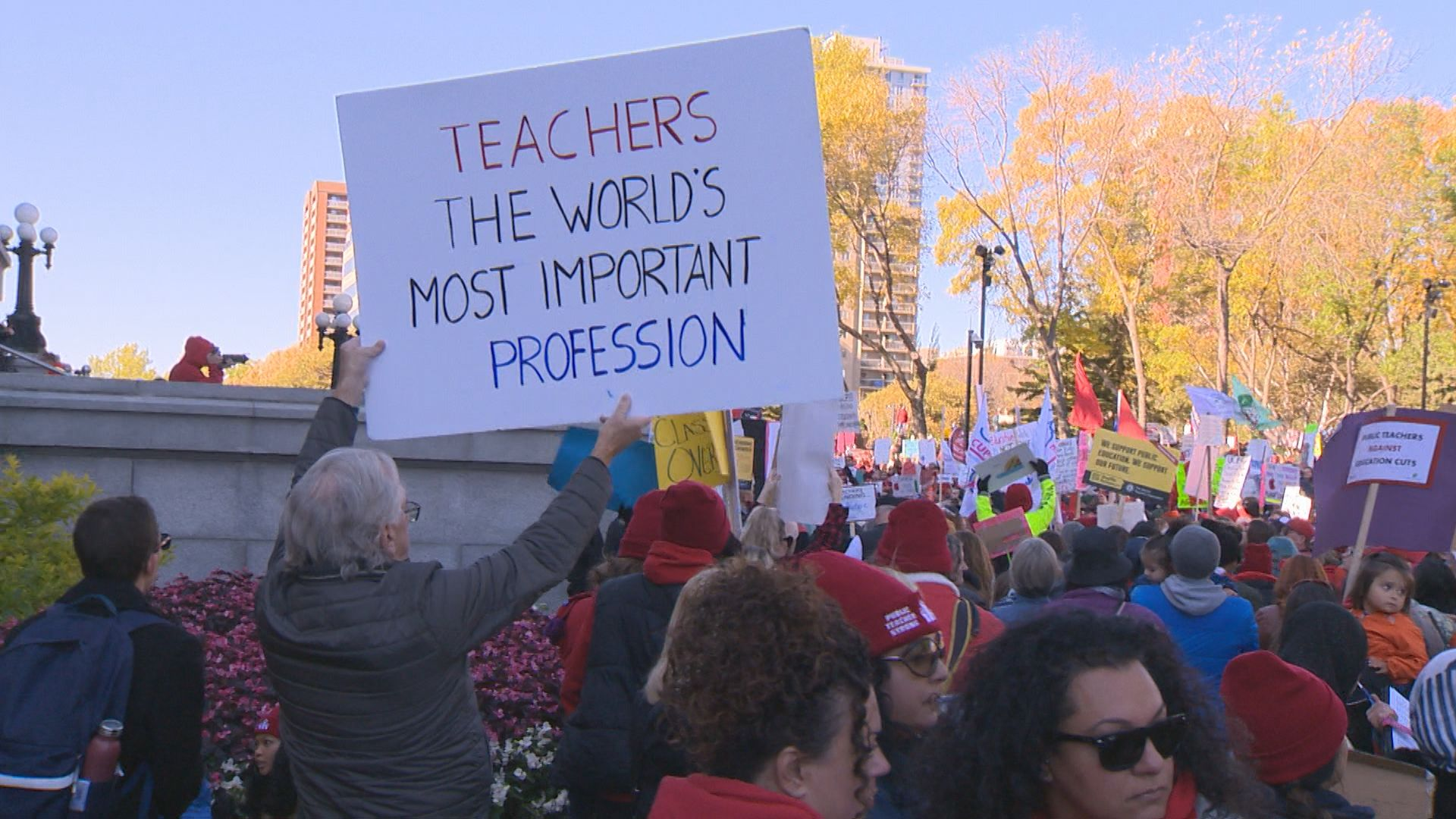
Alberta teachers report highest stress levels globally, CityNews Calgary

Source: Zach Dafoe, CityNews

Costa Rica

AI surges in Costa Rican schools ahead of official policy, TicosLand

Artificial intelligence, in this particular case, can likely contribute significantly to reducing the teacher’s workload. Because if it is used appropriately and efficiently, it can streamline many processes such as receiving information, reviewing in-class assignments, grading exams, and organizing activities.”

Croatia

Croatian teachers among the most education, however, the workload is constantly increasing, PortalHr

Czechia

Young teachers are disappearing: Why is the profession uninteresting even though salaries are improving, Iustecko.cz

“Despite higher satisfaction with salaries, the profession suffers from low social recognition. Only 22% of teachers feel that society values ​​their work, and only 15% of educators perceive recognition from political representation.”

Estonia

Study: Nearly half of teachers plan to change jobs in the coming years, ERR

Finland

TALIS 2024: Lower secondary teachers are satisfied with their work — Increasing diversity in schools challenges teachers to learn new skills, Valtioneuvosto

“The growing diversity in schools and the increasing need for student support are reflected in teachers’ professional learning needs. Areas for development included using artificial intelligence, teaching students with special education needs, supporting students’ social and emotional development, and teaching in multicultural or multilingual settings.”

France

Teaching in France: a despised and increasingly difficult profession on TALIS 2024 Survey, cafepedagogique.net

Hungary

Hungarian teachers report rising satisfaction and greater autonomy, OCED TALIS survey shows, The Hungarian Conservative

Source: Hungarian Conservative

Iceland

Almost all teachers satisfied with jobs — but pay worries persist, RUV.is

“Icelandic teachers are among the most dissatisfied with their pay: only 19% are content with their salaries, compared with an average of one third across the OECD.”

Israel

Israeli teachers satisfied but face staffing crisis, The Jerusalem Post

Japan

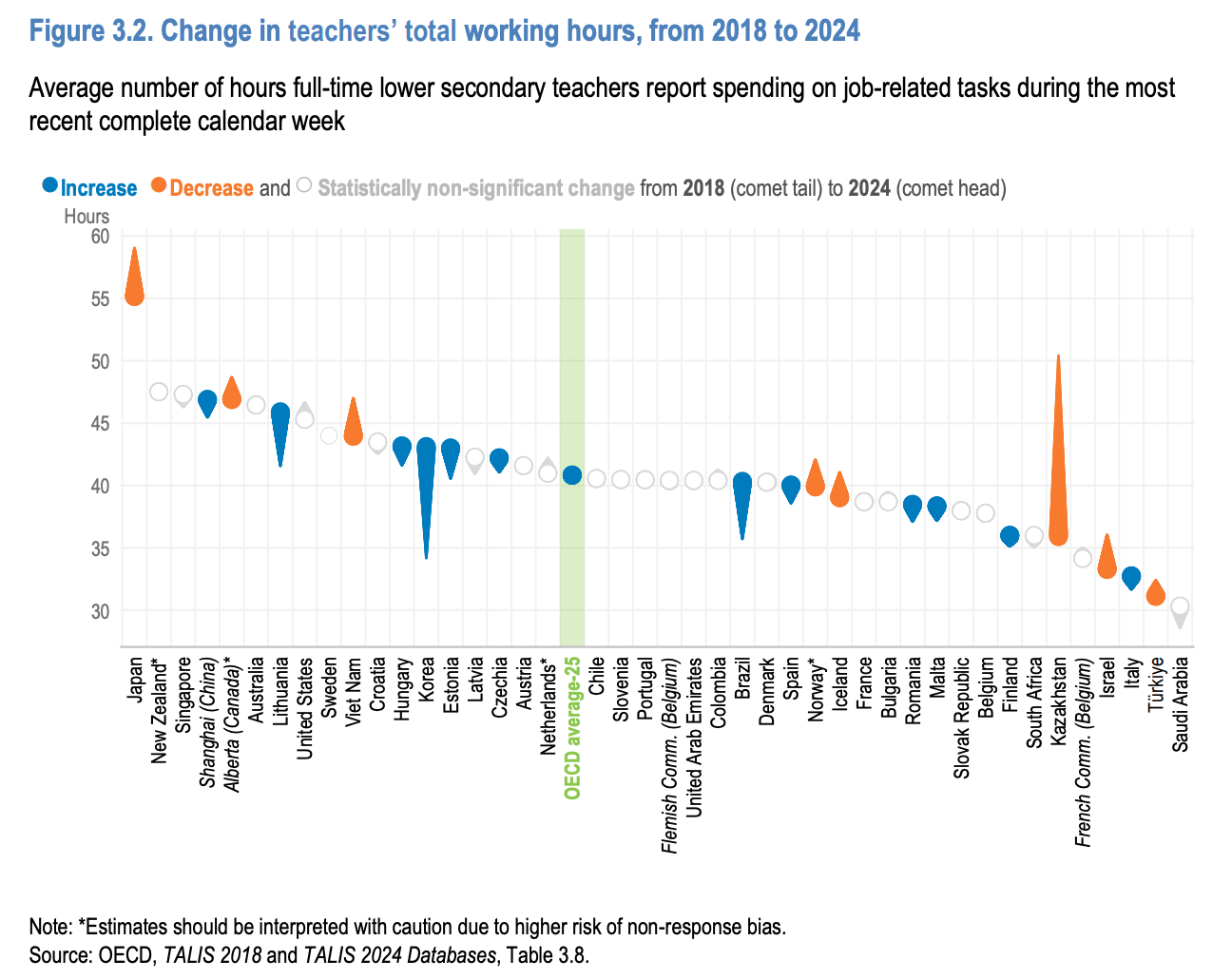
Japan’s teachers work longest hours among OECED peers, Nikkei Asia

Latvia

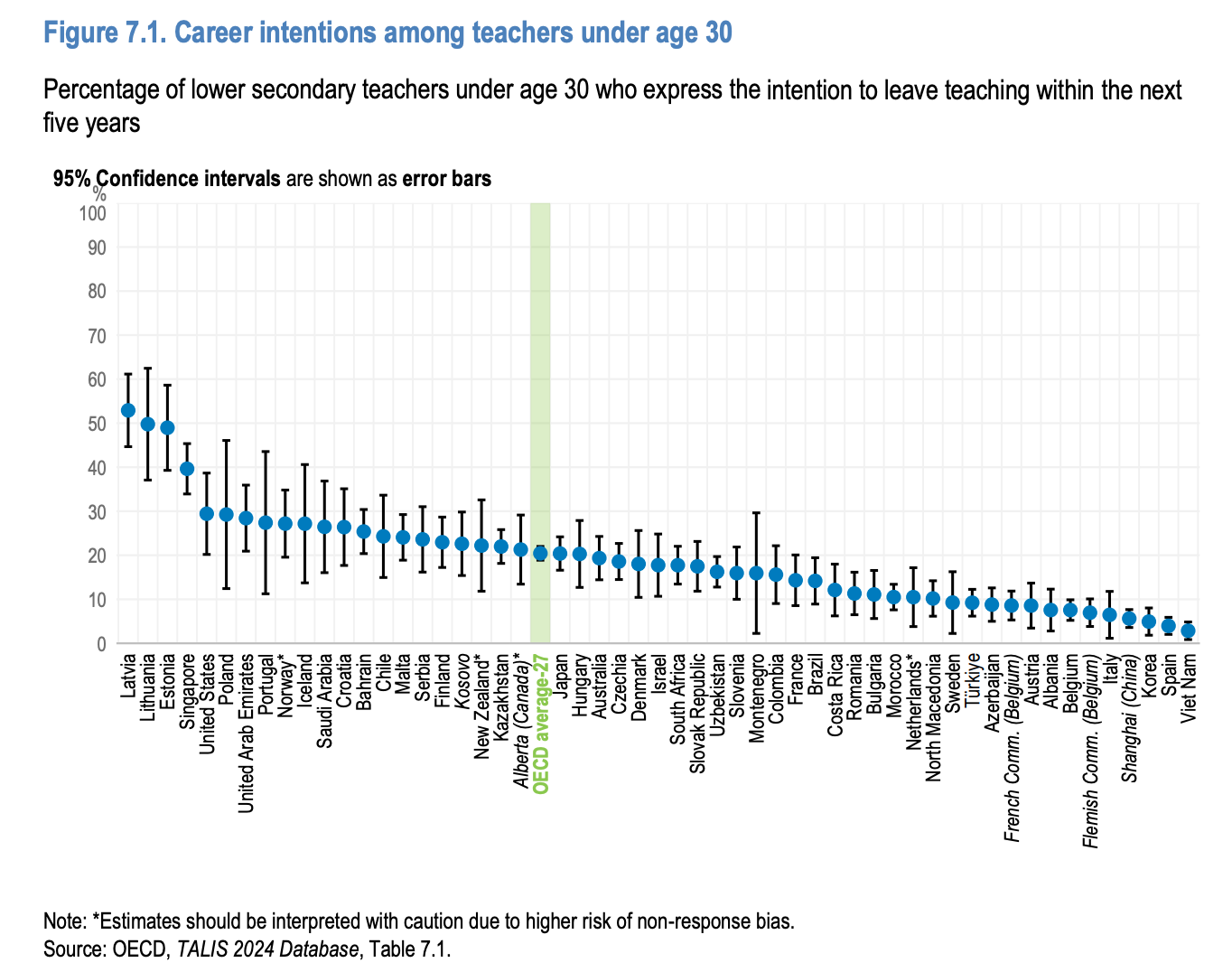
Half of new teachers in Latvia could leave the profession within five years, Baltic News Network

“Half — or 53% — of new teachers in Latvia may leave the profession within the next five years, according to the initial results of the OECD Teaching and Learning International Survey.”

Lithuania

Most Lithuanian teachers higher confident, happy with their working conditions, The Baltic Times

New Zealand

Initial teaching training needs strengthening, The National Tribune

OCED TALIS 2024: NZ teachers lack confidence in core teaching skills, gov’t acts, Devdiscourse

“Education Minister Erica Stanford acknowledged the findings, noting that 62% of graduate teachers lack confidence in teaching the content of all the subjects they handle, and 54% are unsure of how to teach these subjects effectively using proper pedagogical approaches.”

Portugal

Portugal faces an urgent need for 38,000 new teachers by 2034, Cnedu.pt

Portuguese teachers among the most satisfied in the OECED, Portugal Pulse

Singapore

Global survey finds Singapore teachers spend less time teaching and marking, but work longer hours, The Straights Times

Source: MDDI

3 in 4 Singapore teachers use AI, more than double overseas peers: OCED Survey, The Straights Times

South Korea

Over half Korean teachers identify parental complaints as major source of stress, Korea JoongAng Daily

South Korean teachers top OECD in career regret due to stress, The Chosun Daily

“It has been found that the stress South Korean teachers experience due to parental complaints and students’ verbal violence is among the highest globally.”

Spain

Almost half of the secondary school teachers in the State believe that initial training is not adequate, Diari ARA

Spain is one of the countries where the fewest teachers consider leaving the profession, Sur in English

Source: Sur in English via Álex Sánchez

Sweden

Swedish Teachers Report Job Satisfaction Despite Stress and Challenges, Sweden Herald

“Nine out of ten upper secondary school teachers like their job, and the proportion who expect to stay in the profession has increased. But Swedish teachers also testify to stress and chaos.”

United States

For teachers, work-life boundaries are harder to keep than ever, Education Week

“[N]early 30% of U.S. teachers report frequent on-the-job stress, compared to less than 20% for OECD countries on average. U.S. teachers were also more likely to report that teaching had taken a toll on their mental and physical health. U.S. lower secondary teachers worked on average more than 45 hours a week in 2024, nearly five hours more than the OECD average.”

High satisfaction, high demands, and changing demographics: Scanning the headlines on the results of the TALIS 2024 (Part 1)

90% of teachers around the world say they are satisfied with their jobs, but many also face an increased workload that challenges their work life balance. In this two part post, IEN explores these and other findings from OECD’s Teaching and Learning International Survey (TALIS) 2024. Part 1 provides a summary of OECD’s results, and Part 2 will round up some of the headlines that highlight the results from different countries. For comparison, see previous coverage of the release of the results of TALIS 20218 (Volume 1; Volume 2).

Most teachers are happy in their jobs,” declared the OECD, but demographic and technological changes contribute to increasing demands on teachers around the world.  Those are two of the take-aways from the report on the results of the 2024 TALIS survey. Launched first in 2008 with a survey of 23 countries, OECD has also carried out the survey of teachers and school leaders in 2013 and 2018 to compare educator’s perceptions, working conditions, and learning environments. In 2024, around 280,000 educators from 55 education systems participated in the survey. Among the other key findings in 2024:

Job satisfaction

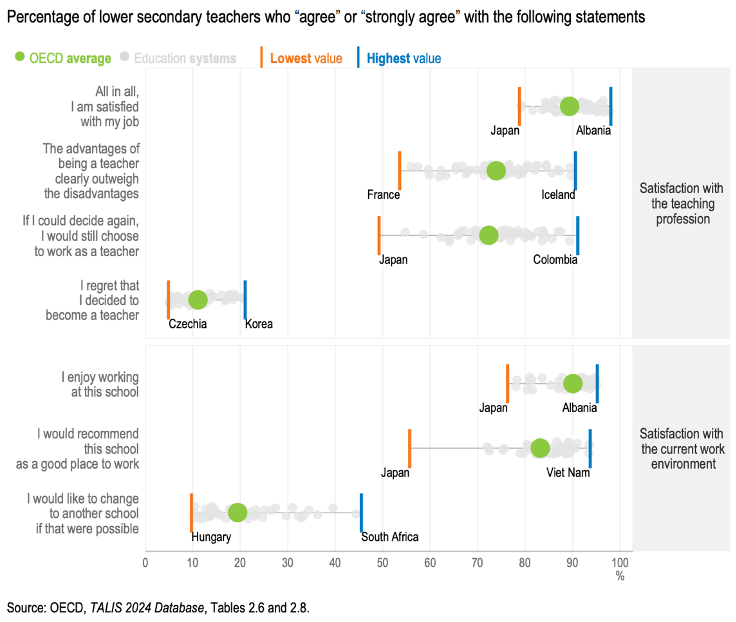
On average, almost 9 out of 10 teachers report that they are satisfied with their jobs.

  • In South Africa, teacher satisfaction has risen by 8% since 2018
  • In Colombia, 90% of teachers say they would become a teacher again.

Value of the teaching profession

Around 2 out of 3 teachers say they are valued by parents and guardians, but with significant variations:

  • Over 90% of teachers feel valued in Vietnam Saudi Arabia, United Arab Emirates, Uzbekistan
  • Less than 50% of teachers feel valued in French-speaking Belgium, Croatia, France, and Japan
  • Saudi Arabia, Bulgaria and Denmark have increased the share of teachers who feel valued by almost 20%

Age

The average age of teachers across the OECD is 45 years-old, but:

  • More than half of teachers are 50 or older in Estonia, Hungary, Latvia, Lithuania
  • The average age of teachers is 38 or 39 in Türkiye, Morocco, the United Arab Emirates and Uzbekistan

Workload and stress

Roughly half of teachers report excessive administrative work as a source of work-related stress

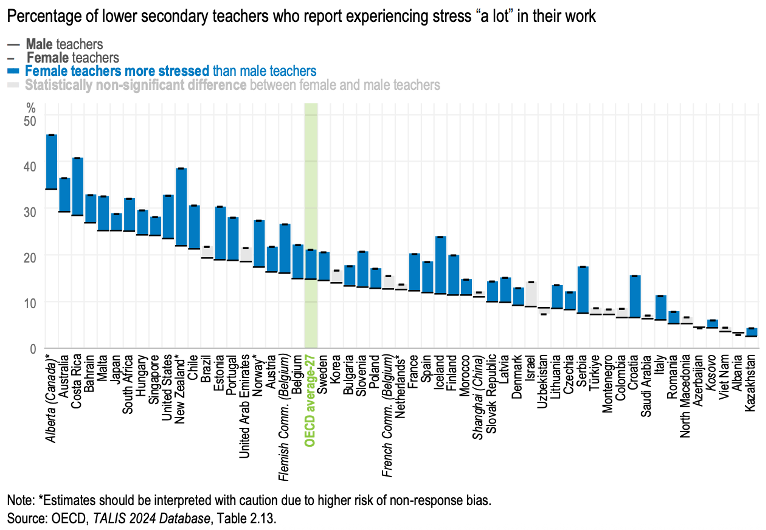
  • The share of female teachers reporting stress “a lot” in their work is 21% compared to 15% for male teachers.
  • Japanese teachers work almost 55 hours a week (down from 60 hours a week in 2018, the highest in the world).
  • Teachers’ sources of stress are more closely linked to constant, unsupported change than to resource shortages

The amount of time spent maintaining discipline has increased in almost all education systems since 2018

  • About 1 in 5 five teachers, on average, report significant disruptive noise and disorder in their classrooms.
  • More than half of teachers in Brazil report such disruptions, compared to about a third of teachers in Chile, Finland, Portugal and South Africa
  • Less than 5% of teachers in in Albania, Japan and Shanghai (China) report facing such disruptions

Preparation

Almost 4 out of 5 teachers participated in regular teacher preparation programs to obtain their initial qualification, but:

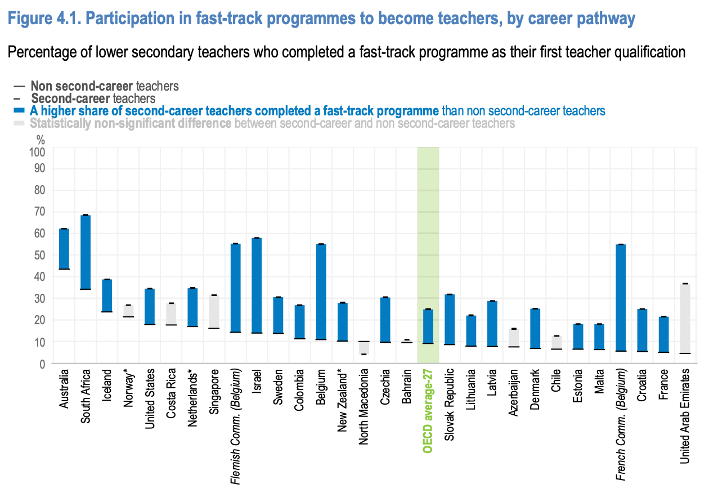
  • More than half of teachers in Australia, Costa Rica, Kazakhstan, Romania, Saudi Arabia and South Africa, do not follow the regular path through teacher education
  • Almost half of teachers in Australia and almost a third of teachers in Iceland completed “fast-track” or specialized teacher education program
Source: OECD, TALIS 2024

Teacher evaluation and support

Almost 90% of teachers work in schools where they are formally evaluated at least once a year by school leaders, and:

  • 65% of teachers are engaged in post-evaluations discussions about how to improve their teaching.
  • Slightly less than half of teachers are offered “development or training” plans, ranging from over 90% of teachers in Bahrain and Kazakhstan to under 15% in Iceland.
  • A little over 10% of teachers participate in programs where they are offered financial incentives and less than 5% participate in programs that include potential sanctions.

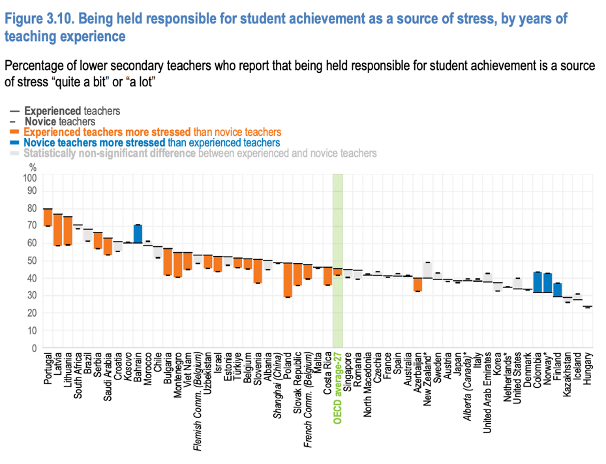
Almost half of teachers’ report that being held responsible for students’ achievement is a source of significant stress:

  • Over 70% of teachers in Latvia, Lithuania, Portugal and South Africa report such stress
  •  Less than a third of teachers in Finland, Hungary, Iceland and Kazakhstan report this stress
Source: OECD, TALIS 2024

Roughly 20% of teachers, on average, participate in mentorship programs: 

  • Almost 80% of teachers in Shanghai (China) report having an assigned mentor and over 60% of teachers with high self-efficacy report exchanging materials with peers, more than double the percentage of teachers with low
  • In systems like Uzbekistan over two-thirds of teachers with high self-efficacy report observing other teachers’ classes and providing feedback

AI and online learning

1 in 3 teachers, on average, report using AI in their work:

  • Roughly three-quarters of teachers in Singapore and the United Arab Emirates (UAE) use AI
  • Fewer than 20% of teachers in France and Japan use AI

Over 15% of teachers, on average, work in schools where at least one class was taught hybrid, but:

  • Over 80% of teachers in Singapore, and over 45% of teachers in Israel and the UAE report working schools where at least one class was taught hybrid or online

Next week: High satisfaction, high demands, and changing demographics: Scanning the headlines on the results of the TALIS 2024 (Part 2)

Scanning the headlines for creativity around the world: PISA Creative Thinking Assessment 2022

Can students think outside the box? That’s the question that OECD’s PISA test on creative thinking attempts to answer. This week, IEN shares a scan that pulls together the headlines from those countries where we found reports on the test results. IEN’s previous PISA scans include: Scores Plummet Around the World: Scanning the Headlines on the Release of the 2022 PISA Results; Headlines Around the World PISA 2015 Edition; Headlines around the world: PISA (2015) Collaborative Problem Solving; and Headlines around the world: PISA (2015) Well-Being Report

Despite attempting to assess an entirely different set of skills, the results of OECD’s 2022 test of creativity shows that the top scorers – Singapore, Korea, Canada, Australia, New Zealand, Estonia, and Finland –  are many of the same countries that score highest on the PISA tests of reading, math, and science. 

Other results highlighted in OECD’s report include: 

  • Roughly half of the students who excelled in creative thinking did not excel in academic domains.
  • Girls performed much better than boys; in terms of average performance, boys did not outperform girls on the creativity assessment in any participating system. 
  • Socio-economically advantaged students performed better than less advantaged peers, but the association between socio-economic status and performance is not as strong as it is in mathematics, reading and science.

OECD bases the test on a definition of creative thinking as “the competence to engage productively in the generation, evaluation, and improvement of ideas that can result in original and effective solutions, advances in knowledge, and impactful expressions of imagination.” OECD’s description of the assessment also notes that this definition focuses on “little c’ creativity” that “15-year-old students can reasonably demonstrate, and underlines that students need to learn how to engage productively in generating ideas, reflecting upon ideas by valuing their relevance and novelty, and iterating upon ideas until they reach a satisfactory outcome.”

Australia

Australian teenagers strong creative thinkers, ACER Discover

Oz students rank amongst world’s leading creative thinkers – but what does that mean?, EducationHQ

Belgium

Flemish pupils score well for creative thinking, VRT NWS News

England

“Secondary school students in England feel less able to express ideas at school and are less likely to report being able to take part in creative activities compared with their peers in many other countries, according to a major international assessment. And they are less likely to say that their teachers value creativity, according to the latest report from the Programme for International Student Assessment (Pisa) on creative thinking, from research carried out in 2022.”

Students in England less likely to say creativity is valued, TES

Finland

Finnish students excel in PISA creativity rankings, Yle News

Germany

“For 27% of students tested in Germany, the levels correspond to creative thinking skills that are strongly indicative of future success in the career world. Meanwhile, 22% were barely able to generate ideas for simple visual designs and written descriptions or find solutions to problems.”

Study finds German students rank middle of the pack in creative thinking, phys

German Youth Occupy Median Position in Global Assessment of Creative Thinking Based on Pisa Study, Aussiedlerbote

Hong Kong 

Hong Kong students score behind first-place Singapore in global study on creative thinking, South China Morning Post

Latest Pisa results show Hong Kong education stuck inside the box, South China Morning Post

Korea

“Korea scored above the OECD average in creative thinking in school environment and participation in creative school activities. The ministry said “We were able to confirm school efforts to improve the creative thinking skills of students.” On the nation’s low score in the creative thinking self-efficacy index, the ministry quoted the OECD as saying countries with higher scores in creative thinking tend to have lower indexes in self-efficacy.”

15-year-old students’ creative thinking ranked 2nd by OECD, korea.net

New Zealand

“Compared to other countries/economies, a relatively large proportion (39 percent) of Aotearoa New Zealand students were ‘top’ creative thinkers and most (86 percent) performed at or above baseline proficiency. “Expressing creativity through writing and social problem solving was a strength of Aotearoa New Zealand students, as was generating diverse and creative ideas. They did less well in scientific problem solving, visual expression and evaluating and improving ideas.”

NZ teens score highly for creative thinking, RNZ News

Philippines

PH students second to last in creative thinking —PISA, GMA News

“The Philippines’ score may be concerning, but some may have seen the writing on the wall long before the PISA results came out. Our educational system tends to emphasize creativity only at the preschool level, dramatically shifting to more traditional methods of education such as rote memorization and ‘right versus wrong’ approaches from First Grade onwards.” 

The Philippines ranked at the bottom of a global creative thinking test. How do we fix this?, adobo

Poland

Polish pupils outperform OECD average in creative thinking study, TVP World

Scotland

“New data suggests Scottish teachers are doing a good job of encouraging creative thinking – but the government’s decision to opt out of new Pisa test means evidence is limited”

Scotland absent from first Pisa report on creative thinking, TES Magazine

Serbia

Serbian students achieve substandard results on PISA’s creative thinking tests, Serbian Monitor

Singapore

Singapore’s 15-year-old students score top marks in OECD’s creative thinking test, The Straits Times

Singapore students top PISA study on creative thinking, despite not thinking of themselves as creative, CNA

United States

“The OECD had difficulty reviewing U.S. schools’ instructional practices for creativity and innovation, because practices differ significantly among states and districts, and did not release U.S. results.”

What Schools Can Learn From a Global Assessment on Creative Thinking, Education Week

Happy New Year from IEN!

IEN will be taking a break over New Year’s returning with our first stories of the year on January 9th. In the meantime, please revisit some of our most viewed stories of the year and have a restful, peaceful, and healthy New Year!

What’s changing in classrooms and schools right now? Micro-innovations for teaching, learning and education (Part 1)

What’s changing in classrooms and schools right now? (Part 2) Micro-innovations supported by private and public sources

Scanning the headlines for results from OECD’s Education at a Glance: October 2022 Edition

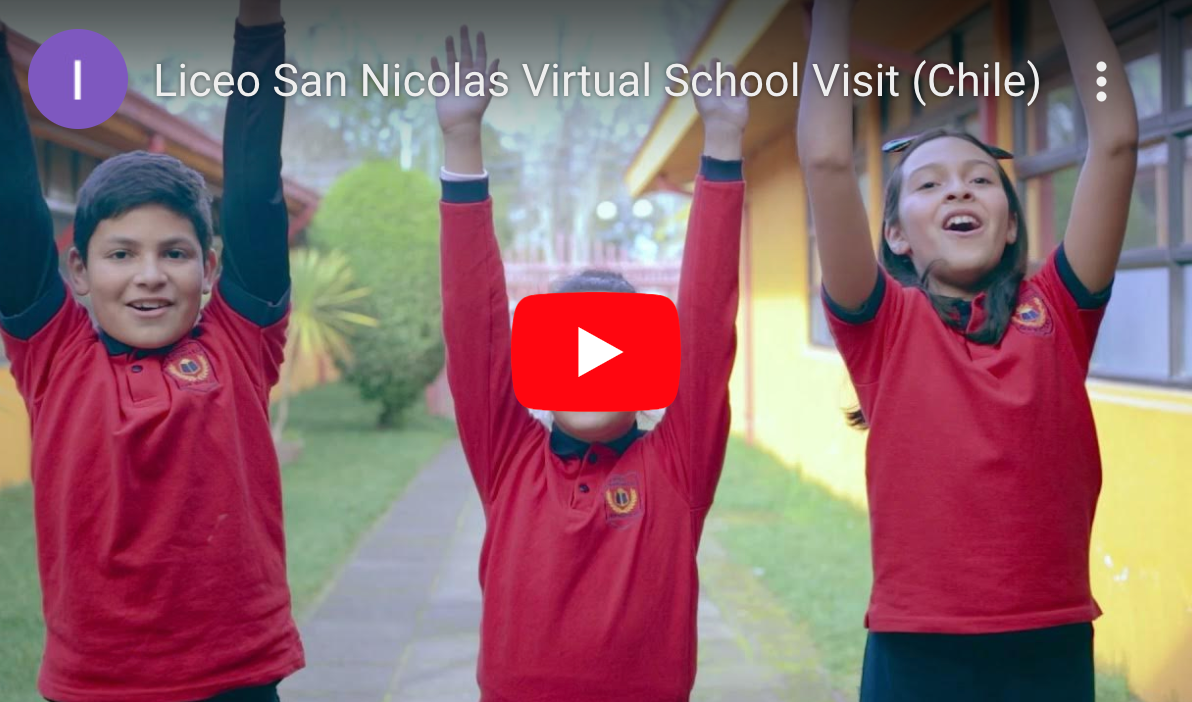
Promoting equity through language access: A virtual visit to Liceo San Nicolas (Chile) and Easton Academy (UK)

Building equal learning opportunities for differently-abled children in Malawi: An interview with Patience Mkandawire on the evolution of Fount for Nations (Part 1)

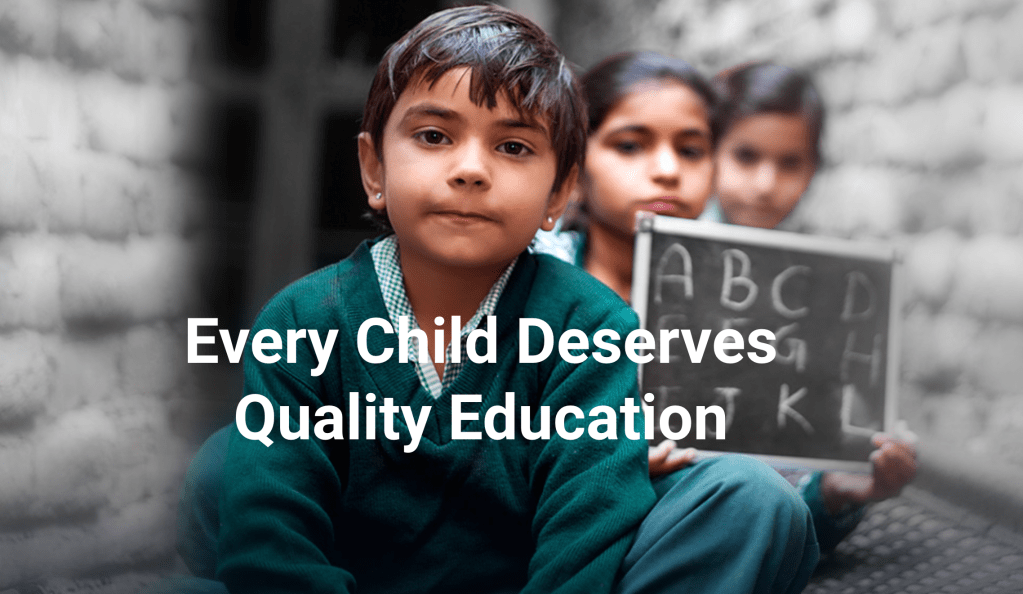
From a “wide portfolio” to systemic support for foundational learning: The evolution of the Central Square Foundation’s work on education in India (Part 1)

Scanning the headlines for results from OECD’s Education at a Glance: October 2022 Edition

This week, IEN scans the headlines of stories reporting on OECD’s Education at a Glance for 2022. OECD’s Education at a Glance 2022 provides an annual overview of comparative education statistics. The scan includes aspects of the report emphasized by media outlets around the world. See IEN’s Education at a Glance 2021 Scan and Education at a Glance 2019 Scan for comparison.

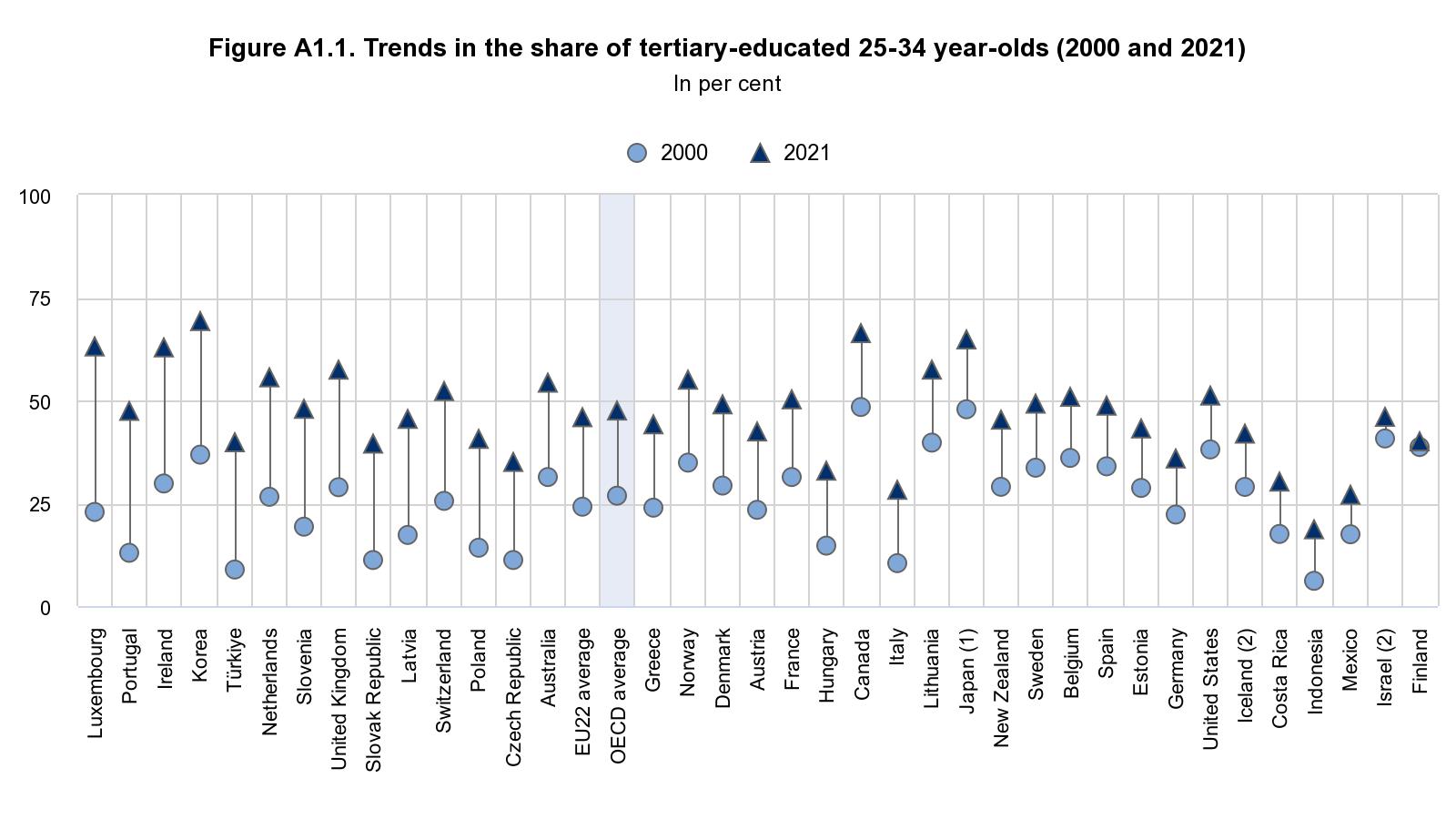
The unparalleled growth in tertiary education was the focal point of this year’s Education at a Glance report. The OECD notes women now make up the majority of young adults with a tertiary degree, at 57% compared to 43% for males. Across all 25-34 year olds, tertiary education has become the most common educational attainment level, which the OECD attributes to the labor-market advantages tertiary degrees provide. The indicators in the report included student participation, progress, and outcomes, as well as the resources countries invested in tertiary education. Additionally, the report explored educational outcomes from the second year of the COVID-19 pandemic, described by OECD as “a return to normalcy.” Correspondingly, many of the headlines, both those discussing the report in general and highlighting results from particular countries, focused on the results related to tertiary education. As in the past, a number of headlines emphasized problems that the report revealed (Australia; Finland; Ireland; Israel; Italy; Japan) with only a few highlighting more positive findings (Portugal; Spain). 

Figure 1: Trends in the share of tertiary-educated 25-34 year-olds (2000 and 2021), OECD

International 

Education at a Glance 2022: Higher Education Still Pays Off, OECD and NCEE

We must grow multiple pathways to success through an array of post-secondary options, including, of course, the rich array of some baccalaureate options and apprenticeships. ” – Amy Loyd, President of the Kentucky Council on Postsecondary Education

Tertiary education rates reach record high, with more efforts, Mirage News

“The share of young adults with advanced qualifications across the OECD, driven by the growing need for advanced skills in labor markets, reached a record 48% of 25-34 year-olds in 2021, compared to just 27% in 2000. Shares of tertiary educated 25-34 year olds are highest in Korea (69.3%) and Canada (66.4%), according to a new OECD report.”

Many students choosing useless decrees over learning skills, OECD official says, The National

“We have large shares of young people choosing degrees that actually may not exist when they graduate.” – Andreas Schleicher, OECD director for Education and Skills

Education at a Glance: Addressing the need to build a more effective and equitable education system, International Education

“Only three countries reported mainstreaming all four aspects of the SDG 4.7.1 on Global Citizenship Education and Education for Sustainable Development which includes policies, curricula, teacher education, and assessment, (Brazil, France, and Spain).”

Australia 

Australia’s public education funding went backwards during COVID pandemic, ABC

“The latest OECD Education at a Glance report shows Australian public education expenditure was cut by nearly 2 per cent from 2019 to 2020, by comparison the OECD average rose by around 1.5 per cent.”

Finland

OECD comparison: educational attainment of Finnish young people fallen below average, Finnish Ministry of Education

“In 2000, the proportion of highly educated younger adults in Finland was among the highest in the OECD countries, in the same league as the United States and South Korea. In 2021, instead, Finland’s position had dropped well below the OECD average, ranking at the level of Chile and Turkey.”

Ireland 

Ireland is worst in OECD for education spending as percentage of GDP, report finds, The Irish Times
“Ireland spends less than 36 other developed countries on its education system, when spending is measured as a portion of countries’ gross domestic product (GDP), according to a new report from the OECD.”

Israel 

The OECD report: about a quarter of the young Israelis are neither working nor in school, Globes

“According to the report, the rate of young people neither working nor in school (NEET) is considered quite high in Israel, standing at 22%, compared to 16% in the OECD average.”

Italy

OECD says 34.6% of 25-29-yr-olds in Italy are NEETS [Not in Education, Employment or Training], ANSA

“The proportion of young people in Italy who are not in education, employment or training (NEET) has increased significantly since the start of the COVID-19 pandemic… the proportion of 25-to-29-year-olds who are NEETS climbed to 31.7% in 2020 and then rose further to 34.6% in 2021.”

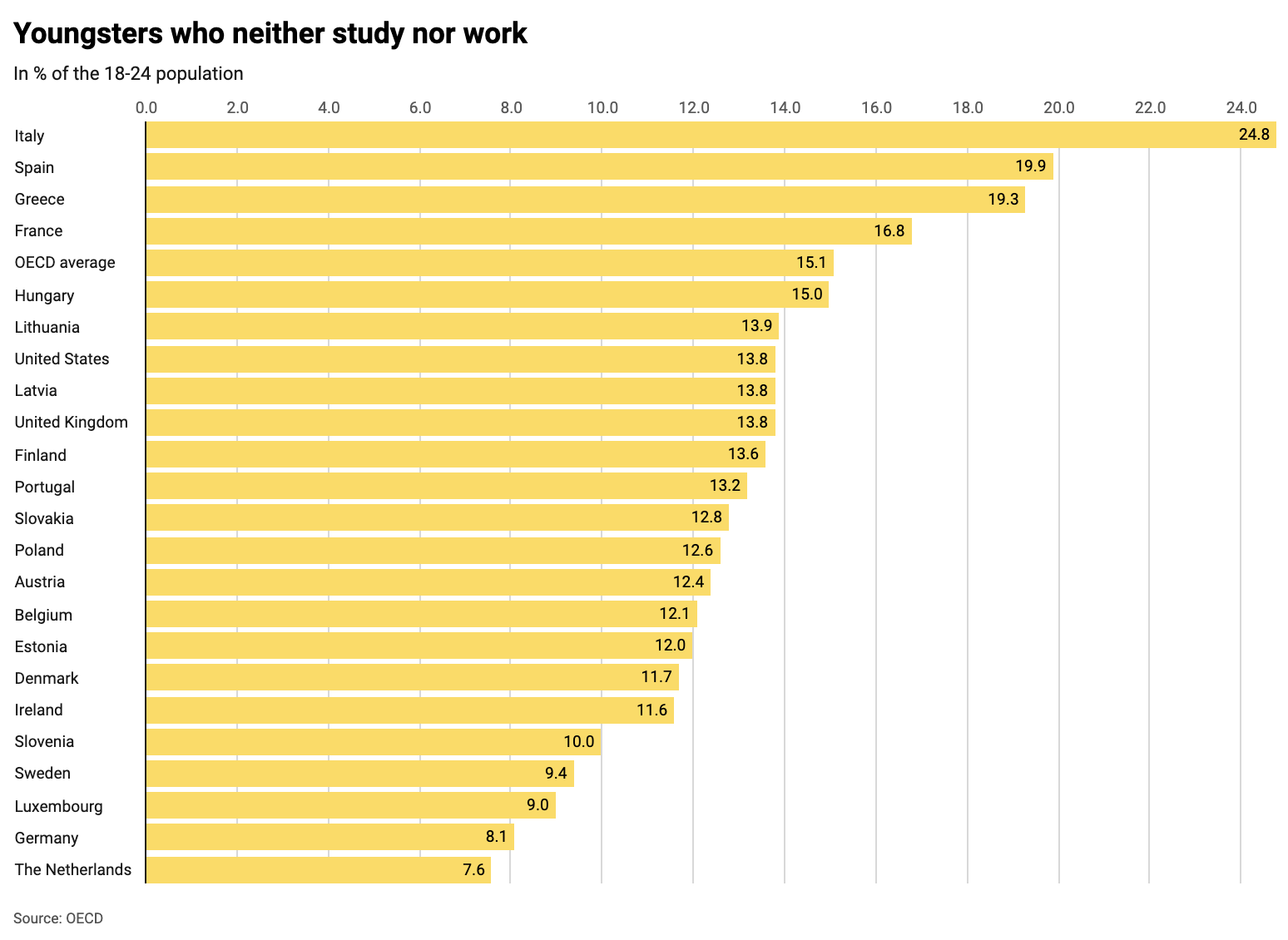
Figure 2: Trends in the share of NEETs among 18-24 year-olds (2019 and 2021, annual date), OECD

Japan

Japan ranked last in women staff in tertiary education: OECD, The Japan Times

“Japan had the lowest share of female staff in tertiary education in 2020 among 32 comparable member countries of the Organization for Economic Cooperation and Development, at 30%…Women represent 45% of academic professionals across OECD countries on average.”

New Zealand 

How NZ education compares to other OECD countries, RNZ

“The number of young New Zealanders with tertiary qualifications had grown in the past 10 years, but not as much as in most other OECD nations… In New Zealand the percentage of 25 to 34-year-olds with tertiary qualifications rose 16 percentage points from 29 percent in 2000 to 45 percent in 2021.”

Portugal

University graduates in Portugal earn more than double salaries of those that left school at 18, Portugal Resident 

“The findings appear to show that graduates everywhere receive higher salaries in the workplace than colleagues without degrees – particularly in Portugal where they can end up earning double the salaries of less qualified counterparts. The report cites Information Technology and Communication as the sector in Portugal paying the highest salaries.”

Scotland 

How do Scottish head teacher salaries compare?, TES

“Scottish head teachers tend to be paid more than the average earned by their counterparts in countries such as Finland, New Zealand and France – but they lag behind heads in England, new figures show.”

Spain

Nearly 50% of Spanish Students Aged 25-34 have a Higher Education Degree, Erudera News

“This was an increase of 8.4 points more than in 2011 and nearly 15 points or 34 percent compared to 2000. Moreover, the figure is above the average for the OECD countries, where the percentage is 46.9 percent, and also above the average for 22 EU countries (45.9 percent), Erudera.com reports.”

Switzerland

Vocational training drives tertiary qualification rise in Switzerland 
“The proportion of 25- to 34-year-olds with a tertiary qualification has doubled in Switzerland within 20 years, and at a faster pace than many other countries, according to an OECD study. A key factor in this: Swiss-style higher vocational training and degrees for apprentices.”

United States

U.S. Teachers work more hours than their global peers. Other countries are catching up. EducationWeek 

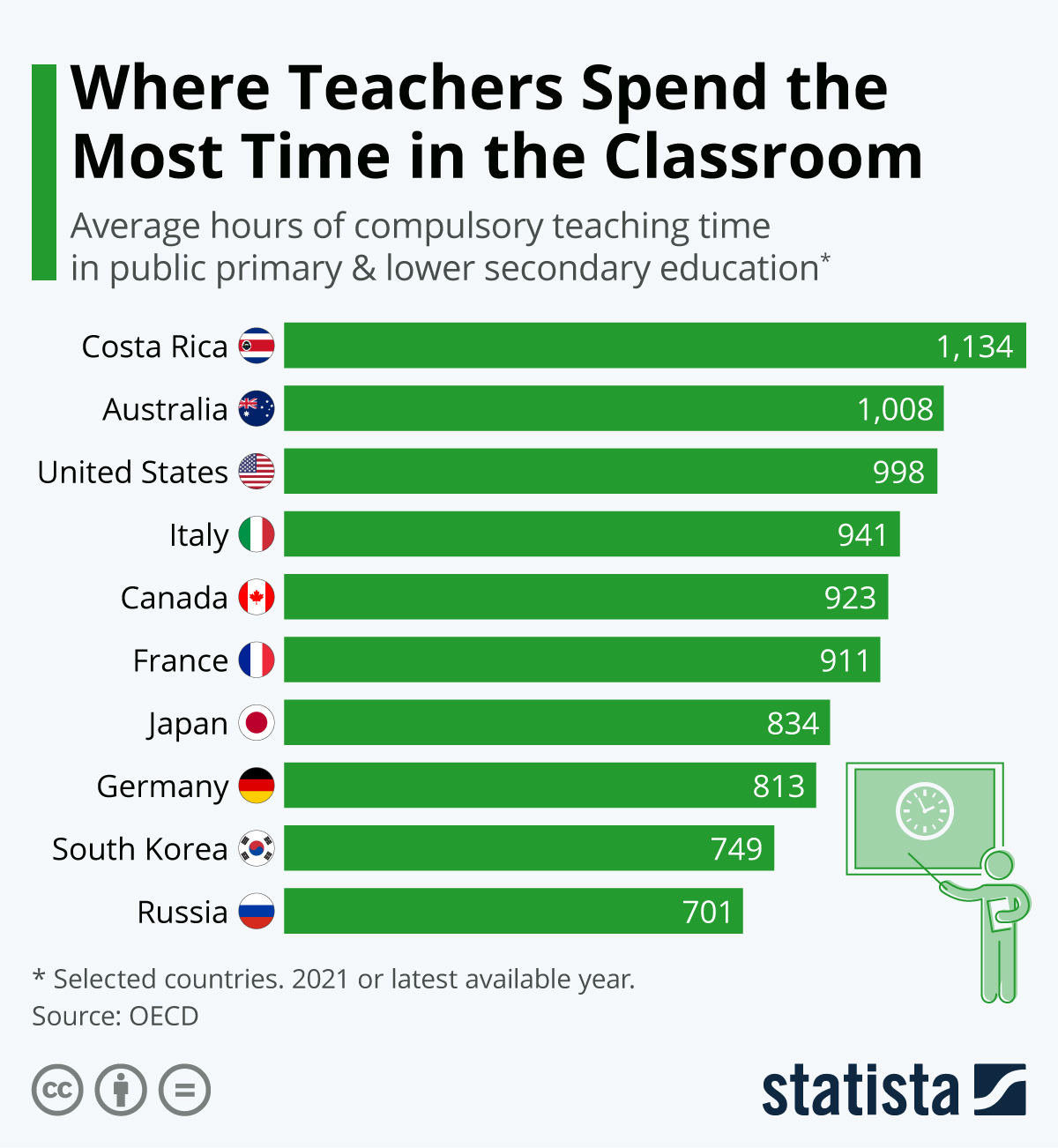
“U.S. elementary school teachers’ work hours haven’t changed much since 2019, but at more than 1,000 a year on average, American educators work more than 200 more hours than their peers worldwide.”

Scanning the headlines for results from OECD’s Education at a Glance: September 2021 Edition

OECD’s Education at a Glance 2021 provides annual international comparisons of education statistics. This year, the report focuses on equity and also highlights the measures countries have implemented to the educational response during the pandemic. This week’s scan reveals the aspects of the findings that media outlets around the world have emphasized. For a comparison, see IEN’s Education at a Glance scan from 2019.

Australia

Australian children at risk of being left behind on early learningMirage

Australia has the fourth highest level of reliance on parent out-of-pocket costs to fund pre-primary education and ranks 41 out of 44 OECD nations on preschool attendance in the year before school.

Austria

OECD study: Austria takes first place in vocational training, APA OTS News

Austria achieved first place with 75.6% in the ranking of pupils who complete upper secondary level with a professional qualification. This value is well above the OECD average of 38.4% and also above the EU average of 43.5%.

Brazil

OECD points to Brazil’s low investment in basic education during the pandemicDire

About two-thirds of OECD member and partner countries reported increases in the budget allocated to primary schools to help them deal with the crisis in 2020. Compared to the previous year, Brazil had no changes in the education budget for primary education, both in 2020 and in 2021

Finland

(Translation) OECD comparison: The socio-economic background still influences educational choices to a great extent – small regional variations in the level of education in FinlandValtioneuvosto Statsrådet

Even in Finland, students with a lower socio-economic background are more likely to continue in vocational education than in upper secondary school after lower secondary school. Of those who chose vocational education, 59% of the parents had not completed a university degree, compared to 27% of students who chose upper secondary school.

Hungary

(Translation) According to the OECD, Hungary has performed at a high level in educationMagyar Hírlap

...Hungary is one of the countries that provided targeted support to education actors during the epidemic, such as the state’s continued provision of free and discounted childcare and additional benefits for educators working in disadvantaged settlements for their work to prevent dropout.

Ireland

Ireland ranks in last place in OECD for investment in educationThe Irish Times

The annual Education At A Glance 2021 report from the Organisation for Economic Co-operation and Development shows spending on education – ranging from primary to higher and further education – in Ireland accounts for 3.3 per cent of our GDP in 2018. This compares to an EU average of 4.4 per cent and is significantly behind top-performers such as Norway with 6.6 per cent

Israel

(Translation) The huge gap in schooling in the corona year was revealed: Israel versus the world in educationY Net

The report shows that during the Corona period, high schools in Israel were closed for more days than in OECD countries, as were middle schools. High schools were closed for 76 days compared to an average of 70 days in the OECD, and middle schools were closed for 93 days compared to 65 days. On average in other developed countries, however, primary schools and kindergartens were closed for fewer days – 52 primary days were closed compared to 58 in OECD countries, while kindergartens were closed for 36 days compared to 43 days in the OECD.

Japan

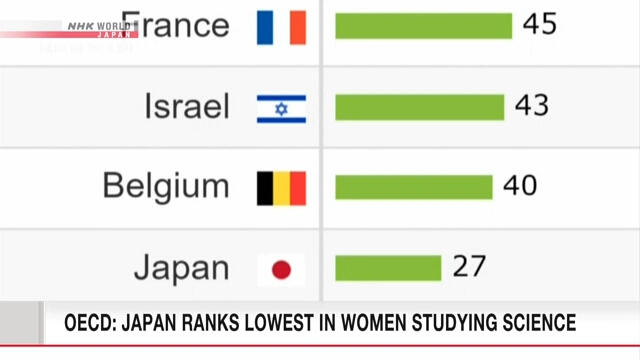
OECD: Japan lowest in women studying scienceNHK World-Japan

Stressing the high level of Japanese women’s knowledge and ability, the OECD noted the effects of the strong imposition of stereotypical images for women’s career options in Japan, and the lack of role models in science fields.

Latvia

The unemployment rate among young adults in Latvia is higher than the OECD averageDiena

In Latvia, the unemployment rate among adults aged 25-34 without secondary education was 19.7% in 2020, which is six percentage points more than in the previous year. This was a higher increase than the OECD average, where the unemployment rate for young adults was 15.1% in 2020, two percentage points higher than in 2019.

Norway

Norway among countries with lowest proportion of women in vocational studies, The Local.no

In total, women make up less than 40 percent of students on vocational courses—this is more than five percent below the OECD average. Among Norway’s Nordic neighbours Finland has the highest proportion, 51 percent, of women studying vocational subjects followed by Denmark, 43 percent, and Sweden, 41 percent. However, depending on the subject, the gender disparity could vary massively. For example, women made up just 8 percent of people studying electrical engineering. This is around half the OCED average.

South Korea

S. Korea has larger classes, lower employment rates among college graduates than OECD averages: Education MinistryKorea Herald

In terms of public education funding, the report showed the South Korean government took a lesser financial burden than other OECD nations.

Spain

Spain has second-highest percentage of young people who neither work nor study in EUEl País

According to a new report, 19.9% of youngsters between the ages of 18 and 24 fell into the NEET category (neither in employment nor in education or training) in 2020 – a problem that was exacerbated by the coronavirus pandemic.

Switzerland

Educational inequalities highlighted by Covid-19 pandemic, Expatica

In Switzerland there have been concerns that some disadvantaged pupils fell through the learning net during the shutdown of schools in spring 2020 – by not having anywhere quiet to study, access to computers or not turning up to online lessons. Switzerland…was not among the countries that allocated additional funds to ensure resources targeted those who needed them the most.

UK

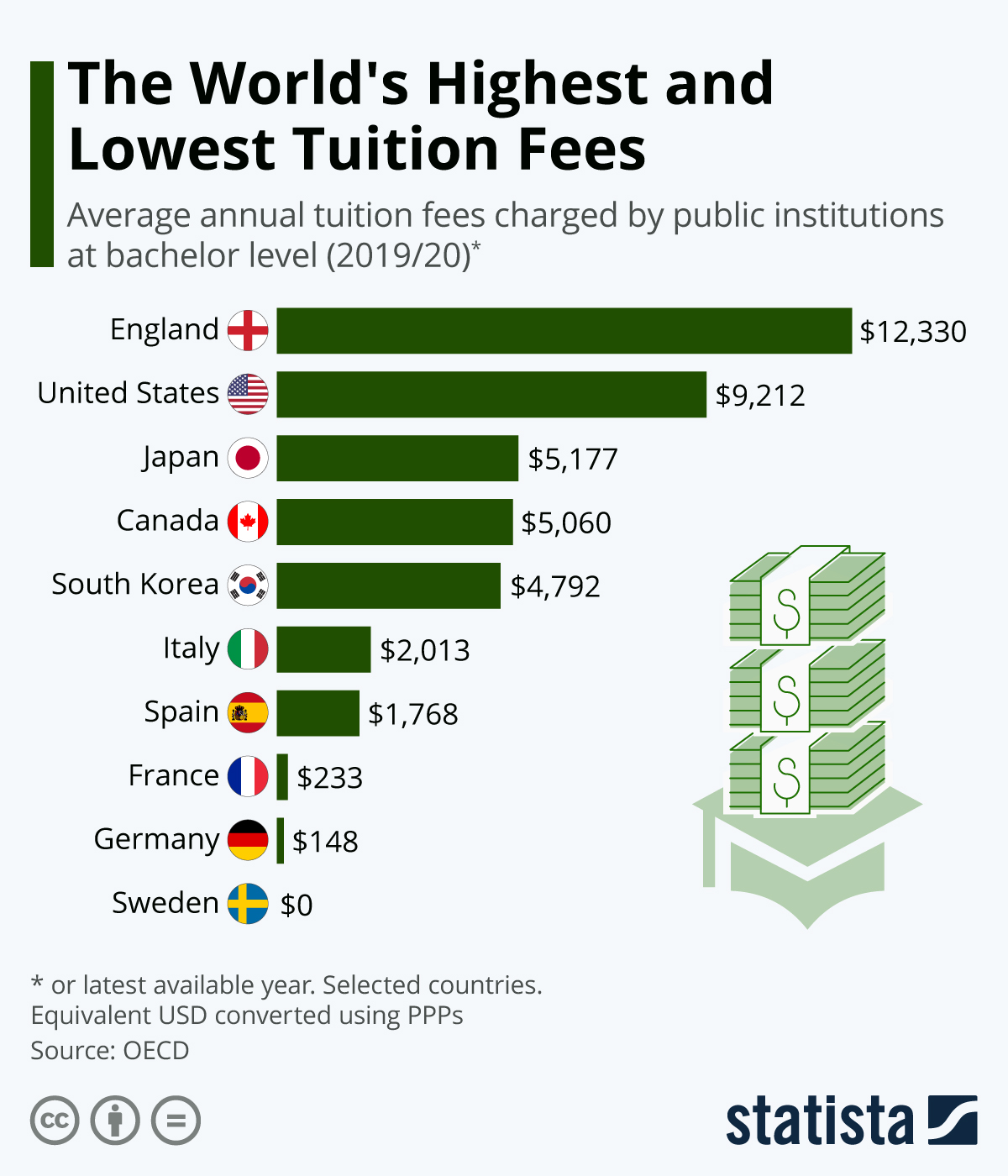
England has highest university tuition fees in developed world – OECD, Evening Standard

Universities in England can charge up to £9,250 per year for an undergraduate degree, and even more to overseas students. Scottish students do not pay tuition fees in Scotland, and Northern Irish students benefit from a lower tuition fee cap in Northern Ireland.

– Correne Reyes

Three Different Types of School Leadership for Learning: Results from TALIS 2018

This week’s post comes from Alex J. Bowers who draws from his recent working paper published by the OECD using the newly released TALIS 2018 dataset. Bowers is an Associate Professor of Education Leadership at Teachers College, Columbia University. 

Across countries, what is the role of school leaders and to what extent do teachers in schools agree with the leader on perceptions of their leadership practices? How many different types of leaders are there and how do these different types distribute across countries?

I examined these issues by analyzing the responses of over 152,000 teachers, across more than 9,000 schools with their principals, in 47 countries/economies on their perceptions of practices linked with the concepts of leadership for learning. I found three very different types of schools based on the alignment and mis-alignment of teacher and leader perceptions, and the results suggest that the proportions of the three different types of schools varies in important ways across national contexts.

I found three very different types of schools based on the alignment and mis-alignment of teacher and leader perceptions, and the results suggest that the proportions of the three different types of schools varies in important ways across national contexts.

Over the last few decades, researchers, policymakers, and school system leaders across the globe have shifted their conception of school leadership from the heroic single leader appointed at the top of the organization, to more distributed and shared conceptions of school leadership between teachers and principals. These new conceptions include leadership for learning, which encompasses aspects of transformational leadership – engaging teachers in the collaborative work of improving instructional practice – and instructional leadership – setting the vision, mission, and goals of the school, leading professional development, and supervising instruction. Importantly, leadership for learning also includes human resource development through mentorship and induction of teachers and strong management of resources to address specific student needs, community outreach, and student behavior and discipline.

To understand the extent to which teachers and leaders agreed across key aspects of leadership for learning, I analyzed data from the newly released TALIS 2018 survey items that asked teachers and principals similar questions around issues in their school of:

  1. Student assessment
  2. Feedback on teacher practices
  3. Teacher self-efficacy and a common set of beliefs about teaching and learning
  4. Professional development and trust
  5. Professional collaboration around lessons
  6. Mentoring and induction of teachers
  7. Engagement of stakeholders, such as teachers and parents
  8. A shared discipline climate

My results showed three different patterns of responses among teachers:

  • A high response type that has the highest responses across the eight domains and is the majority of teachers. These teachers have the highest work satisfaction, more often chose teaching as a career, and are the most experienced.
  • A low response type in which about a quarter of teachers responded with some of the lowest levels of perceptions of leadership for learning in their schools. These teachers reported the lowest job satisfaction and the highest workload stress.
  • A mixed response type in which about a fifth of all teachers reported high levels of self-efficacy, professional development, trust, stakeholder engagement, and a shared discipline climate, yet low levels of teacher feedback, professional collaboration, and mentorship and induction by the principal. These teachers have high job satisfaction and the lowest workload stress.

Second, I found three different patterns of responses between these three different types of teacher responders and their principals. In the first type, the principals have the highest responses across the leadership for learning domains, and thus are generally well aligned with the majority teacher type. In the second school pattern, principal responses are somewhat more in the middle providing a moderate response type. The third type of school, however, is typified by principals who disagree primarily around issues of mentorship and induction of teachers.

Importantly, while a large percentage of the school leadership research is grounded in the USA context and education research literature, the results from this analysis suggest that the USA may have only two of the three types of school leadership identified. The third type, in which leaders disagree more often across the survey, is a type of school that is more often found in countries such as Finland, as well as Portugal, Spain, Chile, Austria, and Argentina among others.

Percentage of respondents by school leadership type and country; Figure 10 from “Examining a congruency-typology model of leadership for learning using two-level latent class analysis with TALIS 2018

As I note on pages 53-54 of the working paper:

…it is intriguing that although the research that supports both theories of instructional leadership and leadership for learning, and the TALIS 2018 items, depends to a large extent on research from the USA context, the results of this study suggest that the USA has only two of the three types globally of leadership for learning schools… Given the global conversation on both leadership for learning, as well as policy in many nations attempting to implement instructional leadership theories and ideas, this finding that the United States is missing one of the three types of schools is intriguing. I will note, that I am not arguing here that the USA research is wrong, but rather that it may be incomplete, as USA researchers have not had access in their context to this third school type in the typology… The point that this model with the TALIS 2018 data captures the current global research issue that indicates that at the education policy level, mentorship by principals is “contested practice” across multiple national contexts provides a means to extend leadership for learning frameworks to include a wider global lens of schooling practice that includes these types of differences across national contexts (p.53-54).

Although no causal interpretations can be made, the results do provide an opportunity to surface previously unknown patterns and similarities across schools and countries, increasing the opportunity for collaboration and dialogue. For instance, in considering professional development and instructional improvement, the three different types of schools may need quite different types of supports and professional development resources. An intriguing professional development opportunity would be to bring together the principals and teachers from each of the three different school clusters, and provide them with the opportunity to collaborate, discuss, and surface the issues for instructional improvement that matter most to their type of school and their instructional practice with students in their community. Countries with similar patterns of leadership for learning across national contexts, may also find interesting and useful collaborative opportunities for improvement around shared interests and conceptions of teaching and school leadership.

Bowers, A.J. (2020) Examining a Congruency-Typology Model of Leadership for Learning using Two-Level Latent Class Analysis with TALIS 2018. Organisation for Economic Co-Operation and Development (OECD) Publishing: Paris, France. https://doi.org/10.1787/c963073b-en

SCANNING THE HEADLINES FOR RESULTS FROM TALIS 2018: TEACHING, LEARNING, AND LEADERSHIP

This week IEN provides a glimpse of how a few media outlets around the world have characterized the results from the OECD’s recent release of Volume II of the TALIS 2018 results, Teachers and School Leaders as Valued Professionals. This volume summarizes the results of a survey of teachers and school leaders from 48 countries, with a focus on questions related to 1) how society and teachers view the teaching profession, 2) employment contracts and salaries, 3) how teachers work together and 4) how much control teachers and leaders have over their work. This week’s online search for “TALIS 2018 volume II OECD” turned up very few stories in English. However, there were a number of headlines in smaller outlets and other languages, some of which were (google) translated below. More English headlines appeared in a scan of the TALIS headlines last June following the release of Volume I.

Australia

TALIS 2018: Valuing teachers and school leaders as professionals, Teacher Magazine (Australia)

9 out of 10 teachers from all OECD countries and economies are satisfied with their job, but only 26% think the work they do is valued by society; 14% believe that policy makers in their country or region value their view, and only 24% believe that they can influence education policy.

Croatia

Teachers overwhelmingly feel they have control over things (translated), srednja.hr

“About 98% of Croatian teachers believe that they have control over the choice of teaching methods and student evaluation, 93% of them have control over the discipline of students (92% in secondary school), 94% of them have control over the choice of homework.”  But only 9% of teachers agree that the teaching profession is valued in society.

Denmark

Danish teachers are more stressed than their Nordic colleagues (translated), folkeskolen.dk

43% of Danish teachers are considering another job, and 31% of “feel that their job has a negative impact on their mental health to some extent. In comparison, only 24 per cent of Swedish teachers, 23 per cent of Icelandic, 13 per cent of Finnish and 10 per cent of Norwegian teachers.”

England

England’s teachers ‘most stressed’ in developed world, Times Education Supplement

“70% of lower secondary teachers report being stressed either ‘a lot’ or ‘quite a bit’… 77% of teachers are ‘all in all’ satisfied with their job, however, this is the lowest rate in the OECD, with all the other countries having rates of above 80%.”

France

Talis: The French teachers, the most despised in the world? (translated), Café Pedagogique

“85% of French teachers feel satisfied with their work, but Talis demonstrates that French teachers are not only isolated and underpaid but also despised by their institution.”

Italy

80% Italian teachers perceive various degrees of stress, low salary always a reason for dissatisfaction (translated), Orizzontescuola.it

“Only 12.1% of teachers in upper secondary schools feel valued, without particular differences by geographic areas and by order of school. The data also shows that 7% of the entire teaching staff think they are listened to by the country’s political leadership class.”

Japan

TALIS — Teachers’ stress factors: “Amount of work” “Parents” (translated), Kyoiku Shimbun

“The percentage of Japanese elementary and junior high school teachers who have a lot of administrative work and stress on dealing with parents exceeded the average in participating countries. Principals at elementary and junior high schools were also stressed about their responsibility for their students’ abilities and dealing with parents.”

Korea

1 out of 4 middle school teachers “will quit teaching in the next 5 years” (translated), Chosun Edu

“Nevertheless, the proportion of teachers who agree that the teaching profession is valued is 67%, much higher than the OECD average of 26%.” However, only 54% OF teachers and 62% of principals said they were satisfied with their working conditions, slightly lower than the OECD average (66%).

Latvia

Almost all Latvian teachers are satisfied with their work, the survey shows (translated), nra.lv

“23% of teachers surveyed agree or totally agree with the statement that their profession is valued in the community, while 91% of Latvian teachers indicate that they are generally satisfied with their work”

Norway

Norwegian teachers work well together (translated), NEA Radio

95% of teachers say that there is a good culture for supporting each other and working together at the school…Teachers also feel that they have good control over their own teaching.”

Slovakia

Survey: Our educators receive little respect (translated), Felvideck.ma,

“Only 4.5% of teachers in Slovakia feel that teachers’ work has a high degree of social appreciation, while only 2.1% of school principals believe it”

Slovenia

They are not appreciated by the public or by policy makers (translated), Večer

The majority of “Slovenian teachers and principals were satisfied with their profession and workplace, and slightly less satisfied with their salary… but only 3% of teachers say policy makers value their views and opinions.”

  • Thomas Hatch

Does preschool need PISA?

In his recent IOE Blog post, Peter Moss describes a new OECD study, called the International Early Learning Study (IELS), which is set to begin piloting in 2017. As Moss points out, while government officials are aware of what’s in store, few in the early childhood education field are. Moss and his colleagues have written an article intended to spark a broad conversation about this study will mean for early learning and they have identified five areas they view as causes for concern. Among their concerns, the authors point to the complexity of all educational systems and the potential harm of applying one standard to many different countries. To quote the IOE Blog post:

The IELS, and similar testing regimes, seek to apply a universal framework to all countries, all pedagogies and all services. This approach rests on the principle that everything can be reduced to a common outcome, standard and measure. What it cannot do is accommodate, let alone welcome, diversity – of paradigm or theory, pedagogy or provision, childhood or culture. The issue raised – and not acknowledged, let alone addressed by the OECD in its documentation – is how an IELS can be applied to places and people who do not share its (implicit) positions, understandings, assumptions and values.

As we often scan education news from around the world, this week we share links that provide some information about the issues and concerns facing several countries on the issue of preschool, or early childhood education. Here is a short list of articles that have been posted by online news organizations this summer.


IRELAND

Why we need more men working in our creches http://buff.ly/2aZGqPa

Preschools issue warning over free childcare scheme http://buff.ly/2aZOkYT


SCOTLAND

Bill to increase free pre-school childcare in Scotland – BBC News http://buff.ly/2aX1PKt

How will early years be affected by Brexit? | Nursery World http://buff.ly/2aX1Yxi


UNITED STATES

How the U.S. Is Failing Its Youngest Students http://buff.ly/2b5JcXn


AUSTRALIA

Reimagining NSW: tackling education inequality with early intervention and better research http://buff.ly/2axJ9CR

Why We Need To Teach Our Kids About Money In Early Childhood http://buff.ly/2aPaHCD


MALAYSIA

Study to gauge standard of English at preschools – Community | The Star Online http://buff.ly/2aPbTWv

Skills upgrade for pre-school teachers – Community | The Star Online http://buff.ly/2axLSMN


SINGAPORE

What goes on in the (not so) secret world of 4-year-olds http://buff.ly/2axLQEE

Free child care may limit options, increase burden on taxpayers: MSF http://buff.ly/2axMqCi


INDIA

Preschool or Child Care Market in India to Grow 21.84% by 2020 – Increasing Implementation of Childcare Services at Workplace – Research and Markets | Business Wire http://buff.ly/2aZNqf2

Preschool skills may predict kindergarten math success http://buff.ly/2aZNH1y

Pre-school boys should be treated more like girls, says study | Latest News & Updates at Daily News & Analysis http://buff.ly/2aD5MRL

34 per cent Muslim children have never been to pre-school: UNICEF : News http://buff.ly/2aX0PWN

Deirdre Faughey

The “biggest-ever” league table?

The latest education report from the OECD ranks 76 countries according to the percentage of the population that lacks basic skills. The report, by Eric Hanushek of the Hoover Institution at Stanford University and Ludger Woessmann of the University of Munich, derives the ranking from the latest test scores from the 2012 Programme for International Student Assessment (PISA) for 15-year-olds and the 2011 Trends in International Mathematics and Science Study (TIMSS) for 14-year-olds. In what BBC News called the “biggest-ever education league table,” Singapore, Hong Kong, South Korea, Japan and Taiwan (again) top the charts. Coming in at number six, Finland is the top-ranking non-Asian country. Our latest scan of education news around the world finds many media reports highlighting the relative ranking of particular countries, but a number mention as well the report’s claims of a connection between improving performance on the tests and economic growth. At the same time, it is worth noting that not everyone agrees there is a straightforward relationship between performance on tests like PISA and TIMMS and economic outcomes. James Heckman and colleagues Tim Kautz, Ron Diris, Bas ter Weel, Lex Borghans, in particular, have emphasized that current tests like PISA and TIMMS “do not adequately capture non-cognitive skills, personality traits, goals, character, motivations, and preferences that are valued in the labour market, in school, and in many other domains.” As they explain in Fostering and measuring skills: Improving cognitive and non-cognitive skills to promote lifetime success and Hard evidence on soft skills, for many outcomes, the predictive power of non-cognitive skills rivals or exceeds that of cognitive skills.

“Global school rankings: Interactive map shows standards of education across the world,” The Independent

“Asian kids race ahead on learning: OECD,” The Australian

Bottom in EU on OECD education league, again,” Cyprus Mail

“New education rankings from the OECD put Finland in sixth position worldwide—the top European country and the first non-Asian country in the list,” yle UUTISET

“Ireland ranks 15th in global league table for maths, science; GDP would be boosted by 2.3 per cent if universal basic skill levels were achieved,” Irish Times

“OECD report links school achievement and economic growth; despite oil wealth, Arab world trails far behind,” Israel Times

“When it comes to education, Singapore is a world-beater,”  The Straights Times

“Turkey ranks 41st in education on OECD report of 76 countries,” Today’s Zambian

UK below Poland and Vietnam in biggest ever international education rankings, TES Connect

“Improving Basic Education Can Boost U.S. Economy by $27 Trillion,” U.S. News & World Report

–Thomas Hatch