Tag Archives: PISA

Scanning the headlines for creativity around the world: PISA Creative Thinking Assessment 2022

Can students think outside the box? That’s the question that OECD’s PISA test on creative thinking attempts to answer. This week, IEN shares a scan that pulls together the headlines from those countries where we found reports on the test results. IEN’s previous PISA scans include: Scores Plummet Around the World: Scanning the Headlines on the Release of the 2022 PISA Results; Headlines Around the World PISA 2015 Edition; Headlines around the world: PISA (2015) Collaborative Problem Solving; and Headlines around the world: PISA (2015) Well-Being Report

Despite attempting to assess an entirely different set of skills, the results of OECD’s 2022 test of creativity shows that the top scorers – Singapore, Korea, Canada, Australia, New Zealand, Estonia, and Finland –  are many of the same countries that score highest on the PISA tests of reading, math, and science. 

Other results highlighted in OECD’s report include: 

  • Roughly half of the students who excelled in creative thinking did not excel in academic domains.
  • Girls performed much better than boys; in terms of average performance, boys did not outperform girls on the creativity assessment in any participating system. 
  • Socio-economically advantaged students performed better than less advantaged peers, but the association between socio-economic status and performance is not as strong as it is in mathematics, reading and science.

OECD bases the test on a definition of creative thinking as “the competence to engage productively in the generation, evaluation, and improvement of ideas that can result in original and effective solutions, advances in knowledge, and impactful expressions of imagination.” OECD’s description of the assessment also notes that this definition focuses on “little c’ creativity” that “15-year-old students can reasonably demonstrate, and underlines that students need to learn how to engage productively in generating ideas, reflecting upon ideas by valuing their relevance and novelty, and iterating upon ideas until they reach a satisfactory outcome.”

Australia

Australian teenagers strong creative thinkers, ACER Discover

Oz students rank amongst world’s leading creative thinkers – but what does that mean?, EducationHQ

Belgium

Flemish pupils score well for creative thinking, VRT NWS News

England

“Secondary school students in England feel less able to express ideas at school and are less likely to report being able to take part in creative activities compared with their peers in many other countries, according to a major international assessment. And they are less likely to say that their teachers value creativity, according to the latest report from the Programme for International Student Assessment (Pisa) on creative thinking, from research carried out in 2022.”

Students in England less likely to say creativity is valued, TES

Finland

Finnish students excel in PISA creativity rankings, Yle News

Germany

“For 27% of students tested in Germany, the levels correspond to creative thinking skills that are strongly indicative of future success in the career world. Meanwhile, 22% were barely able to generate ideas for simple visual designs and written descriptions or find solutions to problems.”

Study finds German students rank middle of the pack in creative thinking, phys

German Youth Occupy Median Position in Global Assessment of Creative Thinking Based on Pisa Study, Aussiedlerbote

Hong Kong 

Hong Kong students score behind first-place Singapore in global study on creative thinking, South China Morning Post

Latest Pisa results show Hong Kong education stuck inside the box, South China Morning Post

Korea

“Korea scored above the OECD average in creative thinking in school environment and participation in creative school activities. The ministry said “We were able to confirm school efforts to improve the creative thinking skills of students.” On the nation’s low score in the creative thinking self-efficacy index, the ministry quoted the OECD as saying countries with higher scores in creative thinking tend to have lower indexes in self-efficacy.”

15-year-old students’ creative thinking ranked 2nd by OECD, korea.net

New Zealand

“Compared to other countries/economies, a relatively large proportion (39 percent) of Aotearoa New Zealand students were ‘top’ creative thinkers and most (86 percent) performed at or above baseline proficiency. “Expressing creativity through writing and social problem solving was a strength of Aotearoa New Zealand students, as was generating diverse and creative ideas. They did less well in scientific problem solving, visual expression and evaluating and improving ideas.”

NZ teens score highly for creative thinking, RNZ News

Philippines

PH students second to last in creative thinking —PISA, GMA News

“The Philippines’ score may be concerning, but some may have seen the writing on the wall long before the PISA results came out. Our educational system tends to emphasize creativity only at the preschool level, dramatically shifting to more traditional methods of education such as rote memorization and ‘right versus wrong’ approaches from First Grade onwards.” 

The Philippines ranked at the bottom of a global creative thinking test. How do we fix this?, adobo

Poland

Polish pupils outperform OECD average in creative thinking study, TVP World

Scotland

“New data suggests Scottish teachers are doing a good job of encouraging creative thinking – but the government’s decision to opt out of new Pisa test means evidence is limited”

Scotland absent from first Pisa report on creative thinking, TES Magazine

Serbia

Serbian students achieve substandard results on PISA’s creative thinking tests, Serbian Monitor

Singapore

Singapore’s 15-year-old students score top marks in OECD’s creative thinking test, The Straits Times

Singapore students top PISA study on creative thinking, despite not thinking of themselves as creative, CNA

United States

“The OECD had difficulty reviewing U.S. schools’ instructional practices for creativity and innovation, because practices differ significantly among states and districts, and did not release U.S. results.”

What Schools Can Learn From a Global Assessment on Creative Thinking, Education Week

Scores Plummet Around the World: Scanning the Headlines on the Release of the 2022 PISA Results

Dramatic score declines dominated the headlines reporting on the release of the latest PISA scores, with many sources highlighting the impacts of the COVID-19 pandemic on teaching and learning. Some reports focused particularly on math scores, which, in a number of cases, experienced the most drastic drops from the 2018 results. In some instances, reports noted that some education systems (like the US) were able to rise up in the rankings because their scores did not decline as much as others. A few headlines also emphasized issues such as low levels school belonging for migrant students, increased student anxiety and reduced psychosocial well-being, and the effects of income inequality on score results. Numerous critiques have identified serious issues with the PISA findings and their use (see for example Two decades of havoc: A synthesis of criticism against PISA or PISA: Mission Failure and PISA Mission Failure), but for context on the reporting on PISA, this year’s scan of the headlines reporting on the release of the 2022 Program for International Student Assessment (PISA) results can be compared to  IEN’s previous PISA coverage, including: Around the World in PISA 2018 Headlines, and Headlines Around the World 2015 Edition.

Global 

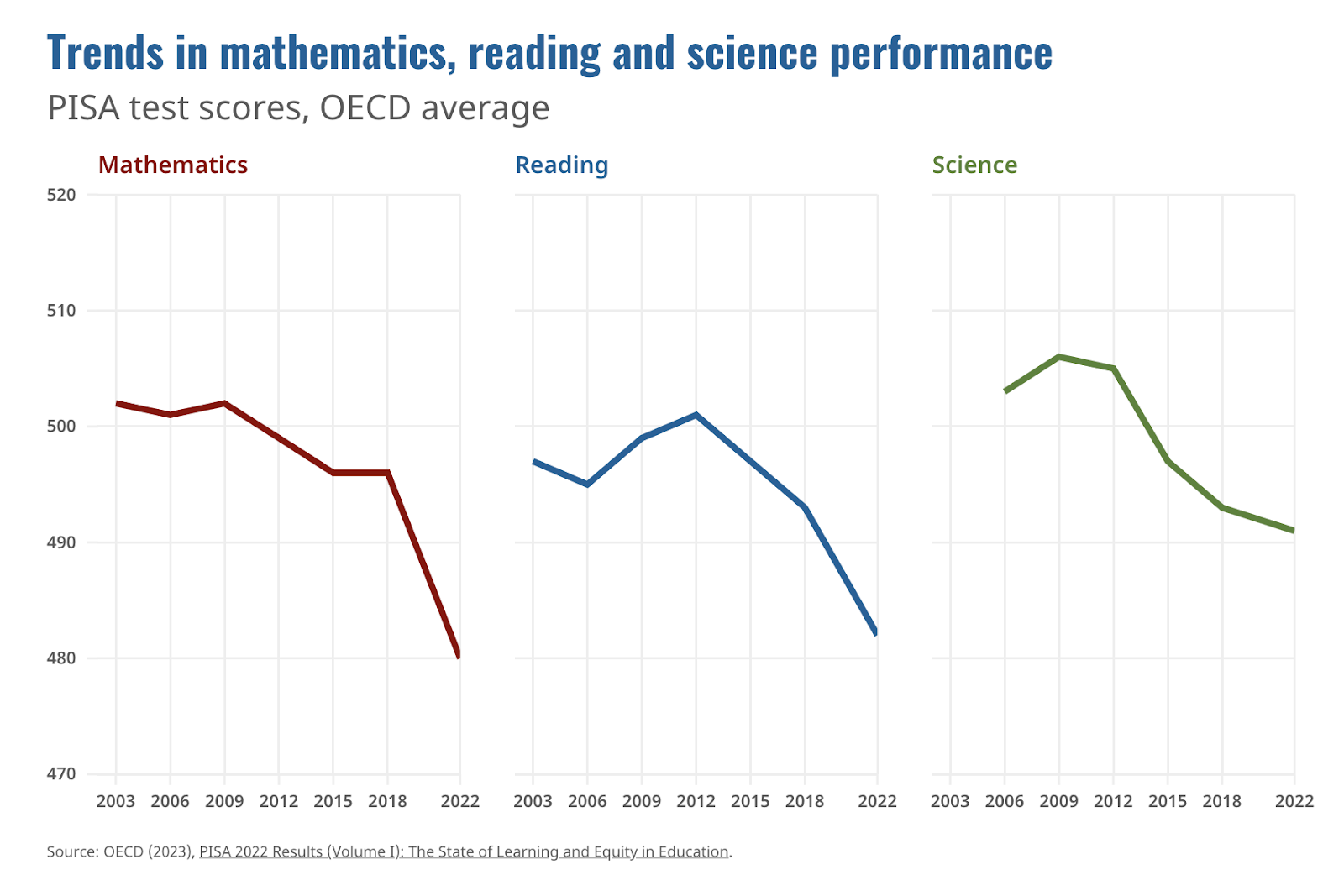
“Eighteen countries and economies performed above the OECD average in mathematics, reading and science in 2022. Between 2018 and 2022, mean performance in mathematics across OECD countries fell by a record 15 points. Reading fell 10 points, twice the previous record, whereas science performance did not change significantly. On average, reading and science trajectories had been falling for a decade, though math had remained stable between 2003-2018. Colombia, Macao (China), Peru and Qatar improved in all three subjects on average since they began to take part in PISA.”

PISA 2022 Results: Summary, OECD

“The average international mathematics score fell by 15 points since the 2018 tests, the equivalent of three-quarters of a year of learning, reading fell by the equivalent of half a year, with only science scores remaining more or less the same.”

‘Unprecedented’ decline in global literacy scores, OECD report says, AlJazeera 

OECD education survey shows ‘unprecedented’ drop in student performance, France 24

How Absenteeism, Math Anxiety, and Other Factors Shaped the Troubling Results From PISA, Education Week

Argentina

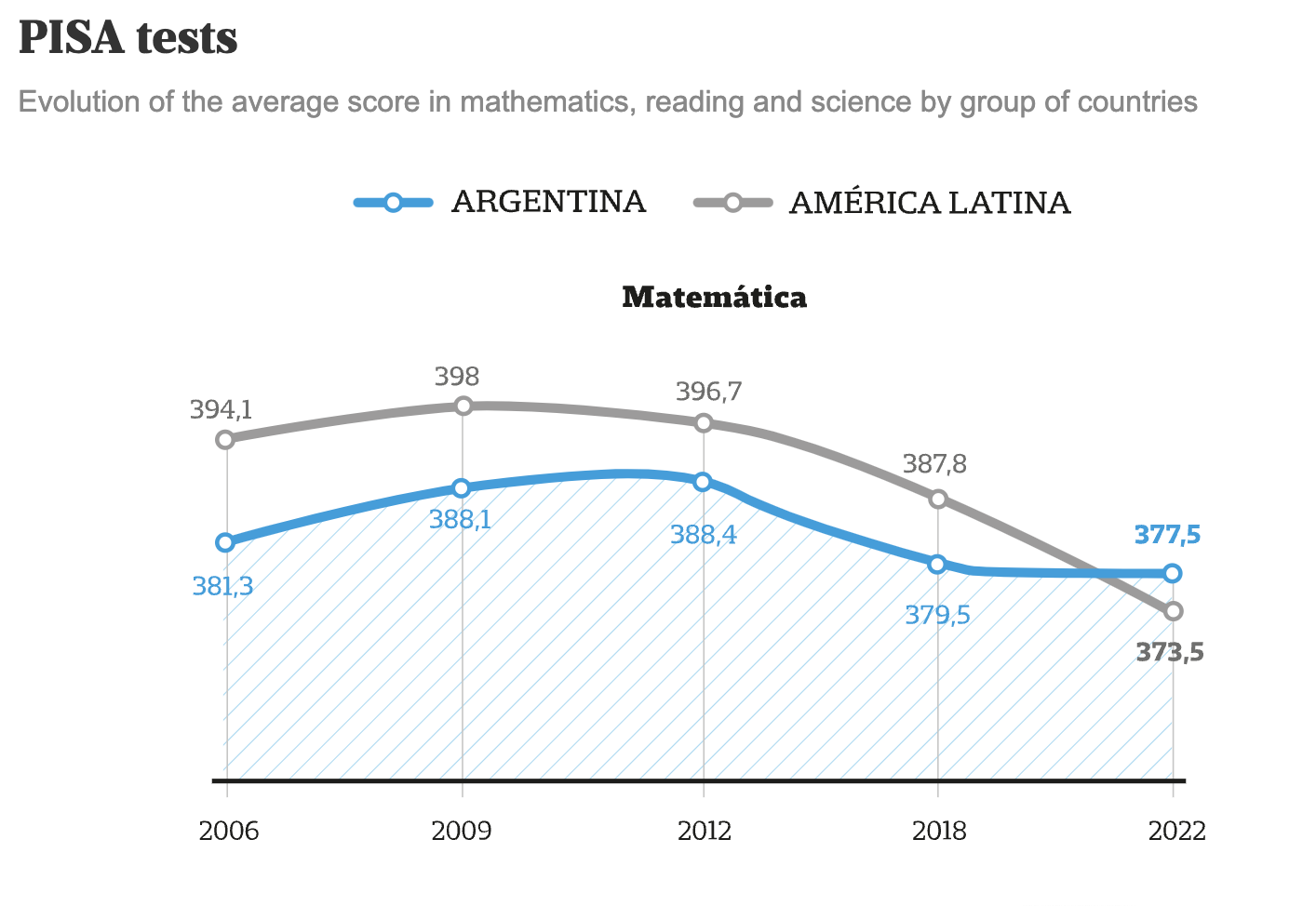
PISA tests: almost 73% of secondary students do not reach a minimum level in mathematics, La Nación

PISA tests: the crisis of basic learning contradicts all inclusion discourses, La Nación

Australia

Australian students’ Pisa scores still declining despite climb into OECD top 10, The Guardian

The Balkans 

PISA School Test Results See South-East Europe Pupils Falter, Balkan Insider

Canada 

Global high school test scores show ‘worrying’ decline. Here’s how Ontario students did, Toronto Star 

Chile

PISA 2022: Chile maintains results in science and drops again in mathematics and reading, La Tercera

PISA 2022 and the case of Chile: what is behind the averages, El País

Colombia

“In Colombia the decline was smaller (8 points less in mathematics, 3 in reading and 2 in science), but it is still significant given the complexities due to the confinements that teachers and students faced during the pandemic in a country with profound inequalities. . Colombia retained the best performance achieved compared to the results of 2006, when it participated for the first time in the test.”

The results of the PISA test reiterate the weaknesses of the educational model in Colombia, El País

Cyprus 

Majority of Cypriot students lack proficiency in reading comprehension, PISA results show, Philenews

El Salvador

El Salvador in the last places in the new PISA report on education, ElSalvador.com

Estonia

Estonia drops to fourth in latest PISA rankings, ERR News

PISA: Estonian 15-year-olds top the European knowledge scoreboard, Estonian World

Europe

European education slips downward, according to PISA report by OECD, EuroNews

The kids are not alright: Most EU pupils educational results tumble in PISA rankings, The Brussels Signal 

Finland

“Finnish 15-year-olds saw their mean score in mathematical literacy – the main focus of the latest assessment – decline by 23 points from 2018 to 484 points, 12 points higher than the mean score of pupils across the OECD.”

Finland’s Pisa results continue to decline, sparking concern, Helsinki Times 

Germany 

“The general state of global education has been slammed by the first PISA performance assessment report since the pandemic. German students fared particularly badly, but those in Asia performed highly.”

Germany’s students fare worse than ever in PISA school tests, DW

Ireland 

Irish teenagers ‘are second best in the world at reading’, The Irish Times

Hong Kong 

“Hong Kong pupils have dropped out of the top 10 to 11th place for mother tongue literacy in the Programme for International Student Assessment. But in a related study, Hong Kong ranked second worldwide in terms of effectiveness in digital learning and educational equity”

Hong Kong secondary school pupils’ performance falls in global Pisa study on reading and maths competency, with pandemic blamed for general decline, SCMP

Japan

Japanese Students Move Up PISA Rankings; Now 3rd in Reading; Shorter School Closures in Pandemic May Be a Factor, The Japan News 

Latin America and the Caribbean 

The PISA report measures the effect of the pandemic in Latin America: worse in mathematics, reading and science, El País

PISA 2022: How did Latin America and the Caribbean do?, Inter American Development Bank

Latvia 

Latvian students’ performance has weakened in maths and reading, improved in sciences – PISA, The Baltic Times

Malaysia 

Malaysian students’ Pisa scores drop in 2022, The Star

Mexico

“The economic condition of the students’ families is the most influential data in Mexican education. The gap in the evaluations is 58 points between rich and poor , although it is much smaller than in the rest of the OECD countries, where the difference is 93.”

Mexican students drop to the lowest level in reading and mathematics since 2006, El País

PISA Report: How did Mexico do on the exam? It came out WORSE in these subjects, Milenio

Morocco

New report underlines deteriorating academic performance of Moroccan students, Morocco World News

The Netherlands

Dutch kids reading, maths, and science skills declining: OECD, NL Times

New Zealand

“This country’s 15-year-olds’ average scores in the PISA dropped a disastrous 15 points in maths to 479 points, their science and reading scores fell just 4-5 points to 504 and 501 points respectively, and the gap between rich and poor students grew.”

NZ records worst ever PISA international test results, amid global decline, RNZ

Student hunger, bad teachers revealed in latest PISA tests showing dip in NZ teens’ scores, RNZ

Philippines 

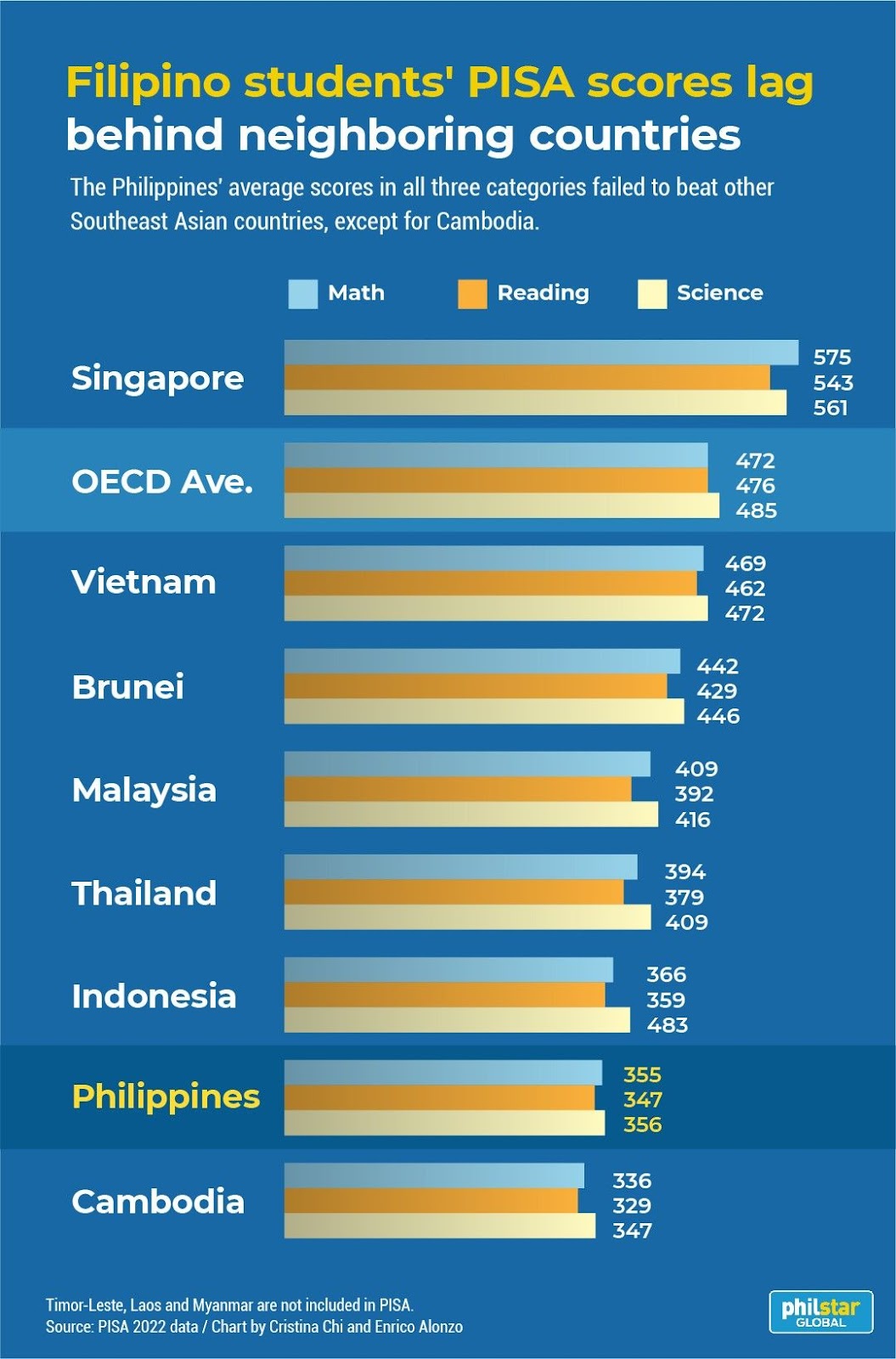
Philippines still lags behind world in math, reading, and science — PISA 2022, Philstar

Saudi Arabia

Saudi schools ‘doing better at maths but still lagging behind’, AGBI

Singapore

“Singapore was ranked No. 1 for mathematics, science and reading in the Programme for International Student Assessment (Pisa) 2022. Compared with 2018, Singapore students who took part in Pisa 2022 maintained their performance in mathematics and improved substantially in science, but their performance declined slightly in reading.”

Singapore students rank top in maths, science and reading in OECD study, The Straits Times

Spain

“Spanish students in the last year of secondary education have dropped 8 points in mathematics compared to the previous edition, in 2018 – in which they already fell a lot -, until they remain at 473. They have gone back three in reading comprehension, to 474. And they have risen two points in science, to 485. The global setback has been, however, of such caliber…that Spain had never been so close to the average of both organizations.”

PISA Report: Spain obtains its worst result, but resists the global educational setback better than its surroundings, El País

Catalonia attributes the poor results in the PISA Report to an excess of immigrant students in the sample, El País

Taiwan

“Taiwan maintained student well-being and math performance across all social groups, with 87 percent of Taiwanese students reporting a sense of belonging at school, which improved from 85 percent in 2018, the report said.”

Taiwan demonstrates ‘overall resilience’: report, Taipei Times

Thailand 

Thai students ranked lower on every PISA index, The Nation

Turkey

PISA report shows Turkey’s scores below OECD average in education, Turkish Minute

United Arab Emirates 

“For the first time ever, Dubai private schools have ranked among the top 14 in the world in mathematics, science and reading in the most recent cycle of the Programme for International Student Assessment (PISA), exceeding the National Agenda target of top 15.” 

Dubai private schools rank in top 14 in global assessment for maths, science and reading, Gulfnews

United Kingdom 

PISA 2022: Rise in maths, but warning over inflated results, Schools Week

Pisa: Wales slumps to worst school test results, BBC

United States

US teendagers decline in global test of math, but hold steady in reading, science, Education Week

“In the first comparable global results since the coronavirus pandemic, 15-year-olds in the United States scored below students in similar industrialized democracies like the United Kingdom, Australia and Germany, and well behind students in the highest-performing countries such as Singapore, South Korea and Estonia — continuing an underperformance in math that predated the pandemic.”

Math Scores Dropped Globally, but the U.S. Still Trails Other Countries, The New York Times

Uruguay

PSA 2022 Tests: Uruguay worsened results in mathematics, improved in science and remained unchanged in reading, El Observador

Vietnam

Pisa 2022: Vietnamese students experience decline in performance rankings, The Star

Response to PISA: Exploring the success of Singapore

Last week, when the PISA 2015 scores were released, Thomas Hatch shared a response and a scan of headlines from around the world. We reached out to an international group of scholars and asked them to share their own response to the PISA results as well. Today we share a comment from Dr. Saravanan Gopinathan of the Lee Kuan Yew School of Public Policy, National University of Singapore.

2016 has been a good year for Singapore Education. Results released in the TIMSS and PISA assessments shows a sustained trend towards high performance in Maths. Science and Literacy. Those who are critical of Singapore’s education model point to two features. One is that while Singapore students have admirable mastery of PISA content domains, they are incapable of problem solving, applying content to authentic situations, etc. This is attributed to teacher dominated teaching, memorisation and extra out-of-school coaching. The other is that while Singapore may have an excellent system, it is not sufficiently equitable, showing a long tail in performance. And yes, we have not produced any Nobel Prize winners.

What can be said in its defense? There has been a conscious, sustained effort since 1997 to promote knowledge building pedagogies via curriculum and assessment reform, teacher professional development and textbook redesign. It would be reasonable to assume that in a tight compact system like Singapore, reforms are beginning to change teaching and learning practices. With regard to the second, Singapore’s Ministry of Education (MOE) has pointed to the fact Singapore’s proportion of low performers in each of the three domains is at about 10% among the lowest of all participating systems and its proportion of top performers in each domain is the highest among all participating education systems.

Let us enjoy our status as a top education reference system, at least until the next PISA results!

For more from Dr. Gopinathan, read “Real Singaporean Lessons: Why do Singaporean students perform so well on PISA?” which was published as part of the Leading Futures series on IEN.

For more on the recent PISA results, explore the following recent articles:

Pisa results 2016: Singapore sweeps the board http://buff.ly/2hr1zYN (TES, 12/6)

Behind Singapore’s PISA rankings success http://buff.ly/2hsWfRB (ABC online, 12/7)

Asian countries dominate, science teaching criticised in PISA survey http://buff.ly/2hsS3RJ (Business World, 12/7)


Response to PISA 2015: Beware of simplistic representations in media

Last week, when the PISA 2015 scores were released, Thomas Hatch shared a response and a scan of headlines from around the world. We reached out to an international group of scholars and asked them to share their own response to the PISA results as well. Over the next few days we will be posting their comments. Today we share a comment from Yong Zhao, of the University of Kansas:

While I understand news media have to use some sensation-seeking headlines, I wish journalists would be more careful because these headlines have serious consequences. Education is very complex, culturally rooted, and local and cannot be simplistically represented with rankings. More important, I hope PISA and TIMSS stop presenting their results in simplistic ways to the media, for example, stop using league tables. Better yet, stop the programs entirely. 

For more from Zhao, read his latest commentaries, including:

“How does PISA put the world at risk? (part 5): Racing to the past,”

Excerpt: “PISA has certainly successfully put a number of East Asian education systems on a pedestal and thus constrained their ability and desire to make drastic changes. But they need drastic changes if they wish to truly cultivate the kind of talents needed to become innovative societies that rival the West because the authoritarian East Asian education model leaves little room for creative and unorthodox individuals to pursue their passion, question the authority, and develop their strengths, although it is extremely effective in homogenizing individuals, enforcing compliance, and hence producing great test scores.”

“Don’t Read Too Much into it: What Brexit and U.S. election surprises can teach us about PISA”

Excerpt: “These two back-to-back spectacular failures of data-driven predictions remind us that data can be deceiving, misleading, and sometimes just quits working. Blind faith in data can have disastrous and long-lasting consequences…”

“Don’t Read Too Much into it: Did the shift from paper to computer ruin east Asia’s? (China’s?) PISA performance?”

Excerpt: “What could have caused such a uniform change in eight education systems in as short a time as three years? The only common factor I could find is the change of PISA delivery format: from paper to computer.” 

For more on the recent PISA results, explore the following recent articles:

Pisa: Can the results really be trusted to tell us anything about education standards? http://buff.ly/2hqT6o4 (TES, 12/6)

Finland’s schools were once the envy of the world. Now, they’re slipping. http://buff.ly/2hsRNCs (The Washington Post, 12/8)

Opinion: Dip in PISA results a sign of things to come http://buff.ly/2hsNEhX (The Educator, 12/12)

Real Singaporean Lessons: Why do Singaporean Students perform so well in PISA?

In this latest post in the Leading Futures Series, edited by Alma Harris and Michelle Jones, Zongyi Deng and S. Gopinathan shine a spotlight on the success of Singapore’s school system and argue that the country’s success comes from educational policies and practices that have helped to develop social cohesion, economic development, and nation building. As Deng and Gopinathan suggest, reforms that aim to borrow “best practices” must consider the social, cultural and institutional contexts of which they are a part.

Singapore has been widely recognised as one of the world’s top-performing systems. Its extraordinary record of students’ performance in international comparative studies of achievement includes: first in problem-solving, second in mathematics, and third in science and reading (PISA 2012); second in mathematics, fourth in science and fifth in reading (PISA 2009); first in science (both primary 4 and secondary 2 levels) and second in mathematics (primary 4 level), and third in mathematics (secondary 2 level) (TIMSS 2007); and fourth among 45 education systems (PIRLS 2006). What explains the top rankings in the current PISA tests? What lessons, if any, could Singapore offer other countries who want to improve on their educational performances?

As with other high-performing countries, answers to these two questions can be found in a body of literature (reports, books and articles) written by international organizations like the OECD and the World Bank, consultancy firms like McKinsey and Grattan, and educational spokesmen and scholars like Pasi Sahlberg and Pat Tee Ng. Singapore is said to have a high- quality teaching force ensured and enhanced by high standards of teacher recruitment, effective teacher preparation and professional development. The school system is run by high-quality school leadership developed through careful selection, leadership experiences and professional development programmes. In addition, the country sets high academic expectations and standards for its students and monitors the performance of schools against those expectations and standards. Furthermore, Singapore is noted to have implemented educational reform to promote student-centric and ICT-enhanced pedagogy that encourages deep learning, critical thinking and creativity.

Overall, this body of literature adopts the “best practice” approach to explaining the educational success of a high-performing system wherein a set of particular characteristics are identified and translated into best practices for borrowing worldwide. However, whether the identified characteristics are causally linked to the system’s superior performance in PISA is an open question, with little or no empirical evidence to justify the identification. In addition, lacking in such explanation are those factors beyond school—educational history, family aspirations, parental involvement, private tuition, etc.—that could play a part in PISA success, particularly in Asian countries.

In our latest article (Deng & Gopinathan, 2016), we provide an alternative explanation for Singapore’s education success and, in so doing, question such an approach to explaining the education success of a high-performing country. From a historical perspective, education has played a vital role in the success story of Singapore—the remarkable transformation from a fishing village to a first world country over four decades.  Such a transformation has much to do with the effective implementation of a set of educational policies and reforms by a strong and competent government. Among these policies were the bilingual policy in the 1950s which encourages Singaporeans to be proficient in both the English language and in their respective ethnic mother tongues (Chinese Mandarin, Malay, and Tamil), and the streaming policy in the late 1970s which track primary and secondary students into various streams based on their examination results.  The implementation of the bilingual policy entails a commitment to equality with respect to language rights of the three main ethic groups and a recognition of the necessity and value of English as an international language to Singapore.  The streaming policy, modified and adjusted over the years, has reduced attrition and early school leaving.  In addition, the government mandated and implemented a uniform and common curriculum (taught in English) centered on the study of mathematics, science and languages, with technical subjects as a supplement, and made a firm commitment to the principle of meritocracy.  Universal free primary education and curriculum standardization were achieved by the late 1970s and early 1980s, respectively. In short, educational policy and practice in Singapore has functioned as a means for social cohesion, a vehicle for economic development, and for nation building.

While it has been sometimes fashionable to decry the significance of school education in the West, and indeed be skeptical about the role schools can play in social, civic, and even economic functions, in Singapore there are few such doubts (Gopinathan, 2007). This leads to our questioning of the employment of PISA results as the prime yardstick of the educational performance of an education system. The primary function of school education as conceived in PISA is economic—developing competencies for the economy in the 21st century. Such a conception entails a narrowing of the function of education, thus reducing the social and civic significance of an education system.

The historical perspective also brings to light two basic features of the system that may better help explain Singapore’s high rankings in PISA:

First, the national curriculum stresses the development of students’ competences in mathematics, science and languages – the three subjects tested in PISA.  Second, a commitment to academic rigour and standards, underpinned by the principle of meritocracy and enforced by a system of national high-stakes examinations (PSLE [Primary School Leaving Examination], ‘O’ and ‘A’ levels), has lifted the floor under the quality of teaching and learning for all student groups throughout the school years (Deng & Gopinathan, 2016).

However, the national curriculum, together with the high-stakes examination system, has steered classroom practice towards a kind that is still largely traditional and didactic in nature, directed towards the transmission of curriculum content and examination performance. Since the mid-1980s the government has attempted to alter such a traditional practice through educational reform.  The most progressive and radical reform came in 1997 when then Prime Minister Goh introduced the framework of Thinking Schools, Learning Nation (TSLN). Subsequently, a plethora of reform initiatives have been rolled out in schools, which aim at producing pedagogical changes characterized by: (1) more opportunities for constructing knowledge, higher-order thinking, and innovation; (2) more meaningful use of ICT for teaching and learning;  (3) more time on interdisciplinary learning and a greater emphasis on knowledge application.

What has been the impact of reform initiatives on conventional classroom practice? What is the present nature of pedagogy in Singapore’s classrooms? According to the findings of Centre for Research in Pedagogy and Practice (CRPP) in the National Institute of Education (NIE),

Notwithstanding multiple reform initiatives to encourage the TSLN’s pedagogical vision, pedagogical practice in Singapore’s classrooms has remained largely traditional, directed towards curriculum content delivery and examination performance. There is very little evidence of sustained teaching for higher order thinking, meaningful use of ICT, students’ constructing knowledge, and interdisciplinary learning (Deng & Gopinathan, 2016)

This finding, in fact, is consistent with what is found in the international literature about the inability of reform to alter conventional classroom practice.

It is therefore questionable that the success of Singapore in PISA can be attributable to the government’s implementation of educational reforms aimed at transforming classroom pedagogy. In fact, if TSLN’s reform initiatives had an impact on classroom practice, it would probably have led to a fall in students’ performance in PISA. There is empirical evidence in Finland and Canada (Quebec) confirming that when the traditional and teacher-centred pedagogy is replaced by a student-centric, constructivist one, the PISA results of a system decline (Sahlgren, 2015).

The CRPP’s empirical findings reveal a distinct kind of ‘hybrid pedagogy’ that serves to explain in part Singaporean students’ success in PISA:

  • Classroom teaching is largely driven by content coverage and preparing students for semester-end and high-stakes examinations, with the primary focus on the transmission of knowledge and skills contained in the national curriculum (represented by teaching and examination syllabi).
  • Accordingly, classroom teachers tend, to a large degree, to rely on whole-class forms of lesson organisation, with whole-class lectures and question-and-answer sequences (IRE) as the dominant methods. They also depend heavily on textbooks and instructional materials and provide students with a significant amount of worksheets and homework, with a special focus on their mastery of specific procedures and problem-solving skills.
  • When teachers do make limited use of constructivist pedagogical methods – such as checking prior knowledge, monitoring understanding and providing formative feedback – they largely do so for the purpose of getting students to know the correct answers rather than developing their conceptual understanding and higher order thinking. Classroom talk, largely dominated by teachers and used mostly for checking content mastery, does not lead to extended conversation and critical thinking on the part of the students (Deng & Gopinathan, 2006; also see Hogan, 2014).

And, this pedagogy is regulated and shaped by a centralized education system, with a national curriculum that prescribes what is to be learnt and taught. It is also powerfully driven by high stakes examinations which stream students into various school types and curriculum tracks based on their examination performances.

In view of such pedagogy and its underpinning cultural and institutional arrangements, Singapore’s superior performance in PISA no longer appears to be a miracle.  Here comes a paradox. Singapore’s pedagogy is still largely conservative, directed toward the transmission of predetermined content and examination performance. Yet PISA is strongly forward-looking and future-oriented, with the ambition of testing skill in authentic contexts deemed essential for the 21st century. If this is true, then Singapore’s pedagogy must be seen as functioning well in preparing students for the 21st century. However, it has been widely recognized that such pedagogy is ineffective in developing individual talents, critical and innovative thinkers for the knowledge-based economy.

The paradox exists because of the uncritical acceptance of PISA by many politicians and policy-makers.  PISA tests, framed by the test taking situation and in the form of paper-and pencil items, do not live up to its promise of testing real-life skills and competencies in authentic contexts. Furthermore, the claim that PISA measures the competencies needed for 21st century, Stefan Hopmann argues, is unwarranted and questionable; OECD provides neither sufficient justifications nor systemic research evidence for it.

In conclusion, the social, cultural and institutional contexts of schools in Singapore, and the kind of pedagogy regulated, supported, and constrained in such contexts, are vital in understanding Singapore’s top rankings in the current PISA tests. It is therefore questionable that one can borrow “best practices” from a system without a careful consideration of the social, cultural and institutional contexts of which they are a part. Furthermore, the OECD’s claims that PISA results provide the prime indicator of the educational performance of a country and that PISA measures skills needed for life in the 21st century are questionable and contested.

Notes on Authors

Zongyi Deng is an associate professor at National Institute of Education, Nanyang Technological University.

S. Gopinathan is an adjunct professor at the Lee Kuan Yew School of Public Policy, National University of Singapore.


Does preschool need PISA?

In his recent IOE Blog post, Peter Moss describes a new OECD study, called the International Early Learning Study (IELS), which is set to begin piloting in 2017. As Moss points out, while government officials are aware of what’s in store, few in the early childhood education field are. Moss and his colleagues have written an article intended to spark a broad conversation about this study will mean for early learning and they have identified five areas they view as causes for concern. Among their concerns, the authors point to the complexity of all educational systems and the potential harm of applying one standard to many different countries. To quote the IOE Blog post:

The IELS, and similar testing regimes, seek to apply a universal framework to all countries, all pedagogies and all services. This approach rests on the principle that everything can be reduced to a common outcome, standard and measure. What it cannot do is accommodate, let alone welcome, diversity – of paradigm or theory, pedagogy or provision, childhood or culture. The issue raised – and not acknowledged, let alone addressed by the OECD in its documentation – is how an IELS can be applied to places and people who do not share its (implicit) positions, understandings, assumptions and values.

As we often scan education news from around the world, this week we share links that provide some information about the issues and concerns facing several countries on the issue of preschool, or early childhood education. Here is a short list of articles that have been posted by online news organizations this summer.


IRELAND

Why we need more men working in our creches http://buff.ly/2aZGqPa

Preschools issue warning over free childcare scheme http://buff.ly/2aZOkYT


SCOTLAND

Bill to increase free pre-school childcare in Scotland – BBC News http://buff.ly/2aX1PKt

How will early years be affected by Brexit? | Nursery World http://buff.ly/2aX1Yxi


UNITED STATES

How the U.S. Is Failing Its Youngest Students http://buff.ly/2b5JcXn


AUSTRALIA

Reimagining NSW: tackling education inequality with early intervention and better research http://buff.ly/2axJ9CR

Why We Need To Teach Our Kids About Money In Early Childhood http://buff.ly/2aPaHCD


MALAYSIA

Study to gauge standard of English at preschools – Community | The Star Online http://buff.ly/2aPbTWv

Skills upgrade for pre-school teachers – Community | The Star Online http://buff.ly/2axLSMN


SINGAPORE

What goes on in the (not so) secret world of 4-year-olds http://buff.ly/2axLQEE

Free child care may limit options, increase burden on taxpayers: MSF http://buff.ly/2axMqCi


INDIA

Preschool or Child Care Market in India to Grow 21.84% by 2020 – Increasing Implementation of Childcare Services at Workplace – Research and Markets | Business Wire http://buff.ly/2aZNqf2

Preschool skills may predict kindergarten math success http://buff.ly/2aZNH1y

Pre-school boys should be treated more like girls, says study | Latest News & Updates at Daily News & Analysis http://buff.ly/2aD5MRL

34 per cent Muslim children have never been to pre-school: UNICEF : News http://buff.ly/2aX0PWN

Deirdre Faughey

The “biggest-ever” league table?

The latest education report from the OECD ranks 76 countries according to the percentage of the population that lacks basic skills. The report, by Eric Hanushek of the Hoover Institution at Stanford University and Ludger Woessmann of the University of Munich, derives the ranking from the latest test scores from the 2012 Programme for International Student Assessment (PISA) for 15-year-olds and the 2011 Trends in International Mathematics and Science Study (TIMSS) for 14-year-olds. In what BBC News called the “biggest-ever education league table,” Singapore, Hong Kong, South Korea, Japan and Taiwan (again) top the charts. Coming in at number six, Finland is the top-ranking non-Asian country. Our latest scan of education news around the world finds many media reports highlighting the relative ranking of particular countries, but a number mention as well the report’s claims of a connection between improving performance on the tests and economic growth. At the same time, it is worth noting that not everyone agrees there is a straightforward relationship between performance on tests like PISA and TIMMS and economic outcomes. James Heckman and colleagues Tim Kautz, Ron Diris, Bas ter Weel, Lex Borghans, in particular, have emphasized that current tests like PISA and TIMMS “do not adequately capture non-cognitive skills, personality traits, goals, character, motivations, and preferences that are valued in the labour market, in school, and in many other domains.” As they explain in Fostering and measuring skills: Improving cognitive and non-cognitive skills to promote lifetime success and Hard evidence on soft skills, for many outcomes, the predictive power of non-cognitive skills rivals or exceeds that of cognitive skills.

“Global school rankings: Interactive map shows standards of education across the world,” The Independent

“Asian kids race ahead on learning: OECD,” The Australian

Bottom in EU on OECD education league, again,” Cyprus Mail

“New education rankings from the OECD put Finland in sixth position worldwide—the top European country and the first non-Asian country in the list,” yle UUTISET

“Ireland ranks 15th in global league table for maths, science; GDP would be boosted by 2.3 per cent if universal basic skill levels were achieved,” Irish Times

“OECD report links school achievement and economic growth; despite oil wealth, Arab world trails far behind,” Israel Times

“When it comes to education, Singapore is a world-beater,”  The Straights Times

“Turkey ranks 41st in education on OECD report of 76 countries,” Today’s Zambian

UK below Poland and Vietnam in biggest ever international education rankings, TES Connect

“Improving Basic Education Can Boost U.S. Economy by $27 Trillion,” U.S. News & World Report

–Thomas Hatch

The Latest Recommendations for Education Reform in Finland

Even in Finland, consistently a top performer on international tests, declines in recent national and international assessments have spawned tasks forces and calls for improvement. As Pasi Sahlberg tweeted last week, recently released reports in Finland have focused on creating a “Continuum of Teacher Development,” establishing “Tomorrow’s Comprehensive School,” and (most recently) exploring the future of higher education. While teacher preparation is often highlighted as a strength of the Finnish system, improving support for teachers figures prominently in many of the proposed recommendations. In fact, the report on creating a “Continuum of Teacher Development” is described as calling for an “overhaul” of teacher training. That report includes recommendations for Universities and teacher education colleges to develop an approach to mentoring and “induction” into the teaching profession that includes training and supporting mentors, developing a national network of mentors, and ensuring that graduating students have a personal development plan and support in the transition to “working life.”

“Tomorrow’s Comprehensive School” (with an accompanying brochure in English) was produced by a task force that included researchers, teacher educators, school principals and teachers. As Jari Lavonen, a task force member and Professor and Head of the Department Teacher Education at the University of Helsinki explained, their main charge from the Minister of Education was to assess the current situation, examine the reasons for the drop in learning outcomes in the PISA survey and other national assessments, and “find ways to make students feel more motivated and enjoy school.” The task force identified challenges to improvement at the national, municipal, and classroom level, as well in teacher preparation. In response to these challenges, the report highlights several key “themes” deemed central to improving learning attitudes and outcomes:

  • The structures and practices of basic education must strive to eliminate links between a pupil’s learning outcomes and his or her social background, living area or gender.
  • Allocation of resources adequate to guarantee a high standard of teaching in basic education must be ensured in the future.
  • Development of new pedagogical solutions that will support both communal and individual learning.
  • Developing the school as an ethical and a learning community where pupils have a voice and a choice, and also responsibility for their own learning.
  • Further development of research-based teacher education in cooperation with universities and municipalities to form a continuum of initial education and professional development of teachers
  • Support for teachers’ lifelong professional development.
  • Develop new models for teachers’ work and the use of their working time.
  • Enhancing principal’s preparation and establishing personal plans to support their professional development.

One news item on the task force report focused particularly on proposals to increase extra-curricular activities and to make changes in the school schedule, quoting Aulis Pitkälä, Director General of the Finnish National Board of Education, as saying, “We more or less unanimously came to the conclusion that the school day should begin no earlier than nine in the morning.” (Notably, calls for reform in the United States often involve demands to increase class time, already substantially more than is required in Finland, though not as much as is often reported, as Sam Abrams sorted out in a recent post on teaching time in the U.S.)

Auli Toom, University lecturer in Higher Education at the University of Helsinki, highlighted that creating a more systemic approach to “in-service” support for teachers and connecting pre-service and in-service teacher education have been under discussion for over ten years, but she hoped that this report might finally lead to some changes. She was also encouraged by a task force recommendation to establish a national, longitudinal programme of research that would investigate the characteristics of the Finnish educational system and its impact on student learning, but it is not clear if that recommendation will be implemented.

Pasi Sahlberg, author with Andy Hargreaves of a new post about “saving” PISA, commented that the report was particularly welcome because it provides a much-needed look at Finland’s education system and its current challenges. “It takes a comprehensive look at not only cognitive aspects of education but also how to make teaching and learning more meaningful,” he added. “However, it remains silent about what many have said to be the most important shortcoming in Finland: What kind of comprehensive school do we need in 2030?” Without a clear vision Sahlberg worries that some will see the report as an effort to bring PISA results in Finland back to the top of the charts. “Making Finland the top PISA performer is the wrong vision.”

Thomas Hatch


Growth in national assessments?

With the implementation of new state tests (PARCC and Smarter Balanced) connected to the Common Core in the US, it has been hard to avoid concerns about the quality and extent of testing in the US in recent weeks (including in Delaware, Minnesota, Ohio, and California among others). At a recent seminar series from the Laboratory of International Assessment Studies, however, I also heard reports about the marked growth in the use of national assessments in many other countries. Although the new state tests in the US provide data on the performance of individual students and schools, the 2015 EFA Global Monitoring Report to be released in April, will include data on the number of national learning assessments (designed to provide information on system performance) conducted worldwide since 1990. As initially reported in “Improving, not over-hauling learning assessments post-2015,” that report will show that the number of countries administering national assessments has doubled in the last twenty-five years:

Before 2000, national tests were conducted in:

  • 49% of developed countries
  • 34% of developing countries
  • 6% of countries in transition

Between 2000-2013, national tests were conducted in:

  • 82% of developed countries
  • 65% of developing countries
  • 78% of countries in transition

The FHI 360 Education Policy and Data Center (EPDC) also released results of the National Learning Assessment Mapping Project (N-LAMP). As described in a blog post on the key findings, the project reviewed data on standardized exams and assessments administered at the national level from primary to upper secondary education in a sample of 125 countries from 6 regions of the world. They identified 403 national-level learning assessments from 105 countries. The majority of the assessments (55%) were low-stakes national large-scale student assessments (NLSA’s sample-based assessments used to monitor the performance of education systems like those documented in the Global Monitoring report). Most of the remaining assessments were high stakes exams (mandatory assessments required for completing a given level of schooling or gaining admission to the next level). Not surprisingly, the project found that almost all of the assessments focused on “Literacy & Communication” and “Numeracy & Maths,” with more than half also addressing “Science & Technology.” Nonetheless, other domains were represented with 73 assessments addressing “Social & Emotional” domains, 33 addressing “Physical Well-Being” and 11 addressing “Learning Approaches & Cognition.”

Also worth noting for those interested in international assessments, Teachers College Record has a new theme issue focusing on PISA, “Moving Beyond Country Rankings in International Assessments: The Case of PISA.”

Thomas Hatch

The search for a more equitable education system in Chile

Recently, I spoke with Dr. Beatrice Avalos-Bevan, Associate Researcher at the Center for Advanced Research in Education, at the University of Chile, in order to follow-up on an earlier post about the recent reforms in Chile. In that post, we noted that reports on educational reforms in Chile made it seem that the country might be putting an end to private education. Diane Ravitch also commented on these reports and followed up with Mario Waissbluth. As we explained in our earlier post, while the country is not ending private education, President Michelle Bachelet aims to eliminate parental payments or co-funding of subsidized private schools and increase funding for all schools by implementing new education and tax reforms that would help pay for a more equitable education system.

In conversation with Dr. Avalos-Bevan, we spoke about the issues of educational inequality that have captured the attention of teachers and students, leading to the large and sometimes violent protests over the past decade. Beginning in 2006, protests were organized by secondary students during the first term of President Michelle Bachelet’s administration – a movement that came to be known as the “Penguin Revolution” (after the white shirts and dark jackets of students’ school uniforms). The protests became more numerous and violent during the following Sebastián Piñera administration. When Bachelet returned for a second term as President in 2014, she was elected on an education reform platform that was embraced by students and teachers, and she even brought some of the former student leaders in to work in her administration.

As Mario Waissbluth explained in our last post, the “first wave of legislation” was sent to Congress in May; however, students continue to be dissatisfied because initial actions did not consider as yet changes in the administration and improvement of municipal or public schools, although these have been announced for the second semester of this year. This has caused students and teachers to reconvene their street protests as a way to put pressure on the administration and call attention to their ongoing concerns this past June. Those protests ended with the use of tear gas on thousands of university students

School Funding and Student Protests

As Dr. Avalos-Bevan explained, in the current system there are public or municipal schools, subsidized private schools, and elite private schools. The concern over inequality stems from the fact that the subsidized private schools are able to collect money from the government while also charging tuition. As a result, these schools receive a level of funding that the public or municipal schools cannot attain. Over time, the student population attending public schools has been shrinking, as more families strive to place their children in well-resourced subsidized schools.

The student protests have honed in on school funding because the students personally experience the increasingly segregated school system and the differences in the quality of education provided by the public or municipal schools versus the subsidized private schools. They also pay attention to the country’s poor performance on international assessments, such as Pisa and TIMSS, and attribute it to the flaws they see in the system.

Dr. Avalos-Bevan explained that in order to create a more equitable system, all schools need to receive a higher amount of government funding. For this reason, President Bachelet has suggested increasing taxes by 3% of gross domestic product, and increasing the corporate tax rate to 25% (up from 20%). President Bachelet will also stop funding of current private subsidized schools that operate on a for-profit basis, making all subsidized primary and secondary education free, creating more universities and increasing kindergarten funding and pre-K institutions.

Quality and Teacher Education

Colegio de Profesores, the largest teachers’ union in Chile, joined the student effort and held a strike last month to protest President Bachelet’s reform efforts, which they say don’t go far enough to address the fundamental issues of inequality that plague Chilean schools. Despite what some have seen as indicators of significant reform, others are concerned that the process has not encouraged “adequate public participation in the bill-writing process.”

In addition to refining school funding in Chilean schools, Dr. Avalos-Bevan says that there is a similar problem with private universities and the teacher preparation programs they have created. In the years between 2004-2010, private colleges have increased and are now being criticized for what many identify as an increase in profits without sufficient evidence of quality education. These institutions are known to admit students to their teacher education programs with very low qualifications, who graduate without adequate skills. According to Dr. Avalos-Bevan, the government has created a test (the Prueba Inicia, or Start Test) that aims to assess the students’ content knowledge as they leave university, but the test is currently administered on a voluntary basis. Therefore, many teachers graduate without taking this assessment. Of the few who take this test, many perform poorly.

Despite this issue of teacher education, Dr. Avalos-Bevan believes the main problem has to do with teachers’ working conditions. Salaries are low compared with those who enter professions that require the same level of education (4-5 years), and 75% of a teacher’s contract time has to be spent teaching in the classroom (27 hours per week, which is the highest of all OECD countries, according to the latest TALIS survey), leaving little time for planning, grading, and meeting with other teachers. Dr. Avalos-Bevan would like to see the establishment of a teaching career, with specifications as to how teachers may progress, what kinds of salaries they may achieve, and paths for them to move into other positions in the education system. Currently, there is a strong civil society movement pushing for changes in this direction that expects to propose a plan for the President to consider.

Deirdre Faughey