In the third part of this three-part interview, Tapio Lahtero discusses the impact of the pandemic on student learning and concludes with reflections on Finland’s efforts to develop more interdisciplinary curriculum and to reform upper secondary matriculation exams. The first part of the interview focused on how the schools Lahtero leads responded initially to the school closures and how they developed their digital competence (Leading when following is not required). The second part addressed how the schools Lahtero leads continued to carry out their key role as teacher training schools and addressed concerns about students’ mental health (Sustaining teacher education and supporting students’ mental health).
Lahtero serves as the Administrative Principal of both Teacher Training Schools of the University of Helsinki – Viikki Teacher Training School and Helsinki Normal School. He also leads the principal training program of the University of Helsinki and has written extensively on issues of leadership in Finland. This post is one part of a continuing series looking at what aspects of schooling and education are and are not changing following the school closures in different education systems. For more from the series, see “What can change in schools after the pandemic?” and “ We will now resume our regular programming. Previous interviews and posts have also looked at developments in the Netherlands, Italy, Poland, Finland, New Zealand, South Africa, and Vietnam.
Thomas Hatch (TH): What about learning loss – in the US, there’s a lot of talk about learning loss and that students test scores have gone way down and that some may never recover. I know that there has not been as much of a discussion about this in Finland, but have you seen any evidence of this kind of effect on academics or on particular groups of students such as immigrant students or those from lower socioeconomic backgrounds?
Tapio Lahtero (TL): Some students dropped out during COVID, but not that many in our schools. It is not only because of us, though; it is because of the socioeconomic environment around our schools. But I know that in some schools, there were dropouts and teachers couldn’t get into contact with them. Some students didn’t participate in virtual meetings, and even some students who did, wouldn’t turn on their cameras, so we couldn’t tell what was happening with these students. Maybe learning loss is the wrong word for this. Maybe it’s more like “pupil loss.” We lost these students. We don’t know where they are. This is, of course, quite a bad thing, especially because this often happened with the students who had the most difficulties before COVID. However, when it comes to the so-called “average” student there was not as much direct effect on academics, but these mental issues contributed to learning loss indirectly.
“in some schools, there were dropouts and teachers couldn’t get into contact with them…so we couldn’t tell what was happening with these students. Maybe learning loss is the wrong word for this. Maybe it’s more like “pupil loss.” We lost these students. We don’t know where they are.”
TH: You’ve talked about a number of changes you made in response to COVID, including changing the digital environment, particularly in terms of meetings and communication; some new digital tools are being used; and you’ve hired some additional special educators or other staff. Are there any other major changes you’ve made? For example, many in the US are trying to implement more tutoring, are there other things that you’ve had to do now that you haven’t had to do before?
TL: The school is like an athlete who needs continuous training. When the match begins, they should be in good condition, technically sound, and well-prepared. If there are significant difficulties with teachers not trusting each other or lacking trust in the principal, then we are in trouble. All these aspects need to be in good condition for the school to function effectively. Now, with uncertainty about when the “match” (normal operations) will start, we need to stay vigilant and maintain readiness. It’s crucial to have a solid foundation in various aspects for the school to function well.
The school is like an athlete who needs continuous training. When the match begins, they should be in good condition, technically sound, and well-prepared.
TH: I’ve used this metaphor as well. I think it’s part of the global lesson, although we already knew it in some ways. When schools or school systems were already in good condition, they took a hit, and staggered, maybe even got knocked down, but they could get up. Other schools and systems that were already struggling are more like boxers in the sixth round who have already been knocked down a few times. When they get hit, they go down, and it takes them much longer to get back up.
TL: Yes, and let’s think about my relationship with my Dean [my boss]. I don’t need to be afraid of our Dean. What would happen if I was afraid of making a mistake? Maybe because of that I wouldn’t have the courage to do anything. But I don’t need to be afraid, and that’s why I have the courage to do these things.
TH: That’s fascinating. I’d like to get your take on a couple of other things before we end. Have you seen what I would call “micro-innovations” that your teachers have developed during COVID to help them teach specific skills or topics?
TL: Yes, we have a good example from one our math teachers, Päivi Kivelä. It started before COVID when she was a new teacher. After just two weeks working here, she went to one of our Assistant Principals and said, “I can’t work here; this school is too old.” She said “I have a method, and I need two smartboards – one ‘passive’ and one ‘active.’” The Assistant Principal asked me what to do. I said, “We have to try these boards. I want to see what exactly happens.” We found out that the active” board was a touchscreen where she wrote and calculated mathematical examples, and then her work was transmitted to all the pupils’ computers. Afterward, students could review the examples, and they could see the result, but also the steps the teacher went through. The passive board is just a typical screen for the teacher or student to project examples or answers. And then other math teachers in the school noticed and said they wanted to use this method too. So we put more of these dual screens in our classrooms.
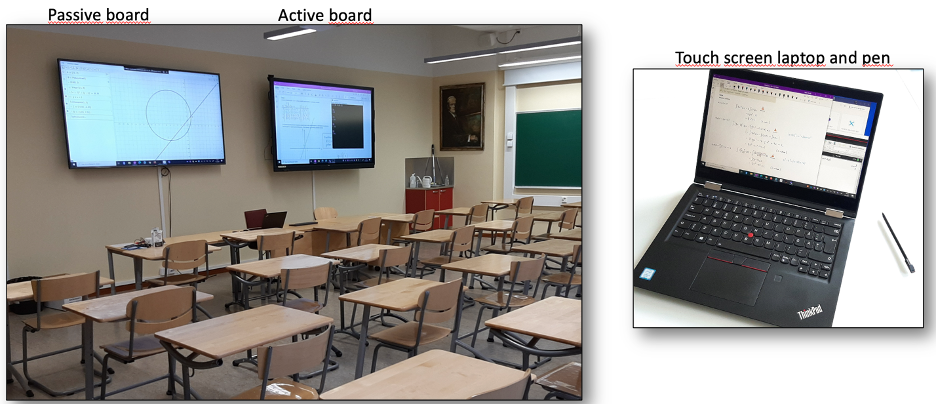
When COVD started, they could use this same method for remote teaching by using a touchscreen laptop computer. Microsoft was so interested in this method that they made their own video [in Finnish] about what Päivi was doing. This is a good example because it is a new pedagogical solution that saves evergy and helps students to learn. Now, this solution has been adopted more widely by our chemistry and physics teachers as well.
TH: That’s a fabulous example! I also wanted to ask you about Finland’s efforts to develop more of what in the US we call interdisciplinary learning. Here in Finland you call it transversal or phenomena-based learning, and when I was in Finland the last time in 2016, the latest curriculum reform was being discussed, including the importance of pursuing more phenomena-based learning. Now, on this visit, I haven’t heard much talk about it. Have you seen any innovations in your schools in terms of transversal or phenomenon-based learning?
TL: You actually can’t find the word phenomenon-based learning in the national curriculum. Our new curriculum is quite nice, but I cannot find any major differences with earlier curricula. Some of the same kind of ideas about phenomenon-based learning were found in earlier curriculums. When the new core curriculum came out in 2016 some people and the media started to talk a lot about phenomenon-based learning because, of course, they found the idea very cool. But we haven’t talked that much more about it because it already happens. We use the method every day in primary school education and quite a lot also in lower and upper secondary school education. There may be more now than before, but I think we don’t find a lot of schools where the whole thing is phenomenon-based learning.
TH: But the latest curriculum does say every student should engage in a module with transversal learning every year? How do you make sure that happens?
TL: Yes, and we make sure that happens, but not by measuring. I know it happens. In primary school, our teachers have co-teaching sometimes, and I know when they have co-teaching, they do projects that are organized around some phenomenon. It’s a quite normal way for them to teach, and it has been going on for some time. But we have changed our system in some ways. For example, in the Viikki school, where we have more space, all three first grade teachers are in one classroom, and they can group things flexibly, and they have a special education teacher who is the fourth teacher in the room. They have projects where they put different subjects together. And if you read their timetables, it cannot say that this lesson is math; they feel they’re teaching in a different way. In lower secondary school where we have subject teachers, we don’t have as many possibilities, but we also have some co-teaching projects. For example, history teachers, physics teachers, and mother tongue teachers have a yearly project together, and I know all our students go through this project. Every year, we also have other yearly projects. For example, we have a “Light Week” in the fall, and during this week, at the whole school level, we have different projects that link different subjects together to study light and electricity.
TH: I also wanted to ask you about the upper secondary schools and the matriculation exams. I know that a reform has been passed, but that right now students who do well on the mathematics exams have a better chance of getting in to university. Have you seen any positive or negative effects of that?
TL: Negative. You can say that the higher level of education always leads the orchestra. What happens in the university always leads what happens at the upper secondary level; and the upper secondary schools leads the orchestra for the lower secondary schools. When students in lower secondary schools want to get into high-level upper secondary schools, they are very interested in their grades in mathematics, mother tongue, and so on. When we have these weeks for projects, some pupils and parents don’t like that because they are just focused on getting high grades in the subjects. Now, our upper secondary school students know that the system is that you need high grades in mathematics. Even if you want to study history, you need high grades in mathematics. If you want to pursue law or become a medical doctor, you need high grades in mathematics. So all of them want to take mathematics, but they struggle because they dislike mathematics, but they have to do it because it is so important both for the exam and for their grade point average if they want to go to university. Now, they have changed the system, and in the fall of 2024, our new students in lower secondary school they knew that the university system is going to be a bit different when they get there. I hope it’s even possible for people who love history and want to study history at the university to concentrate on history. We really hope this helps the situation. Students could choose more languages, more humanistic studies, and more.

 International Education News