Can the changing economic, political, and demographic conditions in China combine with growing concerns about students’ mental health and wellbeing to create a more balanced education system? Thomas Hatch explores this question in the final post in a series that shares his reflections on his conversations with Chinese educators and visits to Chinese schools over the past two years. The first post in this series explored some of the “niches of possibility” within the conventional Chinese curriculum and schedule that may foster the development of more student-centered approaches. The second post reviewed changes in educational policy in China that may have created some additional flexibility for schools to pursue innovative educational approaches and reinforced exam pressures at the same time. The third post discussed how one experimental school is trying to take advantage of AI to support students’ learning and development and the fourth considered recent efforts to respond to growing concerns about students’ mental health.
For other posts on education and educational change in China see “Boundless Learning in an Early Childhood Center in Shenzen, China;””Supporting healthy development of rural children in China: The Sunshine Kindergartens of the Beijing Western Sunshine Rural Development Foundation;” The Recent Development of Innovative Schools in China – An Interview with Zhe Zhang (Part 1 & Part 2);” “The Desire for Innovation is Always There: A Conversation with Yong Zhao on the Evolution of the Chinese Education System (Part 1 & Part 2);”“Surprise, Controversy, and the “Double Reduction Policy” in China;””Launching a New School in China: An Interview with Wen Chen from Moonshot Academy;”and ”New Gaokao in Zhejiang China: Carrying on with Challenges
The elite schools I visited in China demonstrate the kinds of innovative practices that can fit into the Chinese education system even with its exam-based focus and intense academic pressures. At the same time, the academic pressures continue to constrain any attempt to change instruction and spread more student-centered pedagogies on a wide scale. Although it seems that there may be no way out of the “trap” of increasing academic pressure, it’s also clear that the Chinese education systems has changed substantially over the past thirty years, in concert with significant developments in the demographic, economic, technological and political conditions in China. These realities left me wondering: Could China leverage the changing societal conditions to create more balanced educational experiences for future generations of students?
“Could China leverage changing societal conditions to create more balanced educational experiences for future generations of students?”
Changing conditions in China over the past 30 years
In China, the massive expansion of education at every level, and particularly the growth in the number of university places could have helped to lessen some of the exam-based pressure on students. However, those developments took place along with the massive growth in the Chinese population to over 1.3 billion people by 2010. At the same time, almost 800 million people have lifted themselves out of poverty and China’s middle class, now the largest in the world, includes over 500 million people. Even with the substantial increases in the number of colleges and universities, those developments mean that many more parents aspire to get their children into a handful of top institutions of higher education and many more students are competing for those limited places.
Further fueling the pressure is a substantial rural-urban divide, with students in rural areas experiencing much more difficult basic conditions and much less chance of getting a good education, getting a good score on the Gaokao, or getting into college. Although most villages had a primary school of some kind in the 1990’s, as birth rates fell and rural parents migrated to cities to take advantage of the economic opportunities, almost three-quarters of all primary schools – around 300,000 – were closed. As a consequence, some children have to travel long distances to school and others spend the school week at boarding schools, including what are estimated to be some 60 million “left-behind children” whose parents could not take them when they migrated to find work. As of 2015, there were about 100,000 boarding schools in rural China, with an estimated 33 million children living in them, including about 12% of primary school children and 50% of rural secondary school students. Crucially, the difficult conditions contribute to the gap between urban and rural students in high school completion and access to higher education.
Recent changes in birth rates, employment, and college enrollment
But conditions are changing again – fast. Births in China have now declined so much that the birth rate in 2023 was about half of what it was in 2015 only eight years earlier. The population decline in 2023 was also twice as large as it was in 2022, the first year the population dropped in 60 years. China’s economic growth has now slowed to one of its lowest rates in more than three decades; a real estate crisis has contributed to plunging house prices; and unemployment among youth has been so bad that in 2021 more than 70% of those 16 – 24 year-olds who were unemployed in Chinese cities had a college degree. By 2023, once the overall youth unemployment rate passed 21% China temporarily stopped reporting the figures. In 2024, with a new measure that excludes students, youth unemployment still stood at over 14%. At the same time, the expansion of higher education has continued while employment opportunities for post-secondary graduates have dropped. In 2024, only half of the 11.58 million graduates have gotten a job or gained admission to postgraduate study. Recognizing that problem, the Chinese government has encouraged universities to admit many more masters and doctoral students, leading enrollments in graduate programs to double between 2010 and 2021.
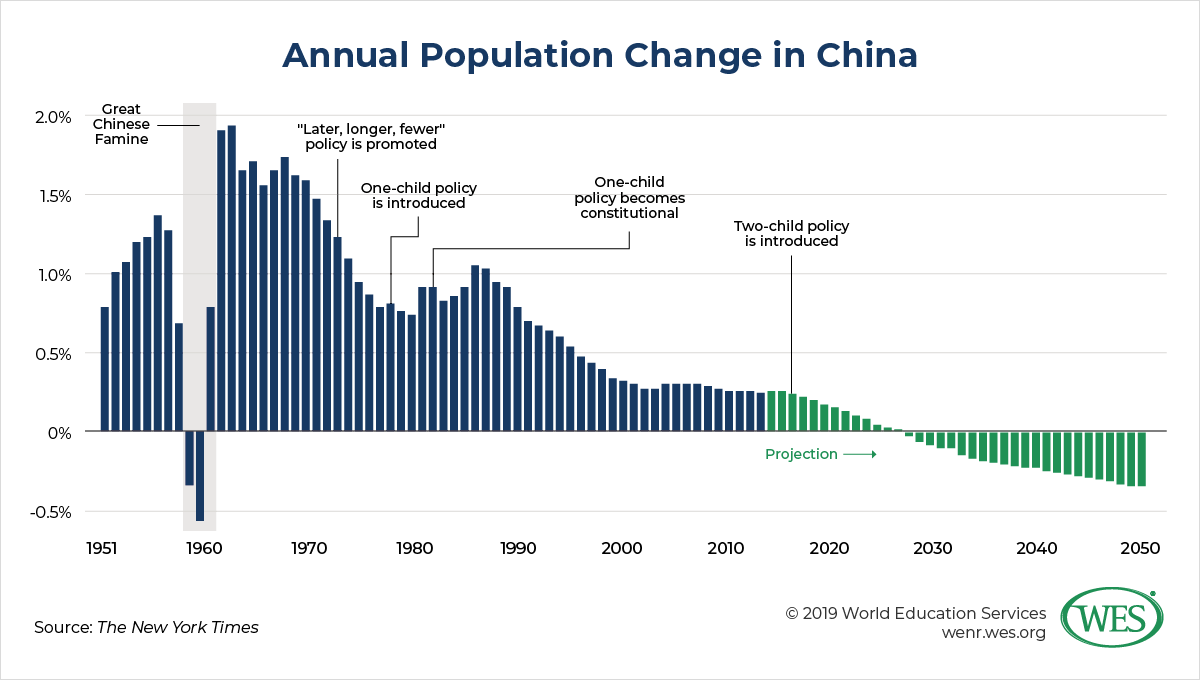
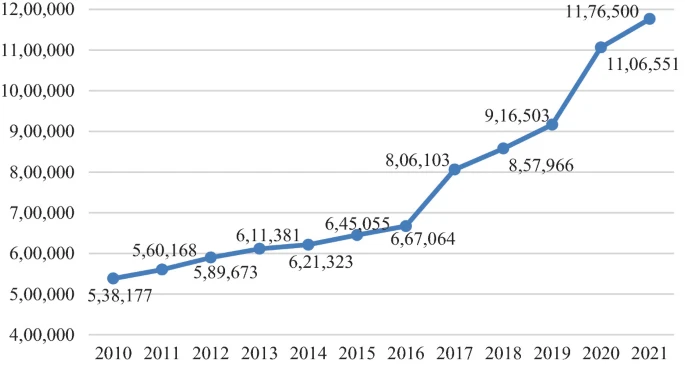
Unfortunately, the glut of college graduates, in turn, has contributed to diminished job prospects for many of those who worked so hard for good grades and high scores on the Gaokao. As one researcher at China’s National Institute of Education Sciences put it, college graduates should lower their expectations and look for jobs in sectors such as food or parcel delivery; other reports claimed masters degree recipients were taking on jobs like trash collectors. These changing circumstances challenge the very idea that schools are a vehicle for upward social mobility As one joke puts it: “The mortgage is nearly 10 million, the spouse does not work, and the second child is studying abroad. This is simply the three things that will cause the middle class to fall back into poverty.” Given these developments, some researchers see a recent drop in the number of graduate school applicants as a “return to rationality” Perhaps, the latest generation of Chinese students are beginning to recognize that postgraduate study can no longer guarantee them a better job.
“[S]tudents should lower their expectations and look for jobs in sectors such as food or parcel delivery“
Under these demographic and economic conditions, it’s possible to imagine scenarios where the seemingly inevitable increases in academic pressure and competition might subside somewhat. After years of urbanization that exacerbated the rural-urban gap in educational and economic prospects, a “reverse” migration and a redistribution of the population back to smaller cities and rural areas may be underway. Rural – urban migration had already slowed down before the COVID pandemic, and China’s statistics bureau reported that there were almost two and a half million fewer migrant workers in urban areas in 2021 than there were in 2019, with more migrants staying closer to home. That reversal has been aided by the development of the digital economy and opportunities for remote work as well as by longstanding restrictions that make it difficult, if not impossible for migrant workers to access housing, schooling for their children, and other benefits.
Since 2012, the Chinese leadership has also made reducing the gap between urban and rural development a priority, and the government has supported investment in rural areas through a variety of policies. In 2015, for example, the General Office of the State Council of China issued the “Opinions on Supporting Migrant Workers and Others Returning to their Hometowns to Start Their Own Business” to encourage migrant workers, college students, and retired soldiers to return to their hometowns to start new businesses. in 2017 those efforts took off with the announcement of a “rural revitalization” strategy. That strategy seeks to make China self-sufficient in terms of food production and consumption and focuses on modernizing agriculture and rural areas by 2035. Policies and investments are designed to accomplish critical tasks like ensuring the grain supply, developing high-quality rural industries, increasing farmers’ incomes, and fostering a beautiful countryside. The strategy is encouraging a generation of “’new farmers,’ mostly well-educated young people with new ideas and skills,” to move from big cities to the countryside. In 2021, 1.6 million more people returned to the countryside than in 2019, with the government reporting that more than half of the entrepreneurial projects it supported focused on using livestreaming and other online methods to sell products.
Taken together, these changes could encourage many more students and their families to stay where they are and to take advantage of the massive growth in higher education outside the major cities. With a decreasing population more distributed around the country there could be fewer students competing for an expanded number of places in colleges and universities. At the same time, if more youth recognize that academic competition is not yielding the access to elite universities or job prospects that previous generations expected – and they see that more studying does not necessarily lead to better results – academic pressure could subside further.
New developments in curriculum, technology, and assessment?
A new set of curriculum standards and new textbooks may also help to fuel this shift, providing a policy context that can encourage many schools to pursue more student-centered learning. As one description of the changes put it, beginning in 2024 with the initial introduction of new textbooks, “compulsory education will enter a new era in which new curriculum standards, new textbooks, and new classrooms are mutually compatible, from the past ‘educating for scores’ and ‘educating for abilities’ to the comprehensive deepening of ‘educating people.’”
[C]ompulsory education will enter a new era in which new curriculum standards, new textbooks, and new classrooms are mutually compatible, from the past “educating for scores” and “educating for abilities” to the comprehensive deepening of “educating people.”
The new curriculum and textbooks continue to highlight the learning of subjects but promote a change in focus from “fragmented class objectives” to more integrated and systematic unit objectives, a new emphasis on the transfer and application of knowledge, and a transition from “practicing questions to solving problems.” The math textbook, for example, has added two “mini-projects” for each semester that are supposed to take up at least 3 lessons. The changes in the English textbooks create another niche of possibility for more interdisciplinary and student-centered learning by spending less time on grammar and organizing each unit around theme-based projects. Changes being made in the questions for the Gaokao to focus more on applications of knowledge and on problem-solving rather than on memorization could play an important part in this shift.
Technological developments could also facilitate the development and spread of innovative practices by facilitating more personalized learning experiences and contributing to more powerful assessments. Although these new technologies and AI could be used to teach students more and more traditional content and skills more quickly, they could also help to make conventional instruction much more efficient. As the efforts of the teachers at the Suzhou Experimental Primary School demonstrated, AI could also create more space and time for student-centered learning experiences and to support the development of a much wider range of interests and abilities and student wellbeing. Of course, such technological development in schools depends on close cooperation between AI and tech companies and Chinese schools as well as the Chinese government’s continuing efforts to support digitization of schools and teaching in remote rural areas.
As I have argued in “The power of condensing the curriculum,” all of these demographic, economic, political, technological and educational changes could create the opportunity and incentives to reduce the time spent on exam preparation and create more balanced school experiences. All of these are enormous “if’s,” however. Predicting generational attitudes, in particular, is far from an exact science and certainly not something to count on. As Yong Zhao, a well-known expert on educational change and China told me in my interview with him before my first trip, “China will not drop the Gaokao,” and taking the “tang ping” route for many is a risk that could have consequences like social isolation, diminished economic potential, and a lower standard of living.
A perfect storm or just another typhoon? Changing society, changing beliefs, changing schools
In the end, real changes in the academic pressure, and expanding support for a wider range of abilities and student mental health and wellbeing in China, as in the US and education systems, depends on the “perfect storm” of changes in education policies, technologies, economic and demographic conditions, and changes in the deep-seated values and beliefs that sustain conventional school practices.
As important as the Gaokao may be, by the time I left China I was convinced that the Gaokao is just an expression and manifestation of a basic belief that those who score the highest, those who work the hardest, deserve the riches they accumulate. In that sense, China may not be that different from the United States, where that same kind of belief in individual achievement sustains a highly inequitable system and the conventional modes of instruction and schooling it relies on.
“[T]he Gaokao is just an expression and manifestation of a basic belief that those who score the highest, those who work the hardest, deserve the riches they accumulate.”
As Daniel Markovitz argues in The Meritocracy Trap, in the US, success in school and in life is generally seen as a product of an individual’s talent and effort. Similarly, failure – in terms of poor grades, the inability to get into a good college, get a good job, or make a good living – is often cast as a personal failing rather than a manifestation of systemic inequalities. From this perspective, those who score high on exams, secure admission to an elite college, become CEO’s or make billions of dollars deserve the rewards and riches they have attained. My conversations with many of my colleagues and many students in China seemed to echo these beliefs, as they noted that competitions and rankings, including the Gaokao, provide the best way to identify those who will be most successful despite the pressure and the problems it produces. Those beliefs also contribute to an internalization of failure and feelings of shame, with many students worrying that with poor performance in school or on the Gaokao they are letting their families down.
Changing any education system depends on understanding the complex interplay of historical, geographic, demographic, economic, political, and cultural conditions that produced the schools, policies, and practices that operate today. But it also means confronting those conditions, while embroiled in them. We can look for leverage and open up opportunities for people to expand their views, question their values and beliefs, and develop alternative points of view that might support the emergence of new institutions, structures, and practices over time. Perhaps these generational changes can support the emergence of a hybrid “East/West” approach to education that provides a better balance between a focus on academic achievement the development of a wider range of skills and students’ wellbeing.
“We can look for leverage and open up opportunities for people to expand their views, question their values and beliefs, and develop alternative points of view that might support the emergence of new educational institutions, structures, and practices over time.“

 International Education News