Author Archives: T Hatch

A Driving Force Behind Educational Change: Cecilia Azorín on Networks, Distributed Leadership & Inclusion

This week, IEN features the November Lead the Change (LTC) interview with Dr. Cecilia Azorín (@CeciliaAzorin), Associate Professor at the Faculty of Education, University of Murcia, Spain. Dr. Azorín is one of the leaders of an Erasmus+ KA2 Project comparing all age schools in Wales, Spain, and Iceland.  She received the Michael Fullan Emerging Scholar Award in Professional Capital and Community (2019).

Lead the Change: The 2021 AERA theme is Accepting Educational Responsibility and invites those of us who teach in schools of education to accept greater responsibility for the inadequate preparation of educators for work in racially, ethnically, culturally, and linguistically diverse P–12 schools and postsecondary institutions. For example, when educators discipline African American students at disproportionately higher rates, misdiagnose them for special education, identify too few of them for advanced placement and international baccalaureate programs, deliver to them a culturally irrelevant curriculum, teach them in culturally disdaining ways, and stereotype their families as careless and hopeless, the schools of education that produced these professionals are just as responsible as the professionals themselves. Furthermore, if scholars who study and document these trends do too little to make our findings actionable, then we, too, are contributors to the cyclical reproduction of these educational inequities.   

Given the dire need for all of us to do more to dismantle oppressive systems in our own institutions and education more broadly, what specific responsibility do educational change scholars have in this space? What steps are you taking to heed this call??

Cecilia Azorín: Accepting educational responsibility implies conceiving education as something that can help individuals overcome inequalities, a mechanism capable of transforming lives and positively impacting people’s progress. This statement leads one to think about the social mobility that can be produced as a result of education. Harris and Jones (2020b) have recently stated that “social and educational mobility are important because they reflect the equality of opportunity in society” (p. 18). Put simply, Hargreaves (2020) defines social mobility as the chance to achieve greater success through education compared to one’s parents.
When your background is humble, for example, when your father is a farmer and your mother a homemaker, becoming the first PhD of your family, and eventually, a university professor, is no easy task. I have experienced social mobility firsthand, and it has not been a bed of roses. And yet, I can say that my own social mobility was the consequence of education and the experiences I received. Creating effective educational experiences for all children is the first step to dismantle oppressive systems. This is linked to an approach that essentially recognizes the power that education has in terms of social justice.

When I think about dismantling oppressive systems in education, a song springs to mind – “Another Brick in the Wall” released by the British group Pink Floyd in 1979. I invariably use this song as a university welcome for my students, future teachers, with whom I work on concepts such as, what is, and what is not, an effective pedagogical approach, how to capitalize on their passion for teaching, how to engage in divergent thinking and what it means to educate in an environment that responds effectively to student diversity. Another Brick in the Wall is a protest against the strict norms and rules of traditional conceptualizations of teaching and learning – a system more concerned with maintaining discipline and restricting creativity than with motivating and transmitting knowledge.

On the occasion of the twentieth anniversary of the Declaration of Children’s Rights, the United Nations declared 1979 the International Year of the Child, thus recalling our collective commitment to protect children. From that moment on, authoritarian approaches to education began to be questioned. Undoubtedly, the message this song projected not only in British society, but in the rest of the world, allowed people to dream that the change in education was possible. In reality, the argument was clear and called for a new teaching, an improvement of the school based on less control and more freedom.

In 1980, one year after its release, this song was adopted as a protest anthem among black students in South Africa who were suffering from apartheid, a system of racial segregation that divided schools and communities in a discriminatory manner and unjustly perpetuated inequalities.

Today, there are new layers of exclusion that leave childhood and youth unprotected. According to the Global Monitoring Report (UNESCO, 2020, 4): All over the world, discrimination is based on gender, remoteness, wealth, disability, ethnicity, language, migration, displacement, incarceration, sexual orientation, gender identity and expression, religion and other beliefs and attitudes; the Covid-19 pandemic has added new layers of exclusion.

Unfortunately, the continued exclusion of many merely confirms that oppressive systems are embedded in the very fabric of our societies, and are traditionally characterized by discriminating forms of oppression that directly attack the most vulnerable groups. For example, in Spain (my home country) and in many other places around the world, discrimination, stigmatization continue as does the fight to make schools more inclusive. Thus, a system of parallel schooling is currently maintained, with students attending so-called “ordinary” schools and others being relegated to “special education” schools. 

Inclusion is a major driving force for educational reform and a central goal of the international agenda. In a recent article, we analyzed how we can help schools to review progress on their journey to becoming more inclusive and show that fostering reflection amongst teachers about the contexts, resources and processes that underpin their work can make a difference (Azorín & Ainscow, 2020). But, how does one ensure that no one’s dream is denied and keep young people on the track to a brighter and equitable future without equal education opportunities for all children? The school cannot and must not leave anyone behind; on the contrary, it must set itself up as a guarantor of the right to a truly inclusive, equitable and quality education, without exceptions. This is probably one of the main challenges and responsibilities facing educational change scholars in these complex times.

“The school cannot and must not leave anyone behind; on the contrary, it must set itself up as a guarantor of the right to a truly inclusive, equitable and quality education, without exceptions.”

LtC: Given your focus on school networks as a strategy to enhance educators’ knowledge and practice, what would be some of the major lessons the field of Educational Change can learn from your work and experience? 

CA: Nowadays, scholars are turning their attention to collaborative networking and all it entails. The inference is that educational networking as a policy mechanism is here to stay, and that networks represent a school improvement strategy with high expectations placed upon them (Azorín & Muijs, 2017). Networking is becoming ever necessary to tackle problems and establish the adjustments demanded by contemporary education. Some interconnected lessons derived from the penetration of networks in education are explained below (Azorín, 2017):

  • An opportunity for crossing boundaries. Networks enable the creation of a whole new scenario in which connectivity is prioritized over isolation; collectiveness over individualism; and collaboration over competitiveness.
  • A strategy for building bridges. When collaboration extends beyond schools and professionals, resources are effectively mobilized and there is an exchange of knowledge and experiences that make it possible to “learn from others”.
  • A driving force behind educational change. Networks are formed by interactive and horizontal structures that act as levers for change, leaving behind the hierarchies of the past to allow progress to gain momentum.

This way of understanding education embraces winds of change that go beyond school gates in the quest for greater collaboration. A few years ago, a couple of research stays in the United Kingdom afforded me the opportunity to see emerging networks and partnership alliances in action (Azorín & Muijs, 2018). In an attempt to promote reflection on why professional learning networks are social, political, and cultural, as well as educational (Azorín, 2019), my research in the British context offers other views of networks that focuses not only on education but also on social welfare issues and aims to target networking from a broader perspective. This results in opening up schools to the community, a topic which is not yet covered widely in educational research.

“Networking is becoming ever necessary to tackle problems and establish the adjustments demanded by contemporary education”

To position school networks at the forefront of research, in 2018 I co-edited a special issue based on new forms of participation and social transformation through networking in education (Azorín & Arnaiz, 2018) in the Spanish journal Profesorado. Revista de currículum y formación del profesorado (see Volume 22, Number 2). This edition put the focus on the expected role of collaborative networks in education, the new forms of participation and social transformation that appear under these modes of organization, and the need to disseminate ideas that contribute to the creation of knowledge within this fruitful line of current and future research.

Recently I edited another issue on leading networks in the School Leadership & Management journal (see Volume 40, Number 2-3), which boasts an excellent line-up of international authors. This edition explores leadership actions that support effective networking and promotes reflection about whether networks can impact positively on students or are merely used as an organizational structure that benefits teachers in terms of professional learning and support (Azorín, 2020b). Together the diverse set of articles in this compendium conclude that empirical evidence in this direction remains thin and requires further attention.        

The central lesson of school networks as a strategy to enhance educator’s knowledge and practice is probably that networking affords a powerful way of organizing and operating; they offer viable solutions for the future of the network society and represent a reality that is advancing towards other forms of social participation and transformation. Networks are, in essence, the constellations illuminating the next routes of educational change.

LtC: In your recent work, you argue that distributed leadership offers new opportunities to understand professional collaboration generally and in the context of professional networks specifically. What do you see as the most needed changes to policy/practice in response to this argument?

CA: While COVID-19 continues, millions of people are caught in a traumatic experience. The pandemic is causing a chronic state of uncertainty and highlighting the weaknesses of education systems to adapt to change.

At the education level, leading schools during a pandemic is a challenge of vast dimensions. Once the initial shock is over, educational leaders need to recover the helm of their schools that this unexpected virus has taken from them. In this respect, networking is becoming a good ally in the fight against COVID-19.

Prior to this period of crisis, educational research and practice had already focused on the prevalence of an important current of thought that advocates distributed leadership as a key condition for effective networking and coherent professional collaboration (Azorín, Harris & Jones, 2020; Harris & Jones, 2017). COVID-19 has accelerated networking to an unprecedented level and distributed leadership is now being used as a mechanism of coherent response to the current situation. 

In education, there is a call for collaboration and leaders are being required to network. According to Harris and Jones (2020a), “most leaders will be running on empty given the myriad of challenges that COVID-19 has created for them, so distributed leadership is a necessity to survive” (p. 246).

We have argued that the adoption of a lens of distributed leadership practice within networks will afford a better understanding of how networks operate (Azorín, Harris, & Jones, 2020). In our work, from the point of view of distributed leadership and networking we provide a three-fold classification that aims to make sense of the complexities involved in changing education policies and practices:

  • Network leadership: based on leadership through organizational connections across organizations, where the type of network dictates membership, there are no implicit barriers to entry and knowledge transfer is central to effective networking.
  • Lateral leadership: characterized by collective agency, interdependent decision making, collaborative action, formal and informal leadership patterns, collective ownership, fluid, interchangeable membership and releasing potential.
  • Distributed leadership: related to leadership by expertise within, between and across organizations, inter-changeable membership according to needs, a focus on leadership practice more than leadership position, and extending or ‘stretching’ leadership capacity as a key purpose.

In terms of policy and practice, Harris (2012) argues that “despite decades of research on school improvement, school effectiveness and system reform, some policymakers are still selecting and implementing policies that have little, if any, independent empirical evidence supporting them” (p.5). Distributed leadership perspective would shift the knowledge base on networks “away from largely normative descriptions, self-report and over assertion to more sophisticated research designs and analytical processes that would generate more rigorous and reliable evidence” (Azorín, Harris, & Jones, 2020, p. 121). If we look at the educational research, there is empirical evidence that supports the following set of propositions about the types of leadership practices that are most prevalent and effective within networks (Azorín, Harris & Jones, in press):

  1. Middle leadership supports effective networking.
  2. Distributed leadership within networks enhances innovation.
  3. Teacher leadership is an essential component of effective networking.
  4. Collaborative practices need to be learned and practiced.
  5. Formal leadership drives distributed leadership.
  6. Distributed leadership patterns matter in networking activity.
  7. Effective networks are communities of practice.
  8. Distributed leadership provides support in networked organizations.
  9. Leadership in networks is not fixed but interchangeable.
  10. Effective network leaders build and sustain professional capacity.

These findings clearly demonstrate that distributed leadership is a successful approach that can support, stimulate, and enhance networking. Within this change of outlook, a good recommendation is to take note of what evidence tells us and bring in policies that include what is functioning in practice to promote reforms that go in the right direction. It is important to facilitate links that allow distributed leadership to flourish in networks at the systemic level. To make this happen, educational leaders’ actions have to go beyond school limits and move towards a process of democratization and openness.

“Distributed leadership is a successful approach that can support, stimulate, and enhance networking.”

LtC: Educational Change expects those engaged in and with schools, schooling, and school systems to spearhead deep and often difficult transformation. How might those in the field of Educational Change best support these individuals and groups through these processes?

CA: One of my priorities as an educational change scholar is opening up schools to their communities and elevate these communities’ importance in decision-making and policy. In education, as in many other aspects of life, it is important to recognize that context matters (Harris and Jones, 2018). Schools have to reflect on the context in which they are immersed, be prepared to work in collaboration networks with neighboring allies, and to take firm steps to open up to the world (Azorín, 2019).

Schools are no longer expected to merely provide an educational function or service, but to safeguard the well-being of their students and, despite the pandemic, ensure continuity of learning. They are asked to take a step forward, to foster rapprochement with their local community, neighborhood, various educational and social agents, volunteer networks, and associations (Azorín & Muijs, 2018). In the 21st century, it does not make sense to live disconnected from what is happening around us. It is vital to open up and remove the barriers that still make it difficult for millions of people to benefit from the improvement provided by the different connections they have in educational and social spheres.

Similarly, the construction of a “school without walls” could be supported, both physically and pedagogically; a renewed institution capable of transcending its own rules and questioning its own practices and relations with its surroundings. Against the backdrop of the pandemic, reimagining schooling in that sense is a reminder that the call for collaboration and networking should not be delayed any longer.

Below are 7 important factors that educational change scholars could bear in mind to support the transformation of education when they engaged in and with different school settings:

  1. Communicate to share and exchange information.
  2. Connect to learn from others.
  3. Collaborate together for a common purpose.
  4. Create new knowledge.
  5. Co-lead for distributed leadership to flourish.
  6. Circulate ideas that allow the dissemination of innovations.
  7. Catalyze the change of cultures, policies and practices.

Educational change scholars act as links that bring the value of ideas and are able to initiate social movements that enable the transformation of educational systems for the improvement of their countries. This is often done through the use of evidence-supported knowledge and advice about practices that work. Their work is to connect theory, policy, and practice, clarifying the meaning of what they do so that others can replicate it.

“Educational change scholars’ work is to connect theory, policy, and practice, clarifying the meaning of what they do so that others can replicate it.”

In short, I have published numerous results of research projects and experiences of educational innovation carried out in schools with which I had the opportunity to collaborate very closely. Often, when I share the trends in scientific literature and the proposals of some schools with others, the professionals working in them say they were unaware this knowledge was available. I have learned from these experiences how relevant it is that ideas travel from one school to another. When we know that something has worked in one school it is easier for another to want to put something similar into practice, while adapting it to its own reality. The educational change scholar has the capacity to make this possible. In summary, the interconnection between the different educational and social agents involved in the school, as well as the dissemination of their practices, is part of the formula for educational change.

LtC: Where do you perceive the field of Educational Change is going? What excites you about Educational Change now and in the future?

CA: Unquestionably, 2020 has been a turning point, a before and after in people’s lives. The pandemic has marked the end of the educational journey of the previous decades. Hargreaves and Fullan (2020) recently stated that “educational reform in the postpandemic age must be transformational and not seek to return to normal” (p. 327). Beyond the COVID-19 supernova (Azorín (2020a) “we need to come out of this crisis as a stronger society, with a fairer and more supportive educational system that really can change lives. Otherwise, we will have missed out on an opportunity” (p. 388).  In the coming years, educational change is going to take huge strides in terms of networking, leadership and innovation.

First, the monitoring of collaborative networks that have sprung up in education and society, especially in these uncertain times, needs to be researched. Since the beginning of the pandemic “the chains of favors have multiplied with initiatives of support and help towards the most vulnerable” (Azorín, 2020a, p. 383).  If networks are at the front-line of the crisis, where formal and informal groups connected by social ties have emerged in force. 

Second, Harris and Jones (2020a) state that “a new chapter is being written about school leadership in disruptive times that will possibly overtake and overshadow all that was written before on the topic” (p. 246). At the school level, there is no single person able to respond to all the demands and challenges deriving from COVID-19. In contrast, many actors are playing crucial roles at this moment and distributed leadership is positioning itself as a viable strategy for the present and future of education (Azorín, Harris, &Jones, in press). 

Third, within this uncertain atmosphere, it is worth asking if COVID-19 can act as a channel for innovation and change in education. I agree with Fullan and Quinn (2020), who conclude, “Our sense is that there are many people (students, teachers, parents and others) who see a dire need for improvement in learning systems and are willing to work toward that end. With the right combination of action positive system change could occur at a more rapid rate than at any time in the past century” (p. 22).

In any case, surely the above ideas can serve as beacons to illuminate the change in education that is so needed and will mark the new coordinates on which we will continue to teach, write and research.

References

Azorín, C. (2017). Redes de colaboración entre escuelas inglesas para la mejora de la inclusión socioeducativa. Profesorado. Revista de currículum y formación del profesorado, Número Extraordinario, 29-48.

Azorín, C. (2019). The emergence of professional learning networks in Spain. Journal of Professional Capital and Community, 4(1), 36-51.

Azorín, C. (2020a). Beyond COVID-19 supernova. Is another education coming? Journal of Professional Capital and Community, 5(3-4), 381-390.

Azorín, C. (2020b). Leading networks. School Leadership & Management, 40(2-3), 105-110.

Azorín, C. and Ainscow, M. (2020). Guiding schools on their journey towards inclusion. International Journal of Inclusive Education, 24(1), 58-76.

Azorín, C. and Arnaiz, P. (2018). Redes de colaboración en educación. Nuevas formas de participación y transformación social. Profesorado. Revista de currículum y formación del profesorado, 22(2), 1-6.

Azorín, C. and Muijs, D. (2017). Networks and collaboration in Spanish education policy. Educational Research, 59(3), 273-296.

Azorín, C. and Muijs, D. (2018). Redes de colaboración en educación. Evidencias recogidas en escuelas de Southampton. Profesorado. Revista de currículum y formación del profesorado, 22(2), 7-27.

Azorín, C., Harris, A. and Jones, M. (2020). Taking a distributed perspective on leading professional learning networks. School Leadership & Management, 40(2-3), 111-127.

Azorín, C., Harris, A. and Jones, M. (in press). Future Leadership. Distributed Leadership and Networking: Exploring the Evidence Base. In D. Netolicky (Ed.), Future Alternatives for Educational Leadership. Routledge.

Fullan, M. and Quinn, J. (2020). Education Reimagined: The Future of Learning, available at: https://edudownloads.azureedge.net/msdownloads/Microsoft-EducationReimagined-Paper.pdf (accessed 27 November 2020).

Hargreaves, A. (2020). Moving: A Memoir of Education and Social Mobility. Bloomington, United States: Solution Tree Press.

Hargreaves, A. and Fullan, M. (2020). Professional capital after the pandemic: revisiting and revising classic understandings of teachers’ work. Journal of Professional Capital and Community, 5(3-4), 327-336.

Harris, A. (2012). Lead the change series Q&A with Alma Harris. AERA Educational Change Special Interest Group, 20, 6.

Harris, A. and Jones, M. (2017). Professional learning communities: A strategy for school and system improvement? Wales Journal Education, 19(1), 331-333.

Harris, A. and Jones, M. (2018). Why context matters: A comparative perspective on education reform and policy implementation. Educational Research for Policy and Practice, 17, 195-207.

Harris, A. and Jones, M. (2020a). COVID 19 -school leadership in disruptive times. School Leadership & Management, 40(4), 243-247.

Harris, A. and Jones, M. (2020b). System Recall. Leading for Equity and Excellence in Education. Thousand Oaks, California: Corwin.

UNESCO (2020). Global Education Monitoring Report 2020. Inclusion and education: all means all. Paris: UNESCO.

ABOUT THE LTC SERIES: The Lead the Change series, featuring renowned educational change experts from around the globe, serves to highlight promising research and practice, to offer expert insight on small- and large-scale educational change, and to spark collaboration within the Educational Change Special Interest Group of the American Educational Research Association.  Kristin Kew, Chair; Mireille Hubers; Program Chair; Na Mi Bang, Secretary/Treasurer; Min Jung KimGraduate Student Representative; Jennie Weiner, LtC Series Editor; Alexandra Lamb, Production Editor.
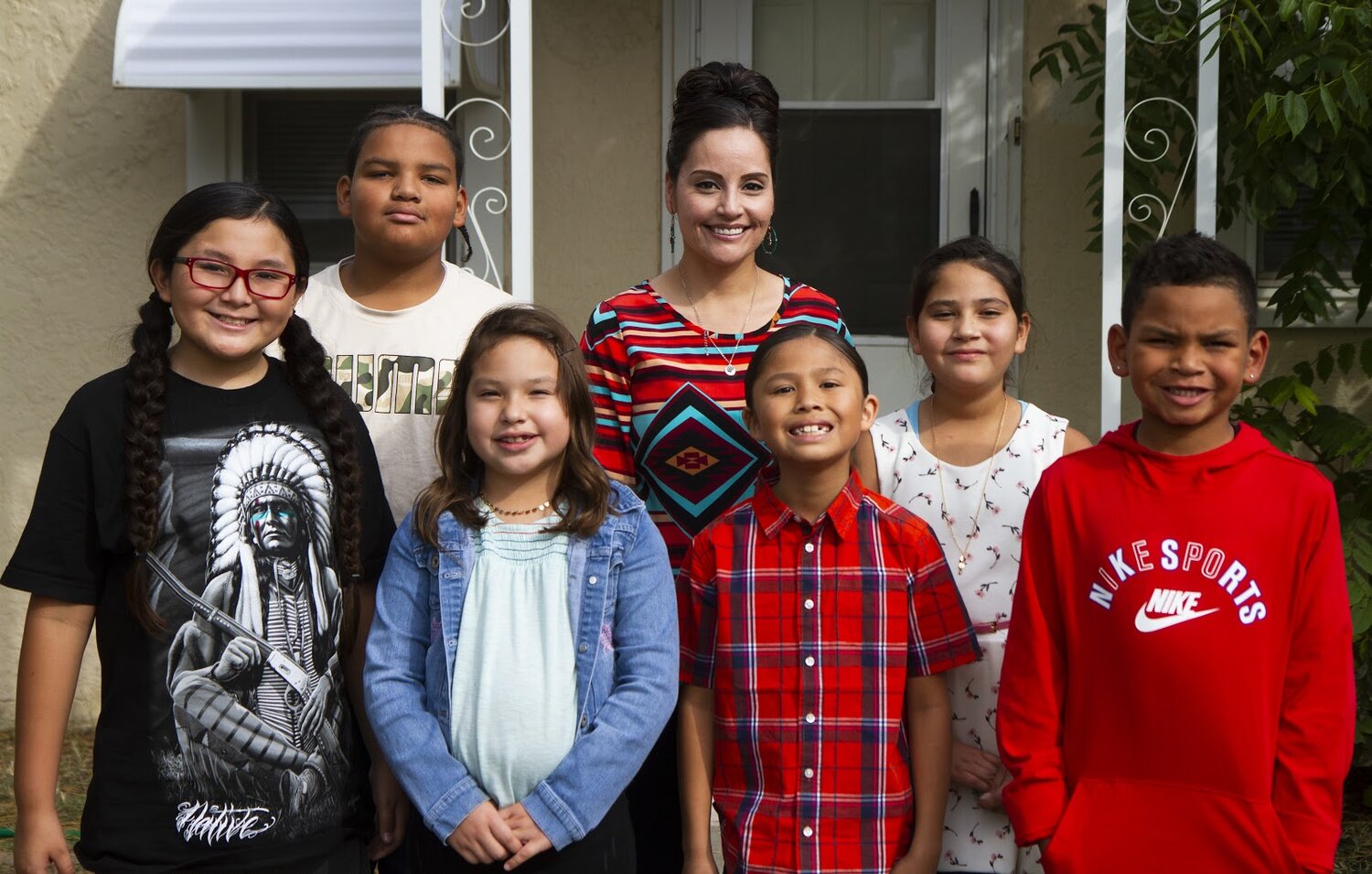
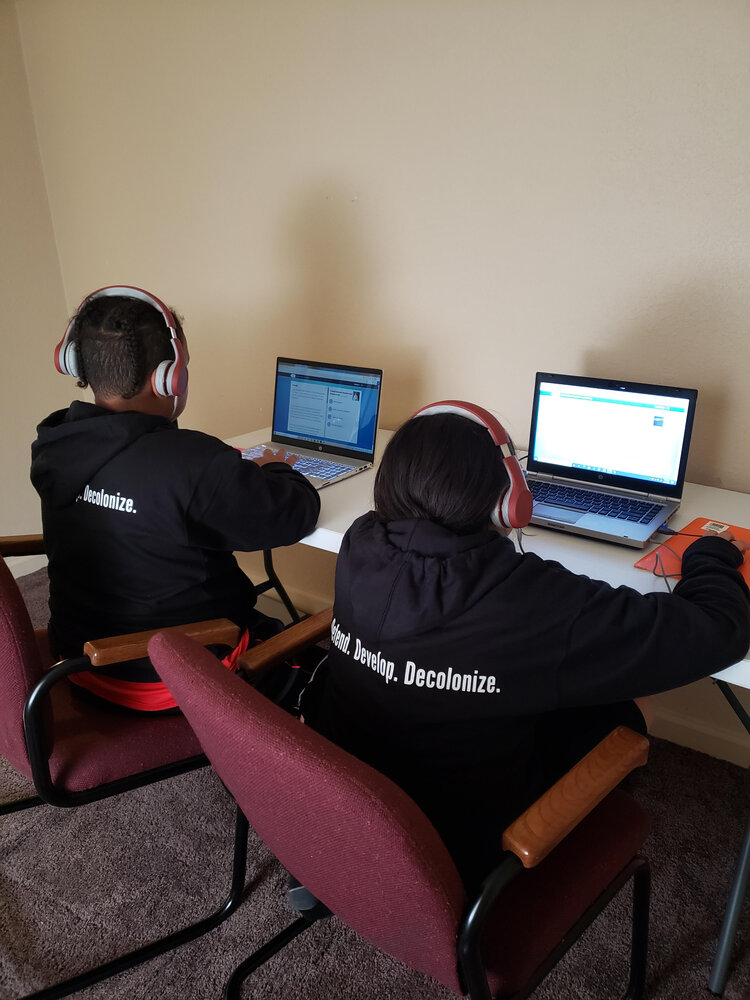
“WE AIM TO REMEMBER”: AFFIRMATION AND BELONGING IN THE LAKOTA OYATE HOMESCHOOL CO-OP

This week’s post comes from Jenee Henry Wood who leads learning at Transcend. The post was published originally as part of their “Roads to Reinventing” blog series focusing on the central question “What now feels possible for education that didn’t before this massive disruption?”

Mary Bowman describes her homeland with grace: “We, the Lakota, live in Ȟe Sápa, The Black Hills. This is an ancient and very spiritual place for us….beautiful pine trees, rugged mountains, and prairie land. We hold very important ceremonies on this land.” She goes on to describe the beauty of the Badlands and the indignity of Mt. Rushmore, “that abomination” that sits at the spiritual home of her people. 

There are about 100K remaining Lakota in the United States. COVID has hit Indigenous communities with ferocity. Indigenous families understandably worried that their children wouldn’t be safe returning to school in the fall. So they did something we associate with the most privileged communities – they started a learning pod. 

The Lakota Oyate Homeschool Co-op

After posting a message on Facebook, Mary  – a Lakota teacher – and a small group of parents, grandparents, and teachers received 140 messages from Indigenous families wishing to unenroll from their public district and re-enroll in the district on the neighboring reservation. During spring remote learning, high numbers of district students were disengaged – they just weren’t logging on. The district had no plans to reimagine the model for the fall. But the Oglala district would allow for pod-based remote learning embedded in the Lakota language and cultural curriculum. 

It strikes me that these Lakota families were motivated by two realities: first, the lack of deliberate national or state action to make schools safe; and second, the importance of cultural – not just physical – safety for Lakota youth as a prerequisite for learning. Marie High Bear, now a pod teacher and mother to a young son, recalls, “My son didn’t feel as though he belonged [in his district school]…he was teased by the other kids for his long hair. I’ve had to explain to him that his baby hair is sacred to us.” For these reasons, Mary, Marie, and others in the community got together to design a learning model that would keep children physically safe and rectify centuries of inequity. “I’ve been an educator for 16 years working with indigenous kids in the public school,” Mary reflects. “I’d always say, ‘Work hard and you can change your life.’ I never got the buy-in, they just didn’t believe it. Plus, they would walk with their hands behind their backs all day, single-file. That’s just not how we treat our children.” Mary knew that this homeschooling pod could signal a longer-range shift for Native families by serving as a template for a more permanent Indigenous alternative education. 

this homeschooling pod could signal a longer-range shift for Native families by serving as a template for a more permanent Indigenous alternative education. 

The Lakota Oyate Homeschool Co-op is grounded in the cultural knowledge and ways of being of the Lakota people. This shows up in everything from systems and procedures to core academics. The school day begins by smudging the school house, a ritual of burning sage and cedar, a practice that aims to “cleanse our minds, and make positive thoughts so that we can walk in a good way for our people, each other, and the Creator.” The pod has six children, ranging from 2nd-5th grades. They are taught together in this multi-aged group, which is supported by a whole community of family members. Marie serves as the “proctor” and Lakota Language and Culture teacher, working one-on-one when needed and leading the group during non-virtual learning portions of the day, such as nature exploration and hosting elders. Core academics like math and science are pursued in hands-on, practice-based ways. Students also spend time in nature during science learning, and math is grounded in culturally-relevant practical examples – a future lesson will be on how to erect tipis for maximum occupancy and egress. After the morning sage and cedar burning, the group then moves to a talking circle where the child with the feather or rock holds the floor. This is designed to be a reflective space for setting intentions grounded in Lakota values of respect, generosity, bravery, and courage. The children might reflect on the question, “What is a way that I can be generous today and share with others?” 

As Marie describes the pod’s typical day, she keeps referring to the ways in which their learning community centers Lakota knowledge instead of relegating it to the boundaries of the day, as it had been in the traditional system. In March 2018, after decades of Native pressure, South Dakota adopted the Oceti Sakowin, a set of essential understandings and standards aimed at addressing cultural diversity and raising consciousness to empower Native American students. Marie shares that the implementation of these standards was relegated to “specials,” once a week language classes, guest speakers, or other random experiences. This knowledge wasn’t embedded within the core DNA of school (e.g. daily rituals, curriculum) in ways that were relevant to Native and non-Native learners alike. This learning pod presents the opportunity to do what decades of advocacy couldn’t – center traditional knowledge on Lakota terms. As Mary Bowman says of the assimilative nature of American education so far, “The boarding schools tried to make us forget, but we aim to remember.” 

This learning pod presents the opportunity to do what decades of advocacy couldn’t – center traditional knowledge on Lakota terms.

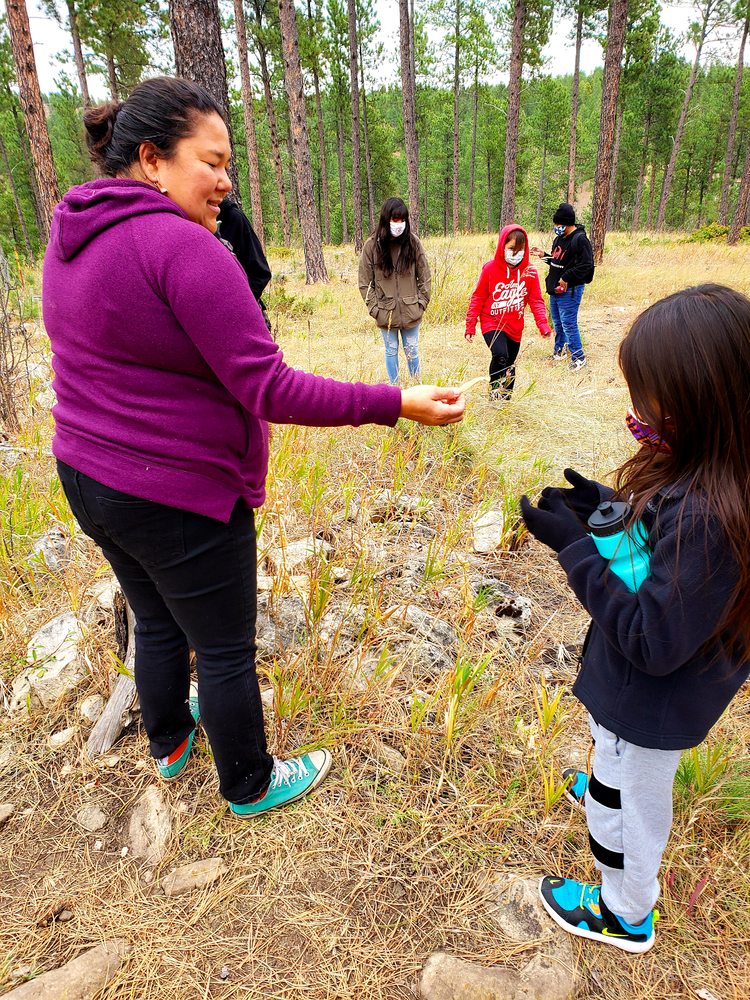
I was also delighted by the presence of nature – dwelling in and learning from it – within this pod. Young people spend time outside studying plants and flora. They learn about the healing powers of natural remedies and the fundamental balance of all living things. They learn about geology and Lakota Star Knowledge, an ancestral tradition used for sacred events such as solstices and to observe the seasons in their sacred order. They eat lunch in a circle outdoors. They tell stories about the buffalo during story time, as Marie encourages them to illustrate what they hear. There is a wholeness to this learning environment that engages young people cognitively, sensorily, spiritually, and physically. In the age of COVID, with millions of children staring at screens, this is a rarity. For the Lakota, this vital aspect of their cultural and spiritual lives is left at the door in mainstream schooling. 

I was introduced to The Lakota Oyate Homeschool Co-op because they are recent recipients of an Enduring Ideas Award, a fund of Teach for America’s Reinvention Lab that I Co-Chair with Sunanna Chand. This co-op is such an intriguing example of reinventing because it adds a much-needed dimension to our discussion on learning pods, equity, and the path for public education in a post-COVID world. While it is too early to render a verdict on pods, the most popular narrative frames them as tools of privilege – yet another way for more affluent (and mostly White) families to hoard resources and opportunities for their kids. In some cases, that narrative is fair and true; in others, it’s incomplete. In this instance, the learning pod is almost an historical corrective. 

In this Lakota community, the road to “reinventing” is about reconnecting to knowledge and ways of being that have been long marginalized and undervalued by the traditional system. Mary Bowman, who is also a fellow with NACA Inspired Schools Network, which works to build Indigenous community schools, believes this pod is the way of the future. While her dream of establishing a Lakota community school predates COVID, she sees this as an unprecedented opportunity to prove what is possible in creating equitable, culturally affirming learning environments. I see this community making tremendous leaps towards Affirmation of Self & Others, Connection & Community, Relevance, and Whole-Child Focus through their deep commitment to culturally-responsive pedagogy. These leaps – while important in their own right – also enable better academic learning. Both Marie and Mary describe how a learning environment that fosters deep connection, sense of self, and pride creates the conditions for better academic progress and far fewer behavioral challenges. For Co-op students, a deep sense of belonging is the foundation for academic engagement and true learning. This community’s learnings could very well influence the public school district and create the demand for more Lakota-run community schools, grounded in Indigenous knowledge and facilitated by Indigenous teachers. 

When I stepped away from our conversation, the school day that Marie High Bear described somehow felt familiar to me, even though I’d never been to this classroom-in-the-living-room. I realize that many of the innovations communities are seeking – particularly the “whole child ones” – try to capture the sense of wholeness, mindfulness, and respect for other ways of knowing and being that are at the center of Lakota life. As we move forward in reinventing learning, we must continue to ask ourselves: what counts as valid evidence and knowledge, and from whom does it count? 

WHAT THE LAKOTA OYATE HOMESCHOOL CO-OP IS TEACHING US ABOUT ROADS TO REINVENTING:

  • The science of learning and development confirms that having a sense of belonging and eliminating identity threats is a prerequisite for learning; the Co-op brings this lesson to life by creating a safe environment, grounded in Lakota language, and culture where learners can thrive. 
  • Innovation isn’t always about inventing something new: this powerful example of applying Indigenous knowledge in new contexts suggests a road grounded in reconnection and remembering. 
  • Learning pods can support the traditional model of school and districts to evolve.  
  • Many “modern” school design innovations highlight practices that have long been part of Indigenous cultures; we must be mindful of which kinds and sources of evidence and knowledge are deemed valid.   

Giving Thanks for Work Around the World

With tomorrow’s Thanksgiving holiday in the US, we wanted to highlight opportunities to support some of the organizations that have been part of IEN posts this year.  They provide just a small sample of the many people and programs that are making a difference across the globe.

Black Lives Matter

Black Lives Matter

Donate to Black Lives Matter here

Dignitas

Inequality, adaptability and survival: A view of the pandemic and school closures from Dignitas’ Deborah Kimathi in Kenya

Donate to Dignitas here

Educate!

Disruption and Rapid Response: A View of School Closures in Uganda From Educate!

Donate to Educate! here

Global School Leaders

Supporting school leadership around the world: A conversation with Sameer Sampat about the development of Global School Leaders

Donate to Global School Leaders here

Second Chance

A view from Liberia: Abba Karnga Jr. on School Closures and the Pandemic

 Donate to Second Chance here

The Citizens Foundation

A view from The Citizens Foundation in Pakistan: Neha Raheel on school closures and the pandemic

Donate to TCF here

Education Innovations Around the World: The HundrED Global Collection for 2021

This week IEN follows up on HundrED’s Innovation Summit by providing a brief overview of some of the 100 innovations featured in their new Global Collection for 2021. The HundrED summit included presentations from Mitchell Resnick on creativity in education, Kiran Bir Sethi Solutions for Inclusion & Equity, Fred Swaniker on the Future of Africa, Vicki Colbert on quality education in challenging environments, and a special tribute from Kate Robinson to her father Sir Ken Robinson. At the summit, along with the launch of the latest Global Collection, HundrED also released a Spotlight Report on Creativity in Education in partnership with the LEGO Foundation and then  shared highlights of the summit along with a full recording on YouTube.

HundrED has been curating these collections of 100 innovations every year since 2016 as part of their effort to support the spread of “pedagogically sound, ambitious innovations” in multiple contexts. To create the collection, 150 academics, educators, innovators, funders and HundrED staff reviewed nominated programs based on each program’s impact and scalability.

In their report on the 2021 Global Collection, Christopher Petrie, head of global research and  Katija Aladin a researcher at HundrED described the latest collection as including many innovations in “areas where there is often a lack of—or a gap—in traditional school education; for example, empathy, social skills etc.” Notably:

  • 63% of the innovations focus on holistic skills like empathy, mindfulness, etc.
  • 55% target the development of 21st century skills
  • 47% develop traditional academic skills
  • 41% Require digital devices to augment learning
  • 35% Use pedagogical approaches that involve playful learning
  • 20% develop vocational skills
Hundred Global Collection 2021 Report

Many of the innovations were created within the last five years, but five were created before 1999.  Among the 2021 collection are organizations from many different parts of the world including:

Genius Lab, China

Genius Lab is a for-profit organization founded in 2013. It has designed more than 600 STEAM and maker education courses in use in over 800 kindergartens, primary and secondary schools with branches in 30 cities around China. It’s “Genius Hour” provides a 21-day online camp consisting of course modules focusing on science, engineering, and design.

https://hundred.org/en/innovations/genius-lab#5e5a409d

Educate Girls, India

Educate Girls has identified 5% of villages that hold 40% of India’s out-of-school girl population. They work in partnership with the government and community volunteers to empower these girls to go back to school. Since its establishment in 2007, Educate Girls has enrolled 750,000+ girls in school.

https://www.youtube.com/watch?v=LwUfhr4hB5Y

NaTakallam Lebanon

NaTakallam builds on the expertise of refugees in several different contexts to connect them with opportunities to provide language instruction and translation services to users worldwide.  Currently, NaTakallam’s conversation partners offer language sessions in multiple Arabic dialects, French, Persian and Spanish.

https://www.youtube.com/watch?v=AOF2YY-n02

Metis Collective, Kenya

The Metis Collective offers a fellowship program for local innovators with ideas for reimagining teaching and learning. The fellowship provides access to a design thinking approach to innovation, a learning community, and coaching.  The program has supported 63 Fellows who have created learning experiences for over 1.3 million learners across Kenya.

https://www.youtube.com/watch?v=fzowlnYClJc

Agora, The Netherlands

Agora replaces the courses, tests, schedules and homework of conventional secondary schools with challenges, collaboration and coaching in order to give 12-18 year-old students control over their own education. As one article described it, Agora is a school with no classes, no classrooms, and no curriculum. Founded in 2014 in Roermond, there are now 12 Agora’s in the Netherlands and beyond.

https://hundred.org/en/innovations/agora#5e5a409d

Self-Sustaining Agricultural School Model, Paraguay

Fundación Paraguaya’s Self-Sustaining Agricultural School Model combines classroom learning in agricultural methods and business practices with hands-on training in the schools’ enterprises.  Those enterprises include organic vegetable gardening, dairy processing, beekeeping, tending to goats and chickens, and managing a tree nursery, a rural hotel, and roadside stores. Fundación Paraguaya is now responsible for four self-sustaining schools in Paraguay.

https://hundred.org/en/innovations/self-sustaining-agricultural-school-model#5e5a409d

How to Take Responsibility for the Future of Education

This week, IEN shares a post from managing editor Thomas Hatch that is adapted from his forthcoming book The education we need for a future we can’t predict and “Building the capacity for collective responsibility in Norway” (to appear in Leading and Transforming Education Systems edited by Michelle Jones and Alma Harris). The post appeared originally on GettingSmart.com

In a recent article in Forbes, Tom Vander Ark outlined 15 “invention opportunities” that can support the development of equitable high-quality learning opportunities in the future. Among the fifteen, are challenges to create an “accountability 2.0” and develop the mechanisms that can bring people together to share diverse perspectives and support community agreement on the aims and purposes of education. These mechanisms are essential for fostering the common understanding and collective responsibility that fuel the social movements we need to dismantle systemic racism, create equitable educational opportunities, and transform education.

Re-defining accountability itself serves as a first step in developing these new mechanisms. For too long, accountability in the US has been synonymous with answerability: Answerability reflects the beliefs that individuals and groups should be accountable for meeting clearly specified and agreed-upon procedures and/or goals. Yet the focus on answerability ignores responsibility another crucial aspect of accountability. Responsibility reflects the belief that individuals and groups should be held accountable for living up to and upholding norms of conduct and higher purposes that are often ambiguous and difficult to define in advance.

Individuals and groups should be held accountable for living up to and upholding norms of conduct and higher purposes that are often ambiguous and difficult to define in advance.

Although carefully specifying outcomes that need to be achieved and establishing consequences for failing to meet those targets can increase efficiency, it also ignores many other valued outcomes, and it can undermine the discretion and expert judgment that may be needed to make many decisions. When taken to extremes, this approach spawns a compliance mindset and leads to efforts to game the system that make it look like the goals have been achieved when they haven’t.

At the same time, simply leaving individuals and groups alone is not the same thing as supporting the development of individual or collective responsibility. Developing responsibility also involves developing the capacity—the investments, materials, abilities, commitments, and relationships—needed to carry out responsibilities effectively. In short, accountability comes from the capacity to support a balance between answerability and responsibility.

Finland’s PISA scores have slipped a bit in recent years, its education system still excels in many respects and continues to stand out as one of the most equitable high-performing systems. Even though many analyses highlight the autonomy of teachers as central to that performance, those analyses often fail to mention several other key aspects of Finland’s education system that support the development of the relationships, trust, and common understanding in education so central to developing collective responsibility and achieving equitable outcomes:

  • A well-established social-welfare state that supports all members of society by connecting education, health, social services, and other sectors
  • A national curriculum framework and a strong, coherent infrastructure of facilities, materials, assessment and preparation programs to support teaching and learning
  • A curriculum renewal process in which stakeholders from all parts of society participate in reflecting on and revising the curriculum framework
  • The use of a variety of high-quality informal and formal assessments that inform efforts to improve practices and performance throughout the education system

The Finnish approach to assessment plays a particularly important role in supporting the development of common understanding and common aims. That approach includes diagnostic and classroom-based assessments that elementary teachers can use early in children’s school careers to identify those who may need some additional help with academics and to ensure that all students stay on track. In secondary schools, well-known exit exams anchor and focus the system. The National Board of Education in Finland also regularly gives tests to samples of students and schools, providing an overview of national and regional performance in key subjects, such as Finnish and mathematics. Although the National Board doesn’t use that information for ranking (and can’t, because not all students and schools are assessed), it shares school-level information with the schools that participate and municipal-level data with the municipalities involved. In addition, the National Board makes these sample assessments widely available for free, so that any teacher, school, or municipality that wants to administer these tests can do so. As a consequence, even without national testing, Finnish schools and municipalities have government-paid tools that link directly to the core curriculum that they can use to benchmark their performance against regional and national samples.

Under these conditions, students don’t have to pass tests that require them to demonstrate proficiency by third grade; they hardly ever “fail” or have to be held back; and most students reach at least a basic level of educational achievement. At the same time, this approach both supports considerable autonomy for educators and schools and builds the common connections that steer the system toward broad education goals without having to rely heavily on rewards or punishments.

This approach contrasts sharply with those in contexts like the US that focus almost exclusively on answerability by using tests to hold teachers, school leaders, and schools “accountable” for reaching specified benchmarks and other outcomes. Rather than using assessments to look back to see whether educators did what they were supposed to do, educators and system leaders in Finland use assessments to look forward and to see if people, classes, and schools are headed in the right direction. Such an approach doesn’t require data on every single aspect of student, teacher, or school performance, but it depends on making sure no one gets too far off course. It means using assessment to look for outliers and listening for signs of trouble, not to check on each individual, or make sure everything is done a certain way or in a certain timeline. In the process, Finland supports the development of the collective responsibility central to guiding education into an unpredictable future.

Rather than using assessments to look back to see what educators did we need to use assessments to look forward and to see if people, classes, and schools are headed in the right direction.

New technologies, artificial intelligence, and many other kinds of innovations can help to improve education. But those technical achievements will not accomplish much without the personal commitments and broader social movements that can transform our communities. If we are truly going to develop collective responsibility in education, then we have to develop collective responsibility for education. We have to hold ourselves, our elected officials, and our communities accountable for making the changes in our society that will end segregation and discrimination, create equitable educational opportunities, and provide the support that everyone needs to thrive.

For more, see:


What in the world is happening in the US? Scanning the Headlines for News on Education and the Election

Given the elections in the United States on November 3rd, this week IEN scanned the headlines and found a few links to news stories related to education both before and after voting took place.

In addition to summarizing the presidential election results so far (using the headline “Trump sets U.S. on course for institutional crisis”), Politico’s Global Translations provided links to headlines from around the world.

Before the election, Education Week focused on 7 Big Questions for Schools and Education and noted as well that Educators Prefer Governors With a More Cautious Approach to COVID-19.

Chalkbeat previewed 8 big consequences the election could have for America’s K-12 schools and after the election continued to report on a series of education related issues in Indiana, Colorado, and Michigan:

The74 continues to curate a live blog with updates on key education related votes across the country, including results of state and local elections for governors, senators, and school board members, along with outcomes of several different ballot initiatives:

2020 Liveblog — Education on the Ballot: Rolling Updates, Results & Analysis From 50 Key Votes That Could Reshape Education PolicyThe74

  • Pre-K Wins Big in Colorado, San Antonio, St. Louis, and Multnomah County
  • California Ban on Affirmative Action in College Admissions Likely to Stay in Place
  • Washington State Passes Sex Education Bill
  • Florida Voters Choose to Amend State Constitution to Say ‘Only a Citizen’ Can Vote

Ballotpedia provides links to an extensive set of overviews and results of national elections, ballot measures/issues, state-by-state elections, and school board elections, and google searches of education and elections turns up many stories on local ballot measures and school board races.

Beyond the results, even before the election, some educators were thinking about how to address what many predicted would be contested and uncertain outcomes:

— Thomas Hatch

Connecting Youth Development and Educational Change: An Interview with Helen Janc Malone

This week IEN features the October Lead the Change (LTC) interview with Helen Janc Malone (@HelenJancMalone), Vice President for Research and Innovation at the Institute for Educational Leadership (IEL) and the National Director of the Education Policy Fellowship Program. Among her books, Malone is a former Chair of the Educational Change Special Interest Group of the American Educational Research Association and helped to launch the Lead the Change series. She also served at the editor of Leading Educational Change: Global Issues, Challenges, and Lessons on Whole-System Reform, a collection of many of the first interviews produced for the LtC series. 

This is the sixth in a series of interviews inviting some of the authors of earlier Lead the Change interviews to review their previous responses and consider how they might modify/ adjust/add to what they wrote based on their experiences and insights since publication.  The fully formatted interview can be found on the LtC website along with the original interview  from 2015. 

Lead the Change: How, and in what ways, has your work evolved since the first publication of this piece? What ideas/points still hold true? Which might you revise?

Helen Janc Malone: First of all, congratulations to the Educational Change SIG on 100+ issues of the Lead the Change Series! Kudos to Drs. Santiago Rincon-Gallardo, Kristin Kew, Osnat Fellus, and Jennie Weiner on their editorial contributions to take the series to the next level. When the newsletter first started, we sought to create a place for members to dialogue about the latest research, emerging questions, and possibilities for further field advancement. I am humbled that the series continues to serve as that platform.

In the 49th issue I spoke in part about the out-of-school time field and the importance of bridging youth development and educational change fields, “What this means is that educational change must pay attention to how we create both the conditions and vehicles for authentic experiences that support student learning and development at the center.” My views from five years ago have only been reaffirmed—linking fields that serve the same students in order to complement experiences of school and out-of-school learning is essential.

There has been significant research in both fields that could inform and reinforce each other’s approaches on the relationship between system design and opportunities to high-quality education access, and by the growing evidence about the importance of cross-actor collaboration as a vehicle for educational change. The research on out-of-school time learning, for instance, has offered new approaches to cultivating authentic student voice in education, to building strong school-community partnerships, and to equity and access in learning. Educational change has started to address the importance of family and community voices within schools and in supporting teaching and learning. Taken together, we now have substantial evidence about connecting the school day with nonformal and informal learning, with strong family and community engagement, and with community services that provide well-rounded, positive, and developmentally appropriate learning experiences through the day.

Having spent nearly twenty years contributing to various domestic and international research networks and creating outlets for knowledge translation, I have observed evolving conversations about the need to authentically engage community partners in educational change efforts in order to facilitate student learning, especially in the face of rising societal inequities that manifest themselves most starkly through persistent resource and opportunity constraints. Today’s unprecedented times in some ways, demand that we further create intentional spaces for research exchange while simultaneously interrogating our collective assumptions about whether our existing structures support the desired outcomes we seek for the most vulnerable student populations.

LtC: What do these shifts suggest to you about the field of educational change more broadly?

HJM: As someone who has been a part of youth leadership development work, comprehensive school reform efforts, out-of-school time learning, community schools strategy, and educational change field, I have witnessed within these spheres a commitment to change that is adaptive and responsive to various actors within and outside schools. At the same time, I have observed that education policies enacted in the U.S. and abroad approach supporting students, and in particular, vulnerable populations, using simultaneously cyclical, continuous, and emerging perspectives. Cyclical, because in education policy, we have witnessed an oscillating dynamic of public dollar investments in the instructional core as the sole driver of educational change and looking broadly at the role various actors play to support teaching and learning. The investment priorities have at times positioned dollars for an in-school approach as an either/or proposition to a coordinated services approach. Yet, we know from practice, the answer is that students benefit when we as a society invest both teaching and learning for equity and supportive learning environments outside of the classroom.

<p value="<amp-fit-text layout="fixed-height" min-font-size="6" max-font-size="72" height="80">While public policy has navigated the narrow/broader debate to educational investments, there have been long standing, though perhaps more discrete sustained efforts to create authentic whole child services that advance learning and positive youth development.  Communities engaged in these efforts display a core belief that teaching does not happen in isolation, and that a holistic approach stands to benefit students, families, teachers, and communities. And finally, especially during time of focusing events, we have observed moments of (re)discovery that necessitate a broader approach to education. These shifts of what approach will lead to the most meaningful and lasting educational change will likely continue into the future unless we flip the debate and start with a foundation centered on equity and students and the facilitating factors that support thriving children and youth. And, that piece is on us to lift up in our research, in practice, and in informing policy.While public policy has navigated the narrow/broader debate to educational investments, there have been long standing, though perhaps more discrete sustained efforts to create authentic whole child services that advance learning and positive youth development.  Communities engaged in these efforts display a core belief that teaching does not happen in isolation, and that a holistic approach stands to benefit students, families, teachers, and communities. And finally, especially during time of focusing events, we have observed moments of (re)discovery that necessitate a broader approach to education. These shifts of what approach will lead to the most meaningful and lasting educational change will likely continue into the future unless we flip the debate and start with a foundation centered on equity and students and the facilitating factors that support thriving children and youth. And, that piece is on us to lift up in our research, in practice, and in informing policy.

“Teaching does not happen in isolation…a holistic approach stands to benefit students, families, teachers, and communities.”

LtC: What most excites you about the direction of the field of educational change is going?

HJM: In the backdrop of the COVID-19 pandemic there is an opportunity to re-imagine education that supports all students, and in particular, student populations that the current system does not serve well. Rather than create a ‘new normal’ that maintains the status quo, we (collectively) could approach this moment from a redesign frame and think deeply as to what we want in and from our education environments. This includes determining the conditions we want for learning, approaches to schooling, to the students’ experiences themselves. We have an opportunity to closely examine the purpose[s] of schooling, the pedagogical approaches to learning, the role external partners play to support and facilitate student development, the fiscal [in]equity in education, as well as systemic alignment with and across a student’s day and life. How we respond to these areas of consideration will be shaped by who is in the conversation. We need to be sure that the proverbial table includes voices that ultimate benefit from the educational changes we collectively seek – children, youth, families, teachers, and community partners. Local communities should be an essential partner in these conversations. Systems are not designed to change overnight, and in many ways, they are designed to resist rapid and discontinuous change, so having conversations regarding the future of education should be the focus of our present, in order to maintain a sense of urgency, obligation, and necessity, while also coupling practice, research, and advocacy to advance new directions.

The Educational Change SIG is well positioned to lead these conversations, as the core of what we do is to explore, examine, and engage in the change processes at all levels. Some of the scholars highlighted in the Lead the Change series have both led and researched within- and cross-sector systemic changes that redefined the narrative on teaching and learning, roles and responsibilities, lifted up local voices and sought educational justice. We could model the conversations that surface deep structural work, to learn from each other across continents, and to lift up innovations that we see make a significant difference in students’ lives. As a global community, we have the power of collective voice to share lessons of the past, the possibilities for the future, and considerations for education at large.

“As a global community, we have the power of collective voice to share lessons of the past, the possibilities for the future, and considerations for education at large.”

LtC: What advice might you have for those interested in affecting change and improvement?

HJM: There is a renewed urgency in our work. As John Kingdon’s (1984) classic work, Agendas, Alternatives, and Public Policies, reminds us, we have a policy window, an opportunity to potentially see new policies enacted at all levels that address the needs of learners. As noted in the previous question’s response, we are in a global moment where countries across continents are taking a deeper look into their teaching and learning practices, their systems, designs, institutional arrangements, and funding for education. There is a pressing need to be informed by innovation, research, and promising practices. As a global SIG, affecting change starts with listening, sharing, and collaborating. First, we have a shared responsibility to engage the field to look for allies in learning that play a critical role in students’ success and positive development. Second, we have a responsibility to bring attention to the political, social, and historical dimensions of educational change. The SIG’s scholars have done due diligence in examining the educational change process from various aspects, structural, institutional, and individual. Their scholarship can contribute to our shared understanding of the why, what, and how of education improvement and policy change for the current moment. And, as I noted in the 49th issue, we have an opportunity to join other SIGs in a collective voice for the change we seek in our communities and across systems.

LtC: What are the future research directions that should be addressed in the field of educational change?

HJM: I’ll note three that immediately come to mind given the current global context. First, we should take note of who is leading during these times of rapid change. In many respects, the immediate responses to directly support students has been at the local level, with school districts, principals and staff, teachers, families, and community allies working together so that students have access to food and basic supplies, health services, WiFi, and online lessons for continuous learning. We should unpack the ways our schools and local communities innovated during these challenging times, what can we learn from their responses about leadership, about change management, about innovation, and look for ways to authentically engage local voices in the shared research so that our work is informing local contexts and we in term, learn from them.

Second, educational change intersects with cross-sectoral issues—equity, racial justice, climate—and thus, we stand to benefit by learning from these issues and associated social movements to understand the macro forces that are shaping what we see inside classrooms, as well as how we can rethink education in the broader context. And, third, this period has given us an important inflection point to examine whether our ‘go-to’ leadership and change theories we apply to understand various education phenomena remain both relevant and adequate given the transformative nature of recent events, or whether this is an opportunity to expand upon the leadership theories, as well as to develop new frameworks and theoretical underpinnings to guide educational change in the future.

ABOUT THE LTC SERIES: The Lead the Change series, featuring renowned educational change experts from around the globe, serves to highlight promising research and practice, to offer expert insight on small- and large-scale educational change, and to spark collaboration within the Educational Change Special Interest Group of the American Educational Research Association.  Kristin Kew, Chair; Mireille Hubers; Program Chair; Na Mi Bang, Secretary/Treasurer; Min Jung KimGraduate Student Representative; Jennie Weiner, LtC Series Editor; Alexandra Lamb, Production Editor.
Inequality, adaptability and survival: A view of the pandemic and school closures from Dignitas’ Deborah Kimathi in Kenya

In honor of the announcement of the WISE Award winners for 2020, we are reposting our interview with Deborah Kimathi, the Executive Director of Dignitas, an education development organisation in Kenya. Dignitas was one of six WISE Award winners this year for its Stawisha Instructional Leadership Institute. (Dignitas is also a partner of Global School Leaders, the focus of last week’s post.) The WISE awards celebration will take place virtually on October 28th (with free registration) and will include “Building the Future of Education: Conversations with Resilient Innovators.”

This interview was one in a series that included posts from Chile,  from Japanfrom the Netherlands, Scotland, Liberia,  Pakistan,  Australia,  Canada, China, and Ghana. The “A view from…” series editors are IEN’s Thomas Hatch and Karen Edge, Reader/Associate Professor in Educational Leadership at University College London’s Institute of Education.

IEN: What’s happening with you and your family?

Deborah Kimathi: Kenya announced its first case of COVID19 on March 13th, and on March 15th the government announced national school closures, and social distancing measures that included working from home for those in non-essential services. I spent the next morning in the Dignitas office, setting up our team of 15 for remote working, with no idea of what that would really look like (for a team who are typically 80% in the community delivering training and coaching to our 140 School Partners) or how long it might last for. Now, 11 weeks the team are all still working from home, and being incredibly fruitful despite the challenges.

Ever since, my family and I have been working from home in Nairobi, schooling from home, shopping from home, socializing from home, and everything-else-from-home! My husband and I are both still working full time (or more than), and managing our three children. Our childcare ceased on the same day, so that our nanny could also follow the government’s guidelines. Our oldest two (7 and 9 years old, one lockdown birthday later) are doing some home learning (not their school prescribed program which was 6 hours per day of poorly managed Google Hangouts), and our 3 year old, who was due to start nursery this term, is generally having way too much screen time. My working day currently starts at 5am, and goes until around 10pm, with a variety of interruptions.

IEN: What’s happening with education/learning in your community?

DK: One word comes to mind – inequality.  I have two very different ongoing conversations when it comes to education.  The first is with my children’s friends’ parents, mostly struggling with schedules, the need for each child to have a device or laptop, how to turn baking into a science lesson, and where to source real butter for said cake.  The other, and the more urgent conversation, is with our School Partners and friends, largely in Nairobi’s urban informal settlements.  Here, the struggle is not for comfort, the struggle is for survival.  COVID19 has brought with it severe social, health and economic hardship, and these hit the poorest communities the hardest.  In these communities, more than 60% of families were unable to access public education pre-COVID19, as a result of poverty and systemic exclusion.  Marginalised by poverty, these are the same families excluded from a myriad of essential health and education services now, and often fighting a daily, violent war with police in their struggle to exist.

The more urgent conversation, is with our School Partners and friends, largely in Nairobi’s urban informal settlements.  Here, the struggle is not for comfort, the struggle is for survival.  COVID19 has brought with it severe social, health and economic hardship, and these hit the poorest communities the hardest.

The significant challenge of inequality is, as a result, exacerbated in the most violent way, only bringing harm to children, families, and society as a whole.  This raises critical, urgent questions of ‘What happens next?’  When schools reopen, will those who’ve participated in online or home learning be ‘ahead’ of others?  How will schools assess progress and promote students to the new school year?  How many girls will be married or pregnant, never to return to school?  How many families will end up on the street, their children never to return to school?  How many children will have died from starvation?  How many children will be so scarred by the trauma, violence and anxiety of this season that learning never really resumes?

The significant challenge of inequality is, as a result, exacerbated in the most violent way, only bringing harm to children, families, and society as a whole. 

A young learner proudly carries his school books outside a typical partner school. Photo: Dignitas

IEN: What do you/your community need help with?

DK: Dignitas is working tirelessly to protect and promote the learning and well-being of children living in poverty.  Whilst everything else is disrupted, our vision to ensure all children have the opportunity to thrive and succeed remains core to our COVID19 response.

In an effort to reach and protect these children, we immediately thought of our amazing community of School Leaders and Teacher Leaders.  Dignitas has trained over 1,000 educators, and have another 450 educators enrolled for 2020.  These School Leaders have already benefited from Dignitas training and coaching and they are also leaders who are rooted in, and passionate about the needs of their communities. Our partnership lays an ideal foundation for them to be further equipped to respond in these times of crisis as community champions of well-being and learning.  Dignitas is remotely training and coaching these educators as Community Champions who can work in household clusters to protect and promote children’s learning and well-being.  

Dignitas is working tirelessly to protect
and promote the learning and well-being
of children living in poverty.  Whilst
everything else is disrupted, our vision
to ensure all children have the opportunity
to thrive and succeed remains core
to our COVID19 response.

To make this possible, we need help in curating more digital content for these educators, the educators need tablets to access and share learning content, families need basic devices or radios to benefit from the government’s education broadcasts, we need to design and print home learning packs for children, and we need to help families with food!  The list is long, and we’ve been excited to collaborate with some amazing partners like Safaricom Foundation, Team4Tech, Cosaraf Foundation and Synthetic so far, but the need is huge!

A young girl, now at home, facing an uncertain future. Photo: Dignitas

IEN: What resources/links/supports have you found most useful? 

DK: I’ve really appreciated being part of some great networks – WISE, Global School Leaders, RELI, Global Schools Forum and others who have curated relevant content and tools, and offered consistent, valuable support.  The opportunity to share and learn with peers has helped me to stay focused, inspired and fruitful in this season.

Friends and donors who are authentic partners in our work!  Can donor relationships be unhealthy, and have skewed power dynamics?  Yes. However, they can also be wonderful places of strategic collaboration, bringing together passionate, committed teams of people and resources to respond to community need in a wise and compassionate way.  We’re fortunate to largely experience the latter, and they’ve been amazing thought and action partners for this season.

IEN: What are you reading, watching, listening to that you would recommend to others?  

DK: I’m mostly listening to podcasts and recordings of webinars that I’ve missed in the busy-ness!  WISE and Africa.com have had great content, relevant to our context, and not afraid to ask the hard questions.  In terms of reading, material from Harvard Graduate School of Education and Brookings Institute have offered interesting insight.  However, I think my most valuable learning experience in this season has been listening to others – peers in the Kenyan and Global education sector, and the communities in which we work.

IEN: What have you found most inspiring?

DK: People!  People who are so intentional in bringing hope and light to others.  People giving so generously of their time and expertise.  People who don’t have much, always willing to give the most. 

Supporting school leadership around the world: A conversation with Sameer Sampat about the development of Global School Leaders

In this week’s post, IEN’s Thomas Hatch interviews Sameer Sampat. This conversation (which took place early in 2020,  just before the coronavirus outbreak) builds on a previous interview with Sampat in 2016, when Hatch talked with him about the evolution of the India School Leadership Institute (ISLI), the organization Sampat founded in 2012. Since that time, Sampat, working with his colleague Azad Oommen, has been building on the work at ISLI by establishing a new organization, Global School Leaders (GSL). GSL seeks to develop education programs for school leaders in many different parts of the world. Since 2017, GSL has been  working with partners to establish programs for school leaders in Malaysia, Indonesia, and Kenya. In this  conversation, Sampat discusses how GSL has evolved; how they have tried to adapt their approach in different contexts; what they’re learning along the way; and how their work might develop in the future.

IEN: Can you give us a sense of how your efforts to support school leaders around the world have evolved since we talked in 2016?

Sampat: It was interesting to read that earlier post, and it made me realize that there are really two different tracks to talk about. One track reflects what has happened with our school leadership work in India. In that 2016 post, I laid out three ways possibilities for growth:

  • Working with government schools and trying to scale-up through the government system
  • Expanding in the low-fee private schools where we started our work
  • Developing open-source materials that any school leader in India could access

At that time, we were working with about 300 schools. But by 2019, ISLI was working with about 2,000 schools a year. A reason for that big jump from 300 to 2,000 schools was that ISLI pursued that first path by embedding their training in the government system. Late in 2019, however, ISLI hit bureaucratic road blocks that have forced us to close its programs in India. But a few ex-ISLI staff members have come together to form Alokit and GSL is supporting them to get off the ground. Alokit plans to continue focusing on scaling via partnership with state governments.

In work like this that is focused on government partnerships, the second question that gets asked is “how do you deliver high quality training at scale with the existing human capital resources in the government system?” So, all of that work has happened since I left India. And we have been seeing through third party assessments, that the student outcomes in the ISLI schools seem to be increasing compared to schools who don’t have the program. Now there are lot of caveats: We can’t attribute those improvements directly to ISLI, and there are still validity questions about the outcome scores as well. But we plan to do a randomized evaluation of our work starting in the next academic year.

That’s the first track of work, but the second track is the work on Global School Leaders. In 2017, I left my role as CEO of ISLI and went on to co-found Global School Leaders, and over the last two years, I have been consumed with the question of how countries work on this issue of school leadership. When I listened to the education reform conversations that were happening in international venues, people were talking generally about things like teacher training, improving access to girls’ education, educational technology, and early childhood development. All these things are very important, and I think these things are coming to the forefront because the whole conversation has shifted towards “how do you improve the quality of learning?” And it’s not just how you get access. But in that whole conversation of how you improve quality, it seemed to me that we were missing some key issues including “how do you work with the leadership at the school level?” And “how do you create enabling environment conditions for leadership to thrive?”  So that’s what prompted me to start GSL with my co-founder, Azad Oommen, who was on the board of ISLI when I was running it but also joined me to start GSL. At that point I felt like we could help get people to start thinking about school leadership as a critical part the education system, and I also felt that this would be of value in India as well because it would bring more light to the issue and help show the promise of the work in India. I can’t say that we’ve met either objective yet but I think we’re on the way.

IEN: Why didn’t you just try to expand the India School Leadership Institute? Why create a whole different organization?

Sampat: I think there still needs to be huge expansion in India and we’re by no means saying that we’ve reached where we need to be there. I could spend my whole life working in India and still have work to be done. But we started GSL to address a different need: to get leadership into the international conversation in a way that wouldn’t take away from the ability of our program in India to expand.

Did I leave ISLI at the right time? It is difficult to say. Programmatically, there was a lot of progress in terms of embedding the programming into the government that has been really valuable. Operationally, we’ve had our hurdles. So there wasn’t really a scientific process to that decision, and I don’t know in hindsight if it was the right decision, but what we’re working on in terms of GSL seems like a very important challenge and opportunity.

IEN: What did you take from your experience in India that helped you get started with Global School Leaders?

Sampat: Initially, we started with all these materials that we built in India around how to do this leadership work. We had address questions like “What are the materials used to train principals? How do you do the ongoing coaching? How do you measure if this program is actually making an impact or not?” Although those ISLI materials have been valuable in other countries, I think, the biggest value-add has been having a clear focus on this issue of school leadership. When we just bring this to people in different countries, they resonate with it immediately, but they haven’t thought about it as a critical lever for system improvement. And then it’s not so much about saying, “Oh, we have these materials you can use;” it’s really saying, “Here are some starting points. You don’t have to reinvent the wheel, but we’ll work with you to develop processes for you to create your own materials.”  “Here’s a model, but let’s really think about how to contextualize this for your situation.” Then we look at what’s policy relevant; what’s culturally relevant; what addresses the needs of the specific school leaders that they are working with. So it’s been more of a process of saying “this is how we thought about addressing this in India.”  We help people to develop their mental maps of what a leadership program can look like. That’s very different from what I expected originally, when I thought we would say “Here’s the curriculum we use in India, take the curriculum.” We’ve realized that’s not at all what’s helpful for folks. There is a core curriculum, about 50% of the overall content, that is useful. But then the process of co-creation and customization to fill out the second 50% is where the really valuable work happens.

We help people to develop their mental maps of what a leadership program can look like. That’s very different from what I expected originally, when I thought we would say “Here’s the curriculum we use in India, take the curriculum.” We’ve realized that’s not at all what’s helpful for folks.

IEN: Did you have some experiences that helped bring that lesson home to you? Some places where you tried to share those materials and then you realized, wait, this isn’t working?

Sampat: From the beginning, we were clear that we didn’t want to run GSL as a traditional international NGO. We recognized early on that the key decision makers had to be in country so we’ve structured it so that the programs in each country are independently operated and financed, and they have local boards. A GSL member may have a seat on the boards, but the boards have independent CEO’s. From a strategic perspective, we knew this was going to be a challenge, but even at the curriculum content level, it’s been interesting to see how different countries have contextualized the work. For example, one of the big units in the India program focuses on how school leaders help teachers plan their lessons. We developed that unit because we were finding in India that something like 80% of the teachers that we work with initially didn’t have a plan for the day’s lesson. So, one of our hypotheses was that this was leading to a lot of rote learning in India because teachers were just reading out of a book or copying something from a book onto the board, and then the students would just parrot it back. So the planning unit tries to help leaders work with teachers to get them to think about what activities they want to do before they get into the classroom and then to add activities that are promoting student engagement and critical thinking. But when I was talking to the team in Malaysia, they said that this whole thing about having a lesson plan and motivating it and explaining why it’s important, all that stuff wasn’t relevant because in Malaysia you already have to have a book of lesson plans that you bring to school. Somewhere in their education laws, it even suggests that one of the penalties for not having those plans could be going to jail. So, leaders don’t have to motivate teachers to bring a lesson plan to class. The question is how do you actually improve these plans? How do you make sure they are focused on student learning? So that was a big adjustment. That is just one of the many adjustments we’ve had to make.

IEN: That’s a great example. It reflects the nitty-gritty operational work that can make the difference between a program succeeding or failing. What did you do in that case? If the solution wasn’t to try to help teachers plan, what did you figure out to do instead?

Sampat: For this specific instance, it was recognizing that the teachers all do have plans and trying to take advantage of that. We said to the school leaders we worked with in Malaysia “All your teachers have to make plans, so how do you as a principal support your teachers in making those plans? How do you make sure planning isn’t just a ‘checkbox exercise’?” That’s kind of the tack we took. But more generally, we ask the school leaders to do a needs assessment first. The broader framework from India was helpful for this because that model gives a lot of autonomy to the school principal to decide where they’re going to make their improvements and impact student learning. It’s all about how do the school leaders evaluate their schools? How do we help them make an assessment of where their schools are doing well and not doing well, and then make a plan for improvement? That approach has been really helpful across the different countries because the process is directed by the learners, the school leaders, in each case.

IEN: What are some of the key things that you’ve learned over the past couple of years as you’ve tried to expand globally?

Sampat:  There are a bunch of things, but the first few things that come to mind are actually pushing in slightly opposite directions. One is that I’ve found that there’s a lot of knowledge in a country that is just locked in that country. You can take the US as an example. There’s been a lot of work on leadership in the U.S. and a lot of nonprofits like The Wallace Foundation and others are working on it. There’s also a lot of government agencies that are working on school leadership. So you have this group of people that have spent years and years working on these models, developing them, testing them out, seeing what works, what doesn’t work. But very few of the countries we’ve been working in have been able to access that knowledge in a way that’s meaningful for them. So you might have a country that will fly principals to the U.S. for 10 days and then fly them back. But it’s a one-off thing. It’s difficult to create a system that can build on the best practices from somewhere else. And it’s not just coming from a place like the US. For example, if I look in Indonesia, they have some really interesting policies around principals getting together regularly on their own led by peer principals, and they have a whole system of how that peer learning is filtered down through a principle led cohort. That could be really interesting to think about using in a place like India. So that’s kind of one piece.

I think the piece that’s competing with that that I’ve also learned is how important the depth understanding of a context is: the in’s and out’s of schools; how policies are being felt by school leaders; the specifics of different school districts. As I was saying earlier, those kinds of little tweaks that fit the context are very important. Now we’re trying to figure out how you bring these two things together. On the one hand, there’s this really valuable knowledge about a specific place and its functioning that’s important but on the other hand, there’s this rich global knowledge about school leadership more generally. As an organization, we’re trying to bridge that gap between the two.

On the one hand, there’s this really valuable knowledge about a specific place and its functioning that’s important but on the other hand, there’s this rich global knowledge about school leadership more generally. As an organization, we’re trying to bridge that gap between the two.

IEN: How are you trying to bridge that gap now? 

Sampat: A lot of that is in process, but one of the things we’ve done is work on theories of action. Our program is not the first program focusing on school leadership so we are trying to develop a sense of the different theories of actions of some of these programs. We’ve taken that knowledge to our partners, and there’s been a lot of back and forth so that each partner can develop their own. At least right now, our hypothesis is that it’s just a lot of really intentional conversations that are ongoing. These are not one-time engagements. They repeatedly bring together people with these different sets of expertise, some with a knowledge of the local context, some with an understanding of the best practice across contexts.

IEN: Would you say that before with ISLI, you were the program architects and now with GSL you’re the convener of the program architects within a particular country? You’re trying to bring together the various stakeholders, bring what you’ve learned globally about school leadership and make that part of a process that will then allow your partners within that country to develop their program?

Sampat: That’s definitely the role of GSL. In Malaysia, for example, there’s already a lot of work going on in education, and we worked with our partners there to create an entity that is focused on improving the leadership that can complement some of the other initiatives.  We are helping them to hire their initial staff, and then once that’s done, GSL plays the role of supporting a Malaysian organization to bring the right stakeholders to the table to engage together, to use the resources that GSL has as well as the resources they already have available in-country to do this work.

IEN: Given what you’ve said about looking back at the interview in 2016, if you imagine that it’s three years from now and we’re doing another interview about how things have developed, what do you think you might say? What are the next steps and what are some of the challenges that you’re going to have to navigate?

Sampat: I think there are a few pretty clear pathways that we’re exploring right now.  One thing is how do we think about improving school leadership in a system? We have focused on training as the main way to improve school leadership on a large scale. But if you were to think about all the tools available to anyone running a network of schools, whether it’s a government or a private entity, they would have more than just training available to them to improve school leadership. They could think about:  

  • How do they select their leaders in the first place?
  • How are they encouraging people to go into positions of leadership?
  • How are they selecting those leaders?
  • How are they holding their leaders accountable?
  • How are they rewarding their leaders?
  • How are they showcasing models of excellence around good school leadership?
  • What are the decision-making powers they give to leaders?

I think the reason that we’ve focused on training so far is that it’s the first step that all the key folks support. In the countries where we work, school leaders haven’t had a lot of training themselves, so they recognize the need for training. Government officials also know that, often, they have rules on the books around training principals, but they recognize that they are under capacity to deliver that training. As a result, both see our work as supportive, but some of these other pieces are more problematic. For example, in India, leaders tend to be selected based on seniority. I think that’s starting to change but changing a system like that is going to require a lot of political will. Consequently, at GSL we’re thinking about how we build our capability to support our partners to work on these more difficult issues, particularly political issues. 

Another piece we’re thinking about is how do you use technology to help you scale the leadership training? Even if we look across the work in all four countries where we work, we are only working with about 3000 school leaders a year. And these four countries together must be in the range of a million and a half schools to maybe just under two million schools. So we’re trying to identify the components of our training model that the principals appreciate. They tell us it’s the content that we deliver to them; the way that the coach comes once a month, gives them personal support and provides some “soft” accountability; the peer network and the ability to share ideas and even have a little bit of friendly competition with their peers. How do we enhance some of those things with digital delivery? Can we do some kind of digital coaching? Can we do digital content delivery? Can we do digital peer network, peer sharing with school leaders? These are all things that people have tried in different contexts, but how do you put it all together and can we move towards something that is fully online? I know that we’re a long way away from that, but if we’re having this interview three or four years from now I hope that we have a better sense of the possibilities.

IEN: That’s particularly challenging because you don’t know what the technological developments are going to be, but they’re either going to make your work easier or more difficult, and probably both. It’s certainly a challenge to adapt to that going forward. Any other lessons or things that you are keeping in mind as you are continuing your work?

Sampat:  We’re thinking a lot about partnerships. How do you embed this work into education systems whether government or nonprofit systems? If you look at India and the other three countries, we’re working with organizations that we started ourselves or that are new and usually relatively small. But there is a whole set of organizations that are much bigger who’ve already done some of the hard work of getting to some level of scale. They have a bunch of schools in different contexts, but how can we embed school leadership into that work at scale in a way that has the same sense of urgency that you’ll see in the four countries we’re working in now? I think that’s been one thing.

I think one of the other big challenges for us is around evidence. We’re working with school leaders who are then working with teachers who have an impact on students. We’re a few steps away from direct impact. Of course, working with school leaders will take a little bit of time for them to make the changes that can have a positive impact on students. As a result, when we’re in conversations about investing in school leadership, the big question is often “how do you know that that’s actually going to impact students?”

Revisiting The Power And Paradoxes of Education In Singapore: Lead The Change Interview With Pak Tee Ng

This week’s post features a Lead the Change (LTC) interview with Dr. Pak Tee Ng, Associate Professor, at the National Institute of Education (NIE), Nanyang Technological University. At the NIE, Dr. Ng previously served as Associate Dean Leadership Learning and Head of the Policy and Leadership Studies Academic Group. His main work is in educational change, policy and leadership. His latest book is “Learning from Singapore: The Power of Paradoxes” (Routledge, 2017).

This is the fifth in a series of interviews inviting some of the authors of earlier Lead the Change interviews to review their previous responses and consider how they might modify/ adjust/add to what they wrote based on their experiences and insights since publication.  The fully formatted interview and the original interview  from 2015 can be found on the LtC website of the Educational Change Special Interest Group of the American Educational Research Association.  

Lead the Change: How, and in what ways, has your work evolved since the first publication of this piece? What ideas/points still hold true? Which might you revise?

Pak Tee Ng: My previous interview in Lead the Change Series was published in 2015. Most of the questions then were about the key success factors and developments in the Singapore education system at that time. Since then, in 2017, I published my book called “Learning from Singapore: The Power of Paradoxes”, which is part of the Routledge Leading Change series edited by Andy Hargreaves and I. In my 2015 interview, as well as my 2017 book, I pointed out a very important philosophy in the Singapore education system: “Education is an investment, not an expenditure.” We invested heavily in our public education system and professional development of our teachers.  We ensured our children would receive good education even during periods of tough economic conditions. Our education system worked to shift its focus from quantity to quality. Instead of obsessing over examination results, we tried to help students appreciate what they were learning, to apply their new knowledge in real life and to experience joy in learning. The education system provided more pathways to nurture different talents and fulfill different aspirations. Those points are still valid today. Singapore’s education system is always a work in progress. There is still much room for improvement.  But let me give readers an update regarding the more recent initiatives in Singapore through a few examples.

First, we changed our national Primary School Leaving Examination (PSLE) scoring system. Instead of absolute points, students with scores within a certain range are now awarded the same grade. In doing so, we hoped to reduce the keen competition and high stress levels among students because they would no longer need to chase after every point. We also scrapped some mid-year exams at the lower primary levels.  Teachers can use the time originally reserved for examinations to engage students in activities that develop them holistically. At the secondary level, we introduced subject-based banding in the place of streaming. In streaming, students in a particular stream take all their subjects at a particular pace. In subject-based banding, students can engage in subjects in which they have strengths at a faster pace than some of their peers. We hope to give students more flexibility to take various subjects based on their strengths and learning pace.

Second, we are also promoting a culture of lifelong learning in the country through the SkillsFuture initiative, a movement that encourages Singaporeans to learn and acquire deep skills continuously throughout life. This is a national effort to shift the focus from academic performance as the primary measure of success and towards mastery of deep, practical, skills relevant to industries and the future economy.  For example, many Singaporeans use SkillsFuture credits (essentially financial sponsorship from the government) to learn how to better function in a digital workplace.

LTC: What do these shifts suggest to you about the field of educational change more broadly?

PTN: In my book, I explained the importance of a paradox in Singapore, which I called “timely change, timeless constants.” There is change, and there is continuity. Education in Singapore has to change to keep up with the times, but there are certain evergreen principles in education that we do not change. For example, in Singapore, an evergreen principle is that we see education as investment rather than an expenditure1. Keeping evergreen principles, in itself, is an important principle in the field of educational change. We need both change and continuity. To change or not to change, that is a question that needs both courage and wisdom to answer.

“We need both change and continuity. To change or not to change, that is a question that needs both courage and wisdom to answer.”

Education is highly influenced by technological advancement and changes in industries and work. New jobs appear and traditional ones disappear. Everywhere in the world, education has to change to keep itself relevant and to prepare children for the future. But because we must change continuously, we must exercise good judgement on what to change, rather than to jump on the bandwagon of any new reform. Sometimes, when everyone seems to be constantly and mindlessly changing, those who stand firm on solid fundamentals, stand out! For example, why does the release of international test rankings so often move educational systems, that were often previously unwilling to evolve, to change? Why should such tests become wake up calls? We should take education seriously, with or without international comparisons!

In my book, I also mentioned another important principle. Education reform is usually a contested process because every intervention has its benefits and consequences. Different stakeholders have different ideas about change and thus there will be tensions among these groups as they negotiate solutions. And yet, despite these tensions, for half a century, Singapore has been able to reform its education system quite systemically and systematically. These reforms include giving schools more autonomy and moving away from an examination-oriented system. Despite differences in opinions, there is generally coherence in the system and change is implemented with order and method.  Therefore, the main question here is whether reform is shouting slogans superficially or fighting missions meaningfully. Slogans fade away, replaced by new ones in perpetual cycles. Missions rally people to bite the bullet of change to benefit the next generation. So, academics in the field of educational change must take care so advancement in the field does not become ammunition for slogan shouting, but rather becomes the driving force for purposeful change. Real substance, which focuses on really improving learning and teaching, lasts. Fads, which distract us from such improvement efforts, don’t.

LTC: What most excites you about the direction of the field of educational change is going?

PTN: I think that if the field of educational change can succeed in advocating for the importance of formulating far-sighted education policies (rather than knee-jerk reactions), based on sound fundamental principles (such as equity and excellence) and implemented tenaciously over the years, that will be exciting. I have observed some jurisdictions that have flip-flopped too often in their education policies. That is difficult for stakeholders, especially the professionals on the ground, who need stability to create a conducive environment for students to learn. We need change that is meaningful and purposeful, and that is given the necessary time to bloom.

“We need change that is meaningful and purposeful, and that is given the necessary time to bloom.”

An evidence-based approach to change is important. But I am more concerned that evidence-based decision-making is sometimes actually decision-based evidence gathering. Someone has made up his or her mind about something and is just looking for ‘evidence’ to support their case. Therefore, I think other than researching for evidence, or developing more measures of performance or comparisons, it would be exciting to develop a deeper and more philosophical discourse about educational change. Many jurisdictions make changes structurally in response to performance measures and comparisons. Not that many districts currently address fundamental issues such as meaning and joy in learning, or student well-being and character education.

For many of us who work in this field (and indeed in any other field), we have benefitted from more senior academics who advised us or opened doors for us. This is not about the direction of the field per se, but I think it will be exciting if there is a systematic way of paying it forward. One way is what this SIG has done for a few years through its mentoring of students and early career faculty! The SIG provides a platform for mentors and mentees from different parts of the world to come together. I think it is great for growth, understanding, and continuity in the field. As an example, I served as a mentor last year and I had a mentee from the United States. It was great as I had an opportunity to understand her work and I brought her in contact to some others working in the same field. I hope to see such mentoring expand its scope and influence.  

LTC: What advice might you have for those interested in affecting change and improvement?

PTN: Do not change for the sake of change! Do not charge forward blindly just because the fast-pace change in the world seems to mandate change at a fast pace in education. I am not suggesting that schools and systems should look for excuses not to change, or to take a “back to basics” approach for everything. However, it is good that we sometimes examine certain fundamentals to either refute, revise, or reaffirm them. So, a discussion about improving access to education and/or student well-being is more inspiring than how one jurisdiction can outdo another in international comparisons, although the latter can appear more pressing due to political pressure or media attention. The way to stay strong under such pressure is to commit ourselves to fundamentals and proceed on a sure footing, even when progress seems slow. The main question is whether one would like to do good or just appear good. Of course, it would be great to be able to do good and appear good at the same time. But when it is a choice between one or the other, one chooses to focus on doing good, rather than appearing good.

Improving education is a long process. Change is seldom, if at all, neat and orderly. We need to be patient and adaptable. The approach to change is also important. We should increasingly draw upon the expertise of the professional teaching community. The professionals in school should feel they are engaged and empowered in the change process. They should not be made to feel that change is done to them. As a result of greater teacher input, the innovations that emerge in schools will be more organic and appropriate to the operating context and gain wider acceptance.

Most importantly, those who are interested in affecting change and improvement should embrace a very positive spirit of education. They should believe passionately that they are not merely doing a job, but they are, as an education fraternity, contributing to the future of the next generation. Education is not just about transferring knowledge and skills. It is about building lives.  

LTC: What are the future research directions that should be addressed in the field of educational change?

PTN: During my 2015 Lead the Change interview, I pointed out that while many educational researchers bemoaned policy makers’ failure to pay attention to research, perhaps academics (including myself) also ought to examine the nature of our academic output. I think that point is still valid and perhaps even more pertinent than ever. In the area of nutrition, I am not sure how I should understand the field’s various research reports, each saying different things, for example, about the benefits or perils of consuming egg yolks or red wine. So, what does a person who is more confused than enlightened by all these reports do? Just rely on common sense and eat in moderation! In the same way, I think academics, who would like to advocate change, have to work together on a common message that is easily accessible and understood by all stakeholders. 

Academics can be powerful advocates of positive educational change by highlighting areas that require attention (for example, the needs of the disadvantaged), but they also have to work well with policy makers and other stakeholders so research findings can really hit sweet spots in practice. Moreover, we have to re-examine the meaning of ‘impact’ in educational research.  For tenure considerations, academics aim to publish papers in high-impact journals. That is not wrong. But often the general public does not understand the content in these journals given the esoteric way it is communicated. Therefore, academia becomes an ‘exclusive club’ in which only some have access. We would not want a defense lawyer who was good at collecting evidence to speak in lawyers’ jargon rather than plain language to a jury. In the same way, I hope that educational researchers who do good work can translate that work to a lay audience.  One future research direction is to make research relevant and accessible. This is not the role of just one researcher. It should be the collective quest of all academics.

“One future research direction is to make research relevant and accessible. This is not the role of just one researcher. It should be the collective quest of all academics.”

While doing the final refinements to this interview piece, Covid-19 struck. In many parts of the world, many students learned at home through the use of internet. Over a short span of time, teachers who were not inclined to use information and communications technology (ICT) in teaching were forced to do so. Many picked up skills of using online learning tools because of necessity. Covid-19 also threw into sharp relief the divide between families who were well equipped for home-based leaning, and those who were not. Well-designed research will be critical to understand the experiences of teachers, students, parents, and school leaders as they all adapted to the change. What worked? What did not? What were the challenges? What were the lessons learned? Well-articulated findings will be very helpful to policy formulation: what has changed, what still needs to be changed, and what changes, if they were positive, need consolidation after the pandemic. A point has been made that teachers should not simply replicate their lessons in the virtual medium, but to develop new and more effective ways to help students learn. That is a good point. So, what are these new and more effective ways? Why are they more effective?

The world is shaken up by Covid-19 and policy makers are looking for guidance in making decisions regarding schooling during and after the pandemic. There is a time for quick reaction during the pandemic so that learning could continue in some form, but there is also a time for careful deliberation regarding long term change after the pandemic. Academics should step up as thought leaders. Reflect. Research. Argue. But make the discourse simple. Make it clear.

Notes

1. During the 2008-9 global financial crisis, Singapore’s economy was badly affected but the education budget increased from S$8.0 billion before the financial crisis in 2008 to S$8.7 billion during the crisis in 2009, so that Singaporeans would be ready to take up new challenges when the economy picked up [read Ng, P. T. (2017), Learning from Singapore: The Power of Paradoxes. New York: Routledge, pp. 50-51].  During the current covid-19 pandemic, the government raised the quantum of various school-related subsidies and bursaries, and topped up SkillsFuture credit for Singaporeans to pick up new skills for better job prospects. For more information about Budget 2020, please read https://www.singaporebudget.gov.sg/budget_2020

ABOUT THE LTC SERIES: The Lead the Change series, featuring renowned educational change experts from around the globe, serves to highlight promising research and practice, to offer expert insight on small- and large-scale educational change, and to spark collaboration within the Educational Change SIG, Kristin Kew, Chair; Mireille Hubers; Program Chair; Na Mi Bang, Secretary/Treasurer; Min Jung KimGraduate Student Representative; Jennie Weiner, LtC Series Editor; Alexandra Lamb, Production Editor.