Teacher collaboration and professional development around the world

Last month, at the American Educational Research Association Conference held in Chicago, I attended a presentation that offered multiple perspectives on the recent findings in the 2013 Teaching and Learning International Survey (TALIS) report. As the OECD explains, the TALIS report asks teachers and principals who they are, where they teach and how they feel about their work.

Linda Darling-Hammond focused on what the TALIS report can teach us about teachers in the United States. She explained that teachers in the U.S. have insufficient time for planning and collaboration during the school day, which means that they are often left to do this work alone at home. U.S. teachers report that they experience less helpful feedback (coming from principals more often than peers), and sporadic professional development. Yet, collaborative practices and self-efficacy were indicated as drivers of job satisfaction.

Andy Hargreaves argued that while collaboration can be important to job satisfaction, we need to develop a much deeper understanding of what effective collaboration looks like. He argued that we need to know more about why collaborative practices are not always embraced by teachers. As self-efficacy was also related to job satisfaction, Hargreaves suggested that we also think about collective efficacy—the belief that we have in what we can do together, not just alone. Further work needs to be done, he explained, to develop our understanding of when collaboration is useful, when it is simplistic, and when it takes the form of “contrived collegiality.”

With this attention to collaboration and professional development, I decided to conduct a scan of education news around the world to see what I could learn about how different countries are addressing the topic. This scan showed that countries are grappling with several issues, such as the quality, time, and funding for professional development.

In British Columbia, the government is proposing to create professional development standards. Education Minister Peter Fassbender views the establishment of such standards as an act that would put the teaching profession on par with other professions, such as the legal, accounting, or nursing professions. While teachers are currently required to attend professional development sessions, new legislation would determine what those session cover; however, Fassbender says there will be no increase in funding to support the new standards. Concerns have been raised about the privitization of professional development, and the lack of teacher input.

In Australia, ACT teachers have spent a year arguing that they need guaranteed time each week for professional development and collaboration. According to Union Secretary Glenn Fowler, “Teachers do not trust their employer to protect them from snow-balling workloads, and we say to the employer if there is no guaranteed and quarantined time made in the new agreement, we will never see it, and that time may continue to get stripped away from teachers.”

Meanwhile, teachers in Ireland oppose a plan for mandatory continuing professional development (CPD). While most Irish teachers place high value on CPD, a majority fear that “if compulsory, it would promote a ‘compliance mentality’ with minimal real engagement.”

New Zealand has established Communities of Schools as part of their Investing in Educational Success initiative. These schools will set their own achievement goals and will be funded to allow teachers the time to “work with and learn from each other, supported by new teaching and leadership roles.” While funding for these new positions is proving controversial, as one principal shared, “You have to change things. You can’t stay in your same structures, if you do you will end up with the same result: busy schools that are too busy to share.”

Larry Flanagan, general secretary of the Educational Institute of Scotland (EIS), has noticed how busy teachers in Scotland are as well, and called for a period of “consolidataion and calm.” Flanagan said teachers needed breathing space after the delivery of the Curriculum for Excellence (CfE) and new exams:”The last thing Scottish teachers need to hear at the moment is that the pace of change needs to be stepped up.” He called for additional resources and support for professional development.

Deirdre Faughey

The “biggest-ever” league table?

The latest education report from the OECD ranks 76 countries according to the percentage of the population that lacks basic skills. The report, by Eric Hanushek of the Hoover Institution at Stanford University and Ludger Woessmann of the University of Munich, derives the ranking from the latest test scores from the 2012 Programme for International Student Assessment (PISA) for 15-year-olds and the 2011 Trends in International Mathematics and Science Study (TIMSS) for 14-year-olds. In what BBC News called the “biggest-ever education league table,” Singapore, Hong Kong, South Korea, Japan and Taiwan (again) top the charts. Coming in at number six, Finland is the top-ranking non-Asian country. Our latest scan of education news around the world finds many media reports highlighting the relative ranking of particular countries, but a number mention as well the report’s claims of a connection between improving performance on the tests and economic growth. At the same time, it is worth noting that not everyone agrees there is a straightforward relationship between performance on tests like PISA and TIMMS and economic outcomes. James Heckman and colleagues Tim Kautz, Ron Diris, Bas ter Weel, Lex Borghans, in particular, have emphasized that current tests like PISA and TIMMS “do not adequately capture non-cognitive skills, personality traits, goals, character, motivations, and preferences that are valued in the labour market, in school, and in many other domains.” As they explain in Fostering and measuring skills: Improving cognitive and non-cognitive skills to promote lifetime success and Hard evidence on soft skills, for many outcomes, the predictive power of non-cognitive skills rivals or exceeds that of cognitive skills.

“Global school rankings: Interactive map shows standards of education across the world,” The Independent

“Asian kids race ahead on learning: OECD,” The Australian

Bottom in EU on OECD education league, again,” Cyprus Mail

“New education rankings from the OECD put Finland in sixth position worldwide—the top European country and the first non-Asian country in the list,” yle UUTISET

“Ireland ranks 15th in global league table for maths, science; GDP would be boosted by 2.3 per cent if universal basic skill levels were achieved,” Irish Times

“OECD report links school achievement and economic growth; despite oil wealth, Arab world trails far behind,” Israel Times

“When it comes to education, Singapore is a world-beater,”  The Straights Times

“Turkey ranks 41st in education on OECD report of 76 countries,” Today’s Zambian

UK below Poland and Vietnam in biggest ever international education rankings, TES Connect

“Improving Basic Education Can Boost U.S. Economy by $27 Trillion,” U.S. News & World Report

–Thomas Hatch

#EFF13: A Twitter Chat on Educational Innovation

14592653118_dde584e697_oAs I scan the Internet and Twitter for news to share with out IEN readers, I notice a growing number of twitter chats emerging on education topics. We have also attempted our own Twitter chats, such as our recent effort using #WhatsnewAERA during a symposium we conducted last month at the American Educational Researcher Association Conference (#AERA15). These conversation threads take many forms – they can be enrichment opportunities for students, networking opportunities, or virtual “coffee-klaches” on high-interest educational topics. They can also bring together the online followers of live events. Now that these threads can be collected on one platform (such as on Storify.com), or searched for by using the hashtag as a search term on Twitter, readers might find that they can access some new information and get a sense of what was discussed at these in-person events; however, reading all of the threads can be a headache. Becoming Twitter-literate might be a new skill we all need to develop, but for now I thought I’d share my own attempt to make sense of a Twitter chat that seems relevant to IEN.

This week, I spent some time reading a Twitter chat hosted by an organization called Education Fast Forward, a not-for-profit organization that aims to develop a “global movement of teachers, students, leaders and policy makers who understand education’s challenges well and will support each other in tackling them.” This organization hosts live, international “debates” in which prominent voices in education come together with the aid of high-speed Internet technology. This debate, titled “Rethinking How We Learn,” was held on May 7th and included an in-person panel discussion and audience in Norway, but additional speakers joined from remote locations using video conferencing. Then, the entire event was broadcast live on the Education Fast Forward website (a recording will be made available soon). Those watching on their own personal computers were encouraged to maintain a simultaneous conversation on Twitter using the hashtag #EFF13.

The conversation began with a familiar question that served as a foundation for all that followed: “What is the purpose of education?” Howard Rheingold (@hrheingold) suggested that technology be used to help us rethink how we teach. The focus at the start was on how students learn together, learning how to learn, and asking questions. Commenters on Twitter pointed out that learning, and the education system, seem to be “in collision” with one another. Concern was quickly directed to teachers and teacher education, with calls for teachers to be empowered to innovate. Here, Andreas Schliecher (@SchleicherEDU) claimed that teachers in Asian countries are more open to collaboration and innovation. Gavin Dykes (@gavindk) argued that innovation might not require a change in education legislation, but more risk-taking and less conservatism. On Twitter, many expressed their concern that teachers who might want to innovate are presented with an accountability roadblock: can we innovate in this worldwide, high-stakes accountability context?

Schleicher argued that “everyone likes innovation except for their own children,” a point that made it clear that the #EFF13 debate up to that point had been less about what innovation might look like – what changes might need to be made and why – and perhaps too focused on what was wrong with the current systems. Some on Twitter called for innovative teachers to be rewarded, which led to speculation about what innovation would look like and how it would be recognized. Howard Rheinhold’s suggestion to use voice feedback in response to student work was retweeted several times on Twitter, with May Britt (@baadsto) recommending Evernote for its ability to record voice memos directly on documents. At this point Greg Foley (@GregmFoley) began to wonder what was so wrong with the “conventional” education system of the 20th century? After all, it provided the foundation for innovation as well.

When the example of coding was offered as a movement that relied mainly on those who are self-taught, I began to think about the stunning lack of diversity that the discipline of coding has become known for. At the same time, it became clear that diversity was not part of this conversation on educational innovation – in fact, the Twitter conversation here was among a pretty homogenous group. The connection between innovation and privilege was made by an undergraduate student from Australia, Olivia Hill (@ohill8) who said “I would also like to acknowledge my privilege as a student who is white, cis-, middle class and able #EFF13.” Another interesting comment was shared on Twitter by @CoRe2dot0, from Germany. Unfortunately, it was not taken up by the others on the chat: “Maybe one shld differ between disruptive and sustaining innovations”?

We will continue to try to follow and learn from Twitter chats on the topic of educational innovation around the world as they happen.

Deirdre Faughey

For recent news on educational innovation around the world:

Latin America’s big education innovation | Miami Herald Miami Herald http://buff.ly/1PR8qku

Quality education, innovation & research the key – The Times of India http://buff.ly/1c0jq1A

Saudi’s education strategy aligned with innovation agenda – Zawya http://buff.ly/1c0jHkY

What Drives Innovation in Education Publishing (and What Doesn’t) | Digital Book World http://buff.ly/1FnLlnU

Education World: Educational Innovation Is a Team Effort, Expert Says http://buff.ly/1c0krXa

Education and innovation in Europe | #MITIDE | SiliconANGLE http://buff.ly/1HnorfR

Principal evaluation in China and the U.S.

When principals and teachers are evaluated based on student achievement, what do they do to promote student learning? I recently spoke with Min Sun, Assistant Professor at the University of Washington, who explained that a principal’s leadership in promoting instruction might make a difference in improving student achievement. In 2012, Sun published a study titled “Association of District Principal Evaluation with learning-centered leadership practice: Evidence from Michigan and Beijing,” with Peter Youngs, Haiyan Yang & Hongqi Chu & Qian Zhao, which showed that one key difference between principals in China (where students earn top scores on the PISA exam) and in Michigan is the extent to which they can be instructional leaders.

China’s top-ranked performance on the international PISA exam has piqued the interest of many Western countries that hope to learn from its success. As Andreas Schleicher, OECD director for Education and Skills, has explained, “Obviously, one can’t copy and paste school systems wholesale. But PISA has revealed a surprising number of features that the world’s most successful school systems share and from which others can learn.” In their study, Sun et al. (2012) found that a comparison revealed a few key differences in leadership approaches.

For example, in Beijing principals more frequently report, “supervising and evaluating instruction, coordinating curriculum, protecting instructional time, maintaining high visibility, and providing incentives for student learning.” In both Beijing and Michigan, district principal evaluation informed personnel decisions, professional development, and was used to hold principals accountable for student achievement; however, in Beijing principals were more likely to feel that their evaluation was used to determine merit salary increases or sanctions. While the content of each evaluation was similar,

“a significantly higher percentage of Beijing principals felt that district leadership evaluation emphasized teacher evaluation, provision of professional development programs for teachers, curriculum design, and supervision of student learning during school time than their counterparts in Michigan did….Moreover, when district principal evaluation focused on leaders’ instructional and management knowledge and skills, leadership behaviors, and organizational impacts, principals were more likely to engage in various learning-centered leadership activities.”

Sun et al. (2012) found that principals in Beijing have more teaching experience than their Michigan counterparts. Therefore, they are able to engage with teachers and students on the classroom level. As Sun explained, when a teacher is absent in Beijing it is the principal who covers their class. Since principals typically have extensive experience with instruction, they can step in to help a teacher who is struggling in the classroom. As stated in the article, “In China, almost all K-12 public school principals are former senior teachers who have demonstrated pedagogical expertise in classrooms, and principals in China are respected as head teachers.”

The authors also found that Chinese principals were more likely to perceive that their evaluation held them accountable for student achievement, which, they say, is not surprising given the long tradition in China of accountability based on test scores. As a result, “Chinese principals perceived a stronger impact of specific aspects of district evaluation.” The emphasis on the purpose, content, and evidence, of specific leadership activities meant that the principal was more likely to focus on “learning-centered leadership activities.”

All of this raises questions about the current high stakes accountability measures we see in the U.S. While policymakers would like to see better outcomes on standardized tests, might we also need to consider whether or not the people responsible for improving such outcomes know how to do so? And, when those in charge don’t have the capacity to focus on learning-centered activities that might promote achievement on standardized tests, might we see instead a corruption of the system, such as in the recent cheating incident in Atlanta that resulted in x teachers and school leaders being sent to jail? Will we begin to view school leaders as untrustworthy when it comes to evaluating classroom instruction?

In the U. S., this topic is also highly relevant at the moment as high-stakes accountability has led to a growing number of parents across the country “opting out,” or allowing their children to refuse to take high stakes exams. Education Secretary Arne Duncan explained that if the number of students refusing State exams continues to grow, the Federal Government may need to step in to address the problem.

While the U.S. looks to the East for accountability policies that can promote student achievement, in contrast, China looks to the West for policies that can promote whole-child development and creativity. However, in the efforts of policymakers in the East and the West we can see what happens when “borrowed” policies confront cultural differences.

For example, in striking contrast to the U.S. parents engaged in the growing opt-out movement, parents in China are focused on doing whatever it takes to help their children perform well on standardized tests. While Chinese policymakers are now starting to think about whole-child development, creativity, and student happiness—other things that children need, such as physical and emotional health—the primary focus remains on test scores. Chinese parents view the college admission exam as crucial for their child’s future success, and therefore they are willing to devote considerable time and money to preparing their children for it from a very young age. As a result, Chinese parents pushback when schools attempt to promote non-academic activities.

In addition to cultural factors that might influence student achievement, a new book raises questions about the connections we have made between test scores and education policies. In Real Finnish Lessons: The True Story of an Education Superpower, Gabriel Heller Sahlgre presents the (somewhat controversial) idea that Finland’s high ranking on international assessments has more to do with economic factors than it does with educational factors.

In the midst of all of these questions and concerns about student achievement, we might need to begin a deeper conversation about how we can a) promote policies that cohere with real-world practice, and b) develop universal assessments that allow us to address global questions of educational equity, while also considering the needs of unique cultures and communities—and even individual stakeholders, such as parents, students, teachers, and principals.

Deirdre Faughey

Educational Innovation Around The World (Revisited)

Last month IEN hosted a symposium on educational innovation around the world, featuring commentary papers from and a discussion about innovation in:

In addition to slides from the framing introduction and the presentations, Deirdre Faughey and an online audience shared notes and questions from the session which can be found at #Whatsnewaera on Twitter.

The discussion highlighted for me several key questions about innovation in different contexts that we need to continue to address:

What’s really “new” and what difference does it make? 

The discussion emphasized that rather than a property of a particular idea or practice innovations make possible more productive and beneficial activities and outcomes in a particular context. In that sense, ideas and practices that may already be in use or may be well known in one context may lead to new developments and improved outcomes in another context.

What innovations are worth spreading?

Not every “new” development is worth pursuing. However, ideas and practices worth spreading includes those that create new opportunities to address problems, achieve existing goals, or pursue productive but previously unimagined directions and activities. In education, in particular, valuable innovations are those that transform the “instructional core,” changing the relationship between students, teachers and content in ways that lead to advances in learning.

What strategies can support the spread and productive use of educational innovations?

The session highlighted a number of different approaches to spreading and deepening innovation that are linked to particular contexts:

  • Start work on developing innovations “at the margins” of the educational system, where there may be fewer requirements and less attention; demonstrate success; and build demand for spread (as in developing peer-tutoring in rural schools in Mexico)
  • Build (and build on) regional clusters and other means of organizing “like-minded” schools and organizations that can incubate innovations that meet their particular needs (as in Singapore)
  • Leverage existing networks and infrastructure (as in efforts in Africa to take advantage of work to build networks focused on health and use of health data)
  • “Occupy” existing structures and re-direct resources (as in Mexico where success of tutoring networks created demands for using professional development resources in new ways and helped to put those involved in developing tutoring networks into central roles in the education system)
  • Use the central structures and resources to seed and reward local and regional innovations; to identify those of broad relevance; and to incorporate selected local innovations into central policy-making and support (as in the “Centralized decentralization” approach in Singapore)
  • Foster conditions that support innovation at the school/community level; the regional/cluster level; and the national level (as in Finland’s efforts to support high levels of professionalism among teachers; coherent but flexible expectations for learning; adaptive leadership; and productive networks and partnerships)

These different approaches, however, have strengths and weaknesses. On the one hand, starting at the margins, for example, can be labeled and stigmatized as only appropriate for students, teachers, and schools in those schools. On the other hand, centralizing and systematizing local innovations can reduce flexibility and adaptiveness and limit the local ownership that may have been central to the innovation’s value. Further, while promoting the use of partnerships, clusters, and networks can facilitate spread to some individuals and groups, others are still likely to be left out. As a consequence, questions of whether and when to scale innovations and how to link work at the margins/work at the center and work across networks and clusters have to be addressed.

**************************

While the session made clear that developing productive educational innovations is challenging in any context, it also demonstrated the possibilities for innovation under a wide range of conditions.

Ultimately, the session suggested that innovation cannot be a goal in and of itself. Rather than trying to create new solutions to old problems, the promise of innovation lies in finding new problems, opportunities, and possibilities for advancing learning of students, educators and systems.

Thanks to all those who have contributed to the discussion so far. We welcome further conversation and look forward to hearing more about the work on educational innovation underway in many different contexts.

Thomas Hatch

Teacher autonomy in South Korea and around the world

Teacher autonomy – which refers to teachers’ ability to develop their own curriculum and instruction – has sometimes been seen as a way to support teachers’ professionalism. However, in a recent conversation, Won-Pyo Hong, an Associate Professor at Yonsei University, described how teachers may not always see “autonomy” as a positive development. He talked with me about a study he conducted with with Peter Youngs, Associate Professor at the University of Virginia, titled “Why are teachers afraid of curricular autonomy? Contradictory effects of the new national curriculum in South Korea.” That study focused on teachers’ experiences with the new national curriculum (designed in 2009), which was supposed to allow for teacher autonomy. As Hong explained, the reality was more complicated:

“Policymakers insisted that granting curricular autonomy would provide more freedom to schools from the central controls and encourage them to develop varied curricula according to their local conditions and student interests. However, it needs to be noted that the curriculum revision in 2009 was made under a conservative government who pursued a market-based approach to education reforms. So, the curricular autonomy embedded in the 2009 national curriculum had conveyed dual meanings; on the surface, it seemed to empower teachers by giving more curricular discretion to individual schools. On the other hand, it reduced government interventions over curricular issues which could cause competition among schools and widen the gap between schools of poor and better conditions in terms of the quality of school curriculum.”

While the prior curriculum presented a sequence of study in each content area and grade level, the new curriculum set a total number of instructional hours for a given subject over three years. Additionally, the number of subjects that a school could offer was reduced to eight or less in a semester (down from ten), and schools were encouraged to offer intensive courses. As Hong explained,

“if a school previously offered both music and visual arts for an hour per week throughout the year, now it had to make a semester-long course to offer only one subject per semester. This change was made to reduce students’ workload and thus make learning more engaging and comprehensive. Schools were also allowed to reduce or increase the number of instructional hours for each subject up to 20% in general schools, 35% in self-managing schools designated by provincial authorities. This was quite a substantial change, as it was the first time that trade-offs became possible across the subject areas. For instance, schools were allowed to teach more hours for a certain subject area as long as it maintained the total number of instructional hours by reducing hours assigned to other subjects. Therefore, teachers in a school were required to work together to determine how to adjust instructional hours across the subject areas, considering the local context and student needs.”

Hong and Young found that when autonomy was built into the curriculum the teachers questioned its authenticity, as they felt that the autonomy had been provided as an expectation, rather than obtained through their own efforts. Hong explained that another notable finding was that “teachers worried that schools would abuse the given autonomy to teach major subject areas more often, further marginalizing other subject areas. This is because student performances in Korean, English, and math carry the most weight for the college admission process, thus becoming primary concerns for parents and students.”

As a result, Korean teachers did not feel more empowered as the autonomy felt artificial. The authors noted that “curriculum scholars need to examine more closely when and how teachers’ curricular autonomy promotes positive results in practice.” They also noted that teachers who participated in the study felt that autonomy was impossible when subject area content standards remained unchanged.

While the current government in South Korea is pursuing a new revision of the national curriculum, one that focuses on cross-disciplinary thinking, attention to teacher autonomy is quickly waning. As Hong explains, the Korean cases illustrates some of the complexities of government-initiated curricular autonomy and raises questions about what it might take to support teachers’ autonomy in productive ways.

Teacher autonomy around the world

The conversation about teacher autonomy in South Korea was particularly interesting given recent interest in issues of teacher autonomy in a number of different parts of the world. In the US, in particular, the word “autonomy” is used frequently to describe what some educators believe is lacking in the teaching profession today. For example, recent Global Teacher prizewinner Nancy Atwell, noted for her innovative and playful pedagogy, has called for a more “autonomous, creative and thoughtful” approach to teaching, which she fears is now impossible in U.S. public schools. Atwell caused a bit of a stir online when she said, “If you’re a creative, smart young person, I don’t think this is the time to go into teaching unless an independent school would suit you.”

In addition, this past month NPR in the US presented a series in which they focused on the teacher pipeline, noting in one segment that enrollment in teacher training programs is down as much as 50% in some states. The reporters followed up in another segment with Richard Ingersoll, a Professor of Education and Sociology at the University of Pennsylvania who has studied the topic of teacher retention for decades. As Ingersoll explained, his research has shown that the problem of teacher retention is related to teacher autonomy, and few opportunities for teachers to have “input into the key decisions in the building that affect a teacher’s job.” Ingersoll says, “One thing we’ve found is that the shrinking classroom autonomy is now the biggest dissatisfaction of math teachers nationally.”

Similar concerns about teacher autonomy have been echoed in news reports from around the world as well. For example, one report from Canada decries the country’s lack of support for teacher professionalism, and provides a comparison with Holland, Finland, Switzerland and Japan; teachers in British Columbia call for greater control over their own professional development; leaders of the Labour Party in the UK have criticized what they see as an ‘exam factory’ approach to schooling, and call for more teacher autonomy; and, a new national curriculum in Wales has been designed to allow for teacher autonomy. However, is everyone talking about the same thing?

Does “autonomy” = more responsibility?

One report from Hong Kong presents an example that shows that when “autonomy” is linked with “professionalism,” it can mean that teachers are expected to become stakeholders in their schools. The South China Morning Post writes that since Hong Kong introduced a school-based management policy, teachers must “participate in groups such as student academic affairs and pastoral care committees to help keep the school functioning effectively.” The article goes on to commend these changes, but it also notes that in other countries teachers might expect to be compensated for these additional responsibilities – rather than have them incorporated into a newly defined “professionalism.”

Does “autonomy” = innovation?

In another article from the UK, Labour Party leader Tristram Hunt criticized what he called the “exam factory” approach to schooling, and called for changes from the “bottom up, ‘through giving teachers and school leaders the freedom and autonomy to deliver an exciting education.’” However, as with much of the discussion on teacher autonomy, there is little attention to how teachers and schools interpret what the term “autonomy” means, and/or what it is that teachers and schools want to do, or will be expected to do, with this autonomy. Will teacher autonomy lead to the excitement and innovation that many hope for? Or, will it leave teachers alone to address the needs of the students and the community? For example, in Shanghai, teachers are expected by parents to prepare students for high stakes exams. As one article explains, student performance on such exams is so important that parents are willing to attend school with their children so that they can learn the material and reinforce it at home. Lacking support, teachers might feel pressured to do more of what they feel they need to do, which might be more test prep.

Deirdre Faughey

Interview with Pak Tee Ng

Dr. Pak Tee Ng

Dr. Pak Tee Ng

Pak Tee Ng is Associate Dean of Leadership Learning and Head of the Policy and Leadership Studies Academic Group at the National Institute of Education (NIE), Nanyang Technological University (NTU) in Singapore.

In this interview, which is part of the Lead the Change Series of the American Educational Research Association Educational Change Special Interest Group, he describes where he would like to see the country’s educational system moving forward:

“I would like to see that teachers will believe, even more strongly, that they are not merely doing a job in school but they are, as a whole teaching fraternity, contributing to nation- building and the long-term well- being of Singapore. Teachers will also change their mindsets towards teaching and learning, so that we will succeed in teaching less, so that children may actually learn more.”

This Lead the Change interview appears as part of a series that features experts from around the globe, highlights promising research and practice, and offers expert insight on small- and large-scale educational change. Recently, Lead the Change has also published interviews with Diane Ravitch, and the contributors to Leading Educational Change: Global Issues, Challenges, and Lessons on Whole-System Reform (Teachers College Press, 2013) edited by Helen Janc Malone, have participated in a series of blogs from Education Week.

A Framework to Organise the Enabling Factors for the Spreading of Curricular Innovations in a Centralised-Decentralised Context of Singapore Schools

As part of a symposium focused on educational innovation around the world  at the annual conference of the American Educational Assocation in Chicago this week, we are sharing commentary papers from the participants.  Today’s contribution is from Paul Meng-Huat Chua and David Wei Loong Hung, of the National Institute of Education, Singapore. 

Contextual and Research Background

Building on descriptions of the Singaporean educational context as a blend between centralization and decentralization, this post seeks to provide a framework to account for the way that curricular innovations may spread both inside and across Singapore schools. Individual schools in Singapore are first organized as clusters then into geographical zones. Schools in Singapore are expected to develop curriculum innovations and deepen them into distinctive identities while a set of recently-launched Future Schools are also expected to spread their digital-based curriculum innovations to other schools throughout the country. In short, we argue that the centralization of the system can complement the decentralized schools’ efforts to develop and spread their own curricular innovations.

The research behind this blog post was carried out in two Future Schools in Singapore, as well as on three other Singaporean technology-mediated innovation-occurring schools. From the data collected, three models of curricular innovation diffusion have been identified, which exist along a continuum. These models range from “deep but narrow” diffusion to “non-deep but wide” diffusion, with a variety of models that exhibit neither deep nor wide diffusion in between. Some of these models adopt a school-based approach to innovation spreading while others adopt a cluster-/zone-based approach to innovation diffusion.

In the case of “deep but narrow” diffusion, a six-year inquiry-oriented, mobile technology-based science curriculum innovation for primary three and four students (aged 9–10 years) has been diffused to five other schools within the same zone since 2013. An example of the “non-deep but wide” diffusion relates to the spreading of a digital-based learning trail innovation from one school to over two hundred schools in a space of a few years. Digital-based learning trails harness real-world data found in a physical trail for students to subsequently apply their inquiry skills to actively construct knowledge.

Several factors appear to support the spread of curricular innovations in each instance, including significant numbers of expert-teachers who can mentor novice-teachers; cross-schools’ leadership and champions; augmentation of school resources from the community; capacity of school leaders and teachers; social capital (trust); as well as passion and belief in the innovation.

Framework to Organise the Enabling Factors of Curricular Innovation Spreading

From these enabling factors, a 3-tier framework to account for the spreading of curricular innovations was developed. The 3 tiers comprise:

  1. Micro-supports for spreading innovations
  2. Macro-supports for spreading innovations
  3. Meso-supports for spreading innovations

Micro-Supports for Spreading Innovation

The micro-level for spreading curricular innovation focuses on the practices within the innovation spreading schools that teachers and leaders are engaged in to develop capacity, since capacity building is a key factor in enabling the spread of curricular innovations. From our research, it was found that both the design of the capacity building tasks and the process of the capacity building mattered. On the task design, a feature of effectiveness was when teachers engaged in the co-designing of the innovative curriculum with teacher-experts. In terms of the process of capacity building, when the learning relationship was approached from an apprenticeship perspective of observation and critical inquiry and reflection, the learning relationship was productive as the teacher-novices were able to appropriate the dimensions of innovative pedagogy (e.g. hypotheses formulation and critical and creative thinking) i.e. to develop the capacity needed to enact that innovation.

Macro-Supports for Spreading Innovation

Any education system exists within a larger environment or eco-system of infrastructures, policies and alignments. The macro-supports for spreading curricular include the macro system-at-large socio-technical-economic and policy infrastructures that facilitate and sustain the spreading of innovation. In the Singapore educational context, features of the larger environment that are established by the Ministry of Education include policy signals for curricular innovation; school autonomy policy vis-à-vis the school cluster system; a tight-loose-tight of perspective for curriculum-pedagogy-assessment design; and the augmentation of resources (financial and technological).

Meso-Supports for Spreading Innovation

Where the contribution lies, we suggest, is in conceptualization of a meso-tier of innovation spreading, which allows for the interplay of the macro- and micro-supports for innovation spreading. The meso-tier has be structured into existence at the level of the innovation spreading schools such as a sub-group of cluster schools which decidedly want to spread the curricular innovation. The meso-tier consists of leadership stances, behavioral norms and structural/organizational arrangements that seek to leverage the affordances of the macro infrastructures in order to “distribute” the learned capacity at the micro-level to other schools within the group of innovation-spreading schools.

From our research, instantiations of the meso-tier leadership stances, norms and structural/organizational arrangements include the culture of learning and innovation in schools. As this tier mediates both macro and micro dimensions, success of this mediation is observed when teachers’ passion towards curricular innovations are stirred; teacher champion-leaders serve as “experts” to apprentice other teachers; visits by principals create awareness of the curricular innovations; and resources such as time, financial, technological and capacity are created and harnessed towards the end of innovation spreading. Last but not least, a final piece to the meso-tier framework is the presence of system leaders who initiate, orchestrate and drive the development of leadership stances (e.g. cultivation of teacher leaders); cultivate behavioural norms (e.g. culture of innovation); and put in place structural/organizational arrangements (e.g. principal visitations, harnessing of resources). In the same vein, Yancy Toh and colleagues have theorized the need for ecological leadership which mediates and orchestrates the various tiers.

Conclusion and Next Steps

This framework has been conceptualized using data from the case study research of two Future Schools in Singapore, as well as on three other technology-mediated innovation-occurring schools. A thread running through the framework is that macro infrastructures that are centrally determined in Singapore schools could be leveraged or appropriated to enable and facilitate the spreading of innovations in individual autonomous schools. For instance, system leaders in the research have been known to capitalize on the affordance of school autonomy in the macro environment to initiate and ensure the spreading of innovation (i.e. learned capacity) from his or her school to another group of schools within the cluster.

A possible next step in the trajectory of this research is to test the robustness of this organizing framework of innovation spreading by using it to predict the extent of innovation spreading in other educational scenarios (including for non-technology mediated innovations) in Singapore schools and to ascertain the reliability of the predictions.

Real-time Data for Real-time Use: Case Studies from Ghana and Mali

As part of a symposium focused on educational innovation around the world  at the annual conference of the American Educational Assocation in Chicago next week, we are sharing commentary papers from the participants.  Today’s contribution is from Radhika Iyengar, of the Earth Institute at Columbia University.

A common and most often used source of education data comes from household surveys. These household surveys are helpful to measure the “impact” of the education strategies and policies adopted by developing countries. The Multiple Indicator Cluster Survey (or MICS) are household surveys that various countries along with UN agencies (specially UNICEF) use to collect data on educational outcomes-such as net attendance rate, net intake-rate, primary school survival rate. These indicators are helpful to track progress towards the Millennium Development Goals (MDGs) indicators. The primary focus of the MDGs is to measure the progress towards universal primary education for both girls and boys. The indicators focus on issues like whether girls and boys alike attend primary school at the right age and are able to complete a full primary school cycle.

Despite their potential utility, household surveys like the MICS come with a set of challenges. The process of collecting household-level data using the surveys is very time intensive. Not all countries have the time and the resources to conduct these surveys on an annual basis. Even if they do, a full population census to calculate the denominator of indicators like Net Enrollment ratio could be a decade old. For the most part, the data is entered at the national level. The data is then cleaned, processed and sent back as aggregate numbers usually at the state level. District indicators are hard to find. The schools that patiently supplied this information and the households that took time to respond to those lengthy surveys never get to see the “end product.” The data appeared to vanish in thin air and what comes back in aggregate form is usually not useful for a school or a district to measure its progress. In fact, by the time the data is released, a student who was in Grade 2 may have dropped-out or may have proceeded to the next class without learning anything.

To address this lag in feedback, The Millennium Villages Project along with the Sustainable Engineering Lab have designed and implemented an android phone-based data collection system that collects real-time data. This data is then analyzed using faster back-end processing to provide feedback to the schools and the district education offices on a monthly-basis. This data collection, management and utilization system was developed after multiple years of practice based learning from the Health care system. The processes were tightened and improved upon and tis system is now being utilized for an integrated planning approach for the Education Sector as well as the Water Sector.

Let us first try to understand why is it important to collect all this education data in the first place. Figure 1 below shows that people’s perception don’t always reflect reality. The reality is that many children are not able to do Grade 2 level literacy and numeracy even when they are in Grade 4. This seems counter-intuitive to the general perception that things are going well in education.

Screen Shot 2015-04-13 at 9.37.38 AM

Figure 1. Satisfaction Results in Education (In East Africa)

Source: Pritchett (2013) . The Rebirth of Education: Schooling Ain’t Learning

However, we need quicker and useful data to make any difference. If time goes by and the people who supply this data don’t ever get to “see” the usefulness of collecting this data in the first place, these indicators may just become statistics.

In the Millennium Villages Project site at Tiby Mali, the data collected via the phone-based collection system showed an interesting geographic trend. Figure 2. presents the proportion of enrolled students attending observed classes at the time of observations for a particular month. In Tiby, Mali the data shows that the schools circled in green have a much lower student attendance than the schools circled in blue. It is surprising to see a clear geographical clustering of indicators based on the location of the schools. Why is it that the schools clustered near each other (in blue) have better attendance than the rest of the schools scattered (in green)? This map helped to form the basis of discussion with the District Education Offices. The discussions showed that the geography was a part of the problem. Schools are much more dispersed (in the north and south) than schools near the towns therefore distance to get to schools may be longer. The discussions also suggested some structural issues that promote teacher absenteeism. For instance in Mali full working days are Monday, Tuesday and Friday, with two school sessions per day but on Wednesday and Thursday schools are working with only a morning-shift. Absences are more frequent on Wednesdays and Thursdays because many teachers use those days to take care of their personal and administrative needs. The data helped to start a conversation in Mali on teacher attendance issues and made those issues much more visible and easy to understand. As a result of this early detection of the teacher absenteeism trend, government school inspectors have increased their school supervision and focus on the specific schools that showed repeated student attendance issues. The Mali example shows how stakeholders are able to use the data to assist in the functioning of the schools.

Screen Shot 2015-04-13 at 9.37.53 AMFigure 2. Proportion of enrolled students attending observed class at the time of the visit in Tiby, Mali.

Source: Millennium Villages Project Database.

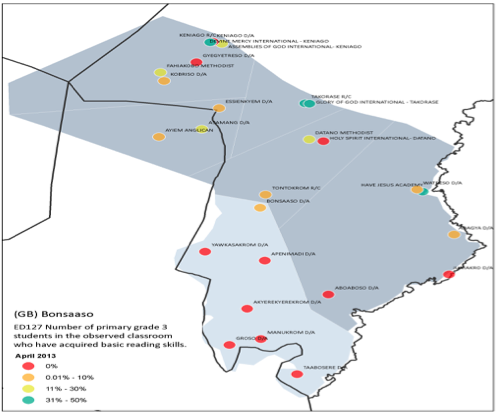
Another very important indicator is that of student’s learning levels in basic literacy skills for numeracy and language. The data are collected on a monthly basis to measure if children are falling behind. The data are intended to help the school and the teachers to plan for remedial education based on understanding the gaps in the literacy measure. For instance, if a majority of the children tested are in the word recognition category, the teachers can focus on activities that are geared towards move children from the word recognition level to higher levels of readings – reading paragraphs and simple stories. The monthly data depicted on a map from Bonsaaso, Ghana suggested that the schools that lack full time teachers are also the schools where students lack basic reading skills. Surprisingly all these schools are grouped towards the south of the cluster.

Screen Shot 2015-04-13 at 9.38.13 AM

Figure 3. Reading Levels of children in Grade 3 in Bonsaaso, Ghana.

Source: Millennium Villages Project database

Further discussions with district education officials revealed that these schools are located in the remotest part of the cluster with many in the Amansie West District. The area lacks basic infrastructural amenities and teachers do not accept postings to those areas, hence lack of teachers is one of the characteristics in that area of the cluster and the district as a whole. Many of the teachers who accept postings to these areas are untrained. Since reviewing these data, multiple-stakeholder meetings have focused on improving the learning environment of these southern schools.

These case studies bring up several points. First, regarding the data collection and utilization process, frequently collected data with frequent feedback helps to make the data more useful. Also, the people who can in a position to act after seeing the data are best suited to collect the data. The closer they are to the issues, the better the data use is going to be. The second point centers on the use of technology to improve the functioning of the schools. Often the use of technology is limited to laptops used by students for learning and by teachers as teaching aids. However, the use of technology as a lever to improve education planning as a whole leaves much to be desired. “Real-time” data collection using efficient technology has more chances of being used. The time elapsed between data collection and feedback needs to be relatively short, since people forget what data was collected in the first place. We also need to keep in mind that different data users (policymakers, district officials, school members) often like to see different indicators. Therefore data displays need to be created at various levels.

However, efficient adoption of this technology-based solution for issues of data collection depends on many factors. Political will as well as local capacity to collect frequent data and disseminate the results is key. Stakeholder buy-in from a multi-sectoral perspective can help to gain insights from already existing practices from other sectors such as health. A democratic process that weighs the different data needs at the national, state and district levels is also critical in maximizing data use. This is critical since different stakeholders at various levels may have very different data uses. Who uses what data and how much capacity the system has to collect and process the data are iterative discussions. Despite relatively limited resources, innovation is still possible and can lead to quicker diagnosis and remediation. It is clear that education planning not only requires outcome indicators from the survey, but also process indicators from facility (school) inventories. A great step forward is the UN Secretariat on Data Revolution, which recognizes the importance of such facility mapping (see the case study on the Nigeria Information Management System). Real-time data leading to real-time use should be the data mantra for UN’s Post 2015 Agenda.


How Do School Sites Support the Adoption of Educational Innovations in the Finnish Context?

As part of a symposium focused on educational innovation around the world  at the annual conference of the American Educational Assocation in Chicago next week, we are sharing commentary papers from the participants.  Today’s contribution is from Jari Lavonen, Tiina Korhonen & Kalle Juuti, Department of Teacher Education, University of Helsinki, Finland. 

This post introduces an Innovative School Model (ISM) currently being implemented at a Finnish elementary school and shares reflections on the model by several of the school’s teachers. Building on the work of Michael Fullan and Everett Rogers, the ISM is designed to create conditions in Finnish schools that will enable teachers, pupils, the school principal, parents and other collaborators from the neighbourhood to work together to generate and implement innovative structures and practices.

Among the innovations developed at the school are a project in which teachers and pupils created an approach to personalized science learning using smartphones. The pupils used phones mostly within a water-themed science project for making notes, revision and information gathering. This innovative approach was then adopted by the other teachers in the school. The second innovation was a new model for School-Community Collaboration (SCC) emphasizing the use of ICT. This collaborative model was developed and researched in an iterative way as teachers and students worked with researchers and other collaborators from outside the school in real science learning and collaboration situations. The SCC helped students learning creative problem-solving and inquiry strategies and to develop skills in collaboration.

The Innovative School Model (ISM)

Students’ learning and learning environments. The Finnish national and school level curriculum emphasize meaningful learning (and the learning of 21st century competences in versatile learning environments. Especially, students should learn to think critically and creatively, to use a wide range of tools, to interact in heterogeneous groups as well as to act autonomously and to take responsibility for managing their own lives. Due to the inclusion of most special need students in the regular classrooms in Finland, it is important to utilize a variety of teaching methods to engage students in learning of 21st century competences. A learning environment refers to the diverse physical locations, contexts and cultures in which students learn). A learning environment does not need to be a physical place, it can also be virtual, online, or remote. In the ISM, goal orientation and interaction are supported through the ICT tools available in the learning environment, including basic writing and drawing applications, social media environments as well as various types of mobile devices and other tools that facilitate flexible, remote and mobile learning. High-quality learning materials, including digital learning materials such as learning games and other interactive learning content are also essential parts of the learning environment.

Teachers’ professionalism. Professional teachers are at the heart of the ISM. Professional teachers are seen as academic professionals who are committed to their work and are able to plan, implement, and assess their own teaching and their students’ learning. They formatively monitor students’ progress, particularly those with special needs, and they try to support all students’ learning.

This model of a professional teacher, however, is different from the model of the effective teacher reflected in policies in the US. In those policies, an effective teacher is defined as one who is able to support students’ learning and achievement as measured by tests. The view of teacher in the ISM context is closer to that described in the “teacher leadership” movement. These teachers are goal oriented and have a clear vision for school development. Moreover, these teachers are able to work collaboratively and in interaction with other teachers towards their shared goals. They are considered to be able to use research productively, and they have a deep understanding of teaching and learning that allows them to act as curriculum specialists.

Leadership. The professional culture in a school is a key element in supporting teachers’ collaboration, in classroom operations, and in the development and adoption of innovations. In turn, the school principal and their approach to leadership plays a key role in establishing the school’s professional culture. Teachers are positively influenced when school leaders encourage collaboration among teachers, students, families, and other school personnel. Therefore, school principals in the ISM have an important role in facilitating a school culture and creating a school schedule that supports teachers’ collaboration. In practice, this collaboration manifests itself in various school teams and networks, such as grade level teams and multi-professional teams.

Networks & partnerships. Parents are the most important partners in education. A fruitful partnership with parents facilitates the sharing of responsibility for students’ weekly activities.

Family events and personal meetings with teachers are particularly important in establishing that partnership. ICT offers a multitude of opportunities for enhancing home and school collaboration (HSC), and it can be applied to enable continuous interaction between the school and families. The aim of HSC is for parents and teachers to develop shared educational values and goals, with the important consequence that mutual trust is established in each other’s ability to work towards supporting the child’s growth and education. In addition to HSC, partnerships with a wide range of other members of the local community are also important including collaborations with school support personnel, day-care providers, public librarians and senior homes as well as actors in national and international networks. Respect for the thoughts, opinions and wishes of all stakeholders serves as an essential part of all partnerships. Through long-term collaborative development, more families, teachers and community members learn to work with each other as parts of a community for the benefit of all children.

Key aspects of the ISM from the teachers’ perspective

Students’ learning and learning environments. The teachers see their school building as rather traditional, including standard classrooms and a couple of special classrooms found in many Finnish schools like a workshop for the teaching of handcrafts (such as knitting and woodworking), a minor science and technology lab and a music class. The teachers feel that the structure of the physical environment does not support flexible grouping of pupils. Nonetheless, the teachers and pupils have used their creativity and created learning spaces all over the school building. They have, for example, used curtains and pillows for creating learning spaces in the corridors and other areas of the schoolMoreover, the students learn in out-of-school locations such as a library and outdoor environments such as parks where they use mobile ICT tools like smart-phones for learning.

In their reflections the teachers also identified several aspects of their physical and virtual environments as crucial for supporting learning. Beyond the nature of the environments themselves, the teachers emphasized the need for strategic and collaborative planning on how to use those environments. However, the teachers agreed that there are enough basic ICT tools, like computers and data projectors at the school. From the point of view of personalisation of learning there are not enough basic laptops or mobile devices. Further the Internet connection and wireless network is undeveloped. The city is not able to offer these services. In addition, the city is not able to offer enough technical support to the teachers, and the web-based learning environments do not support the use of mobile devices and, therefore, different cloud services, like SkyOneDrive are used.

Teachers’ professionalism. In their reflections, the teachers suggested that school staff including teachers and classroom assistants have high levels of competence that support planning, organising and evaluating learning and learning outcomes. They also reported that the teachers are skilled in using versatile learning environments and ICT tools as well as in networking. Teachers have a strong orientation to life-long-learning and were eager to learn from one another and to adopt educational innovations developed by their peers. Their learning and collaboration is supported through weekly meetings that are designed specifically for teachers to information with one another in “pedagogical coffees” and other formal and informal meetings. Teachers are especially eager to learn new technology and use of this technology in education:

Leadership. The teachers also emphasized the importance of strategic planning and goal orientation; interaction; and an open decision-making process. There should be versatile interaction forums for leadership in schools using the ISM. For example, teachers at the school meet once a month in official teacher meetings and once a week in informal “noon”-meetings. Moreover, there are team meetings of the teachers working at the same grade. Furthermore, the official development discussions and unofficial daily personal discussions are important for teachers. Because of the versatile use of ICT in leadership, there are opportunities for interaction that are both face-to and virtual.

Principals and vice principals also need to be able to share/distribute leadership and to be aware of the division of labour. For example, teachers and classroom assistants belong to grade-level teams responsible for co-planning and evaluation. ICT is used in a versatile way in administration. The principals, teachers and classroom assistants work together to develop ways to use ICT in administration and collaboration. The use of ICT in school operations support the teachers to acquire ICT skills the teachers can utilize in their teaching as well. It is important that the school follows technology developments on the principal, teacher and classroom level.

The role of a principal is important in supporting both teachers’ designing and adopting educational innovations. In particular, principals need to be able to support teachers by starting where they are and by helping them to integrate all kind of learners in the same classroom.

Partnerships. In their reflections, teachers recognised five different levels of networks and partnership, and in all levels, ICT is used. Inside the school there are several networks, like grade-level networks/teams and school-level networks, like the multiprofessional team (consisting of school nurse, social worker, special need teacher and principal) that supports the welfare of pupils. At the city level, the teachers of the school belongs to several networks, including a local curriculum development team and an in-service training team). The school is also involved in networks with other schools in Finland, among them networks to foster the use of ICT in education and collaboration.

Networks with families and community organizations function more as partnerships than networks. In particular, the school is in partnership with several organisations including the library, kindergarten and senior house located near the school. This partnership allows pupils opportunities for learning and collaboration in those organisations. In addition, these organisations also benefit from the partnerships. The pupils have, for example, introduced the use of mobile devices to the senior citizens at the senior house and to the young kids at the kindergarten. All teachers also emphasised that collaboration with parents is an important type of networking for the school.

Challenges for the future

The teachers emphasised that one of the biggest challenges for the future is to continue the partnerships and networks with all important parties. In particular, updates to the ICT tools require continuous learning on the part of all those involved. Another challenge in the use of ICT is the variation in the competence of the parties, particularly the variability in parents’ ICT competence and their access to ICT tools. The third challenge is the resources needed in coordinating the networks. As one teacher put it, “there are too many networks and we do not utilise them enough.” The teachers also felt that networking with some companies was not fruitful as only the companies benefited from the collaboration. 

Acknowledgments

This work was made possible with support from the Finnable 2020 project, funded by the Finnish Funding Agency for Technology and Innovation (Tekes).