Tag Archives: Africa

Bringing a Tablet-Based Foundational Learning Program to all the Primary Schools in Malawi: Joe Wolf and Kira Keane on the Evolution of Imagine Worldwide (Part 1)

What does it take to scale a tablet-based foundational learning program to all the primary  schools in Malawi? In this 3-part interview, Joe Wolf and Kira Keane describe how Imagine Worldwide has approached that challenge and share some of what they have learned in the process.  The tablet-based program at the center of Imagine Worldwide’s work, developed by software partner onebillion, serves as a supplement for regular instruction, with each child in a school spending a targeted 150 minutes per week working independently on problems related to reading and mathematics. Imagine Worldwide partnered with the Government of Malawi to rollout the program in 500 primary schools in 2023-24, with the ultimate goal of expanding to all 6000 primary schools in Malawi, serving 3.8 million learners in standards [grades] 1-4 annually. Joe Wolf is the Co-CEO and Co-Founder of Imagine Worldwide and Kira Keane is the Director of Communications. (Photos/graphics are from Imagine Worldwide unless otherwise noted.)

TH: Can you describe for us some of the key steps or phases you went through as you developed your work to test and then to scale-up this tablet-based program in Malawi? 

Joe Wolf: The first phase of our work was all research oriented. We wanted to see if these learner-centric tablet models could work – were they really effective for children? – before asking under-resourced systems to spend time, energy, and capital on them. That meant we had a prolonged research phase that included nine randomized controlled trials. That was across different contexts, different languages, different implementation models, different countries – really exhaustively trying to prove that these solutions can, in fact, add significant value. 

The second phase was what we call “learning to scale:” What are the processes that need to be done repeatedly well to scale within these contexts? We purposely spread our work out across seven countries, with different implementation models, different implementation partners, different types of structures to really test what needs to be done repeatedly well so that these systems can adopt the work at scale. Then, only in the last three years, we’ve put the pedal down and said, “Okay, I think we’re ready to really think about scaling.” And we were only able to act on scaling thanks to the leadership of the government of Malawi, who saw the learning gains of our pilot programs and saw how this edtech intervention could support their national goals of improving foundational skills.  At that point in 2022, we served around 6000 children, but we increased it to about 700,000 children by the beginning of 2025. That’s a 100x increase in the last two years, which I think is a testament to the scalability of the model, the execution of the team, and the leadership of our government partners. 

A map of africa with a yellow circle

AI-generated content may be incorrect.

TH: What’s the third phase? Implementation? 

JW: I would say it’s scale plus continuous improvement. Now, our research is less efficacy oriented and more implementation oriented. How do we make it better and better and better? To address that, we have four levers we focus on: 

  • Access: How do we serve more and more children and make the solutions easier and easier to implement? 
  • Cost-effectiveness: How do we bring down the recurring costs to be as low as possible? We’ve brought costs down around 75% in the last five years, and we think there’s still room to go. Our key inputs are all highly deflationary, so we’re getting better economies of scale as we grow. Right now, we’re at about seven dollars (USD) per child per year. We think we can get that under five dollars (USD) as we get better economies of scale. 
  • Advocacy: How do we use data to improve the implementation model in the software so that the efficacy of the program continues to go up and up and up? It’s one of the beauties of technology that it can iterate and improve. You’re not building a building and putting in books and then five years later it’s deteriorated. We actually have the ability to use data to continuously improve through this flywheel of innovation.
  • Sustainability. How do we work with our government partners to build operational and financial sustainability?  And how do we do it starting day one, where we’re building the “muscles” within the existing education system, as opposed to the classic approach of starting off outside the system and then trying to hand it off to the system. Too often, if you haven’t done a good job of building that internal muscle, and then things fall apart. So we’ve really taken the system strengthening approach, acknowledging that there are capacity and infrastructure gaps within the countries where we work and that there are key functions that need to be built that don’t currently exist within some of these systems. We’ve tried to give it time so that, by the end of the implementation phase, the system has already been doing the work for an extended period of time. That way, you don’t have this fall off as you try to hand-off everything to the system itself.

Kira Keane: I just want to underscore a couple of points that Joe made. For Imagine, this notion of the continuous improvement loop, it’s not like we did things, something went wrong and we’re like, “Oh, we have to fix this.” This was an intentional design element from the very beginning: How do we get continuous feedback to improve both the software itself and the implementation model? And the other point is that our key question is “How do we serve as many children as possible?” The need is so immense and the population growth will be so intense over the next 10-15 years so we really need to be focused on scale. That means working with our government partners to aim for generational impact, really looking at country-wide scale, and focusing on how we design for that.

JW: I’ll add two more things to what Kira said. The ecosystem is exhausted by pilots – by small things that don’t scale, that don’t have evidence, that take a lot of time and resources. Scale from day one very much aligns with where the governments are. They have a big problem with the lack of foundational learning among their students, and they need big solutions. Little, tiny things are just distracting and take too much time and energy. The second thing is that we have positioned our organization to be temporary in nature, so our job is to put ourselves out of business as quickly as we possibly can. We don’t see these as “Imagine Worldwide” programs in Malawi or “Imagine Worldwide” in Sierra Leone. These are programs of the government in Malawi and of the government in Sierra Leone that we are helping to support. We’re helping to build capacity and infrastructure to build muscle within the systems. But as soon as the government is ready to maintain this on its own, we are more than pleased to step out of the way and to move on to the next challenge. I think that positioning is really important for the governments. It’s really important for the funders. It’s really important for us and our team. Too many times, an NGO establishes itself and 50 years later, the NGO is still there, doing the work. We need this work to be sustainable within existing systems. Part of that is a commitment for us to get out of the way. We have to believe in sovereignty and the power of governments to run themselves, while also acknowledging that the use of technology in a place like Malawi is new, and so there is going to be a period of time where we have to build some functions that do not currently exist.

TH: That certainly resonates with my experiences in the US where we’ve seen multiple improvement efforts collide in schools in ways that can actually undermine their capacity for improvement. What made Malawi a good context for you to work on scale-up?  

JW: The work in Malawi actually predates the partnership with Imagine. There was a program called “Unlocking Talent,” with the software developer onebillion that became our partner. The onebillion CEO went to Malawi, I think, 15 years ago, fell in love with the country, and developed the product. The first product they developed was in Chichewa, in Malawi. In other words, this was not developed in the West and then adapted to the context. This actually was developed within the Malawian context. We became a research partner to look at impact and to help do the RCT work. That has now evolved into a much more scalable model that we call the BeFIT Program. It’s serving standards [grades] one through four, whereas the first program was only standard two. 

A person holding a tablet

AI-generated content may be incorrect.
Key elements of the BeFIT program in Malawi

There have been a whole bunch of iterations along the way to develop our general approach, but it basically evolved by thinking about what it would take to actually scale the program much more cost effectively to many more students in more systems. If you look at the other places that we worked, you’ll see that we started with finding local partners, mostly local NGOs, some local social-oriented businesses, and then turned over a lot of the functions to those local partners to see what worked in different contexts. From that, we have built a series of centralized functions that we’re now drawing on in our country partnerships, as opposed to having it be completely decentralized. We learned a lot from the initial more decentralized exploration, but we’re now in the process of creating more standardization. Part of scaling depends on acknowledging that you can’t have fifty different bespoke operations. You need to have systems and standards and data systems. When you have 6000 children in Malawi, using a total of 1000 devices, you can do some things by hand; but now we’re trying to serve millions of children in Malawi, with hundreds of thousands of tablets. We now need data driven systems in order to be able to manage that equipment in the field. 

TH: Let’s follow the arc of that evolution in Malawi. What are some of the steps that were crucial to your learning and to the development of the model?

JW: In Malawi, we took seven or eight years to do the research and to get the right level of government buy-in to understand what was working. That included learning things like what’s the infrastructure for the typical school in Malawi? Just to give you the context, that means more than 100 children per teacher and inadequate levels of teacher training. There’s very rarely basic infrastructure in place, so no electricity and certainly no internet connectivity. That’s the reality of the average class in Malawi. So as you think about the components of our model that have emerged the first was what you would call the infrastructure component. We put solar power into all of our schools, addressing questions like: 

  • Where do solar panels go? 
  • How does the solar electricity feed a bank of lithium batteries? 
  • How do the tablets get stored and secured overnight so that they’re charged and they’re safe? 
  • How does all that equipment get distributed to children in a really efficient manner, so that you’re getting as much asset utilization as possible and as much learning time as possible? 

In the end, our research consistently shows that the number of minutes each student uses the content is directly correlated to the level of learning. So we’re addressing these 101 things that need to be done in terms of the infrastructure and operations to maximize that time on task. And that has to take into account that the school day and the school periods are very short in Malawi and you have a lot of children in the classroom. So even just getting kids in and out of a classroom is a lot harder than in many other contexts.

A group of children raising their hands

AI-generated content may be incorrect.
A classroom in Malawi

TH: You just described those complexities really effectively, but for those of us who aren’t familiar with the context, can you go into it even more deeply? What does it really take to get a program like this up and running at scale? 

JW: I think that in addition to a foundational learning organization, we are, in a lot of ways, also a supply chain logistics company. Learning gains are still our north star, but the reality is you’re talking about a phase one of BeFIT that involved launching the program in five hundred schools in five months across half of the country of Malawi, including very rural districts. So we have to deal with the logistics of getting five hundred secure storage cabinets into those schools. We have to deal with the logistics of getting 100,000 tablets distributed across those 500 schools and of getting the solar equipment put into 500 schools. That’s a significant operational lift, and you have to approach that with a level of rigor in terms of those key functions, if you’re going to be able to scale, and you’re going to be able to do that on time. And we had to do that on budget in the middle of a huge macro-economic meltdown in terms of currency and raw materials. In the grand scheme of things, once the equipment is in place, kids can get learning very, very quickly. There’s not a huge lift in terms of adult training. There’s not a huge lift in terms of the role of the adult in the model itself; the content has been built to be autonomous, meaning the child can be self-directed. The tablets themselves have been built to be very robust. A lot of enhancements have been made to make the tablet durable. There’s a long battery life so it can be used throughout the day. Every part of the tablet has been built with screws so that a component can be swapped out if something breaks. So every part of the context has been taken into account in order to get that equipment into the field and utilized. This is one of the big learnings: you have to start with the context in mind, and you have to start with the learning objectives in mind. You then make a series of software decisions, and then you make a series of hardware decisions. Too often in education, it goes the other direction, where people buy stuff, but then they haven’t really thought about what’s going to go on the stuff? What’s the training required? What are the charging and security components of it? What is our learning objective at the end of the day? You have to start with learning, move into the context, and think about all the infrastructure decisions that need to be made in order to make that learning possible in that context. 

KK: I think it’s also important to flag that in working on the logistics we included the government from day one. That means things like using the delivery trucks the government already had. Trying to manage that coordination may have been a little slower or less efficient in some ways, but too often people design an implementation model, put a bow on it, and then hand it to the government without including them from inception. 

Next Week: Building the Capacity to Improve and Sustain Foundational Learning Through Government and Local Partnerships in Malawi: Joe Wolf and Kira Keane on the Evolution of Imagine Worldwide (Part 2)

Revisiting Innovative Educational Change in Africa, the US and India

IEN will be taking a break until the end of August, but in the meantime, please revisit some of our posts highlighting specific improvements that organizations like Fount for Nations, Van Ness Elementary School and Transcend, and the Central Square Foundation are making in schools and learning opportunities around the world. IEN returns in September with our annual scan of “back to school” headlines in the US and other parts of the world.

Inequality, adaptability and survival: A view of the pandemic and school closures from Dignitas’ Deborah Kimathi in Kenya

In honor of the announcement of the WISE Award winners for 2020, we are reposting our interview with Deborah Kimathi, the Executive Director of Dignitas, an education development organisation in Kenya. Dignitas was one of six WISE Award winners this year for its Stawisha Instructional Leadership Institute. (Dignitas is also a partner of Global School Leaders, the focus of last week’s post.) The WISE awards celebration will take place virtually on October 28th (with free registration) and will include “Building the Future of Education: Conversations with Resilient Innovators.”

This interview was one in a series that included posts from Chile,  from Japanfrom the Netherlands, Scotland, Liberia,  Pakistan,  Australia,  Canada, China, and Ghana. The “A view from…” series editors are IEN’s Thomas Hatch and Karen Edge, Reader/Associate Professor in Educational Leadership at University College London’s Institute of Education.

IEN: What’s happening with you and your family?

Deborah Kimathi: Kenya announced its first case of COVID19 on March 13th, and on March 15th the government announced national school closures, and social distancing measures that included working from home for those in non-essential services. I spent the next morning in the Dignitas office, setting up our team of 15 for remote working, with no idea of what that would really look like (for a team who are typically 80% in the community delivering training and coaching to our 140 School Partners) or how long it might last for. Now, 11 weeks the team are all still working from home, and being incredibly fruitful despite the challenges.

Ever since, my family and I have been working from home in Nairobi, schooling from home, shopping from home, socializing from home, and everything-else-from-home! My husband and I are both still working full time (or more than), and managing our three children. Our childcare ceased on the same day, so that our nanny could also follow the government’s guidelines. Our oldest two (7 and 9 years old, one lockdown birthday later) are doing some home learning (not their school prescribed program which was 6 hours per day of poorly managed Google Hangouts), and our 3 year old, who was due to start nursery this term, is generally having way too much screen time. My working day currently starts at 5am, and goes until around 10pm, with a variety of interruptions.

IEN: What’s happening with education/learning in your community?

DK: One word comes to mind – inequality.  I have two very different ongoing conversations when it comes to education.  The first is with my children’s friends’ parents, mostly struggling with schedules, the need for each child to have a device or laptop, how to turn baking into a science lesson, and where to source real butter for said cake.  The other, and the more urgent conversation, is with our School Partners and friends, largely in Nairobi’s urban informal settlements.  Here, the struggle is not for comfort, the struggle is for survival.  COVID19 has brought with it severe social, health and economic hardship, and these hit the poorest communities the hardest.  In these communities, more than 60% of families were unable to access public education pre-COVID19, as a result of poverty and systemic exclusion.  Marginalised by poverty, these are the same families excluded from a myriad of essential health and education services now, and often fighting a daily, violent war with police in their struggle to exist.

The more urgent conversation, is with our School Partners and friends, largely in Nairobi’s urban informal settlements.  Here, the struggle is not for comfort, the struggle is for survival.  COVID19 has brought with it severe social, health and economic hardship, and these hit the poorest communities the hardest.

The significant challenge of inequality is, as a result, exacerbated in the most violent way, only bringing harm to children, families, and society as a whole.  This raises critical, urgent questions of ‘What happens next?’  When schools reopen, will those who’ve participated in online or home learning be ‘ahead’ of others?  How will schools assess progress and promote students to the new school year?  How many girls will be married or pregnant, never to return to school?  How many families will end up on the street, their children never to return to school?  How many children will have died from starvation?  How many children will be so scarred by the trauma, violence and anxiety of this season that learning never really resumes?

The significant challenge of inequality is, as a result, exacerbated in the most violent way, only bringing harm to children, families, and society as a whole. 

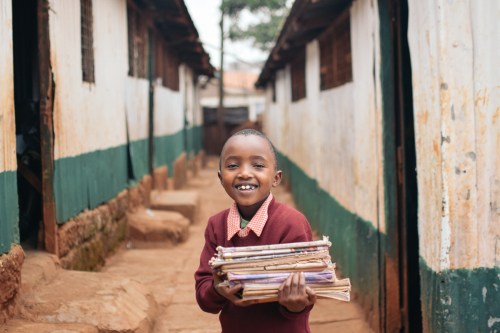
A young learner proudly carries his school books outside a typical partner school. Photo: Dignitas

IEN: What do you/your community need help with?

DK: Dignitas is working tirelessly to protect and promote the learning and well-being of children living in poverty.  Whilst everything else is disrupted, our vision to ensure all children have the opportunity to thrive and succeed remains core to our COVID19 response.

In an effort to reach and protect these children, we immediately thought of our amazing community of School Leaders and Teacher Leaders.  Dignitas has trained over 1,000 educators, and have another 450 educators enrolled for 2020.  These School Leaders have already benefited from Dignitas training and coaching and they are also leaders who are rooted in, and passionate about the needs of their communities. Our partnership lays an ideal foundation for them to be further equipped to respond in these times of crisis as community champions of well-being and learning.  Dignitas is remotely training and coaching these educators as Community Champions who can work in household clusters to protect and promote children’s learning and well-being.  

Dignitas is working tirelessly to protect
and promote the learning and well-being
of children living in poverty.  Whilst
everything else is disrupted, our vision
to ensure all children have the opportunity
to thrive and succeed remains core
to our COVID19 response.

To make this possible, we need help in curating more digital content for these educators, the educators need tablets to access and share learning content, families need basic devices or radios to benefit from the government’s education broadcasts, we need to design and print home learning packs for children, and we need to help families with food!  The list is long, and we’ve been excited to collaborate with some amazing partners like Safaricom Foundation, Team4Tech, Cosaraf Foundation and Synthetic so far, but the need is huge!

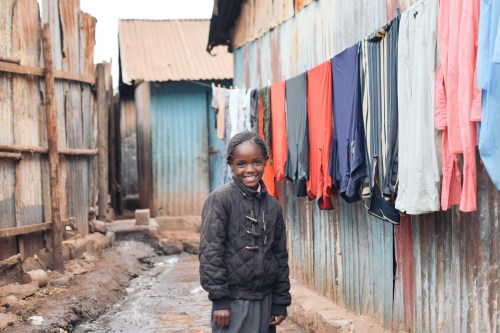
A young girl, now at home, facing an uncertain future. Photo: Dignitas

IEN: What resources/links/supports have you found most useful? 

DK: I’ve really appreciated being part of some great networks – WISE, Global School Leaders, RELI, Global Schools Forum and others who have curated relevant content and tools, and offered consistent, valuable support.  The opportunity to share and learn with peers has helped me to stay focused, inspired and fruitful in this season.

Friends and donors who are authentic partners in our work!  Can donor relationships be unhealthy, and have skewed power dynamics?  Yes. However, they can also be wonderful places of strategic collaboration, bringing together passionate, committed teams of people and resources to respond to community need in a wise and compassionate way.  We’re fortunate to largely experience the latter, and they’ve been amazing thought and action partners for this season.

IEN: What are you reading, watching, listening to that you would recommend to others?  

DK: I’m mostly listening to podcasts and recordings of webinars that I’ve missed in the busy-ness!  WISE and Africa.com have had great content, relevant to our context, and not afraid to ask the hard questions.  In terms of reading, material from Harvard Graduate School of Education and Brookings Institute have offered interesting insight.  However, I think my most valuable learning experience in this season has been listening to others – peers in the Kenyan and Global education sector, and the communities in which we work.

IEN: What have you found most inspiring?

DK: People!  People who are so intentional in bringing hope and light to others.  People giving so generously of their time and expertise.  People who don’t have much, always willing to give the most. 

A View Of The Lockdown And School Closures From Chikodi Onyemerela And Branham Anamon In Ghana

In this week’s post, Chikodi Onyemerela and Branham Anamon share their view of the coronavirus outbreak and school closures in  Ghana. Onyemerela is the Director of Programmes and Partnerships and Anamon is Operation Manager, Education and Society both for British Council (Ghana).

This post is the tenth in a series that includes views from ChileJapan the NetherlandsScotlandLiberiaPakistanAustraliaCanada, and China. The “A view from…” series editors are IEN’s Thomas Hatch and Karen Edge, Reader/Associate Professor in Educational Leadership at University College London’s Institute of Education.

IEN: What’s happening with you and your family?  

Onyemerela: My family members are in Nigeria and I am based in Accra, Ghana. We are doing well. We are using more virtual means to keep in contact daily. There is higher pressure on my wife at home as she has to do a lot on her own with 4 kids… 24/7…without help and it adds up.

Anamon: I am living alone in Kumasi and keeping up with work. I am speaking with friends around the world and watching a lot of Netflix. It feels like time has been running so fast during the lockdown

IEN: What’s happening with education/learning in your community?

Onyemerela & Anamon: As the government in Ghana is grappling with COVID-19 virus, all levels of education are closed introducing a new paradigm into the school system. Following the outbreak of COVID-19 in Ghana, the national government announced the closure of schools and other social and religious gathering on the 16th of March, 2020. Subsequently, to ensure that learning is taking place during the period of closure, the government has setup Ghana Learning TV and Radio as well as what it has called iCampus to house digital resources for students and teachers. As of mid-June, there has been a partial reopening for students in their final years of junior, senior and university programs to assist them in preparation for exams. Even though the government has made sure all schools are linked to a health centre, there has been a mixed reaction from parents and guardians about PPE for kids and following some cases of COVID -19 recorded in some schools.

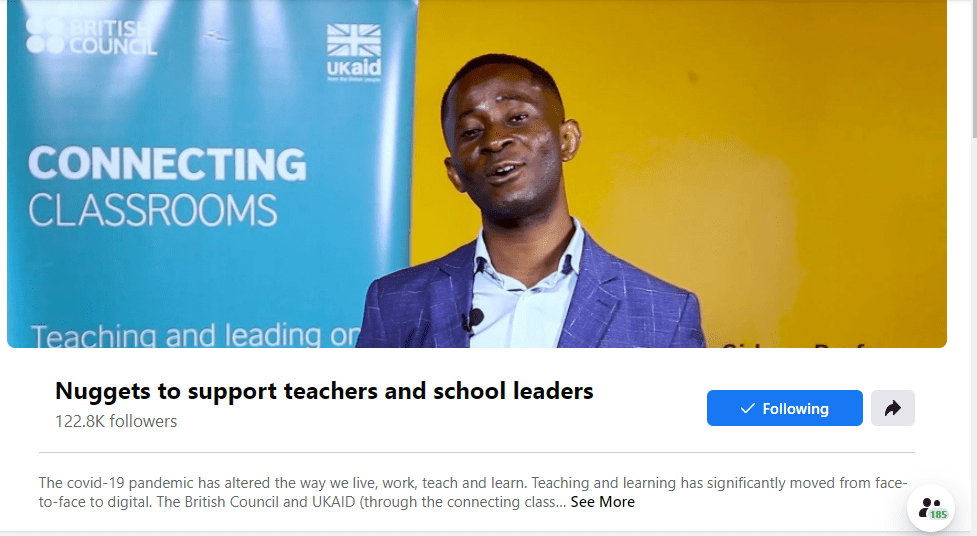
At the British Council, we work within the various sectors of education including higher, vocational, secondary and primary education. Our three priorities continue to be working in partnership with the education authorities in Ghana on 1) engagement at policy level 2) capacity building for teachers and school leaders; and, 3) professional partnerships and networks for practitioners. Following the advent of COVID-19, activities in these three areas have been migrated to online platforms often in the form of webinars. Our professional development offer for teachers and school leaders has been on building their capacity to deliver effective teaching and learning and the integration of the six core skills in their teaching methods as contained in Ghana’s National Pre-Tertiary Education Curriculum Framework. During this period of the pandemic, this capacity building programme has been delivered through series of webinars for cohorts of teachers and through short videos on social and traditional media. A series of topical webinars have also been organised for policy makers in respective areas, including Progression in core skills, encouraging instructional leadership, building inclusive education systems and the role of research in creating a curriculum. Similar to many countries of Africa, there has been the challenge of stable internet and reaching teachers and school leaders in low resourced areas. We have developed a series of radio, television and nuggets to support teachers and school leaders through these different access options.

IEN: What do you/your community need help with? 

Onyemerela and Anamon: Following the closure of schools and setting up of alternative learning platforms by the government, community access of these resources is disproportionate across the country depending on accessibility to various infrastructures including internet, television and radio programmes. Mobile penetration and capacity to afford the required internet data for these online resources and smart phones are limited. It is causing what might be termed as the learning divide. Electricity is also a challenge for some rural communities which results in limited access to the Ghana Learning TV and Radio put together by the government. Other challenges include families who need their children to work on their family business or who have to work while trying to support students learning at home.

IEN: What resources/links/supports have you found most useful?

Onyemerela: Over the years, the British Council has always had a lot of online resources for the professional development of teachers, school leaders, learners and parents. These resources are now being contextualised and adapted to radio and television broadcast and also mapped to the national curriculum, while other development partners have provided Ghana government with various subject specific content the British Council has uniquely provided resources/content for teachers and School Leaders’ professional development and that has been most useful. There has been a campaign by the government to prevent the psychosocial issue surrounding COVID-19 to protect survivors of the pandemic so they can go to back to school and study effectively. The government is very serious about this.

Anamon: The Connecting Classrooms programme in Ghana is known for its support to basic and secondary education systems and training of teachers and leaders. There are now more online resources for kids and content to support international learning as well. Between April and June 2020, we engaged about 70 students from three regions of Ghana (Greater Accra, Eastern and Ashanti Regions) to learn with their peers (about 500 of them) from other countries of the world. The programme (Christened Global Conversation), which was co-implemented with the Economist Foundation helped these students to learn and share their views virtually on climate change and how it affects communities. The successful execution of this event shows that blended learning is possible in Ghana’s public-school system.

IEN: What are you reading, watching, listening to that you would recommend to others?  

Onyemerela: COVID19 is a phenomenon that everyone is grappling with, to understand how to live and work with it. There are opportunities for learning even if you are stuck in a room all alone. Because digital learning is the new normal and I have a background in Digital Marketing, I have been reading digital resources for enhancing learning and I would recommend the same for teachers to enhance their digital literacy and delivery.

COVID19 is a phenomenon that everyone is grappling with, to understand how to live and work with it. There are opportunities for learning even if you are stuck in a room all alone.

Anamon:  I appreciate knowledge and am curious about how the world operates, so naturally I do love reading books, articles and novels as well as watching drama series, documentaries and docuseries on issues such as political history, global economy, criminology, Religion, Self-help etc.. I have already finished reading four books during lockdown: Becoming by Michelle Obama; Talking to strangers by Malcolm Gladwell; Why nations fail by Daron Acemoglu and James Robinson; and Outliers by Malcolm Gladwell. In terms of documentaries/drama series I would recommend Greenleaf, 13th, Immigration Nation, when they see us, Trial by the Media, Breaking Bad, Big Bang Theory etc.  In addition to this I was very excited about the resumption of football especially the English Premier League for which my beloved Manchester United, against all odds, qualified for the UEFA Champions league next season.

IEN: What have you found most inspiring? 

Anamon: COVID19 offers opportunities for introspections and reflections. I am bombarded with learning content. Opportunities to recharge and repackage yourself and explore opportunities. My main focus has been mental health. Hard to keep mental health a priority when you feel bored. I encourage people to call someone. Working remotely – it is hard to believe what we can live with. There are opportunities to reconnect with old friends, check up on other people and offer support.

During the lockdown, the Black Lives Matter movement has moved from the house to the street. Companies are talking about it. There has been a reaction from different stakeholders. Having experienced racism in the EU and the US, I do want to fight it. Staying silent won’t help. As the co-lead of Equality, Diversity and Inclusion (EDI) in British Council Ghana, I am leading staff discussions on BLM and racism. It is inspiring to share and listen to experiences of others.

Onyemerela: The Ghana government has done well to provide free education to senior high schools and are doing well to manage the current capacity of primary and secondary schools. I am really interested in learning how effective learning can take place virtually. Work has been generally challenging under the current circumstance. It is encouraging to see how life is going ahead despite the limitations. We are not easily broken.Even though working from home (WFH) is a common practice, it is actually my first time to be WFH. It has its ups and downs. You want to reach out and talk to colleagues, but you are not able to do that. We have the digital tools now to deliver programmes via Microsoft teams. There are so many opportunities to do things differently using digital tools which actually reduces our cost of delivery.

Disruption and Rapid Response: A View of School Closures in Uganda From Educate!

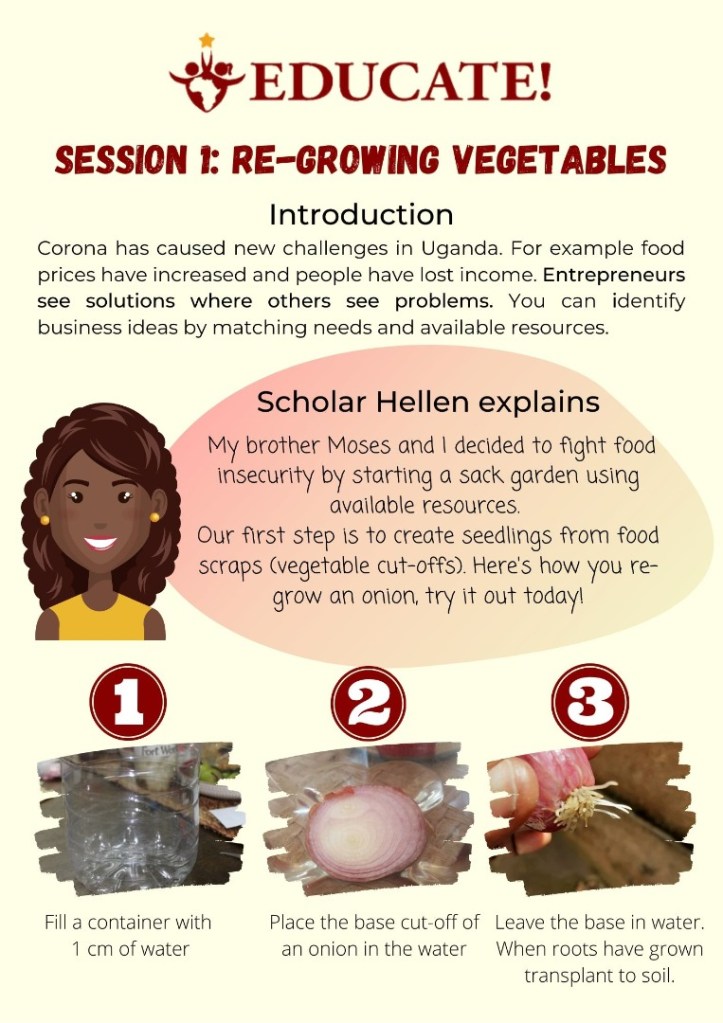
This week’s post provides a glimpse of what is happening in Uganda during the school closures. The post begins with short email interviews with two Associate Teachers from Educate! and then includes some examples of how Educate! has adapted their work in response to the coronavirus outbreak. The excerpts are drawn from an article published on Medium by Boris Bulayev, one of Educate!’s Co-founders.

This post is the ninth in a series that includes views from Chile, Japan, the Netherlands, Scotland, Liberia, Pakistan, Australia, Canada, and China. The “A view from…” series editors are IEN’s Thomas Hatch and Karen Edge, Reader/Associate Professor in Educational Leadership at University College London’s Institute of Education.

In 2009, Educate! launched an experiential model for secondary education focusing on entrepreneurship. The key components of that model include a skills course in the last two years of secondary school, mentoring to help students start enterprises and community initiatives, and a professional development network for course leaders and mentors. Since that time, Educate! has scaled their approach in Uganda, expanded to Rwanda and Kenya and established partnerships with governments to support skills-based education nationally.

With the school closures in Uganda and most of Africa since March, As Boris Bulayev, put it in the article on Medium, “given our business model is rooted in in-person delivery, we were effectively out of business.” Although the Ugandan government is expected to make an announcement about reopening in September, in the meantime, the lockdown has been challenging for teachers as well as students and parents.

Alisio, an Associate Teacher with Educate! in Northern Uganda, and Akello, an Associate Teacher from the Lira District, shared their experiences in an email interview with IEN:

What’s happening with you and your family/friends? 

Alisio: I am fine, doing farming work and family work. Friends are also busy on the farm doing agriculture, but a few in the town have been left with no source of revenue since small- scale businesses have been closed. Life is harder in urban centers than the village.

Akello: Life is a bit difficult due to the lock-down since we cannot move anywhere. But I’m pushing on well.

What’s happening with education/learning in your community? 

Alisio: It’s been hard, lessons going on in the radio station from primary to secondary school. Five radio stations are conducting different lessons but I am uncertain of the education outcomes.

Akello: There is no serious learning taking place, some lessons are happening on Radio, TV but very few students pay attention to it and most parents are not also ensuring that the students get to listen and learn.

What do you/your community need help with?

Alisio: Relief food, agricultural inputs, repair of water sources. For education: financial sponsorship after lock down, both in primary and secondary especially as many parents have lost their source of livelihood.

Akello: It’s hard to determine the specifics, people want the lock down to end, and there are a lot of domestic violence related cases in families and this will affect the children. The help that can be given would be aimed at supporting orphans and designing projects that can respond to domestic violence cases.

What resources/links/supports have you found most useful? 

Alisio: History textbooks.

Akello: Reading the text books and making notes for students in preparation of the school opening.

What are you reading, watching, listening to that you would recommend to others?  

Alisio: Reading books – preparing notes for students, conducting behavioral research on the community.

Akello: Listening to/ watching the lessons on radio and TV respectively. Managing the students who are either watching or listening to the TV or Radio to be attentive. In my free time, I make briquettes.

What have you found most inspiring?

Alisio: I have shifted my mindset to have a positive attitude towards life. I have established other sources of income and now have a piggery project (7 pigs) and I hope to diversify my revenue stream.

Akello: Value everybody irrespective of status, put what you have learnt in practice.

While the schools have been closed and their direct relationships with students have largely had to stop, Educate! has also been trying to adapt. Drawing on resources like the Bain CEO plan for coronavirus and an article from Deloitte on resilient leadership, Bulayev described Educate!’s response as moving quickly into “defense” – ensuring they had the funds to survive for at least a year – and going on “offense” – essentially digitizing key aspects of their services and in-person delivery models.  To carry out that strategy, Educate! created three different teams, each focused on a different product:

  1. A version of their in-person, direct-to-school curriculum that can be delivered over a combination of radio, phone and SMS/text
  2. A government partnership to continue student learning of core subjects by USSD [“Unstructured Supplementary Service Data] and radio
  3. A light-web e-learning platform focused on youth, but open to others, on how to start and run hygienic motorbike delivery businesses during the coronavirus pandemic and stay safe while doing it, with potential to expand into informal retail and other informal sectors.

As Bulayev explains, although these strategies are designed to maintain their core services and impact over the short term, the crisis has also spawned the hope that over the long-term, the “digital will be blended with in-person to ideally achieve greater impact, scale, and sustainability.”

A view from Liberia: Abba Karnga Jr. on School Closures and the Pandemic

This week’s post features an e-mail interview conducted by Maretta Silverman with Abba Karnga Jr., Program Manager at the Luminos Fund in Liberia, where the school lockdown continues. During the Ebola crisis, Karnga also served as Director of the Stop the Spread of Ebola Campaign. In partnership with the Country Health Team, he created an Ebola Emergency Response program responsible for social mobilization, case identification, and distribution of emergency supplies to affected homes. In 2019, he also reflected on his own educational journey in a Luminos staff profile: The Fight for Education Equality in Liberia: Living Up to My Father’s Example. Diaries from the Frontlines from the Center for Global Development provides additional perspectives on the outbreak and school closures from Luminos Fund staff as well as staff from The Citizens Foundation.

This interview is the sixth in a series that includes posts from Scotlandfrom Chile,  from Japan, and from the Netherlands.  The “A view from…” series editors are IEN’s Thomas Hatch and Karen Edge, Reader/Associate Professor in Educational Leadership at University College London’s Institute of Education

Maretta Silverman: What’s happening with you and your family/friends? 

Abba Karnga Jr.: My family are like every family in Liberia: on lockdown, staying home, and not doing normal things. All of Liberia is in a state of emergency and there are lots of rules. We’re observing curfew, wearing masks when we go out in public, and handwashing constantly!

Right now, my kids are with my mom who lives in another county, doing the same thing. The major challenge my mom faces is trying to find activities for the kids to keep them occupied. It is the same for my friends and neighbors. Everyone’s kids are idle. My family has it better than most in Liberia, especially regarding food: we were able to prepare well for this crisis, have food, and can stay at home. But many families are having a lot of difficulty finding food. People aren’t eating regular meals. I feel like I have a responsibility, as someone who has a little, to share with those who are less fortunate. It’s a very weird and strange situation in Liberia. I think it’s much harder on children than adults.

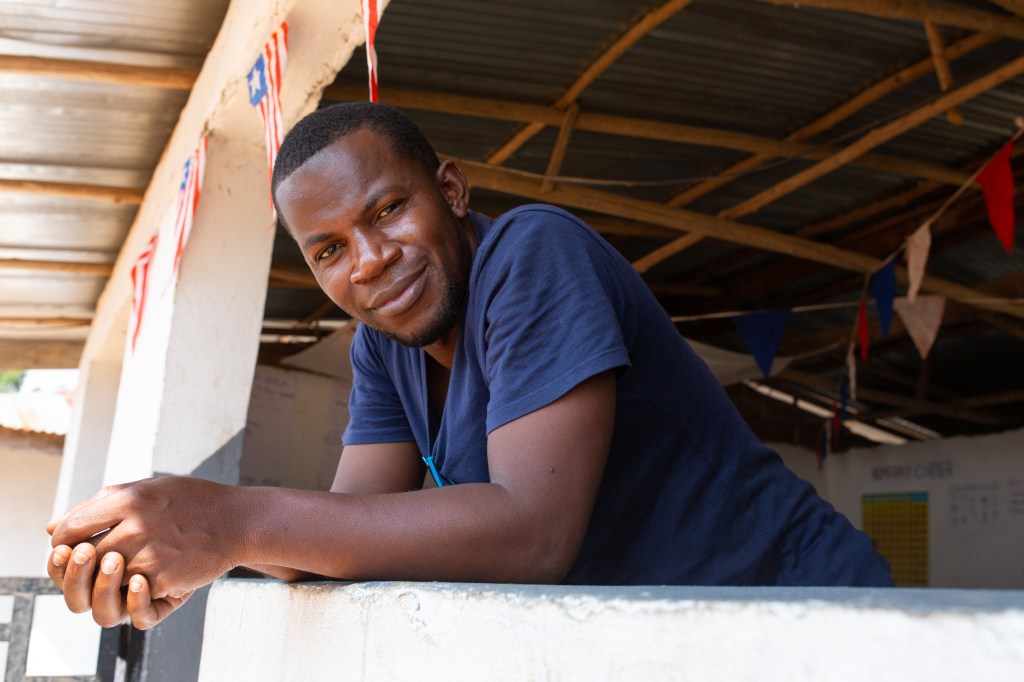
LOWAH, LIBERIA: November 27, 2019 – Luminos Liberia Project Manager Abba Karnga Jr. Carielle Doe for The Luminos Fund.

MS: What’s happening with education/learning in your community? 

AK: Liberia’s Ministry of Education has ideas and strategies to help schools reach children and to help programs like us at the Luminos Fund to reach our students. One major thing they are concentrating on is radio programs. This is a great effort but I do see challenges because, in some places like the rural communities where Luminos works, either radio stations don’t reach, or families don’t have radios, or people haven’t heard about the program schedule so don’t know to listen. I’m afraid many students aren’t paying attention. I think everyone realizes the limitations, but radio is perhaps the best tool in the national toolkit to reach children.

Education is very, very slow in most of our communities. Some school systems have created lessons to send home but, anecdotally in my friend group, most kids aren’t really doing them. In Liberia, we know most learning happens at school. Parents are busy and may not be educated, so it’s hard to expect them to guide learning at home.

At the Luminos Fund, we offer a 10-month program to help out-of-school children catch up on their learning: to learn to read, write, and do math. In March, all our classes closed because of COVID. We decided to focus on learning that students could continue at home, as well as to distribute materials directly to our students’ homes: readers, math workbooks, and worksheets. We believe this is good practice for students, helps them continue engaging in education, and it’s useful for them to know their teachers are thinking about them. There are challenges, of course. I’d estimate that about forty percent of our facilitators (teachers) live in the community they serve and can easily assign lessons and check on students regularly by walking past their homes, which is great. In communities where there aren’t facilitators, one of our supervisors goes to check in with students once a week.

About forty percent of our facilitators live in the community they serve and can easily assign lessons and check on students regularly by walking past their homes

MS: What do you/your community need help with?

AK: Two things. First, food. There’s extremely high unemployment right now in Liberia. Most people depend on a daily hustle or contracts to survive, and much of that work has stopped due to the Coronavirus and lockdown. The Liberian government proposed a stimulus package some weeks ago, but it hasn’t moved forward. Families are really suffering.

Second, I wish children had more home recreation options during this period. Most homes in Liberia don’t have electricity, so TV isn’t realistic. Board games would be nice. It’s lockdown, but many kids still try to play outside and people have to chase them away. It’s risky. Parents are trying to make ends meet.

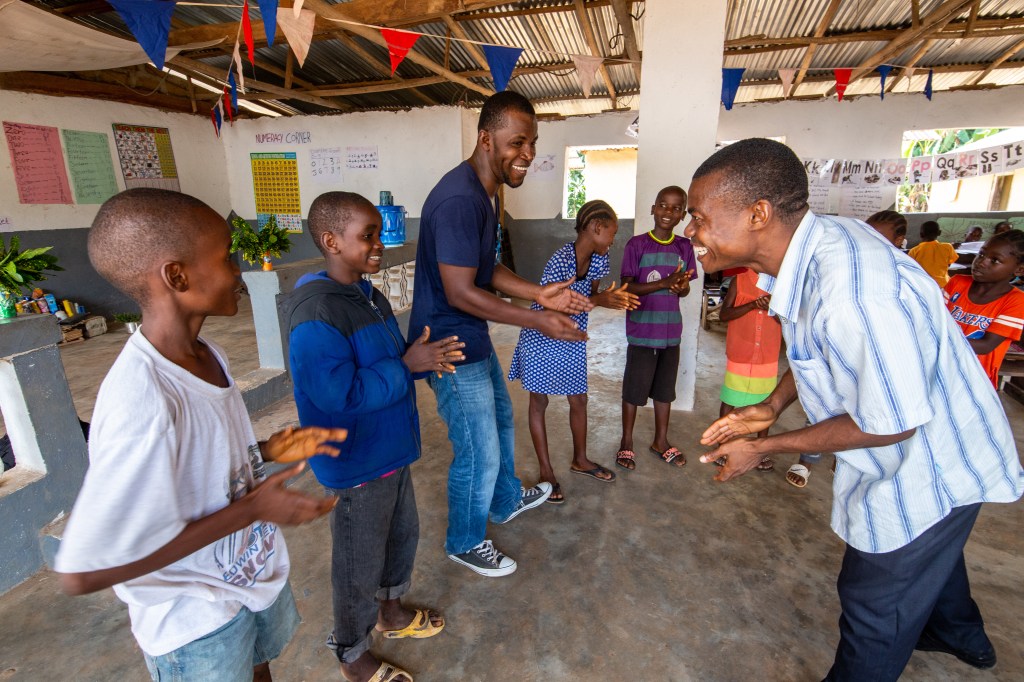
LOWAH, LIBERIA: November 27, 2019 – Abba Karnga, center, playing a learning game with students before the Covid-19 school closures. Carielle Doe for The Luminos Fund.

MS: What resources/links/supports have you found most useful? 

AK: I’m excited about the support we’re witnessing from people in communities across Liberia, who have created local Coronavirus awareness teams. I’m on the team in my community. I think this community-level action comes, in part, from our experiences with Ebola a few years ago. Right now, we’ve set up handwashing sites. We ensure people coming into the community wash their hands and wear a mask. We go around with flyers (practicing social distancing) or loudspeakers on cars to raise awareness about COVID and share good information. It’s motivating and useful. I think it’s great when people mobilize themselves.

MS: What are you reading, watching, listening to that you would recommend to others?  

AK: I listen to the Liberian Ministry of Health press releases that are shared every Friday on certain radio stations. They are credible and have the latest information.

MS: What have you found most inspiring?

AK: Our program! Luminos is an education organization but pivoted quickly to provide relief to students’ families during this crisis, including learning materials, soap, detergent, barrels for water, and food. Recently, we distributed food to over 1,600 of our students’ homes. For more than a week after, we received calls from parents. Some parents were literally crying in appreciation of what Luminos did. They said they never expected it and it was so timely. Some families were out of food and hadn’t known where they would find their next meal. We even heard from other community members and local leaders who heard what we did and called – not even parents. So, seeing the humanitarian aspect of this work is what’s most inspiring for me. I’m grateful we can do this for these families, and to be involved.