Tag Archives: Educational Reform

Building the capacity for high quality education at scale: Can Vietnam transform the conventional model of schooling (Part 2)?

Despite a much more limited budget and a much larger population than “high performing” countries like Finland and Singapore, some common factors help explain Vietnam’s educational success. Drawing on observations from a trip to Vietnam, the second post in this 4-part series from Thomas Hatch focuses on some of the key elements that helped Vietnam make substantial improvements in education. Future posts explore Vietnam’s subsequent efforts to shift to a competency-based approach and some of the critical issues that have to be addressed in the process. For other posts related to Vietnam, see part 1 of this series, Can Vietnam transform the conventional model of schooling? Educational improvement at scale, and earlier posts including Achieving Education for All for 100 Million People: A Conversation about the Evolution of the Vietnamese School System with Phương Minh Lương and Lân Đỗ Đức (Part 1); Looking toward the future and the implementation of a new competency-based curriculum in Vietnam: A Conversation about the Evolution of the Vietnamese School System with Phương Lương Minh and Lân Đỗ Đức (Part 2); The Evolution of an Alternative Educational Approach in Vietnam: The Olympia School Story Part 1 and Part 2; and Engagement, Wellbeing, and Innovation in the Wake of the School Closures in Vietnam:  A Conversation with Chi Hieu Nguyen (Part 1 and Part 2).

What does it take to create a “high-performing” education system? For long-standing top-performers like Singapore and Finland a comprehensive educational infrastructure includes: 

  • Technical capital – adequate funding, facilities, curriculum materials, and assessments 
  • Human capital – well-prepared, well-supported, and well-respected educators
  • Social capital – shared understanding and strong connections and relationships among educators, policymakers, community members and between schools and the education sector and other parts of the society.

In Vietnam, a more limited budget and a much larger population have made it harder to produce and sustain high-quality facilities, a well-prepared and supported workforce, and a tightly connected and coherent education system. Nonetheless, the Vietnamese education system has been able to draw on and develop some key aspects of technical, human, and social capital that have contributed to the establishment of a system that provides almost universal access to education through 9th grade at a relatively high level of effectiveness.

Technical capital: Funding, Facilities, and Textbooks 

In terms of funding, the Vietnamese government demonstrated its commitment to education by increasing public spending on education from about 1% of GDP in 1990 to about 3.5% in 2006. Those investments were essential for the construction of large numbers of new primary and lower secondary schools in the 1990s and for the production and distribution of free textbooks for students whose families could not afford them. In turn, these efforts contributed to the substantial increases in enrollment and access to education during that time. 

Vietnam has continued that financial commitment to education by spending nearly 20% of its budget (almost 5% of its GDP) on education from 2011 – 2020,  a level of spending higher than countries like the US and even Singapore. That commitment was put into a law passed in 2019 that stipulates that the government should spend at least 20% of its budget on education moving forward, though it has not quite reached that level. Notably, the government commitment has included an investment in equity as Vietnam allocates more spending per capita to disadvantaged provinces and municipalities and pays higher salaries to teachers serving in those areas.

A graph of red bars

Description automatically generated with medium confidence

Government-produced textbooks have also played a critical role in the evolution of Vietnam’s education system. These textbooks served as the “de facto” curriculum for some time, with teachers trained to deliver the content in the textbooks and large classes of students moving through the textbooks in a lock-step fashion. Like “managed instruction” approaches that have raised test scores and achievement levels in some districts in the US, textbooks produced by the government with centrally established learning goals may have provided the rapidly increasing student population with access to a common educational experience aligned to conventional assessments and international tests. As a history of the education system in Vietnam explained it, the replacement of textbooks at all school levels in the early 1990s “brought consistency to general education across the nation.” 

Human Capital: Respect for teachers and teachers’ expertise 

In Vietnam, explanations of the development of the educational system often cite the respect for teachers and their work and dedication as critical factors in the development of the education system. Notably, in OECD’s 2018 TALIS survey of teachers and teaching 92% of Vietnamese teachers report feeling valued by society, some of the highest rates among all OECD countries and astoundingly high compared to the OECD average of 26%. By comparison, slightly over 70% of teachers in Singapore (#2 in the rankings) and slightly less than 60% of teachers in Finland say they feel valued by society. In addition, 93% of teachers in Vietnam reported that teaching was their first choice of career (versus an average of 67% of teachers in other OECD countries).  Correspondingly, teacher absenteeism is virtually unknown in Vietnam. 

There is also some evidence to suggest that, overall, teachers in Vietnam have a relatively high level of expertise. For example, data from the Young Lives project shows that primary school math teachers’ pedagogical skills are the one school variable that explains a significant amount of the difference in the gap between the scores of students in Vietnam and their counterparts in India and Peru. Furthermore, the variance in the effects that teachers have on their students’ learning is much smaller in Vietnam than it is in many other countries, suggesting that there are relatively few really bad teachers. 

A graph of the teacher's values

Description automatically generated with medium confidence

Social capital: Shared values, common commitment, and relationships

Along with Asian countries like China and Singapore, Vietnam shares Confucian traditions that have placed high value on education for hundreds of years. That commitment to education has also been a critical part of the economic and social development of Vietnam over the last half century of the 20th Century. In 1945, for example, Ho Chi Minh declared Vietnam’s future depended on the education of its children, and that same year, the government issued decrees announcing a call for “anti-illiteracy” campaigns and the establishment of literacy classes for farmers and workers. Shortly thereafter, 75 thousand literacy classes with nearly 96 thousand teachers were serving 2 and a half million people. 

The intertwining of education and national development was also evident in the 1980’s as Vietnam’s shift towards a more market-based economy aligned well with the interests of international NGO’s like the World Bank and the Asia Development Bank. These and other international organizations have provided crucial funding and guidance for economic and educational development in Vietnam since the 1990’s.  

Those I talked to in Vietnam also emphasized the importance of the commitment to education that parents demonstrate in their support for schools. Vietnam’s education minister in 2015, put it succinctly:  “Vietnamese parents can sacrifice everything, sell their houses and land just to give their children an education,”

Importantly, students also demonstrate a belief in the power of education and respect for their teachers. 94% of the Vietnamese students surveyed as part of the PISA tests in 2015 agreed with the statement that “It is worth making an effort in math, because it will help us to perform well in our desired profession later on in life,” and surveys from the latest PISA test in 2022 showed that the proportion of class time teachers in Vietnam have to spend keeping order in the primary classroom (9%) is one of the smallest among all participating countries. 

Along with these shared values and commitments, Vietnam also appears to have developed some strong relationships between educators, government officials, and community leaders and parents.  Attention to these relationships may have played a particularly valuable role in the effort to extend and support schooling in rural ethnic minority areas. Phương Minh Lương, who has worked and conducted research with several ethnic minority communities, explained it to me this way:  “That is the power of the collective or what we might call the ‘power with.’  There’s close coordination between authorities at grassroots levels and schools, with monthly meetings between the village or what we call the commune authorities and school leadership and educators. These include school officials like the headmaster and representatives of mass organizations like the Women’s Union, Youth Union, and Study Promotion Associations at the village level. These meetings are organized by the commune authorities, and they discuss all the problems related to the life of the local people in the village and in the school.  Then if there is a problem, like there are children who have dropped out, then the authorities can support the school in that area and they can come to see what are the reasons these children dropped out, and are there any solutions to get these children back to school.”

Anti-discrimination policies in Massachusetts and socioeconomic education reform in Türkiye

In Part 5 of the Lead the Change (LtC) interviews, IEN shares excerpts from interviews with the presenters discussing “Critical analysis of policy and school reform: Reimagining more just futures” at the upcoming Annual Conference of the American Educational Research Association.  For the other posts featuring presenters from this year’s AERA conference see Part 1 “Leveraging Partnerships, Networks and Teacher Collaboration for Educational Change,” Part 2 “Leaders, Leadership Practices, and Educational Change in the US, Korea, and Hong Kong: Lead the Change Interviews (Part 2),” Part 3 “Educational Transformation in Schools and Colleges in the US and South Africa: Lead the Change Interviews (Part 3),” Part 4 Teacher Education, Teacher Certification, and Teacher Meetings in Israel, Korea, Switzerland and the US: Lead the Change Interviews (Part 4). These interviews are a part of a series produced by Elizabeth Zumpe and colleagues from AERA’s Educational Change Special Interest Group. The full interviews can be found on the LtC website


‘Even-handed treatment of all sides’: A critical policy analysis of Massachusetts anti-discriminatory school committee proposals – Erin Nerlino (EN), Clark University, & Lauren Funk (LF), Boston University

Lead the Change (LtC): What are some of the ideas you hope the field of Educational Change and the audience at American Education Research Association (AERA) can learn from your work related to practice, policy, and scholarship?

EN & LF: By engaging in this work, we aim to enhance the knowledge that the field of Educational Change and the audience at AERA have about how some threats to equal education and student belonging occur locally within cities, towns, and school district communities. While much attention has rightly been focused on states that have more widespread discriminatory laws in place, such as Florida and Texas (Johnson, 2020), local communities in states such as Massachusetts are also facing divisive and discriminatory policies. Educators, parents, students, and community members are organizing in response to resist such policies in many districts; however, an increasing number of these discriminatory and divisive policies are arising (Feingold et al., 2023). We hope to shed light on the communal threat that these policies pose and break the silos of individual districts facing these policies to share resources, strategies, and experiences in successfully resisting.

Furthermore, much of the language and concepts used in these policies can initially seem benign, suggesting that all viewpoints are just and reasonable. For example, the four policies under study in this work use words and phrases such as “neutral,” “unbiased,” and “even-handed treatment of all sides.” These phrases assert the false idea that presenting all sides of a social policy issue constitutes neutrality and that neutrality itself is ideal and not taking a position. Many of the underlying implications impact already vulnerable student populations and hamper the efforts of educators. To refer back to the previously-mentioned phrase of an “even-handed treatment of all sides” as an example, this assertion opens up the classroom as a space that has the potential to deny students’ identities as it allows for individuals to voice problematic ideas based on race, sexual orientation, religion, social class, etc., in the name of covering “all sides” of an issue. By elucidating some of the problematic language, we hope to prepare fellow allies in practice, policy, and scholarship to productively challenge ideas that might threaten the belonging of all students in schools.

Dr. Erin Nerlino 
Dr. Lauren Funk

The implications of educational change on socioeconomically disadvantaged students – Elif Erberk (EE) Van Yuzuncu Yil University, & Yasar Kondakci (YK) Middle East Technical University

Lead the Change (LtC): What are some of the ideas you hope the field of Educational Change and the audience at American Education Research Association (AERA) can learn from your work related to practice, policy, and scholarship?

EE & YK: This study critically evaluates the impact of educational reforms on socioeconomically disadvantaged students and invites both policymakers and practitioners (e.g., teachers and principals) to tailor measures that mitigate the negative impact of the reform on those students. The active involvement of teachers and principals in the design phase of the reform, empowering them during the implementation by providing additional resources, and granting decision-making latitude to contextualize the implementation in socioeconomically disadvantaged areas are practices highlighted by the teachers and principals. However, specific recommendations are made for policymakers, who are encouraged to demonstrate participatory and democratic practices during the design phase of the reform. Additionally, fostering a collaborative climate and inviting both internal (teachers and principals) and external (e.g., universities, labor unions) stakeholders to contribute to the design and implementation of reforms is vital for diminishing the impact on socio-economically disadvantaged students. 

Dr Yasar Kondakci
Dr Elif Erberk

Schooling around the World (from Larry Cuban)

This week, IEN reposts part 2 of a series of blog posts in which Larry Cuban reflects on the endurance of “two dominant patterns of organizing schools and teaching lessons” in the US: the age-graded school and “teacher-centered instruction.” In part 2, Cuban begins exploring whether the patterns he has seen in the US appear in other countries, in this case France. The original post appeared on Larry Cuban’s Blog on May 7th.

In Part 1, I asked the question whether or not the ways that U.S. schools have organized (i.e., the age-graded school) and the dominant ways that teachers teach in American classrooms (i.e., teacher-centered instruction) are unique to the U.S. So in a series of posts over the next few weeks, I will sample how different nations organize their systems of schooling and offer photos of classrooms and descriptions of lessons to see how actual students and teachers appear. 

The organization of schools in other countries and photos of lessons suggest a strong similarity to the U.S.’s age-graded structures and classroom organization. While diagrams of a nation’s schools are helpful to readers in getting a sense of how each country organizes their public schools and while snapshots do convey how classroom furniture is arrayed, the importance of wall clocks, and national flags, neither charts nor photos tell viewers the ways these teachers teach multiple lessons thereby revealing patterns in teaching. Finally, snapshots fail to show student learning since they capture a mere instant of what a class is doing. So charts and photos can inform but they have definite limits.

Another shortcoming to relying upon photos is that I may have used non-representative samples of a nation’s classrooms, given that I pulled photos from the Internet. But those photos are all I have at the moment. I do invite readers to offer other photos and text that challenge the generalizations I make about school structures, given the limited evidence I offer. 

In this post, I will focus on one country–France–and offer photos of “typical” public school classrooms over the past few years including the aftermath of the Covid-19 pandemic. 

France has a centralized system of schooling for its 13 million students. A Ministry of Education establishes the curriculum for all levels of schooling and allocates both staff and funds to the 31 regions or academies headed by a rectuerresponsible to the national Ministry of Education. 

The historically high degree of uniformity in curriculum and instruction has lessened in recent years as the Ministry of Education has delegated to local regions, curricular discretion. Moreover, local variation in schooling and classroom lessons–Brittany in the northeast of France and Marseilles on the Mediterranean Sea–Inescapably exists. 

In France, education is compulsory for children between the ages of three and 16 and consists of four levels:

Students are required to attend school from age six to sixteen. All schooling between kindergarten and university is free except for private schools where parents pay fees. Seventeen percent of French children attend private schools.

Schools open in September and end in June with two weeks of vacation every few months. Also, most French schools are open Monday, Tuesday, Thursday, and Friday. Wednesdays are often a half-day. The school day usually runs from eight AM to four PM. French students usually have over an hour for lunch and many go home to eat. 

Class sizes in public schools vary. For instance, in primary grades, one teacher and a teaching assistant typically will be in charge of 25 children; in secondary school, teachers commonly have 30 or more students.

Even with these similar features, there are differences in schooling across France (e.g., urban/rural, small/large schools, heavily immigrant/mostly middle and upper middle class, public/private). Thus, what some authorities call a “typical” lesson may simply be what they believe (or want to believe) is a common instance of classroom teaching. Readers should keep that in mind.

Here are a few photos of “typical” elementary and secondary classrooms in France. 

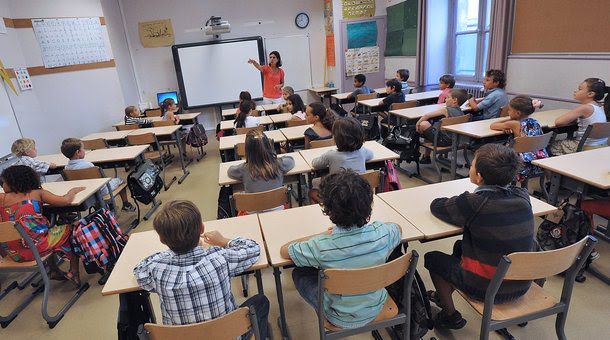
Second grade classroom
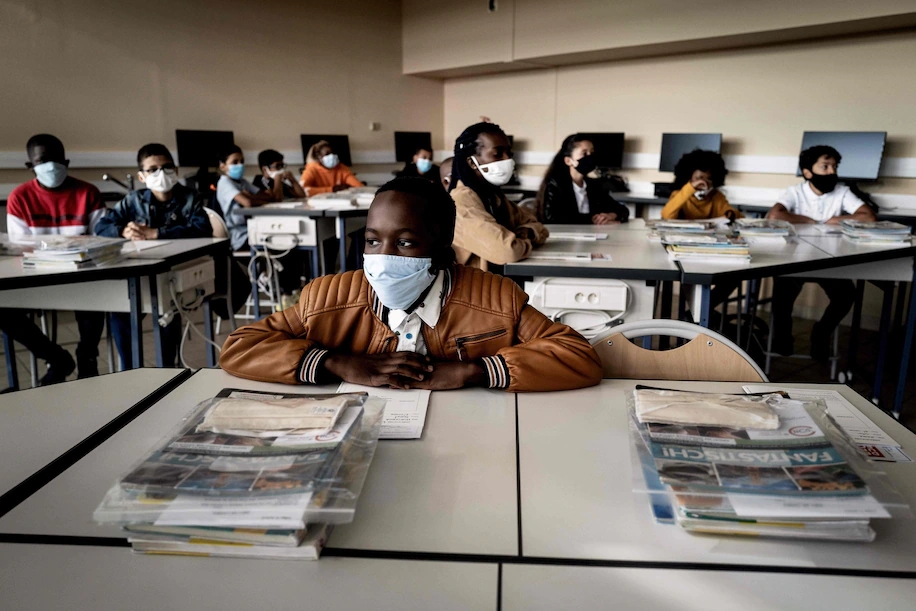
Secondary school classroom
During pandemic, students wearing protective masks sit in a classroom in a middle school in Bron, France (Jeff Pachoud/AFP/Getty Images)
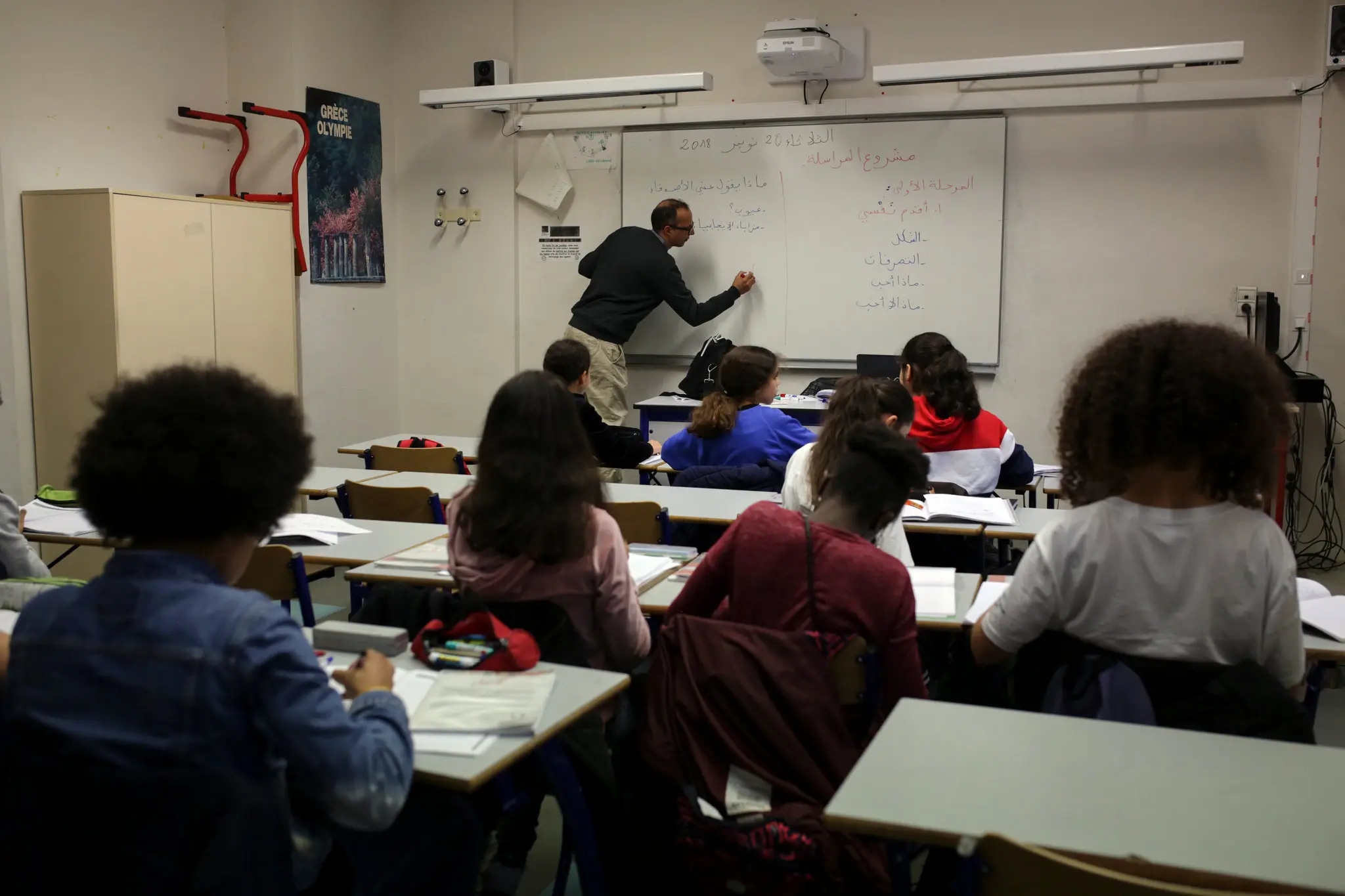
Arabic-language students at the Claude Monet high school in Paris. Here, the teacher opens the lesson by using LinkedIn to show students how many jobs are open to them if they speak Arabic.Credit…Sara Farid for The New York Times
Some 12 million French children returned to school for the first day of the new academic year on September 2, 2021. © Jeff Pachoud, AFP
High School classroom Paris France
A classroom in Nice, southern France. (File photo/September 2020) © Reuters/Eric Gaillard
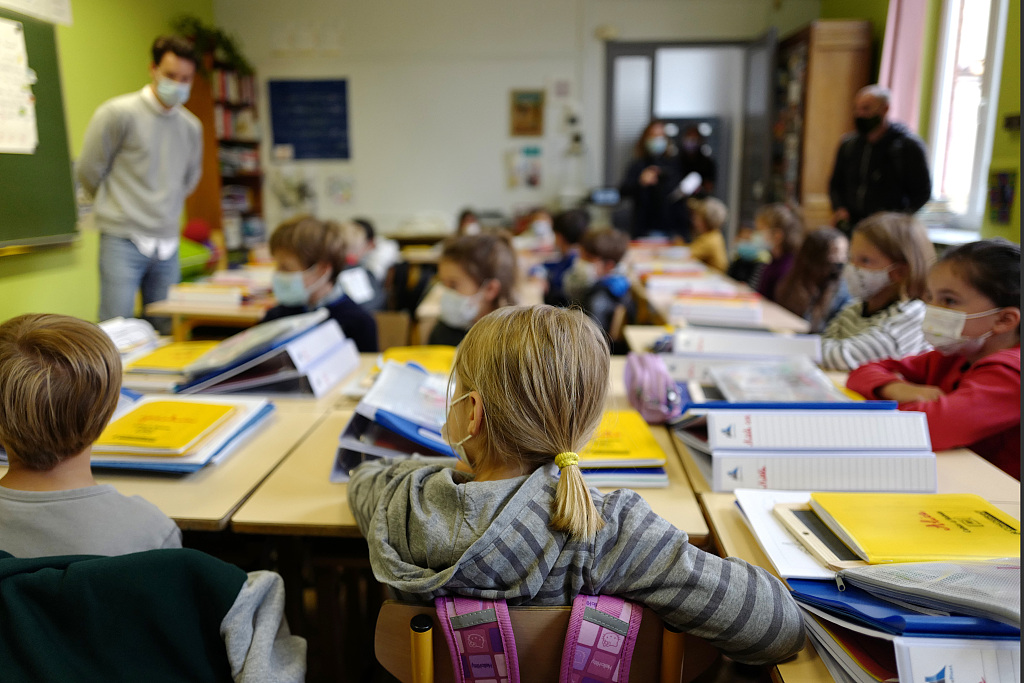
Students listen the teacher during the first day of school for the 2021-2022 year at Gounod Lavoisier’primary school, Lille, northern France, Thursday, Sept.2 2021. 
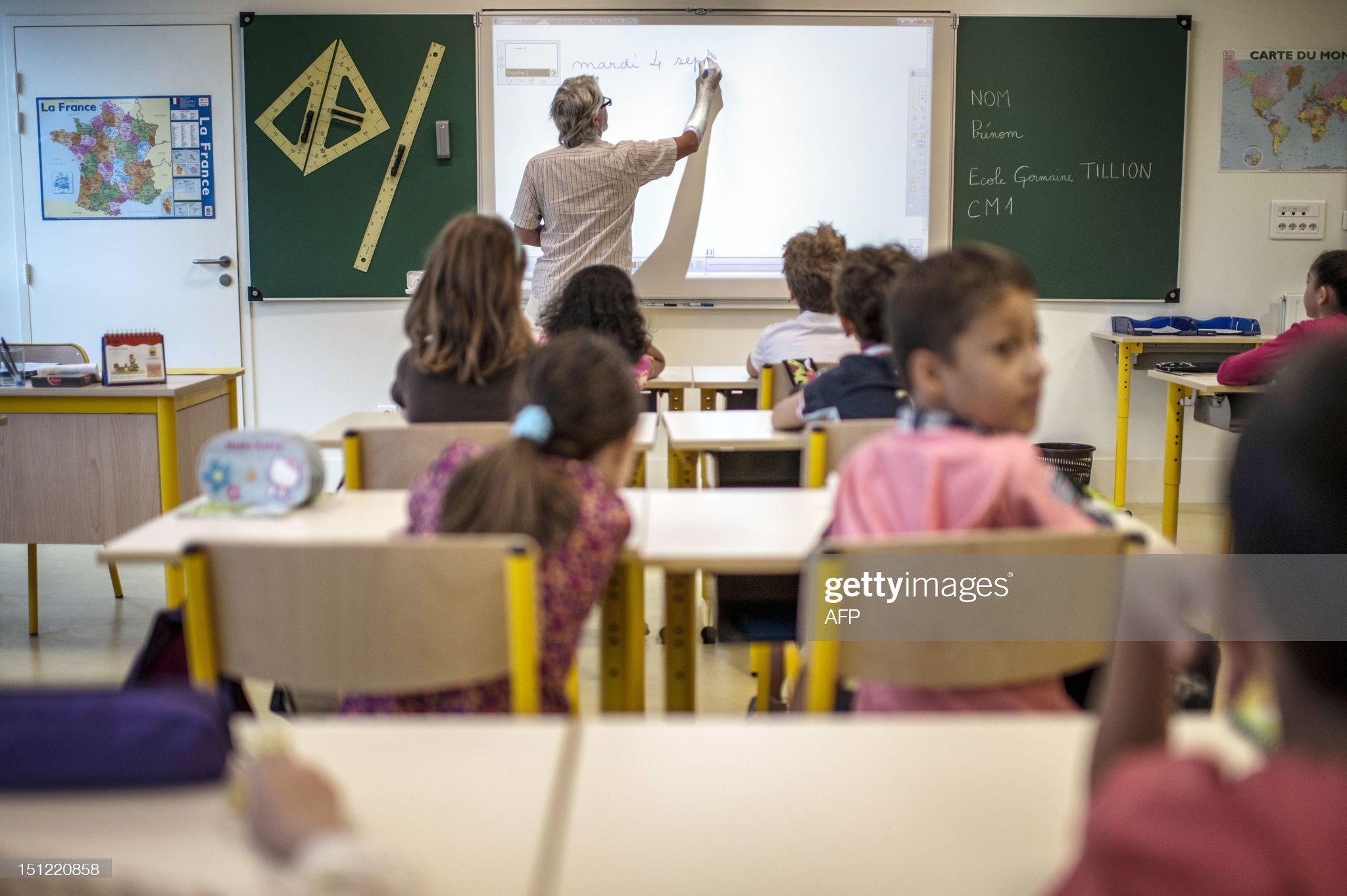
A teacher uses an interactive whiteboard in a classroom at Germaine Tillion primary school, on September 4, 2012 at the start of the new school year in Lyon, eastern France (Photo credit should read JEFF PACHOUD/AFP via Getty Images).
Schoolchildren listen to a teacher showing how to use “GraphoLearn”, an application on a digital tablet, to learn to read, in a primary school on January 8, 2018 in Marseille, southern France. (Photo credit should read BERTRAND LANGLOIS/AFP via Getty Images)

From a “wide portfolio” to systemic support for foundational learning: The evolution of the Central Square Foundation’s work on education in India (Part 1)

Over the next two weeks IEN looks at the first 10 years of the evolution of the Central Square Foundation (CSF) and its efforts to build the capacity for improving learning outcomes in India. The posts draw from an interview with CSF’s Co-Managing Director Shaveta Sharma-Kukreja. Part one explores the first five years of the Foundation’s initiatives (2012-2017) and how they developed their strategy for the next five years focusing on foundational learning, educational technology, and affordable private schools. Part two concentrates on the “four pillars” of their approach to foundational learning and the lessons they have learned in trying to improve learning at scale in India. For more on the 10th Anniversary of CSF’s founding see #10YearsOfCSF: Leaders at CSF on Their Vision for the Next Decade.

Central Square Foundation’s first five years: Developing a “wide-portfolio”

Thomas Hatch: Can you tell me about the background and evolution of the Central Square Foundation (CSF)?

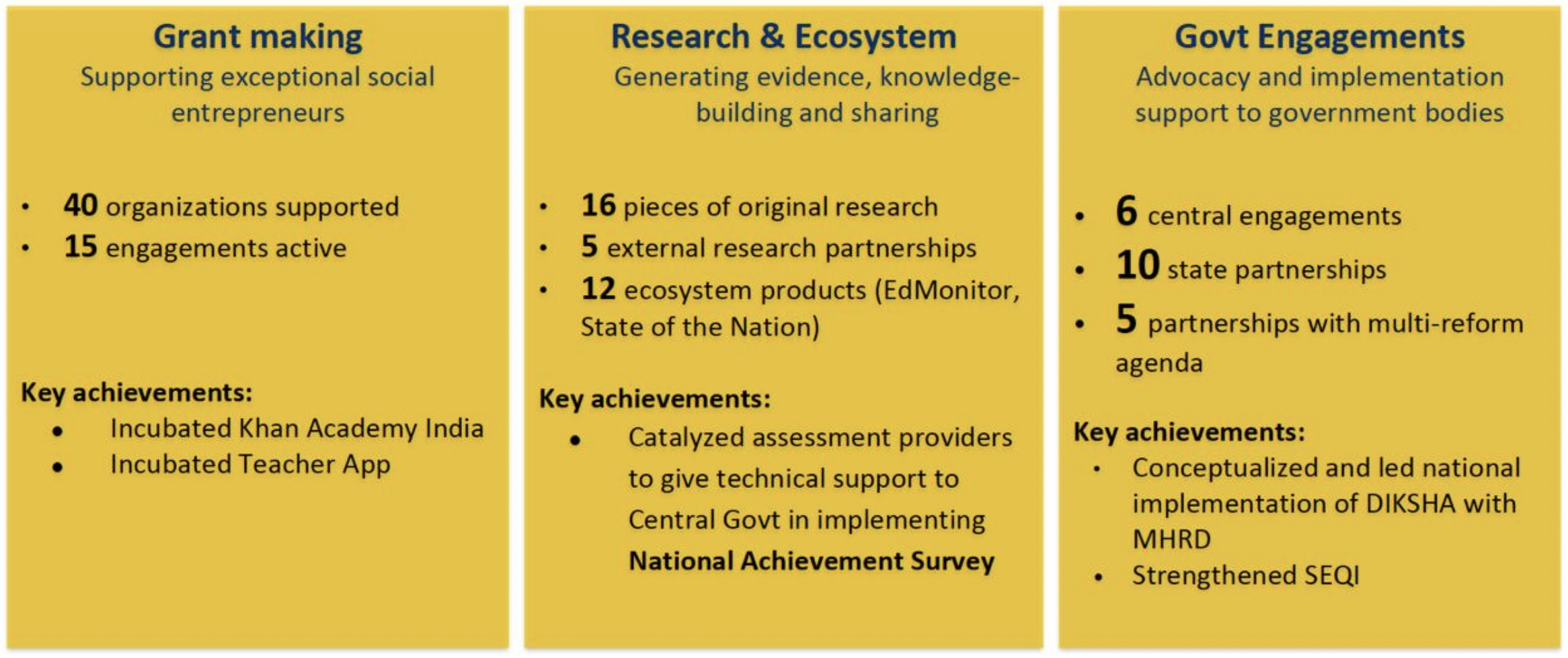
Shaveta Sharma-Kukreja: We started in February 2012. The founder of CSF, Ashish Dhawan, has one of the largest private equity funds in India. He always had a deep desire to move to the development sector, and he started by serving on boards of other NGOs to try to gain an understanding of education. I joined CSF in July 2012, and for the first five years, we were only funded by our founder which allowed us to be very entrepreneurial in how we looked at education. The only “guardrails” he put up were that we would be a non-profit; we will look only at school education (K-12); and we would support young social entrepreneurs. As a result, venture philanthropy shaped a lot of the work that we did in the first phase of our journey.

Without external funders, we had the flexibility to look at a diverse set of issues from education technology to early childhood education to data and assessments. During this time, grant making was one big part of our work. Second, we supported research, particularly research from the perspective of how it can inform policy. Since we are neither a university, or an evaluation agency, our research was always oriented more for policymakers and for other education leaders and on how our research can help the ecosystem develop a collective voice. Third, we focused on government engagement. Even while we were doing grant making and looking for innovative solutions, we knew that for any solution to scale and be sustainable it needed government adoption. Early on, we weren’t even sure what government engagement meant, but we began by trying to come up with innovative solutions, having smart researchers lend their voice to it, and then handing it over to the government to run with it. But, as in much of the developing South, government demands typically include asking you to work in partnership with them, so we ended up setting up a number of project management units both at the central and the state level.

TH: What’s the advantage of an organization like yours taking some of that work on in a partnership with the government?

SS: The reality is that most people in the government understand the issues and challenges that the system is facing; they’re not blind to it. but the education production function is so complex that it’s difficult to pick out one part of the problem and solve it. The government is in the business of setting up the policy, and they are doing the regulation, and they are also the service provider of education. Working with an external partner enables them to hire people with a different profile – with different backgrounds and more specific expertise about a particular issue. The external partner becomes an extension of the government but they’re also able to bring a different profile of talent and to be razor sharp on the issue that they’re working on.

Working with an external partner enables [the government] to hire people with a different profile – with different backgrounds and more specific expertise about a particular issue. The external partner becomes an extension of the government, but they’re also able to bring a different profile of talent and to be razor sharp on the issue that they’re working on.

For example, working on a partnership focused on school leadership was my first project at CSF. At that time, school leadership as a term was not even being used in India. But, in 2012- 13, we were able to bring a group of people together, including myself, from the US and India, with expertise in organizational leadership to create the India School Leadership Institute (ISLI) which worked with principals of “low-fee” private schools. (For an overview of the evolution of ISLI see IEN’s conversation with ISLI Founding Director, Sameer Sampat.) But then the government was able to set up a National Center for School Leadership that built on a lot of our learnings in ISLI even though “low-fee” schools aren’t even part of the government sector.

The development of India’s national online platform for teachers provides another good example. As you know, the growth of technology in India has always had the advantage of better device penetration, cheaper internet, cheaper hardware but the software solutions have been the problem. In this case, states started building their own portals for teacher education but their first version was basically just a PDF of their teacher manual that they put on their websites. So there was a huge opportunity for a platform to be built, not just a portal, but a platform on a national level that states could connect to. 

The national teacher platform called DIKSHA relied on core technology that came from the EkStep Foundation. Their own legacy is from AADHAR which is a platform enabling the Government of India to directly reach residents of the country in delivery of various subsidies, benefits, and services by using the resident’s unique 12-digit Aadhaar number only. They already had sophisticated technology at a level that no state government would have been able to develop itself. CSF then took on the project management responsibilities to integrate and adapt the technology for the state governments so that it aligned with their needs and had the look and feel of their website portals. It was a logical opportunity for CSF to start working with the government, but it was dependent on identifying a strong need where the government wanted support and where CSF had the ability to provide that support.  It’s one of my favorite examples of a government partnership, because it involved a foundation like EkStep that brought in the technical capability; we brought in the project management capability, and we also had a much deeper understanding of teacher education, having worked on that for about four years. To the best of our knowledge, this is one of the most successful examples of a public good being created in partnership with CSO’s and NGO’s and different parts of the government. By 2020, the Prime Minister described DIKSHA As “one nation one platform” for the entire spectrum of education, now serving students and families as well as educators.

Shifting to phase 2: Focusing on “impact”

TH: The examples you talked about illustrate how you were operating during those first five years? 

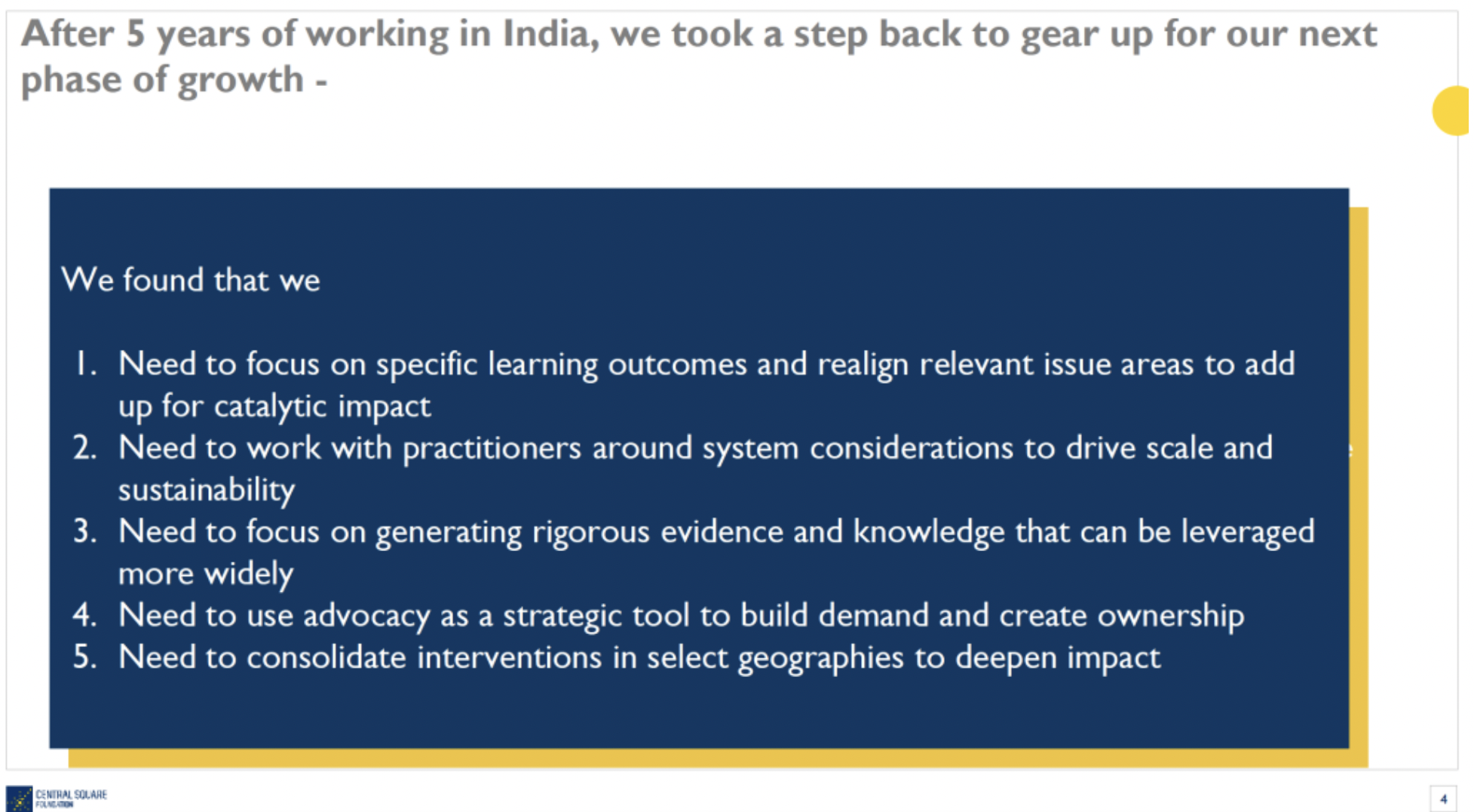
SS: Yes, and this was the time at the end of what we call the first phase of our work that our Board put the question in front of us of “What will CSF’s work look like?” During that phase, we were an operating organization which doesn’t actually work on the ground with students and teachers and school leaders. We incubated ISLI.  

We helped to bring the leader in from the US (Sameer Sampat who went on to co-found, with Azad Oommen the first Executive Director of CSF, Global School Leaders on the ISLI model), but I was the donor on the team. I wasn’t running the organization. We were also working with states who had different interest areas. In Delhi at one point, we were working on the school-to-work transition and department restructuring. Two very distinct areas of work that are not directly related to student learning outcomes. It’s a long value chain for department restructuring: it depends on department re-structuring leading to better pedagogy and better curriculum that reach classrooms in schools and teacher education programs that then leaders to better teaching and learning.  Our board left it up to us to decide: would it be better for CSF to continue with the “wide portfolio” approach and continue to engage with state and central government, when an opportunity and interest appeared? Or should we take stock and pick a part of learning outcomes where we could have a more direct impact? And we felt that the breadth of our work allowed us a space where we could narrow down our focus and make a more meaningful impact. We essentially said:  Let’s pick out an area. Let’s be more outcome and measurement and evaluation driven in our work overall and also in how we work with our partner.” We always say for education reform to stick we need to zoom in to a district and go deep. Similarly, we decided to pick an issue within education and go deep. 

Would it be better for CSF to continue with the “wide portfolio” approach and continue to engage with state and central government, when an opportunity and interest appeared? Or should we take stock and pick a part of learning outcomes where we could have a more direct impact?

This was around 2017 and about the time that the Gates Foundation began looking at doing work in education in India.  Our first validation came when they chose CSF as an “in-country” partner. We were still a relative rookie in the education space when they saw potential in us. 

As we moved into this second part of the CSF journey, we shifted from the portfolio approach to three focus areas: 

  • Foundational learning
  • Technology in education
  • Private school sector

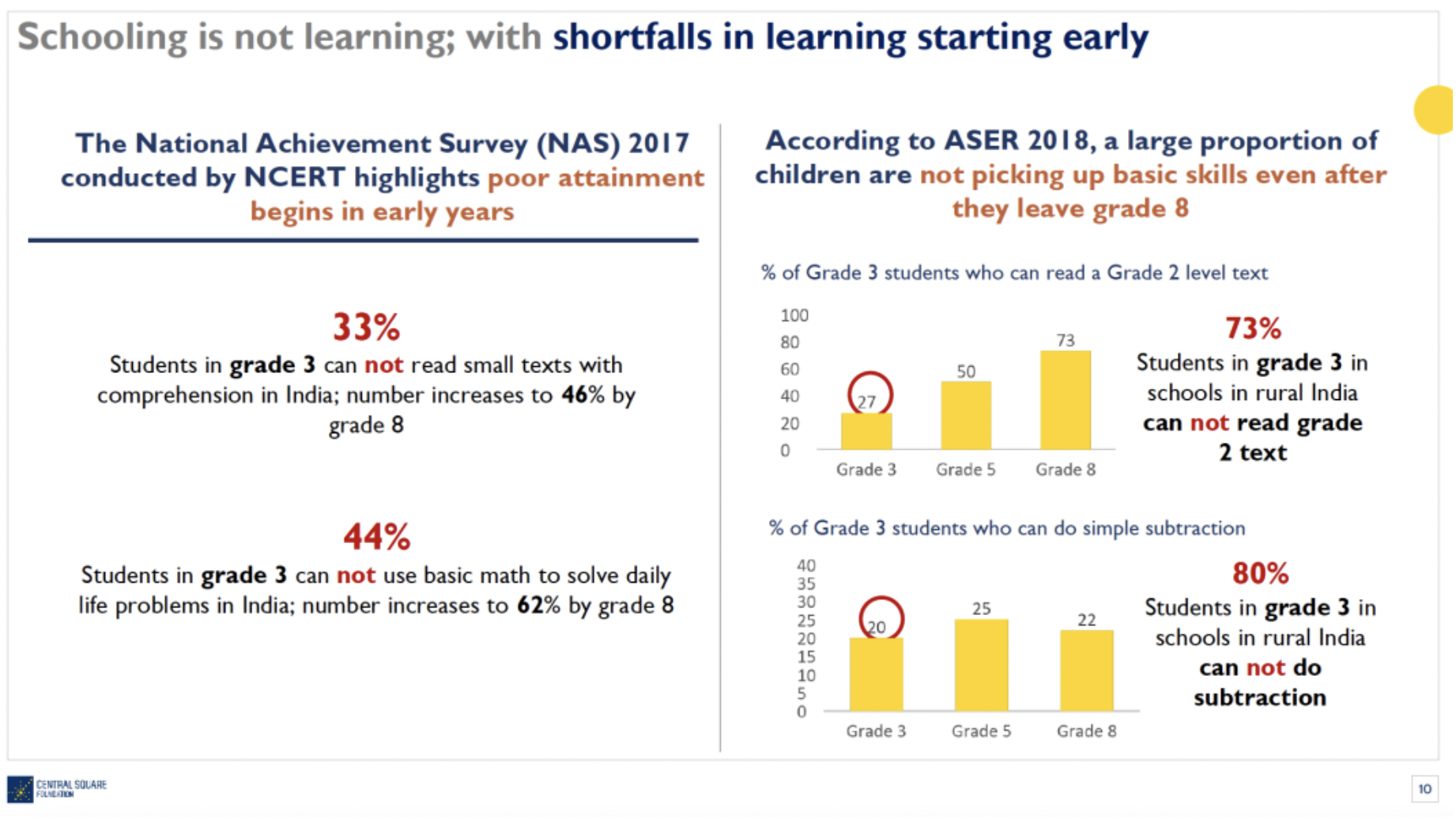
Landing on the need for foundation learning was very evident for us. There is a rural household survey called ASER which has been going on in India for 20 years, and it shows that the problems with basic skills are quite deep.

The second area, building on some of our earlier work, was education technology. The widespread availability and use of mobile devices and data put India in a unique position relative to many other countries. There was also a lot of for-profit entrepreneurial activity happening in India, so we saw an opportunity for solutions to be created and designed locally. We also had a unique advantage because CSF had already been playing an evangelizing role for how tech can be leveraged for education within the government system. 

The third issue area is private schooling.  We are very unique as a country where over 40% of children do not take advantage of the free education provided by the public education system. Education in India, like it is worldwide, is aspirational. The moment a family can afford to pull their child out of the free government school, they would rather send their child to a private school with fees beginning at roughly $10 a month. For the most part, the government has looked at the private school system mostly from the perspective of regulation, and there hasn’t been a strong focus on quality. But in the first phase of our work, because a lot of us, including our founder Ashish, came from the management and the corporate side of the world, many people assumed “Oh you guys must be pro-private schools,” and it took us a while to clarify that whether it’s a government school or low fee private school the school is accountable to deliver quality education. 

Our approach to these three areas has been similar to what I described for our first phase: 

  • Working with the government and creating a reform agenda with a collective voice of other education leaders
  • Evidence building and supply shaping comes from the work we do with our partners, with other NGOs in the ecosystem with a sharp focus on the public good – making sure that whatever we are creating is available to others in the education ecosystem – and an emphasis on research
  • Deepening our government engagement efforts by shifting from working across multiple issues in multiple geographies to focusing our work in certain states on the issue of foundational literacy and numeracy

Getting to scalable and sustainable solutions in these areas became an extension of our approach in phase two. Across focus areas like education technology, we are trying to be more sharply focused on early learning, including at home, and in our work in private schools, we are trying to raise the bar for quality at the primary level. From a measurement perspective, we are targeting the learning poverty index the World Bank has highlighted (measuring the percentage of children who can read and understand a simple text by age 10), asking “how can we contribute to bringing down learning poverty in India?” with an ambitious target of bringing it down from 55% to 15% over the next five or six years. We’ve found this is both a directional goal– requiring us to articulate how our work contributes to it – and an aspirational and inspiring goal that connects our work with others. 

TH: Given how hard it is to achieve these goals, have you also established some benchmarks to see if you’re headed in the right direction?

SS: Unfortunately, because of COVID, the plan to get a baseline is still on paper. The whole principle of system reform is that you’re doing it – not just with the approval of the government – but in partnership with the government. However, with the situation worldwide with COVID, that’s been impossible. We actually adapted a tool that USAID uses, the Early Grades Reading Assessment and the Early Grades Math Assessment. We’ve partnered with an assessment agency, and we’ve piloted it in English and in Gujarati so the tool is ready, but quite honestly haven’t even asked the government for permission yet because it’s just unfair. We’re also acutely conscious that whenever we get an opportunity to do the baseline, it will actually be lower than it would have been before COVID first hit. But, in a way, it will also capture a more picture from ground right now.