Tag Archives: School and community partnerships

How Do You Build a Learning Ecosystem? Gregg Behr on the Evolution and Expansion of Remake Learning and Remake Learning Days (Part 2)

What does it take to expand support for learning in and across communities? In the second part of this 2-part interview, Gregg Behr talks about the development of the first Remake Learning Days in Pittsburgh, Pennsylvania and how they spread to community-wide efforts in 15 different regions in 4 countries. In 2007, Behr, the executive director of The Grable Foundation, founded Remake Learning as a network of educators, scientists, artists, and makers supporting future-driven opportunities for children and youth in Pittsburgh. Celebrating its 10th edition this month. Remake Learning Days began in 2016 as a local learning festival with hands-on learning events for children of all ages at libraries, schools, parks, museums, and other community spaces. Behr is also the author with Ryan Rydzewski of When You Wonder, You’re Learning, sharing the science behind the  work and words of Fred Rogers and Mister Rogers Neighborhood, a well-known television show that ran for over thirty years.  This interview has been edited for length and clarity.

TH:  Let’s turn to one of the activities that I think has become a signature of your work – Remake Learning Days. What were some of the critical “aha’s” in their development? 

GB: The first “aha” happened in one of the human centered design sessions. In Pittsburgh, we had a firm called Maya Design, and they had a retreat room surrounded by whiteboards where they would facilitate these amazing sessions. In 2015, we convened about 30 people, including folks who came from the White House Office of Science and Technology Policy. We were asking these big questions about how far Remake Learning had come and where we might go – asking, essentially, how do you build out a learning ecosystem? What would that look like? It was during that session that it became clear that the network was serving professionals like teachers and afterschool directors, librarians, and designers really well, but that we weren’t really designed to serve parents, families and caregivers. There was a clear “aha” that if we didn’t seriously engage with these members of our community, we’d risk being incredibly faddish, and we started wrestling with what we could do to engage this group. There wasn’t an obvious way to just plug parents and families into our different programs and activities, but through this user design process two things came to light. One was that someone talked about how open houses were one of the singular moments when parents, families and caregivers really come to schools and engage with educators, as surface level as it might be. Then totally separately, someone talked about how, at least in Pittsburgh, we have lots of neighborhood festivals like the Pickle Festival, the Perogie Festival, etc. I can’t even remember who it was, but someone said “Hey, what if we put these two ideas together? This idea of neighborhood festivals with the idea of an open house?” And so we started to talk about having a kind of festival of open houses of all of these places for kids and learning that had been built over the past couple of years. At that point, we had dozens, if not hundreds of makerspaces. We had STEM labs. We began to wonder what might happen if there was a chance for parents, families and caregivers together with their kids to get into all of these spaces and to get beyond their schools and to go into into the Carnegie Museum of Art or whatever it might be. That was the germ of the idea of what became Remake Learning Days, but I can’t even recall what it was called initially. 

A screenshot of a website

AI-generated content may be incorrect.

Within a year, we had the first Remake Learning Days in 2016 because all sorts of organizations said they wanted to participate. There were more 250 events over the course of about nine days. 25,000 people came out in that very first year! That was the second aha – seeing all of those people come out and realizing “Oh, there’s something here!” The other big realization was that there were 250 events that were self-organized: they did it and they weren’t paid to do it. Clearly something had traction, in 2025 in Pittsburgh, we’ll celebrate 10th edition of Remake Learning Days. 

TH: That’s an incredible story. In 2019, other cities in the US and in other countries started hosting their own Remake Learning Days: How did they start to spread? 

GB: The same people from the White House Office of Science and Technology Policy challenged Remake Learning to document its work in what became the Playbook. In fact, someone from that Office left the White House to work with the Sprout Fund in designing the Playbook. The basic idea behind the Playbook was to create something that would be as helpful to people and organizations in Pittsburgh as it would be to Flint, Michigan or Oklahoma City. After seeing how the Remake Learning Days had taken hold in Pittsburgh, we started looking for financial support to develop the Playbook. We got some funding primarily from the Carnegie Corporation of New York, and created what we initially called a toolkit that communities could use to host their own Remake Learning Days.  At the time, Remake Learning was deeply involved with other national organizations and associations that were involved with STEM, the maker movement, and other things like that. We just put the toolkit out there to say, “Who else might want to host Remake Learning Days?” And that’s how they began to spread. 

TH: As I understand it, you’ve tried to let these Remake Learning Days grow and spread more or less on their own?  Are there any particular lessons you’ve learned, either any lessons you’ve learned, either vicariously or from your interactions with those in other communities? 

GB: In terms of letting them spread, yes and no. We’ve tried to provide just enough guardrails so that, if a Martian comes down and goes to Remake Learning Days in Pittsburgh and then Doncaster, England and then southern Wisconsin, it would seem like these things are connected.  If Remake Learning Days are going to be successful, you have to have that connection, but they also have to feel contextualized in these different places. 

Along the way, the team has learned a thousand lessons. They’re going to continue to iterate as they look ahead to years 11 and 12, but like so many other community-based initiatives, you need to have that “backbone” organization; you have to have that clear champion who’s going to lead the work. In one instance, there was an amazing woman who made Remake Learning Days happen where she lived. But after she left, it hasn’t been the same thing. It was so tied to one person and one organization that it just didn’t stick; so we’ve learned that lesson. We’ve also learned the lesson that sometimes things have beginnings and ends. Chattanooga and Chicago hosted phenomenal Remake Learning Days, and they met the needs of the Public Education Foundation in Chattanooga and the Chicago Learning Exchange. But they plateaued in their utility, and both said, essentially, “We’ve loved this, but we’re not going to continue with this,” and we’ve learned that’s totally fine. We’ve seen places like Sarasota and Doncaster completely adopt this approach; raise lots of local money; and Remake Learning Days are now integral to their local efforts. If we were to shut down Remake Learning here in Pittsburgh, they would continue on in some of these other places. We’ve learned all sorts of lessons about leadership, about local financing, about making it local so people feel connected to it. It’s not just a franchise that someone imports; the Remake Learning team has worked hard in terms of monthly meetings and all sorts of things to make sure there’s quality control for successful festivals. 

A group of people standing outside

AI-generated content may be incorrect.
Gregg Behr at a Remake Learning event (photo: Ben Filio)

TH: I didn’t realize how much work the Remake Learning team is putting into these. I thought you put the Playbook out there, and then just let people use it. But you actually have a team that coordinates with these other places, and in a sense sanctions these other events, and says, “Yes, these are Remake Learning Days. This is one of our partner events”? 

GB: Again, the answer is yes and no. Everything that Remake Learning has done, maybe to its detriment, is through Creative Commons licensing, so people have used the Remake Learning Network playbook and also the Remake Learning Days toolkit to their own effect. In New Hampshire, they have used the playbook to support the development of their local learning networks but never with any formal coordination with Remake Learning— – and that’s okay. Places like Qatar have had “Doha Learning Days” and have used the Remake Learning Days playbook. I’d say it’s a loosely sanctioned process. But then there are two producers of Remake Learning Days, and they in turn work with the team in Sarasota or the team in Doncaster, or wherever it may be. 
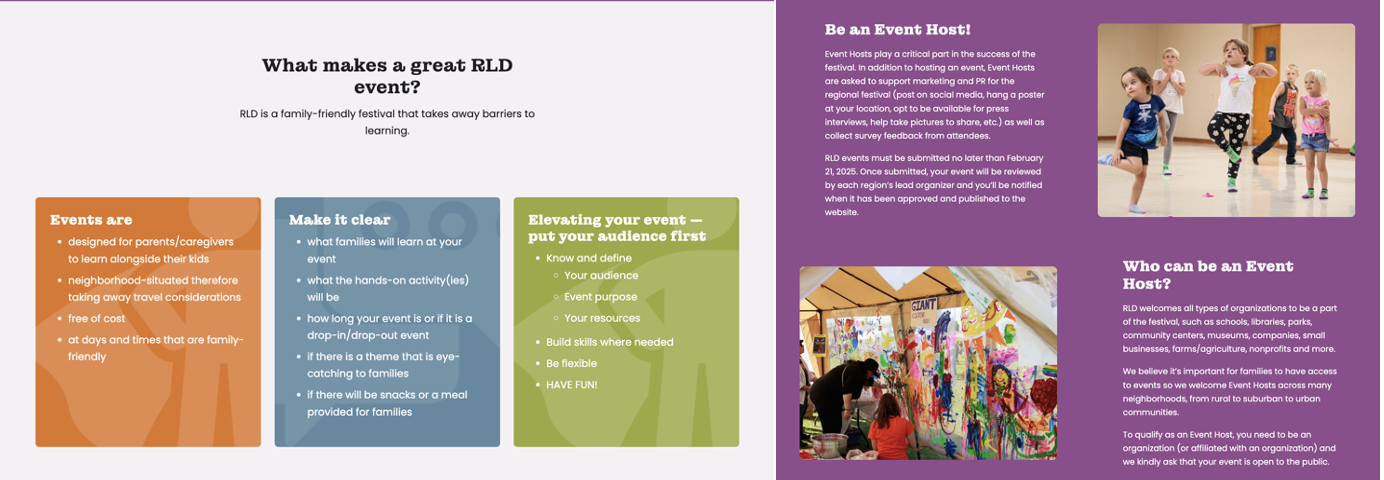
TH: How does that work? Does Sarasota have to pay the producers or are they providing pro bono services to the places that want to do it? 

GB: Yes, they have a remarkable team supported by The Patterson Foundation in Sarasota; and, for Sarasota and elsewhere, Remake Learning has borne the costs for some of the regional and national marketing, because with an event like this, the most significant costs are marketing. 

TH: Have you run into challenges where you wish that some place wouldn’t call their events Remake Learning Days? 

GB: There have been some challenges along the way, with some places that want to call it something else like “STEM Days,” and the team has had some tough conversations with some cities, saying if we’re going to be part of this, then there are a few things you need to do. Some cities have just said, “We’re going to have our own thing.”  There are also challenges around quality control and questions about what kinds of events to connect with.  There are now some pop-up festivals which have been hugely successful.  People have staged events in Tel Aviv and Antarctica, but sometimes these are singular events on a particular day, and they’re branded and connected to Remake Learning Days, and they’re on the website, but it’s not a multi-day festival the way it is in Sarasota or southern Wisconsin or Kansas City. 

Dates are also difficult. Even with the pop-up events, Remake Learning Days have had a set date range, something like April 23rd through May 23rd. For example, the six regions in Pennsylvania that now host Remake Learning days, they all happen at the same time. That is very deliberate, and they are coordinated statewide. But in 

Tennessee, they valued Remake Learning Days, but May didn’t work for them because of state testing, and it turns out that May is not a great time for Remake Learning Days in Uruguay. That raises the question: does it have to be around the same dates around the world for it to be called Remake Learning Days? The team is wrestling with a whole bunch of questions like this as they go forward. They’re trying to provide greater flexibility while maintaining quality control. 

TH: Can you say anything more about the next steps or the challenges ahead for Remake Learning Days and Remake Learning? 

GB: In terms of challenges, like a lot of these things, no one ever imagined there being a 10th edition. But even with that, ongoing fundraising is a challenge. Yet, for corporate funders, sponsoring an event like Remake Learning Days is a lot easier than sponsoring a network. For fundraising, it certainly helps that they have built up a body of data, including qualitative evidence – write-ups and videos – to support it. Quantitative data, too! For example, they worked with Heather Weiss, who led the Harvard Family Research Project to document their impact on parents. Their goals included helping parents understand how learning is being remade; helping parents understand how they can support their own kids if they find their kids are lit up by art and design or coding or maker-centered programs; and building up demand among parents so they might go to school board meetings, parent-teacher conferences, or their local library to ask questions about these approaches to learning that are clearly lighting up their kids. Heather’s work demonstrated that parents were gaining familiarity with STEAM and new approaches to learning and building their interest and support for those approaches.  

Looking toward the future, I think we’ll see fewer sites that host Remake Learning Days, but they will be more embraced by their region, with significant regional funding. In addition to seeing that in southern Wisconsin, on the west coast of Florida, and Doncaster, the Pennsylvania Department of Education has invested significantly in Remake Learning Days and different units from the state government are also providing in-kind support. I think we may see more changes like that where public funding also helps to drive further engagement and support from local and state governments.  

TH: Looking to the future, let’s return to Remake Learning in Pittsburgh. What do you think it will take to sustain and deepen this work overall?  Are there particular problems that have to be addressed or changes that have been made? 

GB: There are always lots of answers to a question like that!  One thing we have to address is leadership. The leadership has evolved over the years. When it was time for the Sprout Fund to sunset, and they wrapped up their work, we hired what amounted to a director for Remake Learning, and there have been a number of directors since that time, each of whom has held the position for at least two or three years. But incredibly, it wasn’t until around 2014 or 2015 that we convened what we call the Remake Learning Council. This is a council of CEOs, learning scientists, leaders of cultural institutions and others who meet regularly with the director and the Remake Learning team and provide advice and support.  Of course, the people in these roles change positions all the time. There are new museum directors, new superintendents and so on. We have to pay attention to that churn and make sure we have the right people and the right support, and that’s a great leadership challenge. It’s also what makes Remake Learning sustainable – it’s crucial to have a large number of leaders across the community who value this work, who are contributing to the design of it and advancing it. 

Relatedly, Remake Learning, if you can believe it, has never been its own separate 501 (c) (3) [which would allow it to be a charitable organization collecting tax exempt donations]. That’s because part of the strategy in the beginning was to demonstrate that this was not going to be something that competed for funding with other charitable organizations, like museums and some of our other charitable partners. Instead, Remake Learning has been fiscally sponsored by other organizations, and I think that’s been a real benefit – so that the focus could be the work itself. Initially, Remake Learning was fiscally sponsored by the Sprout Fund; then it was fiscally sponsored by our regional association of grantmakers called Grantmakers of Western Pennsylvania. It’s currently fiscally sponsored by the Allegheny Intermediate Unit, our region’s educational service agency. But we always have to check in on our structure: Do we have the right home? Do we have the right governance? That’s an ongoing challenge for the network. 

Another challenge with any organization that reaches 20 years is that you’ve got people who’ve been involved for nearly 20 years, and there are people who just joined two weeks ago. We have to keep the work fresh and relevant for the newcomers as much as for the veterans. This is a programmatic challenge.  It’s hard to keep things fresh for most everyone involved. As one example of “keeping things fresh,” Remake Learning started in the past few years to distribute what they call Moonshot Grants. Regionally, I think they’ve spent about three or four million dollars in grants to local organizations and schools that are really trying to push the edge of what constitutes great learning, especially as such much around us is changing. That’s one example that’s kept the work really fresh. 

Remake Learning has also really leaned into some of its national and international partnerships, which has pushed its work forward. Just last week Remake Learning announced ten national moonshot grants, which came out of the Forge Futures Summit, which brought together organizations involved in learning ecosystems from around the US, and even a few other places worldwide. This speaks to the spread and the tension: Remake Learning is committed to being a regional organization and it has to continue to do basic things brilliantly at the regional level. It’s not a national or international organization, but it sometimes has – or could have – a national and international role to play. That’s what Remake Learning Days have done, and Remake Learning is figuring out how to do that as a network while not distracting ourselves from our core mission regionally. 

TH: Can you say a bit more about what Remake Learning has done internationally? 

GB: Remake Learning has partnerships with a number of international organizations including HundrED in Finland, Big Change out of London, OECD, and the Global Education Leadership Partnership.  Just as an example, Remake Learning got connected to Big Change pre-pandemic because they had done a report and Remake Learning ended up being one of their case studies. Now Remake Learning and Big Change are funding a loose federation of international organizations that meet almost monthly. Along with Remake Learning and Big Change, it includes Learning First out of Bermuda, People for Education in Canada, Learning Creates Australia, Innovation Unit, Zizi Afrique in Kenya, Fundacio Bonfill in Spain, Educate! in Uganda, and Dream a Dream out of India. You’ve got people who represent different geographies. In some cases, they are more metropolitan like Remake Learning, but in others are more nationwide, like Uganda Educate! The first meeting focused on Bermuda’s transforming education system. The second one was a showcase of some of the work in Australia. It’s become a global learning community.

‘Finding pathways to equity’: A Conversation with Mel Ainscow and Christopher Chapman

In their new edited book Educational Equity: Pathways to Success (Routledge, 2021), Christopher Chapman and Mel Ainscow and their colleagues, report the findings of an eight-year programme of research carried out in Scotland to find ways of promoting equity. In advance of the publication on July 15th, wespoke with Ainscow and Chapman about how the book came together and some of what they have learned in the process. Ainscow is Professor in Education at the University of Glasgow and Chapman is Professor in Education and Chair in Educational Policy and Practice at the University of Glasgow and Director of Policy Scotland. For more on Ainscow and Chapman’s work, see our conversation with them about their previous book with Mark Hadfield Changing Education Systems.

IEN: Why this book, why now?

Ainscow & Chapman: Educational Equity: Pathways to Success builds on our earlier work on the improvement of education systems. In this book we describe and analyse what happened over an eight-year period when a team of researchers from the Robert Owen Centre for Educational Change at the University of Glasgow worked within the Scottish education system to find ways of promoting greater equity. The accounts we present are unusual, if not unique, in that they involved an engagement at all levels of the system, from the offices of government ministers and officials, through to those involved in classroom activities and the many others who have a stake in the work of schools. Another unusual feature of the book is that, although individual chapters are written by particular groups of authors, it develops a single overall argument. This was achieved by intensive cooperation between members of the team, a process that included mutual reading of draft texts and occasional meetings to agree the ideas to be presented. All of this was built on a tradition of partnership working at the University of Glasgow that has grown over many years.

IEN: What’s the agenda?

A&C: Educational Equity: Pathways to Success focuses on the types of concerns facing schools and education systems across the world on a daily basis as they try to ensure the progress of all of their students. More specifically, it addresses the following questions:

  • What can be done to promote equity within education systems?
  • What are the barriers to progress?
  • How might these barriers be overcome?

With this agenda as our focus, the book presents a series of recommendations as to the actions that are needed in order to find pathways for promoting equity within education systems. We also examine the sorts of barriers that make it difficult to put these ideas into practice.

Our intention is that the information generated in relation to this agenda will be relevant internationally. With this in mind, extensive use is made of detailed accounts of practice to illustrate the argument. In this way, our aim is to make the ideas we present meaningful and relevant to a wide audience of readers, including, senior staff in schools, policy makers at the national and district levels, and post-graduate students who are focusing on using research to analyse educational improvement. Whilst the text has a strong emphasis on practice and policy, it will also be relevant to those in the research community who are focused on the improvement of schools and education systems. With this in mind, strong links are made with evidence from international research. 

IEN: What did you learn in working on this book that you didn’t know before?

A&C: The research was carried out in Scotland during a time of intensive efforts to improve the national education system. Building on the much-quoted adage, ‘the best way to understand an organisation is by trying to change it’, our analysis of these experiences led us to conclude that there is massive untapped potential within Scottish schools and their communities that can be mobilised to address the challenge of equity. It also describes how local pathways can be created in order to make use of this potential. The book shows how university researchers can contribute to the development of such initiatives. In particular, it illustrates the kind of relationships that have to be created amongst practitioners, policymakers and academic researchers for this to happen. Where this works, it can lead to the development of new, context-specific knowledge that can support change processes.

successful educational change requires the coming together of different perspectives in a process of social learning and knowledge creation within particular settings

In these contexts, we saw our role as being that of ‘engaged researchers’. This involved us in stimulating professional dialogues, within relationships that were concerned with the joint production of knowledge. In this way, our aim was to make direct contributions in the field, whilst at the same time drawing lessons that will have wider implications. All of this leads us to argue that successful educational change requires the coming together of different perspectives in a process of social learning and knowledge creation within particular settings. Researchers who get involved in such processes must expect to face many difficulties and dilemmas. Consequently, they have to develop new skills in creating collaborative partnerships that cross borders between actors who have different professional experiences. They also need to mobilise personal support in dealing with the pressures this involves. Hence the value of working as a team.

IEN: What’s happened since you completed the book? 

A&C: As we write, further significant barriers exist within education systems across the world in relation to the continuing impact of the coronavirus pandemic. We argue that these new challenges point to the need for an even greater emphasis on the sorts of approaches presented in our book. There has therefore never have been a more important time for people to get together in order to ensure high quality educational opportunities for all children and young people. With this in mind, members of our team are currently working with colleagues in various parts of Scotland and in a number of other countries to take this thinking forward. We are particularly excited by a new project we are carrying out in the city of Dundee. Known as Every Dundee Learner Matters, the initiative involves a two-year strategy to improve the quality of education for all children and young people. This builds on the established reputation of Dundee as a hub of innovation and creativity. This led it to be recognised as a UNESCO City of Design the first in the United Kingdom to be awarded the honour, which puts it in the company of Berlin, Beijing, Buenos Aires and Montreal.

The guiding vision is of a high performing system that is at the forefront of developments to find more effective ways of ensuring the progress of all students, particularly those whose progress is a cause for concern. Central to this vision is a system that is driven collectively by school leaders and involves practitioners at all levels in taking shared responsibility for improving the quality of education across the city. Using a design-based implementation research approach, the strategy is guided by a series of design features based on lessons that emerged from the research described in the new book. Underpinning these features is a significant adjustment in the way that decisions are made regarding efforts to promote educational change. This approach has significant implications for the roles of local authority staff. It requires them to adjust their ways of working in response to the development of improvement strategies that are led from within schools. Specifically, their task will be to monitor and challenge schools in relation to the agreed goals of collaborative activities, whilst senior staff within schools share responsibility for the overall management of improvement efforts.

Local authorities task will be to monitor and challenge schools in relation to the agreed goals of collaborative activities, whilst senior staff within schools share responsibility for the overall management of improvement efforts.

IEN: What’s your hope for the future and what do you hope this book will contribute to it?

A&C: As we take our work forward – in Scotland and other parts of the world – the impact of the pandemic continues to be a major concern. At the same time, we are conscious that schools have demonstrated remarkable flexibility in response to these unprecedented challenges. This has meant that they have had to find different ways of carrying out their core business of teaching and learning. At the same time, many schools have developed new ways of working with other agencies in supporting families and local communities. The logical implication of these developments is that much of the best expertise regarding ways of providing support in the new context lies amongst practitioners. Therefore, in moving forward with the recovery of education systems, use must be made of this largely untapped knowledge through the sorts of collaborative processes reported in this book. If this thinking is to be implemented, however, there are significant implications for national policies. Put simply, there is a need to foster greater flexibility at the local level in order that practitioners and other stakeholders have the space to analyse their particular circumstances and determine priorities accordingly. This means that policy makers must recognise that the details of policy implementation are not amenable to central regulation. Rather, these should be dealt with by those who are close to and, therefore, in a better position to understand local contexts and develop pathways to success.

Lead the Change Q & A with Terri N. Watson

This week’s post features an interview with Terri N. Watson, Associate Professor in the Department of Leadership and Human Development at The City College of New York. This is the 105th edition of the Lead the Change (LtC) Series.  The fully formatted interview can be found on the LtC website of the Educational Change Special Interest Group of the American Educational Research Association.

Lead the Change: The 2020 AERA theme is The Power and Possibilities for the Public Good: When Researchers and Organizational Stakeholders Collaborate. Organizational leaders, “who bring knowledge, status, and constituents to critical educational topics” were invited to this year’s meeting to reconnect and to harness our collective possibilities. How can the leveraging of such a diverse body of scholars contribute to collaboration and engagement within and across multiple stakeholder groups and to educational change?

Terri Watson: The 2020 AERA theme rightly calls for increased collaboration amongst education researchers, organizational leaders, and stakeholders. These partnerships are essential to educational change and reminds me of a similar charge echoed throughout Freedom Is a Constant Struggle: Ferguson, Palestine, And the Foundations of a Movement, a collection of essays and speeches by Angela Y. Davis. In this work Dr. Davis, a political activist and scholar, passionately articulates the need for ‘movement builders’ and calls for seemingly divergent movements to coalesce for a common good, a public good. She consistently challenges neoliberal policies and practices found in society at large and in far too many K- 20 schools and schooling contexts. The latter is troubling as public education is one of the few services that, if it is to be effective, must address the human condition. In this light, I view the work of education researchers, organizational leaders, and stakeholders as akin to those of movement builders who, by way of AERA’s 2020 theme, are charged to unite for a public good: public education.

We must cease conducting research in schools and communities and, instead, establish meaningful partnerships with schools and communities

If we, as an association of 25,000 scholars, are to leverage educational research for the public good, we must intentionally forge meaningful relationships with the public. And, in addition to organizational leaders and stakeholders, education scholars must join forces with students, parents, teachers, school administrators, community members, and educational policymakers. To do so, we must cease conducting research in schools and communities and, instead, establish meaningful partnerships with schools and communities. Too often, education researchers are detached from the realities of schooling, the lives of young people, and the experiences of those deemed ‘other.’ And while we read journal articles, conduct research, and publish our findings, few researchers engage with schools and communities outside of the course of their study. Moreover, we rarely, if at all, share our findings with the general public nor employ what we have learned to inform education policy. If our scholarship is to impact educational change, we must engage with the public. To be clear, education scholars must endeavor to establish connections with the people, paradigms, and perspectives we persistently marginalize in and outside of the schoolhouse.

‘Theory is cool, but theory with no practice ain’t shit.’  – Fred Hampton, 1969.

At the start of my academic career, I conducted a longitudinal study of the leadership practices exhibited in a large urban high school. Using the lens of Critical Race Theory, I examined how teachers and school leaders identified and considered the challenges to parent involvement “without either engaging in or disrupting normative constructions of the term parent involvement” (Watson & Bogotch, 2015, p.258). Based on what I learned from the school’s parents, teachers, and administrators, and with funding obtained from a community based organization, I conducted parent meetings, teacher workshops, and worked with the school’s leadership team to redefine and reframe the function and purpose of parent involvement. I shared my experience with Sylvia Saunders, a reporter from NYSUT: A Union of Professionals. Our conversation, along with a link to the journal article, Reframing Parent Involvement: What Should Urban School Leaders Do Differently?, can be accessed here. A major lesson the field of Educational Change can learn from this study is that as critical researchers, we must be open to alternative ways of knowing and practice to facilitate change and, ultimately, student achievement.

LtC: Given your focus on how racism manifests and is manifested in schools and the impact of such racism as well as class and gender discrimination on Black girls in particular, what would be some of the takeaways the field of Educational Change can glean from your work and experiences with Black girls?

TW: I wrote the following text (tweet) on November 18, 2019:

Dear Educators,

Black girls are not loud – they want to be heard.

Black girls are not seeking-attention – they are seeking a connection.

Black girls are not aggressive – they know what they want.

Black girls are not bossy – they are leaders.

Last, Black girls are not adults.

To date, this tweet has been shared over 21K times and was ‘liked’ more than 68K times. As a Black woman and the mother of a Black girl, I know that schools, for many Black girls, are sites of trauma. This tweet is based on these truths and aimed to challenge oft-cited (mis)perceptions of Black girls. In addition, my article, “Talking Back”: The Perceptions and Experiences of Black Girls Who Attend City High School, is based on data gathered as part of the aforementioned longitudinal study. In this manuscript, I centered the voices and perspectives of Black girls and Black women scholars “to honor the voices that are oftentimes silenced in schools and to employ standpoints that are seldom considered in education research” (p.239).

As a Black woman and the mother of a Black girl, I know that schools, for many Black girls, are sites of trauma.”

The recommendations from this study appear below and were offered to improve the educational experiences of Black girls at CHS and are offered here as takeaways the field of Educational Change can glean from my work and experiences with Black girls.

Affinity groups. Several of the study’s participants described negative perceptions that many of CHS’ teachers, administrators, and security agents held of Black girls. In response, schools should establish affinity groups for Black girls: They build self-esteem, provide a safe place for students, and foster positive relationships among students and the larger school community.

Mental-health professionals. Mental health is essential to student success. Several girls shared that they suffered from depression and anxiety. Unfortunately, by-and-large, therapy is frowned upon in the Black community, and many Black girls oftentimes suffer in silence. Schools should provide access to mental-health professionals to students and, if requested, their families.

Post clear rules and regulations. Several Black girls felt CHS’ security agents targeted them. By posting clear rules and regulations throughout the school building, unpleasant interactions between students and security agents may be avoided. Moreover, if a student is disciplined, the student should know why she is being disciplined, and the consequence(s) should be clearly articulated in the regulations.

Form a task force. While all the study’s participants were on track to graduate from high school, data trends show Black girls tend to drop out of high school at higher rates than their peers. Furthermore, based on the data gathered for this study, several Black girls at CHS were found to experience challenges during their high school career that could have caused them to drop out. To ensure their success, schools should form a task force aimed at improving the educational experiences and outcomes of Black girls.

Professional development. Several Black girls interviewed for this study detailed conflicts they experienced with teachers and administrators at CHS and readily offered advice for the school’s leader to improve their lived experiences. In this light, schools should invest in professional development centered on meeting the needs of culturally, socially, and linguistically diverse students to improve teacher practices and, ultimately, student achievement.

LtC: In your recent work, you conceptualize racism in schools through an ecological lens to show the ways it operates across the system (i.e., individual, dyadic, subcultural, institutional, and societal) and how it is dynamic and changing. In so doing, you challenge school leaders and others to think beyond traditional approaches to addressing racism in schools and towards more systemic approaches. What do you see as the most needed changes to policy/practice to address these findings and bring them into practice?

TW: To effectively address racism in schools through policy and practice, we must first commit to the fact that society in general and public schools, in particular, are fundamentally racist. This truth is evident in the nation’s founding charter and in legal jurisprudence and throughout the history of public education. It is also quantified in the disparate educational outcomes of America’s children (see NCES Graduation Rates). Next, we must problematize the process of schooling. Meaning, we must ask hard questions about the ways in which schools function in our society. Paying close attention to how neoliberalism and its byproducts (capitalism, school choice, and standardized testing) have polarized the most vulnerable children, families, and communities. Then, we must gather the political and moral will to create systemic race-conscious educational policies and practices. Gathering such will is challenging, as while most people will readily admit that they are not racist, very few will support mandates that operationalize racial equity and social justice in the places that we call schools (see NYC’s Chancellor’s school desegregation efforts) In fact, I will go one step further and suggest that while most people, especially White people, will call out overt racism, very few will acknowledge and address the systemic and insidious ways racism functions in our society and schools. And that, dear colleagues, is wherein the challenge lies.

We must gather the political and moral will to create systemic race-conscious educational policies and practices.”

Dr. Rosa Rivera-McCutchen, my colleague at the City University of New York, and I drafted the case study #BlackLivesMatter: A Call for Transformative Leadership to provide aspiring and current school leaders with the opportunity to engage in critical reflection and transformative leadership practices. We were inspired by the acceptance speech Dr. Gloria Ladson-Billings delivered in the spring of 2015, upon her receipt of the Social Justice in Education Award at the American Educational Research Association’s annual meeting:

In her lecture aptly titled “Justice . . . Just, Justice!” Ladson-Billings explained why she was troubled by the current use of the term “social justice” and feared how it was, for some, purely ideological. Most distressing, she noted how many social justice advocates fail to recognize injustice. Poignantly, Ladson-Billings challenged the audience to move beyond justice as a theory to justice as praxis.” (p. 3).

Public education will not right itself. We must move beyond rhetoric and theory – if we are who we say we are.”

Dr. Ladson-Billings’ message rings true for the field of Educational Change. Public education will not right itself. We must move beyond rhetoric and theory – if we are who we say we are.

LtC: Educational Change expects those engaged in and with schools, schooling, and school systems to spearhead deep and often difficult transformation. How might those in the field of Educational Change best support these individuals and groups through these processes?

TW: I began my teaching career in 1994 at a middle school in East Harlem. I elected to teach at JHS 45 because it was located between two housing projects and many of the students who attended the school shared life experiences similar to my own. Nearly 20 years later I joined the Department of Leadership and Human Development at The City College of New York (CCNY). The College’s legacy of proffering “access, opportunity, and transformation” to the children of the City of New York aligns with my primary aim, as a scholar-activist, to improve the educational outcomes and life chances of historically excluded and underserved children and families. Moreover, based on my educational experiences, I deeply understand that schools are complex systems and require a heavy lift from individuals and groups who seek to transform them. Hence, during my first year at CCNY, my colleague, Dr. Hope Hartman (Professor Emeritus) and I explored the effects of metacognition on school leaders. Our article, Transformational Leaders Who Practice Metacognition, appeared in the New York Academy of Public Education’s research journal here.

Dr. Hartman and I wrote the aforementioned manuscript with our graduate students in mind. We knew that as novice school leaders they would be charged to contend with systemic racism, inequitable funding, and the legacy of low expectations for children of color. We explained:

“We posit that in order to reform schools, specifically in urban areas, transformational leaders who systematically practice metacognition are better able to promote effective, caring, and socially just schools and communities than those who do not. This article provides a paradigm for and examples of metacognitive transformational leadership” (p.8).

The field of Educational Change can best support individuals and groups engaged in the transformation of schools by creating and offering workshops on transformative leadership practices (see Shields, 2010) and metacognition (see Schon, 1983). Those who seek to transform schools and the process of schooling “must observe their own actions, inactions, and attitudes, as well as their impact on others. Upon awareness, they should take steps to enhance their effectiveness” (Watson & Hartman, 2013, p.9). Learning experiences centered on transformative leadership practices and metacognition promotes social justice and self-awareness and can help individuals and groups actualize their goals for educational change.

Where do you perceive the field of Educational Change is going? What excites you about Educational Change now and in the future?

We are currently experiencing unprecedented times. In an attempt to reduce the spread of the COVID-19 virus NYC’s public schools, the nation’s largest public school system, recently announced that its 1,700 schools will remain closed for the remainder of academic year. I am sure other school districts throughout the U.S. will soon do the same. While many are lamenting the possibility (and impossibilities) of this decision, I am inspired by its promise. The physical closure of schools will force many in the field of Educational Change to reimagine and redesign the form and function of schooling. We can no longer rely on traditional paradigms and practices and must find new and different ways to engage young people, establish community, and effect change. This forced shift will be refreshing. The traditional structure and function of schools and schooling created nebulous and hostile environments for far too many children, particularly those of color. This is the time for the field of Educational Change to implement new solutions to old problems. We have nothing to lose and everything to gain!

This is the time for the field of Educational Change to implement new solutions to old problems. We have nothing to lose and everything to gain!”

References

Schon, D. (1983). The reflective practitioner. New York: Basic Books.

Shields, C. M. (2010). Transformative leadership: Working for equity in diverse contexts. Educational Administration Quarterly, 46, 558-559.


Watson, T. N. (2016). “Talking back”: The perceptions and experiences of Black girls who attend City High School. The Journal of Negro Education, 85(3), 239-249.

Watson, T. N.,  & Rivera-McCutchen, R. (2016). #BlackLivesMatter: A call for transformative leadership. Journal of Cases in Educational Leadership, 19(2), 3–11.

Watson, T. N., & Bogotch, I. (2015). Reframing parent involvement: What should urban school leaders do differently? Leadership and Policy in Schools, 14(3), 257-278.

Watson, T. N., & Hartman, H. (2013). Transformational leaders who practice metacognition. The Professional Journal: The New York Academy of Public Education, 8-11.