Tag Archives: tutoring

Tutoring takes off – Scanning the news on the emergence of tutoring programs after the school closures (Part 1) 

How effective are tutoring programs likely to be? What kinds of challenges need to be addressed for tutoring to contribute to real improvements in schooling on a large scale? In this extended series of posts, IEN continues to scan the news and research on the emergence of tutoring as a key strategy to help students “recover” from the school closures of the COVID-19 pandemic. The first part of this series describes some of the funding initiatives contributing to the emphasis on “high-dosage” tutoring as a “recovery” strategy, as well as some of the initiatives to expand access to tutoring being pursued in the US in particular. Part 2 of this scan will describe some of the challenges educators are experiencing as they try to develop and implement tutoring approaches, and Part 3 will survey some of the specific new developments and “micro-innovations” that could make tutoring more effective in the future. This series is part of IEN’s ongoing coverage of what is and is not changing in schools and education following the school closures of the pandemic. For more from the series, see “What can change in schools after the pandemic?” and “ We will now resume our regular programming.” For IEN’s previous coverage of news and research on tutoring, see Scanning the News on High Dosage Tutoring, Part 1: A Solution to Pandemic Learning Recovery, and Part 2: Initiatives and Implementation So Far. This post was written by Thomas Hatch and Jonathan Beltran Alvarado.

In the wake of the COVID-19-related school closures, “high dosage” tutoring represents a rare instance of a “recovery” strategy that seems to have wide support, willing funders, and available resources. Under the circumstances, it’s no surprise that over the past two years, tutoring initiatives have taken off around the world, particularly in the US. 

Tutoring around the world 

The global interest in tutoring has always been reflected in the enormous investments in “shadow education” – often private programs that children attend to supplement and support their schooling. In China, survey estimates suggest that while 65% of families with school-aged children took advantage of private tutoring in 2016, that number may have surged to 92% by 2021. In response, the Chinese government passed regulations designed to ban for-profit companies from tutoring in core curriculum subjects. 

In China, survey estimates suggest that while 65% of families with school-aged children took advantage of private tutoring in 2016, that number may have surged to 92% by 2021

Although the size, scale, and pressure of private tutoring are often highlighted in Asian countries, the interest in tutoring is evident across the globe. In England, according to the Sutton Trust’s 2023 report “Tutoring: The New Landscape,” almost 1 in 3 young people aged 11 – 16 report they have had private tutoring, up from 18% in 2005.  In Spain, nearly half of families pay for children to get private lessons, with those families spending about 1.8 billion dollars (USD) on classes with languages – particularly English – as the main priority. In Egypt, the New York Times reports, “Students in Egypt are flocking to private tutoring centers as the country’s public schools remain overcrowded and underfunded,” explaining that estimates suggest that Egyptian families are spending over one and a half times more on pre-college education than the government does.  A “mind-blowing” amount, as Hania Sobhy, an expert on Egyptian education, described it. 
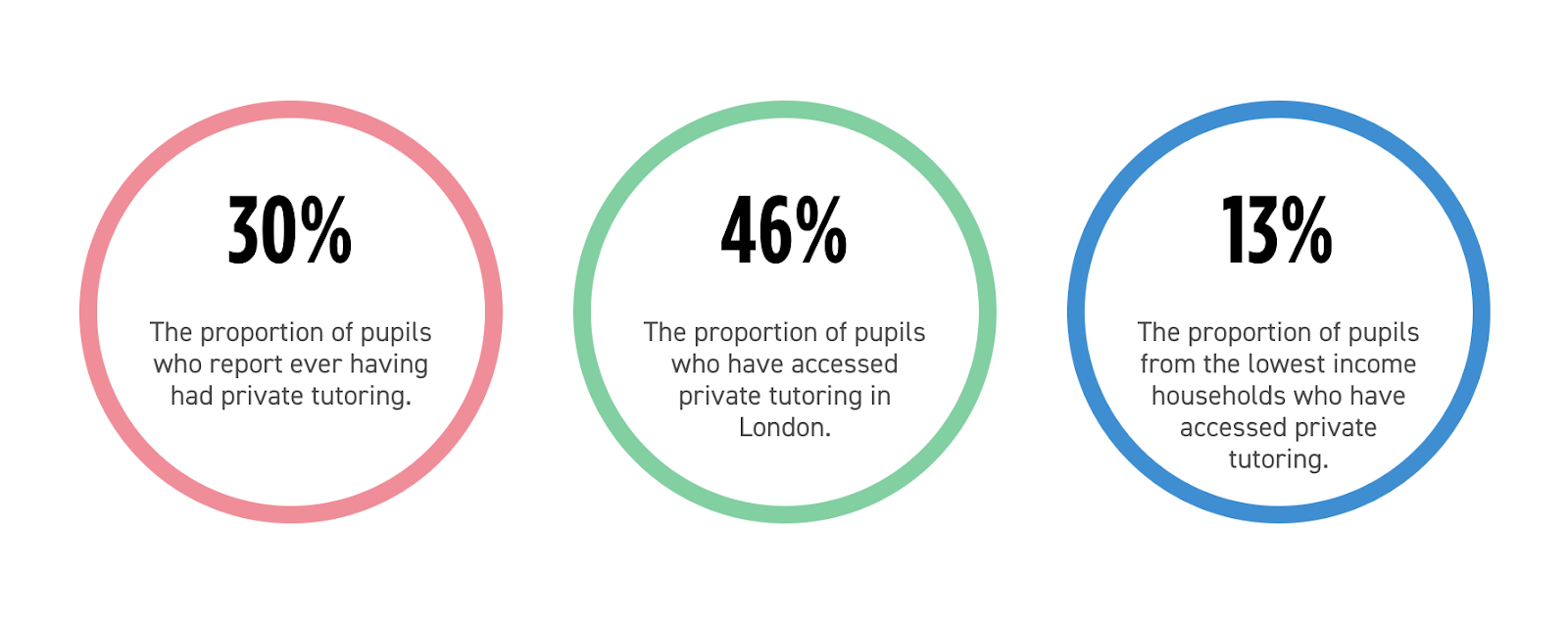
Tutoring: The New Landscape, The Sutton Trust

At least for wealthy elites, private tutoring may have no international boundaries or many other constraints.  Sarah Thomas, in “My Surreal Years Tutoring the Children of the Super-Rich,” explained: “I wanted a job that allowed me free time, so I registered with a tutoring agency. A few weeks later, I found myself in a speedboat cutting across the Indian Ocean towards a superyacht the size of a ferry.” That job soon led to other tutoring arrangements where her “classrooms would be on yacht decks surrounded by dolphins, in Monaco penthouses with infinity pools, and in Mayfair townhouses with halls full of Mapplethorpes.”

I wanted a job that allowed me free time,” she writes, “so I registered with a tutoring agency. A few weeks later, I found myself in a speedboat cutting across the Indian Ocean towards a superyacht the size of a ferry. – Sarah Thomas, My Surreal Years Tutoring the Children of the Super-Rich

To some extent, the recent growth in tutoring has been fueled by the pandemic (as predicted by the Economist). In South Korea, for example, post-pandemic spending on private supplementary education reached a record high of 20 billion dollars. As that headline put it, “Korean households spend more on tutoring than food, housing.” In places like South Africa, private initiatives like Ikamva Youth and the Kliptown Youth have long drawn on tutoring as a crucial strategy to improve learning. Still, a number of new tutoring ventures have been launched since the school closures of the COVID-19 pandemic (Nonprofit help2read steps in to help save a ‘lost generation’; Free maths and science tutoring for all grade 11 and 12 learners).

On top of these private initiatives, numerous countries have also made significant public investments in expanding tutoring both in school and out in response to concerns about learning loss related to school closures. England was one of the first countries to embark on a major, public tutoring initiative (£1bn catch-up tutoring fund for England’s pupils; Funding for national tutoring programme in England to be doubled next academic year); but public tutoring initiatives are also being pursued in places like the Netherlands (Are the Dutch Solving the Covid Slide with Tutoring? Netherlands to spend €105 million to reduce classroom sizes, add tutoring); Australia (New South Wales Labor promises permanent tutors, end to ‘underfunding’ public schools; Victoria and NSW are funding extra tutors to help struggling students); and New Zealand (where 20 million dollars have been dedicated to additional teaching and tutoring services). 

Tutoring takes off in the US 

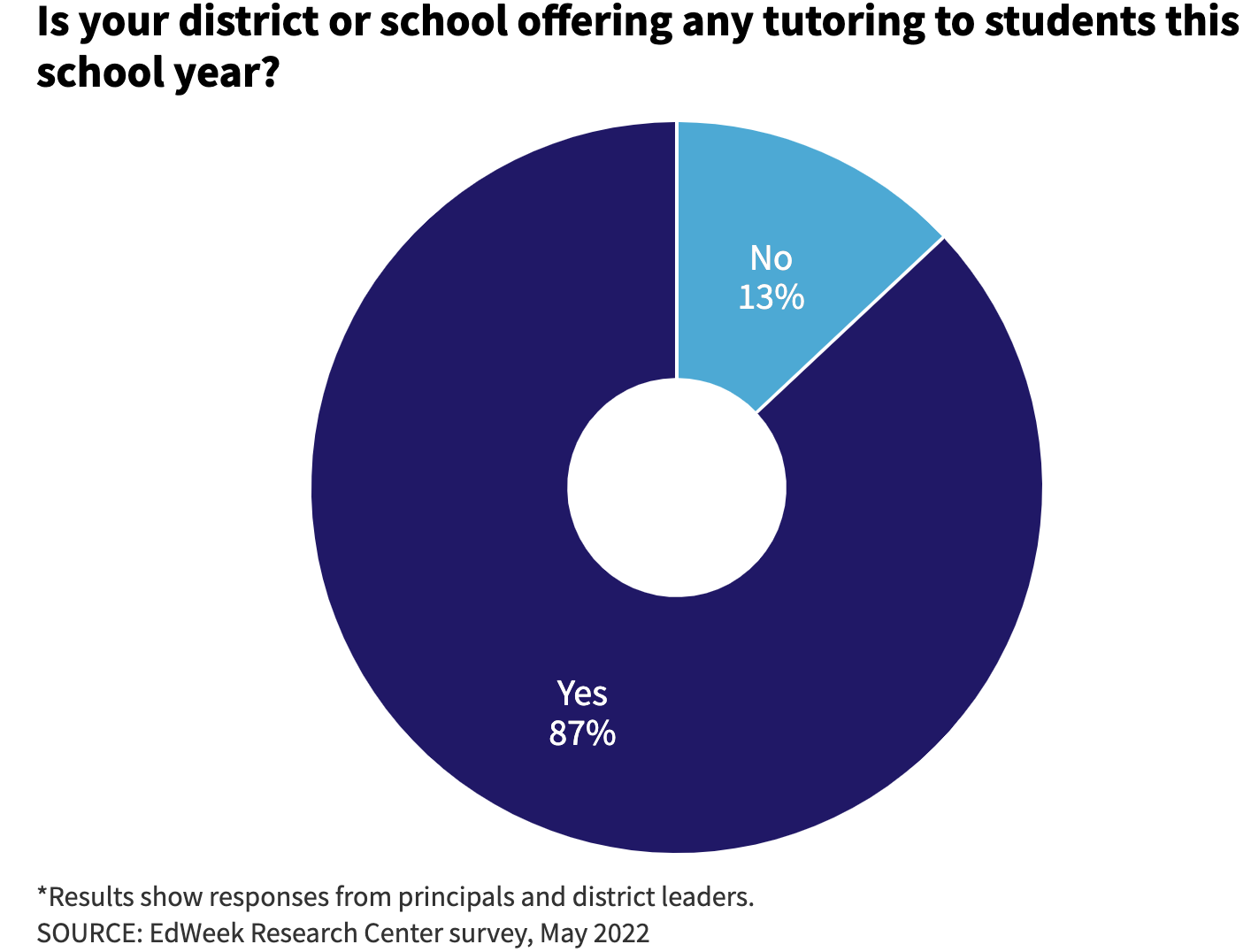
In the US, tutoring has always been a popular strategy for providing “extra help,” but following the school closures, tutoring is emerging as a more integral part of schooling across the US. According to a Education Week survey of school leaders and teachers in 1,287 districts at the end of the 2021-22 school year, almost 90% of those responding said that their school or district was offering some kind of tutoring (interesting, only 75% said that they “somewhat agreed” or “completely agreed” that “tutoring is an effective intervention for students in my district or school”).  Backing up those numbers, by the spring of 2022, estimates suggest that districts had dedicated over $1.7 billion in Federal funding to tutoring-related efforts and predicted spending could reach 3.6 billion by 2024. Correspondingly, the Department of Education reported that in the 2023-24 school year, more than four out of five schools reported offering tutoring programs, ranging from traditional after-school homework help to intensive tutoring. 
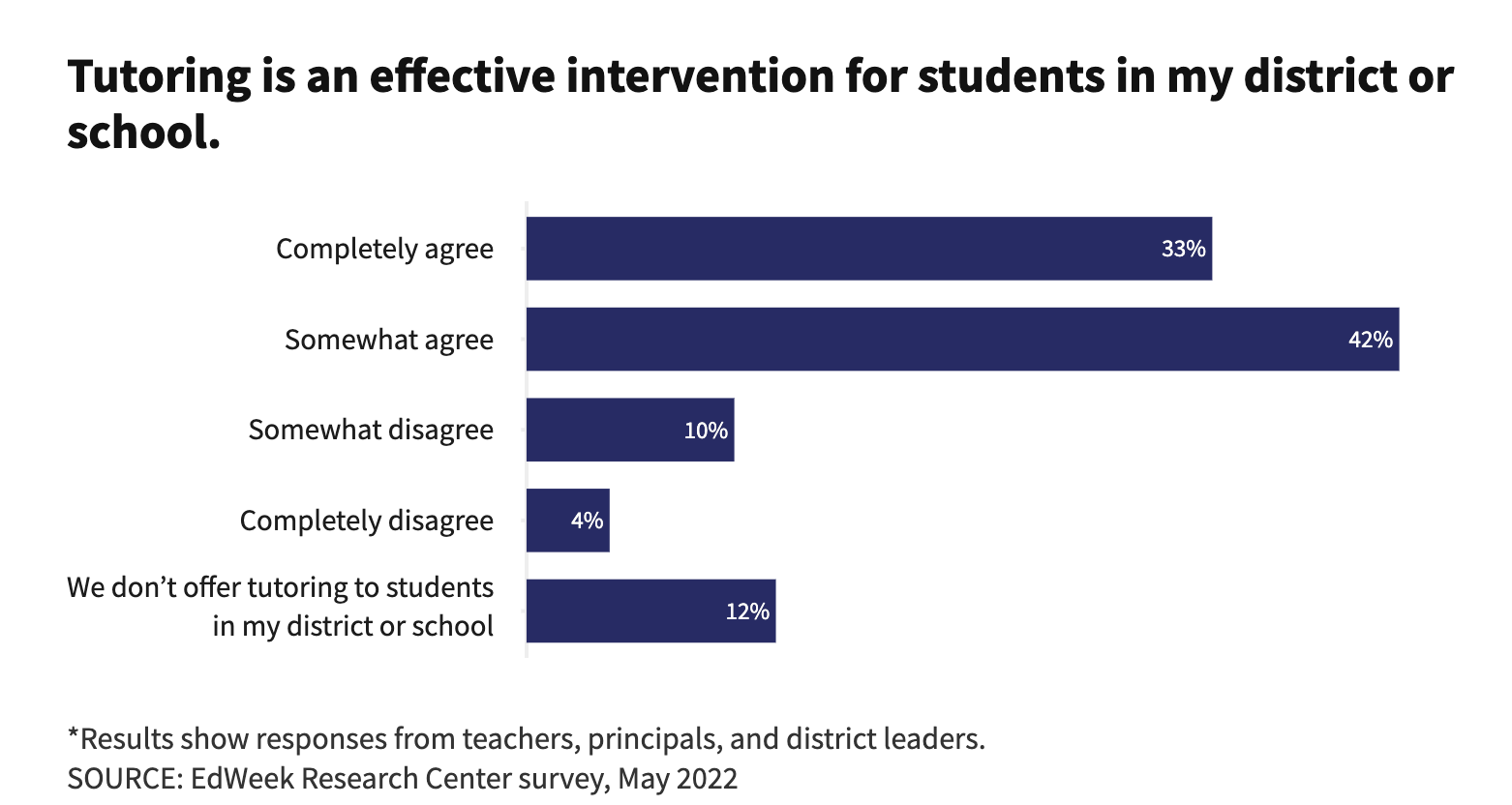
The Rise of Tutoring and Where It Falls Short, in Charts, Education Week

A whole series of funding initiatives have contributed to this widespread use of tutoring. With (unusual) bipartisan support, Congress and the Biden administration included support for tutoring in the package of $123 billion in emergency federal aid to schools. The U.S. Secretary of Education, Miguel Cardona, has urged schools to use their funds to provide at least 90 minutes of weekly tutoring to students most affected by the pandemic. Furthermore, in 2022, the Biden administration launched the National Partnership for Student Success – a three-year effort to create a coalition of organizations to “recruit, screen, train, support, and engage an additional 250,000 caring adults in roles serving as tutors, mentors, student success coaches, wraparound service coordinators, and post-secondary transition coaches”.

Private funders are also supporting tutoring efforts by establishing Accelerate, a new organization dedicated to developing and scaling affordable “high-impact” tutoring programs across the country. With funding from The Bill & Melinda Gates Foundation, Arnold Ventures, and the Overdeck Family Foundation, Accelerate set out to raise at least 100 million dollars to develop a network and make grants to support some of the most innovative tutoring models. According to later reports, Accelerate has provided 10 million dollars to 31 organizations developing “innovative” tutoring models and a million dollars to five different states to establish support and “infrastructure” for integrating tutoring into the regular school day that can serve as a model for other states.

States and cities have also participated in increasing the number of tutoring programs available around the country. New Hampshire’s approach includes offering a Yes, Every Student scholarship providing $1,000 for private tutoring from “state-approved educators” for “any young person whose education was negatively impacted by the pandemic.”  New Hampshire Education Commissioner Frank Edelblut described the reaction to the program this way: “When I explain the program to [parents], they become very excited, like, ‘Oh, this is great. In some cases, they’re almost like, ‘It’s too good to be true. How can this possibly be?’”

“When I explain the program to [parents], they become very excited, like, ‘Oh, this is great. In some cases, they’re almost like, ‘It’s too good to be true. How can this possibly be?’”

–New Hampshire Education Commissioner Frank Edelblut Quoted in ‘Too Good to Be True’: NH Gives Students $1,000 for Tutoring, The74

 Tennessee has launched a three-year tutoring project called Tennessee Accelerating Literacy and Learning Corps (TN ALL Corps), expected to cost almost 200 million dollars. The initiative hopes to serve 150,000 in 79 districts students who are just below proficiency in reading or math. In Texas in 2021, the state legislature passed a bill requiring schools to provide at least 30 hours of tutoring for students who did not pass the state tests in math or reading in grades three, five, or eight. To help meet the ensuing demand for tutoring, the Texas Education Agency established the Vetted Texas Tutor Corps, which seeks to offer support for over one million students by reviewing and approving eligible tutoring providers and offering a High Impact Tutoring Toolkit. 

In Ohio, most families now qualify for $1,000 to pay for tutoring. Through its Afterschool Child Enrichment program, called ACE, the Ohio State Department of Education supports educational activities for students who “experienced learning disruptions during the COVID-19 pandemic.” In Ohio’s case, however, families who meet the income restrictions can use those funds for a range of activities, including summer camps, language and music lessons, and after-school programs, in addition to tutoring. 

Next week: “Predictable challenges and possibilities for effective tutoring at scale – Scanning the news on the emergence of tutoring programs after the school closures (Part 2)

Scanning the News on High-Dosage Tutoring (Part 2): Initiatives and Implementation So Far

“High dosage” tutoring has emerged as a common response, to help support student learning in the wake of pandemic school closures.  In Part 1 of a scan of some of the headlines on the related news and research since the start of the pandemic, Naila Shahid reported on the discussions of the emergence of tutoring initiatives, related research, and support programs, particularly in the US. This week Part 2 of the scan focuses on some of the tutoring initiatives launched in different states and questions about implementation so far. 

The emergence of high-dosage tutoring initiatives across the US

As students pile back into in-person learning settings, many school districts across the US are using COVID relief funding from the American Rescue Plan for high-dosage tutoring programs. A report from The Education Trust, FutureEd and Education Reform Now reveals that by the beginning of 2022, “at least 17 states have committed to investing in targeted intensive tutoring, at least five have committed to building statewide tutoring programs, and at least six have committed to providing state-level guidance and support targeted intensive tutoring programs.” According to the report, states that have committed to utilizing a significant portion of their funding on high dosage tutoring include: Louisiana, New Mexico, Tennessee, and Texas. Louisiana expects to spend  $90 million of its $4.1 billion, New Mexico $176 million out of  $1.5 billion, Tennessee $200 million out of  $3.9 billion; and Texas  $1.4 billion out of $19.2 billion.  

“At least 17 states have committed to investing in targeted intensive tutoring, at least five have committed to building statewide tutoring programs, and at least six have committed to providing state-level guidance and support targeted intensive tutoring programs.”

Promising Practices, Education Trust, Education Reform Now, and FutureEd 

Among the state programs underway or proposed: 

New Jersey

Two years ago, the College of New Jersey’s School of Education, in partnership with the Overdeck Family Foundation, launched the New Jersey Summer Tutoring Corps. The program hired in-service and preservice teachers to tutor students for a minimum of 10 hours a week. The tutoring locations were YMCA and Boys & Girls Club. Tutors earned $20 to $25 per hour. The NJ Summer Tutoring Corps  provided tutoring to 2,000 students in the summer of 2021 and expanded to 42 sites in the fall of 2022. 

Tennessee

Tennessee proposed spending $200 million to initiate a three-year tutoring project called Tennessee Accelerating Literacy and Learning Corps.  That project involves 83 districts across Tennessee participating in the Corps serving 150,000 students in either Math or English language Arts.  The program primarily targets elementary students who are below the proficiency level. 

Arkansas

The Arkansas Department of Education has also launched an Arkansas Tutoring Corps. That initiative aims to build a system to recruit and train tutors to meet the academic needs of students in their geographic area. Total compensation for tutors is expected to be up to $3,000 in their first year and $2,500 in subsequent years. Arkansas Tutoring Corps tutors can be students enrolled in the educator prep programs in institutions of higher education, retired educators, current teachers, and community members. 

Indiana

The City of Indianapolis in Indiana also planned to expand a virtual tutoring initiative as part of their effort to help students catch up on reading and math skills. According to a Chalkbeat report, the results of two pilot programs showed improvement in participating students’ math scores of 12% to 26% and English/language arts scores by 4% to 9%. 

Quality of implementation and effectiveness 

Although it is far too soon judge the effectiveness of most of these plans, despite the promise, numerous questions about the implementation and effectiveness of scaling-up tutoring programs remain. In particular, some stories are already documenting challenges and progress of implementation, including basic logistical issues that are delaying the full implementation of these programs in some places. In Chicago, for example, tutors were hired before decisions were made on who will train the tutors or how they would be trained. Lack of space for tutoring as well as scheduling have also been problematic. Recruiting and staffing also remains one of the critical challenges (Schools need tutors and mentors. Can a new federal initiative find 250,000?). According to the Hechinger Report, in Tennessee, despite strong gains for students overall, the percent of students who were reading at the lowest level on the state’s proficiency test — the students who were the focus of the state’s tutoring initiative grew from 31% to 36% over the past two years (“Early data on ‘high-dosage’ tutoring shows schools are sometimes finding it tough to deliver even low doses“). In the UK, the National Tutoring Program has also been criticized for failing to reach some of the students that need the most help, and there are similar concerns that in the US it will take longer to scale the Federally-supported tutoring initiatives than expected. As Robert Balfanz from the National Partnership for Student Success told the74​​, “We can’t mobilize fast enough. There are still some lost opportunities.”

Scanning the News on High Dosage Tutoring (Part 1): A Solution to Pandemic Learning Recovery?

“High dosage” tutoring has emerged as a common response, to help support student learning in the wake of pandemic school closures.  Naila Shahid has been scanning the tutoring-related headlines throughout the pandemic, and this week she reports on some of the discussions of the emergence of tutoring initiatives, related research, and support programs. Later this month, Part 2 of this post will describe some of the tutoring initiatives launched in different states and related questions of implementation so far. 

What is high dosage tutoring and why is there a need for it?

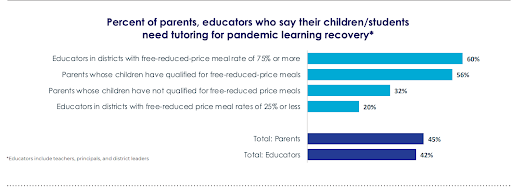
Over the past year, a number of news reports have highlighted the expansion of tutoring initiatives across the US and in some cases other countries. Many of these initiatives have emerged specifically to combat fears about pandemic-driven “learning loss.”  Illustrating the interest in tutoring, an EdWeek Research Center survey reported that, on average, about 40% of educators and 45% of parents say their students could benefit from tutoring to address “learning loss,” and 97% of district leaders said that they expected to offer tutoring for this purpose in the 21-22 school year. Those leaders also anticipated that about 1 in 3 students would receive tutoring (equivalent to about 17 million of the 51 million public school students in the US). If that’s the case, the total national expenditure on tutoring this year could reach over 12 billion dollars.  

The tutoring solution, EdWeek Research Center

But what makes these initiatives – often referred to as involving “high dosage” or “high impact” tutoring – different from regular tutoring? According to Kevin Huffman and Janice K. Jackson, high dosage tutoring reflects some basic principles: student groups of four or fewer meeting multiple times a week, with a trained and consistent tutor, with a focus on helping students gain ground academically, improve attendance, and connect with trusted adults for support. Drawing on recent research, the Annenberg Institute at Brown University outlined a set of design principles (related to frequency, personnel, group size, focus, etc.) they argue will help make “high-dosage” tutoring effective.  SmartBrief  also highlights in a FAQ that what they refer to as high-impact tutoring should not be remedial. Instead, it should focus on scaffolding content so students can learn new skills built on their previous knowledge.  A related overview of the research from the Hechinger Report explains that the emphasis on “high-dosage/high impact” tutoring has been influenced by studies suggesting that tutoring is most effective when “the tutors are specially trained and coached and adhere to a detailed curriculum with clear steps on how to work with one or two students at a time. As Jonathan Guryan, an economist at Northwestern University who has studied tutoring programs put it, “it is not once-a-week homework help.” 

What programs have emerged to support tutoring?

Along with the growing interest in tutoring, after the start of the pandemic, a number of organizations and funders have proposed or launched initiatives designed to provide resources, financing, and other supports for new tutoring initiatives. In March 2020, for example, Brown University’s Annenberg Institute for School Reform started the National Student Support Accelerator to help give K-12 students access to tutoring. The late Robert Slavin and researchers at John Hopkins University also proposed an Educational Marshal Plan to scale-up tutoring initiatives. Based on the AmeriCorps model, the proposal envisioned using billions of dollars in Title 1 funding to recruit and train 300,000 tutors. Relatedly, the Center for American Progress also proposed an Opportunity and Counseling Corps to consist of high school graduates, college students, and community members to tutor students in high-poverty schools. The model suggests employing up to 17,000 tutors and resident teachers and up to 12,000 social workers, counselors, and school psychologists.

 “A Tutoring Marshall Plan would provide intensive funding to enable Title I schools nationwide to substantially advance the achievement of their students who suffered mightily from COVID-19 closures and related trauma” 

Robert Slavin

More recently, in April 2022, funders like the Bill & Melinda Gates Foundation, Arnold Ventures, and the Overdeck Family Foundation helped to raise over $65 million dollars to establish Accelerate, which aims to provide district and state education leaders with technical assistance for high dosage tutoring. As part of their plans to help students recover from the pandemic learning loss, the Biden Administration also announced a plan to provide schools with  250,000 tutors, mentors, and coaches. This National Partnership for Student Success aims to bring together school districts, nonprofit organizations and higher education institutions to recruit, train, and support tutors. A search for virtual and technology-based solutions is also underway, including efforts by non-profits and private companies to utilize artificial intelligence to address the challenges of finding enough tutors.

“The majority of students could never afford a private tutor, so we wanted to build a private tutor that mimics all the qualities of a tutor. We can help personalize the attention and assess a student’s knowledge continually.” — Miral Shah, CK-12 quoted in The74

The interest in tutoring as a response to “learning loss” extends beyond the US as well. The UK, for example, announced a £350-million National Tutoring Program even before many plans got underway in the US.  In China, in conjunction with plans to crack down on private tutoring, the Beijing Municipal Commission of Education has announced a plan to build an online tutoring platform where primary and middle school teachers can provide tutoring services in various forms, including one-on-one teaching, live-streaming classrooms, and pre-recorded videos. Each semester’s compensation for tutors can be up to 50,000 yuan ($7,880), and the platform is entirely free to use for students. 

South Korea

South Korea’s Ministry of Education, Science, and Technology leads education reform to prevent excessive prior learning from private tutoring 

*Original article in Korean

Joongang News (September 26, 2012)

Prior learning in Korea refers to educational programs offered via private institutes, which teach above-grade-level school curricula to students in advance. Subjects are taught a year ahead of  schedule, and even three years in certain cases. South Korea’s Ministry of Education, Science, and Technology announced that the excessive prior learning has caused problems in students’ cognitive, social and emotional, and educational development. The ministry has presented an outline for a new policy that plans to solve the problems through:

-Examination of public school curricula that might encourage prior learning.

-Examination of the effects of prior learning on the entrance exams for high schools and colleges.

-Exploration of the successful public school models with regard to curriculum management.

-Conducting scientific and practical research on the disadvantages of prior learning.

-Probing of private tutoring programs.

For more information:

Link to the article from the blog of the Korean Ministry of Education, Science, and Technology (Korean)

Prior Learning (English)

36% of parents spend W910,000 on tutoring 

 Growing debt worries for South Korea