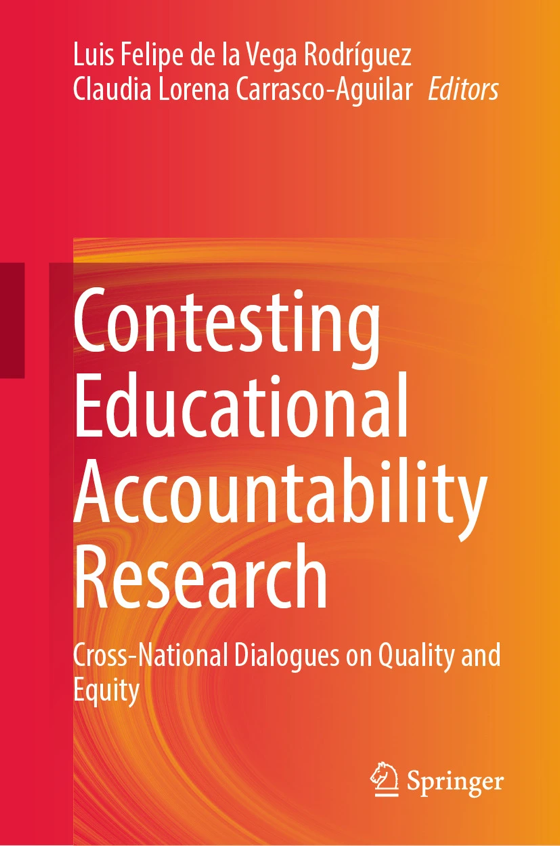
How can we build accountability systems that strengthen professional responsibility, social participation, and equity? That is one of the critical questions that Luis Felipe de la Vega and Claudia Carrasco-Aguilar discuss in this interview about their new edited book Contesting Educational Accountability Research: Cross-National Dialogues on Quality and Equity (Springer 2026). The book includes comparative research on the implementation and effects of accountability systems in countries like Brazil, Chile, Italy, Honduras, South Africa, Spain and Sweden. Chapter 1 — “Performative Accountability: A Close Examination of a Dominant Model”– is available open access. De la Vega is a researcher at Bernardo O’Higgins University in Santiago, Chile and Carrasco-Aguilar is a researcher at the University of Malaga in Spain. AI was used to assist in the translation of this interview from Spanish into English.
For other IEN posts related to accountability, see School Networks, Accountability and Improvement in Scotland, Northern Ireland, England, and Chile; Accountability in Decentralized Systems: Rethinking How We Evaluate Schools; Do Charter Schools in Colombia Provide Sufficient Accountability and Choice?; and School Inspections in Educational Assessment, Evaluation and Accountability.
++++++++++
IEN: Why this book? Why now?
Luis Felipe de la Vega & Claudia Carrasco-Aguilar: We have been analyzing accountability mechanisms in education for several years. Our analysis of the research findings has revealed a significant consensus regarding the implementation and outcomes of the “market-based,” “performance-based,” or “high-stakes” model. While these models have moderate or minor positive effects on improvement processes, they also have negative effects at the system, institutional, and stakeholder levels. Despite this consensus, the adoption of this type of accountability as a strategy for improving systems has continued to spread worldwide.
We investigated how and why some countries incorporated components of this mechanism into their institutional design to understand this phenomenon. We also identified alternative strategies that aim to recognize other ways of conceiving or using accountability. These strategies may be effective and beneficial for educational communities and/or have fewer negative implications for their stakeholders. In short, while accountability can allow for greater transparency and collective, citizen-led monitoring of educational processes, it also places significant pressure on schools, as if continuous improvement were solely the responsibility of schools and their teachers. Globally, educational accountability appears intertwined with market models, where families and communities demand that schools act as service providers and assume the role of customers rather than as true collective learning communities. We find ourselves in a globally polarized era, where the common good and shared responsibilities are overshadowed by a focus on individual gain.
“[W]hile accountability can allow for greater transparency and collective, citizen-led monitoring of educational processes, it also places significant pressure on schools, as if continuous improvement were solely the responsibility of schools and their teachers.”
In a context marked by discourses promoting competitiveness and mistrust at every level, it is important to reinforce the idea that positive improvement processes in education occur more naturally through collaboration and a deep, shared sense of purpose. The data support the need to develop accountability mechanisms grounded in education that align with societal expectations of educational systems.
IEN: What are some of the key similarities and differences in the accountability approaches used by the countries you and your colleagues have written about?
LFV & CCA: The book has helped confirm a significant trend toward incorporating performative accountability mechanisms in different parts of the world. Two decades ago, literature analyzing this strategy focused predominantly on the U.S. context and always took a critical tone. Over the years, however, we have observed growing interest in other regions, such as Latin America, Africa, and Europe. Furthermore, some countries that have long upheld an ethos of trust, such as Sweden, have also begun to incorporate these mechanisms. In general, significant similarities can be observed in these cases. Beyond distinctions in prioritized data, strategies, or associated consequences, there is a trend toward homogenizing an approach that aims to improve educational outcomes through accountability mechanisms. This strategy is often accompanied by a market-driven education system that confuses the public by blurring the lines between empowerment and clientelism. Educational standardization, high-stakes assessments, and the idea that students’ learning outcomes depend solely on the quality of teaching in schools seem to be creating a high-pressure system that is spreading worldwide. In many of the cases presented in this book, we see that educational accountability dissociates schools from their social context. It holds educational leaders and teachers responsible for students’ academic outcomes and obscures the role of social inequalities and injustices.
Nevertheless, the book includes South Africa as an example of how accountability strategies based on different principles, such as culturally responsive assessment, can successfully promote relevant educational goals. Additionally, the debate on performative accountability has been accompanied by alternative proposals demonstrating various accountability approaches. However, these have not clearly established themselves or moved beyond being good practices or promising experiences. It is interesting to consider why this is the case. The book puts forward some hypotheses on this matter.
IEN: What else did you learn while producing this book that you didn’t know before?
LFV & CCA: We learned many things, but one of the most important was that the discussion about performative accountability isn’t just about its use as a technical tool. Rather, it reflects a broader discussion about accountability in education and its ethical, political, and educational implications. Accountability systems reflect not only how education systems conceive of their own improvement but also their priorities for day-to-day operations.
“Accountability systems reflect not only how education systems conceive of their own improvement but also their priorities for day-to-day operations.”
So, two things happen. First, many researchers in education quickly reached a consensus that performative accountability is educationally counterproductive because it clashes with pedagogical logic and sensibilities. It makes it difficult for stakeholders to address the challenges communities identify as essential and fosters a competitive logic. This leads to mistrust and a lack of collaboration within the system. Second, despite this consensus, it has not been possible to build a sufficiently robust foundation to generate alternatives capable of competing with performative logic. In this regard, despite notable and interesting case studies, there is significant criticism of those who have promoted these proposals.
Another key insight is the importance of comparative research. This book introduces vastly different settings and contexts from various continents. The significant socio-geographical diversity involved makes this phenomenon particularly striking. Here, we observe the rise of market-driven education and its influences as they are culturally adapted. Clearly, researching educational accountability in Europe is not the same as doing so in the Global South. This book details both the differences and similarities between the two. Thus, we have learned about the power of local contexts in translating educational policies designed at the global level and how the performativity of these policies can be observed in these translations despite the influence of supranational bodies. In simple terms, performative accountability reshapes and transforms subjectivities, identities, and cultural realities that may appear similar at first glance but possess highly complex differences when analyzed in greater detail. These differences enable movements of opposition and resistance and may help us understand possible alternatives to these forms of accountability in the future, moving toward a more social form of accountability.


IEN: What are some of the key implications for policy and practice?
LFV & CCA: From a systemic perspective, the discussion on accountability should address its meaning and contribution to comprehensive educational improvement. Although the discussion of which test is best or what a certain score implies may be relevant, it does not address how each actor or institution can contribute to helping the education system and students achieve our envisioned goals.
Having strong accountability mechanisms does not mean having harsh ones. Alternative proposals can be equally rigorous in analyzing the extent to which we fulfill our responsibilities to achieve those goals. If educational processes have eliminated violence as a form of correction over many years, then educational principles that promote collective and institutional learning should be established as the foundation for improvement processes. This implies that we must consider other types of accountability relationships, including greater opportunities for peer collaboration among individuals and institutions and creating spaces for dialogue across levels of the education system. These spaces should not be solely marked by the possibility of sanctions but rather reflect a commitment to jointly seeking solutions to educationally relevant problems.
A fair accountability system holds everyone accountable, not just schools. However, the consequences should promote collective learning rather than punishment. Ultimately, what happens in a classroom is the result not only of a teacher’s actions, but also of their school, district, state, and other collaborating institutions. If we all have responsibilities, we should all take ownership of them. In that case, a system based solely on punishment loses meaning, making collaboration more logical.
“A fair accountability system holds everyone accountable, not just schools. However, the consequences should promote collective learning rather than punishment.”
IEN: What else have you learned about accountability since writing that book?
LFV & CCA: As authors, we have learned that educational accountability is much more ambiguous and contentious than is typically assumed in public policy discourse. Our comparative studies and theoretical review show that accountability does not have a single form but rather takes on multiple configurations that answer different questions: What should be accounted for? To whom? For what purposes, and through what mechanisms? When these questions are answered from a technical or administrative perspective, accountability tends to be reduced to measurement, control, and sanctions. However, when answered from an educational perspective, accountability can become an instrument of reflection, improvement, and shared responsibility.
Another important finding is that the global dominance of the performance-based model has had deeper consequences than previously thought in terms of not only outcomes, but also school culture and teaching practice. In many contexts, systems based on standardized tests, rankings, and incentives have reinforced competitive dynamics, narrowed the curriculum, and shifted the focus from educational processes to indicators. Assessment and accountability are not inherently negative; rather, design matters, and certain formats can undermine what they seek to improve, especially in contexts of inequality.
We have also learned that the effects of accountability are not universal but depend heavily on context. The chapters in the book demonstrate that the same policies can generate different results based on the education system’s history, level of institutional trust, regulation of teaching work, and social structure. This calls into question the idea that certain models can be considered transferable without adaptation. It compels us to view educational accountability as a context-specific framework designed according to each system’s actual capabilities and the goals pursued.
“[T]he same policies can generate different results based on the education system’s history, level of institutional trust, regulation of teaching work, and social structure. This calls into question the idea that certain models can be considered transferable without adaptation.”
Based on this information, the most relevant open-ended question for us is how to build forms of accountability that strengthen professional responsibility, social participation, and a commitment to equity, rather than being limited to external control. Reviewed evidence suggests the most promising approaches combine evaluation and collaboration, incorporate community voices, and view accountability as part of education’s public mission, not just an obligation to report. Thus, the future challenge is not to set accountability aside but to shift it from a culture of surveillance to a culture of shared responsibility oriented toward educational improvement.
We believe this requires significant effort from academic and political perspectives, which is why partnerships are needed to drive progress. As academics, we must ask ourselves why our robust evidence is not sufficiently impacting decision-making and consider how we can improve.


