Learning materials, language support, and cultural mediators, these are a few of the elements of Iceland’s efforts to create a more welcoming and inclusive education that Fríða Bjarney Jónsdóttir discusses in the second part of this interview. In the first part of this conversation with Thomas Hatch, Jónsdóttir outlined some of the first steps Iceland has taken to establish their national approach. Jónsdóttir works as a specialist at the Ministry of Education and Children coordinating the MEMM project an abbreviation for education, welcoming and culture. The project is being developed in close collaboration with the Centre for Language and Literacy in Reykjavík and the newly established national Directorate of Education and School Services. Previously Jónsdóttir was the head of the Center for Innovation at Reykjavík’s Department of Education and Youth and before that served as a coordinator for multicultural education in preschools. For earlier coverage of developments in Iceland’s education system see part 1 and part 2 of a conversation with Jón Torfi Jónasson “On the inertia of education systems and hope for the future” and “Relish the freedom you have and find the balance.”
++++++++++++++++++++++
Thomas Hatch: You’ve talked about some of the major initiatives you’re pursuing now including the collaboration around the data system, the production of resources and curriculum for inclusive education, and the development of a group of cultural mediators who can help educators and schools address the needs of immigrant families. But what about the challenges? What are some of the issues you need to deal with in order for your work to be successful?
Fríða Bjarney Jónsdóttir: One of the issues is that Icelandic is a really tiny language. It doesn’t have much global value. As a result, you might have parents who’ve been living in Iceland for years and years without learning Icelandic. They could be working in the tourist industry, for example, but the company owners don’t care whether their staff speak Icelandic or not. There is a policy to support the learning of Icelandic as a second language, but it’s not acted on, and everyone needs to take responsibility for that.
We need to provide an Icelandic learning community to support learning the language, and one way we are trying to do that is through continuous education. In almost every corner of Iceland, you have a center where you can go and you can learn all sorts of things, including instruction in Icelandic. But there’s no standardized syllabus, and we don’t have standardized learning material.
TH: So that’s part of the reason you are trying to create the resources and materials for more effective instruction for Icelandic as a second language?
FBJ: Yes, we’re doing that for the pre-primary, primary and secondary levels, but ideally it would happen for continuing education as well. It should happen at all levels. Just to give you an example, I was in a municipality where almost 70% of the children in the schools have an immigrant background. I told them, “Okay, you want us to do something about the schools and the education of the children, but what is the welcoming plan of the municipality? How do you welcome newcomers into your municipality?” This can’t be just about the schools. There has to be a plan for how the community welcomes newcomers that includes both the municipality and the schools.
“How do you welcome newcomers into your municipality?” This can’t be just about the schools. There has to be a plan for how the community welcomes newcomers that includes both the municipality and the schools.”
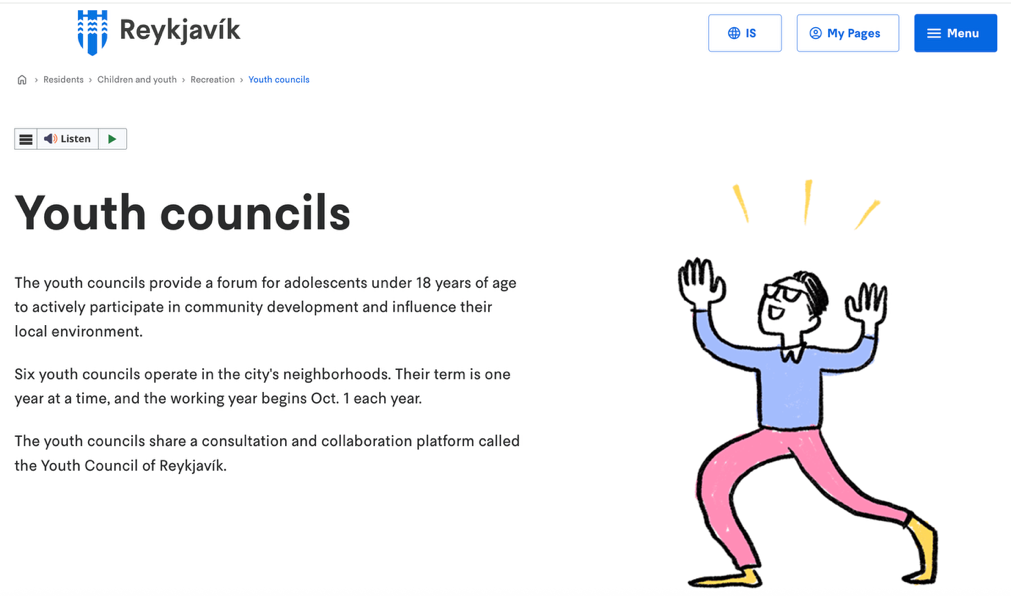
Reykjavik has that kind of plan. The idea for their welcoming plan actually started in the Reykjavik Youth Council. That Council includes kids who are 14 to 18, and they can create proposals and appeals for the City Council to consider. They participate in one meeting with the City Council to put their ideas forward, and the City Council accepts some of the appeals. The ideas that are accepted are sent to the relevant department, like the city’s Department of Education and Youth or the Department of Welfare.
Back in 2015, I was leading the multicultural team at the Department of Education in Reykjavik, and the Youth Council introduced this idea about how the neighborhood could welcome newcomers. I thought it was so interesting that the youth council was bringing this up, so I called them all in and said “I want to hear the story behind your idea.” This guy who was already in upper secondary school, I think he was 17 at the time, said he was Icelandic, and he was living in a neighborhood in Reykjavik, where you have the most immigrants. “I’ve been in the same school for 10 years,” he told me, “and I’ve been having kids coming in my class every year that don’t speak Icelandic. For many, many years, I was with the same boy from Poland, and no one taught me how to talk to him. I feel so guilty about that, and I wanted to do something about it.” That was the beginning. Now there is a collaboration between the schools and a service center in the four districts of the city. This approach has been implemented in all the districts in Reykjavik, but it’s not something that’s happened nationally. One service center situated in the most diverse district has “ambassadors” that have been appointed from about 9 or 10 immigrant groups. The ambassadors act as consultants to the service center to help them improve their services, and they serve as a link to the immigrant groups in the district. There are some municipalities, like, the municipality closest to the airport where they have been doing wonderful work, that we can all learn from, but it’s not exactly the same in each place.
I also remember this wonderful welcoming plan that was in the East fjords some years ago where they had a welcoming person who met all new families. It didn’t matter where they came from, she met all the new families a few days after they moved to the town; gave them a card for the library, visited the pool, showed them where the social services were, and took them to the schools. Now, when I visit other places, I point out to them that you cannot do this in isolation, and you can build on these examples from Reykjavik and these other municipalities.
TH: You’ve talked here about welcoming immigrants, but in many cases, with refugees in particular, you’re welcoming people who’ve experienced trauma. How have you addressed that?
FBJ: This is something that we are learning little by little. I know in the US you have had trauma sensitive education and other initiatives that we have not had here, but it’s coming. We have a project we are working on now, Heillaspor that’s nationwide for Icelandic schools. It’s based on a Scottish project called Nurture. That’s an inclusive trauma sensitive project based on attachment theory: How do you build relationships and connections between adults and children? Between the children themselves? Between children and families? Between families and schools? And how can you support teachers in protecting themselves, their emotions and feelings so that they become less fragile in difficult situations?
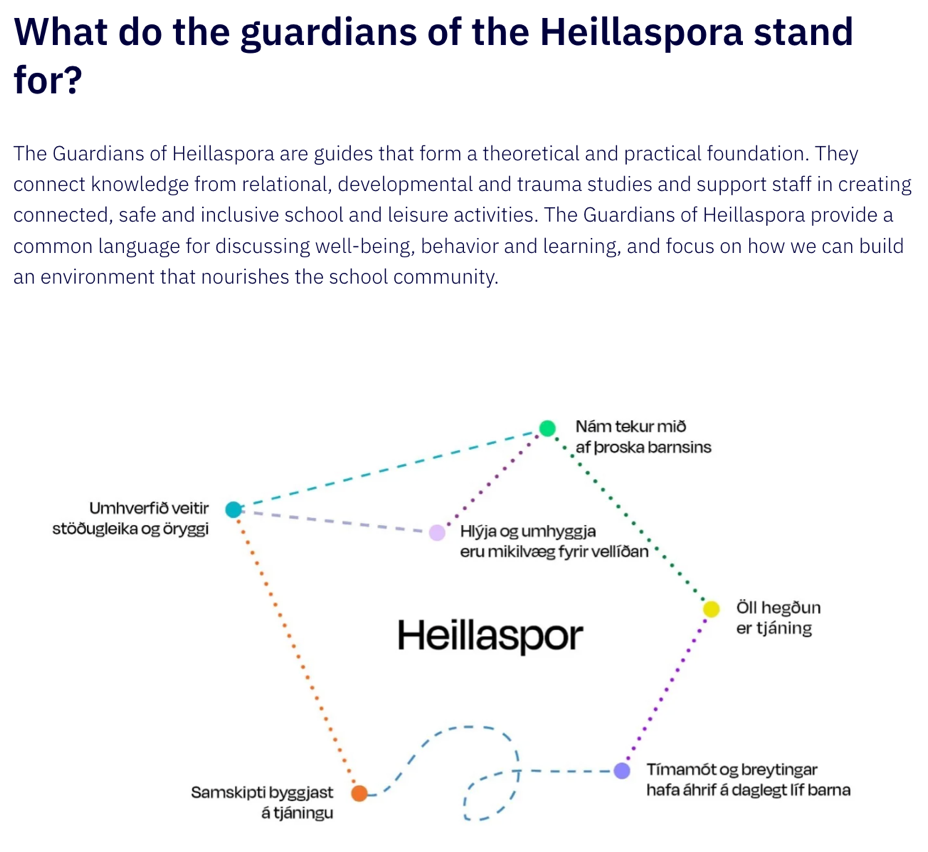
“How do you build relationships and connections between adults and children? Between the children themselves? Between children and families? Between families and schools? And how can you support teachers in protecting themselves, their emotions and feelings so that they become less fragile in difficult situations?”
But we also have some local projects. One that I have visited is developing micro-initiatives to support children and families who having huge challenges, in terms of finances, parents with drug addiction, children not going to school and all that. One of the initiatives that they are implementing, is called SPARE (It stands for supporting parents among refugees in Europe). They provide a 12-week program for parents with a refugee background and provide clinical therapies.
TH: Are there any other major challenges that you’re facing?
FBJ: There are so many challenges! The dominance of English is another challenge for teaching Icelandic as a second language. English is almost the lingua franca in Iceland so there’s a fight to keep the Icelandic language alive. My background is in multicultural, multilingual pedagogy, so when I’m working with multilingual children and families, I build on the strengths and resources that they bring to the school. For example, I will try to activate their languages while teaching them Icelandic. I will try to learn about our similarities and our differences. But that’s becoming a challenge because English is the language that everyone is using, so, for many teachers, it’s easier to speak English to newcomers. Teachers who are responsible for teaching Icelandic as a second language only work with a child for a few hours a week outside the regular classroom, and there is not a focus on building relationships through Icelandic with the classmates. As a result, there is a danger that the child goes back into the regular class and never practices Icelandic. That’s why we are also trying to change attitudes and beliefs and make it clear that learning Icelandic as a second language is a joint responsibility of the whole school not only the appointed second language teacher.
But this work has to deal with the increased racism, hate speech, extremism, and polarization that you are seeing in the US and Europe as well. This certainly makes it difficult when you want to work in an inclusive way with cultures and languages. As one example, I gave a course for all the head teachers of preschools in one of the neighborhoods in Reykjavik. I talked about attitudes and beliefs and what inclusion means. What does it mean to be culturally sensitive? They did all sorts of projects and discussions about this, because you can provide all sorts of material and support, but if people don’t work with themselves and their own beliefs and attitudes, things hardly change. We see this as a huge, huge, huge challenge. This is an issue everywhere, but at least the policy here is in favor of multilingualism and multiculturalism.
The education of teachers is another huge challenge. Icelandic society has changed very, very fast, and teacher education is struggling to keep up with the pace of societal changes. We don’t have a good knowledge of how to teach Icelandic as a second language, for example. We have to build up that knowledge, and we also have to build up the knowledge of culturally and linguistically sensitive practices and our projects are trying to contribute to that.
TH: Is there anything that’s been successful in working on teacher education? Any area where progress is being made?
FBJ: There are some good initiatives at our universities for teacher education, and you have teachers that really want to change things. We are working with many different groups, including representatives from the universities, the teachers’ union, the Association of Municipalities, and we are having meetings about teacher education. You could say, we have “opened the mic.” There is also a recent book about teacher education in the Nordic countries when it comes to multilingual children, and there are two chapters about teacher education in Iceland (Teacher education for working in linguistically diverse classrooms: Nordic perspectives).
TH: All this gives us a great sense of the initiatives you’ve gotten started. Is there anything else that you see coming down the line or that you’re hoping to get going as next steps?
FBJ: We have less than year to go with this project, and it’s supposed to finish with a draft for the parliament that describes what we want support for school services and support to the municipalities to look like. At the same time, I hope we would get some kind of a consensus between the state and the municipalities: What is the responsibility of the state? What are the responsibilities of the municipalities? And how are we going to divide the cost? This work has been going on for a while. I think that now we know the challenges. We know what we have to do. We have a lot of resources, but we need this collaboration, and we need a systemic approach so we can work on this together.
Part of what I’m trying to do during these two years is influence attitudes and change how people view working with culturally and linguistically diverse groups of children so everyone sees that it’s not a matter of fixing someone; it’s not a matter of a single teacher being responsible. We as a society are responsible for building on the resources that people bring and providing them the education they need to live here. That’s where I would like to see us.
“it’s not a matter of a single teacher being responsible. We as a society are responsible for building on the resources that people bring and providing them the education they need to live here.”


Pingback: Highs in the East, Lows in the West, and Concerns All Around: Scanning the Education Headlines for the 2025 PISA results | International Education News