Category Archives: About K-12 International Education News

Digital Tools for Civic Engagement: A Conversation with Joe Kahne

Here at International Ed News, we have been engaged in a series of conversations with researchers working with educational issues in innovative ways on the margins of formal schooling. We previously spoke with Mary Helen Immordino-Yang and John Seely Brown. Recently, we spoke with Dr. Joe Kahne about his work in democracy and education, urban education, and Youth and Participatory Politics. He particularly focuses on digital media and online components of civic engagement. Dr. Kahne is Professor of Education at Mills College as well as Chair of the MacArthur Foundation Research Network on Youth and Participatory Politics, which is part of the Connected Learning Alliance.
While Dr. Kahne’s work has always focused on urban education (stretching back to his days as a teacher in NYC) and innovation, his recent work with institutions such as the Connected Learning Alliance emerged from his recognition of an increasingly digital component to youth civic engagement. As he put it, in the digital world “some of the core acts of civic and political life such as finding information, mobilizing others, and sharing perspectives” occur through social media and other spaces. These spaces enable “individuals to comment on, engage in, and influence civic and political life… and youth are often given such opportunities when online to a greater degree than when engaged in with institutional politics.” Through the affordances of digital media, “those who would otherwise remain marginal gain voice” and gain agency through action such as creating groups and social networks. As an example, Dr. Kahne points to ways that the Black Lives Matter movement has been aided by youth engagement with digital media. While people do not typically buy smart phones to photograph the police, for instance, he points out that these tools have been used to help shift public consciousness and mobilize for reform.
While his work is primarily centered on the U.S., Dr. Kahne sees this line of research as being possible as part of promoting and questioning narratives on citizenship in general and as operating beyond national boundaries. For example, he uses the DREAMers to point to the ways that online spaces are being used to debate the very question of who gets to be a citizen. Additionally, he points to online spaces where non-citizens can play increasingly participatory roles in discourses on national issues such as elections. The Youth and Participatory Politics initiative in which he is involved has also undertaken a Global Dimensions link, which explores the composition and dynamics of activism on a global scale in the digital age.
Much of Dr. Kahne’s research focuses on the Youth and Participatory Politics (YPP) research network. His group “defines YPP as something that is socially networked and peer driven rather than institutionally dictated and driven by elites.” With YPP, Dr. Kahne is currently working on a MacArthur Foundation funded project called Educating for Participatory Politics. In this project, Dr. Kahne and others are working with educators and students in Oakland, Chicago and LA to merge digital tools and classrooms spaces in order to increase civic engagement. Using Web 2.0 and other digital media tools, they are “investigating the opportunities for educators to support youth participation in civic and political life.”
This line of work on civic engagement is not always easily integrated into schools. Though he recognizes that many individual teachers and students have already been deeply involved in civic engagement as individuals, specifically through digital media, Dr. Kahne sees a “tension between institutional actors and other participatory modes of action.” This type of innovation (i.e. networked civic engagement through digital media) is not something he believes that educational institutions have prioritized thus far. He asked is “there a way through [this project] to create institutional commitments that would support those teachers and bring others in to a greater degree?” This project is thus an innovative approach to link and cultivate what had already been present in spaces outside of school with school’s daily life.

Professional Learning in Top Performing Systems, part 2

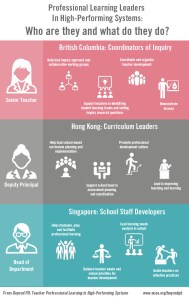
PDinfographicv2The National Center on Education and the Economy’s (NCEE) Center on International Education Benchmarking has released two reports on professional learning environments in top performing systems: Beyond PD: Teacher Professional Learning in High-Performing Systems and Developing Shanghai’s TeachersTo explore and share the findings of these reports, the NCEE held a conference last week featuring presentations and panel conversations with the leading voices in education from around the world. This conference was also streamed live and can be viewed online. Moderated by Marc Tucker, president and CEO of NCEE, speakers included Ben Jensen (author of Beyond PD) and Minxuan Zhang (author of Developing Shanghai’s Teachers).

Ben Jensen began his presentation with the questions, “What is at the core of high performing professional learning systems? What is the strategy to ensure effectiveness?”

Jensen argued that we need to move past the idea that there is a single answer. Instead, we need to understand the fundamentals behind effective professional learning. We need to think about an overall strategy for change, rather than specifics, such as how many hours should be required, or the regulatory environment. According to Jensen, high performing education systems around the world all have one thing in common. They are all really clear in their belief that school improvement = professional learning.

While countries such as Australia and the United States set high expectations for outcomes and leave it up to schools and teachers to meet those expectations in any way they see fit, top performing systems such as Shanghai and Singapore don’t take the same approach. Instead they look for broad policies that will make sure organizations have great professional learning, and talk about accountability as being a cornerstone of good practice for professional learning. While Australia and the U.S. see a dichotomy between development and accountability, higher performing education systems look at the two as interconnected, with several individuals directly accountable for the quality of professional learning.

Jensen explained that assessment of student learning is at the heart of professional learning in high performing education systems. These systems recognize how difficult it is to assess student learning well, and yet how fundamental it is to good teaching. They start by identifying student learning needs, and then how to change instruction. They look at evidence, try new things, work together, and evaluate impact. This inquiry approach has different names in different countries. For example, Singapore has Professional Learning Communities, while Shanghai has Learning Groups. Yet, these approaches are all focused on teacher learning and aligned with accountability (not focused solely on outcomes). Responsibility is shared, and individuals are held accountable for how well they collaborate with each other.

To read the full report: Beyond PD

Deirdre Faughey

Lead the Change interview with Dr. Juana M. Sanhco-Gil

Dr.Juana M. Sancho-Gil

Dr. Juana M. Sancho-Gil

Dr. Juana M. Sancho-Gil is Full Professor of Educational Technologies at the University of Barcelona. Dr. Sancho-Gil has a longstanding and steady experience in promoting research policy at institutional level, advising research programs and projects, and assessing and managing research projects. At the moment she is coordinating the European project DIYLab-Do It Yourself in Education: Expanding Digital Competence to Foster Student Agency and Collaborative Learning. Dr. Sancho-Gil won the national educational research award, first in 1987 and again in 2003.

In this interview, which is part of the Lead the Change Series of the American Educational Research Association Educational Change Special Interest Group, Leithwood shares thoughts on the field of educational change, and provides details of her current work in Spain:

In the context of Spain, where a ruling party has approved and is implementing a regressive educational law, I take part in what is called the Foro de Sevilla. In 2012, the Spanish Minister of Education promoted a new educational law (Ley orgánica de mejora de la calidad educative–LOMCE). Because it was a majority government, the proposal was developed in an authoritarian manner and was highly confronted by diverse political parties, and civic and public entities. A group of university professors, teachers, union members, and representatives of parent associations, concerned about the clear educational and democratic recoil of the proposed law, met in Seville and wrote a manifesto. Since then, we have been discussing the different challenges to be met by education, involving more and more groups in the discussion and engaging in the development of proposals.

This Lead the Change interview appears as part of a series that features experts from around the globe, highlights promising research and practice, and offers expert insight on small- and large-scale educational change. Recently Lead the Change has also published interviews with Diane Ravitch, and the contributors to Leading Educational Change: Global Issues, Challenges, and Lessons on Whole-System Reform (Teachers College Press, 2013) edited by Helen Janc Malone, have participated in a series of blogs from Education Week.

Educating a new population of refugees in Europe

Our review of education news this week focuses on European countries adapting to a surging refugee population, mostly from Syria.

As The Guardian reported, Germany expects the number of refugees entering the country to surpass the million mark. About 196,000 children will enter the German school system this year, and 8,264 “special classes” have been created to help the new students catch up with their peers. Language is a primary concern, and the government has recruited 8,500 people to teach child refugees the German language. Education authorities describe the population change as a challenge, but one that “will become the norm for a long time to come.” In all, Germany will need up to 20,000 teachers by next summer.

Similarly, The Helsinki Times reported that Finland will have to recruit hundreds of teachers as well. As Heljä Misukka, an education director at the Trade Union of Education (OAJ), explained, “The number of unaccompanied minors who have arrived in Finland this year is 2,000. A child is entitled to basic education immediately.” Teachers are needed to teach, for example, preparatory classes for immigrants, integrated classes for special-needs learners and classes for learners studying Finnish as a second language.

While finding teachers for the new students is a necessity, a recent Economist article also argued that distribution of the immigrant students will also be important to their success. As the article explained, the biggest problem is that refugee children tend to be concentrated together. “In Norway, Denmark and Sweden about 70% go to schools where at least half of the pupils are immigrants. This means they are partially segregated and less likely to learn the local language.”

However, a new United Nations Refugee Agency survey has shown that the Syrian refugee population entering Greece is largely highly-skilled and well-educated. The majority is under the age of 35; 86% say they have secondary school or university education. Since, as the Economist argued, parents’ level of education is “the most important predictor of pupils’ school results,” with proper integration, these students might adapt quickly.

Deirdre Faughey

2015 in review

The WordPress.com stats helper monkeys prepared a 2015 annual report for this blog.

Here’s an excerpt:

The concert hall at the Sydney Opera House holds 2,700 people. This blog was viewed about 30,000 times in 2015. If it were a concert at Sydney Opera House, it would take about 11 sold-out performances for that many people to see it.

Click here to see the complete report.

Lead the Change Interview with Ken Leithwood

rsz_leithwood_ken

Ken Leithwood

Dr. Ken Leithwood is Emeritus Professor at OISE/University of Toronto and recent advisor to the Leadership Development Branch of Ontario’s Ministry of Education. His research and writing is about school leadership, educational policy and organizational change. His most recent books include Linking Leadership to Student Learning (2012, Jossey Bass), Leading School Turnaround (2010, Jossey Bass), Distributed leadership: The state of the evidence (2009, Routledge), Leading With Teachers’ Emotions In Mind (2008, Corwin), Making Schools Smarter (Corwin, 3rd edition, 2006) and Teaching for Deep Understanding (Corwin, 2006). With colleagues, he completed in 2013 one of the largest studies of its kind about how state, district and school-level leadership influences student learning. Professor Leithwood is the inaugural recipient of the University of Toronto’s Impact on Public Policy award, AERA’s 2011 Outstanding Leadership Researcher Award, and the 2012 Roald F. Campbell Lifetime Achievement Award from the University Council for Educational Administration. Dr. Leithwood is a Fellow of the Royal Society of Canada.

In this interview, which is part of the Lead the Change Series of the American Educational Research Association Educational Change Special Interest Group, Leithwood shares thoughts on the field of educational change.

This Lead the Change interview appears as part of a series that features experts from around the globe, highlights promising research and practice, and offers expert insight on small- and large-scale educational change. Recently, Lead the Change has also published interviews with Diane Ravitch, and the contributors to Leading Educational Change: Global Issues, Challenges, and Lessons on Whole-System Reform (Teachers College Press, 2013) edited by Helen Janc Malone, have participated in a series of blogs from Education Week.

How to scale John Dewey: A Conversation about innovation from the margins with John Seely Brown

We recently spoke to John Seely Brown of the Center for the Edge. Over an expansive career, Dr. Seely Brown cofounded the Institute for Research on Learning, worked as the Chief Scientist of Xerox, and acted as the director of Xerox’s famous Palo Alto Research Center (PARC). Additionally, he is a prolific speaker and writer, having published numerous books and articles on an array of topics. He is also featured in a number of popular YouTube videos. While his work spans many themes and disciplines, Dr. Brown’s work in books like A New Culture of Learning has particular relevance for efforts to rethink and reimagine education around the world.

Our conversation primarily focused on his concern with innovative ecosystems of learning in the rapidly transforming contexts and demands of the 21st century. This work explores spaces where learning takes place and examines how these spaces operate within the demands of areas like the job market. In our conversation, Dr. Seely Brown suggested a number of examples of innovative learning ecologies such as online communities and the creative spaces of Silicon Valley like PARC. A learning ecology, he believes, accounts for and uses a new kind of learning, where we “step back and loo[k] at the forces and trends underlying” these learning spaces and communities. Learning ecologies, Dr. Seely Brown believes, cultivate innovation and deep learning. Moreover, they are increasingly necessary in modern educational landscapes. If it once took an entire village to raise a child, Dr. Seely Brown believes that it now “takes an entire ecosystem to educate a child.”

One of Dr. Seely Brown’s objectives is to “attack the core,” meaning attack dominant approaches to learning. While he does not specifically disregard mass schooling, he suggests that we “look to the edge,” where the activities of communities and collectives provide a contrast to rote and outcome-based approaches to learning. He believes that these often informal learning environments can provide a “beautiful compliment to formal schooling.” Dr. Brown finds great value in learning that takes place in these marginal space. For example, he spoke of the creativity, collaboration, and innovation present in virtual communities such as players of the video game World of Warcraft. The learning community and the collective indwelling produced in World of Warcraft comes from collective participation in the game, one’s role while playing the game with other players, and the social life that functions around the game. Referring to Jean Lave’s work, he refers to games like World of Warcraft as having the qualities of “virtual communities of practice.” Dr. Seely Brown uses this example as a case for the productive, educative value in activities that Mimi Ito refers to as “hanging out, messing around, geeking out.” These playful and self-directed activities, he asserts, allow learners to creatively tinker or play with their learning and imagination

In moving away from dominant or centered approaches to learning, Dr. Seely Brown suggests that researchers and educators can examine the “broader context of learning.” Again, this line of inquiry does not discount the value of schooling. Instead, it opens up where and how learning takes place and looks for ways to “transform learning into a deep adventure.” To do so, Dr. Seely Brown promotes a heavy role of “deep play,” where learners thoroughly engage problems, tasks, or activities. Within this deep play, whether it is in formal school or elsewhere, he asks “how do you honor” imagination? Regardless of the context, learning runs the risk of becoming rote if it does not value creativity and imagination. Finally, he believes that deep play, and learning more generally, should be driven by curiosity, connection, and an overall intrinsic drive to learn. From his perspective, education should provide opportunities to “help kids navigate through the web of possibilities to explore things they’re interested in.”

Turning our conversation toward “learning in action,” as he put it, Dr. Seely Brown spoke of the problems, needs, and purpose of the types of learning he outlines. A central problem, as he frames it, is “how do you scale John Dewey?” In other words, Dr. Seely Brown writes and talks about many examples of communities and places that embrace and embody a pragmatist approach or a constructivist approach to learning. At issue is how to move these marginal spaces toward the center. Or, to use Dr. Seely Brown’s terms, how do we make more room for the edge?

As learners cultivate higher degrees of imagination, Dr. Seely Brown also proposes the need for them to be adaptable. While he sees many of these places of learning working through an apprenticeship model, where new users progressively learn skills through different forms of participation, he states that, “in a world changing so rapidly, there are very few masters.” So, if those who master a craft are those who have practiced and engaged for extensive, dedicated periods of time, mastery becomes much more difficult when nature of learners’ interactions changes so quickly. Both the notion of adaptability and that of cultivating imagination are reasons why Dr. Seely Brown highlights teachers as another need for this type of learning. “The skillful teacher,” he says, “is a gift to mankind.”

Finally, we discussed the purpose in considering and promoting learning in these way. Dr. Brown sees a playful, creative, and flexible approach to learning as necessary for rapidly changing demands in the job market. Where previous generations dedicated full decades to mastering and practicing singular jobs, Dr. Seely Brown believes that those entering the job market now and in the near future will have to adapt and shift their focus and skills on a rapid basis. The ability to adapt relies greatly on an intrinsic desire to move through certain learning landscapes. This approach to learning instigates a “shift from push to pull” for learners. By allowing learners to guide their learning through their imagination and interests, we invite opportunities for learning and work that is both deeper and more open.

Around the world with OECD’s Education at a Glance 2015

Last week, OECD released the latest version of its annual roundup of education indicators, Education at a Glance 2015. Their own press release highlighted the challenges of reducing inequalities and financing education, but a quick scan of some of the headlines around the world zeroed in on who topped the charts in a number of positive and negative categories:

Headlines in countries like Norway and Switzerland highlighted the continuation of high levels of spending on education, while those in countries like Japan, New Zealand, Mexico, and Hungary focused on how limited education spending is in comparison to others.

Rather than focusing on spending per se, Bloomberg tried to calculate the value of a college degree, declaring: “It may be time to rethink that move to Manhattan after graduation. South America has the best market for your college degree.” Conversely, reports in England focused on the “highest tuition fees in the industrialized world,” while also noting that teachers’ pay is “going backwards” even as teachers work longer hours, with larger classes. Teacher pay was also noted in Turkey, where it’s low, and in Ireland and Canada, where it’s high.

Media in countries like Canada, Israel, the Netherlands, and New Zealand, touted high levels of education and high educational performance, but the US was, as usual, recognized for being “squarely in the middle” on many indicators. A number of media outlets focused as well on the low levels of preschool enrollment in the US in comparison to other developed countries. Time and ‘instructional hours’ was also a focus of headlines in Denmark, where increased instructional time was a focus of recent, controversial reform efforts there “described as the most comprehensive schooling change in modern Danish history, introduced longer school days for students of all grade levels and took total compulsory instruction time from 8,070 hours to 10,040 across students’ ten years of education.”

Reports centered on equity in Austria and the Balkans while University World News focused on generational mobility. That article pointed out that while participation rates in higher education have increased across “the world’s richest countries that “this year’s OECD indicators show for the first time that there is also a proportion of intergenerational ‘downward mobility’ or young people whose parents are university educated but who themselves do not themselves go beyond formal senior secondary qualifications.”

There was also a word of caution from Radhika Gorur in The Conversation about the dangers of basing conclusions and policy recommendations on glancing at the 550 page indicators report.


Spending

Norway among biggest spenders on education

The Local.no

Swiss rank second for education spending

The Local.ch

Public education spending in Japan lowest in OECD for sixth straight year

The Japan Times

New Zealand still lags behind on per-student education spending

New Zealand Herald

Mexico Spends Less on Education than Other OECD Countries

teleSUR English

Hungary invests in education and knowledge… Wait, what?

portfolio.hu

OECD: Spending on education in Hungary half the OECD average

Budapest Business Journal


Costs of Higher Education

These Are the Countries Where Your College Degree Is Worth the Most

Bloomberg

University students in England ‘pay the highest tuition fees in the world’

The Telegraph

England has highest university tuition fees in industrialised world, survey finds

The Guardian


Teachers’ work and pay

Teachers work ‘longer classroom hours’

BBC News

Teacher pay in England and Scotland is ‘going backwards’, OECD …

TES News

OECD: Teachers’ salaries in Turkey below average

Hurriyet Daily News

Teachers in Ireland among the best paid in the world, says OECD

Heraldvoice.com

Irish teachers well paid, but work longer hours in larger classes

Irish Times

Canadian teachers among top paid worldwide, study finds

Thestar.com


Performance

Canadians among world’s most educated: OECD

Vancouver Sun

OECD: Israelis among highest educated in the developed world

Jerusalem Post Israel News

OECD praises achievements Dutch schools

Fd.

NZ shines in OECD education report

NZCity

New findings: US squarely in middle on many global education indicators

USA TODAY

US preschool enrollment low among developed nations, study finds

Fox News – ‎

US lags most countries in pre-school enrollment for 4-year-olds

Christian Science Monitor

Study: US preschool enrollment low among developed nations

Business Insider


Hours

Danish students have most education hours

The Local Denmark


Mobility & Equity

Governments need to tackle persistent inequalities in education – OECD

Balkans.com Business News

Austria falls behind on education mobility

The Local Austria

Upward mobility not assured by rising HE participation

University World News


— Thomas Hatch

Lead the Change interview with Marc S. Tucker

Marc S. Tucker

Marc S. Tucker

Marc S. Tucker is the President and Chief Executive Officer of the National Center on Education and the Economy. He is an internationally recognized expert on academic and occupational standards and assessment, and has also been among the leaders in researching the policies and practices of the countries with the best education systems in the world.

In this interview, which is part of the Lead the Change Series of the American Educational Research Association Educational Change Special Interest Group, Tucker shares his views on what we need to focus on in education today:

 I think the most urgent question is how we rebuild our education system. It is not how we teach reading, how we finance our schools, how children learn mathematics, what forms racial discrimination is now taking in our urban schools. It is all these things and none of them.

This Lead the Change interview appears as part of a series that features experts from around the globe, highlights promising research and practice, and offers expert insight on small- and large-scale educational change. Recently, Lead the Change has also published interviews with Diane Ravitch, and the contributors to Leading Educational Change: Global Issues, Challenges, and Lessons on Whole-System Reform (Teachers College Press, 2013) edited by Helen Janc Malone, have participated in a series of blogs from Education Week.


The evolution of the Millennium Villages Project: Building infrastructure & local expertise

Dr. Rahika Iyengar

Dr. Rahika Iyengar

Over the past year, IEN has begun a series of interviews and events focusing on educational innovation around the world. While attention often centers on how “innovations” and other interventions are supposed to change teaching and learning, some of our interviews will highlight how the work and ideas of leading thinkers and organizations have evolved in response to the realities they have encountered. (For example, see an interview with Eric Schwarz about the changes that Citizen Schools made in order to successfully grow their model for afterschool and extended learning time and an interview with Brahm Fleisch on school improvement efforts in South Africa.) This week, we draw on a conversation with Radhika Iyengar, Director of the Education Sector at the Center on Sustainable Development at the Earth Institute at Columbia University. That conversation concentrated on how the educational initiatives of the Millennium Villages Project (MVP) in Africa have evolved along with efforts to address numerous challenges in agriculture, in health, and in other sectors.

The Millennium Villages Project was launched in 2005 to demonstrate how to achieve the Millennium Development Goals in a number of economically marginalized areas in rural Africa through “integrated, community-led development”. The project was designed to take into account the complexity of problems like poverty and to address them through inter-sector efforts to work on agriculture, health, infrastructure, education and other issues. As Iyengar put it “everything had to come together.” The work on education in particular illustrates the way work in one sector – like improving teaching and learning in classrooms – depends on and can draw from work in other sectors. In order to improve access to quality education on a large scale, the project had to deal with the facts that infant and child mortality was often high, that some children did not have adequate transportation to get to school, and those who did make it to school might be malnourished or in poor health.

Given the problems with nutrition and health, the MVP began with a focus on addressing agricultural issues in several different parts of Africa. The initial goals included improving local food supplies and making sure that farmers could be successful. Work was soon launched to tackle challenges in other sectors as well. In each case, however, “root causes” for complex problems needed to be unraveled in order to develop integrated, systemic solutions. In health, for example, the project quickly focused on key issues including the high numbers of children dying from malaria and large numbers of mothers dying during childbirth. While providing vaccines could help to address infant mortality issues, the health workers soon found critical problems with the supply-chain created by the lack of infrastructure in many regions. Thus, in order to retain their effectiveness, the vaccines needed to be kept cool when transported and stored. That created a need for refrigerators which in turn, required electricity or other power sources that were unavailable in many of the areas where the vaccines were needed most. As a consequence, pursuing the health issues, quickly merged with efforts to develop infrastructure in the villages, including establishing electricity and building health centers.

With each development, however, new challenges were uncovered. Once the health centers were built, considerable work needed to be done to make sure that the local population would take advantage of the new facilities and services. “Just creating health centers on their own was not enough,” Iyengar explained. “Mothers would not go to the health centers on their own. They were too busy. They had many other things to take care of. They had their agricultural work, their children, husbands, the household.”   Convincing mothers who were used to delivering at home to make the trek to deliver their children in an unfamiliar setting was particularly challenging.

In response to these new challenges, the MVP developed a group of community health workers, individuals from the local community who would work with the local population to help them take advantage of the new clinics, hospitals and other services. These individuals could communicate in the local languages and dialects and understood the local beliefs and norms. They visited houses, checking for malaria, testing for HIV, talking to pregnant mothers, educating mothers, checking blood pressure and assessing whether anyone needed to go the hospital. By working closely with the community health workers and a team of local officials and community members, staffer from the MVP were also able to gain key information, feedback, and perspectives that helped to identify issues and generate solutions that fit the local context.

Although these challenges in other sectors had to be addressed, they also created some unanticipated resources, lessons, and opportunities that could then be leveraged to work on other issues of education. Thus, the work on education in 2005 began with a focus on increasing access that in many ways paralleled the work in health. The challenges for increasing access to preschool and kindergarten were particularly pronounced as younger children often could not walk the long distances it might take to get to the nearest schools. Furthermore, many of the existing schools were dilapidated and in disrepair. Consequently, the work in education began by developing the physical infrastructure and building more schools and classrooms. The work proceeded with the MVP providing materials and assisting local teams who built new schools and made existing schools more functional. But as Iyengar explained, simply building more schools and classrooms was not enough to ensure that students would get to schools and classroom at the right time.

Communication was a key factor as many parents simply didn’t know what age students should come to school. Some students did not start coming to school until they were 7 or 8 years old; but sometimes students as young as 3 or 4 might tag along with their older siblings. Similarly, many families did not have information about when school started and ended or the timing of school vacations.

Building on the success of the Community Healthcare Workers in bridging the gap between households and the health centers, the MVP created groups of volunteers they called the Community Education Workers. These local team members went house-to-house discussing the school schedules and policies and identifying children ready for school (including helping families to identify when children were born and how old they were).

Through these kinds of efforts, more and more children started attending school on a regular basis. For instance, on average, of the total children enrolled in grade 3 in all schools in all sites, more than 85% now attend schools on a regular basis. As in many other countries, simply getting students through the door and into classrooms was not sufficient, however. There were still teacher shortages, overcrowded classrooms, and teachers struggling to teach large numbers of students from different grades and working on different subjects at the same time. Given the difficult conditions, even though more students were attending schools, many were dropping out. “They were either getting bored,” Iyengar elaborated, “or parents were seeing that after three or four years the students still weren’t able to read and write.” As Iyengar stated, “there are many, many policy issues, structural issues, instructional issues, implementation issues that we are still grappling with in terms of quality of education.”

One strand of the work to improve the quality of education has focused on developing the capacity to share and use information and data more productively. For the most part, educators and policymakers in the MVP communities have had little or no information on what’s actually happening at scale, across many different schools and classrooms in real time. To address this challenge, the work in education borrowed again from the efforts in health and the community healthcare workers. The healthcare efforts have taken advantage of the development of the technological infrastructure to use a variety of new technologies to carry out testing and to share information between households, local villages, hospitals and the regional centers. That information is being used to make individual diagnoses and treatment decisions and also enable healthcare workers to manage demand and supply for medicines, doctors, and hospital beds. These efforts benefited particularly from the developments in mobile technology and from equipping community healthcare workers with smartphones. In education, they have also begun using smartphones as well. In this case, community education workers use the phones to gather a wide range of data including data on the school environment as well as on student learning. For school environment the data may be as simple as “During the visit, was there electricity? Was there running water?” but the education data includes information on progress in reading and numeracy as well. As Iyengar points out, however, simply transmitting the data to some distant location for eventual analysis and reporting is often of little use to the teachers, teams, and local officials. Thus, the developments in the use of the mobile technologies and assessment at the school level, now go hand in hand with the development of monthly meetings where the local data can be examined, discussed and used to guide decision-making. For example, this data was used to identify and address problems with teacher absences and with low levels of reading in Mali and Ghana respectively. From Iyengar’s perspective, there are often relatively simple solutions that local teams can identify, but solving the problems depends on both on the development and use of the new technologies and the development of social communication networks that link communities with one another and with the regional and national education officials.

Part of the challenge that MVP faces is common to all those working in schools: efforts to increase efficiency and improve performance at one level of the education system – classroom or school – are still constrained by conventional policies and practices at other levels. Thus, in many cases, the educational issues that the MVP works on are also complicated by the histories and conventions of the national education systems. For example, the regional or national languages like French or English often serve as the language of instruction. But many students and teachers do not speak the language of instruction and books, textbooks, and other instructional materials are often not available in the local dialects. As a consequence, educational improvement efforts like those of the MVP face the dual challenges of trying solve problems that are created by the conventional structures of schooling at the same time that they work to increase access and improve quality within those conventional systems. (For more on these issues, see reflections on and discussions of innovation/improvement in Finland, Mexico and Colombia, and Singapore.)