IEN’s roundup of predictions for education in 2026 anticipates an accelerating impact for AI, further calls for school and system transformation, and continuing resistance and challenges for educational reform from changing conditions and political pressures. Last week’s post focused on reviews of some of the key issues and top trends experienced by schools and education systems in 2025. For New Year’s predictions for education from previous years see: 2025, 2024, 2023,2022, 2021 part 1, 2021 part 2, and 2020.
“As India’s higher education system stands at a critical inflection point, shaped by rapid technological change, policy reforms and the demand for inclusion and global competitiveness, the HT Education Summit 2025 is set to bring together some of the most influential voices driving this transformation.”
“…she [Education Minister Fadhlina Sidek] said the initiative includes the creation of dedicated reading spaces in preschools to encourage parental involvement through reading activities.”
“The same technology that allows big companies to run with far fewer people also lowers the barriers to entry for people who want to create value on their own.“
“As generative AI technologies evolve, educators are moving away from fears about AI-enabled cheating and are embracing the idea that AI can open new doors for teaching and learning.”
“Enrollment concerns, growing school choice competition, data privacy and new federal policy priorities are among a slew of challenges facing public schools.”
“K-12 public schools have been through the wringer thanks to a trio of unprecedented disruptions that have rocked teachers and students alike. And in 2026, these high-stakes battles will likely continue.”
IEN’s annual roundup of year-end reviews of top education stories and issues includes discussions of “tectonic” shifts in education related to AI and the actions of the current administration in the US as well as continuing concerns like the use of cellphones in schools, chronic absenteeism, learning loss, and students’ mental health. Here at IEN, major changes also include our exploration of ways to use AI to help us find and share articles related to educational policy, practice, and improvement around the world. Some of those results are included below. Next week’s post will focus on news and media stories discussing predictions and anticipated issues and trends for 2026. To see how education in 2025 compared to previous years, see the end-of-the-year scans for 2024, 2023, 2022, 2021, 2020, 2019 part 1, and 2019 part 2.
“The year 2025 will be remembered as a defining period for Ghana’s education sector—a year marked by difficult choices, honest national reflection, and the beginning of a deliberate reset.”
“[I]t’s hard to see much overall change from 2024. As we wrote this summer, “everything has changed — except the funding priorities.” Most grantmakers have only modestly increased payout, despite record gains in the stock market, and few have upended long-standing priorities to free up more resources for the emergency at hand.“
“When it comes to education news, 2025 was unprecedented. Tectonic shifts to education policy and child welfare were set in motion — and at a dizzying pace. Plus, many other storylines were playing out, including literacy, the state of teacher pay and the challenges educators face as they grapple with the rapid adoption of artificial intelligence.”
As we look back on 2025, we’d like to celebrate some of the extraordinary work in education we learned about this year. In this case, we’re highlighting the work of the Aspire Leadership Fellows of the Africa Leadership Academy. The Aspire Fellowship Programme is a cohort-based program that brings together leaders from across Africa who have started or are leading innovative schools and educational organizations. The Fellows work with global education leaders to expand and sustain their organizations. For those interested in learning more about this work or making a donation, we’re providing the Aspire profiles and websites of several of the Fellows who shared their work with graduate students from Teachers College, Columbia University, in Thomas Hatch’s class on School Change this fall.
Highlight: Running a lean Cambridge model at a community-funded school catering to children from diverse families in rural Lesotho- some facing significant socio-economic challenges and other instabilities
Year Founded: 1990
Grade: Nursery/Pre-Primary, Primary, Secondary, AS & A Level
School Vision: To deliver affordable, globally benchmarked education with a strong emphasis on equity, innovation, and holistic development.
Jayant Vijayakumar is Chief Academic Advisor at Soofia International School in Lesotho, where he leads strategic planning, academic innovation, and AI integration. Under his leadership, Soofia—serving over 1,300 students—has embraced flipped learning, launched coding and robotics programs, and pioneered student-led engagement models. Jayant’s approach blends academic rigour with emotional intelligence, technology, and values-based education, ensuring access and excellence for learners from all backgrounds. He trains educators, drives curriculum reform, and builds partnerships that extend Soofia’s impact across Lesotho and beyond. Passionate about transforming outdated education systems, Jayant’s work is driven by a belief that inclusive, holistic education can empower the next generation of thinkers, leaders, and changemakers in Africa and the world. Donation/Support link
Highlight: Refugee-founded and refugee-led education which started with 26 students in a boardroom, and has grown to serve more than 800 students
Year founded: 2007
Grade Focus: K-12
School vision: A healthy and self-reliant community with knowledge and skills.
Daniel, also known as Khalid, is a Congolese Refugee who has resided in Uganda for the past 26 years. Leveraging the DAFI scholarship, Khalid earned an MS in Environmental Health and a Bachelor of Statistics Degree. He leads this refugee-led youth initiative dedicated to empowering vulnerable refugees and Ugandans towards becoming healthy and self-reliant. P4T Schools delivers comprehensive educational services, including improved teaching methodologies, a school feeding program, engaging children in debate, games, and sports. The overarching goal of these schools is to evolve into centers of excellence, with a focus on nurturing Innovative Leaders and Changemakers.
Kevin is an Education Coordinator and Early Childhood Development project manager at P4T. She attained a BS in Education under MasterCard Foundation Scholarship. She did teaching practice at Mandela Secondary school, taught at the North Green School and had a one-year volunteer experience as a teaching assistant at Lancaster Mennonite School in Pennsylvania, USA. Kevin uses her positive attitude to encourage others to work hard and bring about a positive impact in their communities. She is very passionate about giving back “because in one way or the other it is what made her who she is, a transformative leader.” Donation/Support link
Highlight: Running a school system in Nigerian correctional centers to provide access to formal and informal education as a form of reformation and reintegration for inmates.
Year Founded: 2018
Grade: Nursery/Pre-Primary, Primary, Secondary, National Open University
School Vision: To provide educational opportunities to inmates, empowering them to reintegrate into society and become productive citizens..
Mahfuz Alabidun is the Founder and Executive Director of Inmates Educational Foundation, a nonprofit delivering education in Nigerian correctional centers. With over 500 learners across six states, IEF offers academic, vocational, and reintegration programs that support inmates’ transformation and reintegration into society. Under his leadership, the foundation has received national recognition, including the Governor of Lagos State Social Impact Award. A TEDx speaker and education reform advocate, he is passionate about building inclusive systems that restore dignity and create second chances. Through education, Mahfuz is rewriting the narrative of incarceration in Nigeria—one learner, one center, one future at a time. Cohort 5 Year Founded: 2018 Grade: Nursery/Pre-Primary, Primary, Secondary, National Open University School Vision: To to provide educational opportunities to inmates, empowering them to reintegrate into society and become productive citizens. Donation/Support link
Highlight: Running a school model that not only educates but also heals and empowers children, especially those affected by conflict, displacement, and poverty; with focus on Protection and Integrated Mental Health and Psychosocial Support Services (MHPSS).
Year Founded: 2020
Grade: Nursery/Pre-Primary, Primary
School Vision: To create a new generation of African leaders and change-makers who are self-reliant and capable of lifting others.
Sumi Hamid is a refugee leader and the Founder and Executive Director of Humanitarian Services Action Organisation (HuSA) in Kikuube, Uganda. A survivor of displacement himself, he grew up in Kyangwali Refugee Settlement and now leads community-based initiatives that provide education, mental health support, and protection services to refugee children and families. After overcoming years of interrupted education, Sumi pursued a career in social work and made the bold decision in 2023 to leave formal employment and fully commit to building HuSA. His organization now serves over 130 children with early education and supports women and youth with microgrants, GBV response, and psychosocial care. Rooted in lived experience, his work champions dignity, empowerment, and community-led change—offering vulnerable children and families the opportunity to learn, heal, and thrive. Cohort 5 Year Founded: 2020 Grade: Nursery/Pre-Primary, Primary School Vision: To create a new generation of African leaders and change-makers who are self-reliant and capable of lifting others. Donation/Support link
Highlight: They produce their own play-learning resources which are used to combine play-based learning interventions with life skills development, ensuring that children not only succeed academically but also explore their innate talents and build strong social-emotional and entrepreneurial skills to reach their full potential
Year Founded: 2021
Grade: Nursery/Pre-Primary, Primary, Vocational Training for mothers
School Vision: To create a model Play-Based Learning school in Eastern Uganda where education is focused on academic excellence and skills development so that there’s a clear path for every child to succeed in life.
Timothy David Wambi is the Founder of Ajibu Community Organisation (Ajco) in rural Mayuge, Uganda. Timothy leads grassroots education reform through a dual-impact model: supporting public primary schools and running a vibrant community learning center. Ajco currently educates 77 children aged 3–7 and empowers young women—many of them survivors of early marriage—to become trained educators. Timothy’s model integrates play-based, life-skills learning and develops low-cost teaching materials to improve literacy, numeracy, and STEM outcomes in under-resourced schools. Timothy works to ensure that no child is denied the right to quality education and that local solutions are part of lasting transformation in Uganda’s rural education landscape. Donation/Support link
Highlight: The only inclusive secondary school in Northern Uganda catering to students with diverse abilities such as the blind, low vision, cerebral palsy, intellectual disabilities, and physical challenged, studying alongside their abled peers.
Year Founded: 2024
Grade: Secondary
School Vision: To empower students to thrive, regardless of ability, and promotes a culture of acceptance and inclusion
Acen Kevin (Daniela) is the Founder and Executive Director of the Itinga Charity Education Foundation (ICEF) and Director of St. Mary Goretti Secondary School Ngetta in Northern Uganda. Holding a Bachelor’s degree in Accounting and Finance, Kevin spearheads initiatives that deliver inclusive education to students with and without disabilities, including learners who are blind or physically challenged. Under her leadership, ICEF partnered to establish the region’s first inclusive secondary school, now serving 45 students from across Uganda. She drives accessibility through scholarships, assistive technologies, and inclusive teacher training. As Board Chair of the school’s academic committee, Kevin is dedicated to upholding quality and equity in education. In 2025, she was awarded the MTN Changemaker Grant for her groundbreaking work in assistive learning. Kevin is deeply passionate about creating a future where all learners— regardless of ability—have the opportunity to thrive. Donation/Support link
Highlight: Spearheading the “Recycles Pay” project at Isrina School which empowers parents to offset children’s fees by generating income from recyclable materials
Year founded: 2016
Grades served: K-6
School vision: A world where every child, regardless of their economic background has equal access to quality education
Grace is a fervent champion of inclusive education, dedicating herself to this cause since the age of 15. Fueled by her personal experiences, she remains resolute in her mission to guarantee equitable access to quality education for every child, irrespective of their background. Notably, she advocates for environmental sustainability and spearheads the innovative “Recycles Pay” project, empowering parents to offset their children’s fees through the use of recyclable materials. With her certification as a Microsoft Educator, Grace actively pursues the enhancement of learning experiences and seeks to broaden educational access, aiming to disrupt the cycle of poverty through the delivery of high-quality education. Donation/Support link
ADEOLA TOLULOPE ABAYOMI Tsion Academy Ile-Ife, Osun state, Nigeria
Highlight: Focused on providing free, quality education to out-of-school children in underserved communities using a personal and scalable funding model called the “Big Brother or Sister where each child is matched with a “Big Brother or Sister”—an individual donor who would commit to supporting the child’s education monthly or by term.
Year Founded: 2022
Grade: Nursery/Pre-Primary/Primary/Secondary
School Vision: To restore dignity, build character, and equip each child with the tools they need to thrive academically, emotionally, and socially.
Adeola Tolulope Abayomi is the Founder and Executive Director of Tsion Academy, a free school for out-of-school children in Ile-Ife, Nigeria. A trained lawyer (LLB, BL) and the visionary force behind Evolufy Africa. Tsion Academy currently serves over 140 children aged 4 to 13, delivering quality, inclusive education to underserved communities. Through Evolufy Africa’s two branches—Tsion Academy and Maendeleo Africa— Adeola advances access, equity, and youth empowerment. She is passionate about building sustainable, replicable school models that drive genuine transformation. Her work bridges grassroots action and systemic change, offering hope and opportunity to the next generation of African leaders. Donation/Support link
Highlight: Creating equitable education access to students in second cities.
Year founded: 2022
Grades served: K-6
School vision: All children reach their full-potential and are agents of change in their schools, communities and the world.
With a remarkable 15-year background in supporting social innovations, Tchanlandjou has been instrumental in mapping key actors and organizations within ecosystems for collective systemic impact. Since joining Ashoka in 2013, he has held the pivotal role of Regional Director for the Sahel region, where his strategic vision and ability to inspire and mobilize diverse partners have yielded significant accomplishments. Notably, Tchanlandjou spearheaded the creation of the Education and Youth Clusters, pivotal initiatives that have greatly enhanced Ashoka’s impact in the Sahel. In 2016, he further demonstrated his entrepreneurial spirit by founding ‘SeddoInvest,’ a start-up focused on identifying and preparing a pipeline of young social ventures and attracting investments to accelerate their development. He founded SBA after seeing first-hand the profound disparity between the quality of education available to students in Dakar, and in rural and per-urban areas in Senegal. Donation/Support link
In December’s Lead the Change (LtC) interview Dr. Latrice Marianno argues that meaningful educational improvement must be historically grounded and explicitly centered on equity and justice, not treated as a side effort within school improvement. Despite current challenges, she calls for collective, systems-focused approaches that dismantle structural barriers and urges educators and scholars to continually act as if radical transformation in education is possible. The LtC series is produced by Elizabeth Zumpe and colleagues from the Educational Change Special Interest Group of the American Educational Research Association. A PDF of the fully formatted interview will be available on the LtC website.
Lead the Change (LtC): The 2026 AERA Annual Meeting theme is “Unforgetting Histories and Imagining Futures: Constructing a New Vision for Educational Research.” This theme calls us to consider how to leverage our diverse knowledge and experiences to engage in futuring for education and education research, involving looking back to remember our histories so that we can look forward to imagine better futures. What steps are you taking, or do you plan to take, to heed this call?
Dr. Latrice Marianno (LM): Recently, I had the opportunity to attend the Association for the Study of Higher Education’s (ASHE) annual conference in Denver. During my time there, I visited the Museum for Black Girls and encountered this quote from Angela Davis above one of the exhibits: “You have to act as if it were possible to radically transform the world. And you have to do it all the time.” For me, this quote embodies the work before all of us. To heed this year’s call, I am continuing to deepen my work around equitable school improvement in a few ways.
Latrice Marianno, Ph.D.
First, I am ensuring that my work is continually grounded in the historical context that has produced and/or maintained the inequities we continually see in education. Critical policy genealogy, which focuses on understanding the origin and evolution of policies (Brewer, 2014; Meadmore et al., 2000), is something I have been drawn toward and intend to engage with more deeply. I find it critically important to understand how policies came to be and the issues those policies were intended to address as that insight can shed light on how educational policies create or maintain inequities. One example that illustrates the importance of understanding the histories of educational policies is the history of state teacher certification policies. While characterized as a policy aimed to enhance the professionalization of teachers (e.g., Hutt et al., 2018), requirements for teachers to pass exams to become certified have long reinforced inequities in access to entering the teaching profession (e.g., Carver-Thomas, 2018). Understanding the history of these policies means an awareness that these certification policies were popularized as a way to justify lower pay for Black educators and later the displacement of Black educators (e.g., Fultz, 2004; Tillman, 2004). Remembering our histories is a necessary foundation if we are to reimagine educational systems.
Second, I will continue focusing on interrogating systems, policies, and practices in educational spaces both in my teaching and scholarship. My work focuses on examining how school improvement systems can be reimagined and redesigned to better support educational leaders to engage in meaningful and justice-centered improvement. For example, Marianno et al. (2024) focuses on state-influenced school improvement plan templates and the extent to which educational leaders are prompted to think about and address inequities. This work opens a conversation regarding how this tool (i.e., school improvement templates) might be redesigned to support educational leaders to center equity in the school improvement planning process. Currently, I teach in a principal preparation program which has allowed me to continually engage with educators and aspiring educational leaders around what this could look like in practice. My teaching allows opportunities for me to learn from and alongside my students as we collectively think about the supports, tools, and professional learning that support educational leaders to think critically about equitable school improvement and act on those commitments in sustainable ways. For example, in my course on data-driven school improvement, we use Bernhardt’s (2017) program and process evaluation tool to prompt them to think about ways school policies and practices create or maintain inequities – an activity they have found useful in prompting them to notice and reflect on inequities within their schools and districts.
Finally, I am committed to supporting and engaging in collective futuring in educational spaces. This commitment means sharing my work in practitioner-friendly formats (e.g., policy reports, and/or practitioner journals like Educational Leadership or Phi Delta Kappan), rather than solely academic journals. This commitment also means continuing to challenge assumptions about what it means to improve a school and supporting educators and educational leaders to think critically about school improvement and educational justice as intertwined endeavors. To envision beyond our current system and imagine what could be. To “act as if it were possible to radically transform the world” and “to do it all the time.”
LiC: What are some key lessons that practitioners and scholars might take from your work to foster better educational systems for all students?
LM: Recently, my work has focused on understanding school improvement planning (SIP) processes and how educational leaders think about and work toward redressing inequities through those processes (Marianno, 2024; additional work forthcoming). Through this research, I found that educational leaders viewed equity as either an implicit part of school improvement planning or absent from that process, and that school leaders were not prompted to think about equity within the SIP process. These views and approaches undermined the district’s expressed equity focus by creating a disconnect between their policy intent and implementation. In my work, I argue for the need to explicitly connect equity with school improvement and begin to identify opportunities to center equity within a process that can often be thought of as parallel to school improvement rather than an integral part of those efforts.
“I argue for the need to explicitly connect equity with school improvement.”
Ultimately, I hope my work inspires folks to be transgressive – to push against the boundaries of what is typically considered improvement within the current educational system (e.g., lack of explicit focus on redressing inequities within improvement efforts). To continually question the assumptions that undergird our collective work in improving education for all students, especially those from historically marginalized backgrounds. To believe in radical transformation and work toward it in our pursuit of educational justice. Toward this end, there are a few key lessons I hope folks can take from my work which collectively emphasizes the importance of being systems-focused, centering the knowledge and experiences of marginalized students and communities, and then leveraging that knowledge to design more just futures.
First, there can be no educational improvement without a focus on redressing inequities. Too often equity is treated or understood like a side project rather than integral to the work of educational improvement (Marianno, 2024). However, as scholars like Gloria Ladson-Billings and Michael Dumas have argued, substantively improving education requires explicitly attending to the racism and antiblackness that shape the current educational system (Dumas, 2016; Ladson-Billings, 2006).
“Too often equity is treated or understood like a side project rather than integral to the work of educational improvement.”
Second, we must focus on reimagining our systems, policies, and practices toward educational justice (Welton et al., 2018). There has been a popular illustration that people, particularly in education, have used to describe equity. This illustration shows three individuals of varying heights standing outside of a fence watching a baseball game. One individual is tall enough to see over the fence without additional support while the other two need additional and varied support. While this illustration has multiple iterations, there is often a comparison between equality and equity in which equality represents everyone getting the same number of boxes to stand on, and equity representing everyone getting what they need to, in fact, see over the fence. The version that most resonates with me includes a visual representation of liberation as the removal of the fence. For me, this representation highlights how education broadly and schools specifically have been designed with particular people in mind (in this case the individual tall enough to see without additional support) and how the removal of the fence would serve everyone. I firmly believe that to ensure marginalized students have equitable and just educational opportunities, experiences, and outcomes, it is critical that our collective work (practitioners and scholars alike) focuses on removing the fences (i.e., barriers) that marginalize students and lead to inequities. Engaging in educational improvement in this way centers the experiences of marginalized students, such that educational spaces are designed with them in mind.
Finally, we must recognize the value of collective knowledge and experiences. Brandi Hinnant-Crawford (2020) notes that we need to “intentionally harvest the collective wisdom of many” to “envision better and plot a course for how to get there” (p. 43). That is, futuring for education requires honoring and valuing the knowledge and expertise of diverse stakeholders – teachers, educational leaders, students, and caregivers. In particular, we need to view students and caregivers as valuable partners who can aid in both addressing the educational problems schools are facing and support imagining an otherwise.
LtC: What do you see the field of Educational Change heading, and where do you find hope for this field for the future?
LM: Honestly, I’m not sure where I see the field of educational change heading. The current climate makes that picture a bit hazy for me. We’re in such a significant period of retrenchment with attacks on academic freedom in higher education, undermining of public education through funding cuts and dismantling the Department of Education, and backlash for anything remotely equitable or inclusive. It is disheartening, though unsurprising. This moment in our history reflects longstanding patterns in American history where movements toward justice are met with resistance and retrenchment. As Decoteau Irby’s (2021) work and the Angela Davis quote shared earlier both remind us, the current moment is a reminder that systems of oppression are constantly at work. We have to act as if we can radically transform the world all the time because systems of oppression are constantly mutating and reinventing. With that in mind, I do have hopes for the field moving forward.
I hope we move toward deeper recognition that equity and justice must be central to educational improvement, not a side project or parallel effort. This is the work. There is no meaningful school improvement work divorced from a focus on educational justice. In my own work, I’ve seen how educational leaders are often unclear about how to integrate equity into improvement work or treat equity as an implied focus undergirding their improvement efforts but in ways that actually undermine those efforts (Marianno, 2024). Specifically, district leaders viewed equity as an implied focus and foundation of all of their school improvement efforts. However, this approach led school leaders in that district to believe that equity was absent from the process altogether and left them unsure of where and how to integrate equity in their improvement efforts because it was not explicitly discussed. Moving forward, I hope we regard equity and justice as non-negotiables that guide how we define problems, reorganize educational systems, and measure the success of educational improvement efforts.
I hope we move toward a more historically grounded approach to school and systems improvement. To meaningfully redress inequities, we must understand how past policies and practices created the systems we currently have. Tracing policy histories, such as the racialized roots of teacher certification requirements or gifted education (e.g., Mansfield, 2016), reveal that many present-day inequities are not accidental, and reinforces the understanding that policies are not neutral. I hope the field continues to deepen its engagement with historical analysis, recognizing that remembering the past is essential for imagining futures that depart from it.
I hope the field continues to shift toward more systemic and collective approaches to educational improvement. When working with aspiring educational leaders in my course on data-driven school improvement and building on the work of scholars like Brandi Hinnant-Crawford (2020), I find they often leave the course with a better understanding of how school systems, policies, and practices shape disparities within their schools and districts and the importance and value of collective approaches to their improvement work. This is my hope for the field – that we engage these ideas not just intellectually but as part of our praxis.
Despite the current moment we’re in, I hope that both scholars and practitioners act as if radically transforming education is possible – and that they do it all the time.
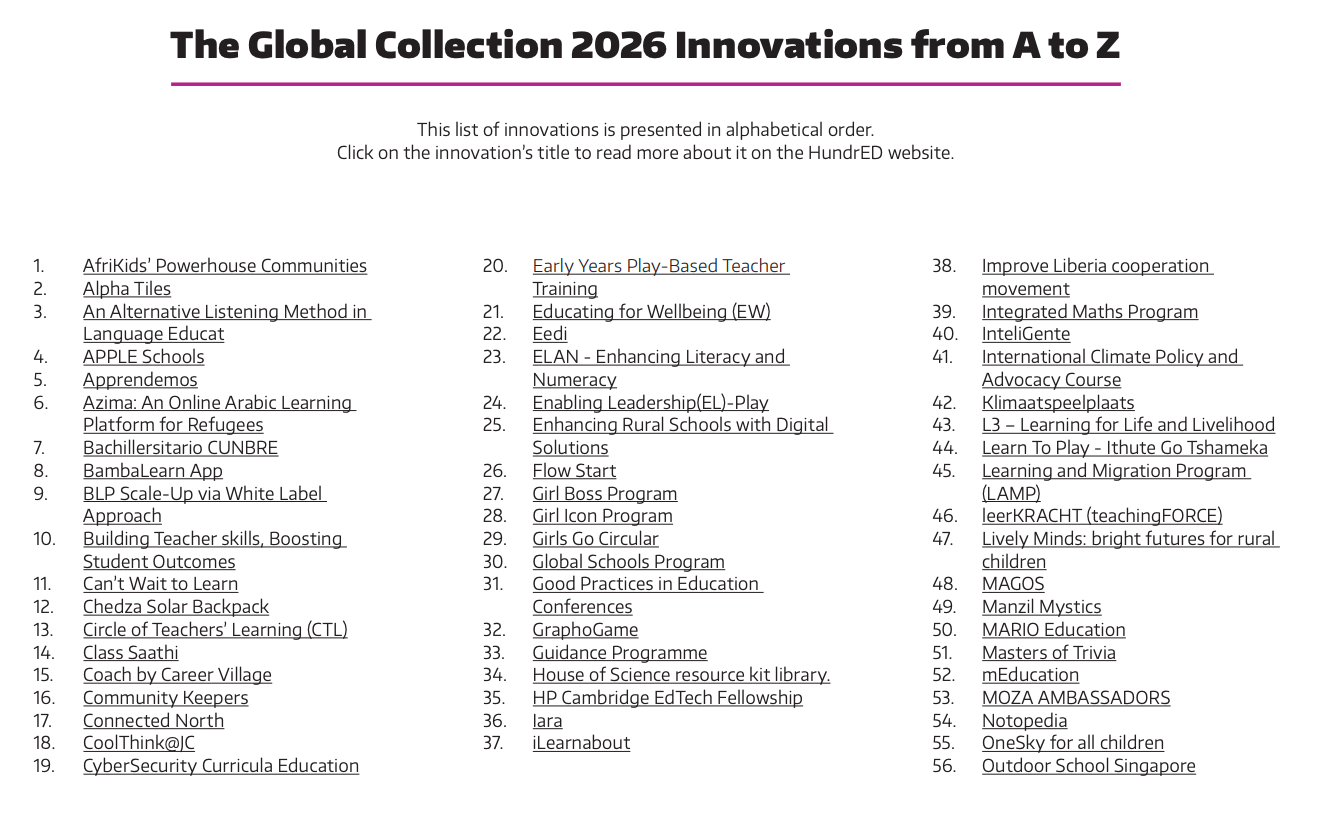
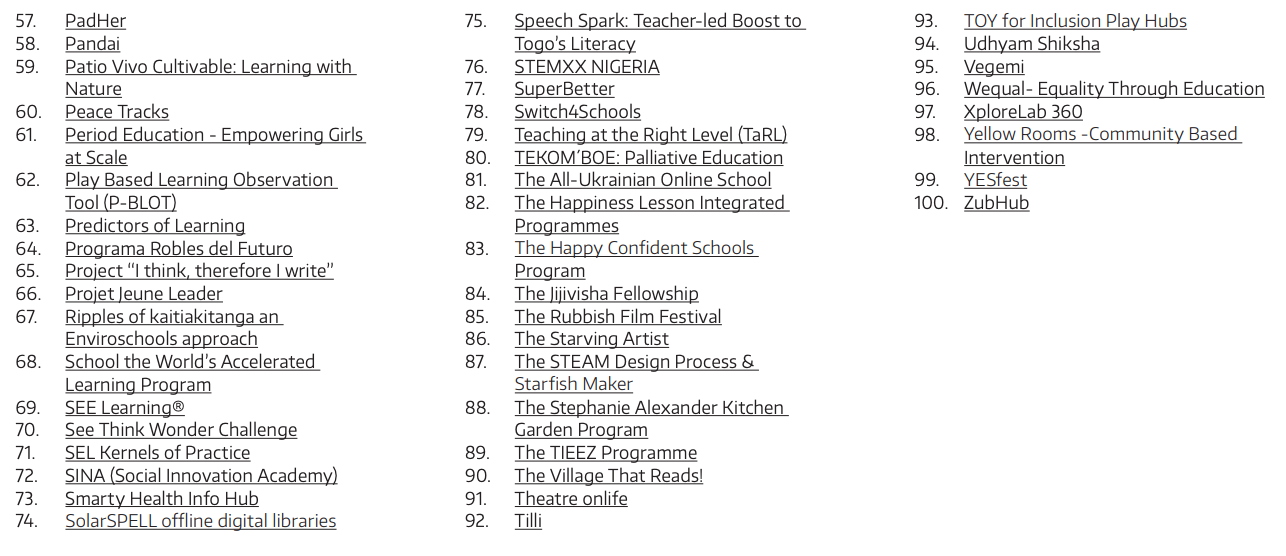
This week’s post highlights education innovations from the 2026 Global Collection curated by HundrED. HundrED was established in 2015 to support the identification and implementation of scalable education innovations worldwide. Since 2017, HundrED has celebrated the annual global collection at an Innovation Summit, which this year was held in conjunction with the WISE summit. To see how this year’s collection of innovation comparesto previous years, see the IEN posts on the HundrED Global Collection for 2025, 2024, 2023, 2022, 2021, & 2019.
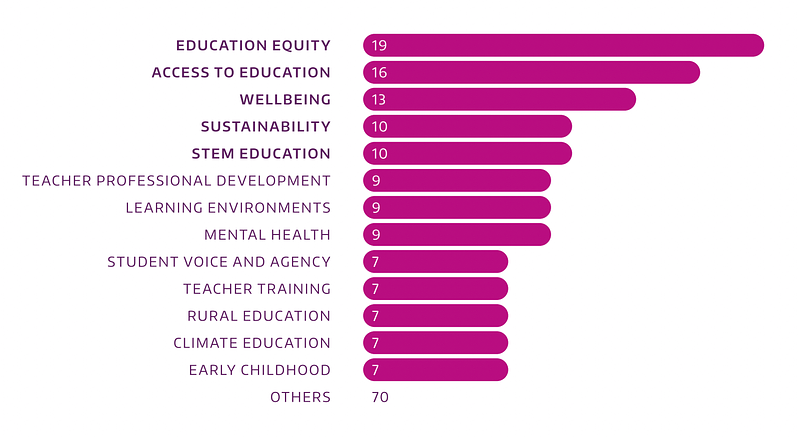
HundrED’s Global Collection for 2026 featured one hundred solutions from six continents selected from more than 800 submissions. The report on the 2026 Global Collection noted that common themes among year’s innovations were access to education, equity, wellbeing, and creativity as well as a 100 percent increase in the number of innovations using some form of educational technology. Some of the panels from the Innovation Summit discussed key findings from the report and introduced this year’s innovations.
In November’s Lead the Change (LtC) interview Edwin Nii Bonney emphasizes that educational research and practice must “look back” by acknowledging colonial legacies and marginalized histories while “looking forward” by centering Indigenous, vulnerable, and community voices. His work highlights deep listening, intergenerational collaboration, and community-designed solutions as essential to dismantling deficit narratives and creating equitable educational systems. The LtC series is produced by Elizabeth Zumpe and colleagues from the Educational Change Special Interest Group of the American Educational Research Association. A PDF of the fully formatted interview will be available on the LtC website.
Lead the Change (LtC):The 2026 AERA Annual Meeting theme is “Unforgetting Histories and Imagining Futures: Constructing a New Vision for Educational Research.” This theme calls us to consider how to leverage our diverse knowledge and experiences to engage in futuring for education and education research, involving looking back to remember our histories so that we can look forward to imagine better futures. What steps are you taking, or do you plan to take, to heed this call?
Dr. Edwin Nii Bonney
Edwin Nii Bonney (ENB): As someone who grew up in Ghana and went through K–12 and college there, I have come to appreciate the wisdom of my elders. That wisdom, often carried in proverbs and the principle of Sankofa, reminds us to look back and learn from the past so that we do not repeat its mistakes. In my scholarship, I wrestle with the reality that educational systems remain deeply embedded in coloniality. We are still grappling with the legacies of colonialism especially in the global South, and those legacies have not disappeared (Bonney, 2022). They persist in the languages we speak and use to instruct students, the books we read, our perceptions of ourselves, our standards of beauty, and even our justice systems (Bonney, 2023; Bonney et al., 2025a). Colonialism continues to shape much of who we are and how our societies function. It is essential that we acknowledge that the legacies of colonialism are still with us. It was not that long ago, and its effects continue to reverberate in our educational systems and beyond.
Having lived and schooled in four different countries, I have come to realize that in every society there are marginalized and vulnerable groups. The dominant discourses in any context, whether social, cultural, or educational, are often so pervasive that marginalized voices, ideas, and ways of knowing are easily erased or silenced. Indigenous wisdom, local knowledge, and community customs are frequently pushed aside. This understanding shapes how I approach my scholarship. We must continually examine how educational leadership, policies, and practices have historically and presently marginalize the ways of being, speaking, and doing of those who are not part of dominant groups. Whether in the United States, Ghana, or elsewhere, there are always minoritized voices whose perspectives are excluded from how education is designed and enacted. Because of that, I believe it is vital to ask how we center the ways of speaking, knowing, and being of Indigenous, marginalized, and vulnerable communities in education. How do we ensure that their experiences and insights shape what we study, how we study it, and how we interpret what we learn?
“We must continually examine how educational leadership, policies, and practices have historically and presently marginalize the ways of being, speaking, and doing of those who are not part of dominant groups.”
In my own scholarship and service, I see my role as coming alongside communities and families, not as an expert above them but as a partner who recognizes them as experts of their own experiences. They understand the root causes of the challenges they face and often hold the wisdom to identify meaningful solutions. In Bonney et al. (2025a) in listening to students who had not been able to obtain passing grades in Math, many of them, after retaking the exam multiple times, I learned that they struggled to understand and make sense math concepts taught in English. They felt like failures until they went against the norm as experts of their own experiences to learn in their native languages. Learning in their own native language according to these students brought them success on the first try even though the system told them it was impossible. As we think about the future of education and research, we must keep asking: whose voices are missing from the table? Whose perspectives are absent from the design process? Which families are not engaged in our schools, and how do we empower them to participate fully? We must always ask who we are not serving well and how we can do better. When we look back at history, we see that we have not always served everyone equitably. Therefore, it must remain at the forefront of our work in education to ask, whose voices are we still not hearing?
“I see my role as coming alongside communities and families, not as an expert but as a partner who recognizes them as experts of their own experiences.”
LtC: What are some key lessons that practitioners and scholars might take from your work to foster better educational systems for all students?
ENB: Much of the work I do alongside educational leaders, students, and families begin with listening. It starts with listening deeply to the experiences of different groups and how they encounter systems of oppression. This kind of listening is to not to defend or to critique but to learn from their perspectives, their realities, and their ways of knowing and being. The next principle is building relationships across generations and forming coalitions among groups who are affected by similar problems of practice or systems of oppression. When these coalitions come together around community-informed problems and community-designed solutions, we are better able to address the issues that matter most to them. In Bonney et al. (2025b), I share about a community-based organization that brings together everyone in their village from as young as seven years to as old as 80 years. The organization gathers the elders to recount stories about the history of their community in their native language. The young people record and document the oral history and then create plays in their native language, where they dramatize the stories on digital media and on stage to be a resource for local schools because there were no resources to teach their native language other than English. This community led movement was in decreasing use of their native language. Communities understand their own challenges, and when they help design the solutions, those solutions are more authentic, effective, and sustainable (Costanza-Chock, 2020). Through these relationships and through genuine listening, we can begin to challenge deficit discourses and narratives that blame individuals instead of systems for the inequities we see in education. Deficit thinking overlooks structural causes and often misplaces responsibility. But lasting change requires us to shift our attention to the systems, policies, and practices that create and sustain inequity.
Change in education will come only through broad coalitions that include not only researchers and educational leaders but also students, teachers, families, community members, elders and even naysayers. Their knowledge, lived experiences, and cultural wisdom are essential for reimagining a more just and equitable educational future. As we engage in this work, it is important to keep asking which solutions are working, for whom, and under what conditions (Hinnant-Crawford, 2025). Sometimes a solution may appear successful in one area but create unintended problems in another. When that happens, we must be ready to respond quickly to stop any harm. Change is not static; it is a continuous and reflective process. At the heart of this work is a simple but powerful truth: we must be intentional about involving those most affected by the problems we aim to address. We must center community expertise, engage families and students as co-creators of change, and together expose even small variations in outcomes for students as opportunities to learn. Finally, we must continue to seek out and listen to the voices and stories of those still impacted by systems of oppression or persistent inequities. Because meaningful change in education begins with listening, building relationships and broad coalitions that endure when we work together to challenge inequitable systems and co-create a more just future. These are the foundational blocks to a justice-oriented improvement approach to undo oppressive systems in education.
“[M]eaningful change in education begins with listening, building relationships and broad coalitions that endure when we work together to challenge inequitable systems and co-create a more just future”
LtC: What do you see the field of Educational Change heading, and where do you find hope for this field for the future?
ENB: The nature of change is that it always comes with uncertainty. Sometimes that uncertainty can bring frustration on one hand or excitement on the other. We can never fully know what the future holds or what the field might look like. We cannot predict what new policies, reforms, or interventions will emerge, or what discourses will shape the field. What I do know is that we can always look back to learn. We can recognize that, as a society and as a field, there are things we’ve done well and others we have not. One of our core goals must be to serve all children well. That means preparing researchers, educational practitioners, students, and teachers so that we can meet the diverse needs of all types of learners. It also means continuing to prepare teachers for a field that is increasingly complex with diverse students who have diverse needs. It also means preparing educational leaders to create inclusive and collaborative environments that enable teachers and staff to do their best work to serve students equitably.
So, although there is uncertainty about the future, one thing we can hold on to is that we know what we value and how to prepare for that future, whatever it looks like. More than what gives me hope is what energizes me. In Bonney et al., (2024) we created an edited volume, to center and hear from educational practitioners on the front lines and how they work with students, teachers, parents, and community to tackle problems of practice in their local schools and districts. In times of uncertainty, the best people to hear from are those on the front lines. Working alongside with these scholars, educational leaders, and practitioners, in the trenches trying to figure out how to serve all students well makes me expectant that things will change continuously for the better. They’re asking critical questions: How do we better support our teachers? How do we solve problems of practice? How do we address discipline issues or chronic absenteeism? How do we engage families more effectively? How do we reduce the overrepresentation of Black and Brown students in special education? How do we increase their representation in gifted and Advanced Placement courses? These are the kinds of questions that inspire hope for the future. Even though the future may be uncertain, we can still prepare for said future. Personally, I am not as concerned about where the field of educational change is heading but rather about preparing my students and practitioners for today’s challenges. I believe that the same justice-oriented and community-centered approach to solving today’s problems will help us address the problems of tomorrow.
To celebrate Thanksgiving in the US, IEN continues its annual tradition of recognizing some of the many groups and individuals who are supporting learning and education around the world. This week, we celebrate the educators and organizations we profiled this year from China, Estonia, Vietnam,
Pushing the boundaries of the conventional school: Indrek Lillemägi talks about the development of a new upper secondary school in Tallinn, Estonia (Part 1; Part 2)
Can Vietnam transform the conventional model of schooling? Educational improvement at scale (Part 1Part 2)
“Will Vietnam be leading the way in transforming the conventional model of schooling that has dominated education for more than 100 years?“
Something’s Happening Here: Gregg Behr on the Evolution and Expansion of Remake Learning and Remake Learning Days (Part 1; Part 2)
Photo by Howard Lipin
Establishing the Children and Families Agency and Promoting Digital Transformation in Childcare: Hiro Yokota on the Development of a “Child-Centered Society” in Japan (Part 1; Part 2)
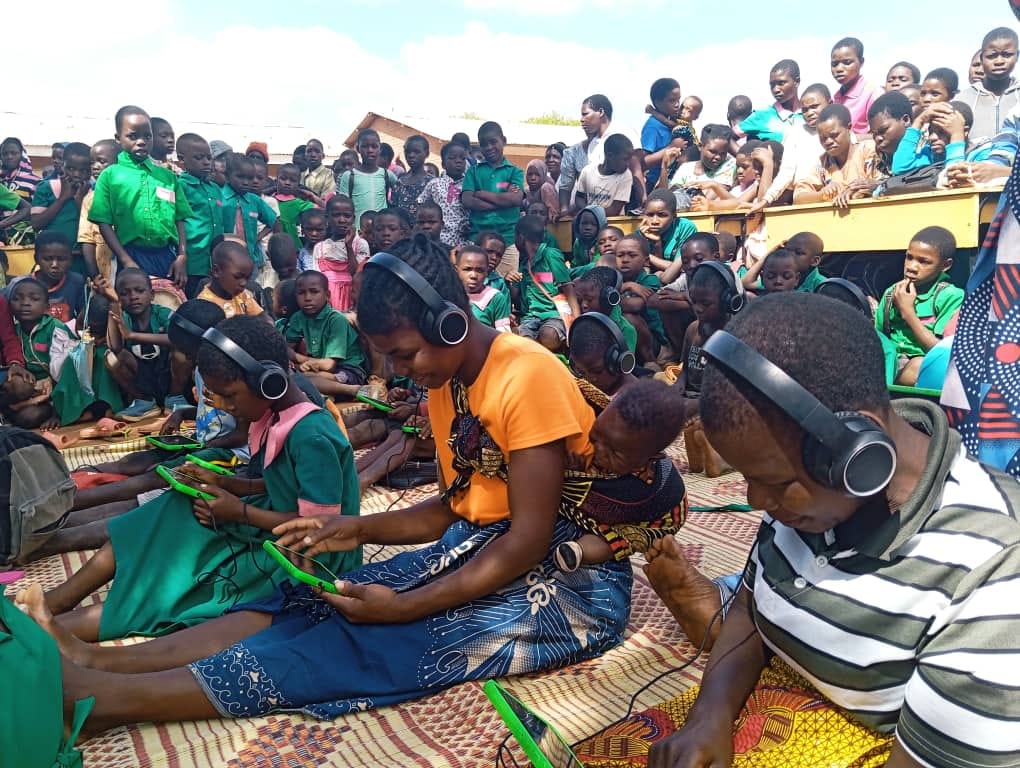
Bringing a Tablet-Based Foundational Learning Program to all the Primary Schools in Malawi: Joe Wolf and Kira Keane on the Evolution of Imagine Worldwide (Part 1; Part 2)
The school closures of the COVID-19 pandemic disconnected children around the world to critical sources of food, including school meals. Fortunately, educators, community members and others have developed a host of new mechanisms, resources, and partnerships to make sure children get access to healthy and healthier meals. These “micro-innovations” include new ways to work with community partners, including farmers, nonprofits, chefs, and local vendors and local ingredients to improve nutrition, strengthen regional economies, and increase student engagement. Other developments include using centralized kitchens and new policies and regulations to increase production and lower barriers to access. A few notable efforts also show how several countries have reworked funding structures to sustainably scale school meal programs. All these initiatives are helping to reduce costs, elevate meal quality, and ensure every child can eat with dignity and ease.
How to Use Community Partners and Local Ingredients
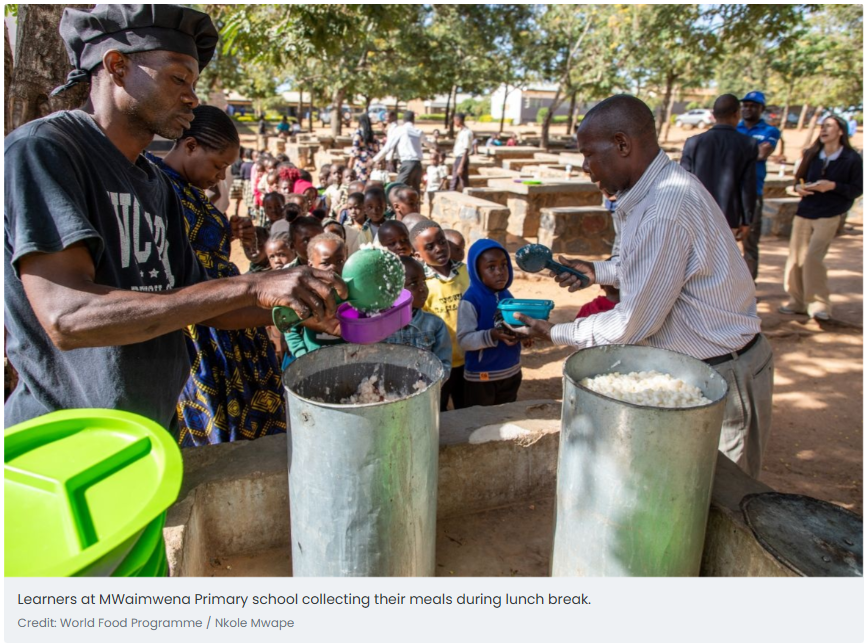
Zambia: Schools across Zambia are receiving funding from the One Hectare Program to support student run gardens and greenhouses. These gardens help supply school meals and make the community less vulnerable to drought and famine; it functions not only as extra food but also an opportunity to learn. The gardens are taken care of by the students who learn valuable skills such as “drip irrigation, organic sack gardening, and environmental protection.”
Kenya: In 2024, Kenya launched its national chapter of the school meals coalition and created a meals program that focuses on relying more on regional resources by employing local farmers growing region specific foods such as sorghum, cowpeas and potatoes. This not only increases the nutritional value of school meals but also supports local small business farmers. In collaboration with the Ministry of Health and the World Food Programme, the Ministry of Education is also developing a national menu guide in order to encourage the production of more sustainable and diverse meals.
France: Legislation has been passed to accelerate the transition to a more sustainable and healthier diet. Regulations put in place since 2021 include requirements for certain percentages of ingredients to be purchased from local and sustainable sources and specify some meal content for school lunch programs. For example, “out of 20 meals, children must be offered no more than four starters with a fat content of 15% or more; at least four fish-based meals (or a dish containing 70% fish or more), and at least 8 whole-fruit desserts.”
Hawai’i: The State Department of Education created a pilot meals program, the ’Aina Pono Farm to School initiative. Through the pilot program, students at schools such as Mililani High School in Oahu were able to sample various healthy, less processed dishes and give their personal feedback on menu choices. As a result, students ate far more of the meals on offer, reducing food overproduction at the school by 20%.
Tasmania: Schools in Tasmania are outsourcing at least one day of food preparation to local charity. Loaves and Fishes get produce from local vendors and cook the food either on or off site. These schools are selected through a competitive application process.
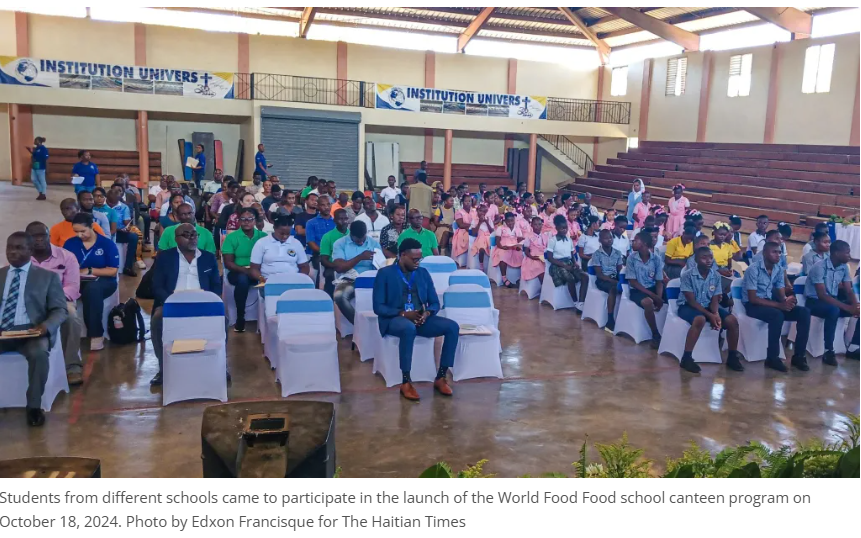
Haiti: Local farmers in Haiti’s Northeast strengthen nutrition and economy by supplying food to school canteens. The World Food Program purchases up to 9,990 tons of local produce to support struggling farmers and supply school meals to approximately 15,000 students across 200 schools with local nutritious food.
New York City: The “Chefs in the Schools” initiative brings in local professional chefs to create nutritious cost effective menus for schools. The chefs also provide training for staff.
Canada: Canada’s first national school food program, funded by 1 Billion dollars in federal funds, is rolling out amid rising need, with provinces and local providers striving to expand hot meal offerings despite funding gaps, aging infrastructure and growing demand from families struggling with food costs.
Using Centralized Kitchens:
France: Centralized kitchens in France prepare 6,000 to 10,000 servings a day of high-quality food following strict food safety protocols. This cuts down on cost and increases quality.
Hawai’i: The Hawaiʻi’s Farm to School Action Plan connects schools with local farms to provide fresh, nutritious meals, support farmers, and promote sustainable food systems through a regional kitchen model and community collaboration.
Sweden: A pilot program transforming school canteens with student-designed spaces, surplus-produce energy bars, and sustainability initiatives has boosted engagement and healthy eating while highlighting the need for long-term investment and multi-agency collaboration to sustain its success.
Lowering barriers to food
Africa: Food4Education (F4E) is transforming school feeding in Africa through a sustainable, locally sourced model that provides nutritious, affordable meals while supporting local farmers and communities. By 2030, they aim to feed 1 million Kenyan children daily and help other African governments feed 2 million more, creating a scalable blueprint to end classroom hunger across the continent.
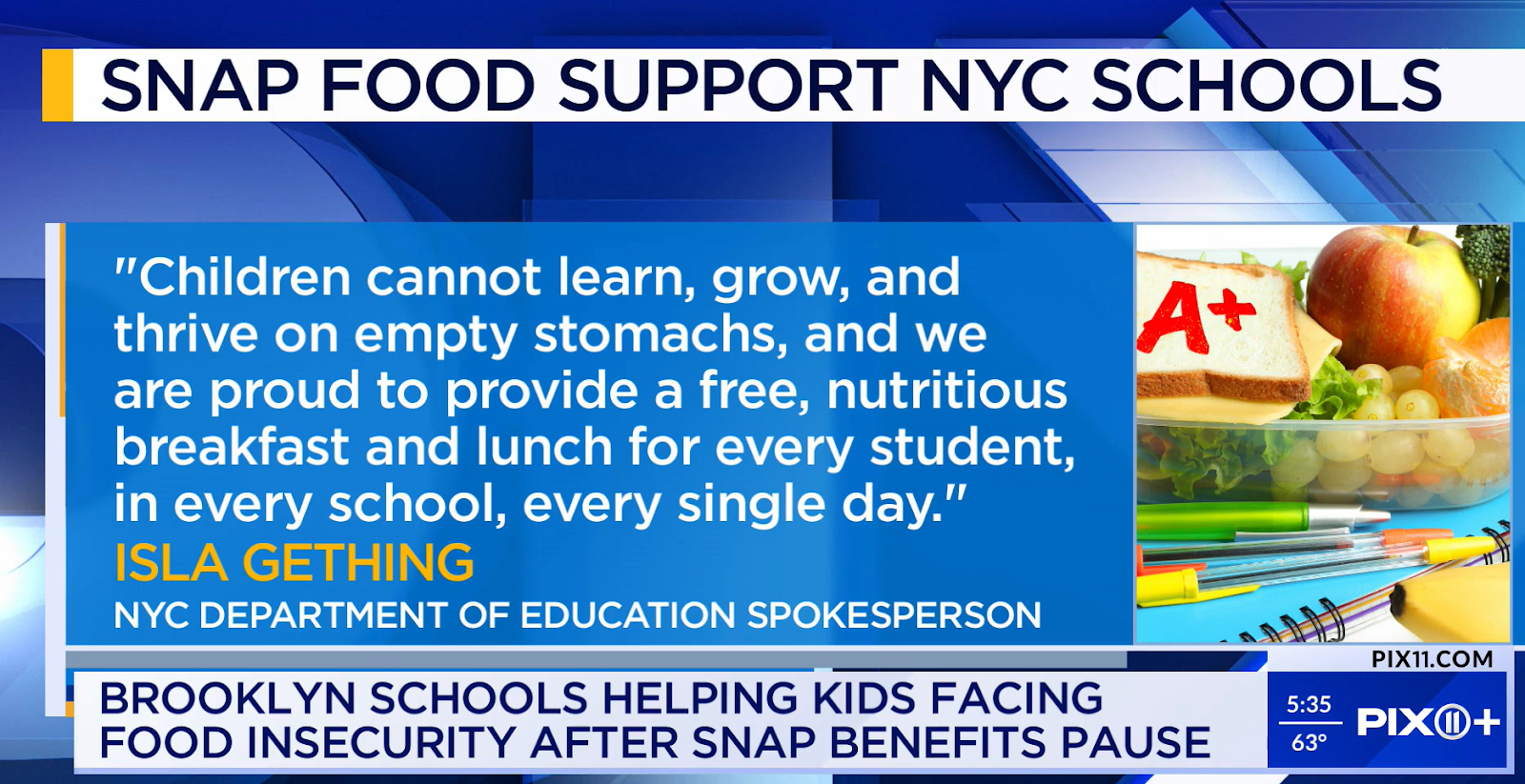
New York City: In response to rising concerns about federal budget cuts to SNAP, the Supplemental Nutrition Assistance Program, a school in Brooklyn has partnered closely with the community organization El Puente and other stakeholders to support their students.
Colorado: All Colorado public school students will continue to have access to free school meals after voters approved two state referendums on November 5th, 2025, one of which — Proposition MM — will raise state income taxes for those earning an annual income of $300,000 or more.
United States: A streamlined certification structure has been implemented for a summer food assistance program launched last year. In the first year, some families missed out on Summer food benefits because of confusing enrollment, limited outreach, and short deadlines, despite the program proving highly effective for those who received it. To address the problem, more families will be enrolled automatically, if they are on certain public benefit programs, including free and reduced price school lunch.
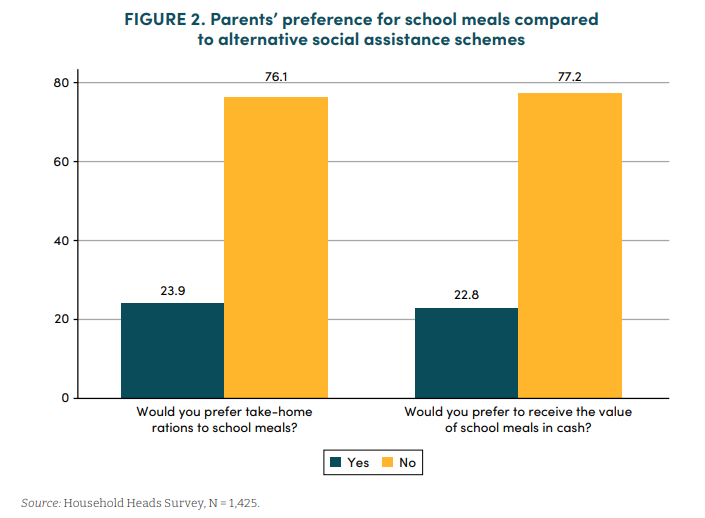
Ghana: The Ghana School Feeding Programme has found most Ghanaian caregivers prefer on-site school meals over cash or take-home rations, with their choices shaped by program satisfaction, time constraints, and local food prices, suggesting school feeding programs could be more effective by tailoring modalities to regional and household needs.
United States: Starting in the 2027–28 school year, the USDA will ban online processing “junk fees” for students eligible for free or reduced-price school meals, aiming to expand the policy in the future to ensure all children can access healthy school meals without extra charges.
California: Schools are offering food trucks to boost lunch participation. Called the Cruisin’ Cafe, the food truck gets more seventh- and eighth-grade students to eat lunch during school. Students won’t have to pay anything for their meals or walk across campus to get lunch at the cafeteria.
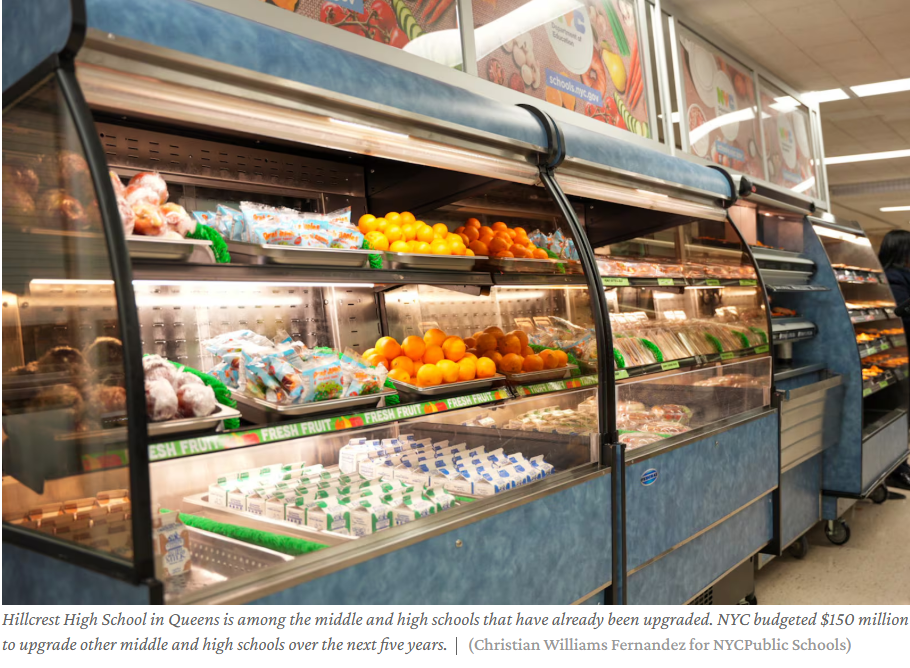
New York City: New York City is investing $150 million to expand modern, café-style cafeteria upgrades to more schools after seeing that redesigned dining spaces boosted student participation in school meals and helped reduce stigma amid rising child food insecurity.
United States: Districts are using the federal Community Eligibility Provision to offer free school meals by strategically clustering schools to maximize reimbursement, clearly communicating and reassessing eligibility data each year, and boosting revenue through expanded breakfast programs like breakfast-in-the-classroom or breakfast-after-the-bell.
Changing Financing Systems
Bolivia: Since 2000, the government in Bolivia has supported what has come to be called the Complementary School Meals Program. By 2019, with investments of more than 100 million US dollars, the program provides school meals to more than 2.2 million students – almost 80% of all school-age children and youth. To fund the program, the government has turned to taxing natural resources, specifically hydro carbons, program.
Mozambique: In Mozambique, $40 million in debt service payments were channeled to school meals by using debt swaps and broader debt relief strategies to redirect repayments toward national education and nutrition priorities.
One of the many repercussions from the COVID-19 pandemic was a world-wide hit to students’ health and wellbeing. In particular, proper nutrition and food insecurity was greatly affected by the pandemic and the lockdowns as many students around the world could not get food and food related support at their schools. In Part 1 of this two part series, Sierra Bickford takes stock of the impact school nutrition programs have globally and highlights the effects of these high-impact interventions. Part 2 will scan recent news and research to find some of the many micro-innovations – new developments in practices, structures, and resources in different contexts – that have been implemented to combat this rise in student food insecurity. These posts are part of IEN’s ongoing coverage of what is and is not changing in schools and education following the pandemic school closures. For more on the series, see “What can change in schools after the pandemic?” For related examples of micro-innovations in other areas, see IEN’s coverage micro-innovations to strengthen student relationships, to increase access to college and careers and to improve tutoring: Building Student Relationships Post-Pandemic in School and Beyond; Still Worth It? (Part 1); New Pathways into Higher Education and the Working World? (Part 2); Tutoring takes off and Predictable challenges and possibilities for effective tutoring at scale.
Food insecurity, particularly among children, was one of the critical problems exacerbated by the COVID-19 pandemic and the related societal shutdowns. Estimates suggest that, during the pandemic, the number of people experiencing food insecurity doubled from about 135 million to more than 270 million. In India alone, household food insecurity skyrocketed from 21% in December 2019 to 80% in August 2020, at the same time that diet quality decreased. By the end of 2021, the UN warned that over 43 million people in 38 countries, including Ethiopia, Somalia, South Sudan, Afghanistan, and Yemen, were at risk of experiencing famine or famine-like conditions.
“Estimates suggest that, during the pandemic, the number of people experiencing food insecurity doubled from about 135 million to more than 270 million.”
Even in wealthier countries household food insecurity increased substantially. In the United States, that meant a rise in households experiencing food insecurity from 11% in 2018 to 38% in March 2020. In a report from 2020, the US Census’s Household Pulse Survey estimated the rates of food insecurity had doubled overall, and tripled among households with children. In the wake of the pandemic, school systems, despite vastly different conditions and challenges in different contexts, are working to reestablish nutrition programs and create new strategies to get children access to nutritious balanced meals.
The impact of school based nutrition worldwide
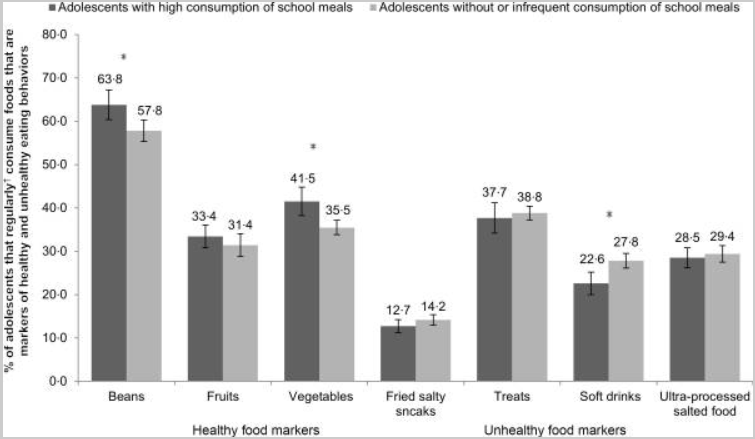
Across the world, school meals have been shown to be a worthwhile intervention with high positive impact on health and learning outcomes. In high income countries, such as those in the United Kingdom, access to nutritious school meals are associated with lower obesity rates. In Sweden, school meals with regulated nutrition requirements have been shown to increase educational attainment, health outcomes, and income across lifetime. One study found that low income families with children in Sweden who received free school meals increased their lifetime income by 6%. The effects that these interventions have on European health care costs estimate “that the return from investment in school meal programs is at least sevenfold, up to a possible €34 for every €1 spent.”
“The effects that these interventions have on European health care costs estimate “that the return from investment in school meal programs is at least sevenfold, up to a possible €34 for every €1 spent.”’
Data from low and middle income countries also support the implementation of free school meals, particularly for increasing attendance and retention. In Burkina Faso female students who were given take-home food attended school at least 90% of the time. Similarly in Bangladesh, the introduction of free fortified biscuits “increased enrollment by 14% and reduced school dropout by 7%.” Nutrition programs in low and middle income countries have been shown to positively affect learning outcomes as well. In India, access to free school meals is associated with higher cognitive outcomes and an 18% increase in literacy test scores. As in the United Kingdom, in Brazil students who were being supplied meals at school were more likely to reduce their intake of unhealthy foods and increase the presence of nutritious food in their diet, which leads to better health outcomes.
The impact of school based nutrition in the United States
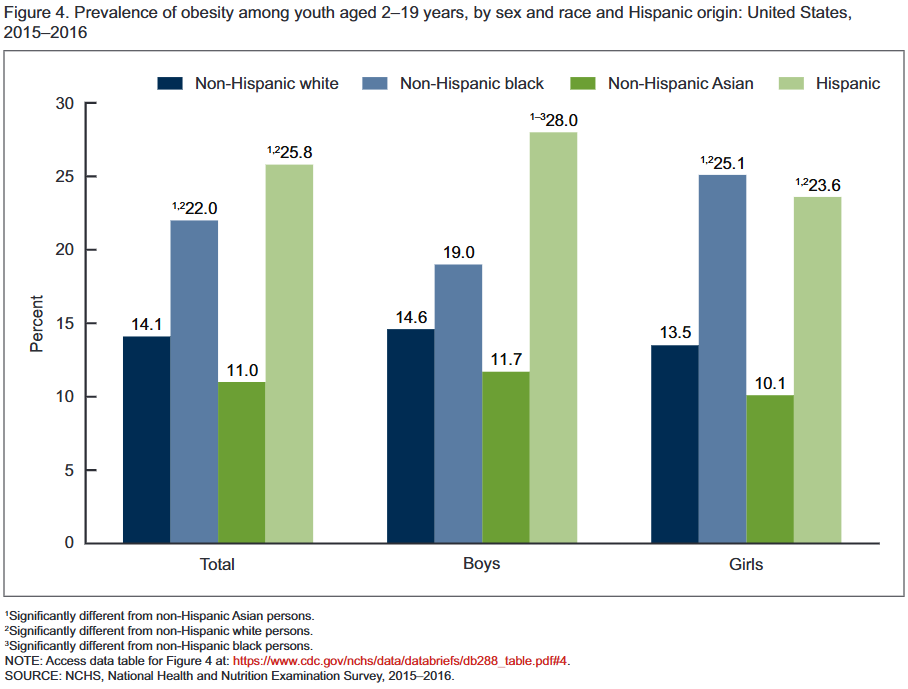
In the US, the National School Lunch Program has long been the primary vehicle for supporting students’ nutritional needs. Around 95% of US elementary, middle, and high schools take part in the program and about 75% of the meals provided through it go to children from low-income families who qualify for free or reduced-price lunches. Students who consistently consumed these meals were more often from low-income households and more likely to be non-Hispanic Black or Hispanic compared to those who didn’t participate. As a consequence, the program is one key means of addressing nutritional and health inequalities in the US, where non-Hispanic black and Hispanic children aremore likely to be overweight or obese and have lower quality diets than white children.
Despite this evidence, the budget bill promoted by the US administration and passed by Congress this past summer reduces funding for federal health and food programs. Estimates from the School Nutrition Association suggest that the bill could create a ripple effect of food insecurity for American children. This ripple effect will include fewer children automatically being eligible for SNAP and school lunch programs as well as fewer schools being able to enroll in Community Eligibility Provision. Nonetheless, even as these cuts are being made, schools and communities across the US and around the world are continuing to develop new ways of reaching more and more children and families and increasing access to higher quality and healthier food.
In October’s Lead the Change (LtC) interview Bernardo Feliciano’s discusses his work through the AITeach Co-design Lab at UMass Lowell; this work brings educators, researchers, and technologists together to co-create strategies and tools for teaching in this age of AI. The LtC series is produced by Elizabeth Zumpe and colleagues from the Educational Change Special Interest Group of the American Educational Research Association. A PDF of the fully formatted interview will be available on the LtC website.
Lead the Change (LtC): The 2026 AERA Annual Meeting theme is “Unforgetting Histories and Imagining Futures: Constructing a New Vision for Educational Research.” This theme calls us to consider how to leverage our diverse knowledge and experiences to engage in futuring for education and education research, involving looking back to remember our histories so that we can look forward to imagine better futures. What steps are you taking, or do you plan to take, to heed this call?
Bernardo Feliciano (BF): Currently I am working with colleagues to build a co-design lab that brings together educators from very different contexts to develop approaches to teaching and learning in a world where generative AI is a reality. The lab is called the AITeach Co-design Lab @ UMass Lowell. (The hyperlink goes to one of many one-pagers we have been developing for partners representing different disciplines and sectors).
Bernardo A. Feliciano, Ph.D.
In the AITeach Co-design Lab, as collaborators we aim to create a structured space where we as a diverse group of educators, researchers, and technologists co-develop practical tools, strategies, and prototypes that respond to the reality of generative AI in education. The intention is not only to design usable products but also to study how to structure co-design itself to help schools navigate AI’s challenges and opportunities. In our co-design sessions, educators, researchers, and technology build spaces where we can address challenges in education and AI that are too complex for any one actor to solve (Snowden & Boone, 2007; Senge, 1990). The Lab functions as a structured environment where we can bring our problems of practice, iterate on small pilots, and use those cycles to build local capacity rather than waiting for top-down policy.
As an adjunct professor, I am also teaching a class on family and community engagement with schools. These roles constantly remind me that people bring distinct personal, professional, and institutional histories into every space. For me, futuring is less about projecting a single vision of “Education with a capital E” and more about the relational, actor-to-actor work of helping people shape their futures from the personal, professional, and institutional histories they inherit. That’s the direction my work is taking me.
The way I approach this is by convening diverse groups around developing tangible projects. The process matters as much as the specific product, whether it’s a research article, curriculum binder, a chatbot teaching/learning companion prototype, or a strategy for helping parents connect to schools. What is essential is how people can communicate their histories, connecting, adapting, negotiating, and reworking them to address problems in the present into a viable future. The varied personal and institutional histories participants bring are neither external resources to be tapped nor barriers to be overcome, but active materials in our negotiation of effective, situated teaching and learning. Innovation emerges as members work through these histories, adapting them in relation to one another to meet particular needs. I may not care whether my own work is labeled research, practice, or a mix of both, but as co-designers we must respect each other’s perspectives, even as those perspectives shift through negotiation. AI brings this into focus. At its core, AI is an immense bank or reservoir of the past, trained on and providing access to what is already known or has already been done. The future is not contained in the AI itself—nor can it be left to AI to imagine for us. The future comes from how we draw on that past to build something meaningful with and for the people in front of us. We explore generative AI as both a design partner and an object of study. Co-designers prototype tools like tutoring agents or parent communication bots, while also interrogating what it means to teach with, against, or around AI in everyday classrooms.
Of course, I have to use my own history, experience, and learning as a researcher, teacher, administrator, entrepreneur, and non-profit professional to leverage the network of histories that generative AI offers. But more than before, I can inform, contextualize, and connect the convening and teaching I do now with the work of so many more people and peoples (to some extent) who came before.
LtC: What are some key lessons that practitioners and scholars might take from your work to foster better educational systems for all students?
BF: One lesson is that teachers cannot be treated as passive implementers of someone else’s design. Too often, educational change is imagined as developing a curriculum or program in one place and distributing it everywhere. That assumes context does not matter and is peripheral rather than integral to learning and teaching. Our relationship to knowledge is always relational and always contextual.
Education has always lived in the complex space where cause and effect are only clear in hindsight (Snowden & Boone, 2007). Simon (1973) describes these as ill-structured domains existing in a state of dynamic heterogeneity in which diverse elements and relationships continually shift, preventing stable equilibrium and requiring ongoing adaptation (Pickett et al., 2017). Ill-structured problems cannot be solved by importing outside solutions but only by negotiation among those struggling with them. I do not believe that educational change—or improvement—comes from a fixed product or process delivered with fidelity. It is an ongoing process of learning through which people shape what they inherit—choosing what to keep, what to adapt, what to reject, and what to forget. It is a process I have found universally involves dynamics of local alliances, conflicts, and negotiations. The lesson I take from this is that if you want to improve schooling, you have to engage with the people who are doing the teaching and learning.
“We explore generative AI as both a design partner and an object of study . . . If you want to improve schooling, you have to engage with the people who are doing the teaching and learning.”
Working on my dissertation underscored this point. I wrote about using one-on-one meetings in a researcher-practitioner partnership to organize co-designing a computer science (CS) curriculum for middle schools. My experience brought home to me that there is no such thing as “shared understanding.” What emerges is never a single, final agreement but alignment good enough to act together, sustained through negotiation as perspectives shift. For example, teachers and researchers sometimes differed on how much detail a lesson plan should contain. Some wanted highly specified steps, others only broad outlines. Rather than force uniformity, we kept both versions and moved forward. That flexibility allowed the work to continue without pretending the difference had been resolved.
My work with different kinds of organizations has shown me how funding and infrastructure shape what is possible. This point is kind of obvious but still seems to bear repeating. Creativity and goodwill are not enough without sustainable and intentional support. For example, in the CS Pathways partnership, we shifted from MIT App Inventor to Code.org’s App Lab during remote learning. That solved one problem but created new ones around district procurement and accounts, showing how infrastructure shapes outcomes. In our recent Lab kickoff meeting, one participant noted that even when AI-enabled data tools existed, district procurement rules blocked their use — showing how funding and infrastructure filter what is possible.
At the same time, I saw that students’ and teachers’ own histories can be powerful resources for change, if we work out how to support them as they need to be supported. In one part of the CS Pathways project, students framed their app design around civic issues in their community, such as neighborhood safety and access to resources. Their lived experiences pushed the curriculum beyond abstract coding skills into work that mattered locally. This reframed computer science as a civic as well as a technical practice and shaped how we sequenced and supported instruction in those classes.
LtC: What do you see the field of Educational Change heading, and where do you find hope for this field for the future?
BF: In my experience, the field often moves toward building monoliths: “the system,” “the conceptual framework,” “the workforce,” “education technology.” Instead of these monoliths, we need to work with lesson plans and pacing decisions that make up “the system,” the overlapping frameworks that guide practice rather than a single “conceptual framework,” the varied teacher and student histories that constitute “the workforce,” and the specific tools and artifacts, from binders to chatbots, that become “education technology.” Monoliths can make things easier to talk about but also risk obscuring the negotiations and translations that are inseparable from those very systems. These relational dynamics are not add-ons. They are the system itself, as much as the actors are (Latour, 2005). As in the earlier example of teachers’ differing preferences for lesson plan detail, the system took shape through the negotiation itself, not through a fixed agreement imposed from outside.
“Relational dynamics are not add-ons. They are the system itself.”
I would like to see the field shift toward paying closer attention to the actor-to-actor interactions and dimensions. That is where change takes shape: when people with different histories and contexts negotiate how to carry those histories forward. I see promising work moving in this direction: Playlab.ai’s participatory approach to AI tool-building, Victor Lee’s co-design of AI curricula with teachers, Penuel and Gallagher’s (2017) and Coburn et al.’s (2021) and others’ emphasis on research–practice partnerships , and Bryk et al.’s (2015) improvement science cycles. The Cynefin co-design principles we are enacting in AITeach — probe, sense, respond — are themselves evidence of a field moving toward valuing negotiation and adaptation over fixed models (Snowden & Boone, 2007).
This is also where I find hope. In my dissertation research, I have seen how a small change in the structure of a meeting can reshape how colleagues relate to one another. Having a teacher go first in one-on-one meetings shifted the dynamic, allowing their concerns to set also frame a negotiation rather being a response to requirements. I have seen middle school students reframe ideas in ways that exceeded what I could have planned, such as attempting to build an app to help students and teachers share resources more effectively in school. Students translated apps they were familiar with into tools for their own purposes, which required reimagining instruction around their designs rather than trying to make pre-existing apps seem interesting. This approach may cause an instructional headache but least it provided an authentic motivation for learning an aspect of coding.
Some might call this the interest or work “micro-level,” but I avoid that term because it suggests hierarchies and fixed layers. I prefer to describe it as the translational dimension: the ongoing work of shaping futures from inherited histories by deciding what to keep, what to adapt, and what to let go.