The current narrative of education stagnancy or decline is misleading. That’s the key argument in this excerpt from a recent paper from Micheal Kirst and Victor Eliot Hau Hong Chan. To make that argument, Kirst and Chan draw on a variety of data from students from ages 15-25 that shows a pattern of growth and progress in Advanced Placement, dual enrollment (i.e., combining high school and college), four-year colleges/universities growth and completion, apprenticeships, certificates, and credentials. The full paper was published in April 2026 as part of the Research and Occasional Papers Series from the UC Berkeley Center for Studies in Higher Education. Kirst is Professor Emeritus of Education at Stanford University and the longest serving President of the California State Board of Education. Chan has an MA from Stanford University. Some images in this post are drawn from the Mike Kirst Biography project produced by Richard K. Jung. For previous posts from IEN on the work of Michael Kirst see “Big Infrastructure, Big Capacity Building, and State-Wide Scale-Up…”: Mike Kirst on the Need to Revitalize Standards-Based Reform and Making public policy work for education: Reflections on the career of Mike Kirst
+++++++++
For decades, the performance of the American education system has been largely judged by one narrow set of indicators: K–12 standardized test scores that encompass both national and international units of analysis (Hatch, 2021). Proponents of such assessments argue that test scores matter for many things, including national economic prosperity and growth (Hanushek, 2015). The predominant narrative about such data argues that over a long period of time, U.S. scores have either declined or remained stagnant (National Assessment of Educational Progress, n.d.). A resulting sense of alarm about the state of American education has only been intensified by recent test score declines, both before and after the pandemic.
However, K–12 test benchmarks are insufficient proxies for measuring the long-term educational and economic value generated by American educational institutions and programs. While K–12 schools prepare students for education beyond high school, the prominent tests are limited to outcomes in high school alone (OECD, 2023). As Nicholas Eberstadt (2025) has found, there is a “robust and remarkably stable correspondence between a country’s mean years of schooling and its per capita productivity,” meaning that test scores “are less powerful predictors of economic performance than … sheer years of schooling for a national population.” Simply put, students are in school for far longer than K–12 data alone would suggest, putting pressure on the continued reliance on test scores for assessing the state of national education. In order to obtain a fuller and more accurate picture of education attainment, it is important to look beyond K–12 test scores and, indeed, beyond high school graduation itself.
Public opinion has turned sharply negative concerning colleges and universities in the past decade. The slogan “college for all” that guided the Obama Administration has been attacked as putting too little policy attention on vocational and career education. Moreover, a considerable public focuses on the tiny segment of highly selective postsecondary institutions. Yet those critiques have not included an understanding or trend analysis of the vast array of postsecondary education that already exists, including high schools (AP), job sites, military bases, and prisons. Perhaps if the public better understood the entire array of postsecondary education available to Americans, and its contributions to national educational attainment, their opinion might become more favorable.
Focusing on youth 15 to 25, our goal is to reframe the current conversation around U.S. education attainment and performance by systematically examining how different forms of postsecondary education and training have grown, evolved, and contributed to workforce development over several decades. Based on our review of the literature, we estimate that at least 73% of high school students proceed on to some form of postsecondary education (Irwin et al., 2023).
Our research demonstrates that stagnancy or decline is not the dominant trend if postsecondary and K–12 education are combined. We find a pattern of growth and progress in Advanced Placement, dual enrollment (i.e., combining high school and college), four-year colleges/universities, apprenticeships, certificates, and credentials. Together, these elements significantly increase the number of years U.S. students spend in educational environments.

Just as importantly, however, our analysis identifies where current research and data infrastructure fall short and thus prevent a full accounting of progress or performance. While there are promising developments in sectors such as career and technical education, college transfer, and remedial education, the data gaps in these three sectors do not permit overall conclusions. Some sectors — like on-the-job training, military education, and credentials — lack sufficient data to determine trends. For this reason, our assessment offers not only a longitudinal scan of institutional and programmatic attainment growth, but also a guide to the questions policymakers and researchers must now prioritize and the places where further data must be gathered. This paper thereby contributes to an extensive literature integrating the K–12 perspective with postsecondary education, a literature that argues that this complex array of secondary and postsecondary entities should not be treated as separate domains, and that policies should span the entire spectrum (Hoffman et al., 2007).
Scope of Analysis
This project evaluates 11 distinct categories of educational pathways beyond the traditional higher education framework: 1) Early College Credit (AP); 2) Dual Enrollment in High School and College; 3) Career and Technical Education (CTE); 4) Apprenticeships; 5) Completion of 4-Year and 2-Year College Degrees; 6) Transfers; 7) Remedial Education; 8) Non-Degree Credentials (NDCs); 9) On-the-Job Training; 10) Military Education; 11) Correctional Education. For most categories, we analyze historical enrollment data, changes in completion rates, and evidence of long-term outcomes such as employment and earnings. Sources include federal and state datasets, institutional reports, and national surveys.
Where data is robust — such as with AP or community colleges — trends can be clearly interpreted. But in many domains analysis is hindered by significant gaps: outdated or irregular data collection, lack of standardized definitions, or the near-total absence of national tracking systems. Identifying these weaknesses, while limiting what can be said with confidence, helps to highlight critical blind spots in our understanding of how education and training systems function across the country, and lays a foundation for future research.
Final Comments and Overall Observations
Contrary to the dominant narrative of decline in U.S. education, the analysis presented here reveals a system that has evolved substantially, and often successfully, over the last four decades. At least 73 percent of high school graduates proceed on to some form of postsecondary education soon after they graduate. The broader landscape of American education includes a combination of secondary and postsecondary education that tells a story of student growth and progress despite data gaps across multiple sectors.
Measurements of Success, Current and Future
Across the domains analyzed, several positive stories stand out:
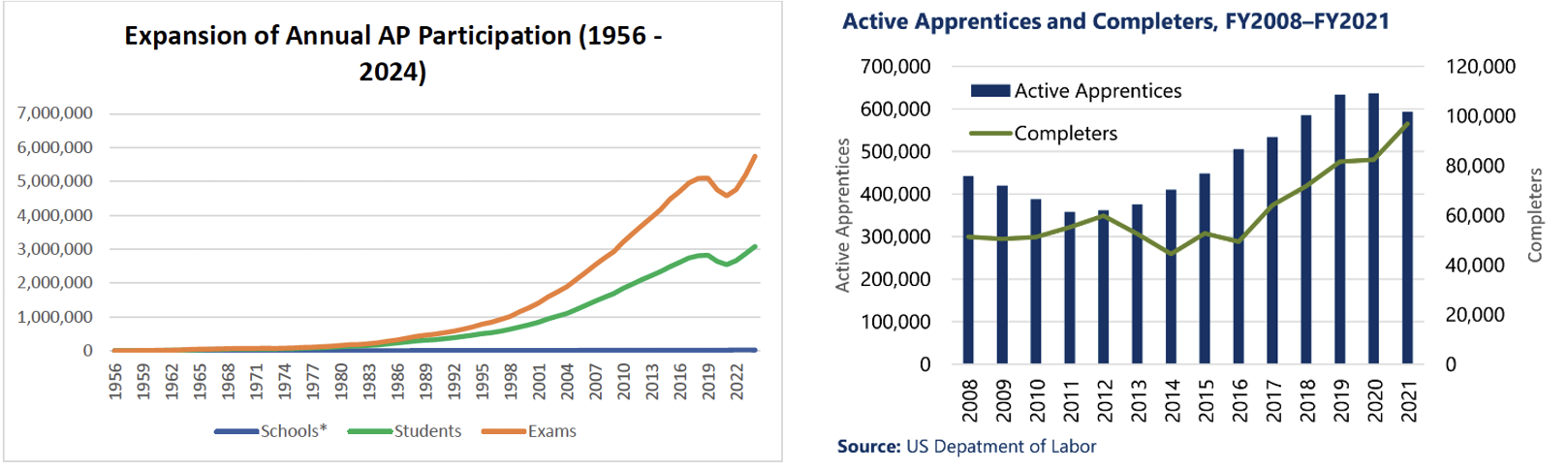
- Advanced Placement (AP) has seen massive expansion, rising to 23,000 schools and over 5 million exams annually while maintaining or improving pass rates. This signals genuine academic rigor amid democratized access.
- Dual Enrollment has rapidly scaled, especially in community colleges, bringing college coursework to nearly 1 in 5 high school students nationwide. Lagging states are catching up fast, signaling sustained future growth. More data is needed concerning program quality and student outcomes.
- Apprenticeships have surged by 73 percent in the last decade, expanding beyond construction into healthcare, IT, and utilities. Completion rates have returned to historical norms, suggesting the system is advancing, not just growing.
- College and university 4-year graduation rates are at all-time highs, with significant gains since 2007. Degrees and certificates have increased at 2-year public colleges. A combination of policies has helped to cause this positive outcome.
- Credentials and Certifications continue to grow rapidly and expand in scope. Licensed individuals are more than twice as likely to be employed full-time compared to their non-licensed peers.
- Correctional Education reduces recidivism by 43 percent and increases employment rates post-release by 13 percent. These are among the strongest outcomes of any education or training program in the country, yet the programs remain underfunded and with fewer participants than in the past.
College Board, Central, n.d. & U.S. Department of Labor, 2021
These positive trends are not isolated. Rather they are systemic. They reveal that American education, far from failing outright, has quietly adapted to serve millions of learners through flexible, applied, and workforce-linked pathways. However, these gains have not been matched by investment in measurement, trend data or evaluation:
- High school Career and Technical Education has developed better career pathways and more linkages to postsecondary education. However, longitudinal data systems are underdeveloped to evaluate effectiveness.
- Remedial education has changed dramatically in its concepts and approach, but benefits are unknown within existing data systems. • Transfer pathways, although central to the community college mission, remain inefficient. Most students transfer without earning a credential, and articulation failures cause widespread credit loss.
- Credential programs have diversified and expanded, but tracking systems have not. Policymakers cannot yet distinguish between high-quality, market-aligned certificates and low-value credentials.
- Military education remains opaque. Despite billions in funding, there is limited visibility into enrollment, skill conversion, or post-service outcomes due to data silos and security-driven limitations.
- On-the-job training, though effective in isolated state evaluations, lacks any national data infrastructure-leaving the largest form of workforce training in the country virtually invisible. OJT is one of the best ways to provide applied and active learning.
The Policy Challenge Ahead
The takeaway is not that the U.S. education system is not broken. It is that it is incompletely understood. Key parts of the system—those with proven returns—are operating in the relative darkness or are misunderstood. Ifthe U.S. is serious about preparing citizens for economic resilience, civic participation, and lifelong learning, then we see three imperatives:
- Elevate what works. Scale programs with clear returns on investment such as AP, dual enrollment, apprenticeships, and correctional education into broader federal and state strategies, with targeted funding and accountability.
- Fix the data infrastructure. Build cross-agency systems that track participation, progression, and outcomes across all postsecondary pathways, not just for transfer to four-year degree programs. Statistics should be presented with separate categories for youth 15–25 years of age.
- Develop policies for a major overhaul of the existing systems. For example, Jobs for the Future (2021) proposes merging grades 11-14 into a single, integrated, and free system. It seeks to eliminate the rigid divide between high school and college, creating a new, equitable educational model that combines academic instruction with workplace learning for 16-to-20-year-olds, directly aligning with modern economic needs.
The U.S. education system is in transformation. In many sectors, postsecondary education is quietly succeeding. The challenge now is to bring success and weakness into full view, build the systems to support attainment, and close the distance between potential and performance.


