What do you do when virtually every activity you ask students to complete can be carried out almost entirely by AI? That’s the challenge Roselyn Baronia faces as she tries to help her students learn to code in AP Computer Science A (CSA). In the first installment of our three-part interview about her efforts to integrate AI into her teaching and transform her assessment process in the 2025-26 school year, Baronia describes her background, how AI crept into her classroom, and the moment she knew something had to change. Part 2 will describe a key change Baronia made in the course: the development and implementation of an oral defense that students are now expected to complete along with one of their coding projects. Part 3 shares some of Baronia’s reflections on what she’s learned as she’s made these changes, as well as the implications for her future teaching. Baronia has been teaching at Tsinglan School, a private international school in Dongguan, China, since 2020. She is also the Head of the Computer Science Department, Technology Coordinator, and chair of the school’s AI committee. This interview has been edited for length and clarity and formatted by Adelaida Kim.For previous posts related to AI, see: Could concerns about the academic pressure on students in China lead to real changes in conventional schooling? Stability & change in the education system in China (Part 4); Scanning the global headlines for recent news on AI, schools, and education: Rapid growth in uses, users, and concerns.
As a resource for teachers interested in adapting an oral defense into their work, a public website provides access to some of Baronia’s materials from the virtual pet project, including a timeline, a lesson overview, student examples, and a rubric.
+++++
Thomas Hatch (TH): Could you give us a little bit of background about how long you’ve been teaching and what courses you’ve taught, and then a little bit about the AP Computer Science A course and how long you’ve been teaching that?
Roselyn Baronia (RB): I’m actually a computer engineer by profession, and I used to work in an IT company in the Philippines. But then I was invited to serve as one of the panelists in an oral defense — in the undergraduate thesis defense at the university where I graduated. That actually started my career in teaching because, after that experience, I became a university instructor. Before I knew it, I fell in love with teaching.
I’ve been teaching for 18 years in total, and in K-12 for the last 13 years. I used to be a teacher in an International Baccalaureate (IB) school, so all the schools I’d worked at were IB schools, except Tsinglan, which I joined six years ago. I’ve been teaching AP Computer Science A (CSA) for 5 years.
TH: How many sections have you been teaching each year?
RB: It started with one class, and I only had 5 students in that very first class. Then it started to grow every year, and currently I have 29 students in two sections. I meet them for eight blocks of 40 minutes in every six-day cycle.
A full teaching load at Tsinglan is 24 blocks, and I handle 16 blocks a cycle. This is reduced because I’m the Head.of the Computer Science Department and the Technology Coordinator for the whole school. At one point, the school asked me if I wanted to just concentrate on being the Technology Coordinator and stop teaching, but I said no; I still want to teach. I love teaching — I just really cannot let it go. I feel that my students need me, even if I have other whole-school work.
TH: And as the Technology Coordinator, you’re working with faculty to help them integrate new technologies and deal with all of their technology issues as well?
RB: Yes, and I’m also the Head of the Computer Science department for the whole school, so I wear multiple hats. In addition, I’m helping the school in data analysis, and I also chair the AI committee — that’s also a whole-school responsibility. There are so many things that I do, but somehow, they overlap. There’s a connection between all of it. It actually puts me in a very good position to understand why assessments should change or be modified, because I can see what is happening and how other teachers are thinking. If I were just a classroom teacher, maybe I wouldn’t have that insight.
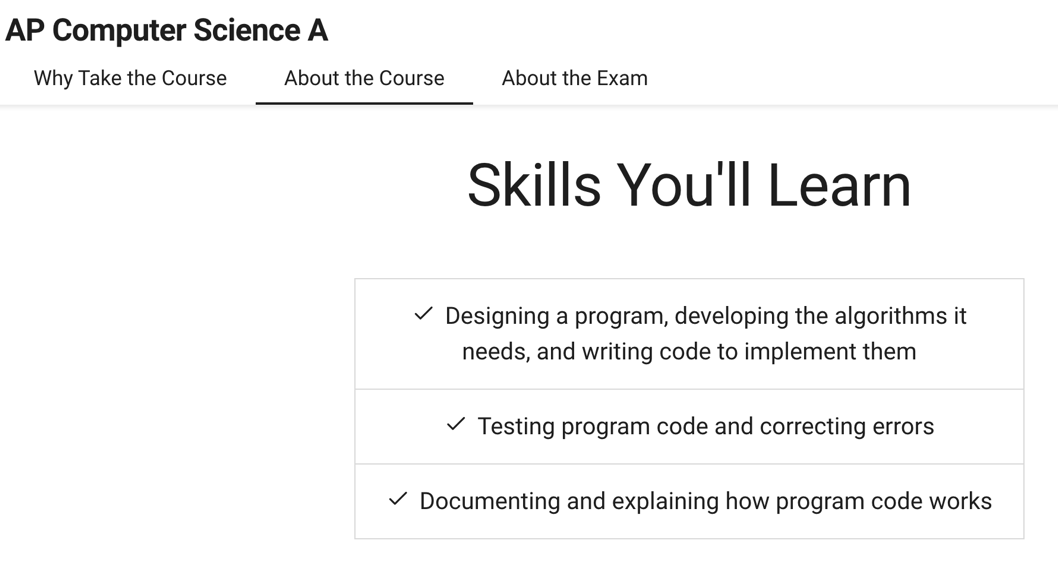
TH: Can you describe the basic structure of Computer Science A?
RB: There are actually four units. This is the first year the College Board changed the syllabus. In the past, it was always 10 units, but this year was the first time they reduced it to just four units, and there are four recommended laboratories that we have to do so that students will be more prepared for the external exam.
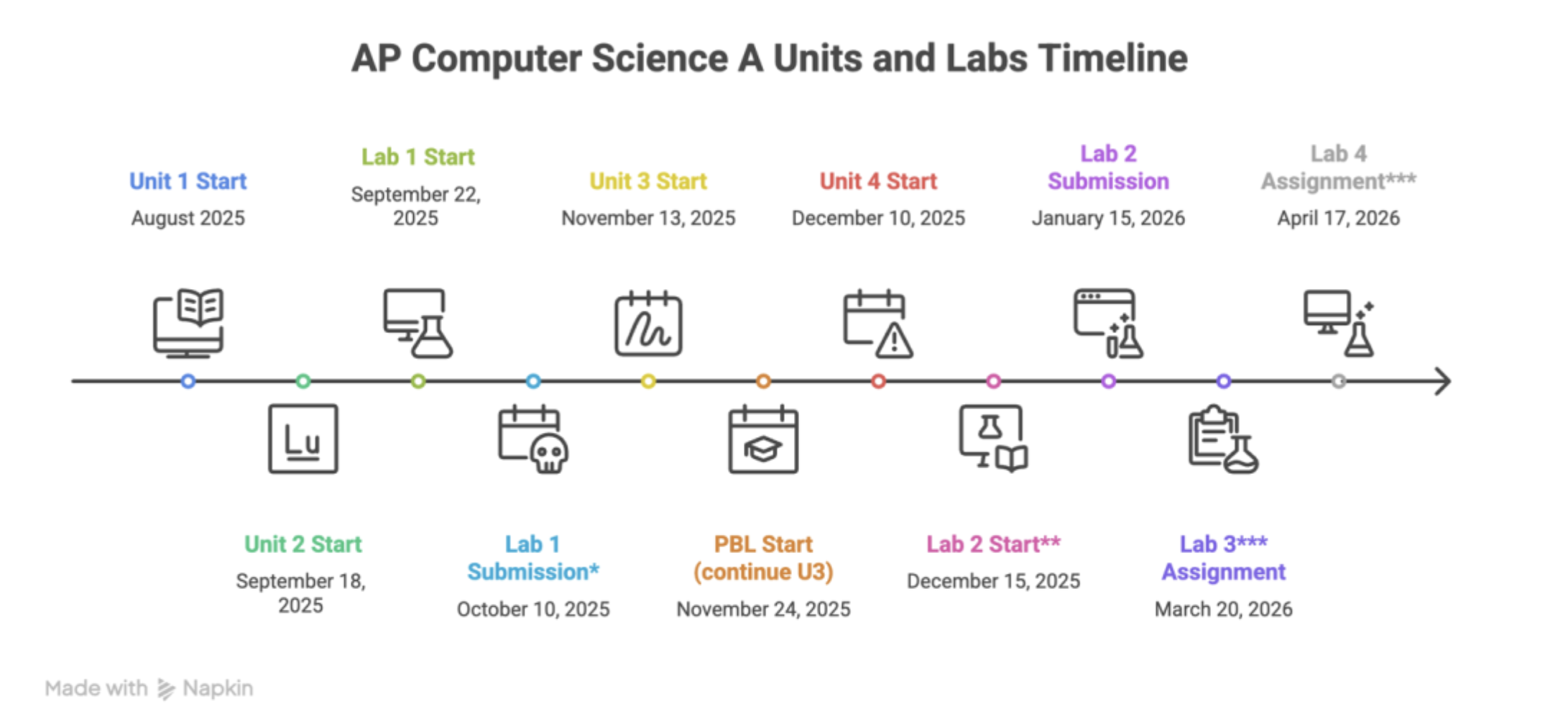
** There is a Winter Holiday from December 20, 2025 – January 3, 2026, followed by a Semester 1 Final Exam until January 8, 2026.
*** These labs are assigned after the mock exam that occurred during April as enrichment activities. Instant feedback is provided; students can mark their own work from the College Board website.
I’m using a book created by RuneStone Academy called CS Awesome. It’s free, and it’s very helpful because it’s very much aligned to how the College Board expects us to deliver the lesson. That book also comes along with an IDE, or Integrated Development Environment; it’s like the platform where students can actually create code. But the students also have access to other IDE’s, and this is where I realized the need to modify the assessment, because the moment students leave the College Board platform or the CS Awesome platform, they begin to use an IDE that has AI embedded in it. This was a turning point for me when I kept seeing that.
TH: Just so I’m clear, can you describe what an IDE is for those of us who don’t know anything about coding?
RB: In the old days, if you used Windows, you had a text pad, and this is where you actually coded, and we coded a lot of HTML or CSS to build a web page. The IDE is similar to that text pad, but it’s much more sophisticated because AI is already built into it. So if you type the first line, AI will already predict what you’re going to do and provide some parts of your code and suggest what you should do next.
However, inside the College Board platform, there is no IDE at all. So, if students are going to answer something or take a test, they don’t have an IDE — they really just have to write code without indentation, without anything that shows it’s code. But for the labs, because they have to create a real project that actually runs, you cannot use the College Board platform. You really need to go outside of that, and that is when we begin having a problem, because they will be using an IDE like GitHub or Visual Studio. When they start using these IDEs, AI is already built in. When they start to write a line of code, AI will automatically suggest the rest. That got me thinking: how will I know that my students are actually thinking critically if they keep on using an IDE that has AI built in?
AI and the Challenges and Opportunities for Assessment and Learning
TH: When did you realize you needed to make a change in your teaching and assessment because of AI?
RB: It started this past year, in our spring semester of 2025. It all happened after the Chinese New Year. The principal spoke about AI and that we have to use AI, so everything became about AI. The teachers were excited about it because they were thinking it was going to save their time — that was the initial feeling.
But then, as Technology Coordinator, I observe classes, and even when I walk through the hallway, I can hear teachers saying, ‘Okay, you can use AI.’ But the students don’t know how to use it effectively. That started the conversation among teachers, and because I’m also chair of the AI committee and also connected to our Continuous Improvement Group, I was a part of a number of conversations where teachers started talking about their concerns about the use of AI. That started me rethinking what I was doing in the classroom.
Before that, I would just kind of ignore AI or try not to recognize that my students were using it. Maybe I was in the denial stage at the beginning, but I was thinking, ‘Oh, my students probably won’t do that,’ or I would remind them, ‘Please don’t use AI.’ I was like that. But then this past fall when I saw that AI was getting more sophisticated, I realized I had to make a change.
TH: Bring me back to the moment last fall — what led you to the realization that you had to change your practice because of AI?
RB: What I usually do in the classroom is spend maybe 5–10 minutes in the beginning to set the tone — to tell the students what the learning objective is, how we’re going to achieve it, point out the vocabulary words, have a little discussion, and then have them do an activity. While they are coding, I walk around, and I usually see errors—there are bugs—and I check if they need my help. If they do, I’ll help them, or I’ll ask them about their reasons. Why is your algorithm like this? Why are you using conditional statements, for example, or why are you using a “while loop” instead of a “for loop”?
In the past, maybe two or three years ago, when AI was not yet very well known to my students, I noticed they could articulate their decisions much better than now. Just as I said, a lot of my students now say, ‘This is what AI told me, I have to do this.’ That was frightening — there would come a point where students would no longer be thinking because they would just follow what AI tells them to do. AI here in China is also embedded in the browser — they have something called Doubao. I don’t know if you’re familiar, but it’s the most popular AI assistant in China; it’s like Gemini in Google Chrome. It’s very accessible to the students, and some of the students even use DeepSeek because their parents told them they can use it for their homework. So, I felt like I was losing my role in the classroom — like I was competing with AI.
“A lot of my students now say, ‘This is what AI told me, I have to do this.’ That was frightening — there would come a point where students would no longer be thinking because they would just follow what AI tells them to do… I felt like I was losing my role in the classroom.”
TH: What do you mean when you say “I feel like I’m losing my role in the classroom”?
RB: I feel like I’m competing with AI. If I say something, and a student says, ‘But Miss, AI said it like this,’ then I feel like I need to justify what I’m doing. And then there’s tension, because I might tell them they’re not supposed to use AI. So I realized maybe what I’m doing is wrong. Maybe I should acknowledge that AI really exists, and that they can use it and do their projects with AI. But then the focus of my marking and scoring should no longer be about the final project, because I can no longer trust that it is fully their work.
What I really want is for my students to be very prepared for the external exam, because the parents are expecting their kids to get a good mark. I was thinking, how can I do that if I allow them to use AI but then mark the final product, which I know they can do so easily because of AI’s suggestions? That’s why I thought there has to be a change in how I conduct my assessment.
TH: That’s really helpful, but let me make sure I understand: The final product you’re talking about — is that the AP exam itself, or is it a project or culmination of your class?
RB: The final product I meant is the projects created based on the AP’s laboratory requirements. The College Board does not require projects for AP Computer Science A, but students have to do laboratory activities because that will help them retain the concepts and skills that are being assessed in the free-response questions, or FRQs, on the AP exam. For the exam, AP uses an app called Blue Book. It’s a kind of software with an embedded secure browser where students cannot leave that window. So when they take the test, they stay only in that environment, and they can’t use AI.
TH: So was part of the problem that, on the one hand, you wanted them to be able to use AI, but on the other hand, you worried that they would then not be able to do well on the exam when they didn’t have AI?
RB: I want them to be prepared for the test — that’s a given. And when they take the test, there’s no AI; that’s for sure. But when they do the laboratory activity — which is very engaging for them because it prepares them for the exam — they’re being very playful, creative, and thinking of other things to add. But for them to be able to do that, they have to go beyond the curriculum, and so they need AI to help them.
It’s kind of tricky, because they are pushing themselves very much to come up with something. For instance, one of the students created a rhythm game. For her to be able to do that, she had to know how to create an interface in Java — and that is not part of the syllabus. She said, ‘Miss, it won’t feel good if I can’t finish this.’ That’s why she needed AI. But at the same time, I was also afraid that if she kept on using AI, maybe she wouldn’t be thinking deeply, and maybe she wouldn’t score high on the exam.
“I Felt Like I Was Losing My Role in the Classroom”: An Interview with Roselyn Baronia on her experiences with AI, Assessment, and a New Oral Defense (Part 1) © 2026 by Thomas Hatch is licensed under CC BY 4.0


Pingback: “AI is a tool that should help us, not something to depend on”: An Interview with Roselyn Baronia on her experiences with AI, Assessment, and a New Oral Defense (Part 2) | International Education News