Teacher shortages, student disengagement, and a disconnect between university completion and job outcomes take center stage in OECD’s Education at a Glance 2026. In addition to these concerns, the headlines pulled together by Anushka Banerjee also highlight the comparative success of some countries like Ireland in teacher recruitment, Spain in early childhood education, and Austria in educational attainment. This year’s Education at a Glance was published in October, shortly after the release of the 2025 PISA results (Highs in the East, Lows in the West, and Concerns All Around: Scanning the Education Headlines for the 2025 PISA results). For some historical context, see IEN’s coverage of previous reports including: Education at a Glance 2024; Education at a Glance 2023, Education at a Glance 2022, Education at a Glance 2021, Education at a Glance 2019.
Global
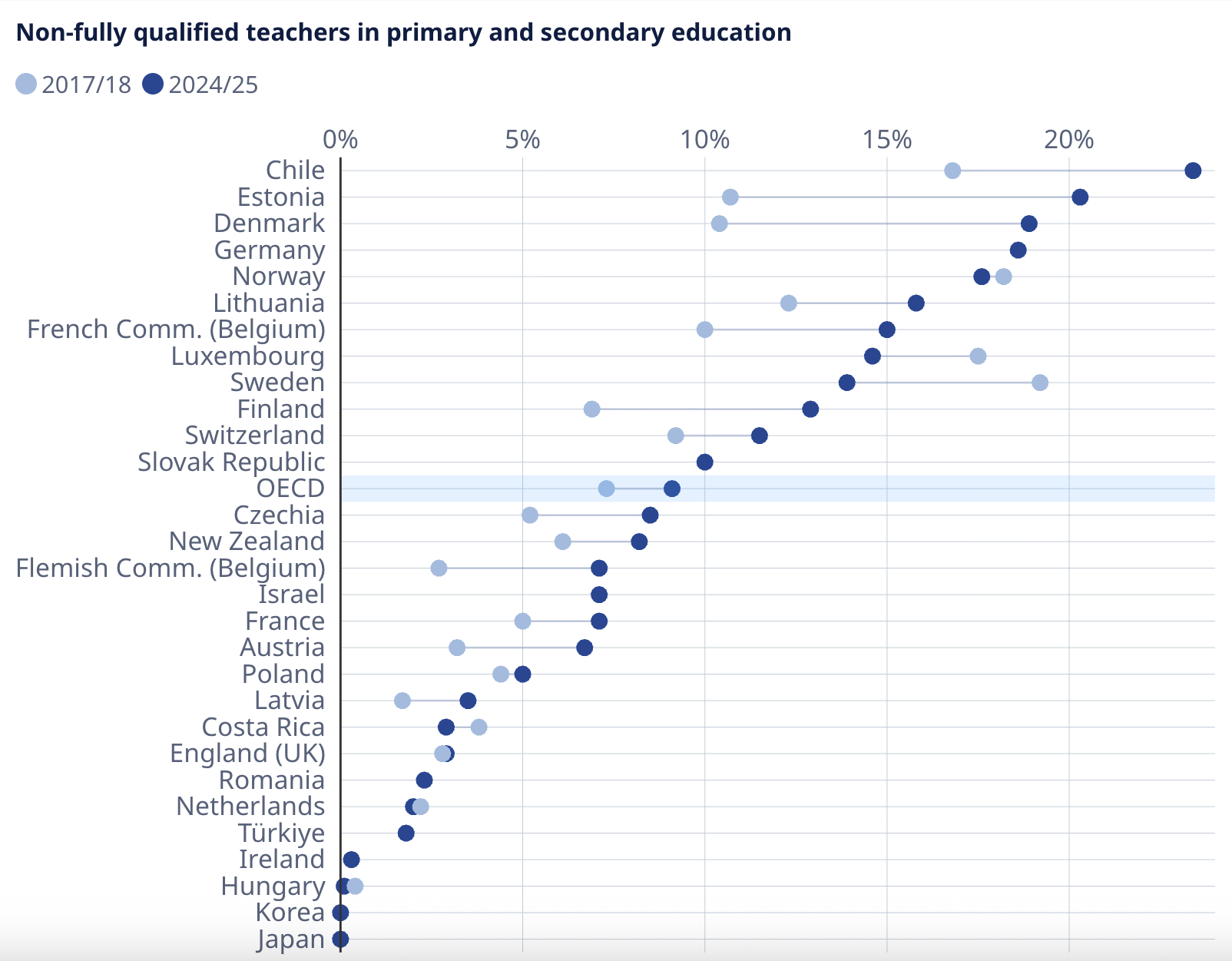
Source: OECD (2026), Education at a Glance 2026
Education at a Glance 2026, OECD
Australia
Public school primary class sizes unchanged for a decade, The Educator Online
Austria
“OECD data shows that Austria is comparatively well-positioned in terms of teacher supply. The proportion of unfilled teaching positions in primary and secondary education is around one percent. Austria also has a lower teacher attrition rate of 5.8 percent, below the OECD average of 6.4 percent and the EU average of 6.9 percent. At the same time, the report shows that Austria needs to focus more on retaining young teachers“
Chile
OECD: Chile is among countries where people spend the most on education, 24 Horas
After concerning OECD report on Chile: Is having more teachers enough? Aquí Entre Nos
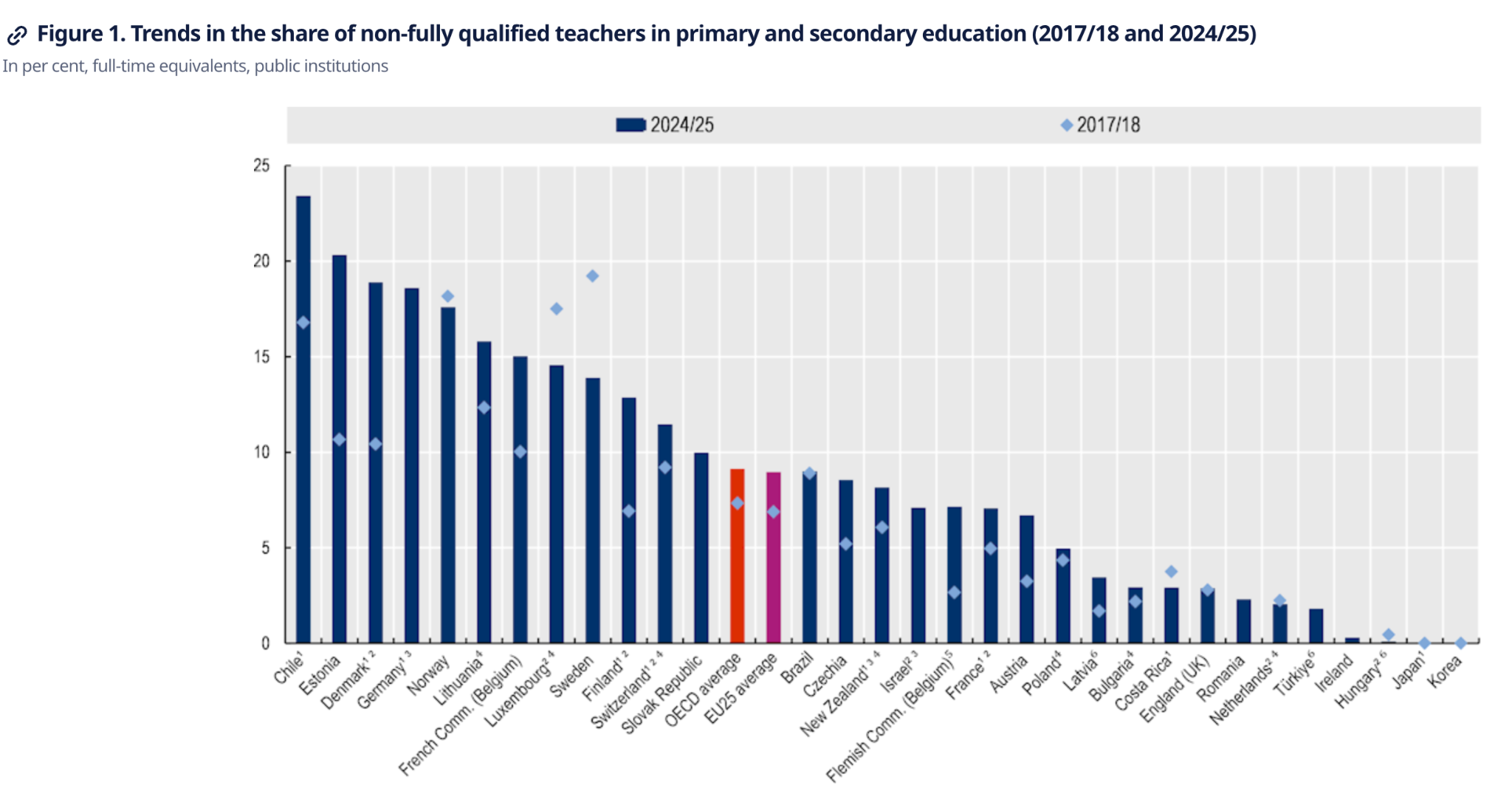
“23.4% of primary- and secondary-school teachers in Chilean public schools were not fully qualified in 2024.”
Colombia
The OECD highlights the satisfaction of Colombian teachers but warns about low educational spending, EFE
“Colombian teachers teach 955 hours of class per year, while the OECD average is 770. In lower secondary school, the workload reaches 840 hours annually, compared to 710 hours...Colombian spending reached $3,526 per student in primary school and $3,594 in lower secondary school. In OECD countries, the figures were $12,893 and $14,291, respectively.“
Costa Rica
Costa Rica’s population of children ages five to 14 will fall 28% by 2033, Infobae
Finland
Education at a Glance: Women make up the majority of teachers but are still underrepresented in leadership roles in education, Finnish National Agency for Education
“Women make up a clear majority of teachers at lower levels of education, but they remain underrepresented in education leadership positions in almost all OECD countries.” In Finland, women account for 97% of teachers in early childhood education and 53% in tertiary education.”
Germany
Germany is a leader in STEM degrees, Tagesschau
OECD criticizes teacher shortages in Germany, Deutschlandfunk
Iceland
OECD Report Highlights Iceland’s Education Spending and Teacher Shortages, Iceland Review
“Iceland devotes a larger share of its economy to public education than the OECD average. However, the system continues to face teacher shortages and uneven educational attainment.”
Ireland
‘Substantial’ decline in younger teachers over past decade, Irish Examiner
The Irish Times view on Ireland’s education system: a detailed comparison with some surprises, The Irish Times
“Despite recent talk of teacher shortages, Ireland outperforms most countries in recruiting and retaining qualified staff. Only 0.3 per cent of teachers are not fully qualified, compared with 9.1 per cent across the OECD, and just 2.1 per cent left the profession in 2024/25, a third of the international rate.”
Israel
1 in 5 young Israelis neither working nor studying, OECD report finds, Ynetnews
“In Israel, the share of 18- to 24-year-olds who are neither studying nor working rose from 17% in 2015 to 20% in 2025 … Across OECD countries with available data, the average fell from 16% to 13% over the same period.”
Italy
Education at a Glance 2026: In Italy, a bachelor’s degree doesn’t pay: salaries almost equal those of high school graduates., Corriere della Sera
Japan
Only 33% of those majoring in education become teachers in Japan, significantly lower than the OECD average, Yahoo! Japan News
Student numbers fell 7%, while teacher numbers rose 7%, OECD’s Education at a Glance 2026 finds, ReseEd
Mexico
Mexico records the largest fall in education spending in the OECD, Diario de México
The number of primary-school teachers in Mexico increases by 7%, Vanguardia
Morocco
Morocco leads France’s international student intake, OECD report finds, Hespress English
Netherlands
Dutch lateral entry is relatively successful, Algemene Onderwijsbond (AOb)
“‘lateral entrants’ [second career teachers] represent 8 percent of the teaching staff in primary and secondary education worldwide. That share is more than twice as high in countries such as the Netherlands (16,9 percent), Iceland, Australia, and New Zealand. That is a huge difference compared to Korea, Japan, Saudi Arabia, and Turkey, countries with a lateral entry rate of less than 1 percent.”
Portugal
Portuguese teachers are the most dissatisfied with salaries in the OECD, Jornal Económico
South Korea
S. Korea leads OECD in college attainment but trails in job outcomes, United Press International (UPI)
“The data showed that 71.1% of South Koreans ages 25 to 34 had completed higher education in 2025, the highest rate among OECD members and 23.6 percentage points above the OECD average of 47.5%…The employment rate for South Korean university graduates ages 25 to 64 was 80.1%, 5.9 percentage points below the OECD average of 86%.”
Spain
OECD’s Education at a Glance 2026 places enrolment of two-year-olds in Spain at 73%, Moncloa.com
Romania
OECD report: Romania lags in higher-education graduates and education spending, AGERPRES
“Around 70% of women aged 25 to 34 who have not completed upper secondary education are outside the labour force, one of the highest rates among OECD and partner countries. By contrast, the inactivity rate among women in the same age group who have completed tertiary education is significantly lower, at around 10%.”
United States
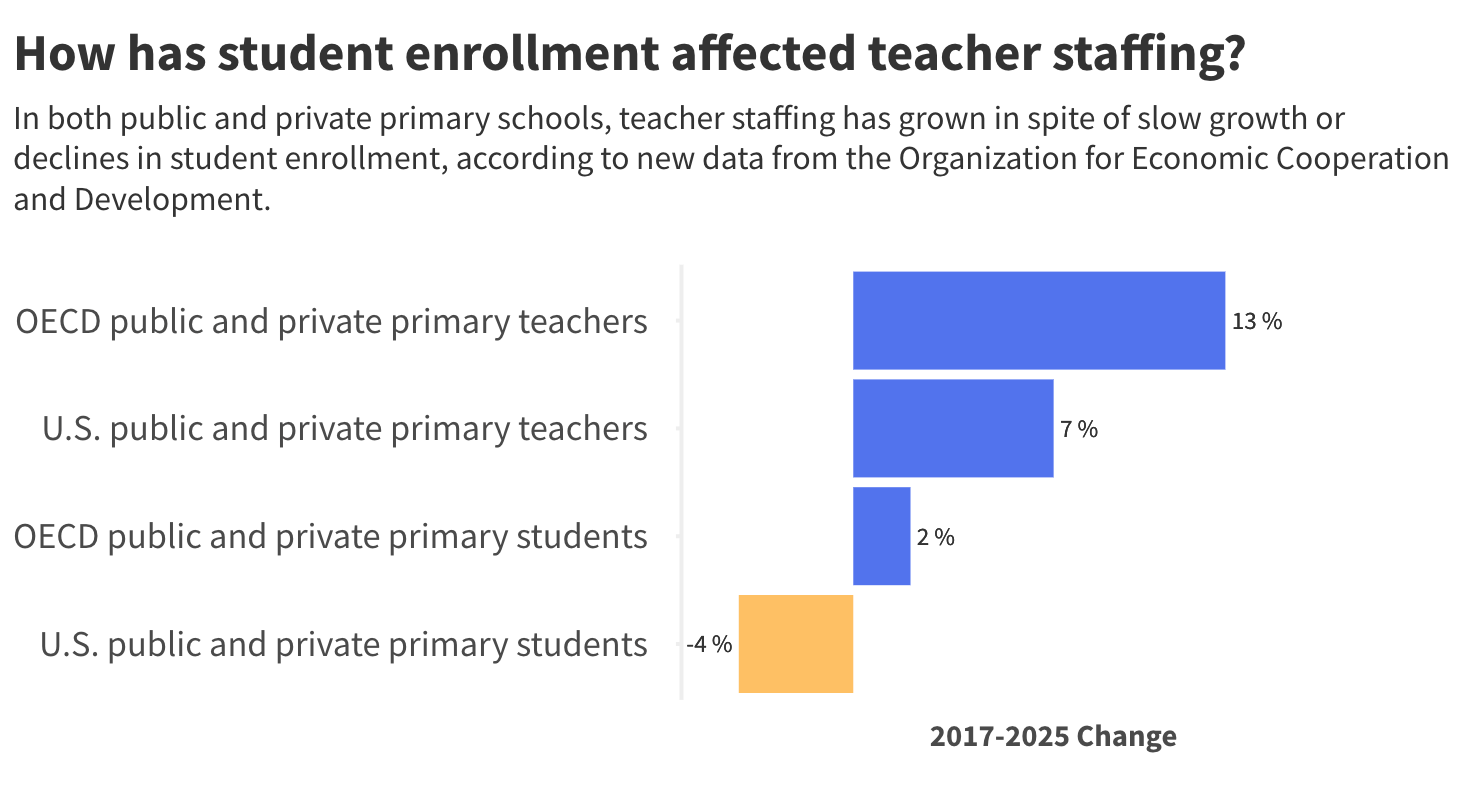
Source: EducationWeek
How the U.S. Teaching Profession Compares to Global Peers, Education Week
Post-High-School Outcomes Vary Around the World. How Do U.S. Graduates Stack Up?, Education Week


