How can educational leaders use infrastructure to change culture? Whitney Hegseth addresses this and other questions in Just Talk To Us Normally. The book draws on Hegseth’s research with students in two different educational systems (Montessori and International Baccalaureate) and two different national contexts (the US and Canada). Hegseth is an Assistant Professor of Educational Leadership at the University of La Verne
+++++++++++++++
IEN: Why this book, why now?
Whitney Hegseth: This book tackles a pervasive problem in schools, and in our broader society. The problem is this: we chronically underestimate our young people. This is particularly true when they are, for example, young and Black, young and female, young and an immigrant. Why address this problem now, when there are myriad other problems with which educators are consumed? Because something that is (rapidly and relatedly) disappearing from childhood are opportunities to practice independence, resilience, interpersonal communication…many skills and mindsets children will need when they become adults.
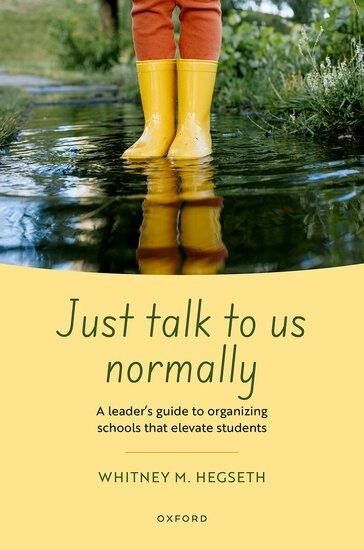
And so, Just Talk To Us Normally takes as its premise that children are far more capable and good than we often realize, and it supports educational leaders in their efforts to change culture. Specifically, I rely on research with schools in different educational systems and national contexts to demonstrate how educational leaders can use educational infrastructure — both their direct and indirect supports to teaching and learning — to improve the way we see and teach young people. I hope that the educators who read this (and those who support and partner with them) walk away from this book understanding their power to transform our beliefs and actions toward children. And, I hope they appreciate this: There is more than one way to change culture, more than one way for leaders to use educational infrastructure to systemically improve how students are perceived and taught. Educational leaders can determine how adaptable, aligned, and specified their supports are for teaching and learning. However, these decisions leaders make around their educational infrastructure have implications for the work and challenges of leaders, the beliefs and practices of teachers, and the experiences and beliefs of children.
There is more than one way to change culture, more than one way for leaders to use educational infrastructure to systemically improve how students are perceived and taught.
IEN: What did you learn in working on this book that you didn’t know before?
WH: Doing this research and writing this book helped me appreciate how very difficult it is to change culture. I draw on anthropologists and sociologists, like Ann Swidler (1986) and Clifford Geertz (1975), when thinking about how to change “common sense;” our deeply held assumptions that we don’t even think to question or challenge.
This book tells two stories in one, and the first story is about how educational systems change culture; how they can change educators’ and children’s common sense around children’s capabilities. As I was conducting the research, I listened back to the focus groups I facilitated with students across different educational systems (i.e., Montessori and International Baccalaureate) and different countries (i.e., the United States and Canada). Much to my dismay, my expectations and treatment of these children mirrored that which I commonly observed in their context. If I was in a context that tended to infantilize, I could actually hear it in my tone when facilitating the focus group. The opposite was true in school contexts where children were very much assumed to be capable.
If I was in a context that tended to infantilize, I could actually hear it in my tone when facilitating the focus group. The opposite was true in school contexts where children were very much assumed to be capable.
I was so disappointed in myself, but this also underscored why this was a book worth writing. Changing our tacit beliefs and assumptions (and our corresponding actions) is a herculean task. It’s too much for a given individual, which is why it’s helpful to read accounts of how to use systems to effect this change. I provide such accounts in this book.

IEN: What’s happened since you completed the book?
WH: So much has happened, including the release of the 2025 PISA scores (see for example, IEN’s Highs in the East, Lows in the West, and Concerns All Around: Scanning the Education Headlines for the 2025 PISA results). In addition to the important conversations that are happening around PISA, my book contains some commentary around the role of comparison, in general.
I was trained in international and comparative education. Throughout this training, I observed how comparison is often used to compete, to rank. How it is used to punish and to reward. Just Talk To Us Normally advocates for comparison, but not for any of these reasons. Throughout the book, I suggest how — whether we are researchers, educators, or policymakers — we might leverage comparison to gain more clarity. In studying the Other, we can better understand the Self. By offering accounts of schooling in different educational systems and countries, I aim to support leaders in better seeing their own values, and their own methods. From there, they can reflect on whether they want to adjust anything as they work toward their desired outcomes for students.
IEN: What are the implications for practice and policy?
WH: This book’s second, related story is about educational infrastructure, which certainly has implications for policy and practice. Educational infrastructure is the water we swim in as educators; it is all those things that directly (e.g., curriculum, assessments) or indirectly (e.g., professional development, standards) support teaching and learning. Throughout the book, I highlight different decisions educational leaders make around how adaptable their educational infrastructure is, how aligned, and how specified. We see in the book that the path toward culture change can and does vary. We also see, however, that the different decisions leaders make have very real implications for the work of educators, and for the experiences and beliefs of young people.
Educational infrastructure is the water we swim in as educators; it is all those things that directly (e.g., curriculum, assessments) or indirectly (e.g., professional development, standards) support teaching and learning.
Just Talk Us Normally is meant to be a leadership guide, a reflection tool, for leaders across different levels (e.g., classroom, school, district) and different school contexts (e.g., public, charter). I don’t tell leaders how to practice, nor do I suggest a given policy to implement. Instead, I use comparison to help leaders see their work, their decisions, more clearly. And I show them the ripple effect of some of the decisions they make when managing their infrastructure to effect change. Reading this book will first help educators gain clarity around the experiences they most desire for children, the practices they most want to witness from teachers, and the challenges they feel most equipped to tackle. Then, with this clarity, these educational leaders will be better equipped to make decisions around their educational infrastructure as they work toward improvement.
IEN: What’s next — what are you working on now?
WH: I am currently an assistant professor of educational leadership at the University of La Verne. As such, I have the immense privilege and pleasure of teaching action research to our doctoral students. All of our students are current educational leaders. For their dissertations-in-practice, they are designing change initiatives to tackle a problem they have identified at their sites. They then conduct research to consider whether, how, and for whom that change initiative is working.
Given the urgent, worthy work of my students, I feel the need to practice what I preach. I have dabbled in YPAR previously, but I’m now diving into youth participatory action research. I’m currently launching a youth leaders project in two elementary schools, where I will train elementary-aged youth in leadership, research, and advocacy skills. Then, together we will work to identify and act on a change they desire for their classroom, school, or community. This work has just begun, and I’m already so grateful to the many people who are in support of this action research.


