Author Archives: internationalednews

Accelerating Learning in Africa: The Expansion and Adaptations of Second Chance (Part 2)

**This post initially appeared on thomashatch.org**

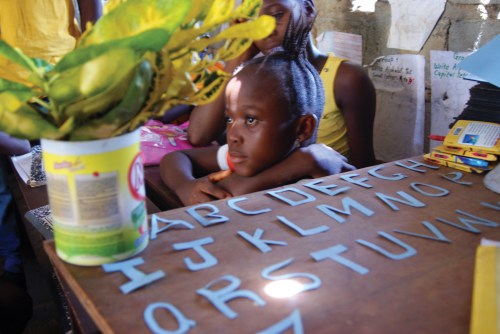
Copy of 7D5A0153_adjusted

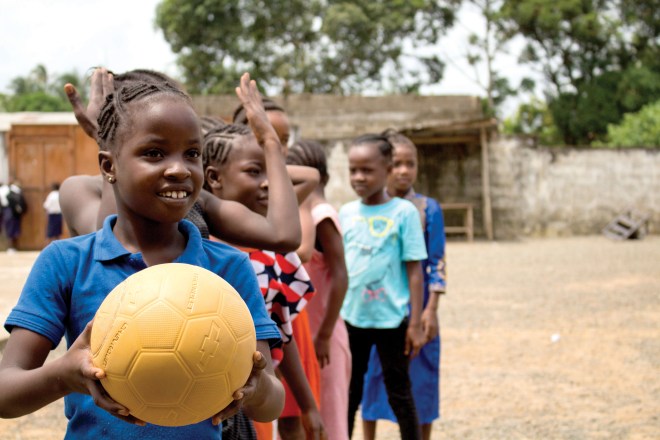
Photo Credit: Rosie Hallam

Expanding Second Chance in Liberia and Lebanon

Second Chance’s efforts to carry out such an unconventional pedagogical approach in what are usually remote areas depends on building an alternative infrastructure for learning that incorporates local materials, training for local youth, partnerships with government schools, and support for parent self-help groups. Rather than creating this infrastructure itself – and growing a larger organization to do it – the Luminos Fund’s efforts to expand Second Chance build on the expertise, resources, and relationships that local implementing partners have already established. Those partners include NGO’s that have a record of accomplishment and a presence in the communities where Second Chance seeks to work. Luminos provides training, materials, guidance and oversight for the partners, but the partners hire and train facilitators, supervisors and project coordinators.

Second Chance’s expansion to Liberia uses this local approach to test the viability of program in what Baron described as an “under-resourced” context.  Khosla was more emphatic:  “It’s exactly the same program, but, oh my god, the challenges are so different.”  Those challenges include an out of school rate in Liberia of over 50% for children of primary school age (compared to about 35% in Ethiopia); extreme poverty and a lack of basic necessities; an economy growing at about half the rate of Ethiopia’s; and public spending on education also at about half the rate of Ethiopia’s.

All of these factors contribute to much higher costs.  With so little money for education, textbooks are scarce – roughly 1 textbook for every 28 students, according to Khosla. That means textbooks have to be imported and delivered to the schools, and the inadequate roads lead to high transportation costs that compound the problem. As a result, initial costs to set up a Second Chance classroom in Liberia run about $10,000 per classroom, where it only cost about about $6000 in Ethiopia.  Although Luminos’ aims for a 300$ per pupil cost once the program reaches scale, the per student costs in Ethiopia work out to only about $150.

Early on in the work in Liberia, the staff also discovered that the impoverished conditions meant that many of the students were going through an entire day without food.  As Khosla explained, “In Ethiopia they have a 1 ½ hour lunch break where they go home everyday to eat lunch and then go back. We thought the same model would work in Liberia, but there’s no food. “Kids were coming to school so hungry,” Baron added, “it was a fool’s errand not to address that need, but that means we are delivering rice and beans to mothers who are cooking food.”  Baron pointed out that this “small” change in the schedule in Liberia introduces a whole new series of problems to be addressed – where to get the food, how to import it, how to prepare it – that requires establishing a whole new supply chain, with new job responsibilities and added costs. “And there are hundreds of weak points in the chain,” lamented Baron. For example, there are periods for traditional religious practices where it is unsafe for children to be out collecting the wood needed to fuel the fires for cooking.  With no firewood, students can end up going several days without food, unless the staff at Second Chance make the local adjustments that enable he work inside the classroom to take place.

The difficult conditions and hardships in Liberia affect the Second Chance facilitators as well.  For example, although initial assessment results in Liberia indicated that students’ literacy learning was far behind the students in Ethiopia,  further analysis showed that the facilitators also had much lower scores on related literacy assessments than their peers in Ethiopia.  Similarly, Khosla pointed out that the content of the training for the facilitators is quite basic “because the focus is on the early grades.  But we are finding in Liberia that it’s not basic. There are still some issues that facilitators have with teaching parts of speech for example, so we are figuring out how we can fill some of those gaps in content knowledge.” These results are not surprising, however, given that the local youth the program relies on for facilitation have had to live through a series of wars and an Ebola crisis that interrupted their own schooling and development.

The transportation problems also complicate the training efforts; discouraging facilitators from getting together to share information, reflect on what they are doing, and address common challenges. Khosla explained, “If you have to deviate from the main road, then you are in the bush, and then you are in the bush for at least 10 miles to reach one school. So for us to tell the facilitators to meet up often is logistically impossible.” The Second Chance leaders solved this problem and the problem of distributing salaries to a widely dispersed staff of facilitators (who need to be paid once a month, in person, in cash, since they don’t have bank accounts) with one adjustment:  they pay the facilitators at the end of the day, after they have attended their monthly learning community meetings. “It’s a good way to ensure they come to the meetings,” Khosla noted.

The initial work in Liberia revealed challenges for Luminos’ strategy of relying on local partners as well. In Ethiopia, Luminos’ has a team of five working with fourteen implementing partners managing a program of 20,000 children. In Liberia, the relatively small number of established NGO’s who have the capacity to serve as partners means more intense engagement for Luminos:  a staff of three works with four implementing partners for a program (so far) of only 2000 children.  The early stage of the work in Liberia also means that, as Khosla put it, neither the local partners nor the facilitators they have hired “know what a Second Chance classroom looks like, and what to aspire to.”  Consequently, in the 2018-19 academic year, Luminos created 4 Second Chance programs to serve as “centres of excellence” with model classrooms so that facilitators, partners, and even government officials can come and see the program in operation. Given the need for all these adjustments, the initial rate of expansion in Liberia may well be slower than it has been in Ethiopia.

Despite these challenges, Luminos chose to work in Liberia because of the possibilities and assets that it found there.  With Liberia’s small size, Baron, Khosla and their colleagues have good relationships with a government working to re-imagine education and other sectors of the society.  That may create opportunities to influence government policies, for example, enabling facilitators to get a license to teach in government primary schools after they go through the Second Chance training.  “That would put facilitators in a really good spot to get placed in a government school,” Khosla said.  It would also create a powerful incentive for local youth to get Second Chance training and provide an entry point into government classrooms for Second Chance’s pedagogical approach. These kinds of possibilities, along with the fact that English is the official language, means that, if Second Chance is successful in Liberia, it may have more of a chance of being picked up by the government and scaled throughout the country than in Ethiopia.

The latest opportunities for expansion have taken Luminos to Lebanon, where the crisis in Syria has produced the largest recent wave of refugees and out-of-school children. In Lebanon, the conditions for refugees are extremely difficult, but the Lebanese government has its own well-established programs for accelerated learning.  However, English and French are the languages of instruction in the government schools and accelerated learning programs, but most of the refugees speak Arabic.  To respond to this situation, Luminos has shifted its focus to use its active learning pedagogy to help refugees make the transition into the Lebanese accelerated learning programs and then into the government schools.  .

Copy of IMG_0194_adjusted

Photo Credit: Lloyd Massah

Moving forward: Building infrastructure and adapting to local conditions

Establishing an alternative infrastructure for learning – or, where possible, grafting it onto and into the local educational system – reflects a clear theory of action: this “second chance” for children to catch up to their peers and transition into primary school at grade 4 constitutes one of the most powerful and cost effective ways to substantially increase educational access. In continuing to pursue this theory of action, Second Chance’s expansion depends on far more than replicating a program “with fidelity.”

For one thing, Luminos has to pay attention to the larger context in which their work on education in the developing world takes place. That means recognizing the fact that priorities have shifted from a focus on increasing access by 2015 (in the Millenium Development Goals) to ensuring quality in education by 2030 (in the Sustainable Development Goals). As a consequence, Luminos needs to talk about the program differently so that those funders who are now working on quality can see the value of the Second Chance approach.

Luminos also has to be responsive to the local contexts in which they work. As Khosla acknowledged “Second Chance cannot just be plopped down in any regulatory environment.” Second Chance needs to find the right “fit” in contexts that provide the model with what the psychologist Lev Vygotsky called a “zone of proximal development”: places with both substantial need for accelerated learning and enough support and resources to take advantage of Second Chance’s alternative infrastructure for learning.

When it finds the right fit in places like Liberia and Lebanon, Luminos then works to stay true to its theory of action. On the one hand, that means remaining focused on key issues and opportunities for accelerated learning that gave rise to the model in the first place:

  • What capacities do children need to succeed in the “regular” school system?
  • What enables and motivates “over-age” students to stay in school?
  • Who has the will and the skill to support and sustain the success of the classroom approach?
  • What connections will ease and sustain the transition into the larger school system?
  • What mechanisms will enable parents and community members to embrace and support their children’s schooling?
  • What local capacities and local organizations can provide a foundation and a “home” for expanding the program?

On the other hand, that means looking for the specific contextual differences and pursuing the problem-finding and problem-solving in each context that makes it possible to adapt. “Pay attention to “all the really small ‘last mile’ things” advises Baron, “things that may not seem so groundbreaking but nonetheless create a foundation for success and expansion. If you are more modest about what individual change you can make, you can have a bigger impact.”

— Thomas Hatch
Accelerating Learning in Africa: The Expansion and Adaptations of Second Chance (Part 1)

Copy of IMG_0530_adjusted

Photo Credit: Lloyd Massah

Despite significant increases in educational access around the world, one out of eleven children of primary school age remain out of school.  For adolescents, that proportion reaches one in six. Illustrating the depth of the problem, in Sub-Saharan Africa, the 21% out-of-school rate for primary school age children balloons to 58% for upper secondary school age children (the highest rate in any part the world).  With global efforts to increase access stalling, UNESCO and the Global Monitoring Report conclude: “Targeted interventions are needed to reach the most marginalised children, such as the millions obliged to work, the girls forced to stay home and the families displaced by conflict… We can no longer only rely on ‘business as usual’ strategies based on more teachers, more classrooms and more textbooks”.

Accelerated learning programs, like Second Chance (formerly called Speed School), serve as one such targeted intervention. Second Chance aims to meet the needs of children from 8-14 years of age who have never been in primary school or who have dropped out of school for two years or more. The program covers the content of first, second and third grade in just 10 months and helps the students to catch up to their peers and transition into the public school system in third or fourth grade.

Second Chance works by identifying a region with a high number of primary school-age students who are not in school and then establishing Second Chance classroom of no more than 25 students and a teacher (or “facilitator”) in that region.  Although this constitutes a relatively small “unit of implementation,” the results have added up. Launched in West Africa by the Legatum Foundation, the Strømme Foundation, and Geneva Global in 2007, what was then called Speed School reached over 100,000 out of school children in West Africa and Ethiopia by 2015.  Building on that initial success, Legatum created the Luminos Fund to expand the program in Ethiopia and to other parts of Africa.

According to a 2018 study tracking Second Chance graduates in Ethiopia from 2011-2017, about 75% of the Second Chance graduates were still in school compared to 66% of a similar group of students who had attended government schools.  Furthermore, the Second Chance graduates had higher aspirations to progress beyond primary education and were over 30% less likely to dropout than comparable students in government schools.  With those results, in 2018 HundrED identified Second Chance as one of 100 inspiring global educational innovations and in 2017 the  World Innovation Summit for Education (WISE) recognized Second Chance as one of six awardees for their creative approaches to crucial education challenges.


As Caitlin Baron, CEO of the Luminos Fund notes, Second Chance “has evolved, as any successful model has to.” That evolution includes the development of several key program elements across contexts:

  • An active-learning pedagogical approach
  • The hiring and training of unemployed youth from the local community in Second Chance’s active-learning pedagogy
  • Partnerships with “Link” government schools to help ease the transition of Second Chance students into the public system
  • “Self-help” groups for parents to encourage them to keep their children enrolled in school

These key elements can be considered “micro-innovations” because they are practices and structures that are new to the contexts in which Second Chance works – but their success depends on the ways in which Second Chance adapts and responds to the specific needs and circumstances in those contexts.


Active learning for basic skills

            “The thing I find truly unique,” Baron explained, “is that when you work in really low-resourced environments, the assumption is that to do anything at scale in education it has to be stripped down and dry and narrow and ‘just the facts’… But Second Chance is a model of very creative, play-based learning, carried out with teachers with minimal qualifications.  It’s a powerful example of being able to do something pedagogically complex in a low-resourced setting.”

            That pedagogical approach was one of the key developments that facilitated Second Chance’s expansion. Developed by Jeyachandran Madurendrum after he became the country director for Geneva Global in Ethiopia in 2010, Second Chance’s approach marries a focus on key skills in literacy and numeracy with an emphasis on active learning.  As the Facilitator’s Guide explains it, students work independently and in groups on learning activities that involve handling and using objects and materials from the local environment, sorting, grouping, and experimenting with them, making observations, recording findings, drawing conclusions, making generalizations, discussing what they’ve observed and learned with peers and facilitators. This active approach stands in striking contrast to conventional classrooms in surrounding areas, which are often overcrowded, with students in rows and the teacher in front delivering a lesson. As Nikita Khosla, Senior Director at Luminos observes, “If you walk into a Second Chance classroom in Ethiopia or Liberia, you will see about 25 children sitting in groups of 5. There will be work on the walls. It might be mud walls, but you will see chart paper stuck to them. You’ll see alphabets made out of clay. You’ll see children using lot of local materials for math, or going outside for nature-based learning.” In the process, Second Chance seeks to create a place where children want to come to school.  Fostering that kind of environment is particularly important given the challenges many of their students face in getting to school and in keeping them motivated throughout an eight-hour school day (with almost twice as much instructional time as government schools).

Khosla makes clear that Second Chance’s emphasis on developing relationships with children is another crucial ingredient to the approach.  “When we have principals and teachers [in government schools] asking us why the children in Second Chance are happy, we tell them, we don’t hit children, we talk to them, we ask them how they are, and this is very different from the teacher led classrooms in conventional schools, so even a slight deviation of that is welcomed by the students.” Both the active-learning pedagogy and the relationships with students aim to prepare Second Chance’s students to be independent learners and to help sustain them throughout their school careers.

This approach responds specifically to the opportunities and challenges in the local environment in two key ways. First, the program treats the facts that the students are older and out of school as assets. As the Facilitator’s Guide outlines, they see these students as able to learn at a faster pace and over a shorter time span than younger children and as more motivated and enthusiastic about learning.

Second, rather than developing and delivering a stand-alone curriculum, Second Chance facilitators use the active learning approach to teach the content of the national curriculum where they work. This approach also allows the facilitators to use the textbooks and other materials created to support the national curriculum – content with which local most facilitators and local partners are already familiar.  This choice also eases the transition of Second Chance students into government schools that are using the same materials, and it reduces the costs of having to produce their own materials substantially.

SONY DSC

Photo Credit: Lloyd Massah

Hiring and training unemployed youth

In another move that takes advantage of local circumstances, Second Chance looks for facilitators who are unemployed youth who know the local language and have at least a 10th grade education. Khosla reports that although this group has “zero experience teaching,” they bring other assets: “they have a real hunger for learning,” Khosla notes, “And we’ve seen they are very open, and they really absorb everything like a sponge.”  On the downside, these facilitators are familiar with the content, but the active learning pedagogy is entirely new.  To help them take in such a novel approach, 21 days of training are spread across the 10 months of the program.  That training focuses on the activity-based pedagogy and equips facilitators to develop their own lessons that are linked to the national curriculum, draw on the Second Chance activities, and utilize local materials.  In addition to the training, Second Chance tries to cultivate a “professional learning community” by bringing together facilitators periodically to share their learning and discuss their challenges.

From Khosla’s perspective, two aspects of this approach help to motivate facilitators. First, they can get a job at only slightly below the salary of government teachers and at a good rate given their qualifications. Second, they have an opportunity to develop positive relationships with the students. “The facilitators talk about how happy and excited the children are, and that motivates them to employ the approach,” explained Khosla.


Establishing “Link” school partnerships

Recognizing the challenges that Second Chance students face in staying in government schools once they graduate, Second Chance now establishes relationships with “Link schools.”  Link schools are government schools that Second Chance graduates may go on to attend.  Through the partnerships, Second Chance seeks to build some understanding of the Second Chance approach among the Link school staff and to encourage the staff to welcome the Second Chance graduates. “If a school already has a classroom of 70 children in grade 4,” Khosla explains, “and now Second Chance sends 15 more children, the principal and teachers really need to be on board with accepting the children. So this is just a way for us to develop some good will.”  To build that good will, Second Chance provides the teachers and the principal in the Link schools one week of training to expose them to the active learning model. In some instances, principals may also allow Second Chance to operate inside a Link School by using an empty classroom.  With this arrangement, the students are already in a government school building; they get into the habit of going to the school; and the parents get to know where the government school is as well. Seeing the Second Chance children engaged and happy at school has the added benefit that it can lead principals and teachers to try to learn more about the approach.


Creating parent “self-help” groups

Second Chance has also grown to recognize the importance of engaging with parents to address some of the cultural and economic barriers that prevent some children from getting access to schooling.  Economic barriers include things like registration fees and, in Liberia, “hidden” costs like the need to buy textbooks and uniforms.  Beyond the costs, the prospect of lost labor and a lack of clear benefits from sending their children to school can also undermine parental support. Given these challenges, to complement their work in schools, Second Chance establishes self-help groups for mothers.  These groups generally meet once or twice a month to encourage mothers to come up with income-generating activities like raising chickens or selling cassava in the market.  As an incentive, Second Chance provides a small “cash-injection”, matching the money that the mother’s raise.

Khosla noted that a 2016 evaluation of the program’s expansion in Ethiopia led to the realization that they were not paying enough attention to the self-help groups.  In response, they established a new position with a small stipend for a volunteer from the local community who helps to make connections and support the work of the group. The 2018 evaluation tracking the performance of a group of Second Chance students and a comparison group from government schools for six years highlights the importance of addressing these kinds of economic and cultural issues outside of school.  That study shows that costs remain the biggest reason former Second Chance students drop out of school; however, the difference between the drop-out rate of the “richest” and “poorest” Second Chance students narrowed much more than it did for government school students. Although it is impossible to make causal links between the self-help groups and Second Chance outcomes, that same study also found that household assets of Second Chance students improved by about 45%, and the average livestock increased by about 53%, while the household assets and livestock average of students from government schools stayed almost the same over the six years.

                                                                                                — Thomas Hatch

LEAD THE CHANGE SERIES Q & A with Thomas Hatch

Every month, International Ed News features a the AERA Educational Change SIG’s interview series Lead the Change. In the past, Lead the Change has interviewed Kristin Kew and Osnat Fellus and Hellen Janc Malone. This month, Lead the Change features IEN founder and co-editor, Dr. Thomas Hatch. To showcase Dr. Hatch’s work, we are slightly expanding this week’s post and including additional highlights from the interview.

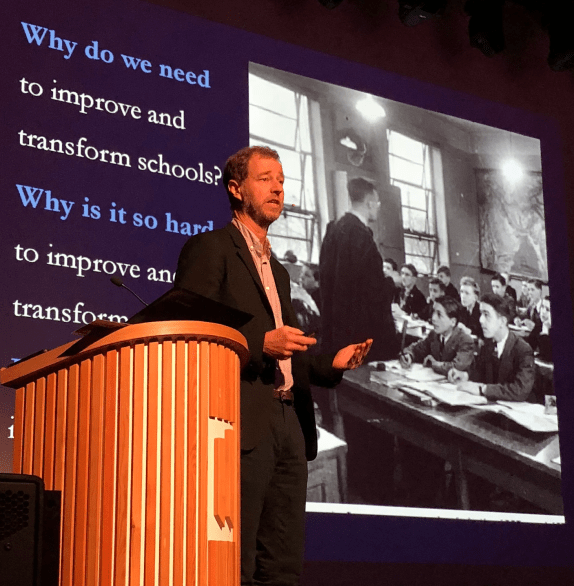
T H presenting

Thomas Hatch is a Professor at Teachers College, Columbia University and Co-Director of the National Center for Restructuring Education, Schools, and Teaching (NCREST). He previously served as a Senior Scholar at the Carnegie Foundation for the Advancement of Teaching. Professor Hatch is also the founder of internationalednews.com and has developed a series of images of practice that use multimedia to document and share teachers’ expertise. His research includes studies of school reform efforts at the school, district, and national levels. His current work focuses on efforts to create more powerful learning experiences both inside and outside of schools in “higher” and “lower-performing” education systems. His books include Managing to Change: How Schools can Survive (and Sometimes Thrive) in Turbulent Times (Teachers College Press, 2009); Into the Classroom: Developing the Scholarship of Teaching and Learning (Teachers College Press, 2005); and School Reform Behind the Scenes (Teachers College Press, 1999).

In this interview, Hatch discusses his work on educational change as well as his work with International Ed News and ongoing research on studying efforts around the world to change education systems. In Hatch’s words:

International Ed News is a weekly blog and daily twitter feed that grew out of the isolation and frustration I felt after I returned from Norway in 2010. When I got back, I quickly found myself immersed in the same polarized debates about education reform in the US that I had left behind a year earlier. I felt cut off from the educational discussions and the different perspectives I encountered while living in Scandinavia. To deal with that frustration, I wanted to take advantage of the emerging possibilities of social media to get access to some of the news, research, and diverse perspectives on educational policy and educational change around the world. I also hoped that sharing some of what is happening in educational policy and educational change in different places could help to foster discussions that go beyond the constraints of current educational systems and the limited debates about how to improve them. This regular connection to some of what is going on in education in other parts of the world has also been instrumental in helping me to continue to develop my understanding of what it will take to foster meaningful educational improvements on a wide scale. In particular, working on IEN has helped me to see that educational reform efforts are often too big and too small. They are too big in the sense that they focus on major policy issues where it is extremely difficult to make visible progress on the ground, in schools and classrooms in the short term. At the same time, these policy efforts are often too small because they get trapped in political disputes, fail to engage broad groups of education stakeholders, and never inspire the kinds of social movements that people like Santiago Rincon-Gallardo argue are central to transformative improvements in education. Through IEN and my international work, I have learned from organizations like Wordworks and IkamvaYouth in South Africa, that are able to make a substantial difference in students’ lives with scarce resources and difficult conditions where large-scale policies have not yet delivered; and I have learned a tremendous amount by being exposed to the successes of grass-roots efforts in places like Mexico and Columbia that have grown to influence policy. Looking at what is happening in education in different countries makes clear the pervasiveness of the conventional “grammar of schooling;” but it can also provide the ideas and examples to rethink the simple linear equation – get a high school diploma which will lead to college which will lead to a good job – that ignores the many learning opportunities inside and outside schools that can support all aspects of development.

Some of Hatch’s international work can be found in previous International Ed posts on Finland, South Africa, and Singapore.

LEAD THE CHANGE SERIES Q & A with Fernando Hernández-Hernández

Fernando Hernández-Hernández is the chair of the national and international research projects at Esbrina: Subjectivities, Visualities and Contemporary Learning Environments—an interdisciplinary research group associated with the Universitat de Barcelona, Universitat Autònoma of Barcelona, Universitat Internacional de Catalnya and Universitat Oberta de Catalunya and is aimed at exploring current and emerging learning environments.

Professor Hernández-Hernández’ bio:
There are several epiphanic episodes in my work trajectory. When I finished my degree in Psychology, a colleague asked me a question that I considered as epiphany: “How do you want toproject your social commitment professionally?” He emphasized the idea of considering others and what is beneficial for the common good in my future agenda. This question has resonated with me throughout my career. My first work was as an educational psychologist, working in a small town close to Barcelona, where I was surrounded by like-minded people who believed that school should be considered as part of a network, where social agents generate alternatives to social problems in a collaborative manner.

Later, I was critically involved in the process of transformation of schooling promoted by the educational reform of 1990, fostered by the Spanish government and run by the Socialist Party. At that time, I was collaborating with the Institute of Sciences Education of the University of Barcelona. One day, during one of the conversation sessions we had, a group of four teachers from an elementary school asked me a question that generated my second epiphanic movement: “Are we helping children to learn in an integrated manner?” Answering this question took us five years of action research processes, classroom observations, multiple conversations, and over all, experimenting a way of teaching and learning to promote children’s processes of inquiry based on their involvement on what they learn (Hernández & Ventura, 2009). Since then, learning has been the focus of my interest with colleagues of the research group Esbrina (http://esbrina.eu/en/home/). During these years we have explored how primary-school children (Hernández , 2010), primary-school teachers in their first five years of profession (Sancho-Gil & Hernández, 2016), high school students (Hernández-Hernández, 2017), and now, secondary school teachers learn. In parallel, I try to promote meaningful experiences of learning through inquiry and to integrate projects, which bring life to the schools and promote learning as a lived and embodied experience.

Dr. Fernando Hernández-Hernández can be reached at: fdohernandez@ub.edu


In this interview, part of the Lead the Change Series of the American Educational Research Association Educational Change Special Interest Group, Hernández-Hernández discusses his work in learning in and out of school as well as issues of inclusion and exclusion from school. As he puts it:

One of the students participating in this project shared an insight that we have put forward for debate with teachers, families, and administrators: “I pay attention to what teachers say in the classroom, I study for the exams, I answer the questions, and pass the exams, but two weeks later I am not able to remember what I studied.” The student’s statement is revealing as it questions what schools expect learning to look like. It has led us to propose alternatives to what may be the role of schools in a society that deals with competing ideas such as market preparedness, critical thinking, or facilitating experiences and ways of relating.

The Living and learning with new literacies in and outside school research also allowed us to understand that ‘real learning’—the very experience that affects youth (and teachers) and helps them to change their point of views about themselves, others, and the world—escapes, as Atkinson would say, the pedagogical norm. Because learning goes beyond cognitive and pedagogical dimensions and confronts us with the unknown. Learning is not only what occurs in the space/time between an input (teaching) and an output (assessment). Learning is a complex matter connected with life and biographical experiences, dialogical conversations, inquiry processes, or the way the (new) unconscious operates. Therefore, learning embodies new and significant challenges for educational systems.

This Lead the Change interview appears as part of a series that features experts from around the globe, highlights promising research and practice, and offers expert insight on small- and large-scale educational change. Recently Lead the Change has also interviewed Kristin Kew and Kirsi Pyhältö.

HundrED announces inspiring innovators for 2019

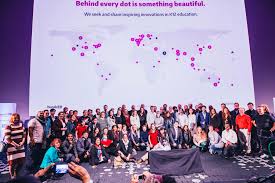
Last week, educators from around the globe convened in Helsinki, Finland for HundrED’s Innovation Summit. HundrED is an organization focused on discovering and sharing scalable innovations in K-12 education throughout the world. The summit featured the announcement of the 100 Inspiring Innovators for 2019 as well as keynote speeches, masterclasses, and workshops from renowned educators such as Pasi Sahlerg and leaders of innovative educational organizations. In this post, we highlight some parts of the summit and feature a few of the organizations included in the 100 Inspiring Innovators for 2019.


In addition to an overview of the summit’s events, HundrED provided:

hundred image

Among the organizations included in the 100 Inspiring Innovators for 2019:

Big Picture Learning (Rhode Island, USA)

“We at Big Picture Learning stand for unbridled, fearless curiosity and we will continue, as we always have, to foster learning spaces which create the wake in which students can freely, and with courage, pursue their passions and interests”

Elliot Washor, Co-founder Big Picture Learning


Talking Tree hill One Day School (Auckland, New Zealand)

Children spend one day of the school week outside reconnecting to nature and themselves through innovation, imagination and creativity.

Redes de Tutoria (Mexico City, Mexico)

Over the past 20 years, Redes de Tutoría has sought to transform students and teachers by developing tutorial relationships and harnessing the power of one to one dialogue. The Redes de Tutoría approach moves away from the traditional classroom where a teacher delivers standard content for all students to work through at exactly the same pace.  Instead, tutees enjoy greater autonomy and choose what interests them most from a selection of inquiry-based projects called ‘Temas’. Supported by individualized guidance from the teacher, students build on their prior knowledge with self-directed study. Once their study is completed, students reflect on their learning before presenting their Tema to the class. The presentation not only builds confidence and self-esteem but also creates a shared learning culture within the classroom.

Project DEFY: Design Education for Yourself (Bangalore, India)

“We do not want education to be merely a transfer of instruction. Education is a much more interesting process of self-discovery and understanding of local and global surroundings.”

Abhijit Sinha, Founder & Director of Project DEFY


HundrED Announces Inspiring Innovators for 2019

Last week, educators from around the globe convened in Helsinki, Finland for HundrED’s Innovation Summit. HundrED is an organization focused on discovering and sharing scalable innovations in K-12 education throughout the world. The summit featured the announcement of the 100 Inspiring Innovators for 2019 as well as keynote speeches, masterclasses, and workshops from renowned educators such as Pasi Sahlerg and leaders of innovative educational organizations. In this post, we highlight some parts of the summit and feature a few of the organizations included in the 100 Inspiring Innovators for 2019.

In addition to an overview of the summit’s events, HundrED provided:


hundred image

Among the organizations included in the 100 Inspiring Innovators for 2019:

Big Picture Learning (Rhode Island, USA)

“We at Big Picture Learning stand for unbridled, fearless curiosity and we will continue, as we always have, to foster learning spaces which create the wake in which students can freely, and with courage, pursue their passions and interests”

Elliot Washor, Co-founder Big Picture Learning


Talking Tree hill One Day School (Auckland, New Zealand)

Children spend one day of the school week outside reconnecting to nature and themselves through innovation, imagination and creativity.

Redes de Tutoria (Mexico City, Mexico)

Over the past 20 years, Redes de Tutoría has sought to transform students and teachers by developing tutorial relationships and harnessing the power of one to one dialogue. The Redes de Tutoría approach moves away from the traditional classroom where a teacher delivers standard content for all students to work through at exactly the same pace.  Instead, tutees enjoy greater autonomy and choose what interests them most from a selection of inquiry-based projects called ‘Temas’. Supported by individualized guidance from the teacher, students build on their prior knowledge with self-directed study. Once their study is completed, students reflect on their learning before presenting their Tema to the class. The presentation not only builds confidence and self-esteem but also creates a shared learning culture within the classroom.

Project DEFY: Design Education for Yourself (Bangalore, India)

“We do not want education to be merely a transfer of instruction. Education is a much more interesting process of self-discovery and understanding of local and global surroundings.”

Abhijit Sinha, Founder & Director of Project DEFY


R4D Study: Promoting Secondary School Retention in Latin America

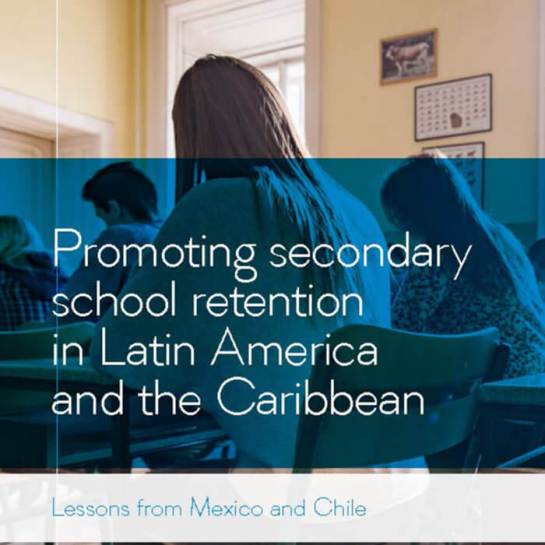
With both the Millennium Development Goals (MDGs) and Sustainable Development Goals (SDGs), much of the focus for improving education has been on enrolling children in and supporting their completion of primary school. The organization Results for Development reminds that “Despite having made impressive gains in primary and secondary school enrollment over the last few decades, countries in Latin America and the Caribbean have struggled to ensure that all children complete secondary school.” This week, we highlight a study from Results for Development, authored by Results for Development’s Kimberly Josephson, Robert Francis, and Shubha Jayaram. The study “explores lessons on reducing secondary school dropouts from Mexico and Chile and provides recommendations on how decision-makers in the region can counter this challenge.” Robert Francies, also from Results for Development, provides a concise summary of the study. We highlight a few additional sections from the report below.

CAF-R4D_report-cover-web3-700x700

On the Mexican School System:
Mexico has a near universal transition rate from primary to lower secondary school, and nearly 90 percent of students complete a lower secondary education.2,3 High dropout rates in upper secondary school pose the most significant bottleneck to completing compulsory education in Mexico: 15 percent of young people drop out every year at this level with young men more likely to dropout than young women (17 percent versus 14 percent, respectively) (INEE, 2017). Over the last decade, several reforms have attempted to strengthen the compulsory education cycle, which includes upper secondary school since 2012, and culminated with the recent introduction of a new education model Nuevo Modelo Educativo [New Education Model] in 2017 that aims to disrupt outdated pedagogical practices and make education content more engaging and relevant.

Lessons from Mexico:
Schools inconsistently implemented both initiatives, selecting certain activities and tools as they deem appropriate. This inconsistency could be due in part to overburdened school staff, inherent variation between school systems and limited coordination at the national level. Both Construye T and Yo No Abandono started as large-scale initiatives. Neither program conducted rigorous pilots to test implementation and effectiveness of program activities, which has complicated their ability to scale up effectively.

On the Chilean School System:
Chile has shown remarkable progress in improving access and completion rates at the secondary education level for all students. Between 1990 and 2013, the proportion of youths between the ages of 20 and 24 who completed secondary school increased from 54 to 85 percent (JUNAEB, 2015). Importantly, the lowest-income groups experienced the greatest gains in enrollment over this period; however, economically and socially vulnerable youth still experience much higher rates of school repetition and early exit. The Chilean government has thus executed policies and programs to expand resources to the most vulnerable schools and students. For example, equity-oriented initiatives provide a high amount of funding to schools based on the enrollment of vulnerable students. Similar to Mexico, female students in Chile are more likely to complete secondary education than males (88 versus 82 percent, respectively) (CEN, 2014; JUNAEB, 2014)


Lessons from Chile:
In Chile’s current education governance structure where municipalities operate schools with significant autonomy from the national government, the “outsider” status of Aquí Presente’s psychosocial professionals sparked initial distrust among teachers and staff.8 Eventually, however, this external perspective allowed them to cause disruptive change and gave them more latitude to speak and act freely than other school actors. The effectiveness of Aquí Presente was also seen as attributable to the full-time nature of these professionals, whose sole task was to reduce dropout and improve school conditions. With the 2017 transition of Aquí Presente to ABE, it remains to be seen whether municipalities and schools will use existing resources to hire similarly dedicated staff.


Recommendations:
The recommendations that emerge from the study’s analysis can be placed into five categories. These are areas that warrant particular attention and should be carefully considered during the design and implementation of a strategy or program that seeks to directly or indirectly influence dropout:

→ Quality of learning environments

→ Inclusive and participatory approaches

→ Data and targeting

→ Coordination

→ Investment in school capacity


For related work, IEN has produced posts on Education reform in Mexico and new programs from the CONAFE.

The Migrant Caravan and Education

This past June, IEN posted a timeline of the Trump administration’s war on immigrant families and children. This past week, those attacks continued in Trump’s violent rhetoric about a migrant caravan traveling toward the U.S. border. In this post, Managing Editor Jordan Corson, follows up by providing an overview of how immigration and migrant caravan intersects with education issues and sharing some educational resources for educators.

In recent days Trump has tried to use the latest migrant caravan as an opportunity to energize his base of supporters before the mid-term elections. Despite Trump’s focus on the most recent caravan of roughly 6,000 immigrants from Central America, Voices of San Diego’s Everything you need to know about the migrant caravan, and those that came before” details, caravans are nothing new. The caravans are not simply a product of conditions within home countries but are “often a manifestation of a profoundly unequal and exploitative relationship between countries from which people emigrate and countries of destination,” as this Business Insider article elaborates.  The latest caravan along with others have been supported by Pueblo sin Fronteras (people without borders), an organization dedicated to “reaching out to the most vulnerable immigrants in the United States and to migrants and refugees on the move.” In doing so, they “accompany migrants and refugees in their journey of hope, and together demand our human rights.” An NBC story on the organization provides further details.

Education and the Caravan

There are about 2300 children traveling in the latest caravan. These conditions leading children and families to travel to the U.S. certainly includes schooling and the opportunity to study and attend school in the U.S. The education system in Honduras is underfunded and, as another outlet puts it “People are unable to access education, health care and employment, and violence is ubiquitous. In an interview with France 24, a “migrant, who gave his name as Jaled, said they were marching ‘because there is no work in Honduras, no education, nothing good. The cost of life increases every weekend.’”

Schools in Honduras, the country of origin for many in the latest caravan, face many struggles, including safety concerns and persistently unequal conditions. At the same time, many in Honduras continue to work to improve the country’s education system. Global Partnership highlights changes and plans to improve the education system. A Relief Web piece describes teachers, with the support of the UNHCR, working together to improve the system at a more local level.

Yet, children in this caravan face increasing risks, with recent reports of a child being abducted. Last Friday, Mexican president Enrique Peña Nieto announced a new program You Are Home (Estas en tu casa), which offers children a place in Mexican schools. Yet, many in the caravan, however, have decided to continue traveling toward the U.S.

Although many adults and children should be eligible to apply for asylum and its accompanying protections, there is considerable speculation and much uncertainty about what will happen when the caravan reaches the U.S. border. In addition, although children in the caravan enter the U.S. are, at least legally speaking, guaranteed equal access to schools, City Lab reports on the educational crisis that many face once they arrive. Within this uncertainty, it is still clear that those in the caravan are travelling in search of opportunities, including the possibility of a different educational path.


Additional resources that may be useful for classrooms

https://blog.education.nationalgeographic.org/2018/05/02/five-myths-about-the-migrant-caravan/


https://www.pbs.org/newshour/world/what-we-know-about-the-latest-migrant-caravan-traveling-through-mexico

Leading Futures: Flip the System UK: A Manifesto for an Education Evolution

In this post, the editors of the new volume Flip the System UK, JL Dutaut and Lucy Rycroft-Smith, offer an introduction to the main ideas of their work. The book focuses on major issues confronting teachers today and what can be done, through teacher agency, to address these issues. This post is part of the Leading Futures series. Previous Leading Futures posts include a series on Future Directions of Educational Change and Alternative Perspectives on Education Reform.

flip system

JL Dutaut and Lucy Rycroft-Smith

Let’s begin with this simple premise: Imagine that your country does not have an education system. As a reformer or as an educational thinker, where do you go from there? What is your priority? How have you determined this priority? The premise is provocative. It invites you to start from scratch, to imagine anew.  Adding in a Rawlsian veil of ignorance might further deepen the thought experiment to include concepts of equity. There should be schools, clearly, but what type of system would support high quality learning and teaching? How should you judge system performance? What agency would teachers have to instigate change and innovation? Your thinking quickly leads you to think of an educational future that is not incumbered by accountability, standardisation and privatisation.

In this thought experiment, you have allowed us to turn you into a politician. You have exercised a whole raft of decision making. In the effort of imagining a new education system, you have considered the consequences you seek, while discounting the strategies unlikely to achieve them. Did you give any thought to the agency of parents, students, employers and communities in your new education system? When the system comes before the people it is designed to serve, democracy has already been de-prioritised.

Who are we then, you might ask, to be publishing a book on system change? And where do we get the audacity to call for the UK’s education system to be flipped?

By ‘flipped’, we mean an ostensibly simple premise:

“Replacing top-down accountability with bottom-up support for teachers.” (Evers and Kneyber, 2016, p. 5)

As teachers in England, we have both suffered the iniquities of being at the sharp end of accountability and decision making in our education system. We found ourselves, and each other, at a dark time in our teaching careers – subjected to the full weight of accountability measures and the dulling grind of questionable professional development. In an effort to find a path back to the realities of the classroom, we met the editors of a book called Flip the System: Changing Education from the Ground Up. This book changed our lives.

Fast forward two years, and we have published our own edition: Flip the System UK: A Teachers’ Manifesto, a book that has added to a global movement and has begun to shift the ground under the feet of policy makers both in the Netherlands and internationally. We are proud to be part of a growing chorus of teachers calling for the re-professionalisation of their work – and to have written a call to collective action for the UK context.

Flipping professional expectations

Flip the System UK: A Teachers’ Manifesto contains 37 chapters by over 40 teachers, headteachers, educational thinkers, researchers and policy makers – and it could have been many more, such was the interest in participating. The book brings people together who often disagree and finds a common cause among them.

“So I started researchED as a conference-based project to bring educators, academics, researchers, policy-makers and everyone else in the eco-system together: to present the best of what they knew, to challenge, discuss and learn.” (Bennett, T. in Rycroft-Smith and Dutaut, 2018, p.7)

“researchED, the brainchild of Sam Freedman (then advisor to Education Secretary, Michael Gove) and doctor/journalist Ben Goldacre (then advisor to the government on research in education) was handed to a high-profile teacher to give it credibility, yet in my opinion its purpose serves the government’s agenda very well.” (Kidd, D. in Rycroft-Smith and Dutaut, 2018, p.65)

Despite disagreement on motives and the very purpose of education, Bennett’s and Kidd’s views on teacher professionalisation offer complementary prisms through which to identify problems and potential solutions. For Kidd, politicians get in the way. For Bennett, they can’t help. Both agree that professionalisation is not only desireable but necessary, and offer unique insights into what it entails.

Not only does flipping the system transcend ideological divides, it also transcends the boundaries of the devolved governments. To a greater or lesser extent, the policy-as-imposition paradigm is the status quo across the UK. In England, it is arguably more advanced but it is unquestionably the case that that professionalism in education has been downgraded and devalued across Scotland, Wales and Northern Ireland too. The impact on teacher wellbeing, retention and recruitment is evident.

“Today’s report found more teachers are now leaving before retirement than five years ago, and schools are finding it difficult to fill posts with the quality of teachers they need.” (NAO, 2018)

“A growing teacher recruitment crisis is looming unless greater support for teachers is forthcoming, the President of NASUWT Scotland warned.” (NASUWT, 2016)

“Welsh Government figures showed the target for trainee teacher intake in secondary schools and for PGCEs had both been missed in 2015-16. Owen Hathway, Wales policy officer for the NUT, said the pressures and stresses of the job were putting people off entering the profession. […] The Welsh Government said it would be looking into the “downwards trend”..” (Betteley, 2017)

“Speaking ahead of this morning’s conference, Ms McGinley said: “Schools are like pressure cookers about to boil over. Teachers are becoming more and more bogged down and are disappearing under a tsunami of initiatives – target setting, monitoring and evaluating.” (Rutherford, A., 2018)

Whether the cause of this is simply well-intentioned yet fundamentally misguided policy making – or a deliberate and sustained attack on public education from vested interests in the shape of what Pasi Sahlberg calls the Global Education Reform Movement, is irrelevant as far as Flip the System UK is concerned. In their original book, Jelmer Evers and René Kneyber make a strong case that the GERM is a destructive factor, but we feel no need to revisit old ground. Our book is resolutely about finding solutions and arguing for collective professional agency.

This is remarkably simple. It stems from taking the word – professionalism – and defining it, re-appropriating it with and for teachers. Indeed, we might say that we have flipped the very idea of professional expectations, no longer to be expectations of us, but our own expectations as professionals. All we ask is the wherewithal to meet them. The effect can be transformative It leads inexorably to reprioritising the agentic and collective nature of practice.

“An understanding of the nature of collaboration, joint exploration and learning also requires a reformulation of the nature of schools as learning organisations that are democratic, fluid and transformative.” (Gibbs, S. in Rycroft-Smith and Dutaut, 2018, p.133)

Indeed, in taking ownership of our professionalism, it becomes evident that ideas previously vociferously contested can be easily re-framed as complementary. There is room for pluralism in our vision. More than that, the very vociferousness with which they have been argued is revealed as a direct consequence of the disempowerment felt by educational professionals with respect to their professional identity. Disconnected from any effective exercise of power (in our classrooms, our schools or our national policy), teachers compensate by attempting to exercise power over what they can. Pedagogy comes to replace curriculum in educational thinking and ‘what works’ methodology usurps questions of purpose and ethics as passionate teachers take to social media to exercise some sense control over their very identities; such is the lack of agency in UK education.

Of course, methodology matters as much as purpose. Pedagogy matters as much as curriculum. But until we attend to agency in all the ways set out in our manifesto, teaching is doomed to continue to suffer the pendulum swings of political whim.

Five facets of professional agency

In collating the contributions to Flip the System UK, it became evident that there were five distinct facets of agency pertaining to education (pertaining perhaps to all public sector professions). Three, it seemed to us, defined that professionalism while a further two developed the context within which it can take root and flourish.

Defining professionalism

It is our conclusion that professionalism in education stems from:

  • cognitive agency – teachers as consumers and producers of professional knowledge;

“Greater research engagement has the potential to lead to a more responsive form of accountability, whereby practitioners continually analyse and modify their own professional processes. Doing so requires teachers to have control over what they do in the classroom, and so the movement towards teacher research engagement has an intrinsic link to teacher agency.” (Firth, J. in Rycroft-Smith and Dutaut, 2018, p.22)

  • collective agency – networks of teachers as self-sufficient developers and deliverers of accountability;

“Those of us who continue to regard teaching as a profession and ourselves as embodying professionalism in our classrooms and staffrooms already have a strong sense of internal accountability. Effective leadership, teaching and learning take place when that internal accountability is harnessed and celebrated.” (Clarke, Z. in Rycorft-Smith and Dutaut, 2018, p.40)

  • ethical agency – teachers and networks of teachers as democratic, purposeful and community-oriented policy makers.

“Democracy involves shared decion making and building a joint vision through direct, deliberative and representative processes. […] Scholarship provides a means by which – practically and through drawing on evidence and theory – professional communities can menaningfully co-construct a vision. Activism involves building networks and communicating more widely the needs of the profession and the nature of education. Solidarity requires us to imagine our disparate sufferings as a common obstacle to overcome. Ultimately, to flip the system we need to construct our actions with respect to all four” (Watson, S. in Rycroft-Smith and Dutaut, 2018, p.74)

Empowering professionalism

To create the conditions for this radical re-professionalisation of teaching, the social context must be one that fosters:

  • political agency – the power of each professional to exercise their voice meaningfully (that is, with impact), to enrich accountability as a two-way flow.

“If more of the readily available expertise in the system was re-admitted into the tiny bubble from which current policy emerges, then ministers might begin to realise that [the education system is not broken and is not in need of urgent substantial change]. A period of ‘benign neglect’ would almost certainly be of greater value to schools, teachers and children than the culturally disconnected, ideologically faith-based hyper-activism we have suffered for the last twenty years.” (Critchley, J. in Rycroft-Smith and Dutaut, 2018, p.184)

  • global agency – the power to compare and contextualise policy and practice from teacher to teacher, classroom to classroom, school to school, locally, nationally and internationally, to enrich decision-making at all levels.

“To everyone serious about education as an evidence-based profession for the maximum benefit of all: Reach out and take part! Participate in the live, ongoing multitude of voices – sharing, informing, communicating, collaborating. Do it with an open mind and you will not only get help when you ask for it, but also learn to be a better judge of what you encounter and make better decisions.” (Hjelm, S. in Rycroft-Smith and Dutaut, p.249)

The manifesto advocated by the writers in this book explores professional agency in the UK context, and in a global sense. Contributions from Sweden, the Netherlands, Australia and even a refugee camp in Northern France show powerfully the similarity of the challenges we teachers face, and the importance of subverting hierarchies to solve them.

They are complemented by a host of examples of grassroots collaborations that do just that, often despite the systems within which they operate. Teacher agency must be global, and we must connect across national and international boundaries to ensure we don’t keep repeating the same mistakes in different time zones.

Evolution, not revolution

Flipping the system means evolving and expanding our conception of educational professionalism, and it requires everyone to play their part if we are to avoid going around in circles.

So, let us end with this premise: Imagine that your country does not have an education system. As a reformer or as an educational thinker, where do you go from there? What is your priority? If you’d like to work with us on some solutions, Flip the System UK: A Teachers’ Manifesto is out and you can contact us at http://www.flipthesystem.uk.

Let’s keep the conversation going!

Betteley, c. (2017), available at https://www.bbc.co.uk/news/uk-wales-40300850

Evers, J and Kneyber, R. (2016), Flip the System: Changing Education from the Ground Up. Abingdon: Routledge.

NASUWT (2016), available at http://edgazette.co.uk/latest-news/unions/nasuwt/nasuwt-scotland-annual-conference-2016/

NAO (2018), available at https://www.nao.org.uk/press-release/retaining-and-developing-the-teaching-workforce/


Rutherford, A. (2018) available at https://www.belfasttelegraph.co.uk/news/northern-ireland/teachers-workloads-turning-northern-ireland-schools-into-pressure-cookers-claims-union-36856539.html


Rycroft-Smith, L. and Dutaut, JL (2018), Flip the System UK: A Teachers’ Manifesto. Abingdon: Routledge.

LEAD THE CHANGE SERIES Q & A with Elaine Simmt

Dr. Elaine Simmt is a professor in the Department of Secondary Education at the University of Alberta. Her scholarship is in mathematics education. She began her career as a secondary school teacher of mathematics and physical sciences. She completed doctoral studies in mathematics education under the supervision of Dr. Tom
Kieren. Dr. Simmt also serves as Associate Dean and the Co-Director of the Centre for Mathematics, Science, and Technology Education. Dr. Simmt’s research is focused in mathematics education. In particular, she explores teaching and learning as understood through the frames of enactivism and complexity thinking with colleagues Brent Davis, Lynn McGarvey, Jo Towers, Lyndon Martin, Jerome Proulx, Jennifer Thom, Joyce Mgombelo and Florence Glanfield. A second and complementary area of study is centred in teacher education, specifically mathematics-for-teaching. In her most recent work, Dr. Simmt has been involved in international projects in Tanzania and Oman where she and colleagues are working to build capacity for mathematics teaching and learning. Dr. Elaine Simmt can be reached at: esimmt@ualberta.ca

In this interview, part of the Lead the Change Series of the American Educational Research Association Educational Change Special Interest Group, Dr. Simmt talks about her work with mathematics teaching and learning as well as complexity theory. As Simmt puts it:

I explore mathematics teaching and learning in “classroom” contexts. That is, contexts that are complex by even everyday definitions of complexity. While working with data from a 7th grade mathematics class that I had taught, Brent Davis, Dennis Sumara, and I
had been co-teaching courses in cognition and curriculum, and doing in-service work with K-12 teachers. The synergy from these activities resulted in us specifically focusing on learning systems in complexity terms. Particularly we were interested in the emergence of “the class” as a collective learning system (Davis & Simmt, 2003; Davis & Simmt, 2006; Davis, Simmt, Sumara, 2006). This work continues today among a group of colleagues (McGarvey et al., 2018).

This Lead the Change interview appears as part of a series that features experts from around the globe, highlights promising research and practice, and offers expert insight on small- and large-scale educational change. Recently Lead the Change has also interviewed Kristin Kew and Kirsi Pyhältö.