Category Archives: About K-12 International Education News

Taking learning and teaching seriously: Reflections on the life and work of Lee Shulman

IEN celebrates the life of Lee Shulman, renowned scholar and mentor, who passed away on December 30th, 2024. Shulman was a Professor of Education at Michigan State University and Stanford University, before becoming the 8th President of the Carnegie Foundation for the Advancement of Teaching in 1996. He also served terms as President of the National Academy of Education and the American Education Research Association where he helped establish the division of Teaching and Teacher Education. Shulman received numerous awards over the course of his career, including the American Psychological Association’s E.L. Thorndike Award for Career Achievement in Educational Psychology in 1995 and the Grawemeyer Award in Education in 2006. Thomas Hatch, who worked with Shulman at the Carnegie Foundation, shares some of his reflections. 

Lee Shulman was an exuberant friend and scholar. Always positive and supportive, whether in his professional advice or as a host as he and his wife Judy welcomed me, my wife (and his graduate student) Karen Hammerness and our young children into his home. Lee’s work and impact cannot be summed up in any one idea or publication, but Those who understand: Knowledge growth in teaching, his 1986 AERA Presidential Address, made clear that teaching involves substantial knowledge and expertise. In the process, he demonstrated that teaching is not just a difficult job, but a demanding profession, worthy of the same kinds of recognition and reward as any other. That work helped to launch a whole new era of research on teaching. Far more than an academic exercise, that work and Lee’s insights were central to the establishment of the National Board for Professional Teaching Standards, as well as to the advancement of the Scholarship of Teaching and Learning and to the creation of a host of centers and institutions dedicated to studying and improving the quality of teaching in K-12 as well as higher education.  

Lee worked out his ideas over time in conversations, at meals as well as in seminars, and his ideas often launched new initiatives and new lines of work. In her remembrance, Jill Perry, Executive Director of the Carnegie Project on the Doctorate – one of several projects spawned while Lee was President of the Carnegie Foundation – explained this as “classic Lee:”

“offering a casually delivered suggestion that was, in reality, a deeply considered and insightful idea. He was known for these moments, where his offhanded guidance would leave young scholars or practitioners inspired yet responsible for sorting out the details on their own.” 

I had that experience, sitting in Lee’s office in 1996, in the heart of Silicon Valley with the internet developing all around us.  He declared that he wanted to bring the power of the three great resources of the university – the laboratory, the library, and the museum – and put them online to support faculty in K-12 and higher education who were creating the scholarship of teaching and learning. And then he asked me to do it. Inspired, I returned to my office to stare for hours at the cursor blinking on my computer screen. But, eventually, we established the Carnegie Knowledge Media Lab to support the Carnegie Academy of the Scholarship of Teaching and Learning (CASTL K-12 and CASTL Higher Education) and began a long line of work that included two books, Into the Classroom and Going Public with Our Teaching, and the development of a whole series of multimedia websites and images of practice that documented the work of exceptional teachers.

Beyond his ability to tell a story and make a powerful point, Lee’s brilliance was in his humanity. Lee was as likely to draw on his experience working at the counter at his parents’ deli on the south side of Chicago as he was to quote Benjamin Bloom or Joseph Schwab, two of his mentors at the University of Chicago. That deli experience, in particular, was evident in a segment he did for NPR’s This I Believe series. What did Lee believe in? He believed in pastrami: 

“I believe that pastrami is a metaphor for a well-lived life, for a well-designed institution and even for healthy relationships. Pastrami is marbled rather than layered. Its parts, the lean and the fat, are mixed together rather than neatly separated.…  Separate layers are much easier to build, to schedule and to design. But I believe that marbling demands that we work with the messy world of people, relationships and obligations in their full, rich complexity. The diet mavens inform us that marbling can be dangerous for our health, but as an educator I’m willing — even obligated — to take the risk. I want to marble habits of mind, habits of practice and habits of the heart with my students — just like pastrami.”

His writings and his talks drew from all his experiences, and, somehow, after a well-known tendency to wait until the last minute, they would burst forth, fully-formed. On one occasion, I remember flying from San Francisco to Washington D.C. for the annual conference of the American Association of Higher Education, where Lee was scheduled to give the keynote address the following day. I happened to be seated in front of him, and as we settled into our seats, I asked him what he would be talking about. He held up a pack of index cards and told me he was going to work on it on the plane. Some six hours later, after the plane pulled into the gate, when we unbuckled our seat belts and stood up, Lee spilled all the cards onto the floor. As I stooped to help him collect his notes, I realized every single card was blank.  

The next morning, seemingly without reference to a script or a single card, Lee delivered a talk, Taking Learning Seriously, that ended in a standing ovation. In that talk, Lee addressed the first question “What does it mean to take anything seriously?” by declaring that “when we take something seriously, we often talk about professing it:” 

“The deepest, oldest meaning of the word “profess” is to take religious orders in a public and visible way. When one professes faith, it means taking on a set of obligations that will serve as the first principles for controlling one’s life, no questions asked. Professing one’s faith, behaviorally and emotionally, is an impressive example of taking something seriously.

Another sense of the word is that we profess our love–for our spouses and partners, our parents, our children, our dearest friends. We profess a kind of commitment that has within it a willingness to sacrifice on behalf of the other. Also in a public manner, we declare our devotion to another. Here is yet another example of taking something quite seriously.

A more contemporary meaning of the word, a meaning more closely associated with the work of those who read this magazine, is to profess one’s understanding, one’s expertise: to be professional, or to be a “professor.” Members of professions take on the burden of their understanding by making public commitments to serve their fellow beings in a skilled and responsible manner. “Professors” take on a special set of roles and obligations. They profess their understanding in the interests of nurturing the knowledge, understanding, and development of others. They take learning so seriously that they profess it.

Throughout the talk, and especially in the conclusion, Lee’s remarks deftly weaved together the insights of a scholar of science and a man of faith: 

“To be deeply educated, I believe, is to understand both when skepticism and evidence are appropriate, and when faith and suspension of disbelief are appropriate. There are no rules or principles for knowing this distinction. Only through studying the examples in both scientific and humanistic sources -through wrestling with that inherent contradiction between faith and reason–can we and our students come to terms with the essential uncertainties that define our roles as professionals and as human beings.

As professors, we are asked to be rational and empirical, to demand evidence. On the other hand, as teaching professionals, we expect ourselves to believe what much empirical evidence says we shouldn’t: that all our students can learn. We express our faith in our students’ potential and in our ability to teach them. As professors, we do not choose between the skepticism of reason and the hope grounded in faith. Our students demand both. And we must learn, as professional educators, to do both.”

***********

Donations can be made in Lee Shulman’s honor to the Leukemia and Lymphoma Society and the Camp Ramah Tikvah Program in Ojai, California

Lead the Change Series Q&A with James C. Bridgeforth

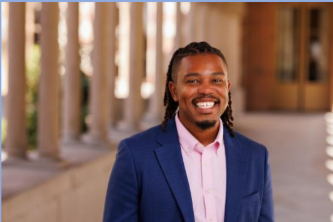
In this month’s Lead the Change (LtC) interviews James C. Bridgeforth on the 2025 AERA theme: “Research, Remedy, and Repair: Toward Just Education Renewal.” Dr. Bridgeforth is an assistant professor of educational leadership in the School of Education at the University of Delaware. His research and teaching broadly examine the politics of educational leadership and governance, specifically attending to issues of racism, antiblackness, and community voice in educational decision-making. His most recent research focuses on the challenges facing K-12 school boards and the possibilities for more inclusive and equitable forms of educational governance.

Lead the Change (LtC): The 2025 AERA theme is “Research, Remedy, and Repair: Toward Just Education Renewal.”  This theme urges scholars to consider the role that research can play in remedying educational inequality, repairing harm to communities and institutions, and contributing to a more just future in education. What steps are you taking, or do you plan to take, to heed this call?

James C. Bridgeforth (JB): This year’s AERA theme could not be timelier and more necessary given the current state of U.S. education. Conservative politicians and policymakers across the nation have continued their assault on academic freedom and anything that they consider “divisive” or “controversial.” Through censorship policies that limit teaching about racism in K-12 schools (Bridgeforth & O’Neal, 2024) and anti-DEI policies that have decimated multicultural centers and programming on college campuses (Lange & Lee, 2024), it is not hyperbole to say that our education systems are under attack. With former President Donald Trump returning to the White House with a unified Republican Congress and a ready-made playbook in Project 2025 (Dans & Groves, 2023), I fear that this heightened state of legislative and political warfare against equity-focused and justice-oriented approaches to education will continue and may become even more aggressive. 

I believe that this moment calls upon us to do more with our research to contribute to a more just future in education. People committed to the lives, hopes, and dreams of marginalized communities have always had to fight for a more just and equitable world. As Dr. Ruha Benjamin reminded us in her 2024 Spelman Founders’ Day address

Black faces in high places are not going to save us . . . That is, our Blackness and womanness are not in themselves trustworthy if we allow ourselves to be conscripted into positions of power that maintain the oppressive status quo. 

While I believe that peer-reviewed journal articles and publications matter, and research conferences can be an incredible space to connect with scholars and engage in rigorous debate, I also recognize the limitations of these spaces in enacting community-oriented change. Far too often, these venues primarily offer opportunities for self-promotion and career advancement with limited attention to how to make the lessons from our research actionable and accessible to communities that can use them. If we continue this cycle, I am deeply concerned that we will fail to meet the challenges of this critical moment in history. I am in full agreement with Dillard (2000) that research is a responsibility “answerable and obligated to the very persons and communities being engaged in the inquiry” (p. 663).

Research can be a powerful tool to reshape the structures and systems that govern our lives, and I am committed to democratizing the ways that we engage in this work. One way that I have tried to have a more direct impact through my research has been working directly with school and district leaders to build and strengthen the community schools strategy. For the last two years, I have been proud to work within the community schools movement in California to support school and district leaders to transform how we do school. Much of this work has involved working with leaders to build their capacities in data-driven decision-making and developing a shared vision for their community schools. 

To guard against the potential for this work to reproduce educational injustices and inequities, I have also coached leaders to reimagine the ways that we understand the data that we have available, what data we value, and how more participatory forms of research can lead to more inclusive, equity-driven educational spaces. For example, leaders’ conceptions of data sources that can be used for school improvement are often limited to traditional surveys or feedback forms. As I work with leaders, I regularly introduce more community-driven, participatory methods, like photovoice, that offer leaders new opportunities to collect and analyze data about experiences within their school communities. Similarly, I have been proud to collaborate with the Center for Universal Education at the Brookings Institution to pilot one example of a more participatory form of education research, The Conversation Starter Tools: A Participatory Research Guide to Building Stronger Family, School, and Community Partnerships (Morris, et al., 2024). What has been most exciting about this collaboration is that it explicitly honors the inherent wisdom and expertise of families and communities, positioning them as co-researchers rather than subjects to be studied. For example, the Conversation Starter Tools engage families, students, and educators in critical dialogues based on community-adapted survey items to collectively examining challenges and collaboratively develop solutions to foster family, school, and community engagement.

LtC: As a scholar, educator, and policy advocate, a major focus of your work has been to elevate community voice in educational governance. What are some of the major lessons that practitioners and scholars of Educational Change can learn from your work?

JB: The main lesson that I want practitioners and scholars to learn from my work is that we cannot remain beholden to what is, and we need to focus on what could be. We must believe that more is possible. 

Much of my work is based on the premise that those who are closest to a problem should be meaningfully engaged developing potential solutions. In far too many spaces where education policies and decisions are being made, those who will be directly impacted by those decisions are missing from the room. In particular, the hopes, dreams, and visions of persistently marginalized communities have often been ignored or opposed in favor of those who hold power. 

My most recent research has been focused on K-12 school boards. Nominally, school board meetings seem to be one of the most accessible spaces for community voice in educational governance. Meetings are legally required to be open to the public and board policies generally require opportunities for the public to address the board on any given number of issues. Yet as I have sat through many hours of school board meetings and interviewed school board members across urban, suburban, and rural contexts, I have confronted a troubling reality: many opportunities for community voice in governance have limited impact on the decisions that boards make (Bridgeforth, 2024). 

Some of my collaborative work that was recently published (with Eupha Jeanne Daramola, Taylor Enoch-Stevens, and Akua Nkansah-Amankra) explains how board meeting policies, norms, and routines can often work to limit dialogue and debate, rather than offer opportunities to influence decision-making. For example, during a contentious series of board meetings focused on proposed school closures, board leadership regularly relied on shifting interpretations of board meeting policies to maintain a sense of order decorum, which in turn, stifled opportunities for members of a majority-Black community to share their concerns and opposition to the closures. After hours of emotional testimony, the board ultimately voted to move forward with the closures. Importantly, the board at the center of this study was also majority-Black, raising important questions about the limitations of demographic representation in promoting more inclusive forms of community engagement. 

School boards remain key sites of educational policy and decision-making. I believe that more scholars and practitioners need to engage in such critical, creative examinations of existing policies and procedures that can be changed or reimagined to enable a more just, equitable, and participatory policymaking process. This requires us to interrogate how existing board-level policies and routines were developed and whose interests they have generally served. Rather than take for granted existing understandings of good governance, I believe we must go further by asking, good governance for whom? Moreover, we must ask, do our systems serve the needs of a more diverse and inclusive society, or are they relics of a more exclusionary past?

LtC: Your research has explored manifestations of antiblackness in educational policymaking and in the practices of educational leaders. What might practitioners and scholars take from this work to foster better school systems for all students?

JB: I believe that if we are going to truly foster better school systems for all students, we must reject policymakers’ rhetoric that racism is a relic of our past. We must begin with the truth that racism is endemic to our society and that we must continue to work to mitigate its harms. Several years ago, I published an article in the Journal of School Leadership entitled “This Isn’t Who We Are”: A Critical Discourse Analysis of School and District Leaders’ Responses to Racial Violence in Schools (Bridgeforth, 2021). This study examined close to 150 letters, press releases, emails, and social media posts from school and district leaders in the wake of racist incidents within their school communities. While conducting the analysis for this project, I was repeatedly struck by the ways that leaders often maintained that “racism had no place in their communities”, even as they were responding to harmful acts of racial violence often committed by members of their school communities—including teachers, students, and administrators.

As I build on my research agenda and work towards disrupting racism and antiblackness in educational spaces, I often return to histories of resistance in our society. Learning about Black fugitivity (Givens, 2021) and the histories of Black educational resistance (Walker, 2018) can remind us that the issues that we face today are not so different from those faced throughout our history. These and other historical insights deeply informed a recent comparative critical policy analysis (Bridgeforth & O’Neal, 2024) which documented how Texas and North Dakota developed their anti-Critical Race Theory legislation, which we characterize as acts of educational censorship. The historical record explains that similar reactive policy actions have occurred throughout our history when any semblance of racial progress has been made (e.g., state legislatures passing Black Codes in response to Black political power during Reconstruction).

Part of our goal in conducting this research was aligned with traditions of bearing witness to these actions and ensuring that the race-evasive, dominant narratives embedded in these policies do not go unchallenged. Particularly in times of rampant disinformation, it is important that scholars use our training to ensure that counternarratives exist so that we do not inadvertently cede the fight for truth and justice to those who are committed to maintaining the status quo by limiting or undoing the racial progress that has been made.

LtC: Educational Change expects those engaged in and with schools, schooling, and school systems to spearhead deep and often difficult transformation. How might those in the field of Educational Change best support these individuals and groups through these processes? 

JM: To support individuals and groups going through challenging transformation processes, I return to some of the lessons I learned through my participatory research partnership with the Center for Universal Education at the Brookings Institution that I mentioned previously. Due to the success of this research spanning 16 countries across six continents, I was recently invited to be a panelist for the closing keynote of the inaugural National Assembly for Family Engagement in Education. Our panel focused on the six global lessons (Morris & Nóra, 2024) that were uncovered through this collaborative research project. While the research primarily focuses on family, school, and community engagement, I believe that several of the lessons can provide useful insights that can support individuals who are leading many kinds of transformation efforts within their school communities. Two lessons that are most relevant to supporting the work of educational transformation are: 1) Begin with beliefs; and 2) Build at the speed of trust. 

The first lesson of beginning with beliefs addresses the understanding that many school communities are undergoing significant demographic changes (Turner, 2020) and in turn, often have diverse beliefs and understandings about the purpose of school. Before attempting to engage in school transformation efforts, this lesson suggests that we should take stock of what the various groups within our school community believe and how those beliefs can inform a shared vision for what our schools should be. This does not mean that we will all eventually agree or that there will not be conflicts or vigorous debates. In fact, I can almost guarantee that things may get contentious as people share their beliefs. However, by sharing our beliefs and openly discussing how we came to those understandings, we can begin the process of building relational trust, which can facilitate greater cohesion and in turn, foster meaningful transformation. 

The second lesson, build at the speed of trust, acknowledges that educational leaders are often working under a sense of urgency, or in some cases, a state of emergency. Whether due to calls to quickly address concerns about post-pandemic student achievement levels or navigating issues due to looming budget shortfalls, leaders are regularly expected to make decisions swiftly, often leaving little time and fewer opportunities for building trusting relationships that can inform those decisions. While it is important to recognize the pressures that many leaders are facing, rushing through transformation without taking the time to build deeper levels of trust among community members is one of the swiftest ways to limit the impacts of the change that you’re seeking to make. Leaders, and those who support them, should prioritize strategies and practices to build trusting partnerships across the school community (e.g., home visits with families, restorative practices with students and educators) before any transformation process begins. Importantly, these practices should continue throughout the process to deepen and strengthen those relationships over time.  

LtC: Where do you perceive the field of Educational Change is going? What excites you about Educational Change now and in the future?

JB: I’m excited to see an increase in critical scholarship calling for meaningful transformation, rather than tinkering around the edges of educational reform. Although this kind of scholarship has traditionally been relegated to smaller, more specialized academic journals and outlets, I have recently seen more critical scholarship showcased in the flagship journals of the field. One such example was the June 2024 special issue of Educational Evaluation and Policy Analysis focusing on critical approaches to educational research. This special issue offered several incisive calls to action to transform education systems and included a diverse group of scholars, particularly junior scholars in the field. Additionally, I noticed several recent articles published in Educational Researcher addressing critical issues and methods that have similarly been a welcome addition to the field of educational change. For example, I have appreciated recent work in this journal by Lewis and Muñiz (2024) about navigating hostile, anti-DEI environments, Murray and Hailey (2024) about racialized network analyses, and Tanner (2024) about the influences of neoliberalism and whiteness in education. 

We are at a moment in time where we cannot afford to be silent or even reserved about the challenges that we face in our society and the need for bold, meaningful change. While we do not know whether the new Trump administration’s proposed policies will come to fruition, I believe that researchers must use every tool within our power to push back against and mitigate the harms that may come to marginalized communities. In the aftermath of the murders of Breonna Taylor and George Floyd in 2020, I remember observing so many marches, calls to action, and events that gave me hope that we might see meaningful changes. While many of those changes proved to be temporary due to the intense backlash from conservative policymakers and those who support them (Samuels & Olorunnipa, 2024), I do remain hopeful that we can eventually realize a more just and equitable future and I believe that the field of Educational Change can and will be a significant part of that future. 

References

Bridgeforth, J. C. (2021). “This isn’t who we are”: A critical discourse analysis of school and district leaders’ responses to racial violence. Journal of School Leadership31(1-2), 85-106.

Bridgeforth, J. C., & O’Neal, D. (2024). (Re) Setting the racial narrative: Antiblackness and educational censorship. Education Policy Analysis Archives, 32(9), n9.

Bridgeforth, J.C. (2024) Beyond board etiquette: Responding to racism in K-12 school boardrooms. In. Johnson, R.M. and Harper, S.R. (Eds.). The Big Lie About Race in America’s Schools. Harvard Education Press.

Dans, P., & Groves, S. (2023). Mandate for Leadership: The conservative promise. The Heritage Foundation.

Daramola, E. J., Enoch-Stevens, T., Bridgeforth, J. C., & Nkansah-Amankra, A. (2024). “On a risky slope of democracy”: Racialized logics embedded in community–school board interactions. Educational Evaluation and Policy Analysis, 46(3), 506-533.

Dillard, C. B. (2000). The substance of things hoped for, the evidence of things not seen: Examining an endarkened feminist epistemology in educational research and leadership. International journal of qualitative studies in education13(6), 661-681.

Givens, J. R. (2021). Fugitive pedagogy: Carter G. Woodson and the art of Black teaching. Harvard University Press.

Lange, A. C., & Lee, J. A. (2024). Centering our humanity: Responding to anti-DEI efforts across higher education. Journal of College Student Development, 65(1), 113-116.

Lewis, M. M., & Muñiz, R. (2024). A call for research on the role of legal counsel in promoting (in)equitable educational policies in a hostile, anti-DEI sociopolitical climate. Educational Researcher, 0(0). https://doi.org/10.3102/0013189X241289402

Morris, E.M. & Nóra, L. (2024). Six global lessons on how family, school, and community engagement can transform education. Brookings Institution.

Morris, E.M., Nora, L. & Winthrop, R. (2024). Conversation starter tools: A participatory research guide to building stronger family, school, and community partnerships. Brookings Institution

Murray, B., & Hailey, C. A. (2024). Missing the forest for the trees: Toward a networked racial analysis of White parents in education policy and research. Educational Researcher, 53(8), 472-477. https://doi.org/10.3102/0013189X241290791

Samuels, R. & Olorunnipa, T. (2024, May 25). George Floyd anniversary sparks retrenchment on racial justice. The Washington Post. https://www.washingtonpost.com/nation/2024/05/25/george-floyd-anniversary-retrenchment/

Tanner, S. J. (2024). There’s no way for this to end well: Lesson planning, neoliberalism, and Whiteness. Educational Researcher, 0(0). https://doi.org/10.3102/0013189X241289932

Turner, E. O. (2020). Suddenly diverse: How school districts manage race and inequality. University of Chicago Press.

Walker, V. S. (2018). The lost education of Horace Tate: Uncovering the hidden heroes who fought for justice in schools. The New Press.

What’s Next for Schools in 2025? Scanning the Headlines for Predictions about Education in the New Year

AI, cellphones, and security – those are a few of the issues highlighted in this IEN’s scan of the predictions about education in 2025. To see the predictions for previous years, review the scans of the “looking ahead” headlines from 2024, 2023, 20222021 part 12021 part 2, and 2020. To discuss the trends and possibilities for education in the new year join Getting Smart’s annual town hall What’s Next in Learning 2025.

The education sources we follow in the US often provide predictions for schools, students, and teachers in the new year, but it’s been harder to find articles looking ahead from other parts of the world. The Ministry of Education in New Zealand, however, did offer a summary of What’s new for 2025 and the Education Review Office produced a series of best practice guides “to help educators effectively implement incoming changes for 2025.” In the US, to put developments in the new year in context, back in 2017, the National Center for Education Statistics shared Projections of Education Statistics 2025 which can be compared to their Report on the Condition of Education 2024

Education predication from the US and around the world

The education revolution: What Nigerian teachers must know for 2025, Business Day

Cleaner and better public schools in 2025 in the Philippines, Sun Star

“As we look forward to 2025, we hope that public schools will be a lot more conducive for learning. This means cleaner and properly ventilated classrooms, better classroom materials, and improved facilities for both teachers and students.

VAT, small firms, workers, education: Changes in France in 2025, The Connexion

“After disappointing results in maths and French tests at the 2024 rentrée, the Education Ministry announced there would be a “complete overhaul” of the curriculums for these subjects in 2025, ranging from maternelle to troisième (infant school to the fourth year of secondary).”

11 Critical Issues Facing Education at Home and Abroad in 2025, Education Week

5 education stories to watch in 2025, Chalkbeat

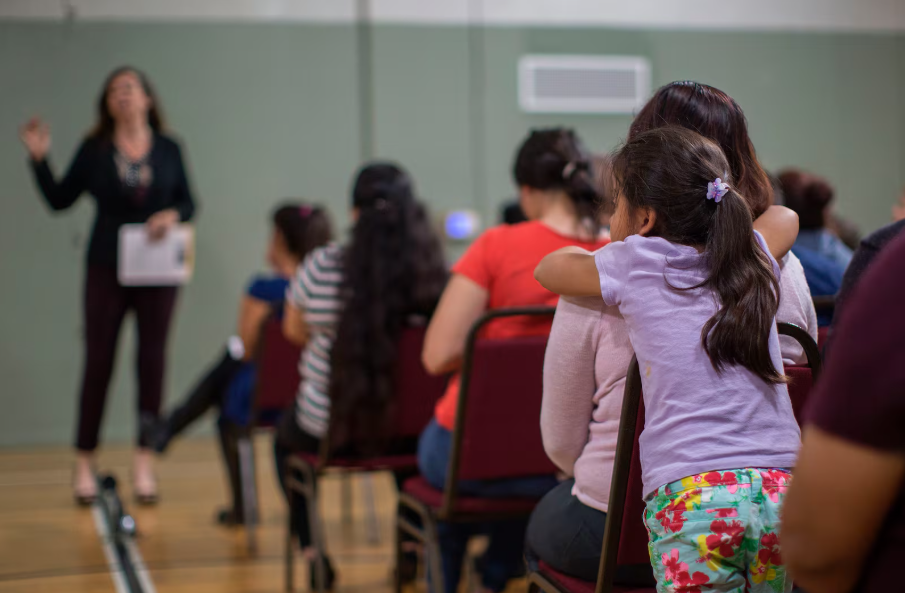
A girl watches during an immigrant rights workshop at Academia Avance charter school in Los Angeles in 2017.

Education leaders should focus on integrating AI literacy, civic education, and work-based learning to equip students for future challenges and opportunities.

Building social capital and personalized learning environments will be crucial for student success in a world increasingly influenced by AI and decentralized power structures.”


4 K-12 predictions to help you lead effectively in 2025, District Administration

K-12 trends to watch in 2025 amid budget, policy shifts, K-12 Dive

“K-12 schools are likely to face several challenges in 2025, including strained budgets due to the expiration of federal aid, cybersecurity threats and staffing shortages, particularly in special education. Additionally, the influx of AI in classrooms and the rise of book bans and curriculum restrictions are key trends to watch for in the upcoming year.”

What Should K-12 Education Focus On in 2025 and Beyond?, US Chamber of Commerce Foundation

Brown Center scholars look ahead to education in 2025, Brookings

Larry Ferlazzo’s 9 Education Predictions for 2025, Education Week

6 Predictions For Education And Workforce In 2025, Michael B. Horn, Forbes

6 Top Education Stories for 2025, Peter Green, Forbes

Five Education Predictions For 2025, Derek Newton, Forbes

 5 education innovation trends to watch in 2025, Julia Freeland Fisher, Christensen Institute

Key Trends to Watch in the Education Market in 2025, Education Week

What 2025 Could Bring for English Learners, Education Week

What’s In, What’s Out for AI, Cellphones, Cybersecurity, and Other Ed-Tech Stuff, Education Week

50 predictions about what 2025 will bring to edtech, innovation, and everything in between, eSchool News

Starring AI, VR, Microlearning and more: ETIH’s 10 predictions for edtech in 2025, EITH

Campuses will also further embrace AI, the cloud, and mobile credentials to improve effectiveness of lockdowns and guest management efforts.

Social Media Issues for Kids Shaping Up to Be ‘Unpredictable’ in 2025, Education Week

2025 Predictions for Video Surveillance in Education and Healthcare, Campus Safety

2025 Campus Lockdown, Visitor Management Predictions: More Installations, Integrations, Campus Safety

Driving Change: 5 Predictions Shaping the Future of Student Transportation in 2025, School Transportation News

2025 food trends shaping K-12 cafeterias, Food Service Director

“Chartwells K12 has identified 10 emerging food trends for school cafeterias in 2025, highlighting a shift toward diverse and nutritious options that align with the preferences of younger generations. Customizable bowls, inclusivity in the form of allergen-friendly and plant-based options and crunchy items are a few of the listed trends.”

25 Philanthropy Predictions for 2025, Inside Philanthropy

Seven Chicago education stories to watch in 2025, Chalkbeat

Five bold predictions for Ohio education policy in 2025, Aaron Churchill, Thomas B. Fordham Institute

New year starts in California with new laws impacting education, EdSource

“New California state laws will protect the privacy of LGBTQ+ students, ensure that the history of Native Americans is accurately taught and make it more difficult to discriminate against people of color based on their hairstyles.”

As lawmakers return to Albany, the fate of New York school funding looms, Chalkbeat

Banning Books and Cellphones but not Conflict: Scanning the Headlines for Reviews of Education in 2024

IEN’s annual roundup of the end-of-the-year education headlines features stories about efforts to ban books and cellphones in the US, while some of the international stories emphasize the conflicts and crises affecting children around the world. To see how education in 2024 compared to previous years, take a look at IEN’s scans from the end of the year of 2023, 2022202120202019 part 1, and 2019 part 2

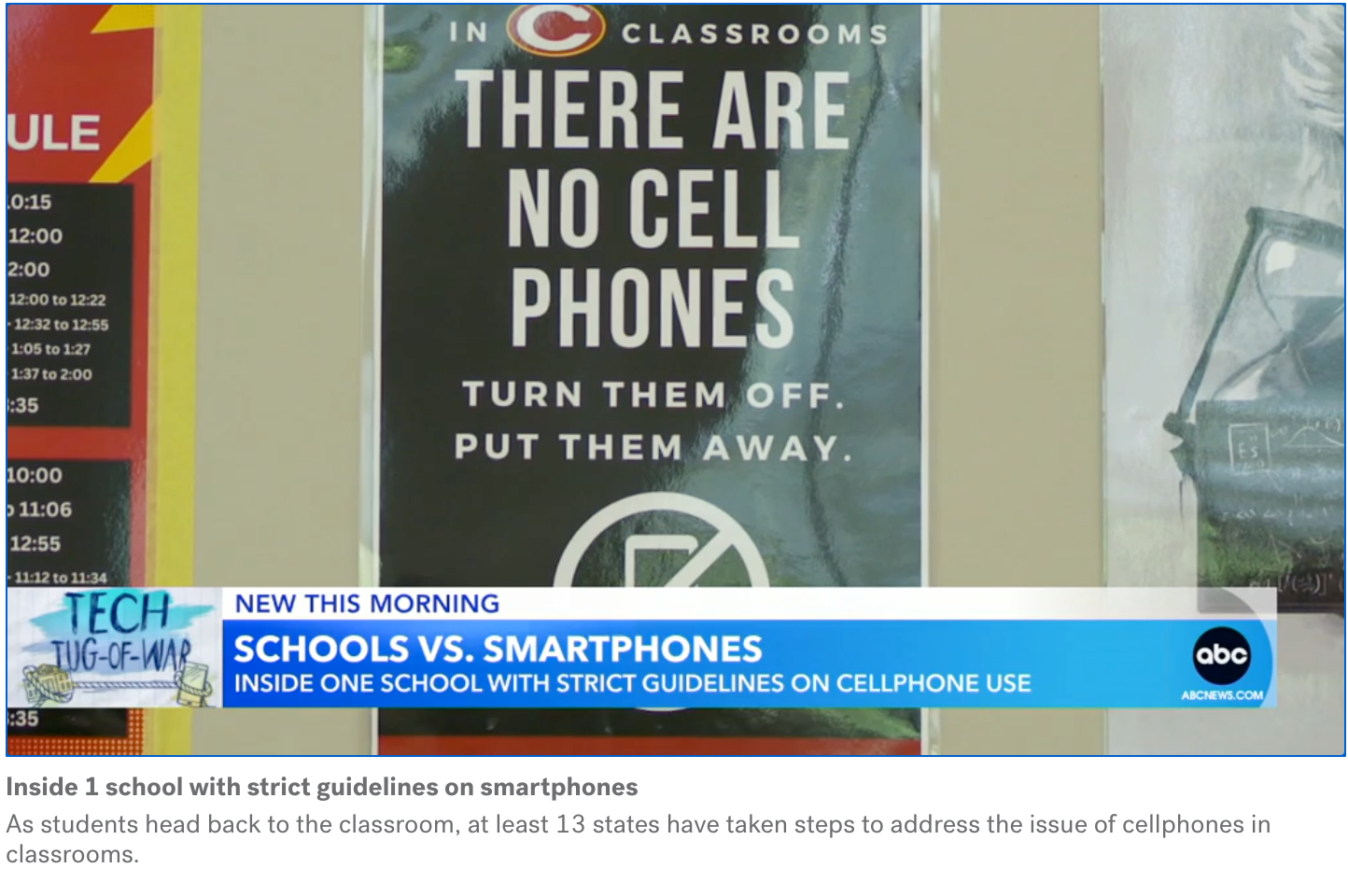
Although relatively few of the international education media IEN follows reviewed the biggest stories from 2024, organizations focusing on children highlighted the crises affecting many young people, particularly those caught up in conflicts. In the US, many journalists and educators noted the impact of AI and other technologies and Education Week highlighted the efforts to limit technology use by declaring that “cellphone ban” was the word/phrase of the year (The education word of 2024 is…) Given the number of articles that discussed efforts to ban books and regulate curriculum and other aspects of schooling, just “ban” may have been a more appropriate choice. To get a sense of the extent of book banning, the American Library Association tracked books banned in 2024 and The Guardian reported on a survey rom PEN America showing that more than 10,000 books were banned in US public schools from 2023 to 2024. That same survey suggested that bans of books nearly tripled in the US from 3,362 the previous year (US public schools banned 10,000 books in most recent academic year). But bans were not limited to books or cellphones. The California legislature also passed a number of laws in 2024 banning or restricting a variety of practices including limiting libraries abilities to ban “books based on subject matter focused on race, gender identity, sexual orientation or other characteristics.” The California legislature also banned legacy admissions in private universities in California, and school districts can no longer institute policies requiring teachers or staff to disclose a child’s gender identity to the child’s parent or guardians (Ten things California is banning in 2025).  

Headlines from around the world

2024 in Review – One in three children in conflict and fragile countries out of school, Africa.com

‘Not the new normal’ – 2024 ‘one of the worst years in UNICEF’s history’ for children in conflict, Unicef

More than 52 million children in countries affected by conflict are estimated to be out of school. Children in the Gaza Strip, and a significant portion of children in Sudan, have missed out on more than a year of school, while in countries such as Ukraine, the Democratic Republic of the Congo, and Syria, schools have been damaged, destroyed or repurposed, leaving millions of children without access to learning.

The Top 15 Education For All Blogs of 2024, GPE

2024 Review of the Year in Comparative International Education: Some reflection on the past year – Gaza, Genocide, Higher Education Crisis and much more, The FreshEdPodcast

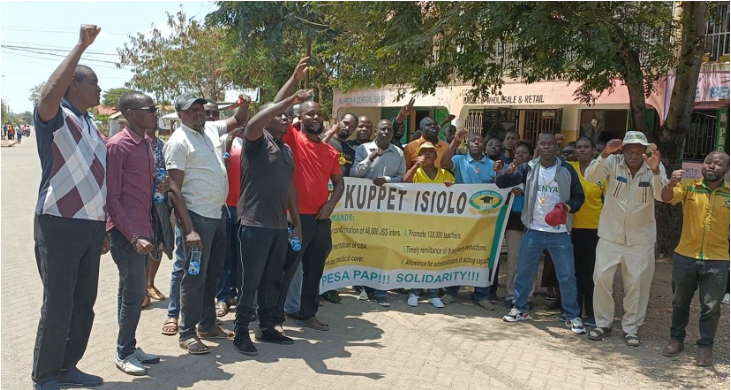
Kenya’s 2024 academic year marred by multiple crises, The Eastleigh Voice

Isiolo Secondary school teachers during a strike earlier this year.

“The 2024 academic year in Kenya faced significant disruptions, stemming from funding delays, natural disasters, industrial action, and social unrest, severely affecting learning activities across the country.”

Seven major events in Education Sector in Ghana in 2024, Ghana Web

2024 Review: Major events, reforms that shaped Nigeria’s education sector, Premium Times

Looking back 2024: Education sector in Bangladesh remains neglected, New Age 

Learning losses to the students of all levels [in Bangladesh] were caused by not only the mass uprising, which began with the student movement against government job quotas, but also natural calamities of cold wave, heatwave and flood that caused the closure of educational institutions several times in 2024.

The year of interrupted learning in Pakistan, T Magazine

How Crises Affect Students and Teachers, T Magazine

2024 wrapped: The biggest education stories of the year in Singapore, and what’s next, The Straits Times

Norway, IQ Tests and Child Care Deregulation: Our Favorite Early Ed Stories This Year, The Hechinger Report

In the UK From recruitment crisis to class war: 2024 in review, School Management Plus

Headlines from the US

Public Schools by the Numbers: How Enrollment, Funding, and More Changed in 2024, Education Week

The Year in Education: Our Top 24 Stories About Schools, Students and Learning, the 74

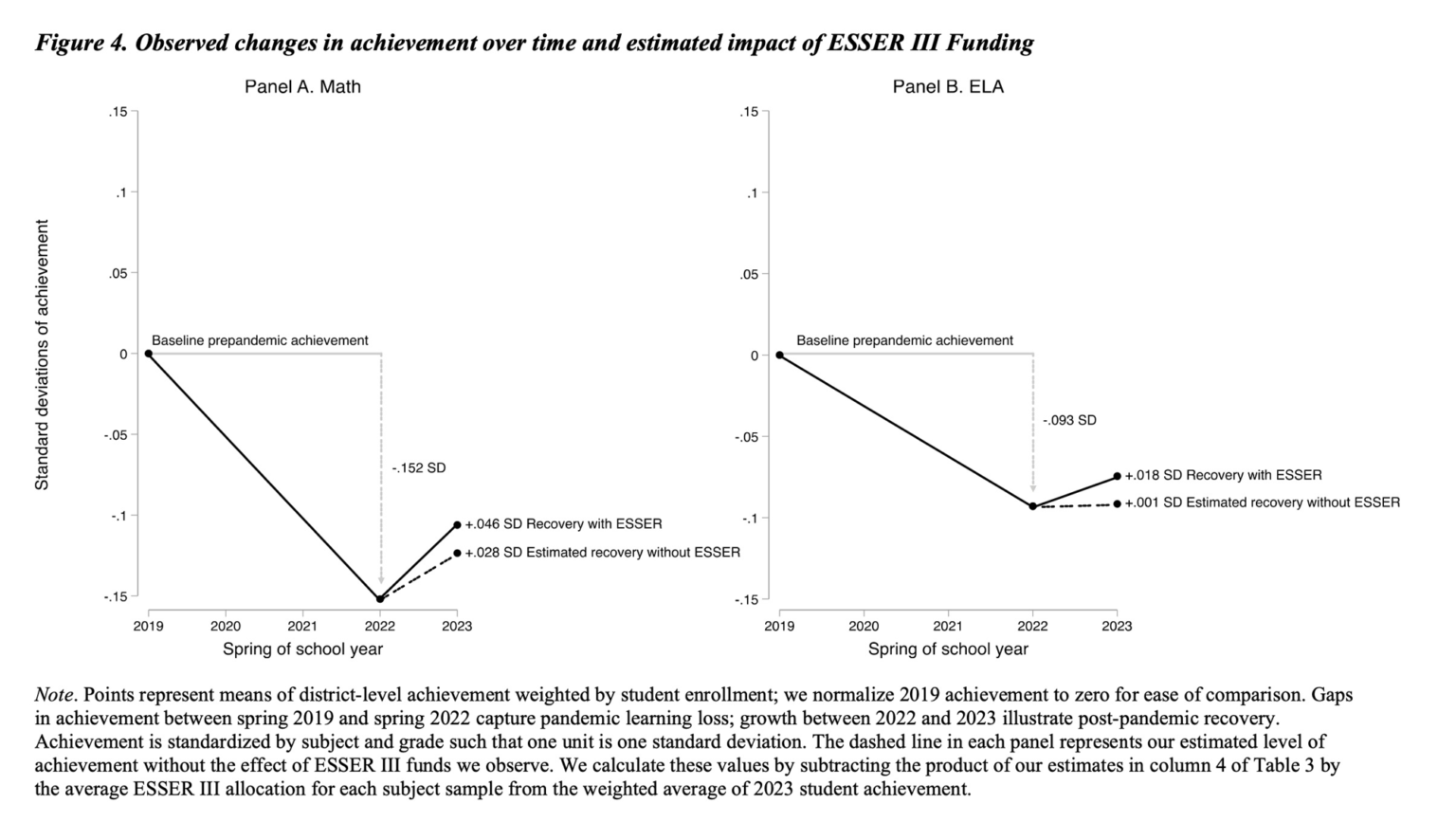
Federal Funds Lifted Learning — But Not Enough, The 74 (source: Calder Center)

2024 in Review, From Your Point of View, Edutopia

Pandemic, Politics, Pre-K & More: 12 Charts That Defined Education in 2024, the 74

The 10 Most Significant Education Studies of 2024, Edutopia

“Warm demanders are teachers who insist on the highest standards but remain sensitive to a student’s need to belong—and to succeed. By bracketing the most frustrating lessons with work that elicits a child’s feelings of competence, teachers can “bolster students’ math motivation and engagement” in a way that does not “involve reducing the rigor of the material that students learn.'”

Jealousy List: 16 Education Articles We Wish We Had Written in 2024, The 74

2024 Must-Reads: 9 Stories About Early Care and Education That We Can’t Stop Thinking About, The 74

A dozen of the best opinion pieces on education that we read in 2024, Michael Petrilli, Thomas B. Fordham Institute

The Best and Worst Education News of 2024, Larry Ferlazzo, Education Week

The best and worst of ed reform in 2024, Thomas B. Fordham Institute

2024 Year-in-Review: Reforming K-12 Education, Hoover Institution

Philanthropy Awards, 2024, Inside Philanthropy

7 Curriculum Trends That Defined 2024, Education Week

How AI Is Changing Education: The Year’s Top 5 Stories

The Best in K-12 EdTech—Last Year and Next, eSchool News

Cellphones in the Classroom: The Year’s Top 5 Stories, Education Week

School Shootings in 2024: More Than Last Year, But Fewer Deaths, Education Week

Local Education News You May Have Missed in 2024 (and Why It Matters), Education Week

Trump’s Education Priorities, Foundation Aid, and Mayoral Control: 2024 in ReviewNew York Focus

Schools continue to rebound, thanks to influx of funding: 2024 year in review, Cal Matters

Next week: What’s Next for Schools in 2025? Scanning the Headlines for Predictions about Education in the New Year

Happy New Year from IEN!

IEN will be taking a break over the holidays and New Year and returning in January with our annual posts surveying the headlines reviewing the education news in 2024 and predicting education trends in 2025. In the meantime, please revisit some of our most viewed stories of the year. We hope you have a restful, peaceful, and healthy New Year!

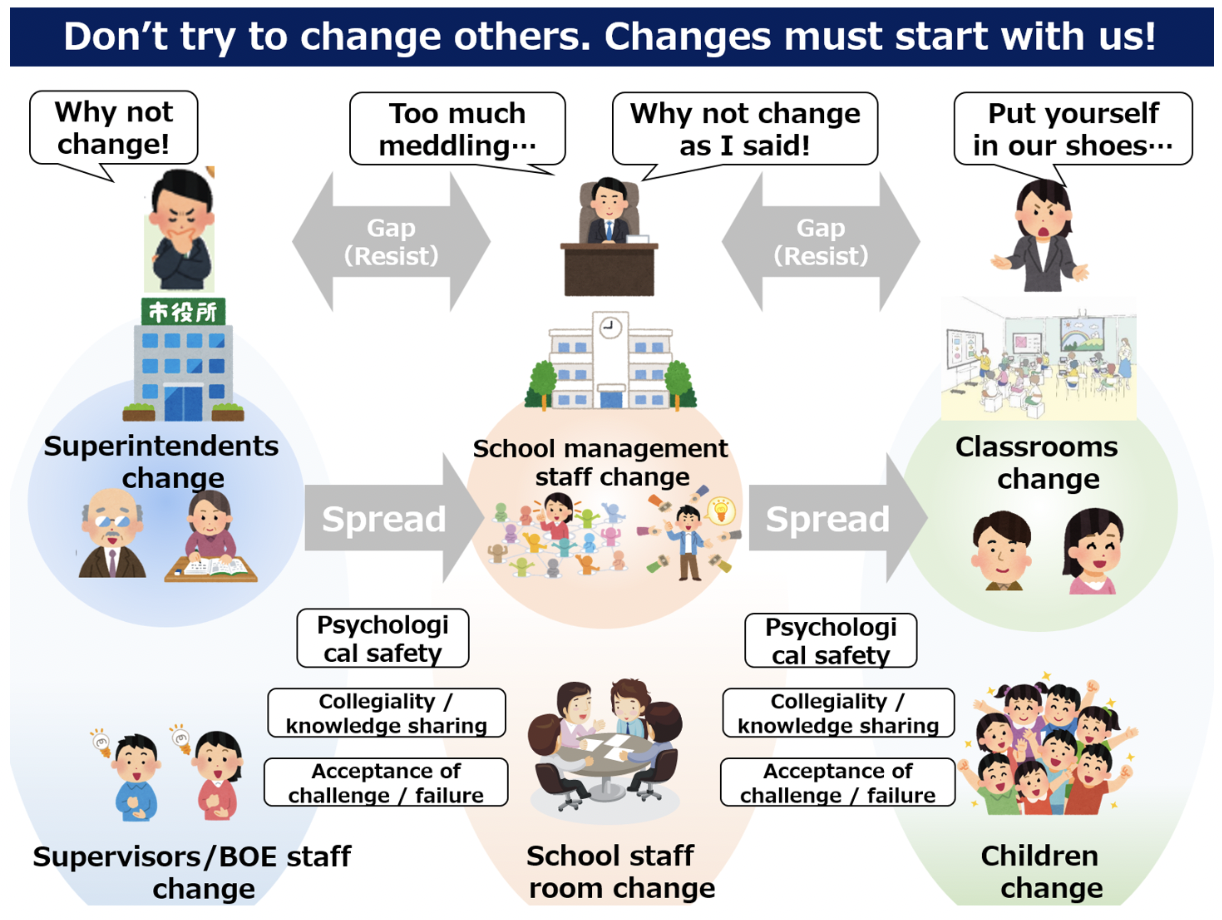
Hirokazu Yokota on aggressive education reforms to change the “grammar of schooling” in Toda City part 1 & part 2

Looking toward the future and the implementation of a new competency-based curriculum in Vietnam: A Conversation about the Evolution of the Vietnamese School System with Phương Lương Minh and Lân Đỗ Đức, part 1 & part 2

Banning Cell Phones Around the World? Scanning the Back-to-School Headlines for 2024-25

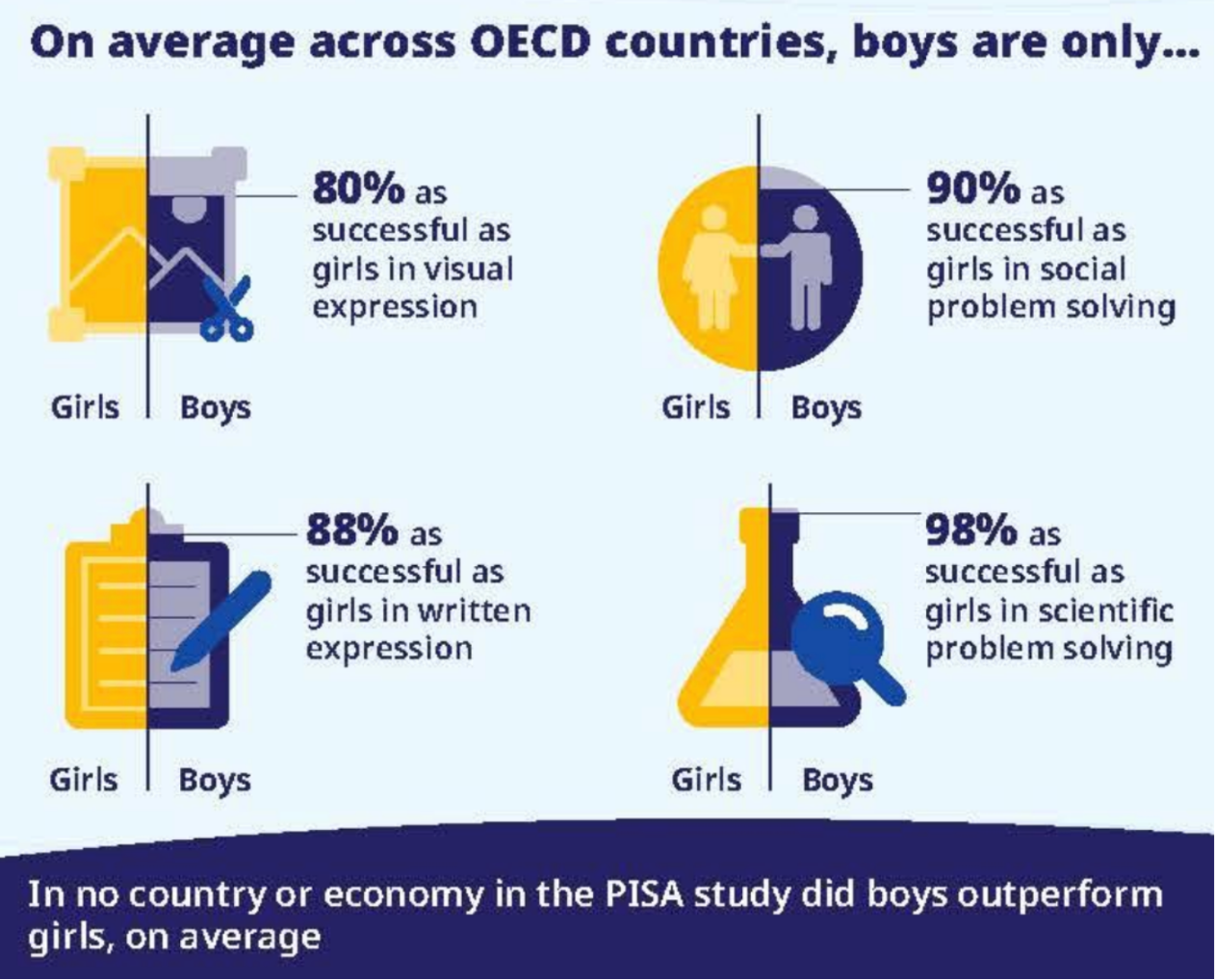
Scanning the headlines for creativity around the world: PISA Creative Thinking Assessment 2022

“Big Infrastructure, Big Capacity Building, and State-Wide Scale-Up…”: Mike Kirst on the Need to Revitalize Standards-Based Reform

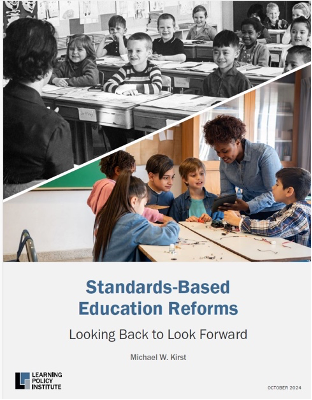
Nearing the end of 2024, it’s an opportune time for Looking Back to Look Forward. In this case, that means looking back on the standards-based education reforms of the 1990’s through a reflection and report from Mike Kirst. As Dick Jung describes in his book and blog series about Kirst’s career and impact, Kirst is an “uncommon academic;” at the same time that Kirst has been a professor of education at Stanford University he has also been an influential public servant. Kirst has been a trusted advisor to California’s former Governor Jerry Brown, and Kirst served four terms as President of the California State Board of Education. This week, IEN highlights Kirst’s continuing influence by sharing a quote from a blog post Kirst wrote for Policy Analysis for California Education along with excerpts from the latest installment of the “Uncommon academic” blog series. Both the blog post and the 21st installment discuss the Kirst’s latest report for the Learning Policy Institute on some the standards based reforms in which he has been intimately involved. (For a previous post on Mike Kirst’s career see Making public policy work for education: Reflections on the career of Mike Kirst)

“After ending my fourth term as president of the California State Board of Education in 2019, I have begun to reflect, in my sixth decade of education policy, about what I did right and what I should have done differently. In my time on the board, we organized many policies around and integrated them with the state standards in English Language Arts, Mathematics, and Science. California made significant progress toward creating coherent and aligned state policies aimed at helping local districts implement the Common Core State Standards. We coupled these policies with a new, more equitable funding system—the Local Control Funding Formula (LCFF)—and a multiple measures accountability system.

Looking back, it was naïve to believe that these policy reforms alone would be enough to achieve the desired impact. We successfully corrected for some of the failures of prior attempts to generate educational improvement by over-focusing on accountability (embodied by policies like No Child Left Behind). I failed, however, to realize the extent to which accountability-focused approaches of the past had underinvested in building the system capacity necessary to support educators in developing the knowledge and skills that would enable them to teach successfully in the new ways that the new standards demanded. Our policies did not do enough to overcome this deficit.”  

— Mike Kirst, Looking Back, Moving Forward: A Vision for Instructional Capacity in California

A Clarion Call for Reform from an ‘Uncommon Academic’ Excerpts from the 21st installment of the Mike Kirst Biography Project produced by Richard Jung

This installment of the Mike Kirst Biography Project features Mike himself, speaking of his rationale and intentions as he toiled, in his eighties, over the lessons from decades of research and policymaking.  This installment allows you to see and hear, through video and audio clips, Mike’s sense of what is most important for policymakers to know and do toward lifting local education practices to meet high standards (standards-based reform).

He elaborates—in his own words, often with captivating metaphors—the answers to three questions:

  • Why has he spent the first five years in his eighties researching and writing this Report?
  • Why have many K-12 education reform efforts, including his own, fallen short?
  • What should be done differently going forward?

So, let’s take a more personalized plunge into the education policy approach of standards-based K-12 education reform, enhanced by recent interviews with Mike.

Mike’s “More-Focused Heart” Years

In the report’s first sentence, Mike writes that its genesis was when he turned 80. His longtime Stanford colleague, walking partner, and hand-selected successor as California’s State Board of President, Linda Darling-Hammond, then President of Learning Policy Institute (LPI), and he had “discussions.” He agreed with her and others that “[a]after almost 60 years of working full-time in education and doing research, I thought it was a good time for me to reflect on” that previous work in federal and state education reform efforts “and to synthesize the research focusing on the impact of standards-based reforms.”3

As Mike turned 80, he reviewed the current research literature. He saw that there was a much deeper understanding of how difficult it is to change classroom instruction and that California had no master plan or strategy based on that research, particularly for math instruction.

Mike persisted for the next three years, through his early 80s, to gather and reflect on this research at a time when, as he writes in this “Preface,” “the COVID-19 pandemic was the overwhelming focus of education policy.” A series of LPI editors worked with him to refine and polish the Report. And now, some five years after those initial discussions with Linda Darling-Hammond, Mike believes “public attention” might be “more receptive to classroom instruction issues and the core subject matter curricula of k-12 schools.”4

Professionally, Mike’s septuagenarian years had hardly been “serene,” unlike those of suffragist Scott-Maxwell noted above. During his stint leading the state board of education and working hand-in-hand with then-Governor Jerry Brown from 2011 through 2019, Mike had led the charge with others to pass and then start to implement one of the country’s most successful school finance and governance reforms, the Local Control Funding Formula (LCFF)  which enhanced both quality and equity in the state’s distribution of funds and accountability for their use.5

With others, he began working quietly—perhaps less quietly recently—behind the scenes to stir up enthusiasm about the standards-based reform ideas embedded in the LCFF, e.g., that standards-based reform involves setting standards and aligning curriculum, instruction, and assessment practices to those standards to ensure that all students have the opportunity to meet high expectations, thereby enhancing both quality and equity.

By the time he was almost 82, in July 2021, like writer and activist Scott-Maxwell, Mike was becoming “more intense” as he aged. He began publicly to “let the cat out of the bag” about his sense of the critical next steps toward fully implementing standards-based reforms when he delivered his acceptance remarks as he received the prestigious  James Bryant Conant Award from the Education Commission of the States.

In his acceptance speech (this clip below), he begins, as is his wont, with a sports analogy—of “being in the fourth inning of a nine-inning ballgame when we got rained out by Covid”—to summarize California’s complex education policy situation as implementation of the reforms in the LCFF were to roll out. He had already highlighted that “local capacity building” is the place to start and emphasized that again. There’s a lot to unpack from this two-minute clip. Let’s first listen in:

Even amid the COVID-19 shut-down of schools across California and most of the country in 2021, Mike looked into the future and beyond when K-12 schools would be fully operational. He drew upon his decades of education policy research and policymaker experience to note, “States… can’t mandate—we can’t even incentivize very well what teachers and principals and school people do together.” Further, “when the teacher closes the classroom door, she or he has the impact, in effect, of a pocket veto, over whether state policies are implemented or not.”

As a politics of education expert, the pocket-veto power of teachers once the teacher closes the classroom door is a metaphor that Mike has often used to depict that state, federal, or even local policymakers cannot merely “mandate” or require classroom practices to improve instruction.

As you can hear in this clip, Mike had been looking in the U.S. and other countries for ways to build the “massive infrastructure” needed to effect reforms in California. He cites Ontario, Canada, Singapore, Australia, Finland, and some states in America, several of which were sites for his early policy work.6 He offers this tease: “I can’t describe all of this to you now, but you’ll be hearing more from me about …”big thinking, big infrastructure, big capacity building, and state-wide scale-up… in the next months and years.”

Now, three years later, Mike has found a more apt metaphor for the complexity of improving classroom instruction; it’s an analogy he picked up from Harvard University’s Richard Elmore.7 Mike now observes that “education policy, particularly at the federal and state level, is like a shell of a turtle. The shell’s important for the turtle, but moving and important, complex parts are underneath. Mike believes that “at this time in my career, my focus is on the operating parts of the turtle rather than on the ‘shell’ of finance and governance.”8

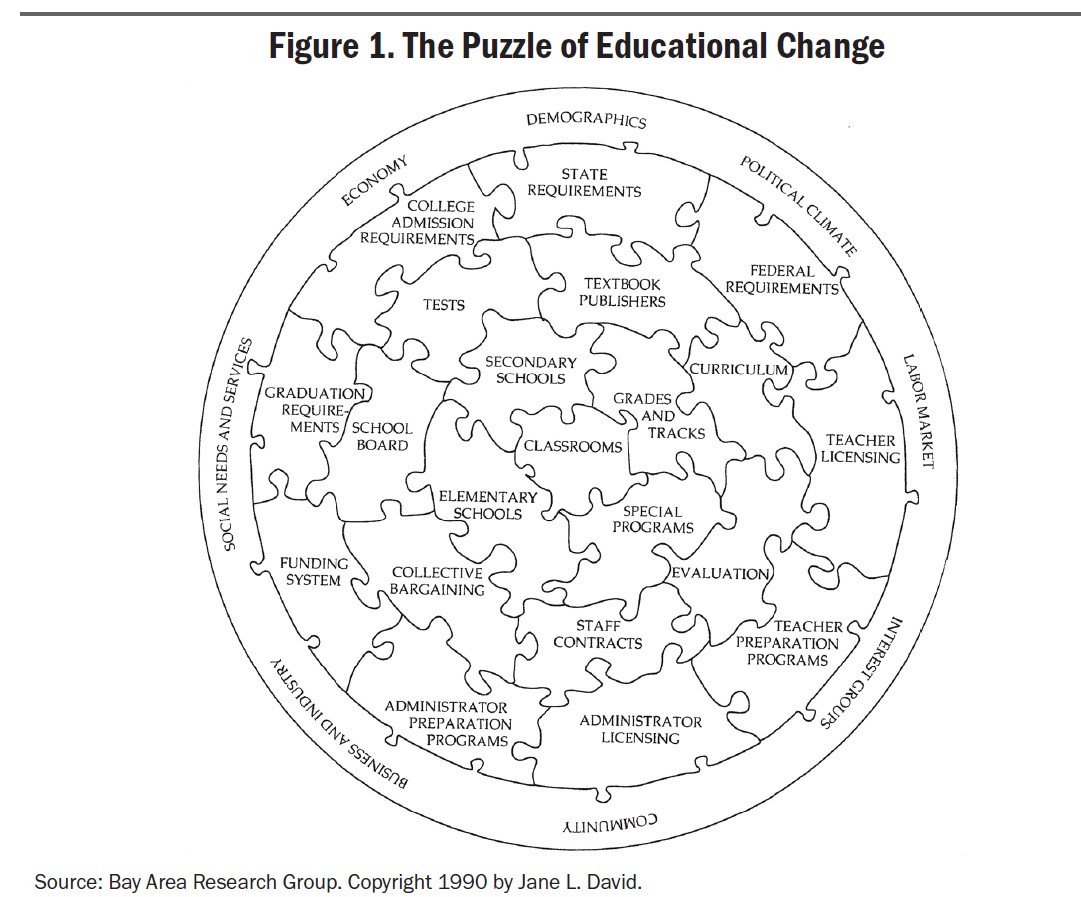
To illustrate this portrayal of education policy by drawing on the Elmore turtle analogy, he borrows an image from his research colleague Jane David, who calls it “the puzzle of educational change.” Mike explains in the Report, “David’s diagram is daunting in its complexity and helps illustrate why it has taken years of effort even to begin to align the supports for standards-based reform, long after support for the concept itself took hold.” In other words it’s one thing to create strong standards. It’s quite another for “those standards” to make “their way into instruction” inside the classroom.9

Massive Infrastructure Needed for Scale-Up

The publication of Looking Back to Look Forward is evidence of Mike’s focus since his Conant Award acceptance speech three years ago. He had been deliberating on the nature of and the necessity for a  “massive” post-COVID standards-based reform of California’s K-12 education system. The word “massive” appears in the Report nine times.

In his “long paper,” he states that all states, “even those…in the midst of piecemeal improvements to instructional capacity-building…would benefit from broader thinking and planning. The objective should be to create a lasting education infrastructure similar to the federal interstate highway system of the 1950s.”10 Mike’s point with this analogy to the National Interstate and Defense Highways Act is that it took 15 years to pour all the concrete to complete our country’s interstate highway system. With COVID hitting only a few years after the standards reform legislation in California was enacted, much of the “concrete” in terms of essential “capacity-building” for improving instruction had only begun to be “poured” or put in place.

“The key word is ‘capacity-building’  of local educators.”

Recall that in the Conant acceptance speech, he told the audience that “the keyword is ‘capacity building” at the local level, that “this capacity building has many aspects,” and that education reformers in other countries had told him, “we build this capacity building into the districts” and “we build it into every day” and “into the professional work of teachers through expanded professional development.”  Mike details this local capacity effort in other countries and states, including Massachusetts and Louisiana, on pages 69 through 76 of Looking Back to Look Forward.

Mike Notes Two Caveats about the LPI Monograph

Mike’s thinking evolved in several significant ways as the publication of this paper “percolated.” Most notably, he, with other colleagues, now more fully admits “how hard it is to scale up PD [professional development]…to statewide implementation.”11 He also recently reflected on two caveats about the paper, especially its conclusions. Click on the link below to hear more from Mike about the first of these:

Mike Kirst: A limitation of the LPI monograph: “The paper ends very vaguely…” (audio, 35 seconds) 

Mike is delighted that the monograph is now out but laments that it “essentially ends with a plea for a detailed plan with very little detail.”  He continues, “I’ve learned now more than I had in the paper about how hard it is.”12 after recently working with several groups–including the California Collaboration on District Reform and the California Math Roundtable, which he refers to jointly as the “collaborative” in this interview excerpt.  Voicing some frustration, Mike concludes, “There is no detailed strategic plan in this paper because nobody has ever done one.” 

He asks rhetorically specifically for math, “So what’s your strategic plan for teachers to teach the math curriculum in California when the students are all over the map in math? You have so much diversity, particularly in that subject, even within middle-class and upper-class classrooms. And so that’s why it’s not there.”13

The second limitation Mike now sees in his Report is that he failed to more forcefully note that educational policy has been imbalanced too frequently, failing to emphasize capacity-building as much as accountability. Click on the link below to listen to how he explains this limitation in his own words:

Mike Kirst:  I wish I had emphasized more “the ‘accountability-capacity’ imbalance trend in education policy over many years.” (audio, 39 seconds) 

Referring to Harvard’s famed education policy researcher, Richard Elmore—what Mike calls “Elmore’s Law—Kirst notes that for too many years, policymakers have put too much emphasis on accountability up front rather than understanding that successful implementation requires more initial investments in capacity building.14 Using a scale of justice metaphor, he notes that even a recent California education funding initiative had still made this mistake when it had “ratcheted up accountability but with no real systematic capacity” and that it’s “a common mistake” among policymakers to “lead with accountability and never get around to capacity building.”

Still Living His Mantra 

Before LPI published  Mike’s “long paper,” Kirst was cautious in what he said publicly about his behind-the-scenes efforts to advance his standards-based reform project, which is close to his heart. That didn’t stop others from wanting to hear more about Mike’s education reform ideas. Earlier this year, for example, Dr. Lisa Andrew, President and CEO of Silicon Valley Education Foundation, hosted for Forbes Books a two-part series offering what she summarized as “a unique bird’s eye perspective on education’s challenges and opportunities,” with the impatient foot-tapping title of “They are Waiting For Us”, perhaps unwittingly reflecting Mike’s wanting for the past several years to get out the ideas now appearing in this LPI paper.

Mike begins this Report with more than a hint of that impatience, noting that the COVID-19 pandemic became “the overwhelming focus of education policy for three years.” So, he and LPI leadership decided to “wait until public attention was more receptive to classroom instruction issues and the core subject matter curriculum of K-12 schools ” to release the monograph.15  With the publication of this Report early in the 2024-25 school year, Mike boldly exhorts, “Now is not the time to give up on state standards.” Instead, he insists, “There is no better time than now to proceed.”16

We note, however, that Mike’s “now” is tempered in his “long paper’s” closing observation that “providing sufficient capacity-building for teachers in making major instructional shifts is more realistically implemented over a decade or more rather than in… a few years”—cautioning policymakers once again to adhere to his time-proven policy reform mantra  of: “patience, persistence, humility, and continuous improvement.” reiterated in the Report’s concluding sentence.”17

See 21st Installment: A Clarion Call for Reform from an ‘Uncommon Academic’ for the complete post, notes, and citations.

Do Adults Have the Skills They Need? Scanning the International Headlines on the 2023 Survey of Adult Skills

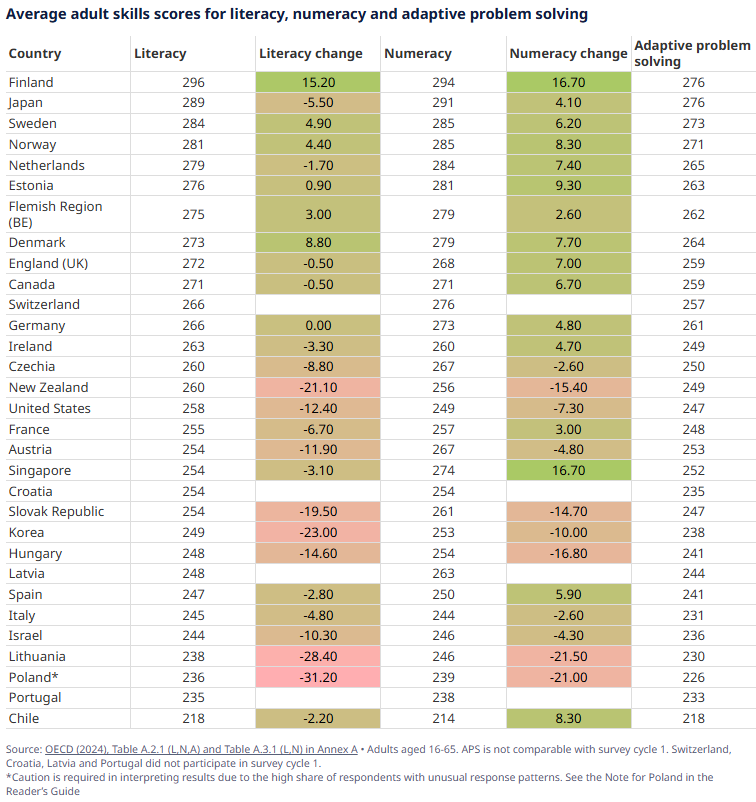
Do adults have the skills they need to thrive in a changing world? That’s the question OECD asks in its report on the results from the 2023 Survey of Adult Skills.  In many places, the answer seems to be maybe not. 160,000 16 – 65 year olds in 31 participating education systems took the test and only test-takers in Finland and Denmark improved their scores in literacy, with scores in the other participating systems remaining stable or declining since the data collection began in 2011. 8 of the 31 systems improved in math, but in both literacy and math the lowest-performing adults have shown the biggest  decline in scores. Along with the latest scan of the headlines in the education sources we follow, this week’s post provides a brief summary of some of the key take-aways reported. Produced by OECD’s Programme for the International Assessment of Adult Competencies (PIAAC), this estimate of adult skills comes only a few weeks after the latest release of the results of the Trends in Mathematics and Science Survey (TIMSS), which assesses the skills of 15 year-olds (Around the World in Math and Science: Scanning the headlines on the results of TIMSS 2023).

Key Takeaways from the 2023 Survey of Adult Skills

  • Finland, Japan, the Netherlands, Norway and Sweden excel in the three tested areas of literacy, numeracy, and problem solving, with significant percentages of adults showing “advanced” abilities.
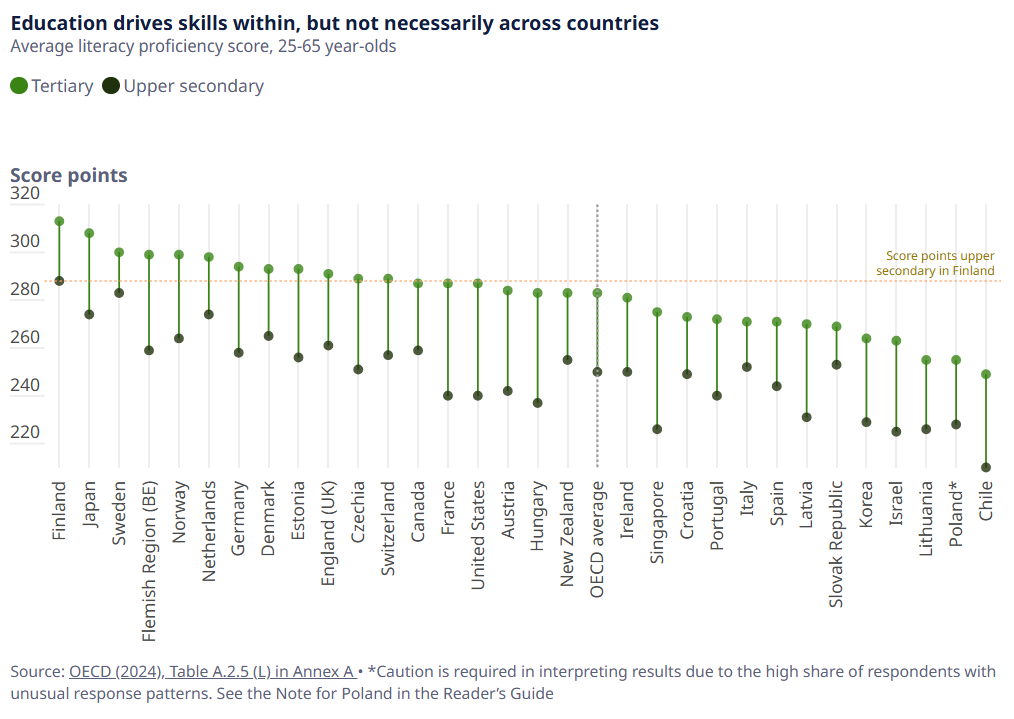
  • Finnish high school graduates outperform those with college/tertiary education degrees in several countries, including Chile, Israel and Lithuania.
  • Adults who show high levels of skill in numeracy are 11 percentage points more likely to report very good or excellent health compared to those with low numeracy skills
  • On average, across participating systems, 18% of adults lack even the most basic levels of proficiency in any of the domains, but the performance of the top 10% has improved, leading to widening skills inequalities within countries
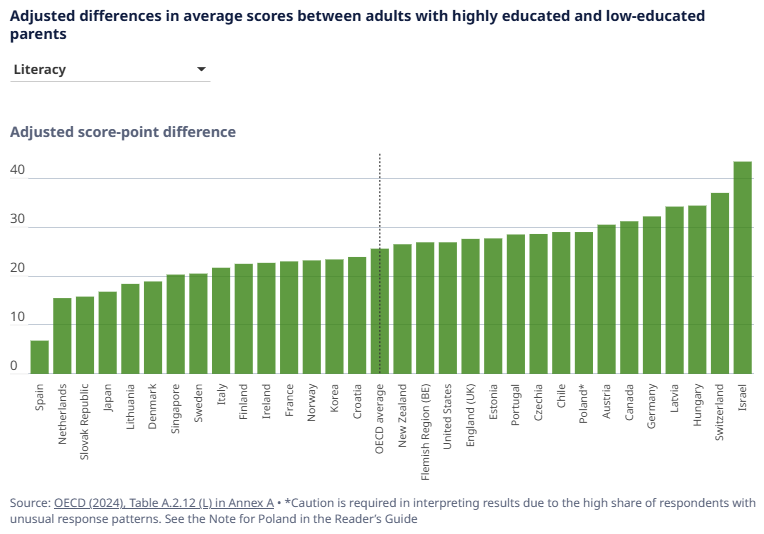
  • Adults with highly educated parents outscored those with “low-educated” parents by 50 percentage points in literacy
  • Singapore and the United States displayed the largest skills inequalities in literacy and numeracy
  • Disparities in educational attainment are largest in Israel, Switzerland, and Hungary (34 percentage points) and smallest in Spain (7 points)

Headlines

Are adults forgetting how to read? The Economist

England

Workers in England more likely to be overqualified than global peers, finds OECD, Financial Times

OECD (PIAAC) Survey: England’s Youth Skills Show Dramatic Improvement Since 2012, FE News

Finland

Finland shines in “adult Pisa” ranking, Yle

Israel

Israeli skills in literacy, math and problem-solving ‘below OECD average’ – report, The Times of Israel

Italy

Italy, a country of functional illiterates, Finestre sull’Arte

Japan

Japan scores high in OECD survey of adult skills, NHK World

Japan again ranks at or near top of survey on adult skills, The Asahi Shimbun

New Zealand

NZ tumbles in international adult literacy, maths rankings, RNZ

Singapore

Singapore improves in OECD ranking of adult skills, but atrophy in literacy a concern, The Straits Times

Spain

30% of Spanish adults do not have minimum skills in mathematics and reading, La Vanguardia

Ukraine

Adults losing edge: Quarter now less skilled than children, RBC Ukraine

United States

In a Test of Adult Know-How, America Comes Up Short, The Wall Street Journal

Survey: Growing number of U.S. adults lack literacy skills, NBC News

U.S. Reading and Math Gap Is Getting Worse for Adults, Too, Education News

What’s next for US education? Scanning the post-election headlines

A flurry of articles in the US press since the presidential election in November explored the effect that a new Trump administration might have on schools, on students, and on a number of education issues. In this week’s post, IEN shares some of the headlines as well as those discussing the results of governor’s races and local propositions with particular relevance for education. 

Results: Education Week’s Guide to the 2024 Election, Education Week

Education policy: How it will shift under new administration , District Administration

Trump has won a second term. Here’s what that means for schools., Chalkbeat

Experts expect civil rights enforcement to change and transgender students to lose new protections.

What’s at Stake for Schools as Trump Returns to the White House, Education Week

How Trump’s Second Term Will Affect Education: 4 Things to Know, Education Week

What education could look like under Trump and Vance, Hechinger Report

What a Second Trump Presidency Could Mean for Education in the U.S.The 74

Can Trump Force Schools to Change Their Curricula?, Education Week

Trump pledged to cut federal funding to schools “pushing critical race theory” and “transgender insanity.”

Trump has vowed to push schools to the right on gender and race. Now he can, Washington Post

What will Donald Trump’s 2nd term mean for Title IX?, K-12 Dive

Education Department’s future uncertain under Trump, Education Week

Can Trump Really Dismantle the Department of Education?, Education Week

Will Trump eliminate the federal role in education or weaponize it?, Flypaper

Is the federal role in education slated for elimination or expansion?…There’s no way to be sure today. But there’s ample reason to be unsure, and that’s because the Trump world has long sent exceedingly mixed messages when it comes to K-12 education and the federal role therein.

Trump’s Push to Expand Choice, Nix the Ed. Dept. Takes on New Momentum, Education Week

Would axing the Education Department hurt kids with disabilities? Experts say: It depends, Chalkbeat

Trump has called for abolishing the U.S. Department of Education. How that affects students with disabilities would depend a lot on what happens next.

What will a second Trump term mean for education and libraries?, School Library Journal

How Trump Could Roll Back Access to Free School Lunches, Education Week

A policy that allows schools to serve free meals to all students may be under fire.

Colleges wonder if they will be ‘the enemy’ under trump, New York Times

New Appointees Impact on Education?

Trump picks Linda McMahon to lead, and possibly dismantle, Education Department, Chalkbeat

Trump Taps Linda McMahon, Donor and Former Wrestling Exec, to be Education Chief, The74

Despite championing apprenticeships and workforce development, her main charge may be dismantling the department she’s set to lead.

5 things to know about Linda McMahon, Trump’s pick for Education secretary, The Hill

Betsy DeVos’ Advice for Trump’s Next Education Secretary, Education Week

What Elon Musk’s New Role in the Trump Administration Means for Schools, Education Week

Musk’s new role may have big implications for schools. 

Trump’s Defense Pick Pete Hegseth has an opening to reshape American Classrooms, Politico

Pete Hegseth has pushed for years to steep American education in patriotic principles and Christian theology — and he could implement that vision for thousands of military families if he’s confirmed to lead the Defense Department.

What Could RFK Jr. as HHS Secretary Mean for School Vaccine Requirements?, Education Week

The vaccine skeptic in line to lead Health and Human Services could influence schools’ vaccine rules

How RFK Jr. could shake up school lunches, K-12 Dive

Trump picks Rollins to lead USDA — and thus school nutrition programs, K-12 Dive

What Trump’s pick for FCC chair could mean for E-rate expansion, K-12 Dive

Effects on States, Cities, and Students

What the new Trump presidency could mean for California students and schools, EdSource

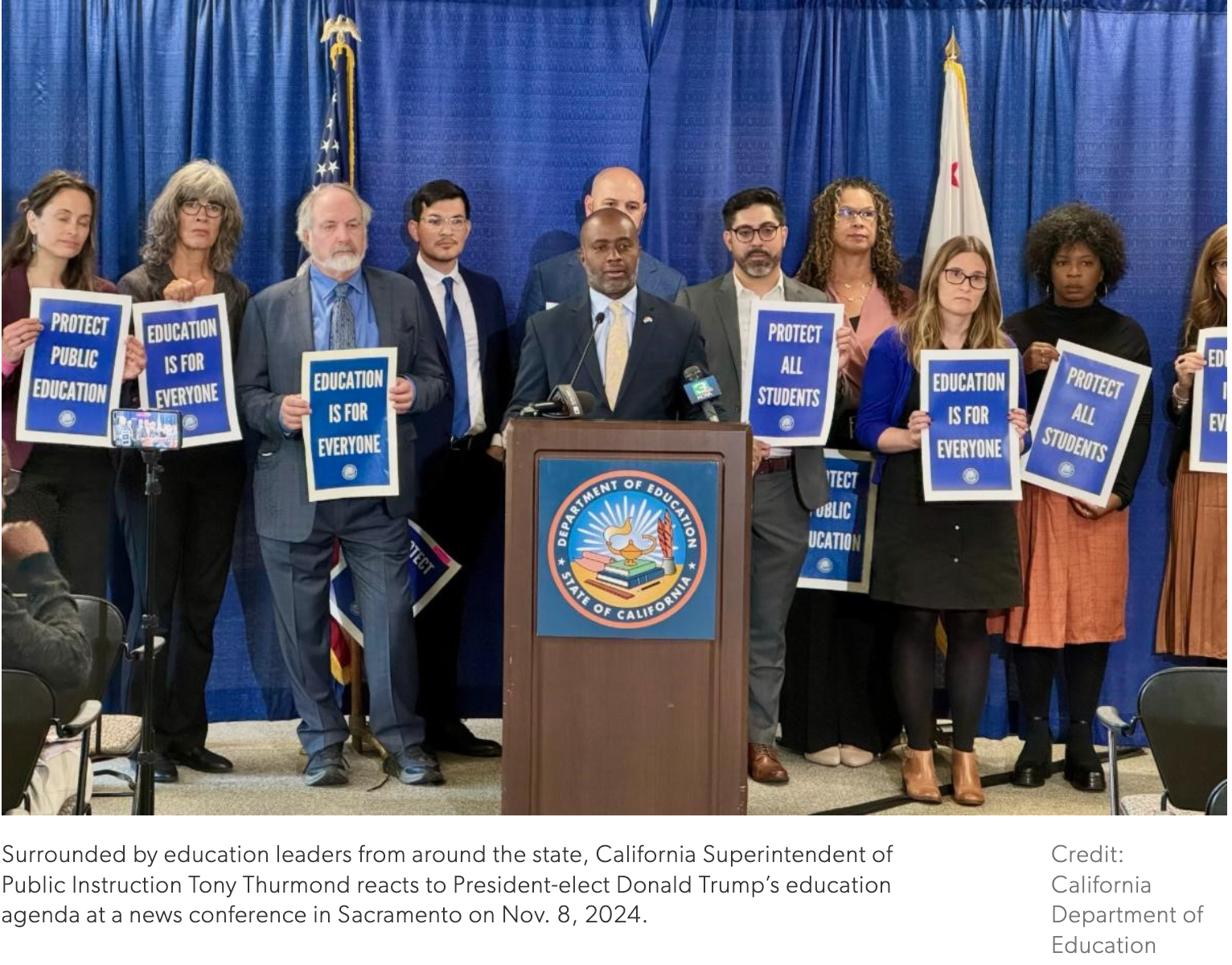
California education leaders try to reassure students of protections against Trump policies, EdSource

Many California children and their families, including immigrants, transgender students and Black and Latino students, are feeling fear and uncertainty.

California schools chief pledges to resist cuts in funding if Trump axes U.S. Dept. of Education, EdSource

Here are how Donald Trump’s promised policy changes could be felt in NYC, Gothamist

Eliminating the Department of Education: What it could mean for NYC, PIX11

In wake of Trump win, Chicago Board of Education moves to reaffirm protections for immigrants, Chalkbeat

Philly students walked out of their classes in protest of Trump’s election win, Chalkbeat

High schoolers said they are concerned about the president-elect’s policies about education, climate change, and reproductive rights.

Young Voters Favored Abortion Rights and President-Elect Trump, New Data Shows, The74

“More than a dozen states had ballot measures related to protecting or codifying access to abortion rights, the majority of which passed. But for Gen Z, being pro-reproductive rights did not equate to voting Democratic. In Florida, over half (52%) of young voters favored ending the state’s six-week abortion ban while supporting Trump by a 10-point margin.”

Trump pledged to roll back protections for transgender students. They’re flooding crisis hotlines, AP

School Leaders Confront Racist Texts, Harmful Rhetoric After Divisive Election, Education Week

Educators say inflammatory rhetoric from the campaign trail is in schools.

FBI investigating post-election text threats sent to Latino, LGBTQ people, many of them young, Washington Post

Protecting undocumented students: How schools and colleges are responding to Trump’s second term, El País

Governors, States, and Local Issues & Propositions

Where Newly Elected Governors Stand on Education Policies – 2024, ExcelinEd

Eleven newly elected governors have big plans for education in their states, with a focus on key issues including school funding, teacher retention, early literacy, math proficiency, career readiness, and school choice.

Texas will approve school vouchers, boost public education spending, governor says, Hechinger Report

Republican Victories in Texas House Give Governor Abbott a Path to Universal Education Savings Accounts, The74

Clashing with Dems’ Education Plan, Republicans Expand Reach in Arizona’s Legislature, The74

In a huge upset for Democrats hoping to curb growth of private school vouchers, GOP lawmakers to lead both houses.

Democratic frontrunner and former teacher Matt Meyer elected Delaware’s next governor, The74

Mike Braun Wins Governor’s Race in Indiana Against Career Educator, The74

Josh Stein Wins Governor’s Race in North Carolina. What’s Next for the Schools, The74

Former North Carolina Superintendent Defeats MAGA Homeschooler for Schools Chief, The74

How did K-12 fare on state ballots in the 2024 election?, K-12 Drive

Voters largely rejected school choice initiatives but embraced a variety of school funding measures

How Child-Focused Ballot Measures Fared This Election, The74

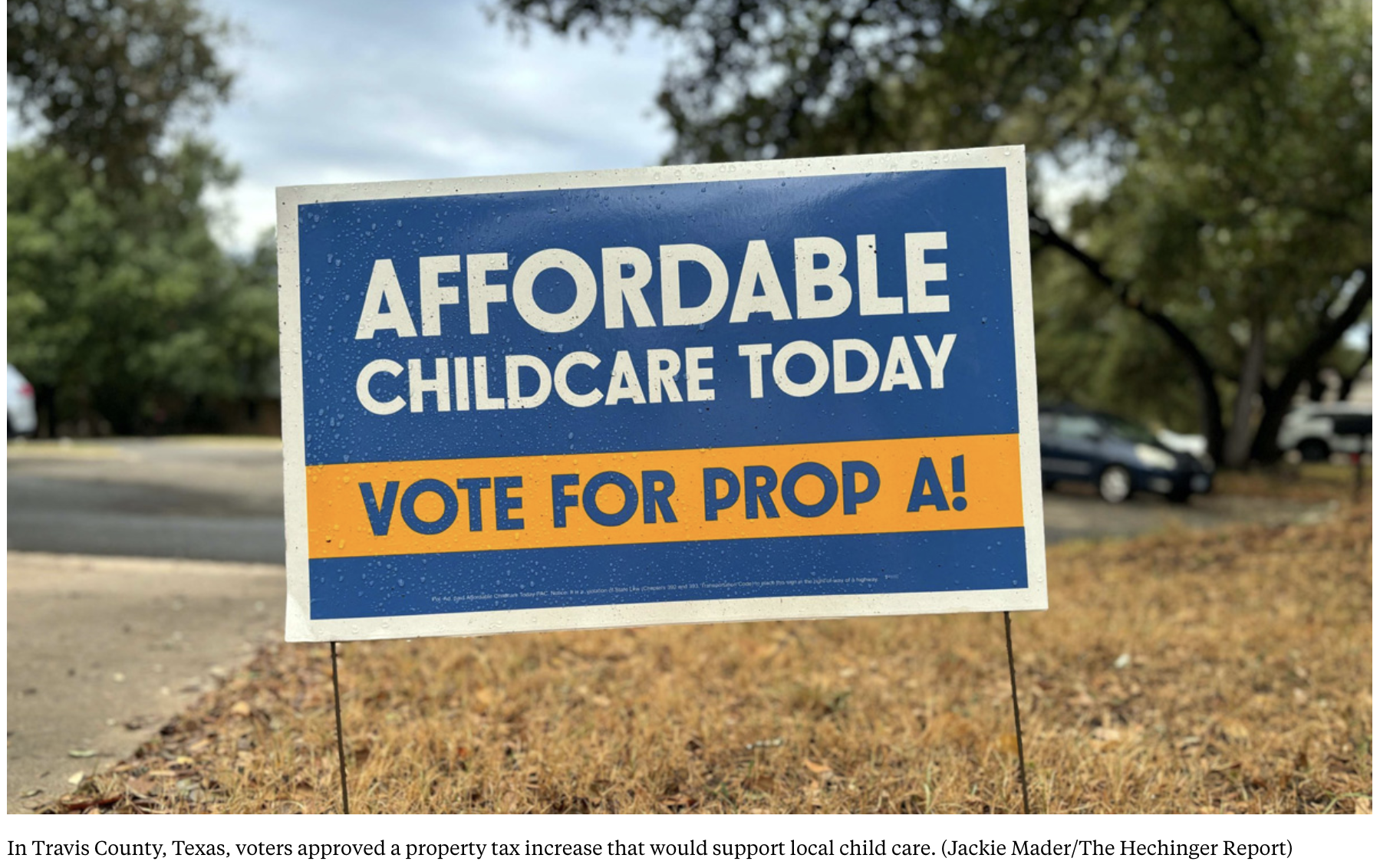
Child care won at the ballot box, Hechinger Report

A bigger child tax credit could ease child poverty and help students in school. But will it happen?, Chalkbeat

Candidates promised a larger child tax credit. Now a Republican-controlled Congress will decide its fate.

School choice may get its biggest moment yet, Hechinger Report

Advocates ready their plans for a new administration they believe will be friendly to vouchers, charters and other schooling options

Ballot Propositions: Voters in 2 States Reject Private School Choice, The74

Voters in Kentucky and Nebraska said no to private school choice Tuesday, dashing the hopes of advocates who wanted to further advance the movement for vouchers and education savings accounts. 

The Future of School Choice in the States That Rejected It, Governing

Voters in three states rejected ballot measures promoting school choice. But they didn’t reject the legislators who favor it.

In Deep-Red Florida, Voters Reject Partisan School Board Races, Education Week

Did School Battles Hurt Democrats in Liberal Strongholds?, New York Times

Voters in the Virginia suburbs shifted toward Trump. Some said they were still frustrated by pandemic closures and fights over gender, race and testing in schools.

Massachusetts Will Do Away With High School Standardized Testing Graduation Requirement, The74

Around the World in Math and Science: Scanning the headlines on the results of TIMSS 2023

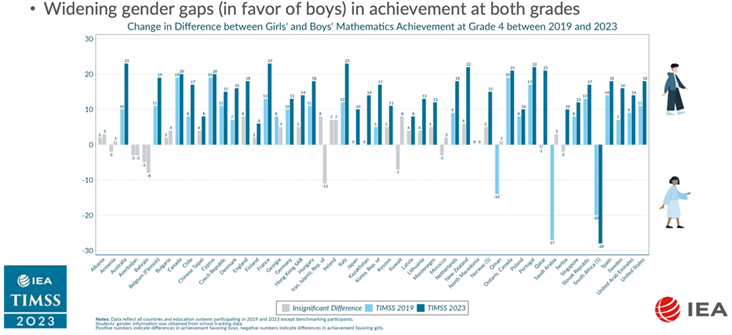
Holding steady in fourth grade but dropping at 8th grade sums up some of the key results from the eighth administration of the Trends in Mathematics and Science Study. The results, released on December 4, 2024, show that 8th graders in only three countries showed an increase in average math scores (Romania, Sweden, UAE) or in average science scores (England, Hong Kong, UAE), but that roughly equal numbers of countries saw increases or decreases in their math or science scores at the 4th grade level. Top performers in both subjects, as usual, included Asian countries like Singapore, South Korea, and Japan. 650,000 fourth and eighth graders in 64 countries participated in the tests in 2023, which also showed a widening gender gap as boys outperformed girls by significant margins in many education systems. Headlines touted gains in some countries like the United Arab Emirates, Turkey and Australia, but highlighted concerns about substantial declines in performance in countries like Israel and the US. In the US, the drop in scores was particularly pronounced for the lowest performing students, with one in five 8th graders able to demonstrate even a basic level of proficiency. Adding to the concerns, yesterday, December 10, OECD released the latest results of the 2023 administration of the Program for the International Assessment of Adult Competencies (PIAAC) which showed US adults are getting worse at reading and math as well, while adults in Finland, Japan, the Netherlands, Norway and Sweden excelled in literacy, numeracy and adaptive problem-solving. To put the latest international assessment figures in a historical context, see the scan of headlines related to the PISA 2022 results, the PISA 208 results and the results of TIMSS 2015.

Australia

Australian primary students score best ever result in global maths and science test, despite pandemic disruption,The Guardian

‘Interesting and disappointing’: Gap between girls and boys in STEM subjects growing, report shows, ABC

Bulgaria

Bulgaria’s Fourth Graders Score 530 in Mathematics and Science, Outperforming Global Averages in 2023 TIMSS Study, Bulgarian News Agency

Bulgaria’s results place its students roughly 14th or 15th globally… Bulgaria’s 530-point score in mathematics matches Czechia and Sweden, surpasses Finland by one point, and exceeds Australia and Germany by 5 and 6 points, respectively.

England

England moves into top five in global rankings for science, Time & Star

Timss 2023: Year 5 maths declines for first time but science scores surge, TES

France

France ranks last in Europe for math skills as education system ‘plagued by inequality’, Anadolu Agency

Hong Kong

Hong Kong students excel in TIMSS 2023 results, Dimsum Daily

“Hong Kong students have consistently demonstrated high levels of performance in mathematics. Our Primary Four students ranked fourth globally with a score of 594, markedly surpassing the international average of 503. Meanwhile, our Secondary Two students secured fifth place with a score of 575, well above the international average of 478. Notably, 38% of Primary Four and 32% of Secondary Two students achieved advanced levels in mathematics, compared to the international median of just 7%.”

Ireland

Pupils in Ireland among top maths performers in Europe, global study finds, The Irish Times

Performance by girls in maths and science falls, RTÉ

Israel

2+2=5? Israeli student math, science scores plummet, study finds, Ynet News

Japan

Japanese Science, Math Scores Remain High in 2023, Nippon.com

Mystery lies behind gender gap in academic performance, The Asahi Shimbun

Latvia

Latvian pupils’ exam results in maths and natural sciences become worse, Baltic News Network

Macau

Macau’s P4 students excel in math and science in TIMSS 2023, Macau Daily Times

Malaysia

MOE Identifies Challenges In Maths, Science Learning Among Students, BERNAMA.com

Malaysia’s Participation Reflects Effectiveness, Quality Of Mathematics And Science Education, BERNAMA.com

Malta

Maltese students obtain positive results in Mathematics and Science, TVMnews.mt

Morocco

Moroccan Students’ Performance Declines in Mathematics, Science, Morocco World News

New Zealand

NZ school science results improve – but international testing highlights a stubborn socioeconomic gap, The Conversation

Taiwan

Taiwan ranks second in global math study for 2023, TVBS News

Singapore

Singapore students top maths and science in 2023 international study, Straits Times

South Africa

Massive maths and science embarassment for South Africa, BusinessTech

South Africa’s grade 5 learners—who were largely assessed against grade 4 learners from other countries—placed stone last among the 58 nations assessed for both mathematics and science. The grade 9 learners—who were largely assessed against grade 8 learners from other countries—placed slightly better, ranking fifth-last, above Morocco, Brazil, Palestine and Jordan in mathematics, and second-last for science, placing above Morocco.

International maths, science study reveals SA Grade 9’s global maths success amid literacy challenges, News24

South Africa’s Grade 5 pupils have been ranked last out of 59 countries in maths and science in an international standardised test conducted last year. However, the country’s Grade 9 performance in maths in the Trends in International Mathematics and Science Study (TIMSS) has shown “a remarkable upward trend” after pupils’ scores improved by eight points from 389 in 2019 to 397 last year.

Spain

Los alumnos españoles bajan en matemáticas y ciencias y se agranda la brecha entre niños y niñas (Spanish students are falling behind in maths and science and the gap between boys and girls is widening), El Pais

España, a la cola en matemáticas y ciencias, según el TIMSS 2023 (Spain ranks last in math and science, according to TIMSS 2023), RTVE

“Balearic Islands, Canary Islands, Catalonia and Andalusia, the worst in Mathematics, according to the TIMSS 2023”

Turkey

Türkiye sees big gains in TIMSS 2023 science, math results, Daily Sabah

Türkiye emerges among top 5 in education improvement: TIMSS 2023 report, Hurriyet Daily News

Türkiye tops Europe in elementary science education: TIMSS 2023, Türkiye Today

United Arab Emirates

UAE tops Arab world in TIMSS 2023, The Print

United States

Some countries show improvements in math post-pandemic. Not the United States, Chalkbeat

U.S. students posted dire math declines on international test, New York Times

Math scores plummet, progress ‘erased,’ NCES reports, K-12 Dive

Average U.S. math scores on the latest Trends in International Mathematics and Science Study reverted to 1995 levels.”

Uzbekistan

Quarter of 4th and 8th graders lack basic understanding of subjects, TIMSS-2023 study reveals, Gazeta.uz

The HundrED Global Collection for 2025

This week’s post highlights the 2025 HundrED Global Collection of education innovations and shares links to some of the panels from the HundrED Innovation Summit.  This year’s Global Collection featured one hundred solutions from six continents selected from more than 700 submissions. Major themes in this year’s collection were access to education, equity, wellbeing, and creativity as well as a 100 percent increase in the number of innovations using some form of educational technology. To see how this year’s collection of innovation compares to previous years, see the IEN posts on the HundrED Global Collection for 2024, 2023, 2022, 2021, & 2019.

Images & excerpts from the the HundrED Global Collection 2025 report

This year’s selections for the global collection include: Alpha Tiles (Mexico); 50/100 Period Education (Taiwan); Bright Eyed (Trinidad and Tobago); Board Games for Improved Learning Outcomes (Nigeria); Barabar (Bulgaria); 7 Gen Blocks (United States).