Category Archives: About K-12 International Education News

Real-time Data for Real-time Use: Case Studies from Ghana and Mali

As part of a symposium focused on educational innovation around the world  at the annual conference of the American Educational Assocation in Chicago next week, we are sharing commentary papers from the participants.  Today’s contribution is from Radhika Iyengar, of the Earth Institute at Columbia University.

A common and most often used source of education data comes from household surveys. These household surveys are helpful to measure the “impact” of the education strategies and policies adopted by developing countries. The Multiple Indicator Cluster Survey (or MICS) are household surveys that various countries along with UN agencies (specially UNICEF) use to collect data on educational outcomes-such as net attendance rate, net intake-rate, primary school survival rate. These indicators are helpful to track progress towards the Millennium Development Goals (MDGs) indicators. The primary focus of the MDGs is to measure the progress towards universal primary education for both girls and boys. The indicators focus on issues like whether girls and boys alike attend primary school at the right age and are able to complete a full primary school cycle.

Despite their potential utility, household surveys like the MICS come with a set of challenges. The process of collecting household-level data using the surveys is very time intensive. Not all countries have the time and the resources to conduct these surveys on an annual basis. Even if they do, a full population census to calculate the denominator of indicators like Net Enrollment ratio could be a decade old. For the most part, the data is entered at the national level. The data is then cleaned, processed and sent back as aggregate numbers usually at the state level. District indicators are hard to find. The schools that patiently supplied this information and the households that took time to respond to those lengthy surveys never get to see the “end product.” The data appeared to vanish in thin air and what comes back in aggregate form is usually not useful for a school or a district to measure its progress. In fact, by the time the data is released, a student who was in Grade 2 may have dropped-out or may have proceeded to the next class without learning anything.

To address this lag in feedback, The Millennium Villages Project along with the Sustainable Engineering Lab have designed and implemented an android phone-based data collection system that collects real-time data. This data is then analyzed using faster back-end processing to provide feedback to the schools and the district education offices on a monthly-basis. This data collection, management and utilization system was developed after multiple years of practice based learning from the Health care system. The processes were tightened and improved upon and tis system is now being utilized for an integrated planning approach for the Education Sector as well as the Water Sector.

Let us first try to understand why is it important to collect all this education data in the first place. Figure 1 below shows that people’s perception don’t always reflect reality. The reality is that many children are not able to do Grade 2 level literacy and numeracy even when they are in Grade 4. This seems counter-intuitive to the general perception that things are going well in education.

Screen Shot 2015-04-13 at 9.37.38 AM

Figure 1. Satisfaction Results in Education (In East Africa)

Source: Pritchett (2013) . The Rebirth of Education: Schooling Ain’t Learning

However, we need quicker and useful data to make any difference. If time goes by and the people who supply this data don’t ever get to “see” the usefulness of collecting this data in the first place, these indicators may just become statistics.

In the Millennium Villages Project site at Tiby Mali, the data collected via the phone-based collection system showed an interesting geographic trend. Figure 2. presents the proportion of enrolled students attending observed classes at the time of observations for a particular month. In Tiby, Mali the data shows that the schools circled in green have a much lower student attendance than the schools circled in blue. It is surprising to see a clear geographical clustering of indicators based on the location of the schools. Why is it that the schools clustered near each other (in blue) have better attendance than the rest of the schools scattered (in green)? This map helped to form the basis of discussion with the District Education Offices. The discussions showed that the geography was a part of the problem. Schools are much more dispersed (in the north and south) than schools near the towns therefore distance to get to schools may be longer. The discussions also suggested some structural issues that promote teacher absenteeism. For instance in Mali full working days are Monday, Tuesday and Friday, with two school sessions per day but on Wednesday and Thursday schools are working with only a morning-shift. Absences are more frequent on Wednesdays and Thursdays because many teachers use those days to take care of their personal and administrative needs. The data helped to start a conversation in Mali on teacher attendance issues and made those issues much more visible and easy to understand. As a result of this early detection of the teacher absenteeism trend, government school inspectors have increased their school supervision and focus on the specific schools that showed repeated student attendance issues. The Mali example shows how stakeholders are able to use the data to assist in the functioning of the schools.

Screen Shot 2015-04-13 at 9.37.53 AMFigure 2. Proportion of enrolled students attending observed class at the time of the visit in Tiby, Mali.

Source: Millennium Villages Project Database.

Another very important indicator is that of student’s learning levels in basic literacy skills for numeracy and language. The data are collected on a monthly basis to measure if children are falling behind. The data are intended to help the school and the teachers to plan for remedial education based on understanding the gaps in the literacy measure. For instance, if a majority of the children tested are in the word recognition category, the teachers can focus on activities that are geared towards move children from the word recognition level to higher levels of readings – reading paragraphs and simple stories. The monthly data depicted on a map from Bonsaaso, Ghana suggested that the schools that lack full time teachers are also the schools where students lack basic reading skills. Surprisingly all these schools are grouped towards the south of the cluster.
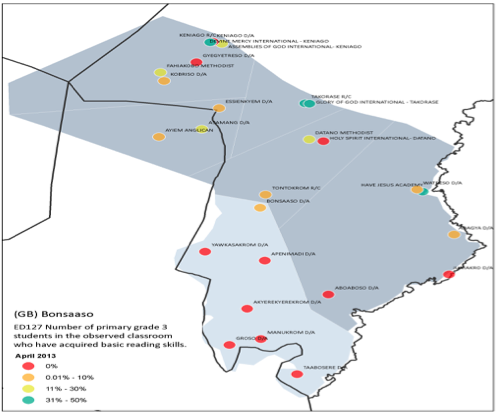
Screen Shot 2015-04-13 at 9.38.13 AM

Figure 3. Reading Levels of children in Grade 3 in Bonsaaso, Ghana.

Source: Millennium Villages Project database

Further discussions with district education officials revealed that these schools are located in the remotest part of the cluster with many in the Amansie West District. The area lacks basic infrastructural amenities and teachers do not accept postings to those areas, hence lack of teachers is one of the characteristics in that area of the cluster and the district as a whole. Many of the teachers who accept postings to these areas are untrained. Since reviewing these data, multiple-stakeholder meetings have focused on improving the learning environment of these southern schools.

These case studies bring up several points. First, regarding the data collection and utilization process, frequently collected data with frequent feedback helps to make the data more useful. Also, the people who can in a position to act after seeing the data are best suited to collect the data. The closer they are to the issues, the better the data use is going to be. The second point centers on the use of technology to improve the functioning of the schools. Often the use of technology is limited to laptops used by students for learning and by teachers as teaching aids. However, the use of technology as a lever to improve education planning as a whole leaves much to be desired. “Real-time” data collection using efficient technology has more chances of being used. The time elapsed between data collection and feedback needs to be relatively short, since people forget what data was collected in the first place. We also need to keep in mind that different data users (policymakers, district officials, school members) often like to see different indicators. Therefore data displays need to be created at various levels.

However, efficient adoption of this technology-based solution for issues of data collection depends on many factors. Political will as well as local capacity to collect frequent data and disseminate the results is key. Stakeholder buy-in from a multi-sectoral perspective can help to gain insights from already existing practices from other sectors such as health. A democratic process that weighs the different data needs at the national, state and district levels is also critical in maximizing data use. This is critical since different stakeholders at various levels may have very different data uses. Who uses what data and how much capacity the system has to collect and process the data are iterative discussions. Despite relatively limited resources, innovation is still possible and can lead to quicker diagnosis and remediation. It is clear that education planning not only requires outcome indicators from the survey, but also process indicators from facility (school) inventories. A great step forward is the UN Secretariat on Data Revolution, which recognizes the importance of such facility mapping (see the case study on the Nigeria Information Management System). Real-time data leading to real-time use should be the data mantra for UN’s Post 2015 Agenda.



How Do School Sites Support the Adoption of Educational Innovations in the Finnish Context?

As part of a symposium focused on educational innovation around the world  at the annual conference of the American Educational Assocation in Chicago next week, we are sharing commentary papers from the participants.  Today’s contribution is from Jari Lavonen, Tiina Korhonen & Kalle Juuti, Department of Teacher Education, University of Helsinki, Finland. 

This post introduces an Innovative School Model (ISM) currently being implemented at a Finnish elementary school and shares reflections on the model by several of the school’s teachers. Building on the work of Michael Fullan and Everett Rogers, the ISM is designed to create conditions in Finnish schools that will enable teachers, pupils, the school principal, parents and other collaborators from the neighbourhood to work together to generate and implement innovative structures and practices.

Among the innovations developed at the school are a project in which teachers and pupils created an approach to personalized science learning using smartphones. The pupils used phones mostly within a water-themed science project for making notes, revision and information gathering. This innovative approach was then adopted by the other teachers in the school. The second innovation was a new model for School-Community Collaboration (SCC) emphasizing the use of ICT. This collaborative model was developed and researched in an iterative way as teachers and students worked with researchers and other collaborators from outside the school in real science learning and collaboration situations. The SCC helped students learning creative problem-solving and inquiry strategies and to develop skills in collaboration.

The Innovative School Model (ISM)

Students’ learning and learning environments. The Finnish national and school level curriculum emphasize meaningful learning (and the learning of 21st century competences in versatile learning environments. Especially, students should learn to think critically and creatively, to use a wide range of tools, to interact in heterogeneous groups as well as to act autonomously and to take responsibility for managing their own lives. Due to the inclusion of most special need students in the regular classrooms in Finland, it is important to utilize a variety of teaching methods to engage students in learning of 21st century competences. A learning environment refers to the diverse physical locations, contexts and cultures in which students learn). A learning environment does not need to be a physical place, it can also be virtual, online, or remote. In the ISM, goal orientation and interaction are supported through the ICT tools available in the learning environment, including basic writing and drawing applications, social media environments as well as various types of mobile devices and other tools that facilitate flexible, remote and mobile learning. High-quality learning materials, including digital learning materials such as learning games and other interactive learning content are also essential parts of the learning environment.

Teachers’ professionalism. Professional teachers are at the heart of the ISM. Professional teachers are seen as academic professionals who are committed to their work and are able to plan, implement, and assess their own teaching and their students’ learning. They formatively monitor students’ progress, particularly those with special needs, and they try to support all students’ learning.

This model of a professional teacher, however, is different from the model of the effective teacher reflected in policies in the US. In those policies, an effective teacher is defined as one who is able to support students’ learning and achievement as measured by tests. The view of teacher in the ISM context is closer to that described in the “teacher leadership” movement. These teachers are goal oriented and have a clear vision for school development. Moreover, these teachers are able to work collaboratively and in interaction with other teachers towards their shared goals. They are considered to be able to use research productively, and they have a deep understanding of teaching and learning that allows them to act as curriculum specialists.

Leadership. The professional culture in a school is a key element in supporting teachers’ collaboration, in classroom operations, and in the development and adoption of innovations. In turn, the school principal and their approach to leadership plays a key role in establishing the school’s professional culture. Teachers are positively influenced when school leaders encourage collaboration among teachers, students, families, and other school personnel. Therefore, school principals in the ISM have an important role in facilitating a school culture and creating a school schedule that supports teachers’ collaboration. In practice, this collaboration manifests itself in various school teams and networks, such as grade level teams and multi-professional teams.

Networks & partnerships. Parents are the most important partners in education. A fruitful partnership with parents facilitates the sharing of responsibility for students’ weekly activities.

Family events and personal meetings with teachers are particularly important in establishing that partnership. ICT offers a multitude of opportunities for enhancing home and school collaboration (HSC), and it can be applied to enable continuous interaction between the school and families. The aim of HSC is for parents and teachers to develop shared educational values and goals, with the important consequence that mutual trust is established in each other’s ability to work towards supporting the child’s growth and education. In addition to HSC, partnerships with a wide range of other members of the local community are also important including collaborations with school support personnel, day-care providers, public librarians and senior homes as well as actors in national and international networks. Respect for the thoughts, opinions and wishes of all stakeholders serves as an essential part of all partnerships. Through long-term collaborative development, more families, teachers and community members learn to work with each other as parts of a community for the benefit of all children.

Key aspects of the ISM from the teachers’ perspective

Students’ learning and learning environments. The teachers see their school building as rather traditional, including standard classrooms and a couple of special classrooms found in many Finnish schools like a workshop for the teaching of handcrafts (such as knitting and woodworking), a minor science and technology lab and a music class. The teachers feel that the structure of the physical environment does not support flexible grouping of pupils. Nonetheless, the teachers and pupils have used their creativity and created learning spaces all over the school building. They have, for example, used curtains and pillows for creating learning spaces in the corridors and other areas of the schoolMoreover, the students learn in out-of-school locations such as a library and outdoor environments such as parks where they use mobile ICT tools like smart-phones for learning.

In their reflections the teachers also identified several aspects of their physical and virtual environments as crucial for supporting learning. Beyond the nature of the environments themselves, the teachers emphasized the need for strategic and collaborative planning on how to use those environments. However, the teachers agreed that there are enough basic ICT tools, like computers and data projectors at the school. From the point of view of personalisation of learning there are not enough basic laptops or mobile devices. Further the Internet connection and wireless network is undeveloped. The city is not able to offer these services. In addition, the city is not able to offer enough technical support to the teachers, and the web-based learning environments do not support the use of mobile devices and, therefore, different cloud services, like SkyOneDrive are used.

Teachers’ professionalism. In their reflections, the teachers suggested that school staff including teachers and classroom assistants have high levels of competence that support planning, organising and evaluating learning and learning outcomes. They also reported that the teachers are skilled in using versatile learning environments and ICT tools as well as in networking. Teachers have a strong orientation to life-long-learning and were eager to learn from one another and to adopt educational innovations developed by their peers. Their learning and collaboration is supported through weekly meetings that are designed specifically for teachers to information with one another in “pedagogical coffees” and other formal and informal meetings. Teachers are especially eager to learn new technology and use of this technology in education:

Leadership. The teachers also emphasized the importance of strategic planning and goal orientation; interaction; and an open decision-making process. There should be versatile interaction forums for leadership in schools using the ISM. For example, teachers at the school meet once a month in official teacher meetings and once a week in informal “noon”-meetings. Moreover, there are team meetings of the teachers working at the same grade. Furthermore, the official development discussions and unofficial daily personal discussions are important for teachers. Because of the versatile use of ICT in leadership, there are opportunities for interaction that are both face-to and virtual.

Principals and vice principals also need to be able to share/distribute leadership and to be aware of the division of labour. For example, teachers and classroom assistants belong to grade-level teams responsible for co-planning and evaluation. ICT is used in a versatile way in administration. The principals, teachers and classroom assistants work together to develop ways to use ICT in administration and collaboration. The use of ICT in school operations support the teachers to acquire ICT skills the teachers can utilize in their teaching as well. It is important that the school follows technology developments on the principal, teacher and classroom level.

The role of a principal is important in supporting both teachers’ designing and adopting educational innovations. In particular, principals need to be able to support teachers by starting where they are and by helping them to integrate all kind of learners in the same classroom.

Partnerships. In their reflections, teachers recognised five different levels of networks and partnership, and in all levels, ICT is used. Inside the school there are several networks, like grade-level networks/teams and school-level networks, like the multiprofessional team (consisting of school nurse, social worker, special need teacher and principal) that supports the welfare of pupils. At the city level, the teachers of the school belongs to several networks, including a local curriculum development team and an in-service training team). The school is also involved in networks with other schools in Finland, among them networks to foster the use of ICT in education and collaboration.

Networks with families and community organizations function more as partnerships than networks. In particular, the school is in partnership with several organisations including the library, kindergarten and senior house located near the school. This partnership allows pupils opportunities for learning and collaboration in those organisations. In addition, these organisations also benefit from the partnerships. The pupils have, for example, introduced the use of mobile devices to the senior citizens at the senior house and to the young kids at the kindergarten. All teachers also emphasised that collaboration with parents is an important type of networking for the school.

Challenges for the future

The teachers emphasised that one of the biggest challenges for the future is to continue the partnerships and networks with all important parties. In particular, updates to the ICT tools require continuous learning on the part of all those involved. Another challenge in the use of ICT is the variation in the competence of the parties, particularly the variability in parents’ ICT competence and their access to ICT tools. The third challenge is the resources needed in coordinating the networks. As one teacher put it, “there are too many networks and we do not utilise them enough.” The teachers also felt that networking with some companies was not fruitful as only the companies benefited from the collaboration. 

Acknowledgments

This work was made possible with support from the Finnable 2020 project, funded by the Finnish Funding Agency for Technology and Innovation (Tekes).

Bringing Effective Instructional Innovation to Scale through Social Movement in Mexico and Colombia

As part of a symposium focused on educational innovation around the world  at the annual conference of the American Educational Assocation in Chicago next week, we are sharing commentary papers from the participants.  Today’s contribution is from Santiago Rincón-Gallardo, Ontario Institute for Studies in Education. 


The Learning Community Project (LCP) in Mexico and Escuela Nueva in Colombia are examples of effective instructional innovation at scale. When I talk about instructional innovation I refer to pedagogical principles and practices that deliberately disrupt the traditional instructional culture and power relations of schooling. More specifically, an instructional innovation is one that radically redefines the instructional core by deliberately shifting the relationships between teachers and students in the presence of content.

Learning Community Project (LCP)

In the LCP, for example, students select their topics of study from the available collection of topics mastered by a tutor in the group, they develop individual lines of inquiry at their own pace, and are expected to demonstrate their learning in writing and in public presentations to the group and often to the larger community. Once they master a topic, they are expected to become tutors to other students – and even to adults in the group. The boundary between teachers and students becomes blurry, with teachers becoming students and students becoming teachers depending on who masters a particular topic and who is interested in learning it. Tutorial relationships are the key technology to encourage deep learning in these learning communities: the tutor and tutee engage in one-on-one dialogue to make evident what the tutee already knows about a topic, identify areas of struggle, and to crafts questions or point to additional materials so that the the tutee t can come up with her own answers.

Escuela Nueva

Escuela Nueva in Colombia transforms the conventional culture and structure of schooling into a learner-centered participatory model with a flexible promotion mechanism that allows students to move from one grade to another and complete academic units at their own pace. In these multi-grade schools, children work individually and in small groups using learning guides that are by design interactive and dialogue-based as well as learning materials available whenever needed in a “Learning Corner.” Students help each other when they struggle, and ask the teacher for suggestions or comments when necessary. Individual mastery and cooperation are seamlessly integrated into every classroom activity. Teachers constantly move from group to group, tailoring their one-on-one and group interventions to the emerging needs in the classroom. Community participation and a student school government are integrated in the everyday activities of the school, offering multiple opportunities to practice and master democratic behaviors and values.

Innovation, effectiveness, and spread

These are examples of instructional innovation in action. They have radically redefined the instructional core. But innovation per se is meaningless if it doesn’t deepen and improve student learning. Both the LCP and Escuela Nueva have demonstrated significant improvements in student performance on national standardized tests, even though standardized tests have not been their area of focus. Learning Community schools increased in 3 years the percentage of students achieving good and excellent levels in language and math at a faster pace than the national average (DGDGIE, 2012), whereas in the 1990s Escuela Nueva students – mostly from rural schools – consistently outperformed their better-off counterparts in urban schools (Psacharopoulos, Rojas & Velez 1992).

And maybe more importantly, these two models, have spread from a handful to thousands of schools at some point in time. In 2012, LCP model was operating in 9000 public schools across Mexico. In the 1980s, Escuela Nueva had been adopted as national policy and reached 20,000 rural schools in Colombia. These initiatives are similar in their genesis and development to social movements. Upon witnessing powerful learning themselves and observing clear improvements in the learning and engagement of their students, teachers and local educational authorities have mobilized in coordination with project leaders to activate social networks, spread interest and gain support. Leaders of both projects have been able to gain access to institutional power and political influence to disseminate the new pedagogies on a large scale. Dalila López and Gabriel Cámara, historical leaders of the LCP were invited in 2009 to the Department of Innovation at the Mexican Ministry of Education and once there brought in several project leaders to her team. Vicky Colbert, co-founder of Escuela Nueva, was Deputy Minister of Education in Colombia when Escuela Nueva was adopted as a national policy, she also brought to her team teacher leaders with strong experience on instructional innovation. Once in power, these two guiding coalitions developed a progressive partnership between policy and practice, rather than the conventional top-down separation that has characterized education policy in Latin America and abroad . Across the system, project participants, regardless of their formal role in the institution, were expected to practice and model the new pedagogies on a regular basis. 

Conditions and challenges for innovation and spread

Here are, in a nutshell 5 key conditions that were created to enable the large-scale dissemination of the new pedagogies advanced through the LCP and Escuela Nueva.

1) developing a new pedagogy that allows teachers to experience powerful learning themselves and to witness observable improvements in the knowledge, skills and attitudes of their students as a result of changing their practice

2) creating access to multiple opportunities to observe, practice, and refine the new pedagogy (e.g., classroom-based coaching, communities of practice, and school visits/exchanges);

3) gaining the support or permission from local educational authorities to depart from conventional schooling practices

4) starting at the margins of the educational system, where the needs are greatest and the presence of institutional controls over the everyday activities of schools is weaker. This offers tremendous opportunities to radically depart from conventional practice

5) creating a guiding coalition of pedagogical change leaders with access to institutional power and political support to protect and expand the influence of the innovation

A key limitation to the large-scale instructional innovation approach just presented is that it is subject to marginalization or disappearance from the policy arena when there are drastic shifts in the political agenda. This has been the case in both the LCP and Escuela Nueva. At the pinnacle of their success, changes in administration and in system priorities resulted in the departure of the national leadership of these projects from their respective Ministries of Education.

Bureaucratization, ritualization or mechanization of the original model is also a risk when the innovation is brought to scale too quickly, a phenomenon that has been observed in the two cases in question. In both cases, the work to sustain the movements of pedagogical change spurred by these projects and to ensure quality of their core pedagogical practices has continued through NGOs formed by the former leaders of LCP and Escuela Nueva. As is often the case with social movements, their visibility may be reduced for now, but they continue to cultivate a movement that is radically redefining teaching and learning in public schools. In this new phase, the model of dissemination at scale will have to rely more on the power of effective networks to consolidate and spread the new pedagogies reliably and at scale than on formal access to institutional power.

What’s New? Challenges and Possibilities for Educational Innovation Around the World

Over the next two weeks, we will be trying something different at IEN. We are participating at a symposium – “What’s new? Challenges and possibilities for educational innovation around the world” – at the annual conference of the American Educational Assocation in Chicago (April 17th, 8:15 to 9:45 AM, Swissotel, Lucerne Level, Lucerne I). In order to broaden the conversation, we will be sharing short papers by the participants in that symposium who will be talking about efforts to support educational innovations in Mexico & Colombia, Finland, Ghana & Mali, and Singapore:

  • Bringing Effective Instructional Innovation to Scale in Mexico and Colombia, Santiago Rincón-Gallardo, Ontario Institute for Studies in Education
  • How Do School Sites Support the Adoption of Educational Innovations in the Finnish Context? Jari Lavonen, Tiina Korhonen, & Kalle Juuti
    Department of Teacher Education, University of Helsinki, Finland
  • Real-time Data for Real-time Use: Case Studies from Ghana and Mali, Radhika Iyengar, Earth Institute, Columbia University
  • A Framework to Organise the Enabling Factors for the Spreading of Curricular Innovations in a Centralised-Decentralised Context of Singapore Schools, Paul Chua and David Hung, National Institute of Education, Singapore

While the participants will be focusing on what has worked in their countries as well as the challenges they’ve faced, in the symposium we will also be looking across contexts and discussing some common questions including:

  • What kinds of resources, expertise and networks are needed to create an “infrastructure for innovation” in different contexts?
  • What commonalities are there in the spread of innovations across these contexts? To what extent are these “context-specific” lessons?
  • To what extent and in what ways are “innovations” in these countries really “new”?
  • What really changes and “improves” if/when innovations take hold?
  • When, under what conditions, and for whom, can innovations be considered “good”?

We invite you to follow along and share your own examples of the possibilities and challenges for innovation in different contexts.

The role of private schools in developing countries

In “Tiptoeing Around Private Schools in the Global Partnership for Education,” a new report shared by the National Center for the Study of the Privatization in EducationFrancine Menashy explores the effort to increase access to education in the developing world. This effort has led to a familiar debate about the role of for-profit school operators and public-private partnerships, with proponenets contending that private schools fill a void created by state failure, and critics pointing out that private schools don’t meet the needs of all students.

Menashy investigates by focusing on the Global Partnership for Education (GPE), a collaborative effort of philanthropic foundations, donor and recipient governments, multilateral organizations, and private companies. Launched by the World Bank in 2002 as the Education For All Fast Track Initiative (FTI), the organization was rebranded in 2011 as the GPE and is now involved in 59 developing nations.

Menashy’s research depicts “an organization so split on the matter of educational privatization that dialogue has all but ceased.” As Menashy concludes, “regulation of the private sector is needed, and the GPE could contribute to ideas around regulatory policies, but does not because the topic is not introduced….strategic avoidance on this (and other) contentious policy matters may risk the legitimacy of the partnership.”

Clarifying the Latest “Reforms” from Finland

Although recent reports in Finland have made a number of specific recommendations for improving student learning, the focus outside Finland has centered on Finland’s interest in promoting more of a focus in schools on interdisciplinary topics.   Following an initial report from the Independent that the school subjects would be “scrapped” around the country, Pasi Sahlberg explained in The Conversation “Finnish schools will continue to teach mathematics, history, arts, music and other subjects in the future.” But he also outlined aspects of the new Core Curriculum and the extent of local authority that will affect how an interest in promoting more interdisciplinary approaches is playing out in Finland.

The Finnish National Board of Education (FNBE) has also responded to the reports and explained some of the changes in the new core curriculum that might have led to the misunderstandings:

“In order to meet the challenges of the future, the focus (in the core curriculum) is on transversal (generic) competences and work across school    subjects. Collaborative classroom practices, where pupils may work with several teachers simultaneously during periods of phenomenon-based project studies are emphasised.

The pupils should participate each year in at least one such multidisciplinary learning module. These modules are designed and implemented locally. The core curriculum also states that the pupils should be involved in the planning.”

Notably, a more radical version requiring much more of a focus on grouping subjects together though more generic competences was proposed earlier in the curriculum renewal process. However, that proposal was stalled by political debates, particularly objections by one of the six political parties that were involved in the coalition government at the time.

Irmeli Hallinen, Head of Curriculum Development at the FNBE and a key participant in the most recent renewal of the Finnish Core Curriculum, provides further clarity on the new emphases in latest curriculum renewal in a blog post (What’s going on in Finland – Currriculum Reform 2016). As she puts it:

“Developing schools as learning communities, and emphasizing the joy of learning and a collaborative atmosphere, as well as promoting student    autonomy in studying and in school life – these are some of our key aims in the reform. In order to meet the challenges of the future, there will be much focus on transversal (generic) competences and work across school subjects.”

Hallinen goes on to explain that the curriculum framework identifies learning goals in seven different competence areas, with local authorities able to consider their own ways of reaching those goals. Hallinen points out that the emphasis on the competences will be reflected in assessments as well:

“The competences will also be assessed as a part of subject assessment. In this way every school subject enhances the development of all seven         competence areas. This is a new way of combining competence-based and subject-based teaching and learning. Nevertheless, the traditional school            subjects will live on, though with less distinct borderlines and with more collaboration in practice between them.”

Thomas Hatch

The Latest Recommendations for Education Reform in Finland

Even in Finland, consistently a top performer on international tests, declines in recent national and international assessments have spawned tasks forces and calls for improvement. As Pasi Sahlberg tweeted last week, recently released reports in Finland have focused on creating a “Continuum of Teacher Development,” establishing “Tomorrow’s Comprehensive School,” and (most recently) exploring the future of higher education. While teacher preparation is often highlighted as a strength of the Finnish system, improving support for teachers figures prominently in many of the proposed recommendations. In fact, the report on creating a “Continuum of Teacher Development” is described as calling for an “overhaul” of teacher training. That report includes recommendations for Universities and teacher education colleges to develop an approach to mentoring and “induction” into the teaching profession that includes training and supporting mentors, developing a national network of mentors, and ensuring that graduating students have a personal development plan and support in the transition to “working life.”

“Tomorrow’s Comprehensive School” (with an accompanying brochure in English) was produced by a task force that included researchers, teacher educators, school principals and teachers. As Jari Lavonen, a task force member and Professor and Head of the Department Teacher Education at the University of Helsinki explained, their main charge from the Minister of Education was to assess the current situation, examine the reasons for the drop in learning outcomes in the PISA survey and other national assessments, and “find ways to make students feel more motivated and enjoy school.” The task force identified challenges to improvement at the national, municipal, and classroom level, as well in teacher preparation. In response to these challenges, the report highlights several key “themes” deemed central to improving learning attitudes and outcomes:

  • The structures and practices of basic education must strive to eliminate links between a pupil’s learning outcomes and his or her social background, living area or gender.
  • Allocation of resources adequate to guarantee a high standard of teaching in basic education must be ensured in the future.
  • Development of new pedagogical solutions that will support both communal and individual learning.
  • Developing the school as an ethical and a learning community where pupils have a voice and a choice, and also responsibility for their own learning.
  • Further development of research-based teacher education in cooperation with universities and municipalities to form a continuum of initial education and professional development of teachers
  • Support for teachers’ lifelong professional development.
  • Develop new models for teachers’ work and the use of their working time.
  • Enhancing principal’s preparation and establishing personal plans to support their professional development.

One news item on the task force report focused particularly on proposals to increase extra-curricular activities and to make changes in the school schedule, quoting Aulis Pitkälä, Director General of the Finnish National Board of Education, as saying, “We more or less unanimously came to the conclusion that the school day should begin no earlier than nine in the morning.” (Notably, calls for reform in the United States often involve demands to increase class time, already substantially more than is required in Finland, though not as much as is often reported, as Sam Abrams sorted out in a recent post on teaching time in the U.S.)

Auli Toom, University lecturer in Higher Education at the University of Helsinki, highlighted that creating a more systemic approach to “in-service” support for teachers and connecting pre-service and in-service teacher education have been under discussion for over ten years, but she hoped that this report might finally lead to some changes. She was also encouraged by a task force recommendation to establish a national, longitudinal programme of research that would investigate the characteristics of the Finnish educational system and its impact on student learning, but it is not clear if that recommendation will be implemented.

Pasi Sahlberg, author with Andy Hargreaves of a new post about “saving” PISA, commented that the report was particularly welcome because it provides a much-needed look at Finland’s education system and its current challenges. “It takes a comprehensive look at not only cognitive aspects of education but also how to make teaching and learning more meaningful,” he added. “However, it remains silent about what many have said to be the most important shortcoming in Finland: What kind of comprehensive school do we need in 2030?” Without a clear vision Sahlberg worries that some will see the report as an effort to bring PISA results in Finland back to the top of the charts. “Making Finland the top PISA performer is the wrong vision.”

Thomas Hatch


Growth in national assessments?

With the implementation of new state tests (PARCC and Smarter Balanced) connected to the Common Core in the US, it has been hard to avoid concerns about the quality and extent of testing in the US in recent weeks (including in Delaware, Minnesota, Ohio, and California among others). At a recent seminar series from the Laboratory of International Assessment Studies, however, I also heard reports about the marked growth in the use of national assessments in many other countries. Although the new state tests in the US provide data on the performance of individual students and schools, the 2015 EFA Global Monitoring Report to be released in April, will include data on the number of national learning assessments (designed to provide information on system performance) conducted worldwide since 1990. As initially reported in “Improving, not over-hauling learning assessments post-2015,” that report will show that the number of countries administering national assessments has doubled in the last twenty-five years:

Before 2000, national tests were conducted in:

  • 49% of developed countries
  • 34% of developing countries
  • 6% of countries in transition

Between 2000-2013, national tests were conducted in:

  • 82% of developed countries
  • 65% of developing countries
  • 78% of countries in transition

The FHI 360 Education Policy and Data Center (EPDC) also released results of the National Learning Assessment Mapping Project (N-LAMP). As described in a blog post on the key findings, the project reviewed data on standardized exams and assessments administered at the national level from primary to upper secondary education in a sample of 125 countries from 6 regions of the world. They identified 403 national-level learning assessments from 105 countries. The majority of the assessments (55%) were low-stakes national large-scale student assessments (NLSA’s sample-based assessments used to monitor the performance of education systems like those documented in the Global Monitoring report). Most of the remaining assessments were high stakes exams (mandatory assessments required for completing a given level of schooling or gaining admission to the next level). Not surprisingly, the project found that almost all of the assessments focused on “Literacy & Communication” and “Numeracy & Maths,” with more than half also addressing “Science & Technology.” Nonetheless, other domains were represented with 73 assessments addressing “Social & Emotional” domains, 33 addressing “Physical Well-Being” and 11 addressing “Learning Approaches & Cognition.”

Also worth noting for those interested in international assessments, Teachers College Record has a new theme issue focusing on PISA, “Moving Beyond Country Rankings in International Assessments: The Case of PISA.”

Thomas Hatch

Interview with Rukmini Banerji

Dr. Rukmini Banerji

Dr. Rukmini Banerji

Rukmini Banerji is director of the Assessment Survey Evaluation Research (ASER) Center in New Delhi, India, and senior member of the national leadership of Pratham, an organization that reaches three million primary school age children in India every year.

In this interview, which is part of the Lead the Change Series of the American Educational Research Association Educational Change Special Interest Group, she describes her own work with educational change what she sees as the status of education in India today:

“Looking back at the last two decades and more, we can see the impressive progress that India has made in providing educational opportunities to children. Today we have more than 96% of children (in the age group 6-14) enrolled in school. There is a government primary school in almost every habitation in the country. Children get free meals in schools, in many states textbooks and uniforms are also free. In 2010, the India Parliament passed the Right to Education Act which guarantees free and compulsory education to all children ages 6-14. In terms of inputs and infrastructure, the Indian government has made huge strides in the provision of schooling. Now it is time to look at some of the outcomes of schooling and more specifically at the question: are our children learning?”

This Lead the Change interview appears as part of a series that features experts from around the globe, highlights promising research and practice, and offers expert insight on small- and large-scale educational change. Recently, Lead the Change has also published interviews with Diane Ravitch, and the contributors to Leading Educational Change: Global Issues, Challenges, and Lessons on Whole-System Reform (Teachers College Press, 2013) edited by Helen Janc Malone, have participated in a series of blogs from Education Week.


What’s new? OECD Report: Gender Equality in Education

The most recent OECD report, titled “The ABC of Gender Equality in Education: Aptitude, Behavior, Confidence,” shows that the wage gaps between men and women worldwide might have more to do with career decisions that are being made by students much earlier than we think.

Confidence gap

The results of this survey show that at the age of fifteen, girls are typically ahead of boys in reading, boys are only slightly ahead of girls in math, and there is barely any difference between the two in science. The report found that when they looked at attitude, behavior, and confidence, boys are more confident than girls even when they underperform, whereas girls tend to be more anxious about math, even when they perform well in the subject.

Career aspiration gap

Despite the fact that girls tend to outperform boys in STEM subject areas, it is the boys who expect to have careers in engineering or technology. In the U.S., for example, 15% of boys expect careers in engineering or computing, compared with only 2.5% of girls (despite the fact that boys and girls perform similarly in STEM subject areas); girls are more likely to aspire to careers in health services.

Teachers and parents

What does this gender gap tell us about parent and teacher attitudes, work life, and society? The report found that parents are more likely to expect their sons to enter careers in STEM fields, except in East Asian countries where both boys and girls are expected to enter careers in STEM fields, and where boys and girls both outperform almost every other country. They also looked at how boys and girls spend their time outside of school and found that boys spend more time playing video games, while girls spend more time on homework. Another difference they found is that when boys read, they are more likely to read comic books, whereas girls are more likely to read fiction. Finally, girls are more likely to get higher grades in school than boys. The report suggests that this might have more to do with compliance than achievement, a result that might actually push boys to work harder, and to expect to work harder throughout their careers.

What’s new?

While much of this information might not seem new to many readers (boys like video games and comic books; girls lack confidence in math), the implications present some interesting ideas for parents and teachers. For example, the report suggests that students might benefit from greater choice in what they read at school. The report also suggested that there is some evidence that single-player video games might promote problem solving and math skills. Finally, educators need to think about the relationship between curriculum and instruction, gender, and student performance. For example, girls tend to perform better in math when they are allowed to solve problems independently. (Note: These topics have all been addressed by education researchers, such as those who study literacy, technology, and gender.)

As Michael Reiss noted in a post on the IOE London blog this morning, while teacher education used to focus on issues of inequality and teacher assumptions, teacher training courses today might be less likely to go in-depth into these issues. According to Reiss, “We need to get back to realising that how school students see themselves and their subjects is important. If we don’t, too many young people, especially girls, will continue to believe that science is not for them and that they aren’t really that good at it – and then they won’t be.”

Deirdre Faughey

For more on the OECD report released today (IEN will be retweeting posts as they come out during the day):

A closer look at gender gaps in education and beyond | OECD Insights Blog http://buff.ly/1M8GPt6

Obsessing over differences between boys and girls at school won’t fix anything http://buff.ly/1M8GWoy

Why are girls in the UK doing so much less well than boys in school science? | IOE LONDON BLOG http://buff.ly/1Nknl8a

Playing video games can boost exam performance, OECD claims http://buff.ly/17UQoi3

Neues Gender-Pisa: Mathe ist „männlich“, gute Schulleistungen „weiblich“ – Wissen – Tagesspiegel http://buff.ly/1BKUDsK

Students aren’t being taught maths correctly, creating a ‘huge’ learning gap – National – NZ Herald News http://buff.ly/1CB0IcB