Category Archives: About K-12 International Education News

Education reform in Mexico

Dr. Santiago Rincón-Gallardo

Dr. Santiago Rincón-Gallardo

The following post is based on a conversation with Dr. Santiago Rincón-Gallardo. I reached out to Dr. Rincón-Gallardo to learn more about his work in Mexican schools and to better understand how the current political climate in Mexico has influenced the grassroots reform efforts of Redes de Tutoría, a small NGO that catalyzed a movement to transform conventional classrooms in public schools into learning communities where independent learning and tutorial relationships are practiced by students and teachers. An excerpt of our conversation appears below. Click here to read more of the interview.

As we have covered in earlier IEN posts, when President Enrique Peña Nieto was elected in 2012 he introduced education reforms that sought to address issues of educational quality and governability through what Andres Delich called a “mix of centralization and decentralization.” As covered in the Harvard Policy Review, lackluster Pisa scores have called attention to the fact while enrollment and basic skills have improved, repetition rates remain high and resources are distributed inequitably. The country’s system for hiring and paying teachers has been pinpointed as a problematic issue. In Mexico, all teachers join the union (SNTE), and the union assigns teachers to schools; teachers earn lifetime tenure after just six month of service. In an effort strengthen government control, President Peña Nieto bolstered the power of the national evaluation agency (INEE), and established higher professional standards and accountability measures for teachers. Peña Nieto also arrested union President, Esther Gordillo, on charges of embezzlement and money laundering, and teachers have been protesting the reforms everywhere from Mexico City to Guerrero.

In the context of all of this change, we wanted to learn more about how the new policies influence the practice of education and, as Dr. Santiago Rincón-Gallardo explains, the social and political aspects of pedagogical reform.

Deirdre Faughey:

Can you tell us about your work in Mexico, and the ways in which political changes in the country have been influential?

Dr. Santiago Rincón-Gallardo:

Let me tell you a little bit about the Learning Community Project (LCP), which provided the context for my research. In 2004, I was part of a small NGO called Convivencia Educativa, A.C. (now Redes de Tutoría, S.C.) that started working with a few teachers in a small number of schools, providing very intensive classroom-based support for teachers interested in turning their classrooms into Learning Communities. We started working on a very small scale, about eight schools total, working with voluntary teachers in middle schools that were built in marginalized communities with very small populations. We started working with some teachers there, providing coaching and training, but also spending a lot of time in classrooms working with them to turn their conventional classroom into a learning community. We would spend a whole week with each teacher every month in their classrooms, trying to understand what we needed to do and what we could do to turn the classrooms into Learning Communities.

Even though the scale was very small there was a strong impact on the engagement and excitement of the teachers and students who joined the project: students were learning better and they were gaining a lot of confidence to undertake individual study, to engage in research and learn on their own, but also to express their views and their learning in public, both in writing and in oral presentations. Maybe most importantly, they also started to work as tutors to other students who were interested in learning what the students had come to master.

The excitement that we started seeing in this small number of schools started to spread through the outreach of teachers themselves, and some local authorities who started to get excited to see what these young kids were capable of and how excited they were about learning. They started reaching out to other teachers in other schools, other local authorities in other regions, visiting other classrooms to showcase or display the practice, and then having other people come to their classrooms to see what was going on there. There was a lot of movement and excitement.

In four years we had moved from eight schools to about 400 schools that were engaged in this new practice of Learning Communities – we call it the Tutorial Relationships Practice. At that point the Deputy Minister of Education at that time visited one of our schools, and he was very impressed with what he saw there, in terms of the engagement and the skill of the students, so he decided to adopt the model and bring it to scale to 9,000 schools all over the country.

At the same time that the movement at the grassroots was taking place, one of the key leaders of the NGO, whose name is Dalila López, was invited to join the Department of Innovation at the Ministry of Education at the national level, and she was able to bring in people from our organization to the ministry. So we were able to create a team within the Ministry to support the kind of work that we felt was worth supporting, which was developing the conditions for teachers to learn the new practice of tutorial relationships and disseminate it to other places. What the leadership at the top did was create opportunities and mobilize infrastructure for teachers to be able to visit other schools in their regions or in other states so that there was the exchange of information and practice all over the country. We found really good results really quickly.

The large-scale project started in 2010. By 2012, the schools that had data available, but also the ones that had been engaged in this model for a long time, since 2010, increased the percentage of kids scoring with an excellent levels, at a faster pace than and surpassing the national average. This happened in 2012, everything was moving very smoothly and powerfully. There has not been any other program or initiative in Mexico that has shown a clear and significant impact on student learning, even as measured by standardized tests. We started getting a lot of international attention. We had Richard Elmore from the Harvard School of Education, come to visit our schools. He experienced being tutored by a girl from a rural community, Maricruz, a 13 year old girl who was just amazing at guiding him through his own thinking, and identifying some of the weaknesses in his own thinking about how to solve a geometry problem. She was very masterful in supporting him. Throughout that visit, Richard and I were able to write a paper for the Harvard Education Review that discusses this model, and he got very excited about it. He’s been talking about it in his classes, and in 2012 and 2013 we welcomed about 10 students from Harvard’s Educational Leadership Doctorate program to come and learn about the model and report back to their cohorts about what they have learned. We had that for two years, so in total we have had 21 visitors or so. The work has been attracting the attention of several other international experts.

What’s happened since that pinnacle of performance? We had a change in administration at the presidential level, and also a change in the Ministry of Education. They came with a very clear agenda of cutting down any relationship with union leadership, in particular Esther Gordillo and her people. And it so happened that the Deputy Minister who had been supporting this work at the national level, and the one who invited us into the Ministry, was the son-in-law of Gordillo, the leader of the teachers’ union. As soon as this new administration came, they decided to cut down any relationship with them which meant also kicking out the whole team that had been building and supporting this work from the top. So the the leaders who launched and disseminated the Learning Community Project are again grouped around a small NGO called Redes de Tutoría, and they’ve continued to support the work on a smaller scale, but at a deeper level. Right now they’re working with five states that have expressed very clear interest in continuing this work. So the idea is to still go to scale – not at the national level, but at the state level. The strategy is to create “Regions of Excellence,” where you would have several schools who are engaged in this practice and sites where people could come and see what’s possible but also having this as a professional development site for others interested in learning the practice. We’re not entirely sure how many schools are going to continue with this work. As we are putting the pieces together we are trying to find ways in which we can continue to support teachers who are committed to this work but not getting a lot of support from the state-level authorities. We are trying to find a strategy to help continue this work. We’re doing the lobbying that we can because we know that there is some vibrancy in this work that won’t disappear unless somebody wants to really shut it down. I don’t think that’s going to be the case, but we don’t have the political backing at the national level so that teachers can feel free to innovate. The practice has gone underground, it’s invisible but it’s still there.

Please continue reading.

Interview with Louise Stoll


Dr. Louise Stoll

Dr. Louise Stoll

Louise Stoll is Professor of Education at the London Centre for Leadership in Learning at the Institute of Education, University of London, as well as a freelance researcher and an international consultant. Her research and development activity focuses on how schools, districts and national systems create capacity for learning and improvement, focusing especially on leadership, learning communities and learning networks. This interviewwhich is part of the Lead the Change Series of the American Educational Research Association Educational Change Special Interest Group, appears as part of a series that features experts from around the globe, highlights promising research and practice, and offers expert insight on small- and large-scale educational change. Recently, Lead the Change has also published interviews with Diane Ravitch, and the contributors to Leading Educational Change: Global Issues, Challenges, and Lessons on Whole-System Reform (Teachers College Press, 2013) edited by Helen Janc Malone, have participated in a series of blogs from Education Week.

How does one of the top-performing countries in the world think about technology?

The following post was written by Sarah Butrymowicz and originally published on The Hechinger Report.

Going ‘at your own pace’ isn’t part of the equation in Singapore

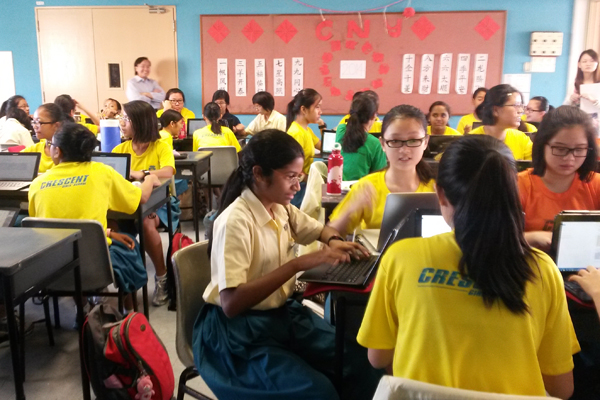
SINGAPORE—Forty students in bright yellow shirts hunched over their computers in Singapore’s Crescent Girls School as they raced against their teacher’s digital stopwatch. They had just a few minutes to add their thoughts about a short film on discrimination into a shared Google Doc and browse the opinions of their classmates.

When the time was up, their teacher led a discussion about the meaning of discrimination and how to judge the credibility of an argument. The computers sat mostly forgotten.

“The technology just fades away, and that’s what we hope for it to do,” said principal Ng Chen Kee.

crescent21

Students at Crescent Girls School in Singapore discuss conflict and discrimination in groups while working on a shared Google Doc. (Photo: Sarah Butrymowicz)

Crescent Girls has plenty of flashy gadgets, but balances those with these more subtle exercises in a way that’s emblematic of how Singapore tries to approach education technology. Glitzy tech that serves no purpose other than being cool is frowned upon. In classrooms in Singapore, digital devices are increasingly viewed as a means to bring students together in collaboration, rather than separate them further.

In contrast, American students who have tools like tablets and computers in the classroom often use them in isolation, powering through interactive worksheets and online quizzes. Indeed, technology’s main purpose often seems to be giving students personalized learning paths and a way to progress at their own pace.

In part, it’s because online learning in America grew out of a push to move away from rigid requirements of the number of hours a student should spend on a subject in favor of allowing them to move on once a concept is mastered. “That’s where the conversation started within the U.S.,” said Allison Powell, a vice president at the International Association for K-12 Online Learning (iNacol). “In a lot of other places, it wasn’t about taking an individual online course. It was ‘Let’s integrate it into the classroom.’”

Singapore has been one of the highest performing countries on international assessments for decades, while the United States remains stuck below the top performers. Investments in education technology have been a key part of Singapore’s national plan for two decades and have been cited by some experts as a reason that the country has so much academic success.

Singapore, South Korea and Uruguay were praised by Richard Culatta, director of the United States Department of Education office of educational technology, as global leaders in technology in the classroom. “These are impressive places and they didn’t get there because they randomly decided to do it. These are countries that have not taken their eye off the ball,” he said. “There’s a point where if we’re going to remain competitive globally, we need to make sure we’re keeping up.”

In the late 1990s, the Singapore Ministry of Education unveiled its master plan for technology. The first phase was spent building up infrastructure and getting computers into schools. In the 2000s, in phases two and three, the ministry focused on training teachers in how to use gadgets and identifying schools to experiment with new innovations.

The Ministry of Education would not provide information on how much money it had spent on these initiatives, but in a presentation for the World Bank, said phase one had cost $2 billion over five years and phase two $600 million over three years. In 2010, the Ministry of Education committed another $610 million over eight years for technology in schools, according to the United Nations Educational, Scientific and Cultural Organization (UNESCO).

Crescent Girls School was selected in 2008 to be one of these so-called FutureSchools. With extra money from the Ministry and support from the National Institute of Education (NIE), Singapore’s teacher training university, these eight schools must develop and trial new types of technology. If they work, the plan is to spread them to other schools.

History teachers at Hwa Chong Institution are working to create new social media platforms for students to share reflections. Students at Canberra Primary School visit a 4D immersive lab in groups to learn about different environments, like the rainforest.  Crescent Girls has developed the “digital trails” platform, where students and teachers make interactive maps by adding text, photos and videos. The school also has a room full of touch-screen tables, loaded with games and applications to prompt discussion and teamwork. In one, four students, each with a different responsibility, must use geometry concepts to protect a submarine from enemies.

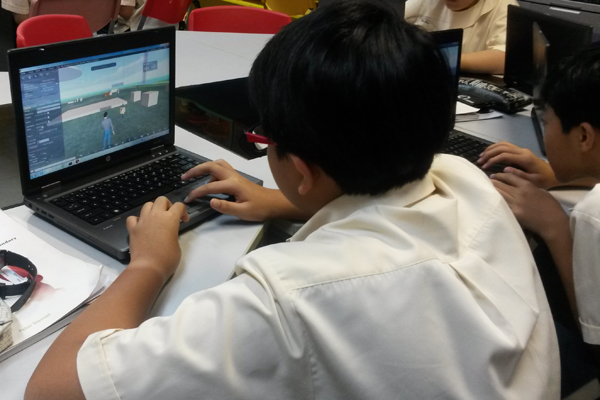
A student at Marsling Secondary School in Singapore navigates around a virtual environment for the first time. His teachers plan to make a digital gallery for the students to show case designs and comment on each other’s work. (Photo: Sarah Butrymowicz)

A student at Marsling Secondary School in Singapore navigates around a virtual environment for the first time. His teachers plan to make a digital gallery for the students to show case designs and comment on each other’s work. (Photo: Sarah Butrymowicz)

Beyond the FutureSchools, the Ministry is also bankrolling other tech endeavors for schools. Researcher Kenneth Lim has set up a lab at the NIE where he’ll design custom immersive virtual environments for any lesson teachers want, such as a lesson on perspective in an art class or one on water shortages in geography.

The worlds are designed to be incomplete and act as a virtual workbook, where students can try to fill in the blanks. They wander around with their avatars, talking to classmates in person and online. “Their whole threat level is lowered,” Lim said. “They make mistakes.”

Singapore is trying to move beyond the much-criticized culture of high-pressure testing and studying by memorization here and in many other Asian countries. That’s why officials are focusing on soft skills, like collaboration and confidence. Technology, like Lim’s work, is becoming a popular way to allow students to learn by exploring without worrying about the consequences of failure.

On a January morning, Lim and his team helped eighth graders in a Design and Technology class at Marsiling Secondary School enter their virtual world for the first time and practice drawing basic shapes. The end goal was create a gallery that would allow students to comment and help each other on their work.

It’s the first major technological project the school has undertaken, and as Principal Foong Lai Leong stood in the corner watching, she was trying to think of other courses that might benefit from some digital lessons. Science and art, definitely, she decided. Maybe even certain topics in math.

There’s no pressure from the Ministry of Education to use technology for any particular subject or in any way. It is encouraged, but always with a reminder to “be wise, be judicious,” said Ng Pak Tee, an associate dean at the NIE. “It should not be a teacher looking at a technology saying, ‘Wow.’”

This careful and deliberate introduction of digital devices into the classroom sets Singapore apart from many places in America. While some districts or schools have rolled out programs thoughtfully, they’re still the minority, Powell said. “I get calls from superintendents and principals on a daily basis [saying], ‘I went out and bought 500 iPads. Now what do I do?”

Education reform in Chile

Is the government really putting an end to private education in Chile? A recent article in Xinhua.net (which was also picked up by Shanghai Daily) makes it seem so. On April 20th, Diane Ravitch noticed the article and posted it on her blog using the headline: BREAKING NEWS. However, later that same day, Ravitch posted two more posts: “More on Chile’s education reforms,” and “Chile: Dismantling the most pro-market education system in the world.” In each of these posts, Ravitch calls upon Mario Waissbluth, President of Educación 2020 Foundation (a Chilean citizen’s movement founded in 2008, which put forth reform proposals) for clarification.

Dr. Mario Waissbluth

Dr. Mario Waissbluth

I also wrote to Professor Waissbluth for more information and he made it clear that Chile was NOT actually ending private education, as Xinhua.net and  Shanghai Daily made it seem. Waissbluth pointed me to his clarifying post, in which he explains that the educational system in Chile is far too complex for such a simple solution. He details the cultural hurdles that Chile must overcome to address what has become, in his words, “a true apartheid.” He also explains what will be changing in Chile: 

Education Minister, Mr. Nicolás Eyzaguirre (with a powerful political and financial experience and profile) has announced the first wave of legislation, to be sent to Congress in May, whose details are now being drafted. They include, amongst other things, the radical ending of academic selection and skimming, the gradual elimination of cost-sharing (to reduce social skimming), the phasing out of 3,500 for-profit schools (to be converted into non-profits), the radical pruning of the standardized testing system, the strengthening and expansion of the public network of schools (so that they can compete in a better way with the charters) and a major reform to the teaching profession, from its training (completely unregulated so far), to improving salaries and working conditions.

While it is not an overall end to private education, these changes do seem – to use a word Waissbluth employs in the quote above – somewhat radical. What seems even more striking, to an outside observer, is the fact that these changes have come about after the student protests that came to be known as the “Chilean Winter” of 2011-2013.

Valentina Quiroga

Valentina Quiroga

It will be interesting to understand better the link between these protests and the reforms. For example, in February Valentina Quiroga (one of the student leaders involved with the protests) was appointed undersecretary of education.

It is also interesting to note that coverage of Chile’s education reforms has been somewhat limited, and information in English-language news sources is not easy to find. We will continue to pay close attention to the evolving situation in Chile and will follow-up with another post in the coming weeks.

Deirdre Faughey

For more information:

Reforma educacional: las claves del proceso que busca poner fin a la selección en los colegios

Chile: Students set to win free higher education

Chile’s Bachelet to unveil $8bn tax hike to fund education boost

Chile: Bachelet elected, social reforms begin

Global Learning Alliance Conference 2014

Screen Shot 2014-04-17 at 9.21.08 AMA recent meeting of the Global Learning Alliance (GLA) included a series of presentations from educators around the world responding to the question: “What in the world are schools doing to cultivate 21st century capacities, and why does this matter?” The GLA was established to to share ideas for moving schools and educational systems towards supporting the development of 21st century skills and brings together scholars, researchers, teachers and school leaders from China, Canada, Singapore, Finland, and the US among others.

Presentations at the conference included discussions of recent developments in countries like Singapore and Finland as well as considerations of broader issues of change and innovation. A symposium of educators from Singapore, for example, described innovative school level programs designed to support the development of engineering and design skills amongst high school students. At the same time, Dr. Suzanne Choo, of Singapore’s National Institute of Education, also cautioned that while students there are excelling in many areas like English language and mathematics, fewer and fewer students are taking traditional liberal arts subjects like English Literature. Dr. Jari Lavonen, of the University of Helsinki, suggested that many of the conditions for innovation in schools are in place in Finland. These include a long-term policy vision rather than “ad hoc” ideas from multiple policymakers; decentralized decision-making and assessment at a local level instead of standardization, inspections, and national testing; trust-based responsibility instead of test-based accountability; and collaboration, networks, and partnerships vs. competition and rankings.

Dennis Shirley, Professor of Education at the Lynch School of Education at Boston College and author of The Global Fourth Way, also focused on the possibilities for cross-cultural learning in education. Shirley, who began his career as an education historian, discussed how examples of cross-cultural learning through history, including the way kindergarten permeated the rest of the world, could be vehicles for innovation or for maintaining the status quo.

At issue throughout were fundamental questions, however, about what constitutes “innovation”: When is a program or a practice actually “new” and when and to what extent do “innovations” lead to better schools and educational systems?


2012 Pisa Creative Problem Solving exam in headlines from around the world

Screen Shot 2014-04-04 at 11.41.50 AMIn a response similar to what we have seen with the release of other global rankings of testing results, the  2012 Pisa Creative Problem Solving rankings prompted a wide-ranging media response around the world.  As you will see in the quick collection of headlines we have gathered here,  the news is interpreted as good, bad, and for some, a call to action – particularly for those countries that interpret their low scores as being related to the fact that this Pisa exam was computer-based. In recognition of the fact that this collection is from mostly English-language publications, we invite you to share other articles on this topic in the comment section below.

Canada, The Vancouver Sun

B.C. students among best in world at problem solving but ‘work’ remains

“When it comes to problem solving, B.C. students are the best in the country and seventh in the world, the latest international assessment scores show. But Canada has fallen out of the top-10 math scores on the Organization for Economic Co-operation and Development’s Programme for International Student Assessment — or PISA — from 2012.”

Finland, The Helsinki Times & yle.fi

Young Finns are persistent problem-solvers, Pisa assessment finds

“On an average, boys outperformed girls in the problem-solving tests in all but one of the participating countries – Finland, where girls beat boys emphatically.”

PISA: Finnish kids best problem-solvers in Europe

“Finnish children scored highly enough to finish joint fourth out of OECD countries with Australia in the ranking, which made Finland the highest-performing European country in problem-solving. Ahead of Finland were South Korea, Japan and Canada.”

Singapore, The Straits Times

Singapore students excel in problem-solving, a global study shows

“Singapore’s 15-year-olds don’t just excel in mathematics, science and reading, they are also world beaters when it comes to solving complex and unfamiliar problems, a global study shows.”

Japan, The Asahi Shimbun

Japanese students place 3rd in problem-solving skill testing

“Japanese students ranked third in problem-solving ability as part of testing of the academic competencies of 15-year-olds in 44 countries and regions in 2012, the Organization for Economic Cooperation and Development said on April 1.”

Malaysia, http://www.malaysia.msn.com

Malaysia ranks 39 out of 44 countries in problem-solving test for 15-year-olds, says report

“Malaysia once again fared poorly in a world student performance assessment test conducted in 2012, ending up in the bottom quarter among 44 countries – a result that reinforces the concern that the country’s education system is in tatters.”

South Korea, http://www.arirang.co.kr

Korean students best at problem solving: OECD

“Their score, just a point behind Singapore, was the second-highest when taking into account all the 44 participating countries, and the highest among OECD countries.”

Taiwan, The China Post

Taiwan places fourth in math: OECD assessment

“Mathematics remains one of the strengths of Taiwanese students, according to an assessment conducted under the Organisation for Economic Co-operation and Development (OECD).”

Spain, http://www.thelocal.es

Spain’s schools are failing immigrants: OECD

First the bad news: Spanish school students with an immigrant background performed significantly worse than their ‘native’ peers in the recent PISA test. In fact, there was a 39-point difference in the OECD exam which assesses practical life skills like how to operate a remote control or buy train tickets.

US, http://www.pbs.org

Mixed messages on whether U.S. students will be well-prepared for the workforce

“According to the first report from the Programme for International Student Assessment, or PISA, American students performed just above average on a new, international test of problem-solving skills given to 15-year-olds. Students in Singapore and Korea had the highest average scores, while U.S. students scored similarly to those in Germany, France, Italy, Ireland, England and the Netherlands.”

UK, www.theguardian.com

Students in England perform highly in international problem-solving test

“Students in England have performed higher than average in a key international test to measure problem-solving skills vital to the job market. England came 11th overall, edged out of the top 10 by Singapore, Korea, Japan, Hong Kong and Shanghai, but outperformed most western rivals.”

Australia, http://www.theaustralian.com.au

Students better at problem-solving than maths, reading or science

“One in six Australian 15-year-olds scored at the highest levels in the tests, compared with the OECD average of one in five, but one in six students also scored at the lowest level and were only able to solve straightforward problems.”

International Cooperation in Education

Our monthly scan of news and reports often reveal numerous discussions of ways in which different countries are collaborating to support the development of education. These collaborations are reflected in a number of reports on the development and deepening of partnerships around particular educational issues, or as part of larger efforts addressing many aspects of society. This month’s news includes cooperative agreements that focus on issues like vocational education, technology, and system building.

Vocational Education:

One of the ways in which countries are working together to improve education is as part of a larger effort to meet the needs of the labor market. For example, Germany is working with Bulgaria on a joint vocational education project that aims to help Bulgaria make reforms to existing legislation, standards, and programs. As Bulgaria’s Education Minister explained in www.focus-fen.com  “Bulgaria would like to introduce the dual education system so that there is a link between vocational education and the labour market.” The Slovak Spectator reported that Germany will also be working to build a similar collaboration with Austria.

Meanwhile, as reported by Thailand’s public relations departmentThailand, Laos, and Vietnam are working together to create tri-country vocational certification programs that will allow students with opportunities to study in each country. Executive Director of the ASEAN University Network (AUN) Nantana Gajaseni said that each ASEAN government should support the grouping of educational institutions specializing in similar fields of study as clusters, in order to push for education development in this region.

Technology:

Finland and Estonia are also working together as part of a specific endeavor to develop cloud technology that will “step up” educational and technological cooperation between the two countries. According to the Finnish government’s press release, “This joint effort aims to enable the creation of cloud services in education and learning and the use of digital materials and find new ways of learning and teaching in the learning environments in both countries. In particular, we wish to help change the school culture to become more student-oriented and inspiring and promote approaches to teaching where the focus is on experiences of success.”

System Building:

As noted in Business Reporter, Denmark and Pakistan have been expanding upon a supportive relationship, as part of Denmark’s interest in “conflict-hit” Federally Administered Tribal Areas (FATA). Denmark supports civil society organizations in the area, such as the Youth Parliament, to which it has given financial aid of 3.5 million dollars. In his most recent visit, Denmark’s Ambassador to Pakistan, Jesper Moller Sorensen, highlighted the importance of education in nation-building, and suggested that Pakistan increase education spending as a means of investing in the country’s future.
A new cooperation between China and South Africa has also been announced. According to Business Day Live, South Africa is “hoping to get lessons from China on curriculum development and implementation; teacher training and development; vocational education and training; and research and development to improve basic education.” The agreement also includes a cultural exchange and the teaching of Mandarin in South African schools.


Bilateral Partnerships:

Cooperative education efforts have also been seen in countries that seem to be looking to build alliance in multiple arenas. For example, The National reports that the United Arab Emirates and South Korea have been building a bilateral strategic partnership since 2009, which is now expanding to the areas of education, cultural, medical and health care sectors. The Kuwait News Agency also reported that Canada and Kuwait are working on ways to enhance cooperation in scientific, cultural, and educational fields, and to facilitate visa procedures for Kuwaiti students and their parents.


Memoranda of Understanding:

In the news we also see multiple examples of countries signing Memorandum of Understanding (MoU) on educational cooperation. Examples include:

Centralized-Decentralization emerging in Singapore

In this post, Corresponding Editor Paul Chua briefly describes an emerging conception of “centralized-decentralization” in Singapore’s efforts to enable schools and educators to support the development of students’ 21st century skills. The post grows out of Chua’s recent conversations with IEN editors Thomas Hatch and Deirdre Faughey, and with Dennis Shirley, who was visiting Singapore to discuss some of his work on convergence pedagogy and mindful educational change.

News and research on education around the world often focuses on issues of autonomy – the extent to which schools and the educators in them have flexibility in decision-making—and the role of central authorities in dictating practices and maintaining system quality.

In Singapore, while strong central decision-making was credited with contributing to high performance on international tests like TIMMS and then PISA, concerns were also raised about the degree of responsiveness and innovation that such a centralized system could support, especially when trying to shift schools to a focus on 21st century skills.

As a consequence, the Singapore education Ministry started to give increased autonomy to schools to make local decisions.   For example, the Ministry developed the Teach Less, Learn More (TLLM) initiative to take the emphasis off rote learning and to encourage schools to develop learning experiences that engage students, promote critical and creative thinking, and support students’ holistic development.  As part of the TLLM initiative, schools were given the flexibility to develop their own pedagogical approaches (e.g. inquiry-based learning approaches, problem-based learning, Socratic questioning) as long as those approaches were aligned to the intent of TLLM.  The Ministry also created “white spaces” in the schedule in which schools were free to develop their own unique courses and learning programs, such as “Introduction to Film Studies” and the like.

At the same time, however, concerns about maintaining system coherence and quality also led the ministry to retain the layer of supervision (centralization) between the Ministry and schools by creating the position of superintendent.  Among other tasks, superintendents were charged with forming and facilitating principal learning communities designed to help school leaders to deepen their understanding of the rationale of the policies to be implemented.  In this way, the Ministry hoped to lessen the pressure on schools to comply with every detail of policies and to encourage them to make adaptions for their local context that were still consistent with the overall intent of the policies.

Since that time, Singapore has pursued several other policies that reflect this centralized decentralized approach (or what Charlene Tan and Pak Tee Ng have described as decentralized centralism). For example, for many years, Singapore maintained relatively high class sizes of about 40 students per teacher. When the Ministry decided to reduce class size several years ago, however, it did not dictate a particular size for all classes. Instead, it created a new matrix of student-teacher ratios that determined the overall allocation of teachers to schools, but left schools with the flexibility to determine the optimal class size for different kinds of classes. Thus, some schools have decided to have larger classes of higher ability students while creating smaller sizes for students who are making progress more slowly (e.g. 20 students per teacher or even smaller like 10 to 15 students per teacher).

Thus, centralized decentralization is built on the premise that decision making needs to be made “on the ground” by principals and teachers since they are closest to the students and can make the decisions that respond to local conditions.  However, much as the flip side of increasing autonomy has been increasing accountability for results, from the Ministry’s perspective, centralized guidance (such as  the parameters of the schools student-teacher ratio) is needed to maintain some semblance of coherence as a system. Ultimately, the approach is designed to enable the system to reap all the benefits associated with tight coupling and a strong central authority without overly constraining the local actors, which would deprive the system of innovation and creativity.  Making centralized decentralization work, however, may well depend on the professionalism and capacity of superintendents and school leaders to resist rote compliance and learn how to make local adaptations that do not stray too far from policymakers’ expectations.

Centralized decentralization: the calibrated application of the forces of centering and calibrated release of the force of centering (resulting in decentering) in order to achieve coherence and optimal results and outcomes for a system. The approach rests on the ability of the policy maker to anticipate the responses of schools to the policy, to understand how the policy sits within the system, and to calibrate the level or point at which to apply the system’s constraining force.

India’s ongoing effort to implement the Right to Education Act

Recent reports from India show that the country is grappling with several issues surrounding the implementation of the Right to Free and Compulsory Education Act, also known as the Right to Education Act (RTE). RTE was signed into law in 2009 with the aim of providing every child between the ages of 6-14 with a high quality, compulsory education. Yet, as outlined below, the country’s efforts to comply with the law have brought to light various issues that have hindered an already confusing and complicated process.

The apparent first step in the effort to educate all children involves enrolling them in school. In some parts of the country, such as Navi Mumbai, 80% of public school seats remain unoccupied. The Times of India quoted one official as saying that last year only a handful of the over 3,000 available private school seats had been filled. The Indian Express noted the particular concerns raised by parents of nursery school children, as well as children with special needs. As one Delhi school principal shared, “In totality, there are no dearth of seats in city schools. But when everyone is looking to get their children into the ‘so-called best schools’ in the city, it is then we have a problem. And frankly, the problem will continue till the problem of supply and demand is solved.”

Reports from areas such as Aurangabad show that private schools, which are legally required to designate 25% of their highly coveted seats to disadvantaged students, are finding ways to bypass this requirement. By altering the application schedule, or failing to post admission dates in public spaces, and in some cases even creating illegal admission tests or enrolling fictitious students, these private schools violate the RTE. As a result, civic organizations are taking up the effort to disseminate information to parents, and the government has promised strict oversight of admission procedures. However, this year the government has also transferred the admission process online, which raises questions about how those who are illiterate and/or do not have access to the internet will be able to apply for school admission at all (some reports indicate that this online system is purposely intended for “unaided,” or private, non-minority schools). Reports from Chennai show that the government has declared only a one week time period for enrolment, which would further hinder the process and is contrary to the spirit of the RTE.

Even with these enrolment issues, some reports point to a drastic increase in applications from urban poor families, from 140,000 last year to 360,000 for next year. As more and more families seek to enroll their children in school, the standard lottery admission process has proven tedious and contributed to an increase in complaints. Many of the complaints derive from the lack of transparency, which has led some parents to apply to a number of schools to increase the changes of their child getting in.

Once students are enrolled in school, concerns arise about what goes on inside of schools. On this topic, reports point to schools’ lack of compliance in terms of infrastructure and teacher training. According to dnaindia.com, only 59.67% of students are in schools that have met the teacher student ratios outlined in RTE. Further, while RTE mandates that all teachers in the country be trained by 2015, India has 660,000 untrained teachers and 500,000 vacant positions.

Student attendance is an additional concern, as The New Indian Express reports that the Education Department in Karnataka has called for an RTE amendment that would establish an authority to maintain attendance records, notifying the parents of absent children. A recent article in The Times of India, quotes Ossie Fernandes, director of Human Rights Foundation (HRF), as saying, “there is no auditing…to check whether RTE is implemented.” Fernandes went on to suggest that if government and private schools are serious about implementing RTE, they should be open to independent school inspections.

Yet, some say that India must first address the larger issue of childhood poverty and slavery, which has forced many children into the workplace rather than the classroom. According to the recent Global Slavery Index, India is home to half of the world’s modern slaves. Despite the government’s 2012 ban of all types of child labor under the age of 14, little has changed in the past two years. With a poverty rate of approximately 25%, and more than 50% of the population under the age of 25, a recent editorial in The Nation suggests that implementation and enforcement of either the child labor law or the RTE will require the ratification of the International Labor Organization’s Convention 182.

Closing the attendance gap in Australia’s schools

The following post was written by Sarah Butrymowicz and was originally published on the Hechinger Ed blog of The Hechinger Report.

Skip school and lose welfare? The good and bad of Australia’s tough tactics on truancy

What if the punishment for skipping school was a loss in welfare benefits for your family? It’s a strategy that some politicians are considering in the U.S. – plans have been floated in Missouri and put into action in Michigan last year.

Australian students in their final year of high school take a break during a conference about what to do after graduation. The country is trying to boost its high school completion rates to 90 percent.

Australian students in their final year of high school take a break during a conference about what to do after graduation. The country is trying to boost its high school completion rates to 90 percent. (Photo: Sarah Butrymowicz)

Australian students in their final year of high school take a break during a conference about what to do after graduation. The country is trying to boost its high school completion rates to 90 percent. (Photo: Sarah Butrymowicz)

But in Australia, they’ve already tried it, and the experience is a cautionary tale.

In 2008, Australia’s high school graduation rate was about 75 percent, according to the Australian Bureau of Statistics. That’s about the same as in the U.S., where it’s nearly 75 percent, but it wasn’t good enough for Australian officials. Many states there allowed students to leave at the age of 15, following their 10th year of schooling and just before college preparation work begins. Thousands dropped out. So that year, the Australian government set a target of 90 percent high school completion. Within a few years nearly all states had increased the age to 17.

Still, the Australians thought they should do more. To make sure all students stayed enrolled until they were 17, officials put strict penalties in place and a series of supports for truants, such as opportunities to work with social workers. Parents could also be fined up to $11,000. And, as a last resort, parents on welfare could lose their payments if their child was truant.

The logic was simple: if parents needed the money, they’d make sure their child got to school.

Attendance did improve in areas where the program was piloted, by about 5 percent. But a 2010 evaluation by the Australian Department of Education found that it decreased after an initial bump and low-income students still had lower attendance than their peers. Critics said that the increases weren’t enough to justify the cost of the program – about $3 million a year for the trial in 44 schools.

At the same time, only a relatively small number of parents lost their welfare payments. In the first two years just 95 out of about 6,600 parents in the trial program were affected and all of them had their payments reinstated, according to the Sydney Morning Herald. In 2012, Queensland stopped cutting welfare payments to parents of truants because attendance didn’t improve.

The program got mixed reviews from parents. Many of them “perceived the program as a ‘big-stick’ approach to dealing with attendance issues,” according to the government evaluation. But they also saw some positives. Even if the strategy didn’t lead to significant increases in attendance, nearly half of parents said that “the implementation had made them think about the importance of their child’s schooling,” the evaluation said. “A further 29 percent also noted the program had encouraged them to make more effort to address their child’s attendance issues.”

For more on this topic:

Truancy officers boost attendance at remote Indigenous community schools

Closing the school attendance gap at one of Australia’s most remote schools

Tony Abbott sets new school attendance target for indigenous students