Category Archives: About K-12 International Education News

International Cooperation in Education

Our monthly scan of news and reports often reveal numerous discussions of ways in which different countries are collaborating to support the development of education. These collaborations are reflected in a number of reports on the development and deepening of partnerships around particular educational issues, or as part of larger efforts addressing many aspects of society. This month’s news includes cooperative agreements that focus on issues like vocational education, technology, and system building.

Vocational Education:

One of the ways in which countries are working together to improve education is as part of a larger effort to meet the needs of the labor market. For example, Germany is working with Bulgaria on a joint vocational education project that aims to help Bulgaria make reforms to existing legislation, standards, and programs. As Bulgaria’s Education Minister explained in www.focus-fen.com  “Bulgaria would like to introduce the dual education system so that there is a link between vocational education and the labour market.” The Slovak Spectator reported that Germany will also be working to build a similar collaboration with Austria.

Meanwhile, as reported by Thailand’s public relations departmentThailand, Laos, and Vietnam are working together to create tri-country vocational certification programs that will allow students with opportunities to study in each country. Executive Director of the ASEAN University Network (AUN) Nantana Gajaseni said that each ASEAN government should support the grouping of educational institutions specializing in similar fields of study as clusters, in order to push for education development in this region.

Technology:

Finland and Estonia are also working together as part of a specific endeavor to develop cloud technology that will “step up” educational and technological cooperation between the two countries. According to the Finnish government’s press release, “This joint effort aims to enable the creation of cloud services in education and learning and the use of digital materials and find new ways of learning and teaching in the learning environments in both countries. In particular, we wish to help change the school culture to become more student-oriented and inspiring and promote approaches to teaching where the focus is on experiences of success.”

System Building:

As noted in Business Reporter, Denmark and Pakistan have been expanding upon a supportive relationship, as part of Denmark’s interest in “conflict-hit” Federally Administered Tribal Areas (FATA). Denmark supports civil society organizations in the area, such as the Youth Parliament, to which it has given financial aid of 3.5 million dollars. In his most recent visit, Denmark’s Ambassador to Pakistan, Jesper Moller Sorensen, highlighted the importance of education in nation-building, and suggested that Pakistan increase education spending as a means of investing in the country’s future.
A new cooperation between China and South Africa has also been announced. According to Business Day Live, South Africa is “hoping to get lessons from China on curriculum development and implementation; teacher training and development; vocational education and training; and research and development to improve basic education.” The agreement also includes a cultural exchange and the teaching of Mandarin in South African schools.


Bilateral Partnerships:

Cooperative education efforts have also been seen in countries that seem to be looking to build alliance in multiple arenas. For example, The National reports that the United Arab Emirates and South Korea have been building a bilateral strategic partnership since 2009, which is now expanding to the areas of education, cultural, medical and health care sectors. The Kuwait News Agency also reported that Canada and Kuwait are working on ways to enhance cooperation in scientific, cultural, and educational fields, and to facilitate visa procedures for Kuwaiti students and their parents.


Memoranda of Understanding:

In the news we also see multiple examples of countries signing Memorandum of Understanding (MoU) on educational cooperation. Examples include:

Centralized-Decentralization emerging in Singapore

In this post, Corresponding Editor Paul Chua briefly describes an emerging conception of “centralized-decentralization” in Singapore’s efforts to enable schools and educators to support the development of students’ 21st century skills. The post grows out of Chua’s recent conversations with IEN editors Thomas Hatch and Deirdre Faughey, and with Dennis Shirley, who was visiting Singapore to discuss some of his work on convergence pedagogy and mindful educational change.

News and research on education around the world often focuses on issues of autonomy – the extent to which schools and the educators in them have flexibility in decision-making—and the role of central authorities in dictating practices and maintaining system quality.

In Singapore, while strong central decision-making was credited with contributing to high performance on international tests like TIMMS and then PISA, concerns were also raised about the degree of responsiveness and innovation that such a centralized system could support, especially when trying to shift schools to a focus on 21st century skills.

As a consequence, the Singapore education Ministry started to give increased autonomy to schools to make local decisions.   For example, the Ministry developed the Teach Less, Learn More (TLLM) initiative to take the emphasis off rote learning and to encourage schools to develop learning experiences that engage students, promote critical and creative thinking, and support students’ holistic development.  As part of the TLLM initiative, schools were given the flexibility to develop their own pedagogical approaches (e.g. inquiry-based learning approaches, problem-based learning, Socratic questioning) as long as those approaches were aligned to the intent of TLLM.  The Ministry also created “white spaces” in the schedule in which schools were free to develop their own unique courses and learning programs, such as “Introduction to Film Studies” and the like.

At the same time, however, concerns about maintaining system coherence and quality also led the ministry to retain the layer of supervision (centralization) between the Ministry and schools by creating the position of superintendent.  Among other tasks, superintendents were charged with forming and facilitating principal learning communities designed to help school leaders to deepen their understanding of the rationale of the policies to be implemented.  In this way, the Ministry hoped to lessen the pressure on schools to comply with every detail of policies and to encourage them to make adaptions for their local context that were still consistent with the overall intent of the policies.

Since that time, Singapore has pursued several other policies that reflect this centralized decentralized approach (or what Charlene Tan and Pak Tee Ng have described as decentralized centralism). For example, for many years, Singapore maintained relatively high class sizes of about 40 students per teacher. When the Ministry decided to reduce class size several years ago, however, it did not dictate a particular size for all classes. Instead, it created a new matrix of student-teacher ratios that determined the overall allocation of teachers to schools, but left schools with the flexibility to determine the optimal class size for different kinds of classes. Thus, some schools have decided to have larger classes of higher ability students while creating smaller sizes for students who are making progress more slowly (e.g. 20 students per teacher or even smaller like 10 to 15 students per teacher).

Thus, centralized decentralization is built on the premise that decision making needs to be made “on the ground” by principals and teachers since they are closest to the students and can make the decisions that respond to local conditions.  However, much as the flip side of increasing autonomy has been increasing accountability for results, from the Ministry’s perspective, centralized guidance (such as  the parameters of the schools student-teacher ratio) is needed to maintain some semblance of coherence as a system. Ultimately, the approach is designed to enable the system to reap all the benefits associated with tight coupling and a strong central authority without overly constraining the local actors, which would deprive the system of innovation and creativity.  Making centralized decentralization work, however, may well depend on the professionalism and capacity of superintendents and school leaders to resist rote compliance and learn how to make local adaptations that do not stray too far from policymakers’ expectations.

Centralized decentralization: the calibrated application of the forces of centering and calibrated release of the force of centering (resulting in decentering) in order to achieve coherence and optimal results and outcomes for a system. The approach rests on the ability of the policy maker to anticipate the responses of schools to the policy, to understand how the policy sits within the system, and to calibrate the level or point at which to apply the system’s constraining force.

India’s ongoing effort to implement the Right to Education Act

Recent reports from India show that the country is grappling with several issues surrounding the implementation of the Right to Free and Compulsory Education Act, also known as the Right to Education Act (RTE). RTE was signed into law in 2009 with the aim of providing every child between the ages of 6-14 with a high quality, compulsory education. Yet, as outlined below, the country’s efforts to comply with the law have brought to light various issues that have hindered an already confusing and complicated process.

The apparent first step in the effort to educate all children involves enrolling them in school. In some parts of the country, such as Navi Mumbai, 80% of public school seats remain unoccupied. The Times of India quoted one official as saying that last year only a handful of the over 3,000 available private school seats had been filled. The Indian Express noted the particular concerns raised by parents of nursery school children, as well as children with special needs. As one Delhi school principal shared, “In totality, there are no dearth of seats in city schools. But when everyone is looking to get their children into the ‘so-called best schools’ in the city, it is then we have a problem. And frankly, the problem will continue till the problem of supply and demand is solved.”

Reports from areas such as Aurangabad show that private schools, which are legally required to designate 25% of their highly coveted seats to disadvantaged students, are finding ways to bypass this requirement. By altering the application schedule, or failing to post admission dates in public spaces, and in some cases even creating illegal admission tests or enrolling fictitious students, these private schools violate the RTE. As a result, civic organizations are taking up the effort to disseminate information to parents, and the government has promised strict oversight of admission procedures. However, this year the government has also transferred the admission process online, which raises questions about how those who are illiterate and/or do not have access to the internet will be able to apply for school admission at all (some reports indicate that this online system is purposely intended for “unaided,” or private, non-minority schools). Reports from Chennai show that the government has declared only a one week time period for enrolment, which would further hinder the process and is contrary to the spirit of the RTE.

Even with these enrolment issues, some reports point to a drastic increase in applications from urban poor families, from 140,000 last year to 360,000 for next year. As more and more families seek to enroll their children in school, the standard lottery admission process has proven tedious and contributed to an increase in complaints. Many of the complaints derive from the lack of transparency, which has led some parents to apply to a number of schools to increase the changes of their child getting in.

Once students are enrolled in school, concerns arise about what goes on inside of schools. On this topic, reports point to schools’ lack of compliance in terms of infrastructure and teacher training. According to dnaindia.com, only 59.67% of students are in schools that have met the teacher student ratios outlined in RTE. Further, while RTE mandates that all teachers in the country be trained by 2015, India has 660,000 untrained teachers and 500,000 vacant positions.

Student attendance is an additional concern, as The New Indian Express reports that the Education Department in Karnataka has called for an RTE amendment that would establish an authority to maintain attendance records, notifying the parents of absent children. A recent article in The Times of India, quotes Ossie Fernandes, director of Human Rights Foundation (HRF), as saying, “there is no auditing…to check whether RTE is implemented.” Fernandes went on to suggest that if government and private schools are serious about implementing RTE, they should be open to independent school inspections.

Yet, some say that India must first address the larger issue of childhood poverty and slavery, which has forced many children into the workplace rather than the classroom. According to the recent Global Slavery Index, India is home to half of the world’s modern slaves. Despite the government’s 2012 ban of all types of child labor under the age of 14, little has changed in the past two years. With a poverty rate of approximately 25%, and more than 50% of the population under the age of 25, a recent editorial in The Nation suggests that implementation and enforcement of either the child labor law or the RTE will require the ratification of the International Labor Organization’s Convention 182.

Closing the attendance gap in Australia’s schools

The following post was written by Sarah Butrymowicz and was originally published on the Hechinger Ed blog of The Hechinger Report.

Skip school and lose welfare? The good and bad of Australia’s tough tactics on truancy

What if the punishment for skipping school was a loss in welfare benefits for your family? It’s a strategy that some politicians are considering in the U.S. – plans have been floated in Missouri and put into action in Michigan last year.

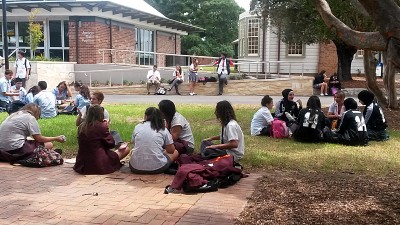
Australian students in their final year of high school take a break during a conference about what to do after graduation. The country is trying to boost its high school completion rates to 90 percent.

Australian students in their final year of high school take a break during a conference about what to do after graduation. The country is trying to boost its high school completion rates to 90 percent. (Photo: Sarah Butrymowicz)

Australian students in their final year of high school take a break during a conference about what to do after graduation. The country is trying to boost its high school completion rates to 90 percent. (Photo: Sarah Butrymowicz)

But in Australia, they’ve already tried it, and the experience is a cautionary tale.

In 2008, Australia’s high school graduation rate was about 75 percent, according to the Australian Bureau of Statistics. That’s about the same as in the U.S., where it’s nearly 75 percent, but it wasn’t good enough for Australian officials. Many states there allowed students to leave at the age of 15, following their 10th year of schooling and just before college preparation work begins. Thousands dropped out. So that year, the Australian government set a target of 90 percent high school completion. Within a few years nearly all states had increased the age to 17.

Still, the Australians thought they should do more. To make sure all students stayed enrolled until they were 17, officials put strict penalties in place and a series of supports for truants, such as opportunities to work with social workers. Parents could also be fined up to $11,000. And, as a last resort, parents on welfare could lose their payments if their child was truant.

The logic was simple: if parents needed the money, they’d make sure their child got to school.

Attendance did improve in areas where the program was piloted, by about 5 percent. But a 2010 evaluation by the Australian Department of Education found that it decreased after an initial bump and low-income students still had lower attendance than their peers. Critics said that the increases weren’t enough to justify the cost of the program – about $3 million a year for the trial in 44 schools.

At the same time, only a relatively small number of parents lost their welfare payments. In the first two years just 95 out of about 6,600 parents in the trial program were affected and all of them had their payments reinstated, according to the Sydney Morning Herald. In 2012, Queensland stopped cutting welfare payments to parents of truants because attendance didn’t improve.

The program got mixed reviews from parents. Many of them “perceived the program as a ‘big-stick’ approach to dealing with attendance issues,” according to the government evaluation. But they also saw some positives. Even if the strategy didn’t lead to significant increases in attendance, nearly half of parents said that “the implementation had made them think about the importance of their child’s schooling,” the evaluation said. “A further 29 percent also noted the program had encouraged them to make more effort to address their child’s attendance issues.”

For more on this topic:

Truancy officers boost attendance at remote Indigenous community schools

Closing the school attendance gap at one of Australia’s most remote schools

Tony Abbott sets new school attendance target for indigenous students

Scanning the globe

News in the last few weeks includes a number of stories on educational quality (often driven by international comparisons), with teacher quality again cited as a critical factor. The news has also included discussions of issues like early childhood education, private/supplementary education, and school inspections.  While there has been comparatively little recent news about educational issues sparking protests, the uprising in the Ukraine has been a major focus of attention. The Voice of America reports that university students there have taken charge of the Education Ministry where a “sign reads ‘Students Welcome.’ Just show an ID card and walk right in. Everyone else is expected to stay out, for now.”

Educational Quality

Stories focusing on “top performers” included a discussion with Elfriede Ohrnberger, Ministerialrätin of the Bavarian State Ministry of Education, in The Global Search for Education, about Germany’s recent improvements on the PISA tests. In a commentary on the Education Nation website “It takes keeping up with the competition,” Amanda Ripley argues that students in “higher-performing” countries like Finland and S. Korea have more challenging work than their peers in the US. (For IEN Editor Thomas Hatch’s take, see this commentary describing his children’s elementary school year in “lower-performing” Norway and the trade-offs involved – a powerful holistic, developmental educational experience, but less focus on basic skills and academics).

Although Finland is usually in the news as a “top performer,” this time in Education Week, Mark Tucker asks Pasi Sahlberg to explain Finland’s declines in reading and math on the 2012 PISA tests. The Calgary Herald reports on a former Canadian Deputy Prime Minister’s concern that “Canadians don’t express similar outrage and disbelief when international testing shows the country’s students, and adults, have been faring worse in math, science and literacy over the past decade;” an OECD report on Sweden’s poor performance on PISA was the focus of a story in the Times Education Supplement.  TES cited “everything from low teacher salaries to excessive spending on keeping class sizes small” as key contributors to the problems; and IOL news reports that the education department in KwaZulu-Natal – a province of South Africa – is getting blamed for failure to address long-standing problems in the schools.  A report presented to the legislature there identified problems including:

“Positions being vacant and the long process involved in getting substitute teachers appointed.

– Schools not having qualified maths, science and accounting teachers, or any teachers at all.

– Toilets being in a “terrible” state.

– Schools being without permanently appointed principals for years as disciplinary cases drag on.”

Teacher Quality

A yearly monitoring report from UNESCO suggests that inadequate teacher training and cutbacks in funding are key factors in underperforming educational systems. As discussed in Voice of America, the report suggests to achieve universal primary education, sub-Saharan Africa alone would need roughly 225,000 more teachers a year, or almost 60% of the number of additional teachers needed worldwide. That report also lists Rwanda, Laos, and Vietnam, as having reduced their out-of-school populations at the primary level by at least 85% over the past five years.  However, The Guardian also cites reports that explain that growth “has come at the expense of teaching excellence, with all three countries forced to recruit less qualified teachers.”

In Australia, on the other hand,  The Hechinger Report  suggests that improving teacher quality has been a key reform strategy.  Those efforts have included increasing standards for teachers to get accredited (the equivalent of certified) and work on a career ladder where teachers who take on more responsibilities can get paid more.

Private/Public and Supplementary Education

While the Asia Pacific Memo talks with Julien Dierkes about the changing status and growing popularity of supplementary education, a story in Airang News describes President Park’s recent call to reduce private education there, explaining:

“In an effort to reduce private tutoring and get students more focused on their schooling, the government will force universities to give a zero-mark on applications that include awards or certificates received outside of school.  These will include TOEFL or other English language test scores, math and science Olympiad awards, and extracurricular education prizes received from private institutions.” 

In Radio Free Asia, Andrei Lankov also shares his thoughts on the problems with private education and education in general in North Korea.

Early Childhood Education

In Slate, Claire Lundberg shares her thoughts on almost 200 years of attention to preschool education in France.  Recent legislation in Scotland should increase free childcare for three and four-year-olds, and BBC News describes the effort that will review the quality of the childcare workforce there.

Assessment, Accountability, and School Inspections

Ofsted, responsible for carrying out school inspections, has also been busy.  The Independent reports that there will be some new, unannounced one-day school inspections to try to address what the Chief Inspector called “a culture of casual acceptance” of disruptions in schools.  The Gaurdian also reports of a rift between Ofsted and Michael Gove, Secretary of State for Education, and, perhaps not coincidentally, a move by Ofsted to begin inspecting chains of academy schools.

Education Reform in Japan

Dr. Christopher Bjork’s most recent publication, Japanese education in an era of globalization, which he co-edited with Gary DeCoker, was published in May of 2013 by Teachers College Press. The following post is based on a conversation in which he discussed educational reform in Japan.

As Dr. Bjork explained, education reforms in Japan in the 1990s aimed to “relax” strict educational standards and policies that many viewed as contributing to anti-social student behaviors, such as bullying and violence. In an attempt to relieve students of stress caused by high stakes testing, long hours spent in school, and rote learning, Japan implemented progressive, student-centered policies that privileged creative thinking and collaboration.  These changes were designed augment student interest in learning.

Teachers tended agreed with the goals of the relaxed education (yutori kyoiku) reforms, but often had difficulty implementing the initiatives in their classrooms.  Secondary instructors, in particular, were reluctant to diverge from practices that had proven effective in the past.  Dr. Bjork attributes this resistance to the cogent influence of entrance examinations, which act as gatekeepers and determine students’ future level of education attainment. Concerns about student performance on these exams made teachers reluctant to adopt strategies that they saw as unrelated to the content of the exam, and parents less willing to rely on the school system to sufficiently prepare their children for the challenges that lay ahead. As a result, many parents looked to private tutoring programs to fill what they saw as a gap in the children’s education.

Today, despite the country’s superior performance on the 2012 PISA test, the conservative government of Japan has a new agenda for overhauling the education system, which includes improving English fluency among teachers and students, teaching morals, and revamping the college entrance exam. A flurry of reports over the past few months also show that there is much debate over the government’s plan to revise curricula to state Japan’s territorial claims over disputed islands in teaching guidelines.  Although some vestiges of the relaxed education policies remain in place, their impact fell far short of the Ministry of Education’s initial projections.  The goal of alleviating pressure in the schools proved more ambitious than had been anticipated.

Teacher Education in Singapore

The following post was written by Sarah Butrymowicz and was originally published on the Hechinger Ed blog of The Hechinger Report.

Lessons from Abroad: Singapore’s secrets to training world-class teachers

Singapore has been a hot topic in education circles ever since it began to appear near the top of the pack of international assessments in math and science in the mid-90s. The country has been held up as an example of a place where education is being done right: Singapore’s standards were higher and better than ours. Its commitment to education stronger. Its teacher training more rigorous.

This month, I visited the tiny nation to see firsthand just what it’s doing and whether lessons from Singapore are really something the U.S. can replicate. During a week touring schools and talking to students and educators, I had a chance to spend several hours at the National Institute of Education (NIE), the school responsible for training all the country’s teachers. It’s a selective school regarded highly by many in the international education community. But I learned a few things that surprised me:

– The school averages 16,000 applicants for 2,000 slots annually, without bothering to do any outreach to high school students.

Teaching is a sought-after profession in Singapore, so the NIE doesn’t need to send brochures to top students or advertise in schools. It is guaranteed an abundance of good candidates because becoming a teacher is highly prestigious. Admissions staff only look seriously at those in the top third of their class, though, and a competitive interview process weeds out those who might just be interested in the salary the Ministry of Education pays students during their training to become a teacher.

– In 2010, the NIE started a pilot e-portfolio program, which quickly expanded to the entire school. All teacher trainees must collect a sampling of projects and main assignments from each of their classes and write about their philosophy of teaching – and document how that changes as their training goes on. Originally intended as an assessment, the portfolio now has no grades or consequences attached to it. Students must present it to faculty prior to graduating, but NIE administration decided that it was better used as a resource and opportunity for reflection, rather than a high-stakes assessment.

– Once students graduate, they must serve in the classroom for at least three years. In that time, though, they have a lighter workload – about three quarters of what a regular teacher has – and a mentor to help them. They’re also not done with the NIE.

The school offers ongoing training for all teachers and has some courses specifically geared towards beginner teachers. A few are even required by the Ministry of Education for recent grads.

Singapore, of course, is a small, centralized country and not everything that they do can apply to the United States. But there were some marked contrasts—such as the popularity of the teaching profession and the continued relationship between teacher and training program even after they’re in the classroom—that the U.S. could learn from. I’ll be checking in again later this week with more of my observations.

Scanning the globe

Several reports over the past month highlight issues such as educational funding, early childhood education, new schools and school closure, and curriculum:

Funding

In the Phillipines, http://www.philstar.com argues that the country is not contributing enough to education. While education spending increased from 1999 to 2011 (13.9% to 15%), it has yet to reach the target 20% of the national budget. According to UNESCO, “The share of national income invested in education, which equalled the subregional average in 1999, had fallen behind by 2009 at 2.7 percent of GNP, compared with an average of 3.2 percent for East Asia.” In CanadaThe Globe and Mail reports that school boards have increased their spending over the past decade. In Canada as a whole, expenditures have increased 53 per cent – or 5.3 per cent a year, a rate much higher than inflation. In Australia, The Australian Teacher Magazine reports that the government is in the midst of a debate over the funding of education. While the government has committed to a new educational funding system for four years starting from 2014, officials are debating the timeline for the new funding system as well as the question of whether the funding should go to private schools as well as public schools. Meanwhile, The Norway Post reports that the Norwegian government is making plans to increase spending on teacher training.

Early Childhood Education

In Bulgariahttp://www.novinite.com reports that, in order to avoid a loss of EU funding, new legislation is being drafted and must go into effect by September 2014. Legislation includes revisions to a draft law on pre-school education, which include making pre-school education non-compulsory for 4-year-olds. Meanwhile, The Helsinki Times reports that Finland, where approximately 63% of children aged 1-6 attended daycare in 2012, is considering a new law that would “secure the high quality of early childhood education,” as well as all other issues, including funding and teacher quality.

New Schools and School Closure

According to Norways The Foreigner, Conservative Education Minister Torbjørn Røe Isaksen has proposed lifting current restrictions on establishing private schools. Meanwhile, in Scotland, the government has amended the Children and Young People Bill in order to defer decisions about school closures to new review panels. The aim of establishing these panels is to improve transparency and remove allegations of political bias from the process. In Lithuania, the Education and Science Ministry has approved a network of Russian-language schools, emphasizing that education programs of foreign countries and international organizations must be consistent with the education goals and principles in the Education Law of Lithuania, as well as the law on national security and other legal acts.

Curriculum

In Finland, The Helsinki Times reports that a high school reform task force delivered a proposal to the Minister of Education and Science in which they proposed reducing compulsory subjects, such as the study of Swedish, and introducing new interdisciplinary studies. The proposal has been met with resistance from some teachers and politicians. Meanwhile, in The New York Times, questions about the relationship between identity and the curriculum surface for Palestinian children who are educated in Israel, and Muslims who are educaed in Germany. The debate over language instruction is ongoing in countries such as The NetherlandsLatvia, and Japan.

In AustraliaAustralian Teacher Magazine reports on a new review of the national curriculum, which leadership feels should be pared back to basics. Kevin Donnely, one of two men who will conduct the review, raises concerns over teaching and learning, and considers the relationship between educational spending and learning outcomes. As he explains, “We really do need to know whether the millions and millions of dollars that’s gone into education over the last 20 years, where results have flatlined or have gone backwards – we want to know how effective that money has been.”

Global Perspectives on Professional Learning Communities

Dr. Jane B. Huffman

Dr. Jane B. Huffman

At the 27th annual International Conference for School Effectiveness and Improvement, held in Yagyakarta, Indonesia, early this January, Dr. Jane B. Huffman presented a paper, “Professional Learning Community Development in High Schools: Conceptualizing the PLC Process through a Global Perspective,” in which she shared her research on the PLC process within multiple Asian cultural contexts. In a recent conversation with IEN Contributing Editor Paul Chua, Huffman defines professional learning communities (PLCs) as “professional educators working collectively and purposefully to create and sustain a culture of learning for all students and adults.” She described PLCs as a multi-dimensional process, including shared and supportive leadership; shared values and vision; collective learning and application; shared personal practice and supportive conditions. Through her research in the U.S. context over the past two years, she has found that successful implementation of PLCs district-wide depends on a coordinated vision of leadership working together towards a common goal, strong interpersonal relationships, and carefully targeted professional learning.

While the PLC process has been practiced and studied in Anglo-American cultures for twenty years, Huffman’s work with the Global PLC Network extends this work to non-Anglo countries including China, Hong Kong, Singapore, and Taiwan. Huffman and four research colleagues – one each from Hong Kong, Singapore, Taiwan, Australia and the U. S. – began the network in 2009 by studying schools in Taiwan and Singapore that were using the PLC model. From those conversations, they began to construct the essential structures of what came to be called the “Global PLC Model.” Their research on the global construct has five facets for development: structures, policy and procedures; leadership; professionalism; learning capacity and a sense of community.

A Dr. Huffman explained, a brief history of the five educational systems show that external and internal differences in educational systems make it impossible to create a ‘boilerplate’ improvement effort that will fit all contexts and meet all teacher and student needs. In Taiwan, the Ministry of Education (MOE) PLC policy began in 2009 and encouraged K-12 teachers to build school-based PLC teams for teacher professional development. Some government programs, such as a high school improvement project (School Actualization Program) and science education (High Scope Program), continue to motivate teachers to establish subject-based or interdisciplinary PLCs for curriculum innovation or professional development. In Singapore, PLCs started in 2000 with the establishment of Teachers Network, and Learning Circles, a teacher collaborative learning model of action research. In China, although the term PLC is seldom used, schools have a long history of enhancing teachers’ professional competency and instructional skills through collaboration and collective inquiry. In Hong Kong, early steps have been initiated to establish policies related to PLCs.

For more on the topic of Professional Learning Communities and how they are being put to use in various countries around the world, readers can look back to Dr. Huffman’s earlier publications and earlier conversation with ICSEI President Dr. Alma Harris, who shared that some of the debates about professional collaboration range from discussions about the best models to follow, about the time and resources available to support these activities, and the issue of impact. In addition, in a recent conversation with IEN, Dr. Philip Hallinger, described the some of the issues related “policy borrowing,” in which countries attempt to utilize policies that have been successful in different contexts.

Scanning the Globe: Access, Protests, and PISA 2012

A quick review of the headlines on education and educational policy we’ve seen from around the world over the last few weeks reveals continuing concerns about issues of access and financing in both developed and developing countries.  Australian Teacher Magazine reported on concerns about the extent to which the current Australian government will support the previously approved “Gonski” reforms, and Education International raised questions about a bill that will introduce an income cap to Japan’s tuition-free program for public high schools. An article in The Hindu described how school cancellations caused by excessive holidays and weather can interfere with the requirements for increased instructional time in India’s Right to Education Act. Euronews reported on the difficulties that students in countries like Uganda, Kenya, and Mexico face just getting to school.

Protests over the past few weeks included those over conditions for education and support for educators in the Ukraine that took place as part of the demonstrations against the government’s efforts to delay an association agreement with Europe; rallies against education cuts in Spain; and protests by students at the University of Copenhagen in response to a working paper from the University administration describing proposals designed to get students to complete their courses on time.

But the big news, at least for a moment, was OECD’s release of the 2012 PISA results including overviews, country-specific notes, full reports and data.  We pulled together headlines from around the world, many of which labeled the results “bad news,” except in countries like Lichtenstein, Poland, Estonia and the usual high-performing Asian countries and portions of countries (like Shanghai).  Alexander Russo rounded-up the responses in the United States and The Times Education Supplement put together their own list of news and opinion.

Concerns about the orchestration of the announcement and the media blitz surrounding it were raised on both sides of the Atlantic, by Paul Morris on the Institute of London Blog as well as Richard Rothstein and Martin Carnoy from the Economic Policy Institute in the US. While Marc Tucker and Tom Friedman agreed on some of the multiple factors that might contribute to Shanghai’s success, Adam MinterJunheng Li, and Diane Ravitch pointed to some of the problems and concerns about the Chinese education system expressed both inside and outside China (as well with some of the concerns about vast numbers of students in Shanghai who are unrepresented in the PISA tests).

Although slipping a bit in math, Finland – along with several other European high-performers like Estonia (discussed by Pasi Sahlberg), Poland (discussed by Amanda Ripley), and Liechtenstein – still serves as a focus for some examinations of the ingredients of a successful education system. Given the domination of the rankings by the Asian high-performers however, some of the main story lines for the next few years seem to be set. On the one hand, stories about success on PISA will highlight how hard students’ work and the amount of time students spend on schoolwork while mentioning concerns about the amount of pressure on students and the need to support the development of higher-order skills. (See for example, reports from the BBC about South Korea and a report in the Japan News that credits Japan’s strong performance on PISA 2012 in part to a decision by the Japanese Ministry to back-off a commitment to “pressure-free” education and an increase in the volume of study content and the number of class hours). On the other hand, others will continue to point to the many issues of inequality and the social and economic factors that play into these results and other comparisons (see for example stories from France, and the US; while it does not focus on PISA, a recent article from the Asia Pacific Journal of Education explores the inequitable distribution resources across schools in South Korea).