Category Archives: educational technology

Something’s Happening Here: Gregg Behr on the Evolution and Expansion of Remake Learning and Remake Learning Days (Part 1)

What does it look like when an entire community supports children’s learning and development? In this 2-part interview, Gregg Behr talks about the origins of Remake Learning and how the expansion of Remake Learning Days has helped to catalyze similar community-wide efforts in several other cities and regions around the world. In 2007, Behr, the executive director of The Grable Foundation, founded Remake Learning as a network of educators, scientists, artists, and makers supporting future-driven learning opportunities for children and youth in Pittsburgh, Pennsylvania. Remake Learning Days began in 2016 as a local learning festival with hands-on learning events for children of all ages at libraries, schools, parks, museums, and other community spaces. Celebrating its 10th edition this month, Remake Learning Days have now expanded to 15 different regions in four countries. Behr is also the author with Ryan Rydzewski of When You Wonder, You’re Learning, sharing the science behind the  work and words of Fred Rogers and Mister Rogers Neighborhood, a well-known television show that ran for over thirty years.  This interview has been edited for length and clarity.  

Thomas Hatch (TH): What were some of the key developments and “Aha” moments in your early work at the Grable Foundation and with Remake Learning? 

Gregg Behr (GB): I joined the Grable Foundation as Executive Director 19 years ago in 2006. I followed on the heels of an exceptional executive director, Susan Brownlee, who had led this organization extraordinarily well. By all accounts, the trustees were incredibly pleased with where the foundation was and where it was going. That meant I came into a position as a leader saying, “How do you build on excellence?” To try to answer that question, I spent time out in the community just connecting with people with whom the Foundation had been working. Meeting with teachers, meeting with librarians, and meeting with others involved in the out-of-school space. I asked them, “What could we do that would be helpful to you?” I heard things like “I’m just not connecting with kids the way that I used to.” This was fall of 2006 and at the time I was 32 years old, and at first, I just thought, “Oh, this is just experienced people saying something like ‘the kids these days…”.  But then I began to notice who was saying these things, and I realized I was hearing this from people in different age groups. Some had just started their work, others were 30 years into their careers, and they were all literally saying that kids are different this year than they were last year. I thought that was strange. It was if something was happening seismically in kids’ lives. Sitting here in 2024 it feels naive to say these things, but looking back, in 2006, there were massive changes underway in kids’ lives. They were consuming information differently, producing information differently, seeking affirmation differently, developing identities differently. There was, in fact, something different happening in their lives.

That recognition sparked something and got me asking questions like, if it’s true that something different is happening, how do we support schools and other sites of learning in different ways?  Then, I had a meeting with a colleague at the Entertainment Technology Center at Carnegie Mellon University, and I began to realize that there were a whole lot of other people asking questions about kids and learning but that weren’t traditional educators. They were designers, artists; they were gamers and what we now call “makers.” I started meeting with those folks and began to wonder what would happen if you brought these people together? So I organized a meeting at a breakfast place called Pamela’s. It was just a dozen people, and I was very purposeful inviting 12 individuals from 12 very different fields, including – as examples – a teacher, a gamer, and someone in museum exhibit design. 

It was one of those things where I scheduled it for an hour for, and it ended up going on for 2 or 2 and a half hours. At the end, everyone said, “Oh, my gosh! I can think of 2 or 3 colleagues that ought to be part of this conversation about education locally.” Then I just started convening more of these meetings. I used an email subject line that said “Kids + Creativity,” just giving it a name. Then people started saying “Oh, that’s the Kids and Creativity meeting!” That continued for a couple of years, and it just kept growing and growing. It went from pancakes to bagels, and then we did a “Gong Show” like event in the basement of the Children’s Museum. After that, people at an organization called the Sprout Fund got involved. They were a community foundation-like organization that served as a “think-and-do” tank in our region. They had a 5 C’s model (Convene and Catalyze; Communicate; Coordinate;  Champion) that we still use today that they used to organize these meetings and give some coherence to this growing network of people and organizations.  They said “It will take the grant maker (me!) out of the center to see if there’s a “there there.”

A person on stage with a large screen

AI-generated content may be incorrect.
Gregg Behr presenting about Remake Learning (photo: Howard Lipan)

This story speaks to a number of aha’s. It was an aha recognizing that something different was happening in kid’s lives — that the learning sciences and evidence from neural mapping now tell us was true. It was an aha and realization that we needed to think differently about who ought to be part of the conversation. There was an aha that this 5 C’s model that was originally used to attract and retain talent could be applied to help us build this network of folks involved in education generally and learning innovation in particular. The other aha was the power in shifting from talking about education to talking about learning; a simple thing in some ways, but at the time, it was profound because education conveyed schooling, whereas learning had this much bigger open sense that kids are learning in lots of places. That speaks to the power of words as well. I didn’t come up with the phrase “Remake Learning,” someone at the Sprout Fund came up with it, but, in retrospect, I think the reason that the name Remake Learning has stuck all these years is that using “remake” suggested that we don’t have to transform everything. We don’t have to blow everything up. You don’t have to get rid of everything that you’ve done for your entire professional life or what you studied. There may be some things that are timeless and classic, but we need to remake it for who today’s kids are. That name also wasn’t wedded to any particular thing like STEM or STEAM or maker education or digital learning. It captured all of those things, and it turned out to be a good umbrella for different approaches, different pedagogies, different frameworks, different words that people were using as they thought about innovation and learning in and out of school. That was another important aha. 

A close-up of a black and white website

AI-generated content may be incorrect.

TH: What were some of the challenges you encountered and some of the changes you made as things developed from there? 

GB: Early on, it was important for this new intermediary – Remake Learning – to build trust and demonstrate this isn’t a zero-sum game. It’s not as if the Grable Foundation or other funders are going to now start funding this to the exclusion of other things. Then the folks at the Sprout Fund, in particular, really learned how to work well with other intermediaries in the early childhood space, the mentoring space, and the out of school time space, to see and recognize the work already going on and build on it. For example, they built on things like the Allegheny Partners for Out of School Time. It meant figuring out how something like Remake Learning builds on that work and doesn’t compete with it or replace it. We use words like “partnership” and “collaboration” pretty freely, but it’s really hard work to build trust among people and organizations. 

TH: Yes, it’s really hard work!  Do you have any examples, from the work with your partners, that helps to show what worked for you in building partnerships? 

GB: I suppose it’s not rocket science, but for one thing, we were really deliberate and very intentional about communications. We took advantage of our position in philanthropy and convened leaders of the key organizations at least quarterly so that there was transparency in our communications. We would always meet with food and other things to build relationships and get to know each other a little better, and we tried to engage in genuine conversations to say, “Here’s what we’re doing” and “How do we really help each other?” Just being really deliberate and reaching out to the Allegheny Partners and others to say “Hey, we’re thinking about an event on September 23rd.” Lots and lots of little ordinary things that would engender trust. Then people feel like, “Oh, I’m being heard.” Being deliberate about inviting leaders of organizations to be part of review committees, to create real, community-based participatory review committees for grant making. All of those simple, ordinary things repeated and done in a rhythm helped the Remake Learning team avoid some key problems. It’s a very human, relational enterprise to build out a network. 

TH: I think time and rhythm are really important. How do you plan for that? Did you have in your mind that this is going to take five years or ten years? 

GB: It’s interesting that you ask this question because I think rhythm is often overlooked. If Doncaster, England calls us or Fremont, California, calls, I always talk about the rhythm. I think the rhythm sets expectation. Like every spring we’re going to host Remake Learning Days. Every fall, there’s a Remake Learning assembly, which is kind of like our “State of the Union.” There are four meet ups every month. You can expect communications to come out every Friday. It’s not haphazard — all of the little things create expectations and make it easier for people to connect. thing. Kids need rhythm in their schools. but it’s also important for organizations, for cities, for regions to have a rhythm. Like this is our birthday. This is when we’re going back to school. For the network, creating a rhythm and being deliberate and intentional about it builds a culture; it builds tradition; it builds relationships. It builds all of those things. 

There are a couple other things that I think kept Remake Learning grounded. One of them is that many times over the course of nearly 20 years, Remake Learning has hired consultants well trained in human centered design. They’ve convened members of the Remake Learning network for half-day or daylong retreats or other gatherings so that Remake Learning can ask “how are we doing? “How might we do things better?”  It’s ongoing strategic management with a real sense of human-centered design in it, regularly checking-in with the broader community. 

TH: So often funders and others are focused on the short-term – on generating outcomes in two or three years, but part of what I’m taking away from what you’re saying is that you weren’t focused on a specific time frame; you were focused on creating a set of activities and events that could be sustained to support activity over time, into the future. 

GB: Yes, and I would add that the focus was more about a mindset, an idea. It was about a movement to think about learning across a landscape that supports young people’s passions and interests. The events, the activities, the grants, the communications are all in support of changing mindsets about learning.

TH: But that also entails a foundation, an organization, and people that are willing to say, “We’ll support these activities into the foreseeable future” rather than to say, “We’ll give you a three-year grant.”

GB: Yes, that is true. Remake Learning’s been lucky, and my work at the Grable Foundation plays a significant role in this, but beyond the Grable Foundation, we’ve had support from lots of other funders. Along the way, there have also been many one year and three year grants and other kinds of support for Remake Learning. But because of the steadiness of the support, Remake. Learning has always been able to budget years ahead. That’s very powerful; it’s never had to budget year to year.  

A collage of kids in lab coats

AI-generated content may be incorrect.
A collage of kids playing with toys

AI-generated content may be incorrect.

Kids in Remake Learning activities (photos: Ben Filio)

TH: What kind of advice do you give other people about how to establish that kind of support? Especially in a context where funders may be more inclined to give a grant for a three-year project than to provide core backbone funding for as long as it’s required. 

GB: I might win a Nobel Prize for philanthropy if I could answer that question! I use the phrase “make yourself lucky” occasionally, but there’s no doubt that you need some funder or, ideally, funders – whether they are individuals, corporations, philanthropies, or municipalities – to recognize that a network or an intermediary organization needs multi-year, discretionary, unrestricted support. Period. That’s the bottom line. If a funder doesn’t get that, you’re in trouble. 

TH: Are there things you’ve done – generating evidence of impact or sharing information – that have helped convince funders to provide that kind of support? 

GB: We use a lot of analogous and proxy examples. When we thought about Remake Learning initially, and its focus on relevant, engaging, equitable learning across our community, the easiest argument to make was to say, “look at what we’ve done collectively in philanthropy in the early childhood space over the past 20 years: we’ve built an intermediary that, in turn, supports hundreds of early learning centers. Look at what we’ve done in the out-of-school time space. Look what we’ve done in arts education space.” We really used those other examples – like the Campaign for Grade Level Reading – to say “these are the types of results we should anticipate when we create a network of schools, museums, libraries, other sites of learning committed to future facing, future driven learning.”

TH: You’ve been doing this work on Remake Learning for twenty-plus years now, but, early on, were there any developments or things you looked at that told you were headed in the right direction or that helped you convince other people to get on board? 

GB: Yes, and I wish we had more, but for one thing, we looked at data from individual organizations. I’ll give you two examples. The Elizabeth Forward School District was deeply involved in Remake Learning early on. They began rethinking how they approach professional development and learning. They sent their administrative teams to go see what was happening at some innovative places here in Pittsburgh at Carnegie Mellon; they went to visit the Quest School in New York City, and to see a media space in Chicago. Then they started reimagining how to use their own spaces. They built a classroom that mimicked the Entertainment Technology Center (ETC) and they were at the forefront of reimagining what school libraries could look like. In pretty short order they started to see some improvements in traditional measures, including math scores and reading scores. Their dropouts went from about 28 or 29 kids a year to 0 or 1. They saw the number of families choosing charter school drop by two thirds. They also suddenly found there was a new energy; there was an agency. People wanted to be in the school, and students were performing at higher levels. At the same time, the Carnegie Libraries of Pittsburgh, like the public libraries in Chicago were at the forefront of imagining what teen spaces might look like. They brought in filmmakers and hip-hop artists alongside librarians, and they filled the shelves not only with books, but also with games and hardware and software. In pretty short order, they saw a two-fold increase of teens coming to the library. There was a massive increase of kids coming back to the library because, in that Mimi Ito way, they wanted to hang out and they wanted to mess around. Then, lo and behold, in the short term, there was something like an 18% increase in book circulation among those kids. Again, traditional measures. So clearly, things were happening, and we could point to those two and lots of other examples. 

Next week: How do you Build a Learning Ecosystem? Gregg Behr on the evolution and expansion of Remake Learning and Remake Learning Days (Part 2)
Critical Consciousness, Digital Equity, and Critical Unschooling in the United States: Lead the Change Interviews (Part 6)

This week’s post includes excerpts from interviews with presenters discussing “Redefining leadership and equity in evolving educational spaces” at the Annual Conference of the American Educational Research Association next week. For previous posts featuring presentions at this year’s AERA conference see Part 1 “Leveraging Partnerships, Networks and Teacher Collaboration for Educational Change,” Part 2 “Leaders, Leadership Practices, and Educational Change in the US, Korea, and Hong Kong: Lead the Change Interviews (Part 2),” Part 3 “Educational Transformation in Schools and Colleges in the US and South Africa: Lead the Change Interviews (Part 3),” Part 4 Teacher Education, Teacher Certification, and Teacher Meetings in Israel, Korea, Switzerland and the US: Lead the Change Interviews (Part 4), and Part 5 “Anti-discrimination policies in Massachusetts and socioeconomic education reform in Türkiye.” The Lead the Change interviews are  produced by Elizabeth Zumpe and colleagues from AERA’s Educational Change Special Interest Group. The full interviews can be found on the LtC website


Action spaces to support teaching critical consciousness: Risk-taking within professional learning communities – Christina L. Dobbs, Boston University – Madora Soutter, Villanova University – Daren Graves, Simmons University – Elianny C. Edwards, College of the Holy Cross – Scott Seider, Brianna C. Diaz, Babatunde Alford, Kaila Daza, Sarah E. Fogelman, Trang U. Le, Alexandra Honeck, Hannah Choi, Yuwen Shen, & Hehua Xu, Boston College.

Lead the Change (LtC): What are some of the ideas you hope the field of Educational Change and the audience at American Education Research Association (AERA) can learn from your work related to practice, policy, and scholarship?

CD, MS, DG, EE, SS, BD, BA, KD, SF, TL, AH, HC, YS, & HX: We will present a project from the past several years called the Critical Crew Project. This project sought to teach middle grade students about critical consciousness (Freire, 1973), the ability to challenge and navigate oppressive forces, and to document how those schools used professional learning community (PLC) spaces to learn and teach critical consciousness with students during advisory meetings….We learned a great deal across this project about systems of multi-level change to build support for learning at a range of levels. Teachers needed space and support to learn about teaching critical consciousness that had structure without prescription. Our approach of having flexible tools with lots of space for specialization for contexts and particular students seemed to resonate with teachers. We found also that, as university partners, we served as conduits to research and other materials for PLCs and to use their feedback for refining the work, without being overly directive about the project. We also learned about producing a range of work products as a result of the project – academic papers, curricular materials, videos from classrooms, etc. – which has helped us push different levers, such as publishing research or presenting teacher workshops or building curriculum and participate in different conversations as a result of the work.

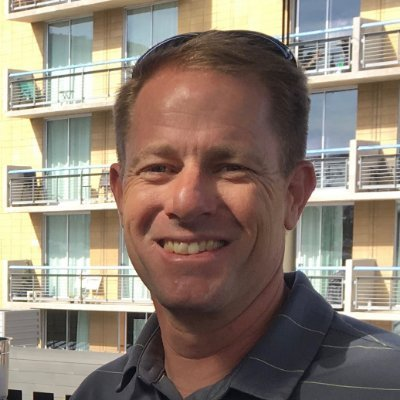
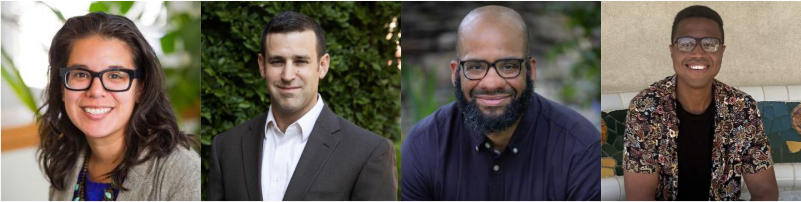
From Left to Right: Dr Christina Dobbs, Dr Scott Seider, Dr Daren Graves, Babatunde Alford

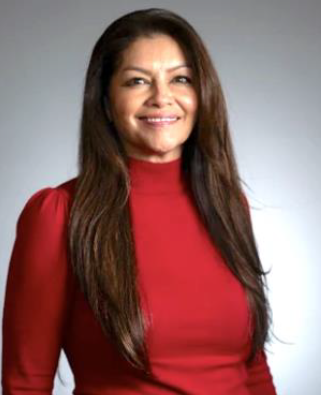
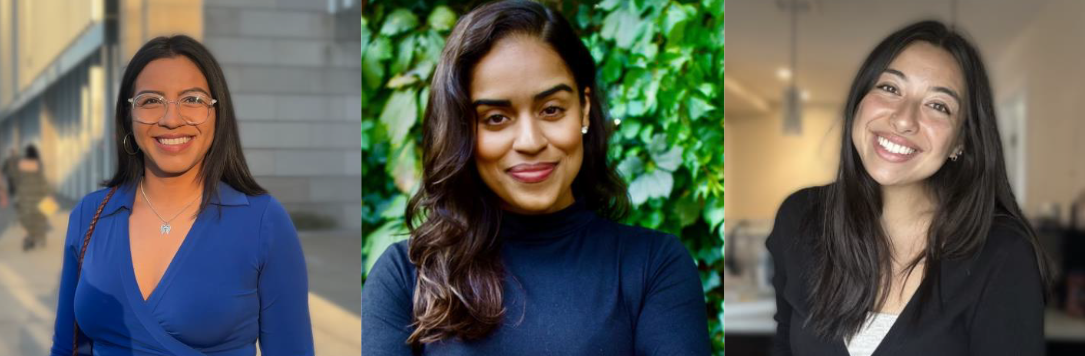
From Left to Right: Brianna Diaz, Dr Elianny Edwards, Kaila Daza

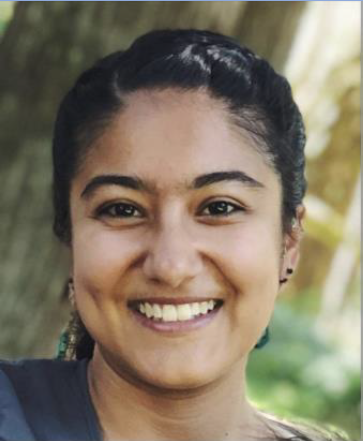
From Left to Right: Dr Trang Le, Alexandra Honeck, Hannah Choi
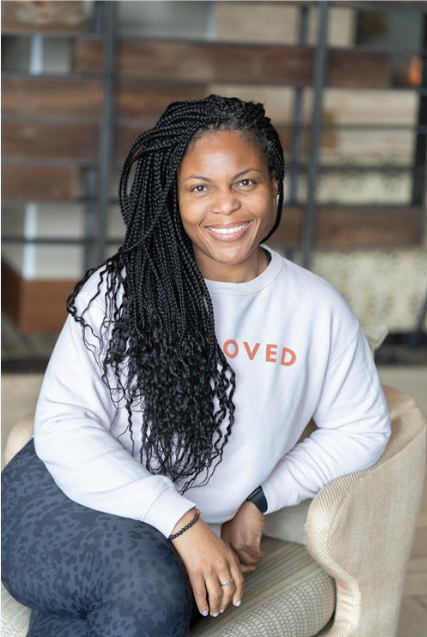
From Left to Right: Sarah Fogelman, Hehua Xu, and Dr Madora Soutter

Digital Equity and Inclusion: Insights into Educational Change and School Initiated Improvements – Christopher Sanderson, University of Arizona 

Lead the Change (LtC): What are some of the ideas you hope the field of Educational Change and the audience at American Education Research Association (AERA) can learn from your work related to practice, policy, and scholarship?

CS: My research offers insights into the challenges and strategies facing K-12 school districts in their efforts to promote digital equity and inclusion, providing valuable lessons for practice, policy, and scholarship. My work emphasizes the importance of integrating digital tools and providing professional development for educators to address disparities effectively. For example, I highlight the need for further training to bridge digital literacy fissures. From a policy perspective, I encourage sustained district-level planning and collaboration to tackle systemic barriers, such as the expiration of temporary programs like the CARES Act and ACP (Federal Communications Commission, n.d.; US Department of Education, 2024). Digital equity must be treated as a long-term priority rather than a short-term response to crises like the COVID-19 pandemic (Petersen, 2024).  

I also emphasize holistic definitions of digital equity and inclusion, which include access to affordable internet, devices, and the necessary digital skills. Collaborative approaches are essential, and I focus on engaging administrators, teachers, parents, and community members in co-creating solutions to foster a shared vision of digital equity and inclusion. My research highlights the importance of addressing systemic inequities and recognizing biases in policy and practice. For instance, I noted that federal programs often exclude K-12 schools, advocating for tailored, inclusive, sustainable, district-level strategies (National Telecommunications and Information Administration, 2024).  

My work offers frameworks to explore the intersections of digital inclusion, systemic inequities, and community collaboration in educational change. It contributes to the growing body of literature on digital equity by providing insights into how schools can navigate barriers to ensure every student has the tools for success. Focusing on localized, context-driven solutions and collaborative efforts, this research aims to inform and create more equitable learning environments that address both immediate needs and long-term goals. This study may support school districts in assessing their progress toward digital equity and inclusion, offering recommended actions for transformative change. Through the collection and analysis of data, districts can identify patterns and make informed decisions on future steps.  

The findings from this study can serve as a catalyst for action-oriented planning beyond its conclusion. The ultimate goal is to develop actionable strategies that help school districts achieve equitable student access. While an outsider can only begin to grasp the challenges students, communities, and schools face regarding technology access, internet connectivity, and digital skills development, addressing these barriers requires strategic, locally driven planning. Schools are complex and diverse, with digital equity and inclusion needs varying from one site to another. For example, one school might require more digital literacy training for caregivers, while another may need additional internet hotspots to ensure students can access devices outside school hours. 

Dr Christopher Sanderson

Achieving Excellence Academy: Critical  Unschooling and the Promise of a  Humanizing Education – Dr. María del Carmen Salazar & Nadia Saldaña-Spiegle, University of Denver, Ashlea Skiles, Denver Public Schools

Lead the Change (LtC): What are some of the ideas you hope the field of Educational Change and the audience at American Education Research Association (AERA) can learn from your work related to practice, policy, and scholarship?

MS, NS, AS: One of the central contributions of this research is the expansion of the concept of critical unschooling. We, the researchers, extend this concept by conceptualizing “home-based” as one’s sense of “home” which is inclusive of home culture, community, native language, intersectional identities, history, heritage, ancestors, and ultimately, of one’s full humanity. We, the researchers, put the concept of critical unschooling on the ground and bring to live a real-world example in an educational setting with secondary students and teachers of color. This is an important contribution to the field because it extends theory into practice.

Another important contribution of this research is that student voices are centered and the concept of critical unschooling is shaped by their experiences and insights. One of the most impactful findings is how students redefine excellence as a result of the Achieving Excellence Academy (AEA). As an example, one student stated, “Excellence is not just holding onto your goals, it’s going after and representing yourself, and reflecting yourself in your goals.” Another student emphasized, “Before, I only thought about excellence athletically and academically, but after this program, I think it’s cultural too…pride in your own culture, accepting other people’s cultures, and being woke.” The AEA expanded students’ perceptions of excellence to include a focus on their well-being and cultural pride. Moreover, teachers of color extended this concept into teaching and learning by sharing how they enacted critical unschooling.

Dr María del Carmen Salazar
Nadia Saldaña-Spiegle
Ashlea Skiles

Reimagining Coaching and Teachers’ Time: Scanning the News for Innovations in Teachers’ Professional Learning (Part 2)

This week, IEN’s managing editor Sarah Etzel continues a scan of recent news articles and research on post-pandemic developments in the teaching profession. In part two of the post, Etzel describes some of the initiatives to use technology to help to free-up time for teachers by reorganizing staffing and scheduling. Part one explored innovations in blended and remote teacher professional development models and the use of AI to provide feedback to teachers. 

What’s happened to teachers in the wake of the COVID-19 pandemic? On the one hand, in the US teacher vacancies appear to have grown substantially. One report released in the fall of 2023 showed 55,000 vacant teaching positions, an increase from 36,000 the previous year. On top of that, the report found that 270,000 teachers – almost 9% of the entire teaching force – are “underqualified,” either lacking full certification or teaching in a subject in which they are not certified. The National Center for Education Statistics also revealed that 86% of K-12 schools reported problems hiring new teachers in advance of the 2023-24 school year, and almost half of all public schools describing themselves as “understaffed.” On the other hand, the pandemic helped to stimulate experiments with new models for staffing and with virtual teachers that might help to address teacher shortages. 

Staffing Changes: Unconventional Teaching Roles

            Whether in-person or virtual, a small set of schools and organizations around the US are exploring what alternative teaching and staffing models for schools could look like. A report from FutureEd focusing on pandemic-inspired staffing strategies, for example, highlights the benefits of some co-teaching, team teaching, and mentor teaching models. Public Impact, working with a network of over 300 schools, has pioneered models designed to use teacher teams to enable teachers who have shown their effectiveness to reach more students. These “multi-classroom” leaders teach part-time and also lead small, collaborative teams of other teachers, paraprofessionals, and intern teachers in the same grade or subject. Cadence extends the reach of effective teachers by developing a national team of mentor teachers who deliver online lessons for a group of partner schools across the US. The teachers in the partner schools both learn from the mentor models and they can incorporate the lessons into the work with their own students. As Steven Wilson, a co-founder of Cadence, puts it: “It’s like being able to sit in the back of the room of the best teacher in the building for weeks at a time and see his or her moves and adapt them and make them your own.”

The FutureED report also emphasizes the potential of flexible class sizes, time blocks, and instructional cycles that allow for teachers to work with smaller groups of students outside of traditional grade-level and schedule constraints. As an example, the report highlights a particularly unusual approach from Kairos Academies in St. Louis that developed a seven-week schedule in which students attend school for five weeks, followed by two weeks off; staff have one week off, but use the other week to review data and plan for the next cycle. The report quotes, Gavin Schiffres, Kairos founder and CEO, describing what he sees as the advantages of the cycles; “With the cycle model, we operate in sprints, much like the technology industry. In a traditional calendar, you have kids in the building for such long stretches that as soon as there’s a break, everyone just wants to crash.” 

Drawing on interviews with a small group of leaders from six districts involved in staffing experiments, the Center on Reinventing Public Education issued a report on how unconventional teaching roles could help to make the profession more sustainable and increase teacher satisfaction in the process. Some of these roles include: 

  • Lead teacher: An individual who mentors a team of teachers (across content areas or grade levels) by developing curricula and co-teaching as necessary 
  • Empowered teacher: An individual who supports with school-level policies and sets learning targets 
  • Team teacher: An individual who teaches a large group of students (50-80) in collaboration with two to four other teachers 
  • Community learning guide: An individual who works with a group of educators and their students to create experiences grounded in students’ wider environment, community, or culture. 
  • Solo learning guide: An individual who independently teaches a small group students (5-15) in school or home contexts
  • Technical guide: An individual who leverages subject area expertise (e.g. robotics, architecture) to provide curriculum support and work with small groups of students 

According to the report, teachers in these roles shared that they experienced less stress and felt more motivated; working in diverse or team settings, teachers were able to share responsibilities, learn from each other, and feel connected to the purpose of teaching. Despite the potential, a review of the CRPE report from the National Education Policy Center cautions that it is too early to tell whether these kinds of staffing changes could be scaled effectively or whether they would have the desired impact. 

In order to address the shortage of teachers and support those that are in place, some schools in the US have also introduced models to support paraprofessionals to gain teaching credentials and become licensed teachers, while others have created pipelines for substitute teachers to gain teacher certifications. Beyond the US, organizations such as GPE KIX and UNICEF have been pioneering child-to-child teaching models, in which older students support the education of pre-primary learners, in areas where there are not enough teachers available (for past IEN coverage of peer-to-peer tutoring approaches, see: Education reform in MexicoAn interview with Dr. Santiago Rincón-Gallardo, and Bringing Effective Instructional Innovation to Scale through Social Movement in Mexico and Colombia).

Virtual teachers for in-person students

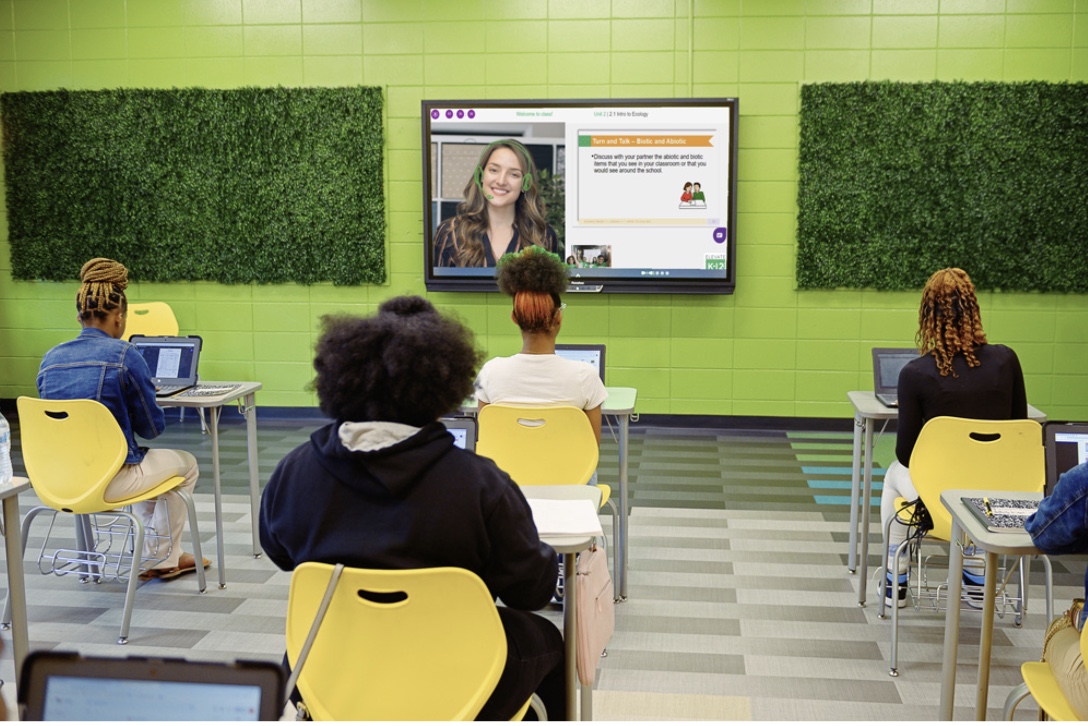
Along with developing new virtual and hybrid approaches for students to learn, during and after the pandemic, reports also note that some districts are spending millions of dollars on virtual teachers to fill-in when they can’t find the personnel they need in their local area. Among these, districts in Little Rock, ArkansasCharleston County, South CarolinaSan Jose, California, and Milwaukee Wisconsin have contracted with companies such as Elevate K-12Coursemojo, and Proximity Learning to address their teacher vacancies and to provide virtual instructors who zoom into their classes. These companies employ fully certified virtual teachers who provide “synchronized learning services” in a range of subjects. The virtual teachers interact with students completely through the online platforms, with, in some cases, in-person supervision provided by paraprofessionals or long-term substitute teachers. 

"live teaching" model

Elevate-K12’s model of “live teaching”, The 74

The benefits and drawbacks of these approaches are also being debated in the press. For some, these virtual options provide an alternative to other “quick fix” solutions that have been used to fill empty classrooms in the past, including hiring uncertified teachers, incentivizing military veterans to join the teaching force, or removing some degree requirementsAccording to the CEO of a San Jose charter school network that contracts with Coursemojo, this situation is not ideal, “but until we really, radically change the education profession here in the United States, we’re going to be looking at solutions like this.” Catherine Schumacher, Executive Director of Public Education Partners stated the importance of not shaming “districts for doing the absolute best they can do to get qualified teachers,” especially in a climate where “we have systematically underpaid…educators for years.”  

Other advocates argue that the subjects virtual teachers are teaching have historically been hard to fill, meaning many students did not have access to these educational opportunities, particularly in low-resource school districts. As the Milwaukee Public Schools talent management director put it: “when we talk equity and access, I want to ensure that if my students want to take pre-calc, if they want chemistry, if they want physics, that they have the opportunity to do so.” 

The cost-effectiveness of the virtual models also remains in question. For one school district in Milwaukee, Wisconsin, a contract with Elevate-K12 helped them fill 55 open positions at a cost of about $3.9 million, a savings from the $5 million it would have cost to hire that many in-person teachers. A district representative reported that they were able to save the $1.1 million because they did not have to provide benefits for Elevate K-12 teachers. In contrast, a school district in Charleston County, South Carolina that has used the virtual learning platform, Proximity found that these models were more expensive, as the schools needed to hire paraprofessionals to watch the students during the virtual classes. 

Critics point to the fact that there is not yet enough evidence to show that students are achieving positive learning outcomes under these models, but proponents such as Elevate K-12 founder Shaily Baranwal, argue that virtual teaching during Covid-19 took place under emergency circumstances and, with more time to prepare and focus on delivery methods, post-pandemic virtual teaching could be particularly effective. Critics also question whether students’ social experiences and sense of belonging will suffer when they have virtual teachers, and some wonder who will be held accountable for student learning under blended learning models (i.e. the paraprofessionals who are in class every day with the students, or the virtual teachers?). With all these uncertainties, many parents remain skeptical of this virtual  solution and question whether virtual teaching will be the best fit for their children. 

The bottom line? Freeing up time to teach? 

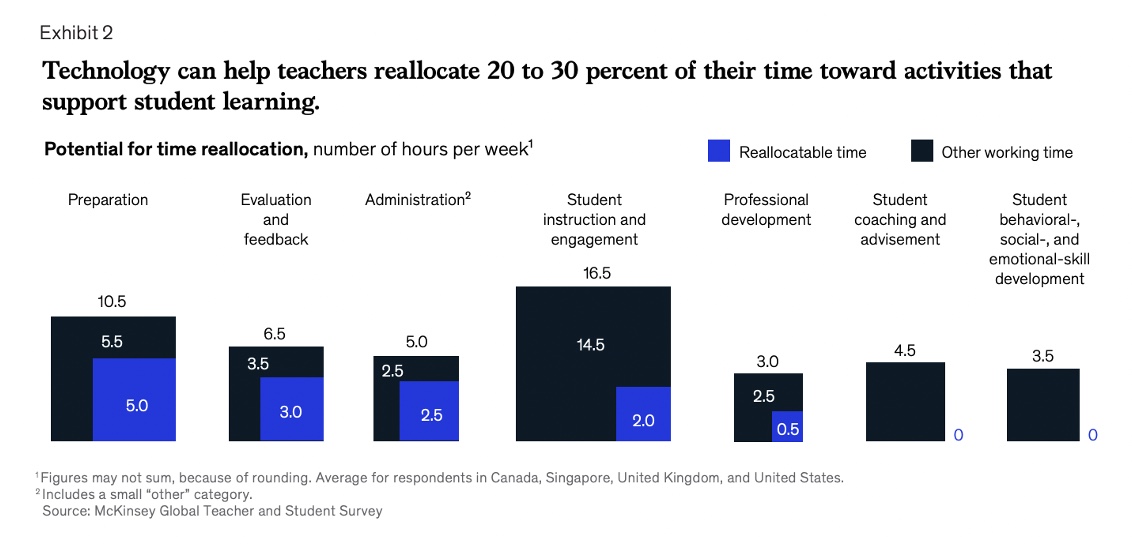
At the end of the day, the success of any of these “innovations” in professional learning depends on whether they can be put in place without adding to teachers already overloaded schedules and extensive set of responsibilities. Post-pandemic articles continue to highlight challenges like a lack of planning time for teachers and excessive time spent in staff meetings as well as hopes that AI may help address these issues by freeing up teachers’ teachers time from administrative tasks and helping teachers create differentiated assignmentsThrough a survey of 368 school-based employees across the U.S., AI-Equity found that 84% of those who used AI in the Daily/Weekly category reported they were “more excited about continuing education sector work because of AI,” compared to 52% of all respondents, while 94% of Daily/Weekly AI users shared that it made them more productive. According to research from MIT, AI can improve the performance of skilled workers in fields such as consulting by approximately 40%. A report from McKinsey and Co. estimates that teachers could free up 20-30% of their time by using AI and other technologies to support activities such as preparation, conducting evaluations and giving feedback, administrative duties, and professional development. The Christensen Institute argues that teachers may not use their reallocated time for increased student engagement without proper incentives, but freeing up teachers’ time could help to alleviate burnout and increase the attractiveness of the profession. 

How artificial intelligence will impact K-12 teachersMcKinsey

However, sources also caution that AI should not be viewed as a panacea for solving these issues, and in fact, may exacerbate some of the challenges that teachers face. As one teacher explained, the expectations developing lessons incorporating AI and other forms of technology “takes extreme planning, and that, we don’t have time for anymore.” Moreover, the increasing use of AI raises numerous questions about the potential impact on students’ learning and development. In particular, as Julia Freeland Fisher cautions, the education market doesn’t prioritize relationship building within its attainment metrics and so may fail to take into account AI’s impact on those relationships. Under those conditions, as Freeland Fisher put it, “the more commonplace that AI companions, coaches, and anthropomorphized bots in learning and support models are, the more fragile students’ social connectedness may become.”