Category Archives: Newspaper Articles

Links to newspaper articles about international educational issues.

South Korea

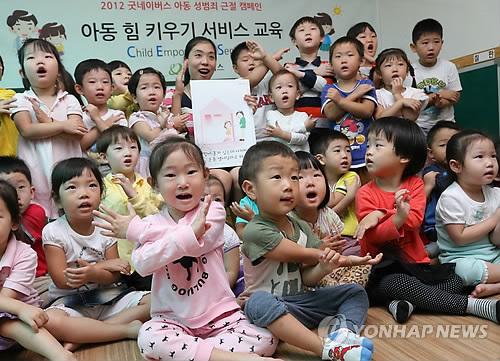
South Korea’s government to increase childcare subsidies for 3 to 5 year-olds

Yonhap News (September 26, 2012)

Under a government plan to expand public welfare benefits and help relieve families of the financial burden of childcare, all South Korean households with kindergarten children between the ages of 3 and 5 will be paid 220,000 won (US$196) per child every month. The Ministry of Education, Science and Technology, has announced that the monthly childcare subsidy for families with 5-year-olds attending kindergarten or daycare centers will rise by 20,000 won (US$18) per child from the current 200,000 won (US$179). Young children not at kindergarten or daycare centers will not be covered by the subsidy program. 

For more information:

Link to article (in Korean)

Link to the Finance Ministry’s final budget plan for 2013 (in English)

//

Scan of Education News: September 19th – October 7th

In 1994, UNESCO declared October 5th World Teachers’ Day in order to call attention to the fact that “all over the world, a quality education offers hope and the promise of a better standard of living.” UNESCO identifies teacher shortage as a major problem in 2012, and recent reports confirm their claim. In the latter half of September, teacher shortages were reported in countries such as India, the Dominican Republic, and in a total of 114 countries worldwide. This fact presents a significant problem for countries such as North KoreaBrazilSouth AfricaIndia, and Barundi, which have all made efforts to increase the amount of time students spend in the classroom. In contrast, Spain has seen education cuts that have left many teachers desperate for work, Guatemala has instituted new teacher education requirements that make it more difficult, and expensive, to enter the teaching profession, and Austria’s conservative party (ÖVP) has proposed a radical reform (“Mission Austria 2025”) that would alter teachers’ working conditions, including an increase in the number of hours teachers spend in the classroom.

Several reports have also shown that many countries have differing opinions about the ease of access to education through testing. While the UK has been debating whether or not it would be “cruel” to make university entrance exams any easier, India has taken steps to ease the entry process.  Ultimately, the UK decided to replace the GCSEs with an English Baccalaureate Certificate that officials say will raise standards and streamline a overly complicated system. In a similar move, South Korea adopted a new English-language exam (NEAT), which they intend to use in place of  the American TOEFL exam in the college application process in 2013.

Meanwhile, countries such as Vietnam and Malaysia have been looking for ways to make school curricula more creative and interesting to students, in a move they believe will foster higher order thinking and cut down on test-prep approaches to schooling.  Sweden is going so far as to rethink school building design in an effort to promote collaboration and creativity in primary school students, while South Korea is implementing policy that aims to prevent excessive “prior learning,” or tutoring, sought by parents in an effort to make sure their children are well-prepared for upcoming high-stakes tests. The high standards that many countries have put in place to promote academic achievement have led countries such as Romania and Switzerland to seek vocational alternatives to higher education.

For more news related to educational policy and change around the world, please follow us by subscribing to our email updates, following us on Twitter, or “liking” us on Facebook.  
South Korea

South Korea’s Ministry of Education, Science, and Technology leads education reform to prevent excessive prior learning from private tutoring 

*Original article in Korean

Joongang News (September 26, 2012)

Prior learning in Korea refers to educational programs offered via private institutes, which teach above-grade-level school curricula to students in advance. Subjects are taught a year ahead of  schedule, and even three years in certain cases. South Korea’s Ministry of Education, Science, and Technology announced that the excessive prior learning has caused problems in students’ cognitive, social and emotional, and educational development. The ministry has presented an outline for a new policy that plans to solve the problems through:

-Examination of public school curricula that might encourage prior learning.

-Examination of the effects of prior learning on the entrance exams for high schools and colleges.

-Exploration of the successful public school models with regard to curriculum management.

-Conducting scientific and practical research on the disadvantages of prior learning.

-Probing of private tutoring programs.

For more information:

Link to the article from the blog of the Korean Ministry of Education, Science, and Technology (Korean)

Prior Learning (English)

36% of parents spend W910,000 on tutoring 

 Growing debt worries for South Korea

Japan

Difficulty in Differenciating Good Teachers from the Rest in the New Teacher Evaluation System

Fukuashiba Elementary School in Ibaragi Japan

Shinano Mainichi Shinbun (September 11, 2012)

*original article in Japanese

Nagano prefecture in Japan began adopting a merit pay system based on the result of the teacher evaluation in 2011. The recent report on the result of the 2011 evaluation indicate that the system doesn’t work effectively. The result  shows that 16,767 out of 17,000 received C  in the A to E scale. A former principal in Nagano commented that he had no choice but to give a C to all teachers because assigning low evaluation scores required an evidence-based account, which was not practically feasible. The Nagano Department of Education commented that the current teacher evaluation system has to be something that produces mostly average C scores. This is due to the reconciliation with the teacher union, which argued against the Nagano Department of Education about highlighting the differences among teachers in terms of their teaching effectiveness.

For more information (in Japanese):

A webpage of Fukuashiba Elementary School in Ibaragi Japan

South Korea

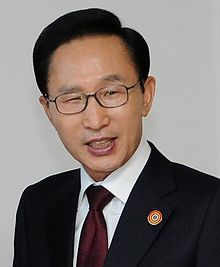
Lee Myung-bak

New English test seems like a big waste of public funds

The Hankyoreh (September 12, 2012)

Since Lee Myung-bak took office in 2008, the government of South Korea has invested close to 30 billion won ($26 million) in The National English Assessment Test (NEAT), an English language test that is expected to replace American tests like the TOEIC or TOEFL in the university entrance system beginning in 2013; however, serious questions have been raised by Rep. Yu Gui-hong of the Democratic United Party from the Ministry of Education and Science as to whether NEAT has been effective and reliable.

Students sit a trial version of the National English Aptitude Test at a school in southern Seoul. (Kim Myung-sub/The Korea Herald)

To read more on this topic, go to:

National English Assessment Test (NEAT)

#KELTChat

Language Magazine

Universities to add Natoinal English Ability Test to admissions

Japan

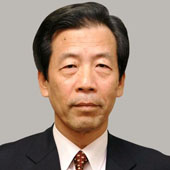
Hirofumi Hirano

Antibullying Guidelines Released/Designated Special Advisors to Provide Expert Advice on Handling Incidents

Jiji Press, The Daily Yomiuri Online (September 7, 2012)

In an effort to reduce bullying in schools, Japan’s education ministry has set guidelines for directly dealing with the issue. The ministry plans this month to seek aid from special advisors such as lawyers, former police officers and psychiatrists on how to “prevent and handle” bullying in schools. Moreover, the ministry has requested that its budget be increased to permit the allocation of more funds directed towards instituting programs to reduce bullying. They have requested an increase from about 2.7 billion yen from fiscal 2012 to about 7.3 billion yen for the next fiscal year. With the institution of the new budget, the ministry plans to direct the funds towards an increase in social workers and clinical psychologists available to public schools and victims.

Education minister Hirofumi Hirano said at a press conference Wednesday, “After serious cases in which students’ lives were at risk, we will face the issue directly and sincerely.”

To read more on this topic:

At Least 3,500 Bullying Cases Seen in Tokyo Schools

Bullied Student Gets Apology / School Recognizes Problem, but Victim Asked to Leave Over ‘Anxiety’

Suicide in Japanese Schools Must Stop

Norway

Marianne Aasen, photo: Arne Ove Bergo

Opening for student evaluation of teacher effectiveness (original article in Norwegian)

Espen Løkeland-Stai, Dagsagisven (September 15, 2012)

On Wednesday, September 19th, Norwegian Labour Party leader and head of the Education Committee in Parliament, Marianne Aasen, will propose a new teacher evaluation process that is systemic and standardized at the national level. Aasen will propose that evaluations of students decrease, while evaluations of teachers increase. In the end, she hopes the overall number of tests will be cut down.

Aasen believes these evaluations will need to be targeted and necessary, indicating that the current system suffers from varying quality of both the collection of data and the information that is actually used. They will also include student surveys of teacher performance.

Mimi Bjerkestrand photo: Linda Cartridge

Aasen, noting the current conflict at the heart of the teacher strikes in Chicago, does not want to introduce incentives such as teacher pay that is linked to student performance. She believes evaluations must be developed in consultation with teachers. Mimi Bjerkestrand, leader of Utdanningsforbundet (the Teachers Union), agrees. She sees the teaching situation as more complex and complicated than teacher performance, but believes that a thorough review is necessary. Bjerkestrand hopes the emphasis is on new information that will improve institutions, and not the rank and competition between schools.

For more information:

In 2004, Norway introduced the National Quality System (NKVS) for all schools.

Egypt

Back to school: Morsi gets black marks from Egypt’s teachers

Randa Ali, Ahram Online (September 10, 2012)

President Morsi

On Sunday, September 9, President Morsi approved a modification to state-employed teacher pay that allows teachers to receive 100 percent of their salary in bi-annual batches to be dispersed on October 2012 and January 2013. For some teachers, this means their salaries will double; however, many teachers believe the compensation remains incommensurate with their levels of experience. Additional demands include permanent positions for long-term temporary employees. There is some likelihood that this demand will be met on Monday, September 17, as temporary public workers are expected to be permanently hired by June 2013.

For more information, see the following links: Egyptians tell Morsi to keep election promises (PressTV)

Three protesters – ‘teachers’ full rights’ (Photo: Randa Ali)

Chile

Chilean students announce new protests demanding a better education

Ultima Hora (September 2, 2012)

“Education is sold”

Chilean university students announced today that they will mobilize once more during the second week of September. These student protests demand better quality of education and reject government intervention, such as the proposed tax reform. Students’ pleas for a restructuring of the Chilean education system have not been addressed by the Chilean government.

Chilean Gov Calls for an End to School Occupations

Gwynne Hogan, The Santiago Times (September 6, 2012)

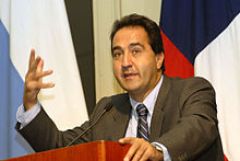
Santiago Mayor Pablo Zalaquett

Santiago Mayor Pablo Zalaquett and Education Minister Harald Beyer have responded to a month of student marches and occupations by calling for students to return to school when in opens, on September 20th: “We are making an appeal to the youth, we encourage them to fight for their right to quality education through peaceful marches and cultural acts, but they must stop missing school because there are not going to be special laws for them,” Zalaquett said. In 2011, 70,000 students were held back when the school system was paralyzed due to similar school occupations.

Australia

PM Pledge for Top Five School Spot

Michelle Grattan, The Age (September 7, 2012)

The Australian Prime Minister, Julia Gillard, announced a new school funding arrangment (dubbed the “Gonksi Plan”), promised to “legislate for a goal of having Australia in the top five schooling systems in the world by 2025.” By then, Gillard said that Australia should be among the top five nations in reading, science, and math, and be noted for the provision of high quality and equity education. Among other things, the Gonski funding plan recommended an extra $5 billion a year overall (in 2009 dollars) for school funding, and variables such as economic disadvantage, disability, school size and the particular needs of indigenous students.

For more information:

“PM Pledge for Top Five School Spot” (video clip)

In a panel discussion, presented by La Trobe University, Ideas and Society Program, May 2012, Carmen Lawrence, Richard Teese, Dennis Altman and (host) Lorraine Ling, discuss the Gonski Report and educational issues present in Australia today.

Experts respond to Gillard’s announcement.