Consequences of privatization

Dr. Henry Levin

Dr. Henry Levin

In response to our recent post on Sweden, Henry Levin shared “Evaluating Consequences of Educational Privatization: Ideas and consequences of market principles in education,” a power point presentation from a lecture that he gave at The Royal Swedish Academy of Sciences in Stockholm, Sweden, in March of 2013.

The presentation puts the Swedish experiences with privatization in a larger context by highlighting the many different approaches to privatization and discussing the different kinds of outcomes that may be worth taking into account. Thus, Levin points out that educational privatization can mean that schools have private funding; or that schools are operated privately by educational management organizations; or that private schools are afforded government funding, through vouchers or other means.  Even those approaches that use vouchers (such as Sweden since 1992; the Netherlands since 1917; Chile since 1980; and in US cities like Milwaukee since 1990 and Cleveland since 1995) can differ significantly in terms of how they are financed, their regulations/requirements, and the support services that are (and are not) provided.

Despite the fact that many privatization and voucher approaches have been around for some time, Levin argues that the evaluations are particularly difficult both because privatization has become a highly ideological and emotional issue and because there are a range of educational goals that should be taken into account (not just test scores). Levin suggests four criteria that should be taken into account for evaluating educational systems: 1. freedom to choose, 2. productive efficiency, 3. equity, 4. social cohesion. Levin also points out that there are trade-offs and conflicts amongst these different possible outcomes, as well as questions about which criteria deserve emphasis. Broadly, Levin suggests that the research indicates that while privatization increases school choice, it also increases social stratification, but there is little evidence yet on social cohesion. He concludes “we have made progress in understanding the consequences of educational privatization. But as we have expanded the circle of light, the perimeter of darkness has also grown.”


Creative Commons License
This work is licensed under a Creative Commons Attribution-NonCommercial-NoDerivatives 4.0 International License.

Interview with Carol Campbell


Dr. Carol Campbell

Dr. Carol Campbell

Carol Campbell is Associate Professor of Leadership and Educational Change at the Ontario Institute for Studies in Education (OISE), University of Toronto and Co-Director of the Knowledge Network for Applied Education Research (KNAER). Carol has international experience in bringing together evidence and strategies to advance policies and practices for higher quality and equity in education systems. This interview, which is part of the Lead the Change Series of the American Educational Research Association Educational Change Special Interest Group, appears as part of a series that features experts from around the globe, highlights promising research and practice, and offers expert insight on small- and large-scale educational change. Recently, Lead the Change has also published interviews with Diane Ravitch, and the contributors to Leading Educational Change: Global Issues, Challenges, and Lessons on Whole-System Reform (Teachers College Press, 2013) edited by Helen Janc Malone, have participated in a series of blogs from Education Week.

The broader context of school choice in Sweden

While Swedish education is not in the news nearly as often as it’s higher-performing neighbor, Finland, it only took a mention of school choice to launch a series of articles and blog posts on Sweden in the past few weeks. The original source was an article in Slate by Ray Fisman, provocatively titled “Sweden’s School Choice Disaster.” While few disputed the characterization of the Swedish education system as “in crisis” (with the decline in international test scores as the primary basis), critics, including Andrew Coulson (from the Cato Institute), Tino Sanandaji (from National Review Online), and Coulson again (responding to Sanandaji) were quick to point out flaws in the analysis linking that decline to Sweden’s approach to privatization of public schools and school choice. Those critiques, in particular, point out the problems with connecting in any direct way the effects of a particular policy amidst so many other educational and contextual factors.

Perhaps co-incidentally, the OECD recently released its own report on the Swedish education system – “Shifting responsibilities: 20 years of education devolution in Sweden” – that discusses the larger decentralization agenda that Sweden put in place the 1990’s. Rather than singling out the effects of school choice, that report discusses a number of factors – including the speed with which reforms were pursued, the lack of a systemic vision, and inadequate capacity for local authorities to carry out their new responsibilities – that may have played a role in Sweden’s educational performance.

To get another perspective on the Swedish education system, we talked with Sam Abrams, a research associate at the National Center for the Study of Privatization in Education at Teachers College. Abrams, who has written about the different path taken by Finland as well as the intensive use of technology by one for-profit Swedish school operator offering an alternative to conventional instruction, suggested that the problems highlighted in the OECD report derive from an impatience in Sweden for change. Providing a historical perspective, Abrams explained that the Swedes had been ruled by the Social Democratic Party from 1932 to 1976 and again from 1982 to 1991, leading to centralized authority and high taxation along with growing resistance from conservatives desiring laissez-faire policies. “Building on the rise of Margaret Thatcher and the fall of the Berlin Wall,” Abrams said, “the conservatives in Sweden swept to power in 1991 and implemented a host of market-based reforms, including a full-fledged voucher system for schools. Yet the passion for school privatization and choice outpaced practical concerns about maintaining academic standards, developing teachers, and preventing segregation.” Abrams, who is completing a book for Harvard University Press on international education reform, predicted the Swedes would soon rein in privatization and refocus their efforts at school improvement. As he put it, the Swedes have learned that teachers as well as students want choice, but that choice is no panacea.

All in all, while it’s clear that Sweden has pursued school choice and the educational system as a whole has not improved, understanding school choice and its effects in Sweden needs to take into account the historical, political, geographic, economic and cultural factors that influence the development of the education system and its outcomes. Even for countries like Denmark, Norway, Finland, and Sweden, which to outsiders may seem so similar, taken together these factors can generate remarkably different stories of educational development.

New OECD report leads to questions about educational innovation

While the OECD has released a number of reports this year, their most recent report addresses the measurement of educational innovation at the classroom and school levels. In this report, the OECD looked at “innovations” in education improvement strategy and ranked 19 countries accordingly. The report acknowledges that while the private sector has established innovation indicators derived from research and development (R&D) statistics and innovation surveys, the measurement of innovation and its effectiveness in the public sector is still in its infancy. Creating such measurements might be more difficult, as the report states that “cultural values, social policies and political goals can lead to differing prioritization of these different objectives across countries.” Innovation indicators will need to be linked to specific objectives, such as learning outcomes, if they are to be better understood.

Denmark came in first place, followed by Indonesia, Korea and the Netherlands. While I could not easily find news reports that focused on the high ranking of Korea, and the sole report I found on the Netherlands referred to parental concerns over a lack of educational innovation, multiple sources published reports that pointed to the near-bottom ranking of the US. Yet, even with the report citing a ‘dearth’ of innovation in the US, EdWeek has a feature article on the ways in which school principals in the US are increasingly acting like entrepreneurs and innovators in business.

Interestingly, as Pasi Sahlberg pointed out in his recent article in The Washington Post, Singapore, Hong Kong, South Korea, and Finland—all high performing countries—have sought out innovative ideas for education from the United States, where many such ideas are largely ignored by the country’s education reformers. So, not only is educational innovation difficult to measure for the ways in which the concept of innovation might be country-specific, as the OECD explained, it might also prove difficult to measure due to the ways in which innovative ideas can travel, as countries share and borrow ideas from one another. In his brief response to Sahlberg’s article, Howard Gardner pointed out that innovative ideas have a history of being co-opted, borrowed, and misunderstood. Further, he notes that it is a mistake to attribute these ideas to sole individuals, such as himself–for he was inspired by other scholars, and all scholars are influenced by the freedom or constrictions of the conditions in which they work. To that point, a recent study of Norwegian teachers, which aimed to study those conditions in which “newness is created,” showed that innovative work is brought into being when “pluralities of perspectives” are taken into account.

In The Washington Post, Valerie Strauss also questioned the meaning innovation by looking at the language used in the report. She notes that Hong Kong’s main innovation was “more peer evaluation of teachers in primary and secondary education”; Korea’s main innovation was “more peer evaluation of teachers in secondary education”; and Singapore’s main innovation was “more use of incentives for secondary teachers.” But is innovation a matter of degree? Reports such as this one raise questions about how we can measure concepts without a shared understanding of what those concepts mean. As the news report from Indonesia points out, even Indonesian education experts were surprised to see the country at the top of the list, especially when it has been ranked among the lowest performing countries in math and science on the 2013 OECD Pisa exam.

Deirdre Faughey

Creative Commons License
This work is licensed under a Creative Commons Attribution-NonCommercial-NoDerivatives 4.0 International License.

Singapore emphasizes 21st Century Competencies

In the wake of our posts on some of the current issues in education in Finland, we asked Paul Chua, Senior Teaching Fellow at the National Institute of Education, to let us know about some of the current discussions in Singapore.

Although Singapore was one of the highest-performing countries on the PISA Computer-Based Problem Solving test, a test meant to, amongst other things, measure students’ ability to think flexibly and creativity, Singapore’s Ministry of Education (MOE) took the opportunity to reiterate the rationale and approaches launched initially in 2010 to cultivate students’ 21st Century Competencies (21CC) .

In reiterating their approach, the MOE  continues to emphasize some of the features of their framework for 21CC that are shared with other countries, including creative and critical thinking, communication and collaboration, and social and cultural skills (see for example Soland et al. 2013, and Voogt & Roblin 2012). However, the MOE has also highlighted a unique connection to the core values that the Singapore education system hopes to cultivate in all its students. Instead of learning the 21st century competencies in a vacuum, in Singapore, the competencies are supposed to be learned in the context of core values, like respect, resilience, responsibility, and harmony. From the Ministry’s perspective, such an approach should remind educators in the classroom of the role that values play in education and help them to enable students to become the self-directed learners, confident people, concerned citizens and active contributors that are the desired outcomes of the Singapore education system.

The MOE’s reiteration also includes an update of their approaches to the delivery of the 21CC.  Rather than creating a separate subject called “21CC,” the Singaporean approach calls for the integration of 21CC into both the academic and the non-academic curricula, such as Character and Citizenship Education and Co-Curricular Activities. In order to support that integration, the MOE hopes to help teachers develop the capacity to deliver a 21CC-embedded curriculum through pre-service and in-service learning courses, as well as on-going collaborative teacher learning through professional learning communities. Schools are also to collaborate with community partners to augment the learning and teaching experience with more imaginative and authentic learning environments and programmes. Finally, while cultivating a school culture that values and promotes the delivery of the 21st century competencies is not mentioned explicitly, that concern is reflected in the Singaporean school quality assurance framework.

In recent years, the MOE has also introduced a slew of initiatives to better assure the effective delivery and attainment of the 21st century competencies. These include modifications to the assessment practices in the primary schools; introduction of more varied secondary schools landscape; tweaking of the direct secondary school admission criteria at the interface between primary and secondary school education; and re-alignment of the school self-assessment and recognition framework. First, modifications to the primary schools assessment, including the development of holistic assessments, were recommended by the Primary Education Review and Implementation (PERI) Committee. These modifications were intended to better balance the acquisition of knowledge with the development of skills and values. In addition, a review of the reporting of the scores of the primary school leaving examination is currently underway “to support a more holistic education for students … on equipping students with values, attributes, knowledge and skills for work and life in the 21st century.” (Heng, 2014a). Secondly, to create a more varied and colourful (secondary) school landscape to realize the vision that “every school a good school,” and thereby alleviate the parental pressure of getting their children admitted to schools with the best academic reputations, all (secondary) schools are being supported by the Ministry to develop distinctive and rich learning programmes through the Applied Learning Programmes (ALP) and Learning for Life Programmes (LLP). Many of these Learning Programmes are themselves focused on the development of students’ 21st century competencies. Third, the Direct (Secondary) School Admission scheme is being tweaked so that a greater range of non-academic attributes such as resilience, character and leadership are recognized and hence encouraged, and yet implemented without adding to the burden of assessment. Finally, the Ministry has re-aligned its school self-assessment and recognition scheme to reflect its desire to nurture “every school a good school.” The re-alignments have been made for the intent of “broadening our definitions of excellence” (Heng, 2014b), as well as to give schools “more space to design student-centric programmes … and to create distinctive schools, good in your own ways” (Heng, 2014b).

OECD measures financial literacy of students around the world

The OECD released the results of an exam that aimed to assess the financial literacy of students in Australia, Belgium (Flemish Community), Shanghai-China, Colombia, Croatia, Czech Republic, Estonia, France, Israel, Italy, Latvia, New Zealand, Poland, Russia, Slovak Republic, Slovenia, Spain and the United States. As we have done with other OECD test results, we conducted a search of international news reports on the results of this exam by country. Note that aside from the deluge of results from US media sources, Australia and New Zealand were two countries that reported extensively on the results  – with the Australian headlines distinctly contradictory. In general, much of the reporting focused on the fact that the majority of teenagers in the world don’t know enough about financial issues. The OECD noted that, similar to results on other OECD tests, student performance tends to fall along class lines, with “more socio-economically advantaged students scor[ing] much higher than less-advantaged students on average across participating OECD countries and economies.”

We also spoke with Anand Marri, Vice president and Head of Economic Education at the Federal Reserve Bank of New York, and Associate Professor at Teachers College Columbia University, about the results. He pointed out that the financial literacy of students likely reflects the financial literacy of teachers as well as other adults. Without a concerted effort to enable teachers to develop their financial literacy and to make financial literacy an explicit part of the curriculum, we should not expect many students to develop financial skills on their own. Yet in the United States, only 15 out of 50 states have graduation requirements related to personal literacy and the vast majority of social studies teachers have not taken more than one economics course. He also noted, as the OECD report pointed out, that financial literacy is highly correlated with performance in math and reading, but that it would be particularly interesting to know more about the teaching of financial literacy and the preparation of those who teach financial literacy in countries that score higher in financial literacy than their math and reading performance would predict (like Australia, the Czech Republic, Estonia, the Flemish Community of Belgium and New Zealand).

Australia 

Aus students lack financial literacy skills: OECD (www.ifa.com.au)

Disadvantaged youth have poor financial literacy – study (www.probonoaustralia.com.au)

Australian students get top marks for financial literacy (www.financialstandard.com.au)

Aussie teens show financial smarts (www.dailytelegraph.com.au)

Columbia

Columbian students last place Pisa financial literacy exam (www.colombiareports.co)

Central Eurpoe, Baltic countries:

Central European, Baltic Teens Score Well in OECD Financial Test (http://blogs.wsj.com)

Czech Republich

Czech teenagers rank sixth in international financial literacy survey (http://radio.cz/en)

Israel

Israeli teens get a failing grade for financial literacy (www.haaretz.com)

Italy

Italian teens can’t handle money: Report (www.thelocal.it)

Shanghai – China

Students in Shanghai score highest for financial literacy (Irish Times)  

Spain

Spanish 15-year-olds lack financial literacy proficiency (www.globalpost.com)

US

American Students score below average in financial literacy (www.forbes.com)

American teenagers outranked by Chinese in money smarts (www.cnn.com)

US Students fail to make the grade on financial literacy (www.time.com)

New Zealand  

Financial literacy depends on wealth (www.stuff.co.nz)

Pisa results shed the spotlight on financial literacy levels (http://www.scoop.co.nz)

Kiwi teens 5th best at managing money (www.3news.co.nz)

UK

Is the UK falling behind? OECD results underscore the importance of financial literacy for future growth (http://www.economicvoice.com)


The search for a more equitable education system in Chile

Recently, I spoke with Dr. Beatrice Avalos-Bevan, Associate Researcher at the Center for Advanced Research in Education, at the University of Chile, in order to follow-up on an earlier post about the recent reforms in Chile. In that post, we noted that reports on educational reforms in Chile made it seem that the country might be putting an end to private education. Diane Ravitch also commented on these reports and followed up with Mario Waissbluth. As we explained in our earlier post, while the country is not ending private education, President Michelle Bachelet aims to eliminate parental payments or co-funding of subsidized private schools and increase funding for all schools by implementing new education and tax reforms that would help pay for a more equitable education system.

In conversation with Dr. Avalos-Bevan, we spoke about the issues of educational inequality that have captured the attention of teachers and students, leading to the large and sometimes violent protests over the past decade. Beginning in 2006, protests were organized by secondary students during the first term of President Michelle Bachelet’s administration – a movement that came to be known as the “Penguin Revolution” (after the white shirts and dark jackets of students’ school uniforms). The protests became more numerous and violent during the following Sebastián Piñera administration. When Bachelet returned for a second term as President in 2014, she was elected on an education reform platform that was embraced by students and teachers, and she even brought some of the former student leaders in to work in her administration.

As Mario Waissbluth explained in our last post, the “first wave of legislation” was sent to Congress in May; however, students continue to be dissatisfied because initial actions did not consider as yet changes in the administration and improvement of municipal or public schools, although these have been announced for the second semester of this year. This has caused students and teachers to reconvene their street protests as a way to put pressure on the administration and call attention to their ongoing concerns this past June. Those protests ended with the use of tear gas on thousands of university students

School Funding and Student Protests

As Dr. Avalos-Bevan explained, in the current system there are public or municipal schools, subsidized private schools, and elite private schools. The concern over inequality stems from the fact that the subsidized private schools are able to collect money from the government while also charging tuition. As a result, these schools receive a level of funding that the public or municipal schools cannot attain. Over time, the student population attending public schools has been shrinking, as more families strive to place their children in well-resourced subsidized schools.

The student protests have honed in on school funding because the students personally experience the increasingly segregated school system and the differences in the quality of education provided by the public or municipal schools versus the subsidized private schools. They also pay attention to the country’s poor performance on international assessments, such as Pisa and TIMSS, and attribute it to the flaws they see in the system.

Dr. Avalos-Bevan explained that in order to create a more equitable system, all schools need to receive a higher amount of government funding. For this reason, President Bachelet has suggested increasing taxes by 3% of gross domestic product, and increasing the corporate tax rate to 25% (up from 20%). President Bachelet will also stop funding of current private subsidized schools that operate on a for-profit basis, making all subsidized primary and secondary education free, creating more universities and increasing kindergarten funding and pre-K institutions.

Quality and Teacher Education

Colegio de Profesores, the largest teachers’ union in Chile, joined the student effort and held a strike last month to protest President Bachelet’s reform efforts, which they say don’t go far enough to address the fundamental issues of inequality that plague Chilean schools. Despite what some have seen as indicators of significant reform, others are concerned that the process has not encouraged “adequate public participation in the bill-writing process.”

In addition to refining school funding in Chilean schools, Dr. Avalos-Bevan says that there is a similar problem with private universities and the teacher preparation programs they have created. In the years between 2004-2010, private colleges have increased and are now being criticized for what many identify as an increase in profits without sufficient evidence of quality education. These institutions are known to admit students to their teacher education programs with very low qualifications, who graduate without adequate skills. According to Dr. Avalos-Bevan, the government has created a test (the Prueba Inicia, or Start Test) that aims to assess the students’ content knowledge as they leave university, but the test is currently administered on a voluntary basis. Therefore, many teachers graduate without taking this assessment. Of the few who take this test, many perform poorly.

Despite this issue of teacher education, Dr. Avalos-Bevan believes the main problem has to do with teachers’ working conditions. Salaries are low compared with those who enter professions that require the same level of education (4-5 years), and 75% of a teacher’s contract time has to be spent teaching in the classroom (27 hours per week, which is the highest of all OECD countries, according to the latest TALIS survey), leaving little time for planning, grading, and meeting with other teachers. Dr. Avalos-Bevan would like to see the establishment of a teaching career, with specifications as to how teachers may progress, what kinds of salaries they may achieve, and paths for them to move into other positions in the education system. Currently, there is a strong civil society movement pushing for changes in this direction that expects to propose a plan for the President to consider.

Deirdre Faughey

TALIS Survey

“Most teachers work ‘largely in isolation’ and do not engage in the collaboration with colleagues that could make their teaching much more effective,” claims a report based on the latest Teaching and Learning International Survey (TALIS). TALIS questioned more than 100,000 lower-secondary teachers in 34 countries, and while the results have not drawn as much attention as the 2013 PISA results, media in several parts of the world have picked up on the release of the TALIS data.

Denmark, http://www.folkeskolen.dk/

Danish teachers have much less training than the rest of the OECD (link in Danish)

 France, Le Figaro

French teachers insufficiently trained and evaluated during their career (link in French) 

Italy, Il Giornale D’Italia

The older teachers? In Italy (link in Italian)

IsraelThe Jerusalem Post

Average Israeli middle school teacher is middle aged female, satisfied with job

“The average Israeli middle school teacher is a middle aged woman who is for the most part satisfied with her chosen profession, the National Authority for Measurement and Evaluation in Education said on Wednesday, citing the results of the Organizations for Economic Co-operation and Development’s Teaching and Learning International Survey.”

JapanThe Japan Times

Japanese teachers work longest hours among OECD members

“Japanese teachers work an average of 53.9 hours per week, the highest figure among the OECD’s 34 member countries. The figure for Japan was well above the average of 38.3 hours among OECD members, according to the Teaching and Learning International Survey, which Japan participated in for the first time.”

Malaysiawww.malaysiandigest.com (with video)

Malaysian Teachers Spend 29pc Of Their Time On Admin Work, Says Study

“Malaysian teachers only spend on average 71 per cent of their working time on actual teaching and learning, while the rest of their time is occupied by administrative tasks and keeping order in the classroom.In comparison, the average teaching and learning time of the 33 countries surveyed in the global poll Teaching and Learning International Survey (Talis) 2013 was 78.7 per cent.”

Mexico, http://www.am.com.mx

Mexico designated by violence in secondary (link in Spanish)

Netherlands, http://www.nltimes.nl

Teachers happier in NL than elsewhere

“Results revealed that on average, Dutch teachers are happy with their work and more satisfied then the majority of their foreign colleagues. In The Netherlands, teachers take five hours for weekly class preparation, compared to an international average of seven. TALIS also found high levels of teaching co-operation occurring the The Netherlands, with over 50% of principles reporting that they rarely need to take steps to support co-operation. Dutch teachers were also reported to actively take extra training to improve in their field, and enjoy high levels of job growth.”

Poland, The News/Polskie Radio (audio clip)

TALIS report shows Polish teachers have excellent education but lack competences required by present day school challenges.

Singapore, Channel News Asia

Teachers in Singapore are the youngest, but among the best-trained worldwide: Survey

“Singapore has the youngest teaching force among the countries surveyed, with an average age of 36 – seven years below the global average is 43, according to TALIS. ‘We have a relatively younger teaching force due to the significant increase in the number of teachers in recent years. The younger teachers complement the depth and expertise of more experienced teachers who continue to be valued, and who provide professional support and mentoring for the Beginning Teachers,’ the Ministry of Education said in a statement.”

Spain, Libertad Digital

Why are Spanish teachers rated so poorly? (link in Spanish)

SwedenThe Local

Swedish teachers feel least valued: OECD

“The Teacher and Learning International Survey (TALIS) asked teachers in OECD countries about their views on their jobs. Sweden landed at the very bottom when it came to rating a career in teaching. Only France and Slovakia had worse results. Only one in twenty Swedish teachers thinks that their profession is appreciated in Sweden.”

UK, Education Media Centre

OECD TALIS authors comment on the experience of England’s teachers (audio)


Educational change in Finland?

Now that I’m back after three weeks in Finland sponsored by the Fulbright Specialist Program, the Fulbright Center in Finland, and the University of Helsinki, a few other aspects of the Finnish educational system stand out.

Social connections, common experiences, and common resources may support coherence amongst “autonomous” individuals

On the whole, our visit highlighted some of the ways in which the strengths of the Finnish education system go far beyond a focus on “human capital” and include attention to “technical capital” and “social capital” as well. Thus, Finnish teachers benefit from what are generally considered to be strong textbooks, instructional materials and assessments that are linked to the national core-curriculum and from social connections that support sharing of information, coordination of activities, and the development of shared understanding across different parts of the education system.

While teachers have considerable autonomy at the classroom and school level, these social connections and several mechanisms that support the coordination of teachers’ activities with others may be particularly valuable. For example, as Helena Thuneberg and colleagues explain, special education is seen as a service for all students and as a collective responsibility of the school. As a consequence, classroom teachers often work with special education teachers in their own classrooms, and each classroom teacher periodically meets with a school welfare teams help to coordinate the work of special education throughout each school (Tim Walker, currently teaching in a Finnish school has described the sense of “shared responsibility” he experienced as part of these meetings). Working groups that are part of the curriculum renewal process also bring teachers together across regions and the country as a whole in a joint enterprise on a periodic basis. In addition, these kinds of working groups of teachers regularly include teacher educators, researchers, school leaders, policymakers, and, in some cases, text book publishers who join together in spirit of trust and collaboration. Notably, many of the members of these other groups have themselves spent time teaching (and, relatedly, going through and graduating from a teacher education program).   The result may be a system with more extensive informal social connections amongst well-prepared educators who share common experiences and rely on a small set of relatively good resources to reach common goals.

The Finnish system has changed (in some ways) over time

The “autonomy” of the current Finnish system only emerged after a highly centralized effort to create the 1-9th grade comprehensive school in the 1970’s. That effort included a required curriculum, massive re-training of teachers, inspection of schools to make sure the curriculum was being followed, and even inspection of textbooks to make sure they were aligned with the curriculum. Since that time, Finland has pursued a number of important reforms, including the development of the core curriculum, the abolition of inspections, and the development of a more inclusive approach to special education. At the same time, Finnish pedagogy is often described as fairly conservative and traditional, and there are concerns about recent declines on international (as well as on recent local and national) assessments. Sorting out which aspects of the system might have contributed to high international test scores and which might be contributing to a recent decline is no simple matter. For example, even the social connections and coherence of the system may reinforce the traditional pedagogy that could make it difficult to respond to changing populations, to take advantage of new technologies, or to support more active student engagement.

Even a system that “works” may need a new approach to change

One of my last meetings in Helsinki was with our hosts Leena Krokfors and Auli Toom and the members of the OmniSchool Project, a group that was asked by the Finnish Ministry of Education to help open schools up to more active learning opportunities for students inside the classroom, outside in the community, and online as well. In many ways, they are trying to reach the same goals that many educational reformers in the US are trying to reach, but the circumstances and conditions in Finland are different. With a relatively successful, coherent system, why should a well-regarded group of autonomous professionals change their pedagogy? Our discussions outlined three different approaches to change that highlight in some ways both the challenges and opportunities for making system-wide improvements in teaching and learning in Finland:

The “within-school” approach

This approach to change (familiar to many in the US and around the world), takes the school as the unit of change and often engages small groups of teachers in developing and piloting new practices. Ideally, those teachers will share what they are doing and learning with others (either informally or formally through “turnkey” professional development), and, eventually, when enough individuals get involved, a tipping point will be reached, and the new practices will spread throughout the school. In Finland, however, the autonomy of teachers (in their teaching and in their choices of professional development), the lack of any school-wide mechanism for collective professional development in many schools, and the lack of obvious rewards for changing instructional practice suggest this may be a difficult task. Furthermore, even if such an approach succeeds in a particular school, the whole process has to be repeated to try to spread the practices beyond the walls of individual schools to the system as a whole. (For a related analysis of the problems with such an approach in a US context, see Richard Elmore’s “Getting to scale with new educational practice.”)

The across schools approach

This approach strives to connect teachers across schools and to make the development of professional networks (as has been championed by Ann Lieberman and many others) a key lever for change. Such an approach may be particularly appealing in Finland, as it builds on a history of networks in which schools and municipalities have participated. Furthermore, this approach could build on the traditions, experiences and practices of the working groups that come together as part of the curriculum renewal process. Thus, rather than trying to create a new mechanism for change at the school-level, an across schools approach can take advantage of this existing mechanism for bringing usually autonomous teachers together in a spirit of national service and collective responsibility. Such working groups, however, still need to figure out how to develop “new” pedagogical practices within existing classroom and school structures and a “grammar of schooling” that, as David Tyack and Larry Cuban have argued, reinforces traditional instruction.

The “beyond-the-schools” approach

A third approach might try to find more advantageous conditions for developing new kinds of learning arrangements by going beyond schools to build on learning opportunities in afterschool programs, museums, online spaces and elsewhere. In most countries, such an approach is limited either because it is so difficult for practices developed outside of schools to penetrate the regular classroom (because of the “grammar of schooling” etc.) or because outside of school time has already been consumed by tutoring, cramming, homework, studying, and other school-directed activities. In Finland, where children spend much less time in school than they do in places like the US (particularly at the primary school level as our children found out), there may be substantial opportunities to engage students in new kinds of learning activities that do not have to conform to traditional instructional models. One could imagine this approach as including a couple of hours of traditional instruction in the morning and then time for a series of afterschool clubs, activities, hobbies, sports, and projects in the afternoon. Thus, classroom practice in school does not necessarily have to change, though it might eventually as students and then teachers and perhaps even teacher educators have more and more opportunities to experience alternate modes of learning. Furthermore, strengthening learning opportunities for all students outside of schools might also help to deal with the ways in which out-of-school experiences contribute to the inequities that the whole Finnish system seeks to address. Challenges to this approach include difficulties coordinating an enterprise that’s distributed across communities and online spaces and concerns about consuming and “curricularizing” students’ free time. In Finland in particular, the value placed on providing children with ample time for play and recreation and for encouraging even relatively young children to take responsibility for their own activities might pose a particular obstacle. As a consequence, the success of this approach may depend on developing learning opportunities that children themselves can organize and direct.

Thomas Hatch


The Finnish Core Curriculum Renewal

While we’ve been in Finland these past two weeks, we’ve been learning about the “renewal” of the Finnish Core Curriculum. In a recent post for Diane Ravitch, Pasi Sahlberg gave a Finnish perspective on some of the similarities and differences between this core curriculum and that of the Common Core in the US. As U.S. educators who have been studying teacher education and school improvement efforts in a number of countries including Finland, we are finding several other aspects of the renewal process particularly interesting.

The “Core Curriculum” is not really a curriculum

As others have noted, the Finnish core curriculum for basic education (grades 1-9) is better understood as a kind of ‘framework’ that guides curriculum and instruction—rather than a strict and specific scope and sequence of topics and skills that must be taught. Less well known perhaps is the fact that the demands of the core curriculum go far beyond specifying the objectives in school subjects. In fact, the core curriculum requires (among other things) that the curriculum developed by municipalities and schools reflects the underlying values of Finnish basic education (“human rights, equality, democracy, natural diversity, preservation of environmental viability, and the endorsement of multiculturalism”); describes the main features of a school’s “working culture”; specifies criteria for grading and for final exams in ninth grade (the end of Finnish basic education); establishes objectives for pupil behavior; dictates that parents’ and guardians should be able to have an influence on local education objectives; and requires the drafting of the local curriculum in collaboration with those involved in municipal social and health services.

The Finnish core curriculum has evolved over time

While we were initially told that the core curriculum is revised or “renewed” every 10 years, we’ve found that there is no hard and fast rule about this (in contrast to Singapore, for example, where the curriculum for each subject is revisited on a regular schedule). However, periodic debates about education have initiated revisions in the curriculum in 1985, 1994, in 2004, and today. Each time the process and outcomes have been somewhat different, calibrated it seems to provide tighter control at some points and more flexibility in others (see Karl Weick and others on tight and loose coupling).

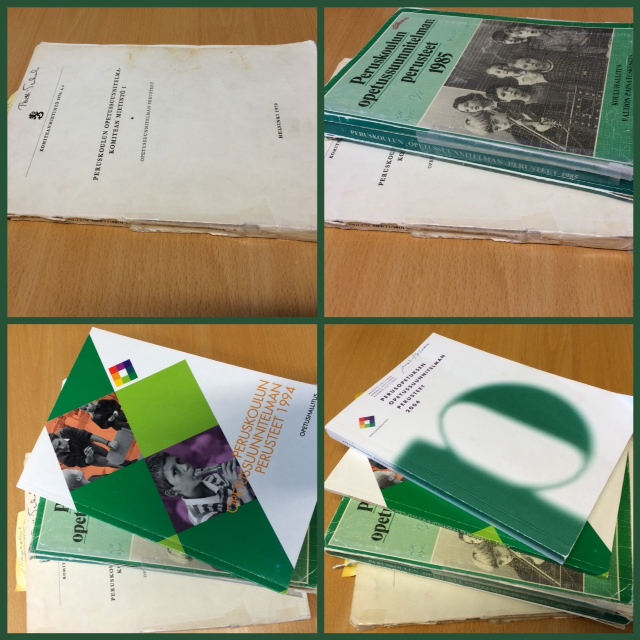
Diptic-2In the 1970’s for example, the entire nation was engaged in the development of the Finnish basic education system and a Finnish national curriculum specifying what was to be taught in each subject and at each level was created. (In fact, the accompanying picture of the original curriculum of the 1970’s only includes the first section, a thicker volume includes the curriculum for each subject). Almost immediately, however, discussions about the need for local flexibility began, and the first revision in 1985 created the first “core curriculum.” The core curriculum was somewhat thinner, providing guidelines, objectives, and content for school subjects, and granting municipalities primary responsibility for developing their own curricula. In the 1990’s, in an era of decentralization, the core curriculum became even thinner as guidelines were reduced further and power to draw up local curricula in many municipalities was delegated to schools. But by the early 2000’s (notably just before the first PISA results were released), there were concerns in Finland about a lack of consistency across schools and about a lack of support and specificity from some municipalities (particularly smaller municipalities that had very limited staff to work on the curriculum). Those concerns contributed to an expansion of the national guidelines in 2004 that specified some of the criteria that teachers and schools had to use to assess students’ performance. In the current renewal, some the initial discussions of changes have focused on the kind of teaching teachers can do to promote learning and on broadening the conception of good teaching beyond ‘traditional’ desk learning to include a variety of active, constructivist and research-based strategies; but whether the core curriculum will be thinner or thicker, “tighter” or “looser,” remains to be seen.

The process for developing the core curriculum may be as important as the outcome

Although the process for developing the core curriculum has evolved over time, particularly in the last two renewal cycles there has been extensive involvement of key education stakeholders from the very beginning of the discussions. Thus, numerous “curriculum groups” have been at work developing the guidelines and objectives in each subject and aspect of the core curriculum. Teachers are at the center of these committees, though the committees also include school leaders, municipal administrators, teacher educators, and researchers among others (and many of those other representatives have themselves been teachers at some point in time). In addition, an advisory board overseeing the whole process includes a cross-section of representatives of teachers, school leaders, parents, students, textbook publishers, researchers, teacher educators, ethnic groups (for instance representatives of the Sami people), and municipalities.

In past revision cycles, there were opportunities available to give feedback to the draft curriculum before it was formally adopted. However, this particular revision has been the most “open” of all. Surveys have been sent to all the municipalities so that they can share their responses to initial drafts; municipalities and schools have been encouraged to share and discuss the initial proposals with parents and students; and initial drafts of the curriculum have been made available online so that anyone who wants to can provide feedback. That feedback has already come from numerous individuals as from more than 200 different organizations representing many aspects of Finnish society. Members of the committees are looking at that feedback as they make revisions. The feedback addresses the broad objectives as well as the specific language used. (For example, the use of the word “tolerance” in an early draft’s discussion of diversity and culture was changed because of feedback that it conveyed a limited sense of acceptance, rather than mutual respect and understanding.) Interestingly, those we talked to who have been involved in the process also report that there are widespread concerns about financing and the ability of schools and municipalities to adopt the new guidelines. In turn, these concerns are contributing to calls from some in the field for more detailed guidance from the national authorities. In the end, the curriculum groups will make the proposals for the new guidelines and the leaders of the National Board of Education will make the final decision.

The process builds shared understanding and collective responsibility

Of course, such an open process can be unwieldy, but the wide engagement of teachers, leaders, teacher educators, textbook publishers, researchers, parents, students and others in the process creates social connections that facilitate the sharing of information and knowledge about the changes long before those changes are actually made. In fact, the working committees and feedback process has been going on since about 2012, well before the new core curriculum is scheduled to be adopted this year and long before the required development of new local curriculum in 2016. That means that those who are involved in supporting the work of teachers and students—like teacher educators and textbook publishers—are already getting a sense of where the revisions are heading and what kinds of changes they will need to make so that the whole system is “ready” at the introduction of the new local curriculum.

More than a mere adjustment to ensure the system is “aligned”, however, the curriculum renewal process can also be seen as an extension of the crucial, collective, nation-building effort that Finland launched in the 1970’s to create the basic education system. Curriculum renewal in Finland provides an opportunity for those all across the country to re-commit themselves to a national enterprise and to develop the shared responsibility for carrying it out.

— Tom Hatch & Karen Hammerness