Tag Archives: ai

What do innovative schools in China look like? Stability & change in the education system in China (Part 1)

Can China reduce the pressures of the national exams that dictate which students get into top universities? Is it possible to maintain a strong academic focus and expand support for student-centered learning and students’ overall wellbeing at the same time? Thomas Hatch explored these questions during interviews with Chinese educators and visits to schools and universities in Beijing, Ningbo, and Dongguan, Shanghai, Nanjing, and Suzhuo in 2024 and 2025. Over the next few weeks, Hatch shares some of what he learned from those experiences. In the first post in this series, he describes the niches of possibility” both inside and outside the school day in China where the conditions can support more student-centered learning. In subsequent posts, he discusses changes in education policies, educational technology and AI, and other societal conditions that both support and challenge the development of a more balanced education system.  

For previous posts on education and educational change in China see “Boundless Learning in an Early Childhood Center in Shenzen, China;” ”Supporting healthy development of rural children in China: The Sunshine Kindergartens of the Beijing Western Sunshine Rural Development Foundation;” The Recent Development of Innovative Schools in China – An Interview with Zhe Zhang (Part 1& Part 2);” “The Desire for Innovation is Always There: A Conversation with Yong Zhao on the Evolution of the Chinese Education System (Part 1& Part 2);” Beyond Fear: Yinuo Li On What It Takes To Create New Schools (Part 1);” “Everyone is a volcano: Yinuo Li On What It Takes To Create A New School (Part 2);” “Surprise, Controversy, and the “Double Reduction Policy” in China;” ”Launching a New School in China: An Interview with Wen Chen from Moonshot Academy;” and ”New Gaokao in Zhejiang China: Carrying on with Challenges.”


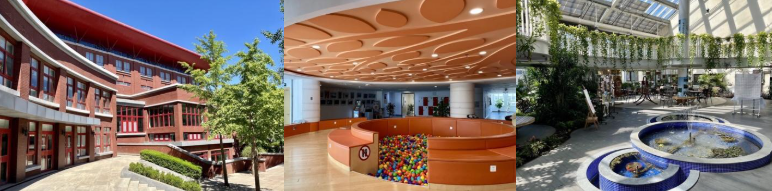
The schools I visited in China were stunning. They were elite schools – public, private, and international – in major cities like Beijing, Shanghai, Ningbo, and Dongguan. Each school had tremendous resources far beyond what a typical school in China might have. What’s more, these schools had facilities that rivaled – or surpassed – those of any of the top schools I have visited in the US, Finland, and Singapore. These schools in China are still focused on conventional academics and on preparing students for exams and college admissions, but they are also developing a variety of student-centered, “hands-on,” and collaborative, learning experiences that offer more opportunities for students to pursue their own interests and support their wellbeing. In that sense, they are not that different from the top public and private schools in the US and around the world that are trying to implement some innovative and engaging educational approaches at the same time that they continue to prepare their students for entrance into top local and international universities. But my visits and my conversations with Chinese educators revealed strikingly different assumptions about innovation and educational change. In the US, the “innovators” I talk to are often seeking to “revolutionize” education and transform almost every aspect of schooling. In contrast, in China, innovative educators often emphasize a more incremental approach to school improvement. That approach aims to integrate a traditional focus on academic knowledge with more progressive pedagogies designed to support the development of the whole person and to foster a wider range of abilities like creativity and critical thinking.

I saw this kind of hybrid approach at almost every one of the elite schools I visited in China (as well in other schools in Asia like the Olympia School in Hanoi). Moonshot Academy, a private K-12 school launched in 2017 in Beijing, offers an education “rooted in China and oriented to the world;” the HD schools, a network of private bilingual schools with campuses in four major cities, describes their approach as striving to “foster a global perspective and integrates the best of Chinese and Western culture to develop the talents of the children it serves.” also reflects this hybrid approach. Wenping Li, formerly principal at Tsinghua University High School and a founding member and head of the Tsinglan School, a private bilingual international school, in Dongguan described Tsinglan’s approach as an “integration of Chinese and Western education, rooted in China with Tsinghua Characteristics.“ These schools, as well as a number of others I learned about, show how to create time and space to pursue more student-centered and hands-on activities, even in a system with intense academic pressure such as China’s.  

“Niches of Possibility” for Student-Centered Learning in China

Although student-centered learning activities are in some sense “countercultural” in Chinese schools (as well as in many other systems around the world), these kinds of activities do not have to be forced into the schedule to replace conventional instruction or to take time away from academic subjects. Some schools in China are finding and creating what I call “niches of possibility” where the conditions are more amenable for more student-centered learning and supporting the development of a wider range of abilities. In the process, the schools are taking advantage of places both inside and outside the regular school day where students can pursue projects and other collaborative inquiries and activities in some core courses and elective classes, extra-curricular programs, summer camps, field trips, competitions, school improvement projects, cultural celebrations and festivals.

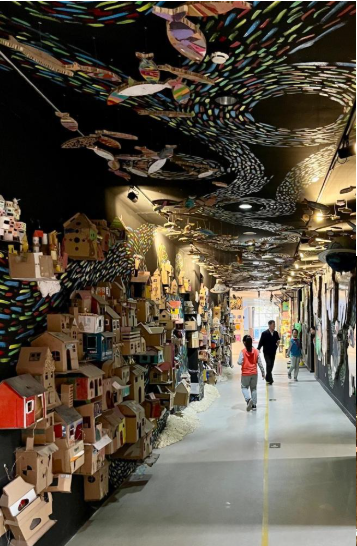
The hallways of E-Town Primary School

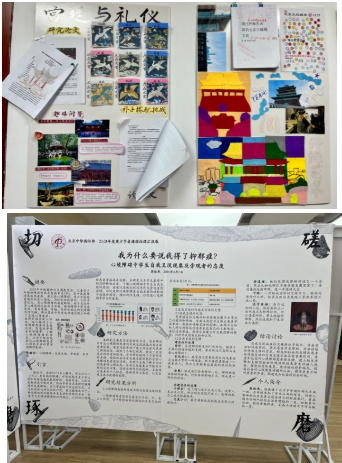
In the primary schools I visited, the attention to student-centered learning, critical thinking and creativity was evident in “signature projects.”  In these projects, students worked for several weeks to solve a problem or design a product related to a particular theme or issue. Sometimes all grades and classes would focus on a broad theme like sustainability, but in most schools each grade took up a different theme like water or the seasons designed explicitly to fit the students’ interests and development levels. At the E-Town Experimental Primary School, a public school in the Beijing National Day School network, the products from these projects include cardboard houses and origami creatures that the students designed and constructed. These and other products spill out of their classrooms, taking over the hallways and serving as visible representations of the school’s philosophy and interdisciplinary approach.

At the middle school level, the student-centered projects often focused on a specific problem or issue in the local community. Students in an interdisciplinary global studies course at the HD middle school in Ningbo, for example, developed products to enhance the history and culture of their city, just south of Shanghai, the oldest and now second-largest port in China. The project, like many of the high school projects I observed, followed a design-based thinking process that included researching the history of the port and developing an understanding of the kinds of products and services that might help support tourism in Ningbo. Building on what they learned, one group of students designed souvenirs incorporating a new symbol they created to represent the city. In the process, the students not only learned about the design and manufacturing process, they also learned how to deal with a crisis caused by an unscrupulous factory owner who failed to deliver the souvenirs they had paid him to produce. Another group scripted, filmed, and edited a video to celebrate the port city, but only after having to convince city officials and security guards to fly their drone over the harbor. 

The high school facilities at the Beijing National Day School

The high schools I visited certainly emphasized preparation for college entrance exams, but students can also engage in many different self-directed, interest-based, and project-based activities. The Beijing National Day School is well-known both for the success of its graduates and for its innovative educational approach and personalized curriculum system. Encompassing both a public school that prepares students for the Gaokao and a private international school preparing students for colleges outside China, BNDS offers 327 Subject Courses, 29 Exploratory Activities, 164 Career Exploration options, and 172 Student Societies. As one teacher at the school described it, “If there are 1,000 students, then there are 1,000 different course timetables.” Although alternative schools in many contexts, often develop outside of or on the margins of conventional systems, BNDS developed their model as part of a pilot program supported by the Ministry of Education, and it has been recognized publicly for its success through awards like a 2014 designation as the only “Flagship Public School in Beijing for Comprehensive Educational Innovation.” BNDS has now expanded its approach in a network of more than thirty schools in Beijing and other areas

Other high schools I visited, such as Beijing City Academy, created a variety of inter-disciplinary courses, including research and design courses where students can develop and carry out investigations of issues of special interest to them as a regular part of their schedule. At the HD Schools network’s Ningbo High School, 9th and 10th graders can enroll in a two-year long course sequence to learn design thinking and to prepare to carry out their own research and action projects as 11th and 12th graders. Illustrating the kinds of projects I observed at many of the schools I visited, at the Shanghai Shangde Experimental School, I witnessed presentations of projects that included the design of an “anti-tipping” device to prevent classmates from tipping too far back in their chairs; a “proof” that used that used Godel’s incompleteness theorems to show that AI cannot replace human judgement in legal decisions; and the production of a competition-winning remote-controlled race car.  

As a result of these developments, even with most classes devoted to conventional academics, students at these schools now encounter repeated opportunities to engage in projects throughout their K-12 experience. At the Tsinglan school, those opportunities include, at the kindergarten level, an investigation of their community that results in the development of a brochure introducing new teachers to local resources and sites; science fair projects in primary school; a 5th grade service project linked to the UN’s Sustainable Goals; end-of-the-year capstone projects in 6th and 7th grade and a culminating “passion project” in 8th grade. Although the emphasis on preparation for college ramps up at Tsinglan’s high school, students can also participate in a “project-period” (after AP exams and other tests have been completed in May) in which they develop a research project in a subject of interest and complete it with some guidance from a mentor. 

Research projects from City Academy

Creating supports and incentives for student-centered learning 

The schools have also found ways to demonstrate the value of innovative educational activities by connecting student-centered activities to field trips and cultural explorations and competitions, cultural celebrations and longstanding Chinese values and traditions.  These strategic moves help to create more supportive conditions for developing a “hybrid” system combining key elements of Chinese and Western educational approaches.

 Field trips 

Beijing City Academy has embedded research and design projects in an extensive set of field trips where the trips themselves provide students with the rewards for their hard work. These efforts began with a one-day trip to a local site and then a two-day camping trip for the 4th grade students. Building on the initial success and popularity of those projects, the trips have now grown to include a week-long cultural exploration of Beijing for students at many different levels, and, for older students, a three week-long cultural exploration of a site somewhere in China. Those extended trips generally involve a week for the students to prepare; roughly a week for the visit; and a week of activities in which the students follow-up and reflect on the experience. These trips usually culminate in performances and presentations where the students shared what they learned (and demonstrate the value of the trips) to their peers, parents and teachers. Notably, the high school students can also elect to work with their teachers in designing and organizing the trips, including booking hotels, arranging transportation, and taking care of other trip logistics.  

Cultural festivals, community-wide celebrations, and competitions

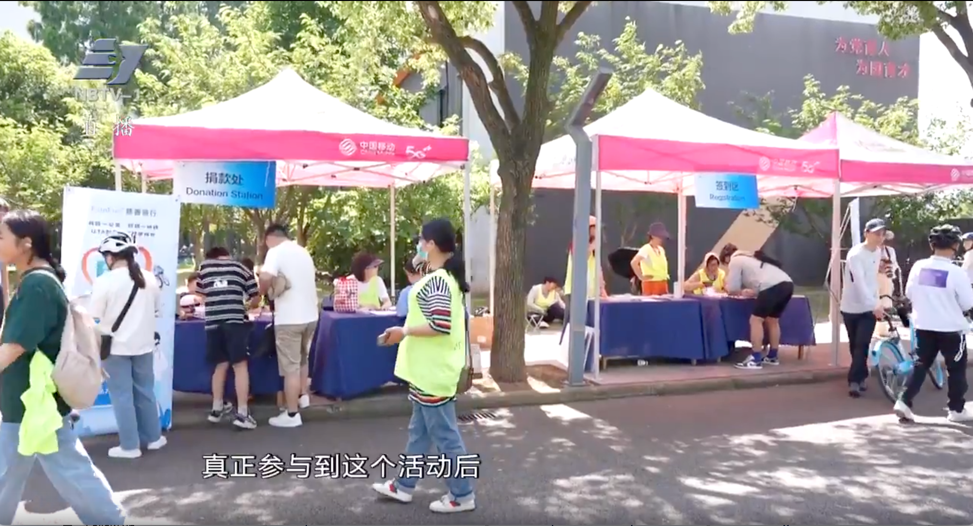
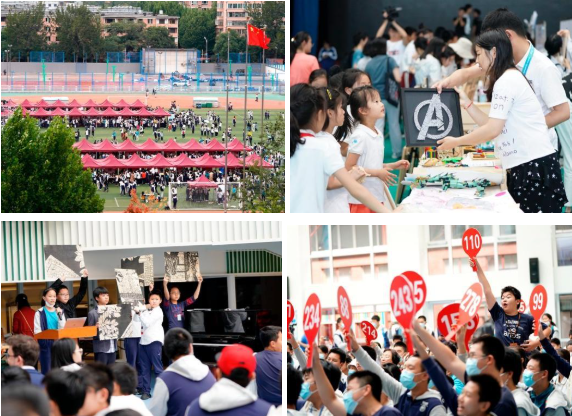
The schools I visited also take advantage of holidays, cultural celebrations, and community-wide events to provide a meaningful context for students to pursue projects, make presentations, and create performances. At BNDS, for example, one teacher in a Chinese literature class engaged her 7th & 8th grade students in a project to learn about “coming-of-age” ceremonies in different communities. In the project, students researched youth development and related ceremonies; wrote reports on what they learned; and produced “flash talks” in which they summarized their reports in 1-minute speeches. The class voted to determine the best speeches, and then the winning students performed their speeches at a ceremony in front of the whole school. At the HD School in Ningbo, middle school students organized a “Cyclathon” to raise money for a local children’s hospital. That event, like other public events at the school, provided opportunities for students to set up booths to sell products they had made and to share performances they had been working on at the same time that they gave members of the wider school community the opportunity to see the value of these student-centered activities

The HD School “Cyclathon,” covered in a local news broadcast

Similarly, at BNDS, every year on the Friday after the college entrance exam, students participate in the “Red Window Fair,” a community wide festival in which students present and share their learning results and sell products to interested teachers and schoolmates. According to the school, the products “can be derived from students’ personal interests, community activities or courses,” and “the purpose of the Red Window Fair is to drive learning motivation from the end of the course chain, improve the implementation of courses, and stimulate students’ internal motivation.” Reflecting the interest in competitions, students vie to be one of the “top ten sellers or even the sales champion” (who will be recognized at the Fair’s opening ceremony the following year), and the students can also participate in the “fierce competition of the auction.”

Many of the schools I visited also encouraged students to participate in a broad range of electives and extra-curricular programs and activities by embedding projects in contests and connecting more student-centered activities to national and international competitions in areas like robotics, debating, and sustainability. Although contests and competitions do create more pressures for students, they are also consistent with the long history of imperial exams and rankings, and they result in highly valued awards and rewards recognized in the college admissions process and by parents and the public more generally. 

Challenges for expanding student-centered learning in China

Pushing the boundaries of conventional instruction in any system is not easy.  Illustrating the challenges, one of the most innovative schools I visited in 2024, the Etu School, a private school in Beijing has faced financial and regulatory challenges that by the end of 2025 threatened to close the school. Furthermore, even if a few schools can create more innovative learning experiences, there is no guarantee that those innovations will spread across the system. Isolated successes do not necessarily lead to system-wide change, particularly when the successes depend on considerable resources and unusual conditions. 

Given the pressures and prevailing conditions, will most schools in China — just like schools in the US and around the world — find it easier to focus on the “innovative” activities that fit into the conventional system with the least disruptions? Schools might adopt just one project period or field trip or cultural experience or celebration (after exams are over) without creating a better balance between conventional and more student-centered activities. What’s more, concerns about the quality of public performances and products and the desire to win competitions might also encourage teachers and parents to dive in and take over or to try to “game the system” to ensure that their child, class or school produces the “best” project-based results. As with any “hybrid,” even innovative activities may become more conventional over time. In the process, projects and other “innovative” educational activities can find a place in the regular school day without disturbing many other aspects of conventional schooling. Under these conditions, expanding the work of innovative schools and taking advantage of the niches of possibility for supporting student-centered learning will depend on changes in many other institutions and the larger society as well. 

Next week: Can changes in education policies create flexibility in schools without increasing academic pressure? Stability & change in the education system in China (Part 2)

AI, Cellphones, Literacy, Students’ Mental Health, Political Turmoil and More: Scanning the Headlines for the Top Education Stories for 2025

IEN’s annual roundup of year-end reviews of top education stories and issues includes discussions of “tectonic” shifts in education related to AI and the actions of the current administration in the US as well as continuing concerns like the use of cellphones in schools, chronic absenteeism, learning loss, and students’ mental health. Here at IEN, major changes also include our exploration of ways to use AI to help us find and share articles related to educational policy, practice, and improvement around the world. Some of those results are included below. Next week’s post will focus on news and media stories discussing predictions and anticipated issues and trends for 2026. To see how education in 2025 compared to previous years, see the end-of-the-year scans for 202420232022202120202019 part 1, and 2019 part 2

Around the world 

The top 15 Education for All blogs of 2025, GPE

The ‘quiet’ revolution in schools: more and more countries are locking up phones – Part 1, World Education Blog

Are phone bans working? Part 2, World Education Blog 

Singapore: The top stories for education in 2025, Straits Times

End of UGC, two board exams and global campuses: How education in India changed in 2025, The Indian Express 

In 2025, Nigeria’s education sector experienced many reforms, challenges, Premium Times

Ghana: Education in Review: 2025 marks turning point, Ghana Web

Review of the year in England: Why we were all at sixes and sevens in 2025, School Management Plus

2025 review: A defining year for further education and skills in England, FE Week

In the US

2025 Research Roundup: 3 Pressing Themes Shaping Early Care and Education, The74

Looking back: What were the big events this year and how might they impact the field of comparative education? The FreshEdPodcast 

The top 10 education stories of 2025, Alexander Russo

California K-12 schools brace for another year of uncertainty: 2025 in review, CalMatters

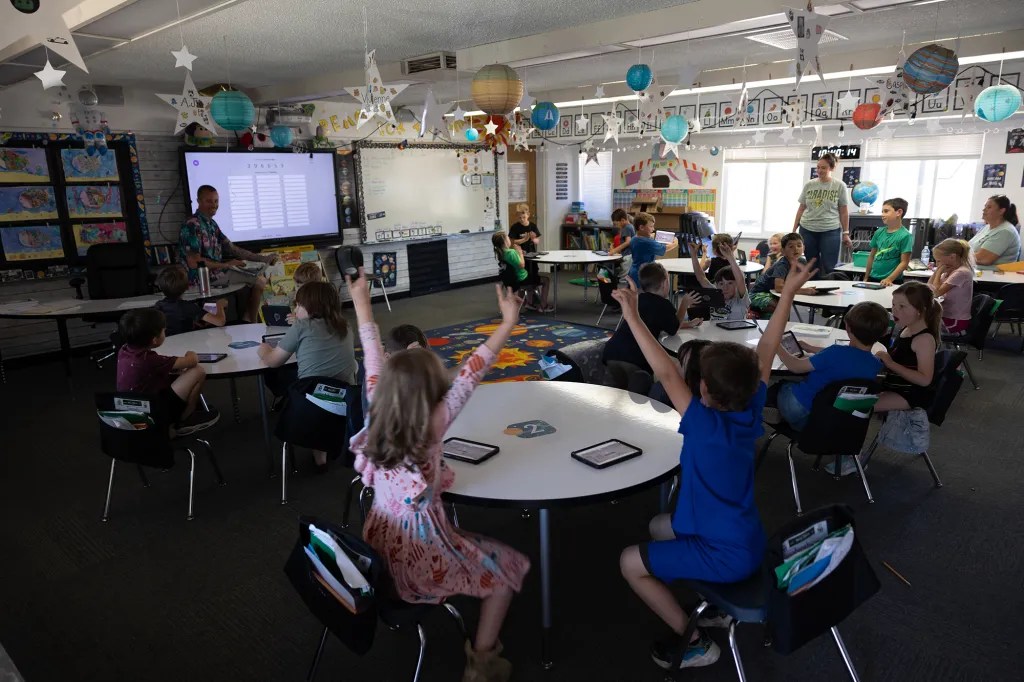
Students in a classroom at Achieve Charter School of Paradise in Paradise on May 21, 2025. Photo by Miguel Gutierrez Jr.

Top higher ed campus safety stories from 2025: Hazing, Charlie Kirk, and Title IX, Campus Safety Magazine

2025 Year-in-Review: AI’s impact on campus security technology, Campus Safety Magazine

Fear, fatigue, gratitude: Students, parents and educators on the new Trump administration’s first year, Chalkbeat

Looking back at Colorado education in 2025,Chalkbeat Colorado

Year in review: Our top stories of 2025, District Administration

School boards: These topics were high priority in 2025, District Administration

5 education innovation trends to watch in 2025, eSchool News

The top 20 education next articles of 2025, Education Next

From classrooms to Sacramento: The education stories that defined 2025, EdSource

Revealing the top EdSurge K-12 stories of 2025, Rebecca Koenig, EdSurge

Most Popular EdSurge Early Education Stories of 2025, Lauren Coffey, EdSurge

The 10 most significant education studies of 2025, Edutopia

The top 10 EdWeek stories of 2025, Education Week

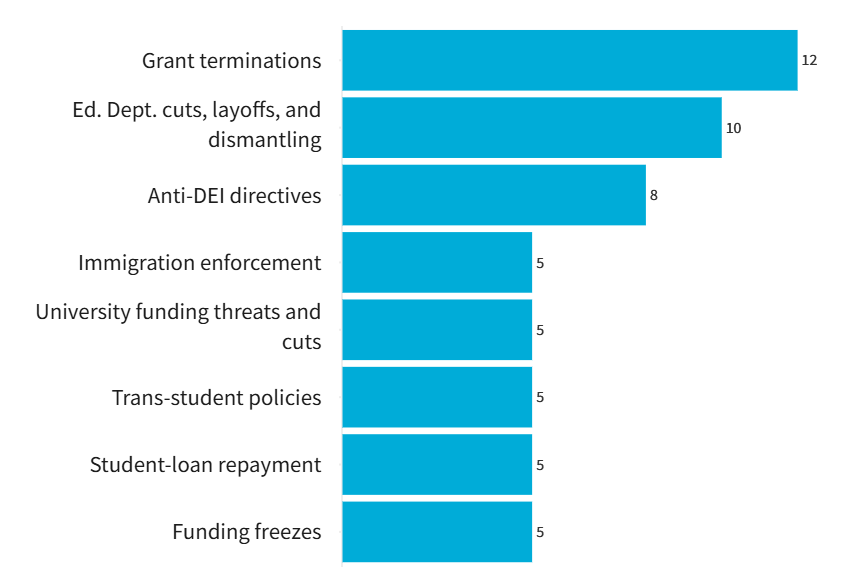
Trump’s Education Policies Spurred 71 Lawsuits in 2025. How Many Is He Winning? Education Week

The education-related policies that have attracted the highest numbers of lawsuits, Education Week

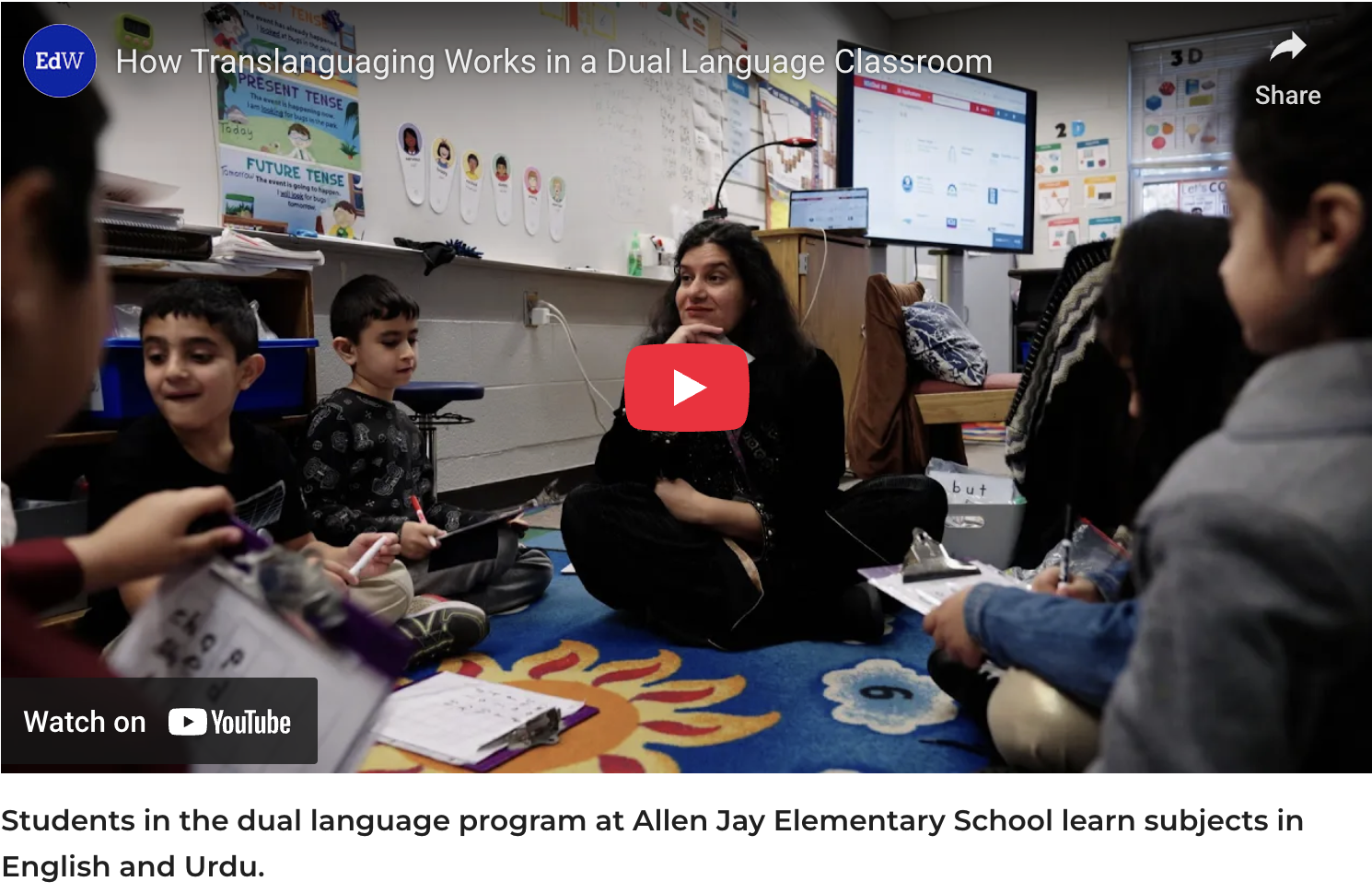
EdWeek’s Must-See videos of 2025, EdWeek

Here’s how AI is reinventing the end-of-year performance review, Forbes

How Trump 2.0 upended education research and statistics in one yearThe Hechinger Report

5 early ed highlights from 2025, The Hechinger Report

Philanthropy Awards 2025, Inside Philanthropy

The K-12 Dive Awards for 2025, K-12 Dive

Inside 2025: A year of urgency and the wins that mattered most New America 

2025 Year in Review: Year of change, tumult in public education, The North State Journal

The year in education: 25 of our top stories about schools, students and learning, The 74

Vax Rates, ESAs and Cell Phone Bans: 12 Charts That Defined Education in 2025, The 74

Why 2025 was a good year for education reform, Michael J. Petrilli, Thomas B. Fordham Institute

The 8 biggest education stories of 2025, Word in Black

National Education Association President Becky Pringle at a rally outside the U.S. Capitol

Teaching in the Age of Generative AI: Lead the Change Interview with Bernardo Feliciano

In October’s Lead the Change (LtC) interview Bernardo Feliciano’s discusses his work through the AITeach Co-design Lab at UMass Lowell; this work brings educators, researchers, and technologists together to co-create strategies and tools for teaching in this age of AI. The LtC series is produced by Elizabeth Zumpe and colleagues from the Educational Change Special Interest Group of the American Educational Research Association. A PDF of the fully formatted interview will be available on the LtC website.

Lead the Change (LtC): The 2026 AERA Annual Meeting theme is “Unforgetting Histories and Imagining Futures: Constructing a New Vision for Educational Research.” This theme calls us to consider how to leverage our diverse knowledge and experiences to engage in futuring for education and education research, involving looking back to remember our histories so that we can look forward to imagine better futures. What steps are you taking, or do you plan to take, to heed this call? 

Bernardo Feliciano (BF): Currently I am working with colleagues to build a co-design lab that brings together educators from very different contexts to develop approaches to teaching and learning in a world where generative AI is a reality. The lab is called the AITeach Co-design Lab @ UMass Lowell. (The hyperlink goes to one of many one-pagers we have been developing for partners representing different disciplines and sectors).

Bernardo A. Feliciano, Ph.D.

In the AITeach Co-design Lab, as collaborators we aim to create a structured space where we as a diverse group of educators, researchers, and technologists co-develop practical tools, strategies, and prototypes that respond to the reality of generative AI in education. The intention is not only to design usable products but also to study how to structure co-design itself to help schools navigate AI’s challenges and opportunities. In our co-design sessions, educators, researchers, and technology build spaces where we can address challenges in education and AI that are too complex for any one actor to solve (Snowden & Boone, 2007; Senge, 1990). The Lab functions as a structured environment where we can bring our problems of practice, iterate on small pilots, and use those cycles to build local capacity rather than waiting for top-down policy.

As an adjunct professor, I am also teaching a class on family and community engagement with schools. These roles constantly remind me that people bring distinct personal, professional, and institutional histories into every space. For me, futuring is less about projecting a single vision of “Education with a capital E” and more about the relational, actor-to-actor work of helping people shape their futures from the personal, professional, and institutional histories they inherit. That’s the direction my work is taking me.

The way I approach this is by convening diverse groups around developing tangible projects. The process matters as much as the specific product, whether it’s a research article, curriculum binder, a chatbot teaching/learning companion prototype, or a strategy for helping parents connect to schools. What is essential is how people can communicate their histories, connecting, adapting, negotiating, and reworking them to address problems in the present into a viable future. The varied personal and institutional histories participants bring are neither external resources to be tapped nor barriers to be overcome, but active materials in our negotiation of effective, situated teaching and learning. Innovation emerges as members work through these histories, adapting them in relation to one another to meet particular needs. I may not care whether my own work is labeled research, practice, or a mix of both, but as co-designers we must respect each other’s perspectives, even as those perspectives shift through negotiation. AI brings this into focus. At its core, AI is an immense bank or reservoir of the past, trained on and providing access to what is already known or has already been done. The future is not contained in the AI itself—nor can it be left to AI to imagine for us. The future comes from how we draw on that past to build something meaningful with and for the people in front of us. We explore generative AI as both a design partner and an object of study. Co-designers prototype tools like tutoring agents or parent communication bots, while also interrogating what it means to teach with, against, or around AI in everyday classrooms.

Of course, I have to use my own history, experience, and learning as a researcher, teacher, administrator, entrepreneur, and non-profit professional to leverage the network of histories that generative AI offers. But more than before, I can inform, contextualize, and connect the convening and teaching I do now with the work of so many more people and peoples (to some extent) who came before.

LtC: What are some key lessons that practitioners and scholars might take from your work to foster better educational systems for all students?

BF: One lesson is that teachers cannot be treated as passive implementers of someone else’s design. Too often, educational change is imagined as developing a curriculum or program in one place and distributing it everywhere. That assumes context does not matter and is peripheral rather than integral to learning and teaching. Our relationship to knowledge is always relational and always contextual.

Education has always lived in the complex space where cause and effect are only clear in hindsight (Snowden & Boone, 2007). Simon (1973) describes these as ill-structured domains existing in a state of dynamic heterogeneity in which diverse elements and relationships continually shift, preventing stable equilibrium and requiring ongoing adaptation (Pickett et al., 2017). Ill-structured problems cannot be solved by importing outside solutions but only by negotiation among those struggling with them. I do not believe that educational change—or improvement—comes from a fixed product or process delivered with fidelity. It is an ongoing process of learning through which people shape what they inherit—choosing what to keep, what to adapt, what to reject, and what to forget. It is a process I have found universally involves dynamics of local alliances, conflicts, and negotiations. The lesson I take from this is that if you want to improve schooling, you have to engage with the people who are doing the teaching and learning.

Working on my dissertation underscored this point. I wrote about using one-on-one meetings in a researcher-practitioner partnership to organize co-designing a computer science (CS) curriculum for middle schools. My experience brought home to me that there is no such thing as “shared understanding.” What emerges is never a single, final agreement but alignment good enough to act together, sustained through negotiation as perspectives shift. For example, teachers and researchers sometimes differed on how much detail a lesson plan should contain. Some wanted highly specified steps, others only broad outlines. Rather than force uniformity, we kept both versions and moved forward. That flexibility allowed the work to continue without pretending the difference had been resolved.

My work with different kinds of organizations has shown me how funding and infrastructure shape what is possible. This point is kind of obvious but still seems to bear repeating. Creativity and goodwill are not enough without sustainable and intentional support. For example, in the CS Pathways partnership, we shifted from MIT App Inventor to Code.org’s App Lab during remote learning. That solved one problem but created new ones around district procurement and accounts, showing how infrastructure shapes outcomes. In our recent Lab kickoff meeting, one participant noted that even when AI-enabled data tools existed, district procurement rules blocked their use — showing how funding and infrastructure filter what is possible.

At the same time, I saw that students’ and teachers’ own histories can be powerful resources for change, if we work out how to support them as they need to be supported.  In one part of the CS Pathways project, students framed their app design around civic issues in their community, such as neighborhood safety and access to resources. Their lived experiences pushed the curriculum beyond abstract coding skills into work that mattered locally. This reframed computer science as a civic as well as a technical practice and shaped how we sequenced and supported instruction in those classes. 

LtC: What do you see the field of Educational Change heading, and where do you find hope for this field for the future?

BF: In my experience, the field often moves toward building monoliths: “the system,” “the conceptual framework,” “the workforce,” “education technology.” Instead of these monoliths, we need to work with lesson plans and pacing decisions that make up “the system,” the overlapping frameworks that guide practice rather than a single “conceptual framework,” the varied teacher and student histories that constitute “the workforce,” and the specific tools and artifacts, from binders to chatbots, that become “education technology.” Monoliths can make things easier to talk about but also risk obscuring the negotiations and translations that are inseparable from those very systems. These relational dynamics are not add-ons. They are the system itself, as much as the actors are (Latour, 2005).  As in the earlier example of teachers’ differing preferences for lesson plan detail, the system took shape through the negotiation itself, not through a fixed agreement imposed from outside.

I would like to see the field shift toward paying closer attention to the actor-to-actor interactions and dimensions. That is where change takes shape: when people with different histories and contexts negotiate how to carry those histories forward. I see promising work moving in this direction: Playlab.ai’s participatory approach to AI tool-building, Victor Lee’s co-design of AI curricula with teachers, Penuel and Gallagher’s (2017) and Coburn et al.’s  (2021) and others’ emphasis on research–practice partnerships , and Bryk et al.’s (2015) improvement science cycles. The Cynefin co-design principles we are enacting in AITeach — probe, sense, respond — are themselves evidence of a field moving toward valuing negotiation and adaptation over fixed models (Snowden & Boone, 2007).

This is also where I find hope. In my dissertation research, I have seen how a small change in the structure of a meeting can reshape how colleagues relate to one another. Having a teacher go first in one-on-one meetings shifted the dynamic, allowing their concerns to set also frame a negotiation rather being a response to requirements. I have seen middle school students reframe ideas in ways that exceeded what I could have planned, such as attempting to build an app to help students and teachers share resources more effectively in school. Students translated apps they were familiar with into tools for their own purposes, which required reimagining instruction around their designs rather than trying to make pre-existing apps seem interesting. This approach may cause an instructional headache but least it provided an authentic motivation for learning an aspect of coding.

Some might call this the interest or work “micro-level,” but I avoid that term because it suggests hierarchies and fixed layers. I prefer to describe it as the translational dimension: the ongoing work of shaping futures from inherited histories by deciding what to keep, what to adapt, and what to let go.

Looking Ahead in 2024: Scanning the Predictions for Education in the New Year

This week, Thomas Hatch shares IEN’s annual scan of headlines that are trying to anticipate key trends and development for education in the New Year. For comparison, review the previous scans of the “looking ahead” headlines from 20222021 part 12021 part 2, and 2020. Last week’s post featured articles that looked back on the key issues and stories from 2023; previous posts looking back on the year in education also can be found for 2022, 20212020, and 2019 part 12019 part 2.

         In some ways, the predictions for schools and education in 2024 reflect “more of the same” – continuing discussions of the influence of technology and AI on education; the impact of the COVID-19 pandemic on attendance, academic outcomes, and wellbeing; the challenges of education financing as pandemic funding runs out; and problems caused by teacher shortages and divisive politics:

This is a critical year as the nation grapples with the long-term effects of the pandemic amid a technological revolution, a still-unfolding refugee crisis, and a presidential election that could intensify political tensions.

In 2024, expect new debates about AI, gender, and guns, New York Times

Educators should expect debates over school choice, teacher pay measures, artificial intelligence, and standardized testing in state legislatures and on Capitol Hill in 2024

What 2024 Will Bring for K-12 Policy: 5 Issues to Watch, Education Week

Budget projections will be easier and more reliable, at least for the calendar year, as the economy continues settling fairly smoothly to a slower pace with inflation easing and interest rates drifting down with it… absent the usual unforeseeables like new wars, oil shocks and pandemics — public finance is returning to something resembling business as usual.

For Public Finance, a Year for Stability and Cautious Optimism, Governing

5 Key Predictions for the Education Market in 2024, EdWeek Market Brief

One of the biggest forces impacting education in 2024 will be labor shortages—and not just in the classroom. Pressures on the wider U.S. workforce caused by a lack of employees with the requisite skills will drive more collaboration between K12 schools and employers… It will also drive a surge in popularity in career and technical education programs.

Education in 2024: Breaking Down 8 Big Trends, District Administration

What Will Teacher Shortages Look Like in 2024 and Beyond? Education Week

“While the rest of us are buying gym memberships we probably won’t use, school leaders are facing far more ambitious New Year’s resolutions: regaining academic ground, tightening those belts, weathering divisive politics, and ensuring more students show up to class.”

Five challenges school district leaders will face in 2024, Education Week

Brown Center scholars look ahead to education in 2024, Brookings

Education Stories We’re Watching In 2024, Chalkbeat

Three Education Stories To Watch In 2024, Peter Greene, Forbes

In 2024, 5 Big Issues Will Shape Education, Vicki Phillips. Forbes

9 Education Predictions for 2024, Larry Ferlazzo, Education Week

3 education innovations to watch in 2024 (hint: it’s not just about skills and AI), Julia Freeland Fisher, Christensen Institute

Looking ahead globally and locally

Five changes the new Government has planned for schools, Stuff (New Zealand)

Top 10 Education trends to watch out for in 2024, Times of India

Literacy, vouchers, an IPS overhaul, and more: Five Indiana education issues to watch in 2024, Chalkbeat Indiana

“New York’s Board of Regents has called for increased investments in the state’s information technology infrastructure, a bolstered educator pipeline, and additional money to update the state’s learning standards.”

Special education data and the teacher pipeline: NY education officials share budget priorities, Chalkbeat New York

Fiscal considerations may weigh on Massachusetts Legislature’s session priorities, Spectrum News

California education issues to watch in 2024 – and predictions, EdSource

Education Technology

“AI is the phrase on everyone’s lips heading into 2024, with 19 education technology experts believing its advantages will range from virtual tutors and faster student feedback to engaging, compelling presentations and better data analysis for teachers. Other predictions include more immersive and multisensory learning experiences, flexible learning locations, and leveraging and reaching community-based help groups.” 

How Will EdTech Change in 2024? TechRound

State of Global E-Learning Market- Ongoing Trends and Seizing Opportunities, EdTech Review

5 Trends Set To Revolutionise Education In 2024, India Today

5 K–12 Ed Tech Trends to Follow in 2024, EdTech Magazine

65 predictions about edtech trends in 2024, eSchoolNews

7 Artificial Intelligence Trends That Will Reshape Education in 2024,The74

AI’s education impact in 2024 could be bigger than many predict, Thomas Arnett, Christensen Institute