Tag Archives: education equity

Centering Equity Through Historical Grounding and Collective Educational Change with Latrice Marianno

In December’s Lead the Change (LtC) interview Dr. Latrice Marianno argues that meaningful educational improvement must be historically grounded and explicitly centered on equity and justice, not treated as a side effort within school improvement. Despite current challenges, she calls for collective, systems-focused approaches that dismantle structural barriers and urges educators and scholars to continually act as if radical transformation in education is possible. The LtC series is produced by Elizabeth Zumpe and colleagues from the Educational Change Special Interest Group of the American Educational Research Association. A PDF of the fully formatted interview will be available on the LtC website.

Lead the Change (LtC): The 2026 AERA Annual Meeting theme is “Unforgetting Histories and Imagining Futures: Constructing a New Vision for Educational Research.” This theme calls us to consider how to leverage our diverse knowledge and experiences to engage in futuring for education and education research, involving looking back to remember our histories so that we can look forward to imagine better futures. What steps are you taking, or do you plan to take, to heed this call? 

Dr. Latrice Marianno (LM): Recently, I had the opportunity to attend the Association for the Study of Higher Education’s (ASHE) annual conference in Denver. During my time there, I visited the Museum for Black Girls and encountered this quote from Angela Davis above one of the exhibits: “You have to act as if it were possible to radically transform the world. And you have to do it all the time.” For me, this quote embodies the work before all of us. To heed this year’s call, I am continuing to deepen my work around equitable school improvement in a few ways.

Latrice Marianno, Ph.D.

First, I am ensuring that my work is continually grounded in the historical context that has produced and/or maintained the inequities we continually see in education. Critical policy genealogy, which focuses on understanding the origin and evolution of policies (Brewer, 2014; Meadmore et al., 2000), is something I have been drawn toward and intend to engage with more deeply. I find it critically important to understand how policies came to be and the issues those policies were intended to address as that insight can shed light on how educational policies create or maintain inequities. One example that illustrates the importance of understanding the histories of educational policies is the history of state teacher certification policies. While characterized as a policy aimed to enhance the professionalization of teachers (e.g., Hutt et al., 2018), requirements for teachers to pass exams to become certified have long reinforced inequities in access to entering the teaching profession (e.g., Carver-Thomas, 2018). Understanding the history of these policies means an awareness that these certification policies were popularized as a way to justify lower pay for Black educators and later the displacement of Black educators (e.g., Fultz, 2004; Tillman, 2004). Remembering our histories is a necessary foundation if we are to reimagine educational systems.

Second, I will continue focusing on interrogating systems, policies, and practices in educational spaces both in my teaching and scholarship. My work focuses on examining how school improvement systems can be reimagined and redesigned to better support educational leaders to engage in meaningful and justice-centered improvement. For example, Marianno et al. (2024) focuses on state-influenced school improvement plan templates and the extent to which educational leaders are prompted to think about and address inequities. This work opens a conversation regarding how this tool (i.e., school improvement templates) might be redesigned to support educational leaders to center equity in the school improvement planning process. Currently, I teach in a principal preparation program which has allowed me to continually engage with educators and aspiring educational leaders around what this could look like in practice. My teaching allows opportunities for me to learn from and alongside my students as we collectively think about the supports, tools, and professional learning that support educational leaders to think critically about equitable school improvement and act on those commitments in sustainable ways. For example, in my course on data-driven school improvement, we use Bernhardt’s (2017) program and process evaluation tool to prompt them to think about ways school policies and practices create or maintain inequities – an activity they have found useful in prompting them to notice and reflect on inequities within their schools and districts.

Featured Exhibit at the Museum for Black Girls

Finally, I am committed to supporting and engaging in collective futuring in educational spaces. This commitment means sharing my work in practitioner-friendly formats (e.g., policy reports, and/or practitioner journals like Educational Leadership or Phi Delta Kappan), rather than solely academic journals. This commitment also means continuing to challenge assumptions about what it means to improve a school and supporting educators and educational leaders to think critically about school improvement and educational justice as intertwined endeavors. To envision beyond our current system and imagine what could be. To “act as if it were possible to radically transform the world” and “to do it all the time.”

LiC: What are some key lessons that practitioners and scholars might take from your work to foster better educational systems for all students?

LM: Recently, my work has focused on understanding school improvement planning (SIP) processes and how educational leaders think about and work toward redressing inequities through those processes (Marianno, 2024; additional work forthcoming). Through this research, I found that educational leaders viewed equity as either an implicit part of school improvement planning or absent from that process, and that school leaders were not prompted to think about equity within the SIP process. These views and approaches undermined the district’s expressed equity focus by creating a disconnect between their policy intent and implementation. In my work, I argue for the need to explicitly connect equity with school improvement and begin to identify opportunities to center equity within a process that can often be thought of as parallel to school improvement rather than an integral part of those efforts. 

Ultimately, I hope my work inspires folks to be transgressive – to push against the boundaries of what is typically considered improvement within the current educational system (e.g., lack of explicit focus on redressing inequities within improvement efforts). To continually question the assumptions that undergird our collective work in improving education for all students, especially those from historically marginalized backgrounds. To believe in radical transformation and work toward it in our pursuit of educational justice. Toward this end, there are a few key lessons I hope folks can take from my work which collectively emphasizes the importance of being systems-focused, centering the knowledge and experiences of marginalized students and communities, and then leveraging that knowledge to design more just futures. 

First, there can be no educational improvement without a focus on redressing inequities. Too often equity is treated or understood like a side project rather than integral to the work of educational improvement (Marianno, 2024). However, as scholars like Gloria Ladson-Billings and Michael Dumas have argued, substantively improving education requires explicitly attending to the racism and antiblackness that shape the current educational system (Dumas, 2016; Ladson-Billings, 2006). 

Second, we must focus on reimagining our systems, policies, and practices toward educational justice (Welton et al., 2018). There has been a popular illustration that people, particularly in education, have used to describe equity. This illustration shows three individuals of varying heights standing outside of a fence watching a baseball game. One individual is tall enough to see over the fence without additional support while the other two need additional and varied support. While this illustration has multiple iterations, there is often a comparison between equality and equity in which equality represents everyone getting the same number of boxes to stand on, and equity representing everyone getting what they need to, in fact, see over the fence. The version that most resonates with me includes a visual representation of liberation as the removal of the fence. For me, this representation highlights how education broadly and schools specifically have been designed with particular people in mind (in this case the individual tall enough to see without additional support) and how the removal of the fence would serve everyone. I firmly believe that to ensure marginalized students have equitable and just educational opportunities, experiences, and outcomes, it is critical that our collective work (practitioners and scholars alike) focuses on removing the fences (i.e., barriers) that marginalize students and lead to inequities. Engaging in educational improvement in this way centers the experiences of marginalized students, such that educational spaces are designed with them in mind.

Finally, we must recognize the value of collective knowledge and experiences. Brandi Hinnant-Crawford (2020) notes that we need to “intentionally harvest the collective wisdom of many” to “envision better and plot a course for how to get there” (p. 43). That is, futuring for education requires honoring and valuing the knowledge and expertise of diverse stakeholders – teachers, educational leaders, students, and caregivers. In particular, we need to view students and caregivers as valuable partners who can aid in both addressing the educational problems schools are facing and support imagining an otherwise. 

LtC: What do you see the field of Educational Change heading, and where do you find hope for this field for the future?

LM: Honestly, I’m not sure where I see the field of educational change heading. The current climate makes that picture a bit hazy for me. We’re in such a significant period of retrenchment with attacks on academic freedom in higher education, undermining of public education through funding cuts and dismantling the Department of Education, and backlash for anything remotely equitable or inclusive. It is disheartening, though unsurprising. This moment in our history reflects longstanding patterns in American history where movements toward justice are met with resistance and retrenchment. As Decoteau Irby’s (2021) work and the Angela Davis quote shared earlier both remind us, the current moment is a reminder that systems of oppression are constantly at work. We have to act as if we can radically transform the world all the time because systems of oppression are constantly mutating and reinventing. With that in mind, I do have hopes for the field moving forward. 

I hope we move toward deeper recognition that equity and justice must be central to educational improvement, not a side project or parallel effort. This is the work. There is no meaningful school improvement work divorced from a focus on educational justice. In my own work, I’ve seen how educational leaders are often unclear about how to integrate equity into improvement work or treat equity as an implied focus undergirding their improvement efforts but in ways that actually undermine those efforts (Marianno, 2024). Specifically, district leaders viewed equity as an implied focus and foundation of all of their school improvement efforts. However, this approach led school leaders in that district to believe that equity was absent from the process altogether and left them unsure of where and how to integrate equity in their improvement efforts because it was not explicitly discussed. Moving forward, I hope we regard equity and justice as non-negotiables that guide how we define problems, reorganize educational systems, and measure the success of educational improvement efforts. 

I hope we move toward a more historically grounded approach to school and systems improvement. To meaningfully redress inequities, we must understand how past policies and practices created the systems we currently have. Tracing policy histories, such as the racialized roots of teacher certification requirements or gifted education (e.g., Mansfield, 2016), reveal that many present-day inequities are not accidental, and reinforces the understanding that policies are not neutral. I hope the field continues to deepen its engagement with historical analysis, recognizing that remembering the past is essential for imagining futures that depart from it. 

I hope the field continues to shift toward more systemic and collective approaches to educational improvement. When working with aspiring educational leaders in my course on data-driven school improvement and building on the work of scholars like Brandi Hinnant-Crawford (2020), I find they often leave the course with a better understanding of how school systems, policies, and practices shape disparities within their schools and districts and the importance and value of collective approaches to their improvement work. This is my hope for the field – that we engage these ideas not just intellectually but as part of our praxis. 

Despite the current moment we’re in, I hope that both scholars and practitioners act as if radically transforming education is possible – and that they do it all the time. 

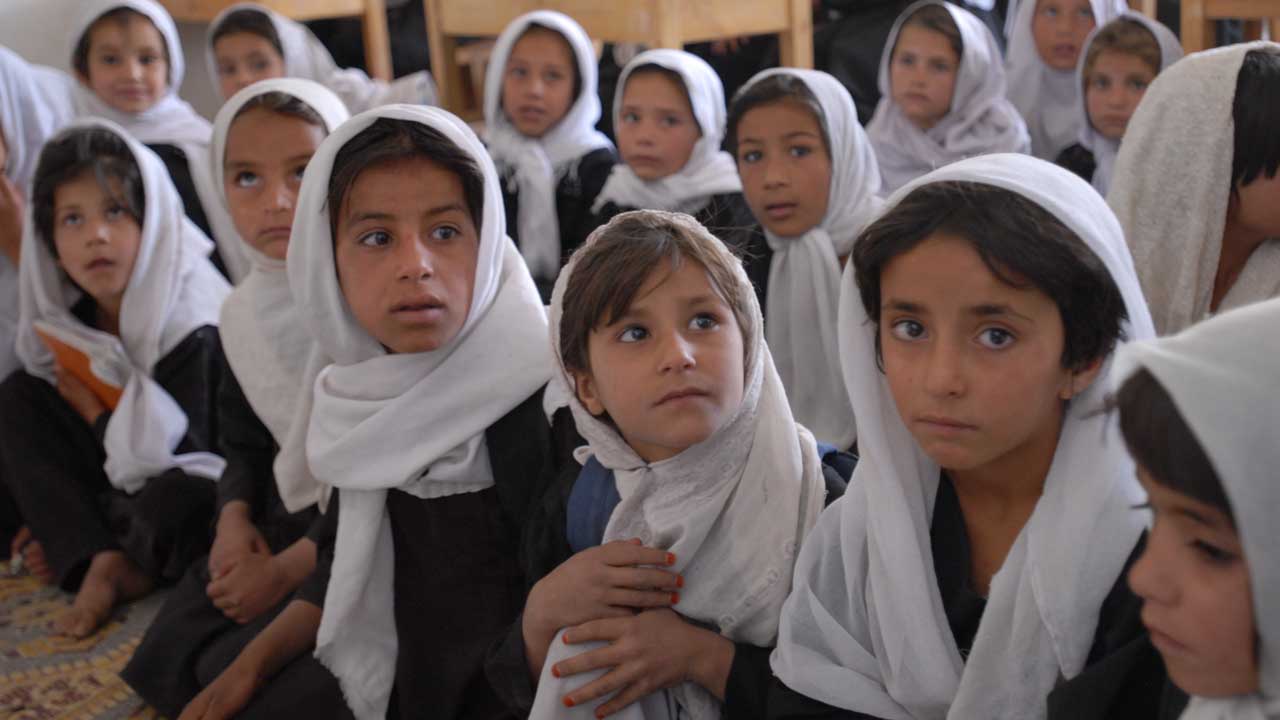
“We are just broken”: The fate of education for girls in Afghanistan after the Taliban takeover

This week, nearly 6 months after the US forces left Afghanistan, Naila Shahid shares some of the news and links since August of 2021 describing the impact of the Taliban takeover on girls’ education there. 

 With the Taliban takeover of the Afghan government last August, many expressed fears that the substantial gains made in girls education in the past 20 years might be lost.  Although an estimated 3.7 million children remain out-of-school in Afghanistan – 60% of them girls, according to World Bank reports, girls’ secondary school attendance increased 32% from 2003 to 2017. By 2018, girls made up almost 38 percent — 3.8 million — of students in the country; by comparison only 5,000 Afghan girls were enrolled in schools in 2001. Over the same period, the presence of women in higher education also rose, and the  gender disparity in higher education enrollment decreased over time in favor of female students entering Afghan universities. For example, there were only 1,000 female participants in the Kankor exam (the University entrance exam) in 2003, while this number jumped to an all-time high – 78,000 – in 2013. In 2020, Shamsia Alizada, the daughter of a coal miner from Kabul, received the highest score out of 170,000 students on the entrance exam.

When the US troops pulled out, however, and the Taliban seized control of the country in 2021,  many businesses and institutions, including schools, shut down. Since that time, public elementary schools have reopened again and in September 2021 the Taliban government announced the reopening of government high schools but only for boys, saying only that “a safe learning environment” was needed before older girls could return to school.  Private schools, including girls secondary schools and universities, only started operating again in 10 out of 34 provinces, after they negotiated with local Taliban leadership.  

 In  October 2021, Afghan officials announced that girls would be able to resume attendance in government secondary schools, but only after the development of a new educational framework. That statement did not give a time frame for reopening and made thousands of girls fearful about their exams, their plans to graduate, their university applications and their academic future in general. In November 2021, the Afghan government added a statement about reopening secondary schools for girls, simply stating“good news coming soon”. As of January of 2022, the  Taliban are pledging/promising to open all girls schools after the Afghan New Year in late March, offering a deadline for the first time. According to the Taliban’s Deputy Minister of Culture and Information, the major barriers for reopening the secondary schools for girls have been the “capacity” as they plan to completely segregate girls and boys schools. 

Depriving girls of their educational rights has contributed to continuing unrest. Reports have shared the stories of  women and girls in some areas of Afghanistan (mostly urban) who are raising their voices against the closure of girls’ secondary schools and taking action. Among those voices: 

Roya, 18,  who was supposed to graduate from high school and was preparing for the university entrance exam, declared: 

“I always dreamed of being a lawyer and had been preparing to get into law school, but now with the Taliban taking over I don’t think I have a future.”

Rahela Nussrat, 17,in her final year of high school and and unable to attend classes since the takeover, lamented:

 “When the Afghan government fell, I lost my right to education, this was the first time I cried specifically because of my gender.” 

Zakia Menhas, a medical student at Kabul university waiting for her college to reopen, told NPR’s Lulu Garcia-Navarro: 

“We really – just fed up – and it is really devastating for us. Like, we had hopes. We had dreams to chase. And now it is just a dark place. And we cannot find that light. And we are just broken.” 

Despite the challenges, some are managing to persevere. 

 Shabana Basij- Rasikh whogrew up in Kabul in the 1990s, has been operating Afghanistan’s only private boarding school for girls – the School of Leadership, Afghanistan (SOLA), explained 

“Education transforms lives and societies. It’s transformed my life and it’s transformed my Afghan society these past 20 years.”

Angela Ghayour, who witnessed the civil war in Afghanistan in 1992 as well, could not bear to see girl’s deprived of education once again. After three months with little progress from the Taliban, she used social media to bring together 400 volunteers and started the Online Herat school to provide educational resources to women and girls. As she put it: 

“I feel this school is the result of all of my pain, my agonies and experiences. Our motto is, the pen instead of the gun.”

In the western province of Herat, the teachers’ union, 40 school principals and parents pushed back and reopened the schools in October. However, they had to negotiate with the local Taliban officials to have completely segregated classes and only female teachers. The parents are determined. Mastoura who now escorts her two daughters to school every day is resolute.

“We had concerns, and we have them still, But daughters must get an education. Without education, your life is held back.”

A timeline of the reported events: 

September 20, 2021- Afghanistan’s new government is likely to impose severe restrictions on girls’ education, The New York Times

September 24, 2021- Deputy UN chief urges girls’ education is a must for Afghanistan, Thompson Reuters Foundation News

October 11, 2021- What will happen to girl’s education under Taliban rule?, Thompson Reuters Foundation News

October 13, 2021- Amnesty International published testimonies from teachers and students in Afghanistan, Amnesty International

October 18, 2021- Taliban stops school for girls over 12, CBS News

October 22- 2021- Afghan girls determined to return to school, CBS News

October 29, 2021- Online learning (secretly) continues for girls in Afghanistan, Global Citizen

October 31, 2021- Afghan girls think their education doesn’t have a future, The New York Times

October 31, 2021- Afghan women’s education in limbo, Deadline

November 02, 2021- Afghanistan’s government says it will soon announce  “good news” about girl’s education, Reuters

— Naila Shahid

Inequality, adaptability and survival: A view of the pandemic and school closures from Dignitas’ Deborah Kimathi in Kenya

In honor of the announcement of the WISE Award winners for 2020, we are reposting our interview with Deborah Kimathi, the Executive Director of Dignitas, an education development organisation in Kenya. Dignitas was one of six WISE Award winners this year for its Stawisha Instructional Leadership Institute. (Dignitas is also a partner of Global School Leaders, the focus of last week’s post.) The WISE awards celebration will take place virtually on October 28th (with free registration) and will include “Building the Future of Education: Conversations with Resilient Innovators.”

This interview was one in a series that included posts from Chile,  from Japanfrom the Netherlands, Scotland, Liberia,  Pakistan,  Australia,  Canada, China, and Ghana. The “A view from…” series editors are IEN’s Thomas Hatch and Karen Edge, Reader/Associate Professor in Educational Leadership at University College London’s Institute of Education.

IEN: What’s happening with you and your family?

Deborah Kimathi: Kenya announced its first case of COVID19 on March 13th, and on March 15th the government announced national school closures, and social distancing measures that included working from home for those in non-essential services. I spent the next morning in the Dignitas office, setting up our team of 15 for remote working, with no idea of what that would really look like (for a team who are typically 80% in the community delivering training and coaching to our 140 School Partners) or how long it might last for. Now, 11 weeks the team are all still working from home, and being incredibly fruitful despite the challenges.

Ever since, my family and I have been working from home in Nairobi, schooling from home, shopping from home, socializing from home, and everything-else-from-home! My husband and I are both still working full time (or more than), and managing our three children. Our childcare ceased on the same day, so that our nanny could also follow the government’s guidelines. Our oldest two (7 and 9 years old, one lockdown birthday later) are doing some home learning (not their school prescribed program which was 6 hours per day of poorly managed Google Hangouts), and our 3 year old, who was due to start nursery this term, is generally having way too much screen time. My working day currently starts at 5am, and goes until around 10pm, with a variety of interruptions.

IEN: What’s happening with education/learning in your community?

DK: One word comes to mind – inequality.  I have two very different ongoing conversations when it comes to education.  The first is with my children’s friends’ parents, mostly struggling with schedules, the need for each child to have a device or laptop, how to turn baking into a science lesson, and where to source real butter for said cake.  The other, and the more urgent conversation, is with our School Partners and friends, largely in Nairobi’s urban informal settlements.  Here, the struggle is not for comfort, the struggle is for survival.  COVID19 has brought with it severe social, health and economic hardship, and these hit the poorest communities the hardest.  In these communities, more than 60% of families were unable to access public education pre-COVID19, as a result of poverty and systemic exclusion.  Marginalised by poverty, these are the same families excluded from a myriad of essential health and education services now, and often fighting a daily, violent war with police in their struggle to exist.

The more urgent conversation, is with our School Partners and friends, largely in Nairobi’s urban informal settlements.  Here, the struggle is not for comfort, the struggle is for survival.  COVID19 has brought with it severe social, health and economic hardship, and these hit the poorest communities the hardest.

The significant challenge of inequality is, as a result, exacerbated in the most violent way, only bringing harm to children, families, and society as a whole.  This raises critical, urgent questions of ‘What happens next?’  When schools reopen, will those who’ve participated in online or home learning be ‘ahead’ of others?  How will schools assess progress and promote students to the new school year?  How many girls will be married or pregnant, never to return to school?  How many families will end up on the street, their children never to return to school?  How many children will have died from starvation?  How many children will be so scarred by the trauma, violence and anxiety of this season that learning never really resumes?

The significant challenge of inequality is, as a result, exacerbated in the most violent way, only bringing harm to children, families, and society as a whole. 

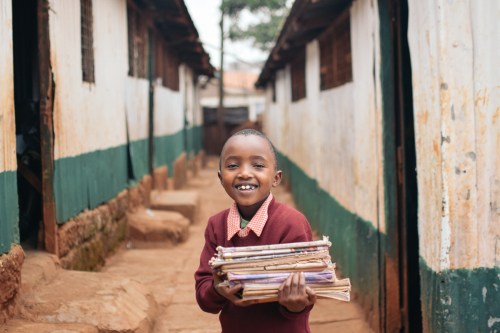
A young learner proudly carries his school books outside a typical partner school. Photo: Dignitas

IEN: What do you/your community need help with?

DK: Dignitas is working tirelessly to protect and promote the learning and well-being of children living in poverty.  Whilst everything else is disrupted, our vision to ensure all children have the opportunity to thrive and succeed remains core to our COVID19 response.

In an effort to reach and protect these children, we immediately thought of our amazing community of School Leaders and Teacher Leaders.  Dignitas has trained over 1,000 educators, and have another 450 educators enrolled for 2020.  These School Leaders have already benefited from Dignitas training and coaching and they are also leaders who are rooted in, and passionate about the needs of their communities. Our partnership lays an ideal foundation for them to be further equipped to respond in these times of crisis as community champions of well-being and learning.  Dignitas is remotely training and coaching these educators as Community Champions who can work in household clusters to protect and promote children’s learning and well-being.  

Dignitas is working tirelessly to protect
and promote the learning and well-being
of children living in poverty.  Whilst
everything else is disrupted, our vision
to ensure all children have the opportunity
to thrive and succeed remains core
to our COVID19 response.

To make this possible, we need help in curating more digital content for these educators, the educators need tablets to access and share learning content, families need basic devices or radios to benefit from the government’s education broadcasts, we need to design and print home learning packs for children, and we need to help families with food!  The list is long, and we’ve been excited to collaborate with some amazing partners like Safaricom Foundation, Team4Tech, Cosaraf Foundation and Synthetic so far, but the need is huge!

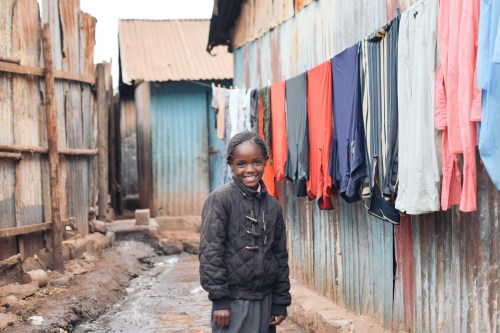
A young girl, now at home, facing an uncertain future. Photo: Dignitas

IEN: What resources/links/supports have you found most useful? 

DK: I’ve really appreciated being part of some great networks – WISE, Global School Leaders, RELI, Global Schools Forum and others who have curated relevant content and tools, and offered consistent, valuable support.  The opportunity to share and learn with peers has helped me to stay focused, inspired and fruitful in this season.

Friends and donors who are authentic partners in our work!  Can donor relationships be unhealthy, and have skewed power dynamics?  Yes. However, they can also be wonderful places of strategic collaboration, bringing together passionate, committed teams of people and resources to respond to community need in a wise and compassionate way.  We’re fortunate to largely experience the latter, and they’ve been amazing thought and action partners for this season.

IEN: What are you reading, watching, listening to that you would recommend to others?  

DK: I’m mostly listening to podcasts and recordings of webinars that I’ve missed in the busy-ness!  WISE and Africa.com have had great content, relevant to our context, and not afraid to ask the hard questions.  In terms of reading, material from Harvard Graduate School of Education and Brookings Institute have offered interesting insight.  However, I think my most valuable learning experience in this season has been listening to others – peers in the Kenyan and Global education sector, and the communities in which we work.

IEN: What have you found most inspiring?

DK: People!  People who are so intentional in bringing hope and light to others.  People giving so generously of their time and expertise.  People who don’t have much, always willing to give the most. 

Leading Futures: Alternative Perspectives on Education Reform and Policy

Series Editors Alma Harris and Michelle Jones

The global discourse about educational policy and change has narrowed considerably because of a preoccupation with the high performing systems, as defined by large-scale international assessments, and the factors that contribute to their success. Building on Alma Harris and Michelle Jones’ book, Leading Futures: Global Perspectives on Educational Leadership, the Leading Futures series is premised on the contention that more contextual and culturally sensitive accounts of educational change are needed in order to consider broader attributions and explanations of educational performance.

The Leading Futures series provides a platform for sharing different views on the process and practice of changing education systems for the better. Its intention is to open up the contemporary debate on school and system performance through critical policy analysis, empirical enquiry and contextualized accounts of system performance.

This post by Alma Harris, Michelle Jones, Jan Heijmans and Job Christians is the first in the Leading Futures series.

The Dutch Way: Is the Netherlands a best kept educational secret?

Alma Harris, Michelle Jones, Jan Heijmans and Job Christians.

Unlike many other education systems, the Netherlands appears to be delivering both educational quality and equity. So why does the Dutch system do so well? To attribute its success to a handful of structural features or to certain strategies is one way to go. However, accurately identifying causal attributions for better system performance is far from straightforward or fool proof. In complex education systems there are often multiple reasons for better outcomes that interact and intersect.

In this post, we argue that the Dutch system provides an example of “principled educational performance,” combining a focus on democratic values with an approach to policymaking that relies on both collaboration and autonomy.

The Dutch system in context: Educational quality and equity

The global interest in the high performing education systems shows no signs of slowing down. The interest in borrowing from the best has placed the international spotlight on a select group of education systems and not others. Earlier this year, the OECD published “Supporting Teacher Professionalism,” drawing upon the 2013 TALIS survey in order to explore teachers’ and principals’ perceived professionalism. Thirty-four countries were scored on three measures: teachers’ professional knowledge, work autonomy, and access to peer networks. Of all the education systems that scored highest on the index of professionalism, seven were in Europe and the Netherlands placed fourth in this group.

The Dutch education system is not necessarily on the radar of policy makers in search of better performance but a quick look at the Dutch system makes interesting reading. The evidence shows that Dutch students perform very well in international student assessments and as a country, the Netherlands has remained just outside the PISA top ten, for successive rounds. At the primary level, results from both the 2011 TIMSS and PIRLS assessments indicate an exceptionally good performance for Dutch students aged nine to ten. Among all participating countries, in these international assessments, the Netherlands was only outperformed by seven countries in mathematics and science, and by nine countries in reading.

Turning next to the all important PISA scores. In 2012, 15-year-olds in the Netherlands achieved results significantly above the OECD average in the 3 areas tested (mathematics, reading and science). Only two other OECD countries achieved significantly higher performance levels in mathematics. In 2011, the Netherlands had the lowest rate of 15-29 year-olds not in employment, education or training across all OECD countries: 7% compared to an OECD average of 16%. While there are some who argue that above average is not good enough, from different vantage points and using different indicators it would appear that Dutch education system is performing well.

Yet, the Dutch seem to be remarkably quiet about their educational successes and accomplishments. Possibly this is because unlike some of their near European neighbours, they are not among the big hitters in PISA. Yet, they have a track record in educational equity that should be the envy of many countries in Europe and beyond. Take for example the fact that the Netherlands has fewer low performers and more high performers than the OECD average. Significantly fewer Dutch 15-years-olds scored below the PISA performance level 2, which is believed to mark the basic competency which enables active participation in a society. The impact of student socioeconomic background on performance in mathematics was less pronounced in the Netherlands than at the OECD average. The Netherlands also has an above average proportion of resilient students i.e. students who manage to overcome difficult socio-economic circumstances and exceed expectations, when compared to students in other countries.

It is no accident that the Netherlands is one of the OECD’s most devolved education systems, with schools enjoying a high degree of autonomy. This particular brand of autonomy however is not to be confused with increased privatization of schooling or the erosion of local control of schooling. Rather, this particular brand of localalized empowerment is based upon the principle of freedom of education where public and private schools are on an equal footing and all schools receive public funding, provided that they meet the requirements for schools in their sector. In the Netherlands, all teachers receive high quality teacher training at bachelors and masters level plus there is a great emphasis on teacher autonomy and professionalism. The Education Cooperative, which involves over 200,000 teachers, is run by teachers for teachers with the chief aim of safeguarding the quality of the profession.

Before concluding that the Netherlands is some educational utopia where schools and teachers are blissfully free from any interference, think again. The central government sets learning objectives and quality standards that apply to both public and private schools. The Inspectorate of Education monitors school quality and compliance with central rules and regulations. Unlike many other education systems however the Dutch system balances support and pressure in a positive way. While there is a framework of standards, with broadly formulated goals, there are also additional resources and teaching support in schools that need it the most. If schools improve, they are rewarded with more autonomy and freedom to innovate, if they are considered high performing they can apply for Excellent School status.

Of particular note is the fact that the Dutch education system is not overly encumbered with regulation, prescription and standardisation. There is no national curriculum in the Netherlands, however certain learning objectives are stipulated by the Ministry and are expected to be met at the end of primary and lower secondary education. There is testing in the Netherlands and notably, the system stands out internationally for its high-quality standardised assessments. While the issue of testing remains for some Dutch educators somewhat controversial, on balance, the pressure to compete and perform is not as acute as in many other countries. The norms of the Dutch society are collaborative and this threads its way through the very fabric of schooling. Competition hardly plays a role in Dutch educational culture; students are seldom graded against each other or expected to compete against one another.

In terms of equity, the Netherlands is a particularly strong system example. It is the only country participating in PIRLS where all students achieved, at least, the low international benchmark of performance in reading. In addition, 99% of the Dutch students achieved at least the low international benchmark in mathematics and science in TIMSS. Young people in the Netherlands, up to age of 18, must attend school until they attain a basic qualification and there is a strong policy on truancy and absenteeism. The Ministry has signed performance agreements on student dropout with municipalities and schools in 39 regions, which ensures that the most vulnerable young people are supported. In 2006, the government introduced a successful program (Aanval op de uitval) with a regional approach to promote school success and to avoid early school drop outs. A recent OECD report shows that in terms of low-performing students, the Netherlands is far below the OECD average. In the Netherlands, students from low socio-economic backgrounds are 1.72 times more likely to be low performers than their peers with high socio-economic status which is below the OECD average (2.37 times). A higher proportion of Dutch disadvantaged students attend schools with students from better-off backgrounds than the OECD average.

In summary, the Netherlands demonstates a strong comitment to collective and equitable development. As Professor Wilma Vollebergh, University of Utrecht and Netherlands Institute for Social Research reports, it has a social culture and Dutch educational policy-making reflects power-sharing and consenses in decision-making. Such strong cultural norms and values are at the heart of educational practice and largely explain the performance of its education system. The national belief in fairness, equity and justice not only drives the education system but also, at a practical level, translates into a collective effort to ensure success for every child in every setting. A recent study of 200,000 students from 42 countries concluded that Dutch students are happy and have high levels of well-being.

What can we take away from the Dutch approach? 

So what can we take away from the Dutch education system? Essentially, there are three things. First, that the Netherlands does not rely on school competition or market forces to secure better educational performance. Conversely, it relies on strong collaboration between teachers and schools to raise achievement and attainment. Second, it does not exclude students from its education system who are disadvantaged, marginalised or are refugees from another country. Instead, it makes every effort to ensure that young people, from all backgrounds, do not leave school early and that they enter the workforce qualified to participate.Third, the Dutch system shows that it is perfectly possible to combine educational equity and quality. While some may argue that there is more work to be done, compared to many other countries the Dutch education system is undoubtedly moving in the right direction.

For those interested in navigating the slopes of quick-fix, high performance, the Netherlands is categorically off-piste. The Dutch way is epitomized by a long history and a proud tradition of building civic society around democratic values that continue to define both an education system and a country. In years to come, when the high-octane remedies for better educational performance have been over-sold to the point where they have lost their lustre and attraction to policy makers, Dutch educators will still be striving, in their quiet but determined way, for educational excellence through equity. With hindsight, it might indeed be the case, that one of our most principled educational performers was there all along.

Notes on Authors

Dr. Alma Harris is Professor of Educational Leadership and Director of the Institute of Educational Leadership at the University of Malaya.

Dr Michelle Jones is Associate Professor and Deputy Director of the Institute of Educational Leadership at the University of Malaya

Dr. J. Heijmans is Chair of the Executive Board KPZ (teacher training Center Zwolle) in the Netherlands.

Job Christians is a former teacher and founder/director of Onderwijs Maak Je Samen (organization for professional development) in the Netherlands.