Tag Archives: education

Real-time Data for Real-time Use: Case Studies from Ghana and Mali

As part of a symposium focused on educational innovation around the world  at the annual conference of the American Educational Assocation in Chicago next week, we are sharing commentary papers from the participants.  Today’s contribution is from Radhika Iyengar, of the Earth Institute at Columbia University.

A common and most often used source of education data comes from household surveys. These household surveys are helpful to measure the “impact” of the education strategies and policies adopted by developing countries. The Multiple Indicator Cluster Survey (or MICS) are household surveys that various countries along with UN agencies (specially UNICEF) use to collect data on educational outcomes-such as net attendance rate, net intake-rate, primary school survival rate. These indicators are helpful to track progress towards the Millennium Development Goals (MDGs) indicators. The primary focus of the MDGs is to measure the progress towards universal primary education for both girls and boys. The indicators focus on issues like whether girls and boys alike attend primary school at the right age and are able to complete a full primary school cycle.

Despite their potential utility, household surveys like the MICS come with a set of challenges. The process of collecting household-level data using the surveys is very time intensive. Not all countries have the time and the resources to conduct these surveys on an annual basis. Even if they do, a full population census to calculate the denominator of indicators like Net Enrollment ratio could be a decade old. For the most part, the data is entered at the national level. The data is then cleaned, processed and sent back as aggregate numbers usually at the state level. District indicators are hard to find. The schools that patiently supplied this information and the households that took time to respond to those lengthy surveys never get to see the “end product.” The data appeared to vanish in thin air and what comes back in aggregate form is usually not useful for a school or a district to measure its progress. In fact, by the time the data is released, a student who was in Grade 2 may have dropped-out or may have proceeded to the next class without learning anything.

To address this lag in feedback, The Millennium Villages Project along with the Sustainable Engineering Lab have designed and implemented an android phone-based data collection system that collects real-time data. This data is then analyzed using faster back-end processing to provide feedback to the schools and the district education offices on a monthly-basis. This data collection, management and utilization system was developed after multiple years of practice based learning from the Health care system. The processes were tightened and improved upon and tis system is now being utilized for an integrated planning approach for the Education Sector as well as the Water Sector.

Let us first try to understand why is it important to collect all this education data in the first place. Figure 1 below shows that people’s perception don’t always reflect reality. The reality is that many children are not able to do Grade 2 level literacy and numeracy even when they are in Grade 4. This seems counter-intuitive to the general perception that things are going well in education.

Screen Shot 2015-04-13 at 9.37.38 AM

Figure 1. Satisfaction Results in Education (In East Africa)

Source: Pritchett (2013) . The Rebirth of Education: Schooling Ain’t Learning

However, we need quicker and useful data to make any difference. If time goes by and the people who supply this data don’t ever get to “see” the usefulness of collecting this data in the first place, these indicators may just become statistics.

In the Millennium Villages Project site at Tiby Mali, the data collected via the phone-based collection system showed an interesting geographic trend. Figure 2. presents the proportion of enrolled students attending observed classes at the time of observations for a particular month. In Tiby, Mali the data shows that the schools circled in green have a much lower student attendance than the schools circled in blue. It is surprising to see a clear geographical clustering of indicators based on the location of the schools. Why is it that the schools clustered near each other (in blue) have better attendance than the rest of the schools scattered (in green)? This map helped to form the basis of discussion with the District Education Offices. The discussions showed that the geography was a part of the problem. Schools are much more dispersed (in the north and south) than schools near the towns therefore distance to get to schools may be longer. The discussions also suggested some structural issues that promote teacher absenteeism. For instance in Mali full working days are Monday, Tuesday and Friday, with two school sessions per day but on Wednesday and Thursday schools are working with only a morning-shift. Absences are more frequent on Wednesdays and Thursdays because many teachers use those days to take care of their personal and administrative needs. The data helped to start a conversation in Mali on teacher attendance issues and made those issues much more visible and easy to understand. As a result of this early detection of the teacher absenteeism trend, government school inspectors have increased their school supervision and focus on the specific schools that showed repeated student attendance issues. The Mali example shows how stakeholders are able to use the data to assist in the functioning of the schools.

Screen Shot 2015-04-13 at 9.37.53 AMFigure 2. Proportion of enrolled students attending observed class at the time of the visit in Tiby, Mali.

Source: Millennium Villages Project Database.

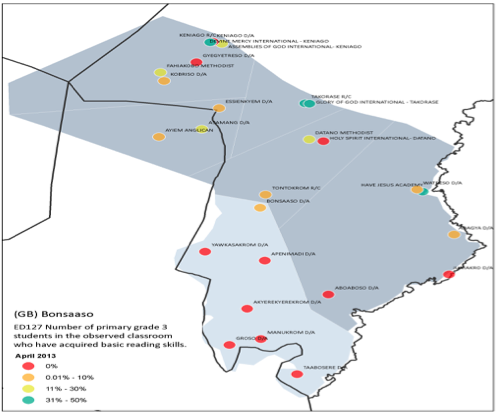
Another very important indicator is that of student’s learning levels in basic literacy skills for numeracy and language. The data are collected on a monthly basis to measure if children are falling behind. The data are intended to help the school and the teachers to plan for remedial education based on understanding the gaps in the literacy measure. For instance, if a majority of the children tested are in the word recognition category, the teachers can focus on activities that are geared towards move children from the word recognition level to higher levels of readings – reading paragraphs and simple stories. The monthly data depicted on a map from Bonsaaso, Ghana suggested that the schools that lack full time teachers are also the schools where students lack basic reading skills. Surprisingly all these schools are grouped towards the south of the cluster.
Screen Shot 2015-04-13 at 9.38.13 AM

Figure 3. Reading Levels of children in Grade 3 in Bonsaaso, Ghana.

Source: Millennium Villages Project database

Further discussions with district education officials revealed that these schools are located in the remotest part of the cluster with many in the Amansie West District. The area lacks basic infrastructural amenities and teachers do not accept postings to those areas, hence lack of teachers is one of the characteristics in that area of the cluster and the district as a whole. Many of the teachers who accept postings to these areas are untrained. Since reviewing these data, multiple-stakeholder meetings have focused on improving the learning environment of these southern schools.

These case studies bring up several points. First, regarding the data collection and utilization process, frequently collected data with frequent feedback helps to make the data more useful. Also, the people who can in a position to act after seeing the data are best suited to collect the data. The closer they are to the issues, the better the data use is going to be. The second point centers on the use of technology to improve the functioning of the schools. Often the use of technology is limited to laptops used by students for learning and by teachers as teaching aids. However, the use of technology as a lever to improve education planning as a whole leaves much to be desired. “Real-time” data collection using efficient technology has more chances of being used. The time elapsed between data collection and feedback needs to be relatively short, since people forget what data was collected in the first place. We also need to keep in mind that different data users (policymakers, district officials, school members) often like to see different indicators. Therefore data displays need to be created at various levels.

However, efficient adoption of this technology-based solution for issues of data collection depends on many factors. Political will as well as local capacity to collect frequent data and disseminate the results is key. Stakeholder buy-in from a multi-sectoral perspective can help to gain insights from already existing practices from other sectors such as health. A democratic process that weighs the different data needs at the national, state and district levels is also critical in maximizing data use. This is critical since different stakeholders at various levels may have very different data uses. Who uses what data and how much capacity the system has to collect and process the data are iterative discussions. Despite relatively limited resources, innovation is still possible and can lead to quicker diagnosis and remediation. It is clear that education planning not only requires outcome indicators from the survey, but also process indicators from facility (school) inventories. A great step forward is the UN Secretariat on Data Revolution, which recognizes the importance of such facility mapping (see the case study on the Nigeria Information Management System). Real-time data leading to real-time use should be the data mantra for UN’s Post 2015 Agenda.



How Do School Sites Support the Adoption of Educational Innovations in the Finnish Context?

As part of a symposium focused on educational innovation around the world  at the annual conference of the American Educational Assocation in Chicago next week, we are sharing commentary papers from the participants.  Today’s contribution is from Jari Lavonen, Tiina Korhonen & Kalle Juuti, Department of Teacher Education, University of Helsinki, Finland. 

This post introduces an Innovative School Model (ISM) currently being implemented at a Finnish elementary school and shares reflections on the model by several of the school’s teachers. Building on the work of Michael Fullan and Everett Rogers, the ISM is designed to create conditions in Finnish schools that will enable teachers, pupils, the school principal, parents and other collaborators from the neighbourhood to work together to generate and implement innovative structures and practices.

Among the innovations developed at the school are a project in which teachers and pupils created an approach to personalized science learning using smartphones. The pupils used phones mostly within a water-themed science project for making notes, revision and information gathering. This innovative approach was then adopted by the other teachers in the school. The second innovation was a new model for School-Community Collaboration (SCC) emphasizing the use of ICT. This collaborative model was developed and researched in an iterative way as teachers and students worked with researchers and other collaborators from outside the school in real science learning and collaboration situations. The SCC helped students learning creative problem-solving and inquiry strategies and to develop skills in collaboration.

The Innovative School Model (ISM)

Students’ learning and learning environments. The Finnish national and school level curriculum emphasize meaningful learning (and the learning of 21st century competences in versatile learning environments. Especially, students should learn to think critically and creatively, to use a wide range of tools, to interact in heterogeneous groups as well as to act autonomously and to take responsibility for managing their own lives. Due to the inclusion of most special need students in the regular classrooms in Finland, it is important to utilize a variety of teaching methods to engage students in learning of 21st century competences. A learning environment refers to the diverse physical locations, contexts and cultures in which students learn). A learning environment does not need to be a physical place, it can also be virtual, online, or remote. In the ISM, goal orientation and interaction are supported through the ICT tools available in the learning environment, including basic writing and drawing applications, social media environments as well as various types of mobile devices and other tools that facilitate flexible, remote and mobile learning. High-quality learning materials, including digital learning materials such as learning games and other interactive learning content are also essential parts of the learning environment.

Teachers’ professionalism. Professional teachers are at the heart of the ISM. Professional teachers are seen as academic professionals who are committed to their work and are able to plan, implement, and assess their own teaching and their students’ learning. They formatively monitor students’ progress, particularly those with special needs, and they try to support all students’ learning.

This model of a professional teacher, however, is different from the model of the effective teacher reflected in policies in the US. In those policies, an effective teacher is defined as one who is able to support students’ learning and achievement as measured by tests. The view of teacher in the ISM context is closer to that described in the “teacher leadership” movement. These teachers are goal oriented and have a clear vision for school development. Moreover, these teachers are able to work collaboratively and in interaction with other teachers towards their shared goals. They are considered to be able to use research productively, and they have a deep understanding of teaching and learning that allows them to act as curriculum specialists.

Leadership. The professional culture in a school is a key element in supporting teachers’ collaboration, in classroom operations, and in the development and adoption of innovations. In turn, the school principal and their approach to leadership plays a key role in establishing the school’s professional culture. Teachers are positively influenced when school leaders encourage collaboration among teachers, students, families, and other school personnel. Therefore, school principals in the ISM have an important role in facilitating a school culture and creating a school schedule that supports teachers’ collaboration. In practice, this collaboration manifests itself in various school teams and networks, such as grade level teams and multi-professional teams.

Networks & partnerships. Parents are the most important partners in education. A fruitful partnership with parents facilitates the sharing of responsibility for students’ weekly activities.

Family events and personal meetings with teachers are particularly important in establishing that partnership. ICT offers a multitude of opportunities for enhancing home and school collaboration (HSC), and it can be applied to enable continuous interaction between the school and families. The aim of HSC is for parents and teachers to develop shared educational values and goals, with the important consequence that mutual trust is established in each other’s ability to work towards supporting the child’s growth and education. In addition to HSC, partnerships with a wide range of other members of the local community are also important including collaborations with school support personnel, day-care providers, public librarians and senior homes as well as actors in national and international networks. Respect for the thoughts, opinions and wishes of all stakeholders serves as an essential part of all partnerships. Through long-term collaborative development, more families, teachers and community members learn to work with each other as parts of a community for the benefit of all children.

Key aspects of the ISM from the teachers’ perspective

Students’ learning and learning environments. The teachers see their school building as rather traditional, including standard classrooms and a couple of special classrooms found in many Finnish schools like a workshop for the teaching of handcrafts (such as knitting and woodworking), a minor science and technology lab and a music class. The teachers feel that the structure of the physical environment does not support flexible grouping of pupils. Nonetheless, the teachers and pupils have used their creativity and created learning spaces all over the school building. They have, for example, used curtains and pillows for creating learning spaces in the corridors and other areas of the schoolMoreover, the students learn in out-of-school locations such as a library and outdoor environments such as parks where they use mobile ICT tools like smart-phones for learning.

In their reflections the teachers also identified several aspects of their physical and virtual environments as crucial for supporting learning. Beyond the nature of the environments themselves, the teachers emphasized the need for strategic and collaborative planning on how to use those environments. However, the teachers agreed that there are enough basic ICT tools, like computers and data projectors at the school. From the point of view of personalisation of learning there are not enough basic laptops or mobile devices. Further the Internet connection and wireless network is undeveloped. The city is not able to offer these services. In addition, the city is not able to offer enough technical support to the teachers, and the web-based learning environments do not support the use of mobile devices and, therefore, different cloud services, like SkyOneDrive are used.

Teachers’ professionalism. In their reflections, the teachers suggested that school staff including teachers and classroom assistants have high levels of competence that support planning, organising and evaluating learning and learning outcomes. They also reported that the teachers are skilled in using versatile learning environments and ICT tools as well as in networking. Teachers have a strong orientation to life-long-learning and were eager to learn from one another and to adopt educational innovations developed by their peers. Their learning and collaboration is supported through weekly meetings that are designed specifically for teachers to information with one another in “pedagogical coffees” and other formal and informal meetings. Teachers are especially eager to learn new technology and use of this technology in education:

Leadership. The teachers also emphasized the importance of strategic planning and goal orientation; interaction; and an open decision-making process. There should be versatile interaction forums for leadership in schools using the ISM. For example, teachers at the school meet once a month in official teacher meetings and once a week in informal “noon”-meetings. Moreover, there are team meetings of the teachers working at the same grade. Furthermore, the official development discussions and unofficial daily personal discussions are important for teachers. Because of the versatile use of ICT in leadership, there are opportunities for interaction that are both face-to and virtual.

Principals and vice principals also need to be able to share/distribute leadership and to be aware of the division of labour. For example, teachers and classroom assistants belong to grade-level teams responsible for co-planning and evaluation. ICT is used in a versatile way in administration. The principals, teachers and classroom assistants work together to develop ways to use ICT in administration and collaboration. The use of ICT in school operations support the teachers to acquire ICT skills the teachers can utilize in their teaching as well. It is important that the school follows technology developments on the principal, teacher and classroom level.

The role of a principal is important in supporting both teachers’ designing and adopting educational innovations. In particular, principals need to be able to support teachers by starting where they are and by helping them to integrate all kind of learners in the same classroom.

Partnerships. In their reflections, teachers recognised five different levels of networks and partnership, and in all levels, ICT is used. Inside the school there are several networks, like grade-level networks/teams and school-level networks, like the multiprofessional team (consisting of school nurse, social worker, special need teacher and principal) that supports the welfare of pupils. At the city level, the teachers of the school belongs to several networks, including a local curriculum development team and an in-service training team). The school is also involved in networks with other schools in Finland, among them networks to foster the use of ICT in education and collaboration.

Networks with families and community organizations function more as partnerships than networks. In particular, the school is in partnership with several organisations including the library, kindergarten and senior house located near the school. This partnership allows pupils opportunities for learning and collaboration in those organisations. In addition, these organisations also benefit from the partnerships. The pupils have, for example, introduced the use of mobile devices to the senior citizens at the senior house and to the young kids at the kindergarten. All teachers also emphasised that collaboration with parents is an important type of networking for the school.

Challenges for the future

The teachers emphasised that one of the biggest challenges for the future is to continue the partnerships and networks with all important parties. In particular, updates to the ICT tools require continuous learning on the part of all those involved. Another challenge in the use of ICT is the variation in the competence of the parties, particularly the variability in parents’ ICT competence and their access to ICT tools. The third challenge is the resources needed in coordinating the networks. As one teacher put it, “there are too many networks and we do not utilise them enough.” The teachers also felt that networking with some companies was not fruitful as only the companies benefited from the collaboration. 

Acknowledgments

This work was made possible with support from the Finnable 2020 project, funded by the Finnish Funding Agency for Technology and Innovation (Tekes).

What’s New? Challenges and Possibilities for Educational Innovation Around the World

Over the next two weeks, we will be trying something different at IEN. We are participating at a symposium – “What’s new? Challenges and possibilities for educational innovation around the world” – at the annual conference of the American Educational Assocation in Chicago (April 17th, 8:15 to 9:45 AM, Swissotel, Lucerne Level, Lucerne I). In order to broaden the conversation, we will be sharing short papers by the participants in that symposium who will be talking about efforts to support educational innovations in Mexico & Colombia, Finland, Ghana & Mali, and Singapore:

  • Bringing Effective Instructional Innovation to Scale in Mexico and Colombia, Santiago Rincón-Gallardo, Ontario Institute for Studies in Education
  • How Do School Sites Support the Adoption of Educational Innovations in the Finnish Context? Jari Lavonen, Tiina Korhonen, & Kalle Juuti
    Department of Teacher Education, University of Helsinki, Finland
  • Real-time Data for Real-time Use: Case Studies from Ghana and Mali, Radhika Iyengar, Earth Institute, Columbia University
  • A Framework to Organise the Enabling Factors for the Spreading of Curricular Innovations in a Centralised-Decentralised Context of Singapore Schools, Paul Chua and David Hung, National Institute of Education, Singapore

While the participants will be focusing on what has worked in their countries as well as the challenges they’ve faced, in the symposium we will also be looking across contexts and discussing some common questions including:

  • What kinds of resources, expertise and networks are needed to create an “infrastructure for innovation” in different contexts?
  • What commonalities are there in the spread of innovations across these contexts? To what extent are these “context-specific” lessons?
  • To what extent and in what ways are “innovations” in these countries really “new”?
  • What really changes and “improves” if/when innovations take hold?
  • When, under what conditions, and for whom, can innovations be considered “good”?

We invite you to follow along and share your own examples of the possibilities and challenges for innovation in different contexts.

The Latest Recommendations for Education Reform in Finland

Even in Finland, consistently a top performer on international tests, declines in recent national and international assessments have spawned tasks forces and calls for improvement. As Pasi Sahlberg tweeted last week, recently released reports in Finland have focused on creating a “Continuum of Teacher Development,” establishing “Tomorrow’s Comprehensive School,” and (most recently) exploring the future of higher education. While teacher preparation is often highlighted as a strength of the Finnish system, improving support for teachers figures prominently in many of the proposed recommendations. In fact, the report on creating a “Continuum of Teacher Development” is described as calling for an “overhaul” of teacher training. That report includes recommendations for Universities and teacher education colleges to develop an approach to mentoring and “induction” into the teaching profession that includes training and supporting mentors, developing a national network of mentors, and ensuring that graduating students have a personal development plan and support in the transition to “working life.”

“Tomorrow’s Comprehensive School” (with an accompanying brochure in English) was produced by a task force that included researchers, teacher educators, school principals and teachers. As Jari Lavonen, a task force member and Professor and Head of the Department Teacher Education at the University of Helsinki explained, their main charge from the Minister of Education was to assess the current situation, examine the reasons for the drop in learning outcomes in the PISA survey and other national assessments, and “find ways to make students feel more motivated and enjoy school.” The task force identified challenges to improvement at the national, municipal, and classroom level, as well in teacher preparation. In response to these challenges, the report highlights several key “themes” deemed central to improving learning attitudes and outcomes:

  • The structures and practices of basic education must strive to eliminate links between a pupil’s learning outcomes and his or her social background, living area or gender.
  • Allocation of resources adequate to guarantee a high standard of teaching in basic education must be ensured in the future.
  • Development of new pedagogical solutions that will support both communal and individual learning.
  • Developing the school as an ethical and a learning community where pupils have a voice and a choice, and also responsibility for their own learning.
  • Further development of research-based teacher education in cooperation with universities and municipalities to form a continuum of initial education and professional development of teachers
  • Support for teachers’ lifelong professional development.
  • Develop new models for teachers’ work and the use of their working time.
  • Enhancing principal’s preparation and establishing personal plans to support their professional development.

One news item on the task force report focused particularly on proposals to increase extra-curricular activities and to make changes in the school schedule, quoting Aulis Pitkälä, Director General of the Finnish National Board of Education, as saying, “We more or less unanimously came to the conclusion that the school day should begin no earlier than nine in the morning.” (Notably, calls for reform in the United States often involve demands to increase class time, already substantially more than is required in Finland, though not as much as is often reported, as Sam Abrams sorted out in a recent post on teaching time in the U.S.)

Auli Toom, University lecturer in Higher Education at the University of Helsinki, highlighted that creating a more systemic approach to “in-service” support for teachers and connecting pre-service and in-service teacher education have been under discussion for over ten years, but she hoped that this report might finally lead to some changes. She was also encouraged by a task force recommendation to establish a national, longitudinal programme of research that would investigate the characteristics of the Finnish educational system and its impact on student learning, but it is not clear if that recommendation will be implemented.

Pasi Sahlberg, author with Andy Hargreaves of a new post about “saving” PISA, commented that the report was particularly welcome because it provides a much-needed look at Finland’s education system and its current challenges. “It takes a comprehensive look at not only cognitive aspects of education but also how to make teaching and learning more meaningful,” he added. “However, it remains silent about what many have said to be the most important shortcoming in Finland: What kind of comprehensive school do we need in 2030?” Without a clear vision Sahlberg worries that some will see the report as an effort to bring PISA results in Finland back to the top of the charts. “Making Finland the top PISA performer is the wrong vision.”

Thomas Hatch


What’s new? OECD Report: Gender Equality in Education

The most recent OECD report, titled “The ABC of Gender Equality in Education: Aptitude, Behavior, Confidence,” shows that the wage gaps between men and women worldwide might have more to do with career decisions that are being made by students much earlier than we think.

Confidence gap

The results of this survey show that at the age of fifteen, girls are typically ahead of boys in reading, boys are only slightly ahead of girls in math, and there is barely any difference between the two in science. The report found that when they looked at attitude, behavior, and confidence, boys are more confident than girls even when they underperform, whereas girls tend to be more anxious about math, even when they perform well in the subject.

Career aspiration gap

Despite the fact that girls tend to outperform boys in STEM subject areas, it is the boys who expect to have careers in engineering or technology. In the U.S., for example, 15% of boys expect careers in engineering or computing, compared with only 2.5% of girls (despite the fact that boys and girls perform similarly in STEM subject areas); girls are more likely to aspire to careers in health services.

Teachers and parents

What does this gender gap tell us about parent and teacher attitudes, work life, and society? The report found that parents are more likely to expect their sons to enter careers in STEM fields, except in East Asian countries where both boys and girls are expected to enter careers in STEM fields, and where boys and girls both outperform almost every other country. They also looked at how boys and girls spend their time outside of school and found that boys spend more time playing video games, while girls spend more time on homework. Another difference they found is that when boys read, they are more likely to read comic books, whereas girls are more likely to read fiction. Finally, girls are more likely to get higher grades in school than boys. The report suggests that this might have more to do with compliance than achievement, a result that might actually push boys to work harder, and to expect to work harder throughout their careers.

What’s new?

While much of this information might not seem new to many readers (boys like video games and comic books; girls lack confidence in math), the implications present some interesting ideas for parents and teachers. For example, the report suggests that students might benefit from greater choice in what they read at school. The report also suggested that there is some evidence that single-player video games might promote problem solving and math skills. Finally, educators need to think about the relationship between curriculum and instruction, gender, and student performance. For example, girls tend to perform better in math when they are allowed to solve problems independently. (Note: These topics have all been addressed by education researchers, such as those who study literacy, technology, and gender.)

As Michael Reiss noted in a post on the IOE London blog this morning, while teacher education used to focus on issues of inequality and teacher assumptions, teacher training courses today might be less likely to go in-depth into these issues. According to Reiss, “We need to get back to realising that how school students see themselves and their subjects is important. If we don’t, too many young people, especially girls, will continue to believe that science is not for them and that they aren’t really that good at it – and then they won’t be.”

Deirdre Faughey

For more on the OECD report released today (IEN will be retweeting posts as they come out during the day):

A closer look at gender gaps in education and beyond | OECD Insights Blog http://buff.ly/1M8GPt6

Obsessing over differences between boys and girls at school won’t fix anything http://buff.ly/1M8GWoy

Why are girls in the UK doing so much less well than boys in school science? | IOE LONDON BLOG http://buff.ly/1Nknl8a

Playing video games can boost exam performance, OECD claims http://buff.ly/17UQoi3

Neues Gender-Pisa: Mathe ist „männlich“, gute Schulleistungen „weiblich“ – Wissen – Tagesspiegel http://buff.ly/1BKUDsK

Students aren’t being taught maths correctly, creating a ‘huge’ learning gap – National – NZ Herald News http://buff.ly/1CB0IcB


Scanning the globe

Several reports over the past month highlight issues such as educational funding, early childhood education, new schools and school closure, and curriculum:

Funding

In the Phillipines, http://www.philstar.com argues that the country is not contributing enough to education. While education spending increased from 1999 to 2011 (13.9% to 15%), it has yet to reach the target 20% of the national budget. According to UNESCO, “The share of national income invested in education, which equalled the subregional average in 1999, had fallen behind by 2009 at 2.7 percent of GNP, compared with an average of 3.2 percent for East Asia.” In CanadaThe Globe and Mail reports that school boards have increased their spending over the past decade. In Canada as a whole, expenditures have increased 53 per cent – or 5.3 per cent a year, a rate much higher than inflation. In Australia, The Australian Teacher Magazine reports that the government is in the midst of a debate over the funding of education. While the government has committed to a new educational funding system for four years starting from 2014, officials are debating the timeline for the new funding system as well as the question of whether the funding should go to private schools as well as public schools. Meanwhile, The Norway Post reports that the Norwegian government is making plans to increase spending on teacher training.

Early Childhood Education

In Bulgariahttp://www.novinite.com reports that, in order to avoid a loss of EU funding, new legislation is being drafted and must go into effect by September 2014. Legislation includes revisions to a draft law on pre-school education, which include making pre-school education non-compulsory for 4-year-olds. Meanwhile, The Helsinki Times reports that Finland, where approximately 63% of children aged 1-6 attended daycare in 2012, is considering a new law that would “secure the high quality of early childhood education,” as well as all other issues, including funding and teacher quality.

New Schools and School Closure

According to Norways The Foreigner, Conservative Education Minister Torbjørn Røe Isaksen has proposed lifting current restrictions on establishing private schools. Meanwhile, in Scotland, the government has amended the Children and Young People Bill in order to defer decisions about school closures to new review panels. The aim of establishing these panels is to improve transparency and remove allegations of political bias from the process. In Lithuania, the Education and Science Ministry has approved a network of Russian-language schools, emphasizing that education programs of foreign countries and international organizations must be consistent with the education goals and principles in the Education Law of Lithuania, as well as the law on national security and other legal acts.

Curriculum

In Finland, The Helsinki Times reports that a high school reform task force delivered a proposal to the Minister of Education and Science in which they proposed reducing compulsory subjects, such as the study of Swedish, and introducing new interdisciplinary studies. The proposal has been met with resistance from some teachers and politicians. Meanwhile, in The New York Times, questions about the relationship between identity and the curriculum surface for Palestinian children who are educated in Israel, and Muslims who are educaed in Germany. The debate over language instruction is ongoing in countries such as The NetherlandsLatvia, and Japan.

In AustraliaAustralian Teacher Magazine reports on a new review of the national curriculum, which leadership feels should be pared back to basics. Kevin Donnely, one of two men who will conduct the review, raises concerns over teaching and learning, and considers the relationship between educational spending and learning outcomes. As he explains, “We really do need to know whether the millions and millions of dollars that’s gone into education over the last 20 years, where results have flatlined or have gone backwards – we want to know how effective that money has been.”

Educational Testing in China, France, and Singapore

Reports in news publications focusing on Singapore, China, and France, show that prominent educational researchers and politicians are raising questions about educational testing, and even introducing reforms that drastically alter the testing landscape.  * Links are embedded as hyperlinks below.

China

According to a new document released by China’s Ministry of Education, the efforts of various education reform efforts over the past few decades has had no impact on China’s “tendency to evaluate education quality based simply on student test scores and school admissions rates.” In order to address the problems brought about by high-stakes testing, the Ministry of Education is taking steps to implement more serious reforms to change how schools are evaluated. Their new evaluation framework, which is called “Green Evaluation,” will end the use of test scores as the only measure of education quality and focus on five new indicators: moral development, academic development, psychological and physical health, development of interests and unique talents, and academic burdens.

France

Ed Alcock for The New York Times

Ed Alcock for The New York Times

As The New York Times recently reported in their article, “Rite of Passage for French Students Receives Poor Grade,” criticism of the baccalauréat in France is building. The weeklong national test is “better known simply as the ‘bac,’ the exhaustive finishing exam that has racked the nerves of France’s students since the time of Napoleon.” It is the “sole element considered in the awarding of high school diplomas,” but many critics such as Emmanuel Davidenkoff, the editor of the education magazine L’Étudiant, say the test does not evaluate the most relevant of students’ capabilities. “In France,” he says, “we evaluate essentially only hard knowledge, not all abilities.” The center-left government wants to reform the national school system, but is focused on primary schools. Education Minister Vincent Peillon believes that the tests will evolve as the country continues to reflect on it.

Singapore

Dr. Linda Darling-Hammond

Dr. Linda Darling-Hammond

The Sunday Times reported on a recent visit from Professor Linda Darling-Hammond of Stanford University, who was recently appointed a Visiting Professor to the National Institute of Education in Singapore. Darling-Hammond shared her impressions of the Primary School Leaving Exam (PSLE) on a visit to the country earlier this month. On the one hand, the examination system in general earned her praise as it places an emphasis on the testing of higher order thinking skills such as application, analysis, synthesis and evaluation. On the other hand, Darling-Hammond has reservations on how the results of a examinations taken at a particular stage (12 year olds) are used to determine the academic future of the children. She is of the opinion that a broader range of modes of assessment be used, including, for example, interviews and portfolios. While the latter approach is “less tidy … more time consuming,” positive results could be yielded from such a broader approach to testing.

Equality of access in math and science in Finland, Sweden, and the United State

In a recent paper presented at the American Educational Research Association, “Moving on up? A framework for evaluating equality of access in education, with illustrations from Finland, Sweden and the United States,” Jennifer von Reis Saari shared the results of a study of the ways in which schools in Finland, Sweden, and the United States, track students in math and science. In this post, von Reis Saari briefly describes some of the current concerns about inequality in Sweden and Finland, as well as some of the differences she has documented in the way these countries, and the US, approach tracking.

Jennifer von Reis Saari

Jennifer von Reis Saari

The recent riots in Sweden are drawing attention to how the assumption that Nordic countries, as well as their school systems, are equitable is oversimplified. Finland, for example, is often considered untracked.  However, visitors to Finland are sometimes surprised that the country has a system of competitive school choice at the upper-secondary level, after age 16.   In fact, despite the Finnish Minister of Education, Krista Kiuru’s resistance to the publishing of league tables of individual school performance, savvy students and parents are well aware of school rankings, and lists of upper-secondary school averages on national exams are published at the end of May each year. In addition, there is an increasing appetite for more differentiation and choice.  In neighboring Sweden, comparatively liberal school choice policies and the allowance of for-profit, publicly funded schools, have coincided with increasing social disparities in educational outcomes.  In a study of student persistence in mathematics and science, I found that students I surveyed and interviewed in both countries experienced ability grouping and tracking in mathematics and science during both compulsory school, and upper-secondary school. To characterize Finnish or Swedish school systems as equal, or un-stratified, obscures the ways these systems react to, and create, inequalities.

A closer look at the experiences of students I interviewed in Finland, Sweden, and the United States, however, highlights how critical aspects of these choice and tracking systems, such as the mechanism for allocation (the how, why, and when students choose, or are selected into, particular schools or tracks), the transparency of the system (how clear the different educational choices and their consequences are), and the permeability (the degree of mobility allowed between tracks and schools), can either promote or obstruct the pathways of students who aspire to careers in mathematics and science related fields. In particular, the Finnish education system can be described as more permeable than either Sweden or the United States; the Finnish secondary school students I studied could more freely choose advanced mathematics and science courses and tracks in contrast to their counterparts in Sweden or the United States.  They could make these choices even if they were not in advanced mathematics tracks before they reached the secondary level.   This seemed to result in a greater retention of passionate, interested students, particularly young men who may have struggled earlier in their school careers.

Focusing on permeability is important not only from a standpoint of equity, but also in terms of efficiency, for retaining and fostering skilled talent in STEM fields.   The lack of permeability of math and science tracks may be a particular concern in the United States, where the high cost of post-secondary education and widening disparities between universities and community colleges, which once served to increase opportunities for mobility, compounds lost opportunities during primary and secondary school. Fostering passion for mathematics and science among students may require structures that respond to increasing commitment and performance by providing clear, built-in pathways for upward mobility.

For more information:

“Equity trends in the Swedish school system: A quantitative analysis of variation in student performance and equity from a time perspective”

“School choice and its effects in Sweden”

“Middle class children’s choices to avoid local schools”

“Tracking Effects Depend on Tracking Type: An International Comparison of Students’ Mathematics Self-Concept”


Guatemala

Program to Promote Educational Reading Levels

Prensa Libre (January 11, 2013)

c9e9ad2a43a146355919a081f7560134_int470As Guatemalan schools begin the 2013 academic school year this month, teachers across the country are expected to implement a new reading program, entitled “Leamos Juntos” (the literal translation of which is “We Read Together”), aimed to promote reading and to involve students, teachers, families, and communities in the development of reading. The program has in common characteristics of earlier reading reforms from 2006 and 2011 – which, among their goals, served to promote healthy reading habits within families as well as to maintain Guatemalan oral traditions – and is a response to an “Ibero-American Educational Cooperation” conference) held last October 2012 . Within that conference, Spanish-speaking countries vowed to prepare a reading plan for the furthering of literacy in their schools.

With 90M Quetzales (a little over $11M) invested in the reform, one primary component of the program involves a normalized half-hour of reading per day within classrooms as a way to foment a love of reading among students. The money, borrowed from the International Development Bank, will be used for four purposes: 1) the purchase of 4.5M books, 2) materials to safeguard and deliver books to schools, 3) infrastructure for the storage of books, and 4) the eventual printing of e-books donated by UNESCO.

The Guatemalan Ministry of Education has created a national commission on reading as well as departmental commissions that are in charge of their respective educational centers and schools (both public and private). These commissions are expected to devise the human resources necessary to follow through with the promotion as well as effective methods – including a systemization of “good reading practices” – for teachers to help children with acquiring and developing their reading skills. Those departmental commissions are also in charge of their own resources and materials, presumably divided from the investments mentioned previously.

Additionally the reform calls for a commission of integrated school reading that includes the director of the institution, two teachers, two parent representatives, and two students whose responsibilities include ensuring the appropriate use of materials (ensuring that they’re organized by theme, type, language, etc.). Teachers in all institutions have the major responsibility of carrying out lessons that involve student participation and activities related to the reading. Finally, periodic evaluations of reading departments, institutions, and areas are a part of the reform.

Contributed by Tran Templeton

For more information:

Guatemala: National Reading Program “We Read Together”

90M Quetzales Invested in Reading Program


Chile

Chile must attract the best to the teaching profession

Marcela Andrés, Latercera (December 9, 2012)

*link in Spanish

Andreas Schleicher (Google Images)

Andreas Schleicher (Google Images)

Andreas Schleicher, Deputy Director for Education and Special Advisor on Education Policy to the OECD’s Secretary-General, has declared that Chile should embark on a campaign to obtain a better education system. He assured that compared to other Latin American countries, Chile has made gains according to PISA results; however, compared to economically developed countries, Chile presents much lower scores, and much higher disparities. Social context, such as public versus private education, has an impact on academic performance that is more significant than in many other countries.

Schleicher proposed measures to avoid the conditioning of the academic future of students according to social class. Additionally, Schleicher declared that Chile must attract the best to the teaching profession and place them in schools most in need of improvement to lessen current disparities.

Schleicher also professed modifications to the PISA test. He stated that in 2009, many students used computers and PISA assessed their ability to read digitally. In 2015, they will be evaluated on their ability to solve problems collaboratively and in  context.

For more information:

Chile should not be satisfied with being the best of the second division (link in Spanish)