In this interview, Barbara Gross talks with Thomas Hatch about her research with schools in Italy and what she observed during the COVID-19 related school closures. Gross is currently Junior Professor in Educational Science with a Focus on Intercultural Education at the Faculty of Philosophy at the Chemnitz University of Technology in Germany. Until October of 2022, she was an Assistant Professor at the Free University of Bozen-Bolzano, in Northern Italy. Bozen-Bolzano is in South Tyrol, a region bordering Austria, where almost 70% of the population speaks German as their primary language. Some of Gross’ work explores this linguistic diversity as Italian is the language of instruction in Italian language schools and taught as a second language in German-language schools; German is the language of instruction in German-language schools and taught as a second language in Italian-language schools (Further Language Learning in Linguistic and Cultural Diverse Contexts: A Mixed Methods Research in a European Border Region). Because of the right to schooling in these official languages teacher education in the region also has to prepare future teachers to work in each system (Approaches to Diversity: Tracing Multilingualism in Teacher Education in South Tyrol, Italy).This interview is one in a series exploring what has and has not changed in education since COVID. Previous interviews and posts have looked at developments in Poland, Finland, New Zealand, South Africa, and Vietnam.
Thomas Hatch: Can you share a little about what happened in schools in Italy when the COVID-19 pandemic erupted, and then how the education system there has responded?
Barbara Gross: Obviously, Italy was one of the first societies to feel the effects of COVID so the schools closed very early, with the first school closures in Europe taking place in Northern Italy on the 21st of February, 2020. Then, because Italy has a centralized education system, the decision was made to close schools and universities nationwide on March 4, but initially they only announced a closure until March 15th. The governments’ decision to close the schools focused on protecting the health of children and young people, and they ultimately decided to leave schools closed until September 2020. I assume the long lockdown was influenced by the fact that there are a lot of schools in Italy with small classrooms and a lack of teachers which made it difficult for social distancing and for staffing smaller groups.
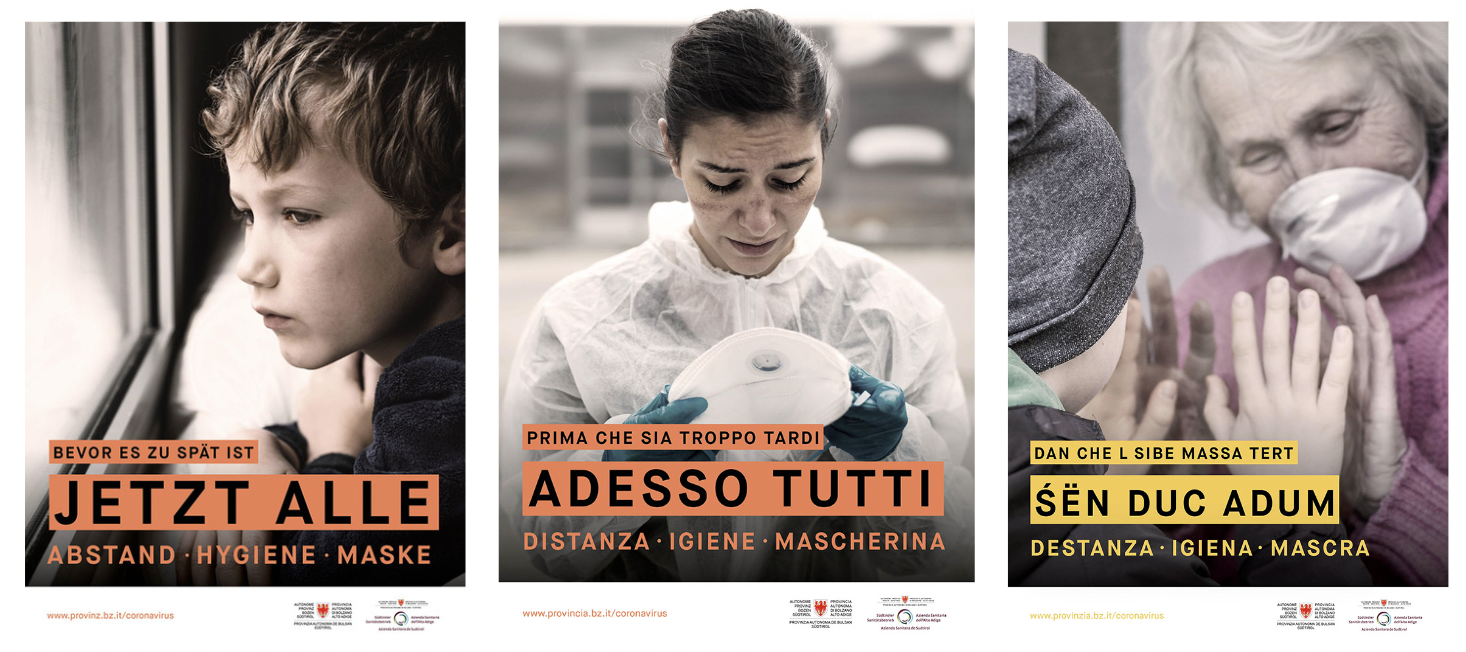
Bozen-Bolzano Province started a multilingual campaign, “before it is too late,” to sensitize citizens to the risks of the COVID-19 pandemic
When the government closed schools, they also announced there should be an immediate switch to online teaching, but in Italy there is something called “school autonomy” and within it “didactic autonomy,”which meant that schools also had autonomy to decide how to deal with online teaching and remote teaching. School autonomy took effect in 2000, and within the School Autonomy Regulations there are rules regulating teaching autonomy (art. 4) and organisational autonomy (art. 5). The application of these rules is the direct responsibility of the school, which implements them with flexible criteria, but respecting the families’ freedom of educational choice and, in any case, recognising and valuing diversity, promoting the potential of each pupil, and adopting all the initiatives useful for achieving educational success. The educational institutions ensure the implementation of remedial and support, continuity and school and career guidance initiatives for pupils. On the basis of autonomy, educational institutions can change the annual number of hours of teaching disciplines (subjects) by a quota of 20%.
In terms of the response to the closures, generally, the tendency was for schools to go to remote teaching immediately and to do a lot of online teaching. That was a challenge, because neither the teachers nor the children were well prepared for the transition. It was difficult also in some regions where the internet connections still are not very good. In those areas, the Ministry of Education encouraged teachers to contact children via phone if they didn’t have access to the internet or to send materials to children or parents. Locally, there were also a schools where teachers would leave materials for the students and then return to pick up the work that the parents brought back to the school after the students worked on them In some primary schools, it went on like that until the end of the 2020 school year so those schools never even had remote teaching. However, some schools reopened for children whose parents had to go back to work, and the government did discuss opening up some “catch-up programs” during the summer, but the teachers’ unions said that the health of teachers also had to be safeguarded. That’s why schools didn’t open up again until September, 2020.
TH: What about other aspects of the response? Was there a local or regional effort to get people connected or to get them devices?
BG: Because the internet access in some places was so sporadic, getting everyone devices wasn’t really a viable solution. But there were funds for devices, especially for what they considered “vulnerable children.” However, from the beginning of the outbreak the decision was to leave the schools closed to protect the health of children, so the focus wasn’t really on education. The expertise that was considered was always the expertise of medical experts. Then the government started to consider the economy and opening up businesses, and it wasn’t until after that that they thought about education.
[F]rom the beginning of the outbreak the decision was to leave the schools closed to protect the health of children, so the focus wasn’t really on education. The expertise that was considered was always the expertise of medical experts. Then the government started to consider the economy and opening up businesses, and it wasn’t until after that that they thought about education.
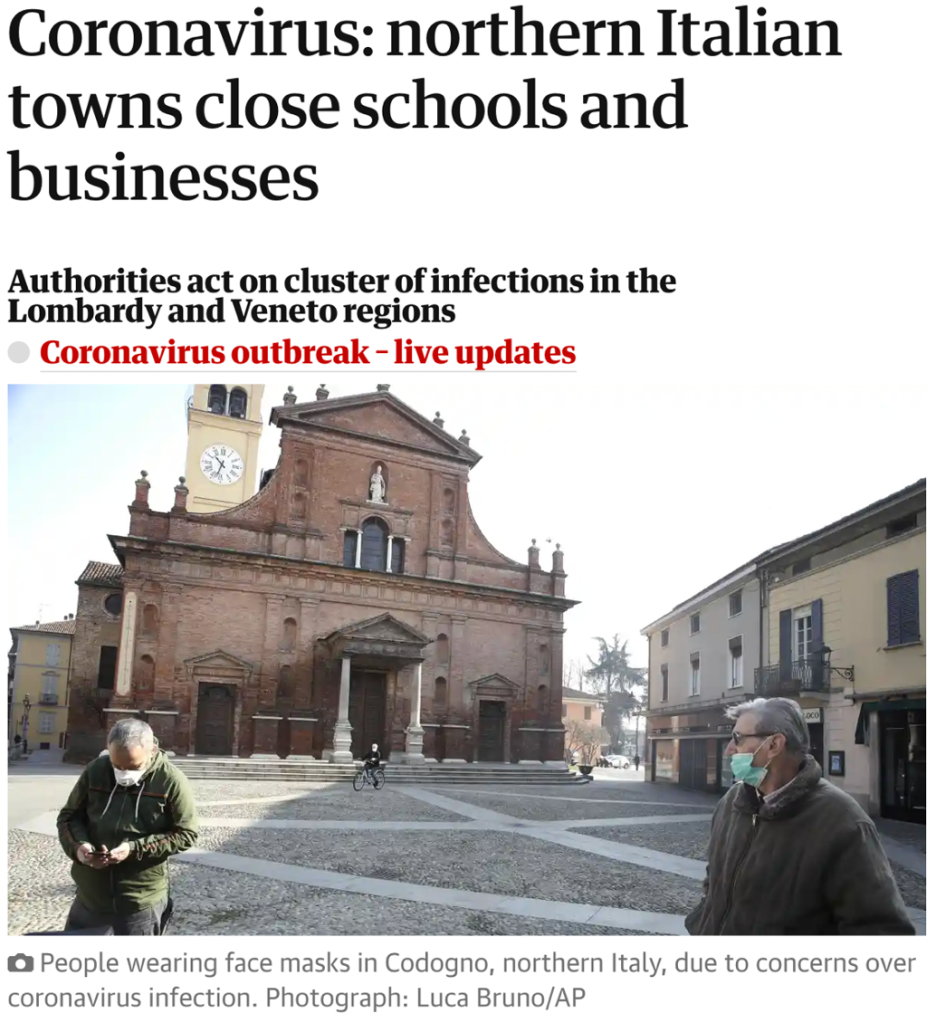
The Guardian depicts the effects of COVID-19 in Northern Italy
TH: And what happened with the exams during the closures?
BG: Generally, the government had a very pragmatic way of dealing with exams, stating that grading should not disadvantage learners. In high schools, for example, exit exams for graduating students were simplified, and in the composition of the final grade, the oral part received a higher weight; however, the oral part was held in person, with social distancing. For younger students, you can see from the data that students’ grades for the year were higher than normal. That probably reflects the concern about inequality and not wanting to penalize students who didn’t have the support to study at home or to get the help they would have gotten in schools. They didn’t want the students’ grades during the closures to hold anyone back.
TH: What happened when the schools came back in person in September 2020?
BG: After the schools reopened, there was no other national shutdown, but in the spring of 2021 there were some local school closures. Again, these decisions were made at the national level, in response to data health, for example, on the number of cases in a particular area. When the students did come back in September 2020, schools in certain regions tried different kinds of social distancing. Some had different entrances and exits. Some schools also continued with hybrid education, having some students in class at school and some at home online at the same time. There was also priority placed on keeping schools open for younger children, to try to make sure they can be in school, every day, in person, but then for secondary school students, it was more of a hybrid mixture.
In terms of other changes, primary schools in my area in South Tyrol introduced a new period of “self-organized learning” during the first hour of the school day. This was supposed to allow for flexible entrances – and thus lower the risk for infections – and, at the same time, help students to adjust to going back to school and catch up on possible learning losses.
“As far as the newly introduced learning format of self-organized or independent learning is concerned, around 80 percent of the teachers and pupils in primary and secondary schools stated that they got along well with the learning format of self-organized or independent learning. A similar picture emerges for parents and guardians: 82 percent believe that their child coped well with this learning period. A point of criticism in connection with self-organized learning is that, especially in primary school, the pupils were often given too few challenging tasks in this learning area. It was also criticized that the use of digital media was limited at this school level.”
From the School year 2020/21: External evaluation of the South Tyrolean Provincial Administration
The national government also took other steps, for example, they were very committed to enhancing or fostering the wellbeing of students. Even though Italy doesn’t normally have school psychologists, they provided funding so that schools could get a psychologist or find other ways to support students and even teachers and parents, if needed – the aim was preventing and treating negative consequences that emerged during COVID-19. That was a national decision, and it meant that schools had a right to a certain number of hours of support from a psychologist in 2022 – however, they also discussed the need for a permanent systemic introduction of the function of psychologists in educational institutions.
References
Gross, B., Kelly, P., & Hofbauer, S. (2022). ‘Making up for lost time’: neoliberal governance and educational catch-up for disadvantaged students during the COVID-19 pandemic in Italy, Germany and England. Zeitschrift für Diversitätsforschung und -management 2, 161-174. doi: 10.3224/zdfm.v7i2.04
Kelly, P., Hofbauer, S., & Gross, B. (2021). Renegotiating the public good: Responding to the first wave of COVID-19 in England, Germany and Italy. European Educational Research Journal, 20(5), 584-609. doi: 10.1177/14749041211030065
Francesconi, D., Gross, B., & Agostini, E. (2021). The role and facets of wellbeing during the first wave of the COVID-19 pandemic: A qualitative analysis of Austrian and Italian educational policy. Psihološka istraživanja, 24(2),141-162. doi: 10.5937/PSISTRA24-32602
Gross, B., Francesconi, D., & Agostini, E., (2021). Ensuring equitable opportunities for socioeconomically disadvantaged students in Italy and Austria during the first wave of the COVID-19 pandemic: A qualitative analysis of educational policy documents. Italian Journal of Educational Research, 27, 27-39. doi: 10.7346/sird-022021-p27

 International Education News