In part 3 of this 3-part interview, Hirokazu Yokota shares his personal reflections on his experiences helping to establish the new Children and Families Agency (CFA) and, previously, the new Digital Agency. In Part 1, Yokota described the development of the CFA and the efforts to promote digital transformation in childcare, and in Part 2, he discusses some of CFA’s current initiative. Yokota has followed a rare career path as a bureaucrat who belongs to the Japanese Ministry of Education, Culture, Sports, Science and Technology (MEXT), but who has repeatedly stepped out of the “education circle” to work in other agencies, including the Children and Families Agency, which was established in April 2023. In September 2021, Yokota was one of the charter members who helped launch Japan’s Digital Agency , and he went on to work as a Deputy Superintendent in Today City. Yokota has previously written about his experiences as a parent and educator during the pandemic as well as his work in the Digital Agency and in Toda City: A view from Japan: Hirokazu Yokota on school closures and the pandemic; Hiro Yokota on parenting, education and the new Digital Agency in Japan; and Hirokazu Yokota on aggressive education reforms to change the “grammar of schooling” in Toda City (part 1) and (part 2). Please note that Yokota is sharing his personal view on CFA and its policies, and his views do not represent the official views of the government. For further information contact him via Linkedin.
IEN: Can you share your personal take on the initiatives by CFA – how is it working? What have you found most exciting, most challenging? What’s next for the agency/society?
HY: It is precisely because these are newly established organizations that they are able to advance policies that would be difficult under the framework of existing institutions. For example, the number of staff at the Digital Agency increased from 571 at the time of its establishment in September 2021 to 1,013 as of July 2023. The government has set a goal of further expanding this to approximately 1,500 personnel. Similarly, the Children and Families Agency’s budget has grown significantly: from approximately JPY 4.8 trillion in FY2023, to approximately JPY 5.3 trillion in FY2024, and to approximately JPY 7.3 trillion in FY2025 with the launch of the “Children’s Future Strategy” (Kodomo Mirai Senryaku) and its “Acceleration Plan” (Kasokuka Plan). Thus, it now far exceeds the Ministry of Education, Culture, Sports, Science and Technology (MEXT) budget (approximately JPY 5.3 trillion in FY2024 and JPY 5.5 trillion in FY2025). Such dramatic increases in staffing and budgets were made possible precisely because these were newly created agencies.
Also, last December we published “New Direction of Childcare Policy,” which details specific policy measures that should be taken in the next five years. There are so many workloads ahead, but I am very excited to take on these new tasks to fully realize the “child-centered society.”
Personally, during my time at the Digital Agency, I worked alongside many private-sector professionals, from developing priority plans for the realization of a digital society to promoting digital transformation in the fields of education and child-rearing. From them, I learned a great deal about flat information sharing and interactive meeting styles, which are common in the private sector. Later, when I was seconded to the Toda City Board of Education as Deputy Superintendent and Director of the Education Policy Office, I was able to take on many “zero-to-one” challenges — such as implementing the use of educational data in schools and piloting one-on-one meetings and reflection workshops to foster a flat organizational culture — things I might not have been able to do if I had remained in MEXT.
Now, as I lead digital transformation (DX) initiatives in the field of childcare at the Children and Families Agency, I feel that the “practical knowledge” I gained from my experiences at the Digital Agency and in Toda City is proving immensely valuable. As with the Digital Agency, we are advancing childcare DX projects with a mixed team of public- and private-sector personnel using a project-based approach. In this work, I constantly strive to serve as a bridge connecting “policy (systems)” and “technology (systems).” These two are two sides of the same coin: without a deep understanding of both, it is impossible to build effective structures. Given my background traversing the traditional bureaucratic divides between policy and systems, I believe that my ability to connect civil servants knowledgeable about policy and politics with private-sector experts skilled in technology is a unique value I bring. While minimizing risks, I find great purpose in leading the highly challenging task of building two entirely new national information systems in the childcare sector.
However, there is something I personally feel about the challenges faced by new organizations like the Digital Agency and the Children and Families Agency. In these organizations, the individuals who often receive public attention are those recruited from the private sector (e.g., the Digital Agency note and an article of CFA staff). Of course, I fully understand that highlighting these individuals is a necessary strategy to attract talented people from the private sector to public service. Still, it must not be forgotten that there are also many government officials—those who may not be in the spotlight—working diligently and persistently to realize a digital society and a child-centered society. During the foundational periods of these agencies, I witnessed firsthand many civil servants who unfortunately had to take leave due to overwork or mental stress. There were times when I blamed myself, wondering if I could have done more to support them. It is easy to criticize bureaucrats. That is precisely why I strongly hope that the media will shine more light on those government employees who, despite struggling to adapt to cultures different from their home ministries, are working earnestly for the public good in these new organizations. In the United States, there have been mass layoffs of federal employees. Precisely because of that, I believe that Japan should reaffirm its respect for civil servants who serve behind the scenes as the “unsung heroes” supporting public service.
“I believe that Japan should reaffirm its respect for civil servants who serve behind the scenes as the “unsung heroes” supporting public service.“
Looking toward the future, at the Children and Families Agency, we are now challenging ourselves to directly listen to the voices of children and young people through various channels and reflect their opinions in policy. In doing so, I believe it is necessary to proactively reach out to “those whose voices are not being heard” — the children and young people who have not yet had the chance to sit at the policymaking table. Constantly being aware of who is not at the table and delivering support in a proactive (“push”) manner, combined with respect for civil servants working behind the scenes, will surely help make this country better.
Furthermore, it is extremely important to make the policy methods developed by the Digital Agency and the Children and Families Agency the new norm across all of Kasumigaseki (the Japanese government). When I shared new policy challenges that I was working on, I occasionally heard comments, even from those inside the government, such as, “You could only do that because you’re in a new agency like the Digital Agency or the Children and Families Agency.” I believe that kind of thinking is truly unfortunate. One day, when I return to MEXT, I want to prove that it is not because of the agency’s novelty, but because each and every civil servant, with a sense of purpose and a little courage, can make change happen.
“[I]t is not because of the agency’s novelty, but because each and every civil servant, with a sense of purpose and a little courage, can make change happen.”
Next Week: From foundational learning to colleges and careers: Critical educational issues in India post-pandemic (Part 1)
To get a glimpse of Japan’s effort to create a “child-centered society,” Hirokazu Yokota shares what he’s learned from his experiences working at the Children and Families Agency (CFA). In the first part of this 3-part interview, Yokota describes the establishment of the CFA and the efforts to promote digital transformation in childcare.Parts 2 and 3 discuss the current initiatives of the CFA and Yokota’s personal reflections on his involvement in the development of new governmental institutions in Japan. Yokota has followed a rare career path as a bureaucrat who belongs to the Japanese Ministry of Education, Culture, Sports, Science and Technology (MEXT), but who has repeatedly stepped out of the “education circle” to work in other agencies, including the Children and Families Agency, which was established in April 2023. In 2021, Yokota was also one of the charter members helping to establish Japan’s Digital Agency , and he went on to work as a Deputy Superintendent in Toda City. Yokota has previously written about his experiences as a parent and educator during the pandemic as well as his work as a government official and administrator in: A view from Japan: Hirokazu Yokota on school closures and the pandemic; Hiro Yokota on parenting, education and the new Digital Agency in Japan; and Hirokazu Yokota on aggressive education reforms to change the “grammar of schooling” in Toda City (part 1) and (part 2). Please note that Yokota is sharing his personal view on CFA and its policies, and his views do not represent the official views of the government. For further information contact him via Linkedin.
IEN: Can you tell us a bit about the Children and Families Agency and why it was established?
Hiro Yokota: The Basic Policy on the New Framework for Promoting Child Policy – Establishment of the Children and Families Agency Aimed at Realizing a Child-Centered Society (Cabinet decision, December 21, 2021) stated a clear rationale for establishing this new agency:
“Now more than ever, we are at a critical crossroads: we must strongly advance child-related policies not only to curb the declining birthrate, but also to enhance the well-being of every child and ensure the sustainable development of society. With the best interests of the child always as the top priority, we aim to place children and child-related policies at the very heart of our society—an approach referred to as a “child-centered society” (kodomo mannaka shakai). From the perspective of children, we will take into account all environments surrounding them, guarantee their rights, and ensure that no child is left behind. As a society, we will support their healthy growth collectively. To realize this vision of a child-centered society, we are establishing a new central governing body: the Children and Families Agency (Kodomo Katei-chō).”
IEN: How did you come to work at the Children and Families Agency?
HY: From April 2022 to March 2024, I served as a deputy superintendent and director for education policy at Toda City Board of Education Office in Saitama prefecture. More than three years had passed since I left my home ministry – the Ministry of Education, Culture, Sports, Science and Technology (MEXT) – so most everyone anticipated I would return to MEXT, as I mentioned in my previous article. However, that did not happen, and I was seconded again, this time to CFA, which was actually what I wished for. In order to change and make education better, I take a stance of getting intentionally out of the “education village” and trying to change the status quo from outside.
IEN: Could you provide some examples of your primary work at the Children and Families Agency?
HY: My division (Childcare Policy Division, Child Development Bureau) is mainly in charge of three policies related to early childhood education and care; connecting children to the childcare system; increasing support for childcare workers; and promoting the digital transformation in childcare.
Free Early Childhood Education and Care
In light of the need to address Japan’s declining birthrate and recognizing the vital role early childhood education plays in personality development and forming the foundation for compulsory education, the government introduced free early childhood education and care in October 2019. Under this initiative — as explained in the English-language pamphlet “What about my child?”— all children aged 3 to 5 can attend nursery schools, certified child centers (nintei kodomoen), or kindergartens free of charge. For children aged 0 to 2, households exempt from resident tax are eligible for free care. Others have to pay a fee for their first child, but the second child in the household receives a 50% reduction in fees, and care is fully subsidized for third and subsequent children.
Connecting All Children to the Early Childhood Education System (Kodomo Dare Demo Tsuuen Seido)
According to the “Children’s Future Strategy” (Kodomo Mirai Senryaku), approved by the Cabinet on December 22nd 2023, many families — especially those with children aged 0 to 2, of whom about 60% are not enrolled in formal childcare — face anxiety and isolation in childrearing. In response, the government aims to support all children and families regardless of work status or lifestyle by enhancing access to high-quality early childhood environments. To achieve this, a new benefit called the Connecting All Children to ECEC System was established, allowing flexible, hourly use of childcare services within a monthly usage limit, without employment-related requirements.
“a new benefit called the Connecting All Children to ECEC System was established, allowing flexible, hourly use of childcare services within a monthly usage limit“
Improving Compensation and Staffing for Childcare Workers
To attract and retain dedicated childcare professionals, enhancing their working conditions is essential. As part of this effort, the FY2024 and FY2025 supplementary budget includes a significant 10.7% increase in personnel costs and, since 2012, total improvements have amounted to approximately 34%. While the average salary still lags behind that of all industries, the government’s recently published “New Directions in Childcare Policy” outlines a clear goal of achieving parity with national averages. Staffing standards are also being revised to improve safety and quality of childcare. For the first time in 76 years, the staff-to-child ratio for 4- and 5-year-olds is being improved from 1:30 to 1:25 through a new Enhanced Staffing Subsidy. Additionally, for the first time in over 50 years, for 1-year-olds a new subsidy has been introduced for facilities improving staffing from 1:6 to 1:5. To ensure that these improvements actually reach childcare sites, the revised Act on Child and Childcare Support also mandates greater transparency in financial operations. Childcare providers must annually report their staffing levels, salary data, and income/expenditure details to prefectural governors, who will then disclose key figures — such as model salaries and labor cost ratios — at both individual and aggregate levels. This transparency will help guide future improvements in standardized pricing.
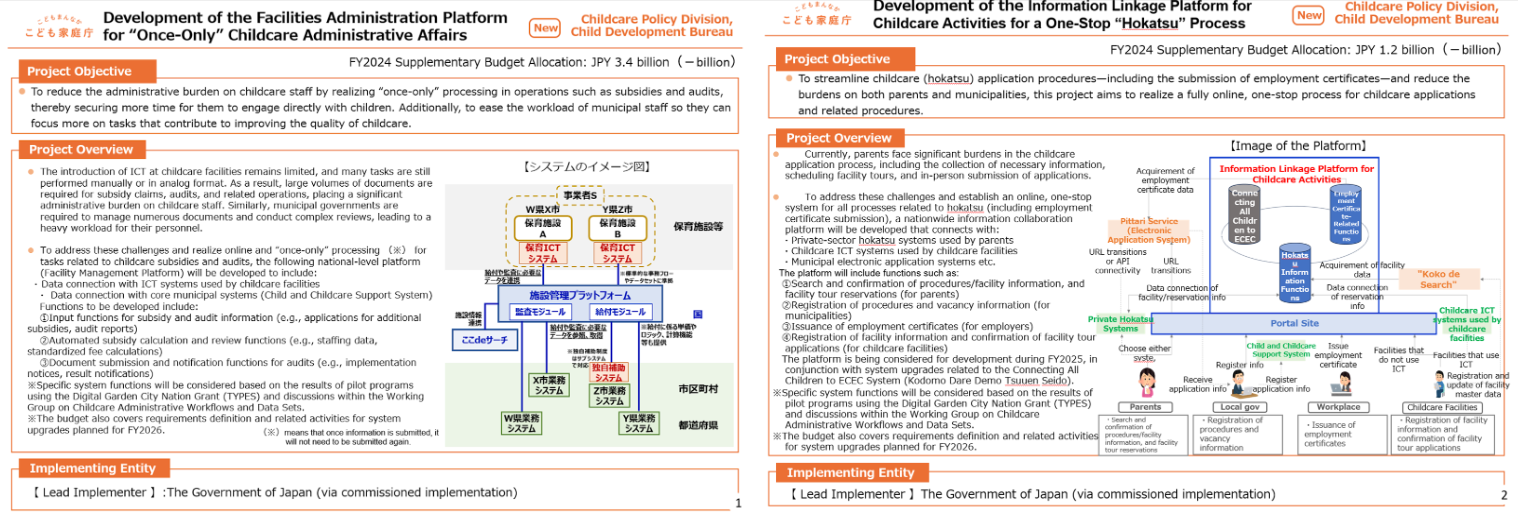
Promoting Digital Transformation (DX) in Childcare Currently, both childcare facilities and local governments face substantial administrative burdens. Facilities must prepare numerous documents for subsidy applications and audits, with formats varying across municipalities. Local government staff spend considerable time manually entering and checking information submitted by facilities, often needing follow-up in cases of errors or omissions. Parents also face burdens, including time-consuming information gathering, the need to call during operating hours to schedule visits, and handwritten application forms submitted in person — even during pregnancy or while caring for young children.
To resolve these issues, the Agency aims to reduce reliance on analog documentation through digital data-sharing and thereby free up time for childcare professionals to focus on children. For local governments, the goal is to reduce the workload associated with data entry and review, allowing staff to focus on improving the quality of care. For parents, we are working toward a seamless, one-stop digital experience for all steps of the childcare application process.
“To resolve these issues, we aim to reduce reliance on analog documentation through digital data-sharing and thereby free up time for childcare professionals to focus on children.“
To that end, we are developing two key national platforms:
The Facilities Administration Platform on Childcare Administrative Affairs, which supports “Once Only” data entry for subsidy and audit-related procedures through integration with facility ICT systems and government backend systems. This will reduce duplicate submissions and streamline communication between facilities and municipalities.
The Information Linkage Platform for Childcare Activities, which connects parents, facilities, and local governments to enable end-to-end digital childcare procedures—such as information searches, visit reservations, and applications—via smartphone.
Plans for the Facilities Administration Platform on Childcare Administrative Affairs & Information Linkage Platform for Childcare Activities
By the end of FY2025, we aim to begin pilot operations for both platforms with nationwide rollout planned from FY2026 onward. Through all of these efforts, we aim to create an environment where the benefits of digital transformation are clearly understood by those on the ground; that enhance the attractiveness of the childcare profession for future generations; and that ultimately make the system easier and more convenient for all stakeholders.
To accelerate the digital transformation in childcare, we also launched a new initiative in FY2024: the Childcare ICT Lab Program. This program supports model projects at multiple sites across Japan, implemented in partnership with private-sector entities.
Next Week: Centering Children and Youth in Policymaking: Hiro Yokota on the Development of a “Child-Centered Society” in Japan (Part 2)
What does it take to expand support for learning in and across communities? In the second part of this 2-part interview, Gregg Behr talks about the development of the first Remake Learning Days in Pittsburgh, Pennsylvania and how they spread to community-wide efforts in 15 different regions in 4 countries. In 2007, Behr, the executive director of The Grable Foundation, founded Remake Learning as a network of educators, scientists, artists, and makers supporting future-driven opportunities for children and youth in Pittsburgh. Celebrating its 10th edition this month. Remake Learning Days began in 2016 as a local learning festival with hands-on learning events for children of all ages at libraries, schools, parks, museums, and other community spaces. Behr is also the author with Ryan Rydzewski of When You Wonder, You’re Learning, sharing the science behind the work and words of Fred Rogers and Mister Rogers Neighborhood, a well-known television show that ran for over thirty years. This interview has been edited for length and clarity.
TH: Let’s turn to one of the activities that I think has become a signature of your work – Remake Learning Days. What were some of the critical “aha’s” in their development?
GB: The first “aha” happened in one of the human centered design sessions. In Pittsburgh, we had a firm called Maya Design, and they had a retreat room surrounded by whiteboards where they would facilitate these amazing sessions. In 2015, we convened about 30 people, including folks who came from the White House Office of Science and Technology Policy. We were asking these big questions about how far Remake Learning had come and where we might go – asking, essentially, how do you build out a learning ecosystem? What would that look like? It was during that session that it became clear that the network was serving professionals like teachers and afterschool directors, librarians, and designers really well, but that we weren’t really designed to serve parents, families and caregivers. There was a clear “aha” that if we didn’t seriously engage with these members of our community, we’d risk being incredibly faddish, and we started wrestling with what we could do to engage this group. There wasn’t an obvious way to just plug parents and families into our different programs and activities, but through this user design process two things came to light. One was that someone talked about how open houses were one of the singular moments when parents, families and caregivers really come to schools and engage with educators, as surface level as it might be. Then totally separately, someone talked about how, at least in Pittsburgh, we have lots of neighborhood festivals like the Pickle Festival, the Perogie Festival, etc. I can’t even remember who it was, but someone said “Hey, what if we put these two ideas together? This idea of neighborhood festivals with the idea of an open house?” And so we started to talk about having a kind of festival of open houses of all of these places for kids and learning that had been built over the past couple of years. At that point, we had dozens, if not hundreds of makerspaces. We had STEM labs. We began to wonder what might happen if there was a chance for parents, families and caregivers together with their kids to get into all of these spaces and to get beyond their schools and to go into into the Carnegie Museum of Art or whatever it might be. That was the germ of the idea of what became Remake Learning Days, but I can’t even recall what it was called initially.
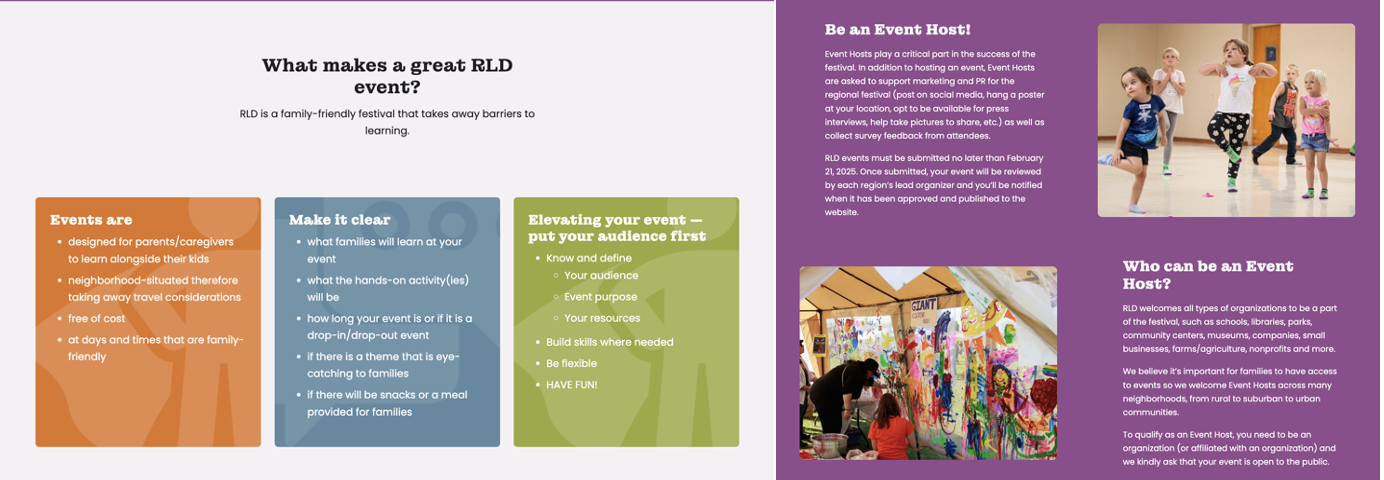
Within a year, we had the first Remake Learning Days in 2016 because all sorts of organizations said they wanted to participate. There were more 250 events over the course of about nine days. 25,000 people came out in that very first year! That was the second aha – seeing all of those people come out and realizing “Oh, there’s something here!” The other big realization was that there were 250 events that were self-organized: they did it and they weren’t paid to do it. Clearly something had traction, in 2025 in Pittsburgh, we’ll celebrate 10th edition of Remake Learning Days.
TH: That’s an incredible story. In 2019, other cities in the US and in other countries started hosting their own Remake Learning Days: How did they start to spread?
GB: The same people from the White House Office of Science and Technology Policy challenged Remake Learning to document its work in what became the Playbook. In fact, someone from that Office left the White House to work with the Sprout Fund in designing the Playbook. The basic idea behind the Playbook was to create something that would be as helpful to people and organizations in Pittsburgh as it would be to Flint, Michigan or Oklahoma City. After seeing how the Remake Learning Days had taken hold in Pittsburgh, we started looking for financial support to develop the Playbook. We got some funding primarily from the Carnegie Corporation of New York, and created what we initially called a toolkit that communities could use to host their own Remake Learning Days. At the time, Remake Learning was deeply involved with other national organizations and associations that were involved with STEM, the maker movement, and other things like that. We just put the toolkit out there to say, “Who else might want to host Remake Learning Days?” And that’s how they began to spread.
TH: As I understand it, you’ve tried to let these Remake Learning Days grow and spread more or less on their own? Are there any particular lessons you’ve learned, either any lessons you’ve learned, either vicariously or from your interactions with those in other communities?
GB: In terms of letting them spread, yes and no. We’ve tried to provide just enough guardrails so that, if a Martian comes down and goes to Remake Learning Days in Pittsburgh and then Doncaster, England and then southern Wisconsin, it would seem like these things are connected. If Remake Learning Days are going to be successful, you have to have that connection, but they also have to feel contextualized in these different places.
“We’ve tried to provide just enough guardrails so that, if a Martian comes down and goes to Remake Learning Days in Pittsburgh and then Doncaster, England and then southern Wisconsin, it would seem like these things are connected.”
Along the way, the team has learned a thousand lessons. They’re going to continue to iterate as they look ahead to years 11 and 12, but like so many other community-based initiatives, you need to have that “backbone” organization; you have to have that clear champion who’s going to lead the work. In one instance, there was an amazing woman who made Remake Learning Days happen where she lived. But after she left, it hasn’t been the same thing. It was so tied to one person and one organization that it just didn’t stick; so we’ve learned that lesson. We’ve also learned the lesson that sometimes things have beginnings and ends. Chattanooga and Chicago hosted phenomenal Remake Learning Days, and they met the needs of the Public Education Foundation in Chattanooga and the Chicago Learning Exchange. But they plateaued in their utility, and both said, essentially, “We’ve loved this, but we’re not going to continue with this,” and we’ve learned that’s totally fine. We’ve seen places like Sarasota and Doncaster completely adopt this approach; raise lots of local money; and Remake Learning Days are now integral to their local efforts. If we were to shut down Remake Learning here in Pittsburgh, they would continue on in some of these other places. We’ve learned all sorts of lessons about leadership, about local financing, about making it local so people feel connected to it. It’s not just a franchise that someone imports; the Remake Learning team has worked hard in terms of monthly meetings and all sorts of things to make sure there’s quality control for successful festivals.
Gregg Behr at a Remake Learning event (photo: Ben Filio)
TH: I didn’t realize how much work the Remake Learning team is putting into these. I thought you put the Playbook out there, and then just let people use it. But you actually have a team that coordinates with these other places, and in a sense sanctions these other events, and says, “Yes, these are Remake Learning Days. This is one of our partner events”?
GB: Again, the answer is yes and no. Everything that Remake Learning has done, maybe to its detriment, is through Creative Commons licensing, so people have used the Remake Learning Network playbook and also the Remake Learning Days toolkit to their own effect. In New Hampshire, they have used the playbook to support the development of their local learning networks but never with any formal coordination with Remake Learning— – and that’s okay. Places like Qatar have had “Doha Learning Days” and have used the Remake Learning Days playbook. I’d say it’s a loosely sanctioned process. But then there are two producers of Remake Learning Days, and they in turn work with the team in Sarasota or the team in Doncaster, or wherever it may be.
TH: How does that work? Does Sarasota have to pay the producers or are they providing pro bono services to the places that want to do it?
GB: Yes, they have a remarkable team supported by The Patterson Foundation in Sarasota; and, for Sarasota and elsewhere, Remake Learning has borne the costs for some of the regional and national marketing, because with an event like this, the most significant costs are marketing.
TH: Have you run into challenges where you wish that some place wouldn’t call their events Remake Learning Days?
GB: There have been some challenges along the way, with some places that want to call it something else like “STEM Days,” and the team has had some tough conversations with some cities, saying if we’re going to be part of this, then there are a few things you need to do. Some cities have just said, “We’re going to have our own thing.” There are also challenges around quality control and questions about what kinds of events to connect with. There are now some pop-up festivals which have been hugely successful. People have staged events in Tel Aviv and Antarctica, but sometimes these are singular events on a particular day, and they’re branded and connected to Remake Learning Days, and they’re on the website, but it’s not a multi-day festival the way it is in Sarasota or southern Wisconsin or Kansas City.
Dates are also difficult. Even with the pop-up events, Remake Learning Days have had a set date range, something like April 23rd through May 23rd. For example, the six regions in Pennsylvania that now host Remake Learning days, they all happen at the same time. That is very deliberate, and they are coordinated statewide. But in
Tennessee, they valued Remake Learning Days, but May didn’t work for them because of state testing, and it turns out that May is not a great time for Remake Learning Days in Uruguay. That raises the question: does it have to be around the same dates around the world for it to be called Remake Learning Days? The team is wrestling with a whole bunch of questions like this as they go forward. They’re trying to provide greater flexibility while maintaining quality control.
TH: Can you say anything more about the next steps or the challenges ahead for Remake Learning Days and Remake Learning?
GB: In terms of challenges, like a lot of these things, no one ever imagined there being a 10th edition. But even with that, ongoing fundraising is a challenge. Yet, for corporate funders, sponsoring an event like Remake Learning Days is a lot easier than sponsoring a network. For fundraising, it certainly helps that they have built up a body of data, including qualitative evidence – write-ups and videos – to support it. Quantitative data, too! For example, they worked with Heather Weiss, who led the Harvard Family Research Project to document their impact on parents. Their goals included helping parents understand how learning is being remade; helping parents understand how they can support their own kids if they find their kids are lit up by art and design or coding or maker-centered programs; and building up demand among parents so they might go to school board meetings, parent-teacher conferences, or their local library to ask questions about these approaches to learning that are clearly lighting up their kids. Heather’s work demonstrated that parents were gaining familiarity with STEAM and new approaches to learning and building their interest and support for those approaches.
“Ongoing fundraising is a challenge. Yet, for corporate funders, sponsoring an event like Remake Learning Days is a lot easier than sponsoring a network.”
Looking toward the future, I think we’ll see fewer sites that host Remake Learning Days, but they will be more embraced by their region, with significant regional funding. In addition to seeing that in southern Wisconsin, on the west coast of Florida, and Doncaster, the Pennsylvania Department of Education has invested significantly in Remake Learning Days and different units from the state government are also providing in-kind support. I think we may see more changes like that where public funding also helps to drive further engagement and support from local and state governments.
TH: Looking to the future, let’s return to Remake Learning in Pittsburgh. What do you think it will take to sustain and deepen this work overall? Are there particular problems that have to be addressed or changes that have been made?
GB: There are always lots of answers to a question like that! One thing we have to address is leadership. The leadership has evolved over the years. When it was time for the Sprout Fund to sunset, and they wrapped up their work, we hired what amounted to a director for Remake Learning, and there have been a number of directors since that time, each of whom has held the position for at least two or three years. But incredibly, it wasn’t until around 2014 or 2015 that we convened what we call the Remake Learning Council. This is a council of CEOs, learning scientists, leaders of cultural institutions and others who meet regularly with the director and the Remake Learning team and provide advice and support. Of course, the people in these roles change positions all the time. There are new museum directors, new superintendents and so on. We have to pay attention to that churn and make sure we have the right people and the right support, and that’s a great leadership challenge. It’s also what makes Remake Learning sustainable – it’s crucial to have a large number of leaders across the community who value this work, who are contributing to the design of it and advancing it.
Relatedly, Remake Learning, if you can believe it, has never been its own separate 501 (c) (3) [which would allow it to be a charitable organization collecting tax exempt donations]. That’s because part of the strategy in the beginning was to demonstrate that this was not going to be something that competed for funding with other charitable organizations, like museums and some of our other charitable partners. Instead, Remake Learning has been fiscally sponsored by other organizations, and I think that’s been a real benefit – so that the focus could be the work itself. Initially, Remake Learning was fiscally sponsored by the Sprout Fund; then it was fiscally sponsored by our regional association of grantmakers called Grantmakers of Western Pennsylvania. It’s currently fiscally sponsored by the Allegheny Intermediate Unit, our region’s educational service agency. But we always have to check in on our structure: Do we have the right home? Do we have the right governance? That’s an ongoing challenge for the network.
“Part of the strategy in the beginning was to demonstrate that this was not going to be something that competed for funding with other charitable organizations, like museums and some of our other charitable partners.”
Another challenge with any organization that reaches 20 years is that you’ve got people who’ve been involved for nearly 20 years, and there are people who just joined two weeks ago. We have to keep the work fresh and relevant for the newcomers as much as for the veterans. This is a programmatic challenge. It’s hard to keep things fresh for most everyone involved. As one example of “keeping things fresh,” Remake Learning started in the past few years to distribute what they call Moonshot Grants. Regionally, I think they’ve spent about three or four million dollars in grants to local organizations and schools that are really trying to push the edge of what constitutes great learning, especially as such much around us is changing. That’s one example that’s kept the work really fresh.
Remake Learning has also really leaned into some of its national and international partnerships, which has pushed its work forward. Just last week Remake Learning announced ten national moonshot grants, which came out of the Forge Futures Summit, which brought together organizations involved in learning ecosystems from around the US, and even a few other places worldwide. This speaks to the spread and the tension: Remake Learning is committed to being a regional organization and it has to continue to do basic things brilliantly at the regional level. It’s not a national or international organization, but it sometimes has – or could have – a national and international role to play. That’s what Remake Learning Days have done, and Remake Learning is figuring out how to do that as a network while not distracting ourselves from our core mission regionally.
TH: Can you say a bit more about what Remake Learning has done internationally?
GB: Remake Learning has partnerships with a number of international organizations including HundrED in Finland, Big Change out of London, OECD, and the Global Education Leadership Partnership. Just as an example, Remake Learning got connected to Big Change pre-pandemic because they had done a report and Remake Learning ended up being one of their case studies. Now Remake Learning and Big Change are funding a loose federation of international organizations that meet almost monthly. Along with Remake Learning and Big Change, it includes Learning First out of Bermuda, People for Education in Canada, Learning Creates Australia, Innovation Unit, Zizi Afrique in Kenya, Fundacio Bonfill in Spain, Educate! in Uganda, and Dream a Dream out of India. You’ve got people who represent different geographies. In some cases, they are more metropolitan like Remake Learning, but in others are more nationwide, like Uganda Educate! The first meeting focused on Bermuda’s transforming education system. The second one was a showcase of some of the work in Australia. It’s become a global learning community.
‘Even-handed treatment of all sides’: A critical policy analysis of Massachusetts anti-discriminatory school committee proposals – Erin Nerlino (EN), Clark University, & Lauren Funk (LF), Boston University
Lead the Change (LtC): What are some of the ideas you hope the field of Educational Change and the audience at American Education Research Association (AERA) can learn from your work related to practice, policy, and scholarship?
EN & LF: By engaging in this work, we aim to enhance the knowledge that the field of Educational Change and the audience at AERA have about how some threats to equal education and student belonging occur locally within cities, towns, and school district communities. While much attention has rightly been focused on states that have more widespread discriminatory laws in place, such as Florida and Texas (Johnson, 2020), local communities in states such as Massachusetts are also facing divisive and discriminatory policies. Educators, parents, students, and community members are organizing in response to resist such policies in many districts; however, an increasing number of these discriminatory and divisive policies are arising (Feingold et al., 2023). We hope to shed light on the communal threat that these policies pose and break the silos of individual districts facing these policies to share resources, strategies, and experiences in successfully resisting.
“Threats to equal education and student belonging occur locally within cities, towns, and school district communities.”
Furthermore, much of the language and concepts used in these policies can initially seem benign, suggesting that all viewpoints are just and reasonable. For example, the four policies under study in this work use words and phrases such as “neutral,” “unbiased,” and “even-handed treatment of all sides.” These phrases assert the false idea that presenting all sides of a social policy issue constitutes neutrality and that neutrality itself is ideal and not taking a position. Many of the underlying implications impact already vulnerable student populations and hamper the efforts of educators. To refer back to the previously-mentioned phrase of an “even-handed treatment of all sides” as an example, this assertion opens up the classroom as a space that has the potential to deny students’ identities as it allows for individuals to voice problematic ideas based on race, sexual orientation, religion, social class, etc., in the name of covering “all sides” of an issue. By elucidating some of the problematic language, we hope to prepare fellow allies in practice, policy, and scholarship to productively challenge ideas that might threaten the belonging of all students in schools.
Dr. Erin Nerlino
Dr. Lauren Funk
The implications of educational change on socioeconomically disadvantaged students – Elif Erberk (EE) Van Yuzuncu Yil University, & Yasar Kondakci (YK) Middle East Technical University
Lead the Change (LtC): What are some of the ideas you hope the field of Educational Change and the audience at American Education Research Association (AERA) can learn from your work related to practice, policy, and scholarship?
EE & YK: This study critically evaluates the impact of educational reforms on socioeconomically disadvantaged students and invites both policymakers and practitioners (e.g., teachers and principals) to tailor measures that mitigate the negative impact of the reform on those students. The active involvement of teachers and principals in the design phase of the reform, empowering them during the implementation by providing additional resources, and granting decision-making latitude to contextualize the implementation in socioeconomically disadvantaged areas are practices highlighted by the teachers and principals. However, specific recommendations are made for policymakers, who are encouraged to demonstrate participatory and democratic practices during the design phase of the reform. Additionally, fostering a collaborative climate and inviting both internal (teachers and principals) and external (e.g., universities, labor unions) stakeholders to contribute to the design and implementation of reforms is vital for diminishing the impact on socio-economically disadvantaged students.
“Policymakers are encouraged to demonstrate participatory and democratic practices during the desire phase of the reform.”









 International Education News