Tag Archives: Teachers

Building Student Relationships Post-Pandemic in School and Beyond 

What’s involved in strengthening relationships among students? This week, Hannah Nguyen surveys some of the news and research that discuss the possibilities for creating a whole ecosystem of relationships to support students in schools. This post is one in a series exploring strategies and micro-innovations that educators are pursuing following the school closures of the pandemic. For more on the series, see “What can change in schools after the pandemic?”  For examples of micro-innovations in tutoring and access to college see: Tutoring takes off; Predictable challenges and possibilities for effective tutoring at scale; Still Worth It? Scanning the Post-COVID Challenges and Possibilities for Access to Colleges and Careers in the US (Part 1, Part 2). 

Strengthening student relationships can begin in schools, but ultimately it involves building a whole ecosystem of relationships that supports students and their connections with their peers, their teachers, and the members of their families and the wider communities.  Healthy relationships support students’ academic achievement, engagement in school, and social-emotional development. In particular, students’ friendships can provide emotional support that contributes to their learning, and strong connections to the members of their school community have a positive correlation to students’ level of engagement and motivation which also supports higher academic performance. In addition, students’ relationships play a crucial role in their sense of belonging – the extent to which students feel personally accepted, respected, included, and supported by others in the school environment. In turn, students with a strong sense of school belonging are more likely to report high levels of academic motivation, less likely to experience emotional distress, and less likely to be absent or drop out. A sense of school belonging has also been shown to reduce behavioral issues and promote mental health, while its absence is linked to loneliness, depression, and risk of suicide.

Despite the well-documented benefits of strong interpersonal connections in educational settings, many students today lack access to these supportive relationships. The COVID-19 pandemic compounded the challenges for developing positive relationships as the school closures and quarantines contributed to social isolation and increased loneliness, stress, and anxiety among students as well as adults. Showing just how widespread the impact has been, these disruptions to relationships extended far beyond school settings contributing to a 40% increase in babies lacking strong emotional bonds with their mothers just after the onset of the pandemic

Even with some awareness of the negative impact of the pandemic on students’ relationships, educators may underestimate the extent of the problem. Julia Freeland Fisher and Mahnaz Charania, who have written extensively about the power of peer relationships, note that over 85% of adults in K–12 schools report that they are building strong relationships with students, but only 45% of students reported experiencing such strong developmental relationships with their teachers. In addition, less than 40% of 10th graders say “‘most of the time they feel they belong at school’” while more than 60% of parents with 10th graders think they do.”

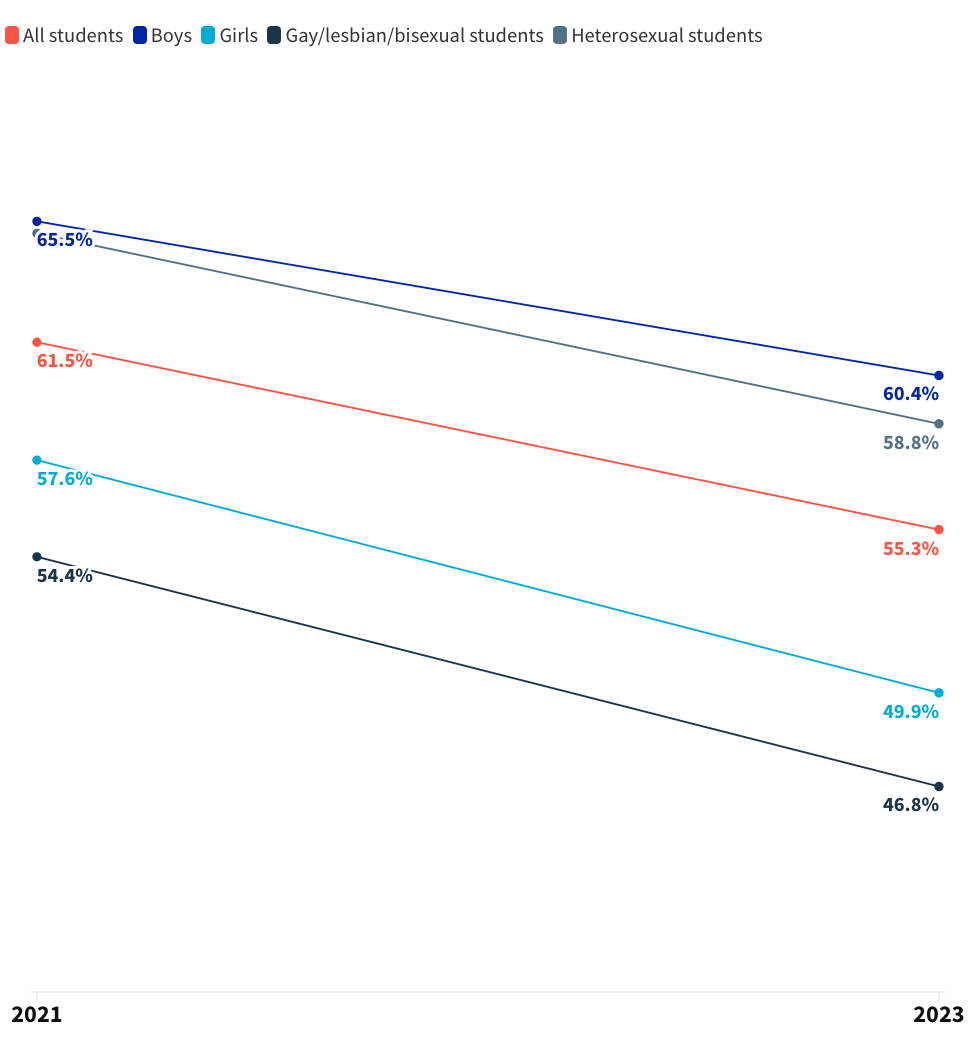
 Moreover, access to supportive relationships is not equitably distributed: factors like race, socioeconomic status, parental education, gender, and immigration status shape the extent and quality of students’ peer relationships and networks—and, consequently, the social capital available to them. For instance, LGBTQ+ students are shown to be over 10 percentage points less likely than their heterosexual and cisgender peers to feel close to others at school, while girls also report lower relational connectedness than boys by more than 10 percentage points. 

Students’ declining feeling of connectedness with consistent disparities for LGBTQ+ and female identifying students after the pandemic 2021-2023  (Peetz 2024)

Addressing challenges of disconnection like these can certainly begin in classrooms and schools, but the external relationships in which students and schools are embedded—including those with mentors, families, and the broader community—are essential sources for the development of a whole system of supportive relationships. It’s important to note that students spend only 13% of their time in school, leaving 87% of their lives dependent on the relationships and environments beyond the classroom. Studies have shown that parental support strongly predicted lower levels of work avoidance, indicating that families of students play a primary role in keeping students motivated and goal-oriented. Furthermore, community conditions play a critical role in shaping students’ academic success, often rivaling or even outweighing the influence of family support. Children in high-poverty neighborhoods may be exposed to antisocial peers, leading to diminished academic progress—even in otherwise nurturing households. Yet, supportive communities with strong social cohesion and access to resources or social capital can buffer against these disadvantages, boosting early academic outcomes even in high-poverty areas. Together, these findings emphasize that relational networks—across school, home, and the community—lays the foundation for physical, mental, and academic support.

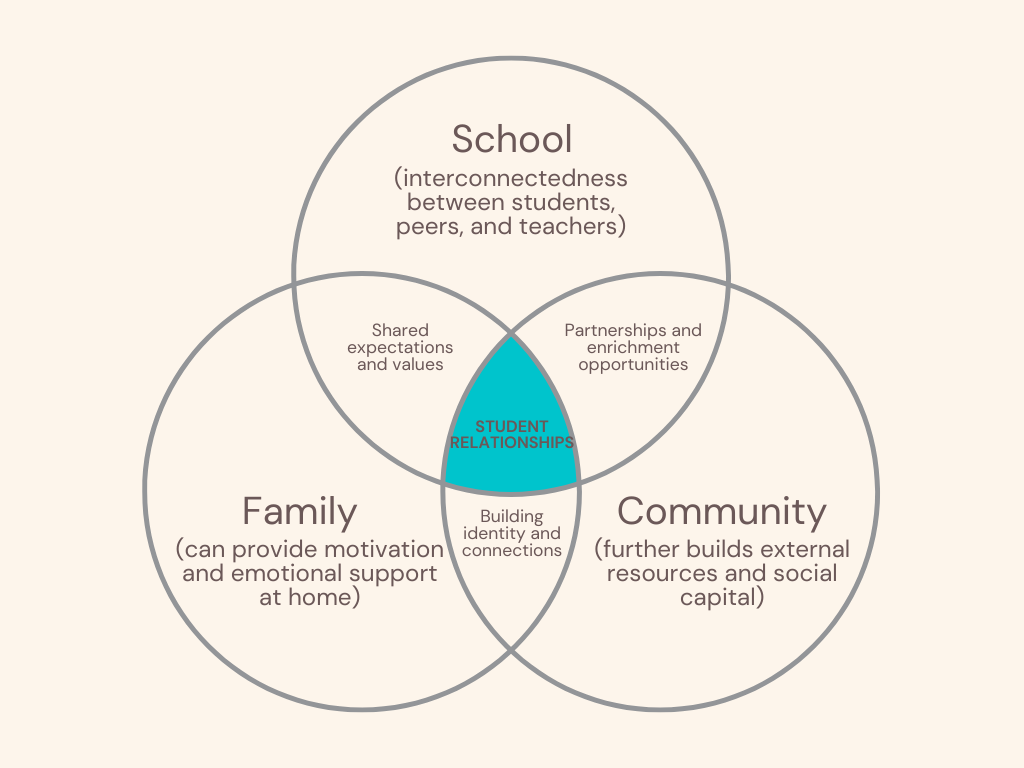
From this perspective, students’ relationships and networks can be seen as embedded in  a broader, community-wide ecosystem rather than as a product of isolated institutions. When one part of that system falters, the entire structure can be weakened or even collapse. This underscores the importance of an interconnected educational ecosystem, where overlapping relationships between students, educators, families, and community members form a foundation for a supportive and effective learning environment. 

Interconnectedness of schools, family, and broader community are essential for building a strong foundation for educational ecosystems that support student learning and engagement 

What can be done to foster strong relationships in and beyond schools? 

Developing a stronger, more equitable educational ecosystem begins with intentionally nurturing the relationships that fuel student learning and wellbeing. Fortunately, schools do not have to wait for large-scale reform: educators and communities are already implementing micro-innovations—small but powerful and tangible shifts in practices, routines, and resources—that foster connection and support. These include efforts to make visible the connections among students and between students and teachers; to deepen family-student ties through more inclusive school-family communication; and to expand community-student connections through partnerships with local organizations.  

Connecting students and teachers

  • Relationship mapping enables teachers to document and visualize the relationships and social networks among their students. In 5 Steps for Building & Strengthening Students’ Networks, Fisher and Charania describe several relationship building strategies including relationship mapping tools. Many of those tools begin with the development of color-coded lists that teachers can use to indicate students with whom they have strong relationships as well as those who may be more socially isolated. Teachers can also engage their own students in developing maps of the peer relationship in their class, and the same social network mapping strategy can be used to document students’ relationships beyond the school with members of their families as well as with mentors and members of community organizations and health and service agencies. As Fisher and Charania  put it, “Not only does relationship mapping provide more detailed information regarding whom your students know and turn to—it can also surface relationships that you could enlist more deliberately to expand supports or opportunities at your institution.” 
  • The Relationship Check Tool assesses the quantity of relationships and the quality of those relationships as well. The tool is a free survey offered by the Search Institute and discussed as well by Fisher and Charania. The survey is designed to support self-reflection and conversation to help practitioners, educators, and families assess where their connections with young people are strong and where they could grow. This tool helps adults gain insight by asking them to reflect on the quality of their relationships with youth, not as a formal assessment, but as a prompt for intentional dialogue and improvement. It is designed to spark meaningful conversations among peers or between adults and young people about the support, care, or challenge present in those relationships. While not built as a diagnostic instrument, the tool can empower users to identify strengths and gaps in their relational practice, creating awareness that can translate into more purposeful relationship-building in classrooms, schools, or home settings.
  •  Peer Partner programs take many different forms, but they generally involve connecting two (or more) students who support each other in one or more activities. In some cases, peers may support each other in carrying out a physical activity, like running, or in getting to school or showing up for extra-curricular activities or clubs. By engaging in shared activities, students can develop relationships with peers they might not normally come in contact with. Some programs also focus specifically on connecting students to support their academic work. For example, at Acton Academy, Running Partners are peer accountability partners who help one another set daily goals, review progress, and provide encouragement throughout the school day. Students begin each morning by articulating their goals with their running partner, who then checks in to hold them accountable and offer feedback—whether by reviewing an essay, asking clarifying questions, or challenging them to aim higher. In younger grades, teachers adapt the practice by forming “housemate” groups of four, which broaden perspectives and make feedback developmentally appropriate. According to Acton educators, running partners not only help students “hold each other to a high standard of work” but also become an emotional support system, cheering one another on and offering encouragement when motivation dips. 
  • Brief, reflective writing exercises can support students’ sense of belonging. In these exercises, students read first-person accounts from older peers describing common challenges—such as homesickness, academic struggles, or difficulty connecting with professors—and then reflect in writing on their own feelings and strategies for navigating similar experiences. The goal is to normalize these challenges and reassure students that feeling out of place is a typical part of the school experience. According to the researchers who have studied these exercises, students who participated reported feeling less anxious about fitting in and experienced slight improvements in academic performance, earning fewer Ds and Fs than peers who did not engage in the intervention. 

Connecting students, schools, families, and communities

  • App-based platforms provide a relatively new way to connect parents and teachers. Apps like ClassDojo, Seesaw, Remind, and ParentPowered allow educators to share updates, videos, and messages with families in real time, giving parents a window into classroom activities they might otherwise miss. Teachers use these apps to reinforce learning at home, provide reminders, and communicate about student progress, while students can showcase work directly to their families. As Helen Westmoreland, director of family engagement at the National PTA, explains, these apps are “a starting place for good family engagement, not the ending place,” emphasizing that the tools work best when paired with thoughtful in-person connections. 
  • Two-way (virtual) town halls were designed to give students and parents the chance to voice concerns, ask questions, and offer suggestions alongside updates from administrators. During the pandemic, these town halls were adapted from the usual, largely ceremonial,  “parents’ nights”, at Knowledge and Power Preparatory Academy (KAPPA) in New York City to both learn from parents and students  about their needs and to provide critical information about the schools’ response to the school closures. . These bi-monthly meetings became a critical means for understanding students’ social-emotional needs and academic challenges, allowing the school to make adjustments—such as changing start times to address students’ concerns about social distancing. Feedback from families also directly informed advisory lessons, social-emotional learning units, and academic goal-setting activities, ensuring programming responded to students’ needs. 
  • Newcomer Liaisons and Newcomer Coordinators provide support to recently arrived immigrant students and their families. Newcomer liaisons are individuals or teams who serve as  a dedicated point of contact who can work with immigrant families on issues like enrollment, programming, communication, and bilingual services. They can help students navigate school systems and access resources such as healthcare and clothing. By centralizing support, the liaisons aim to reduce the burden on teachers, improve students’ access to services, and foster a more equitable and responsive learning environment, particularly for newcomers in historically under-resourced schools.
  • Digital Directories have been created by organizations like Remake Learning to help students and schools connect with community members and organizations who can provide mentorship, apprenticeships and other learning opportunities. contact information for network members, programs, and organizations. At Remake Learning, the directory enables participants to see themselves as part of a larger network, access available resources, and browse calendars of events and engagement opportunities, strengthening connections across the ecosystem. 
  • Learning Festivals  are events designed to bring together schools and other people and organizations to showcase some of learning opportunities across particular communities. For example, Remake Learning Days, launched initially in Pittsburgh, Pennsylvania in 2015, have now expanded to 10 different regions in four countries. These festivals provide creative, immersive learning experiences across diverse settings—including libraries, tech centers, schools, museums, parks, and community centers—who focus on hands-on, and maker-based education. Beyond providing opportunities for students to find out about learning opportunities in their community, these festivals can also help to foster connections among schools and other organizations in their communities and strengthen the whole learning ecosystem. 

By starting with micro-innovations like these for even one aspect of relationship building—supporting connections among students, between students and teachers or among students, schools and the wider community—schools can lay the groundwork for a system where every student is seen, supported, and connected.

High satisfaction, high demands, and changing demographics: Scanning the headlines on the results of the TALIS 2024 (Part 2)

Teachers’ workloads, AI use, and the status of the teaching profession overall are among the key issues highlighted by the media sources that covered the recent release of OECD’s Teaching and Learning International Survey (TALIS) 2024. In this second part of a two-part post, IEN rounds up some of the headlines that discuss the results for different countries. Part 1 provided a summary of OECD’s results, and Part 2 will For comparison, see previous coverage of the release of the results of TALIS 20218 (Volume 1; Volume 2).

Headlines around the world

Albania

Albania among top OECD countries in international teachers’ survey results, Albanian Telegraphic Agency

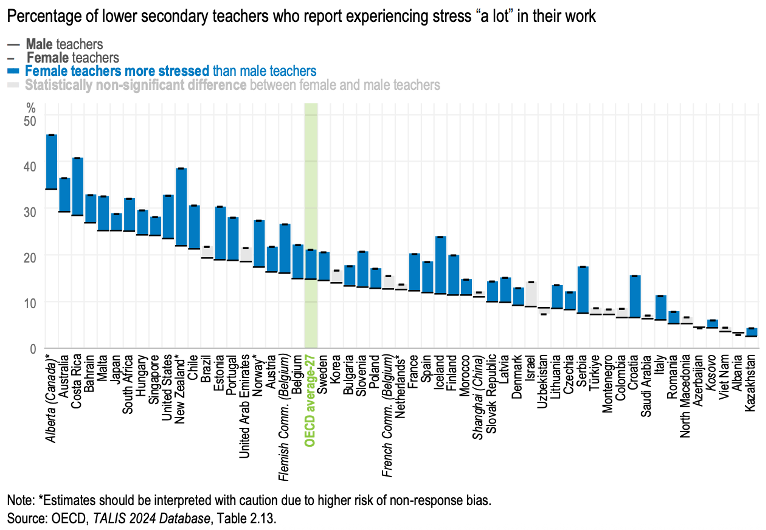
“…98% of Albanian teachers are satisfied with their profession, while only 3% experience high levels of stress—the lowest rate compared to the OECD average of 19%.”

Australia

Australian teachers are some of the highest users of AI in classrooms around the world, Yahoo News Australia

Australian teachers are among the world’s most stressed – despite low class time, The Advertiser

Australian teacher shortage among worst in the OECED, SchoolNews.com

“Australia is now among the top three OECD countries for teacher shortages in public schools. That is unacceptable for a wealthy, developed nation.”

Austria

New teachers hardly feel prepared for everyday school, Vol.at

Belgium

Teachers report high stress due to administrative burden, Belganewsagency.eu

“A striking 70 percent of lower secondary school teachers in Belgium report stress from too much administrative work, far above the OECD average.”

Canada – Alberta

Alberta teachers report highest stress levels globally, CityNews Calgary

Source: Zach Dafoe, CityNews

Costa Rica

AI surges in Costa Rican schools ahead of official policy, TicosLand

Artificial intelligence, in this particular case, can likely contribute significantly to reducing the teacher’s workload. Because if it is used appropriately and efficiently, it can streamline many processes such as receiving information, reviewing in-class assignments, grading exams, and organizing activities.”

Croatia

Croatian teachers among the most education, however, the workload is constantly increasing, PortalHr

Czechia

Young teachers are disappearing: Why is the profession uninteresting even though salaries are improving, Iustecko.cz

“Despite higher satisfaction with salaries, the profession suffers from low social recognition. Only 22% of teachers feel that society values ​​their work, and only 15% of educators perceive recognition from political representation.”

Estonia

Study: Nearly half of teachers plan to change jobs in the coming years, ERR

Finland

TALIS 2024: Lower secondary teachers are satisfied with their work — Increasing diversity in schools challenges teachers to learn new skills, Valtioneuvosto

“The growing diversity in schools and the increasing need for student support are reflected in teachers’ professional learning needs. Areas for development included using artificial intelligence, teaching students with special education needs, supporting students’ social and emotional development, and teaching in multicultural or multilingual settings.”

France

Teaching in France: a despised and increasingly difficult profession on TALIS 2024 Survey, cafepedagogique.net

Hungary

Hungarian teachers report rising satisfaction and greater autonomy, OCED TALIS survey shows, The Hungarian Conservative

Source: Hungarian Conservative

Iceland

Almost all teachers satisfied with jobs — but pay worries persist, RUV.is

“Icelandic teachers are among the most dissatisfied with their pay: only 19% are content with their salaries, compared with an average of one third across the OECD.”

Israel

Israeli teachers satisfied but face staffing crisis, The Jerusalem Post

Japan

Japan’s teachers work longest hours among OECED peers, Nikkei Asia

Latvia

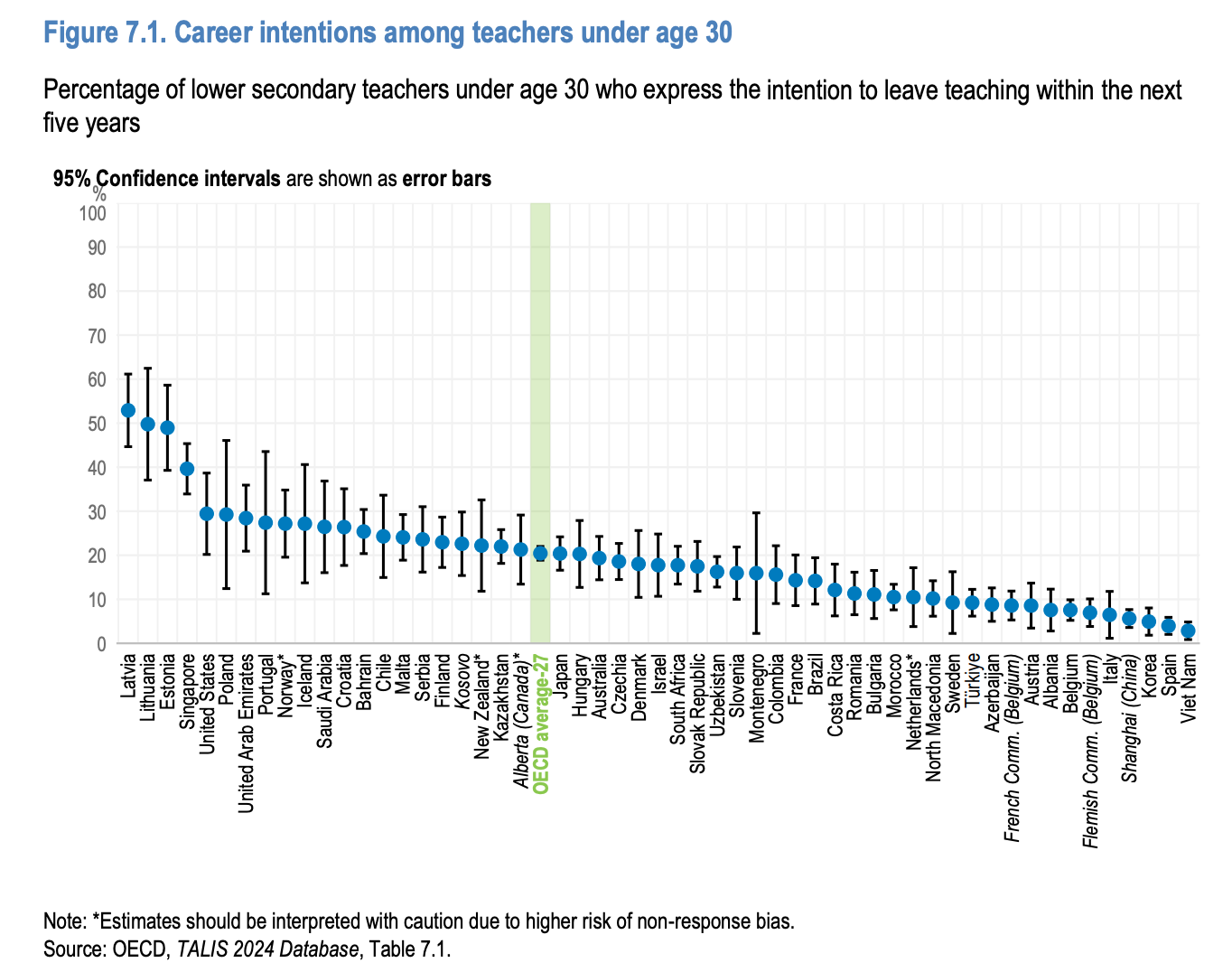
Half of new teachers in Latvia could leave the profession within five years, Baltic News Network

“Half — or 53% — of new teachers in Latvia may leave the profession within the next five years, according to the initial results of the OECD Teaching and Learning International Survey.”

Lithuania

Most Lithuanian teachers higher confident, happy with their working conditions, The Baltic Times

New Zealand

Initial teaching training needs strengthening, The National Tribune

OCED TALIS 2024: NZ teachers lack confidence in core teaching skills, gov’t acts, Devdiscourse

“Education Minister Erica Stanford acknowledged the findings, noting that 62% of graduate teachers lack confidence in teaching the content of all the subjects they handle, and 54% are unsure of how to teach these subjects effectively using proper pedagogical approaches.”

Portugal

Portugal faces an urgent need for 38,000 new teachers by 2034, Cnedu.pt

Portuguese teachers among the most satisfied in the OECED, Portugal Pulse

Singapore

Global survey finds Singapore teachers spend less time teaching and marking, but work longer hours, The Straights Times

Source: MDDI

3 in 4 Singapore teachers use AI, more than double overseas peers: OCED Survey, The Straights Times

South Korea

Over half Korean teachers identify parental complaints as major source of stress, Korea JoongAng Daily

South Korean teachers top OECD in career regret due to stress, The Chosun Daily

“It has been found that the stress South Korean teachers experience due to parental complaints and students’ verbal violence is among the highest globally.”

Spain

Almost half of the secondary school teachers in the State believe that initial training is not adequate, Diari ARA

Spain is one of the countries where the fewest teachers consider leaving the profession, Sur in English

Source: Sur in English via Álex Sánchez

Sweden

Swedish Teachers Report Job Satisfaction Despite Stress and Challenges, Sweden Herald

“Nine out of ten upper secondary school teachers like their job, and the proportion who expect to stay in the profession has increased. But Swedish teachers also testify to stress and chaos.”

United States

For teachers, work-life boundaries are harder to keep than ever, Education Week

“[N]early 30% of U.S. teachers report frequent on-the-job stress, compared to less than 20% for OECD countries on average. U.S. teachers were also more likely to report that teaching had taken a toll on their mental and physical health. U.S. lower secondary teachers worked on average more than 45 hours a week in 2024, nearly five hours more than the OECD average.”

High satisfaction, high demands, and changing demographics: Scanning the headlines on the results of the TALIS 2024 (Part 1)

90% of teachers around the world say they are satisfied with their jobs, but many also face an increased workload that challenges their work life balance. In this two part post, IEN explores these and other findings from OECD’s Teaching and Learning International Survey (TALIS) 2024. Part 1 provides a summary of OECD’s results, and Part 2 will round up some of the headlines that highlight the results from different countries. For comparison, see previous coverage of the release of the results of TALIS 20218 (Volume 1; Volume 2).

Most teachers are happy in their jobs,” declared the OECD, but demographic and technological changes contribute to increasing demands on teachers around the world.  Those are two of the take-aways from the report on the results of the 2024 TALIS survey. Launched first in 2008 with a survey of 23 countries, OECD has also carried out the survey of teachers and school leaders in 2013 and 2018 to compare educator’s perceptions, working conditions, and learning environments. In 2024, around 280,000 educators from 55 education systems participated in the survey. Among the other key findings in 2024:

Job satisfaction

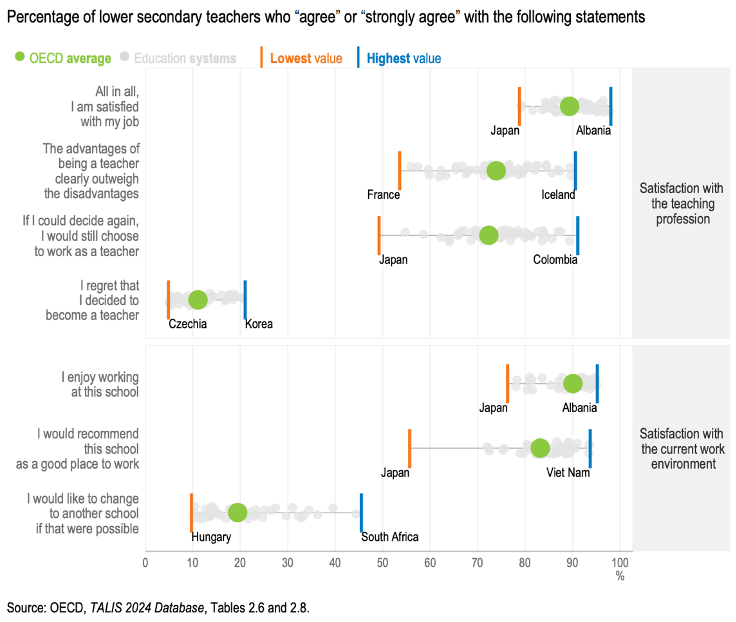
On average, almost 9 out of 10 teachers report that they are satisfied with their jobs.

  • In South Africa, teacher satisfaction has risen by 8% since 2018
  • In Colombia, 90% of teachers say they would become a teacher again.

Value of the teaching profession

Around 2 out of 3 teachers say they are valued by parents and guardians, but with significant variations:

  • Over 90% of teachers feel valued in Vietnam Saudi Arabia, United Arab Emirates, Uzbekistan
  • Less than 50% of teachers feel valued in French-speaking Belgium, Croatia, France, and Japan
  • Saudi Arabia, Bulgaria and Denmark have increased the share of teachers who feel valued by almost 20%

Age

The average age of teachers across the OECD is 45 years-old, but:

  • More than half of teachers are 50 or older in Estonia, Hungary, Latvia, Lithuania
  • The average age of teachers is 38 or 39 in Türkiye, Morocco, the United Arab Emirates and Uzbekistan

Workload and stress

Roughly half of teachers report excessive administrative work as a source of work-related stress

  • The share of female teachers reporting stress “a lot” in their work is 21% compared to 15% for male teachers.
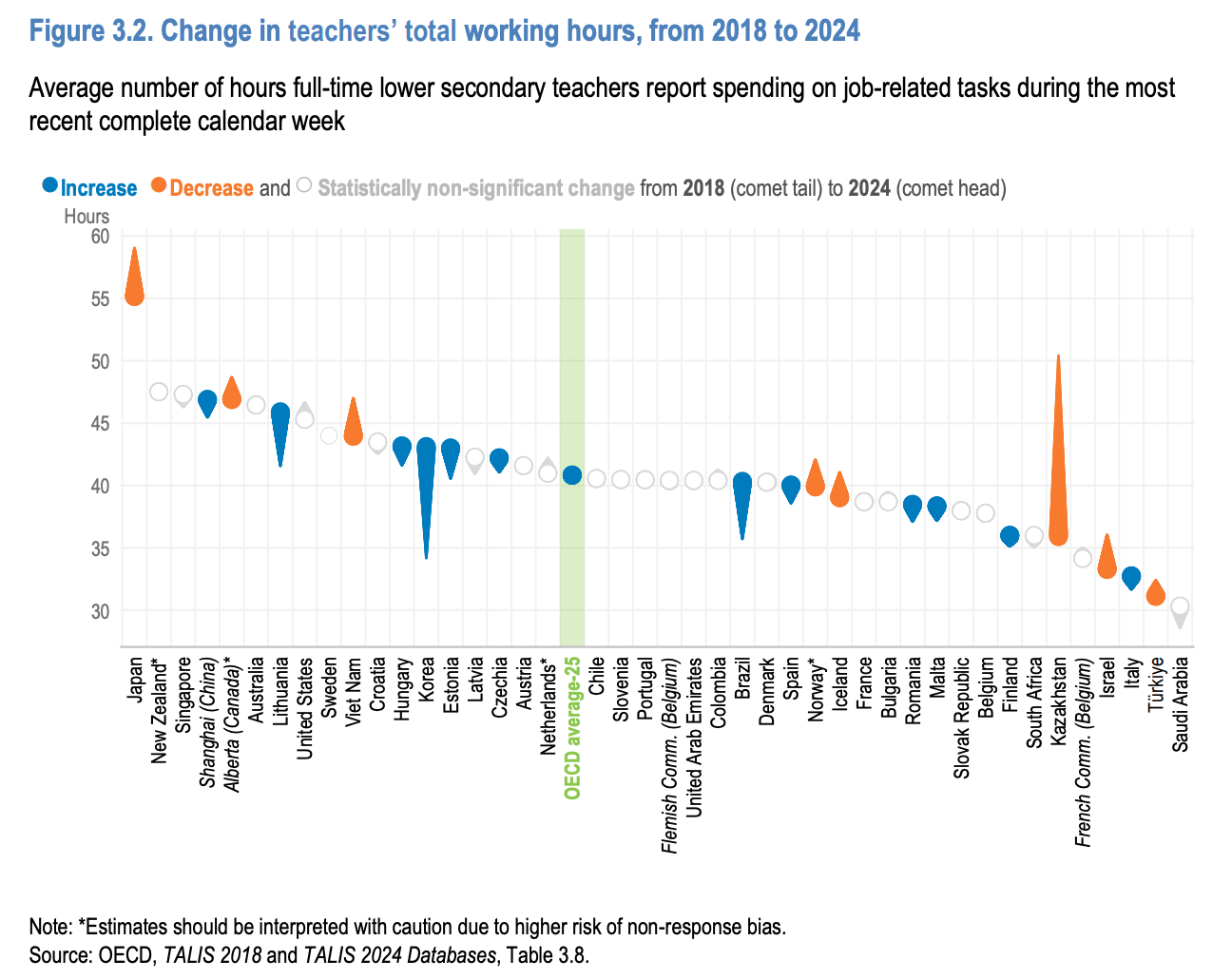
  • Japanese teachers work almost 55 hours a week (down from 60 hours a week in 2018, the highest in the world).
  • Teachers’ sources of stress are more closely linked to constant, unsupported change than to resource shortages

The amount of time spent maintaining discipline has increased in almost all education systems since 2018

  • About 1 in 5 five teachers, on average, report significant disruptive noise and disorder in their classrooms.
  • More than half of teachers in Brazil report such disruptions, compared to about a third of teachers in Chile, Finland, Portugal and South Africa
  • Less than 5% of teachers in in Albania, Japan and Shanghai (China) report facing such disruptions

Preparation

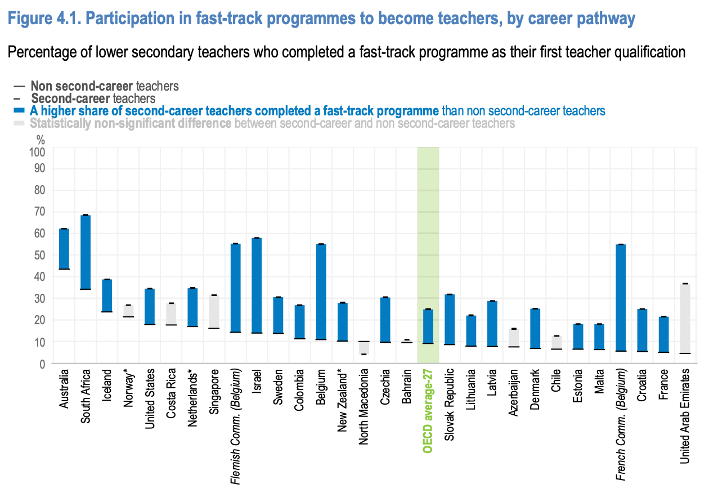
Almost 4 out of 5 teachers participated in regular teacher preparation programs to obtain their initial qualification, but:

  • More than half of teachers in Australia, Costa Rica, Kazakhstan, Romania, Saudi Arabia and South Africa, do not follow the regular path through teacher education
  • Almost half of teachers in Australia and almost a third of teachers in Iceland completed “fast-track” or specialized teacher education program
Source: OECD, TALIS 2024

Teacher evaluation and support

Almost 90% of teachers work in schools where they are formally evaluated at least once a year by school leaders, and:

  • 65% of teachers are engaged in post-evaluations discussions about how to improve their teaching.
  • Slightly less than half of teachers are offered “development or training” plans, ranging from over 90% of teachers in Bahrain and Kazakhstan to under 15% in Iceland.
  • A little over 10% of teachers participate in programs where they are offered financial incentives and less than 5% participate in programs that include potential sanctions.

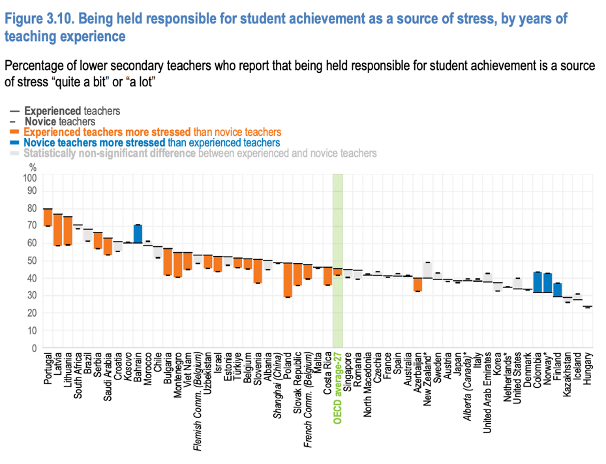
Almost half of teachers’ report that being held responsible for students’ achievement is a source of significant stress:

  • Over 70% of teachers in Latvia, Lithuania, Portugal and South Africa report such stress
  •  Less than a third of teachers in Finland, Hungary, Iceland and Kazakhstan report this stress
Source: OECD, TALIS 2024

Roughly 20% of teachers, on average, participate in mentorship programs: 

  • Almost 80% of teachers in Shanghai (China) report having an assigned mentor and over 60% of teachers with high self-efficacy report exchanging materials with peers, more than double the percentage of teachers with low
  • In systems like Uzbekistan over two-thirds of teachers with high self-efficacy report observing other teachers’ classes and providing feedback

AI and online learning

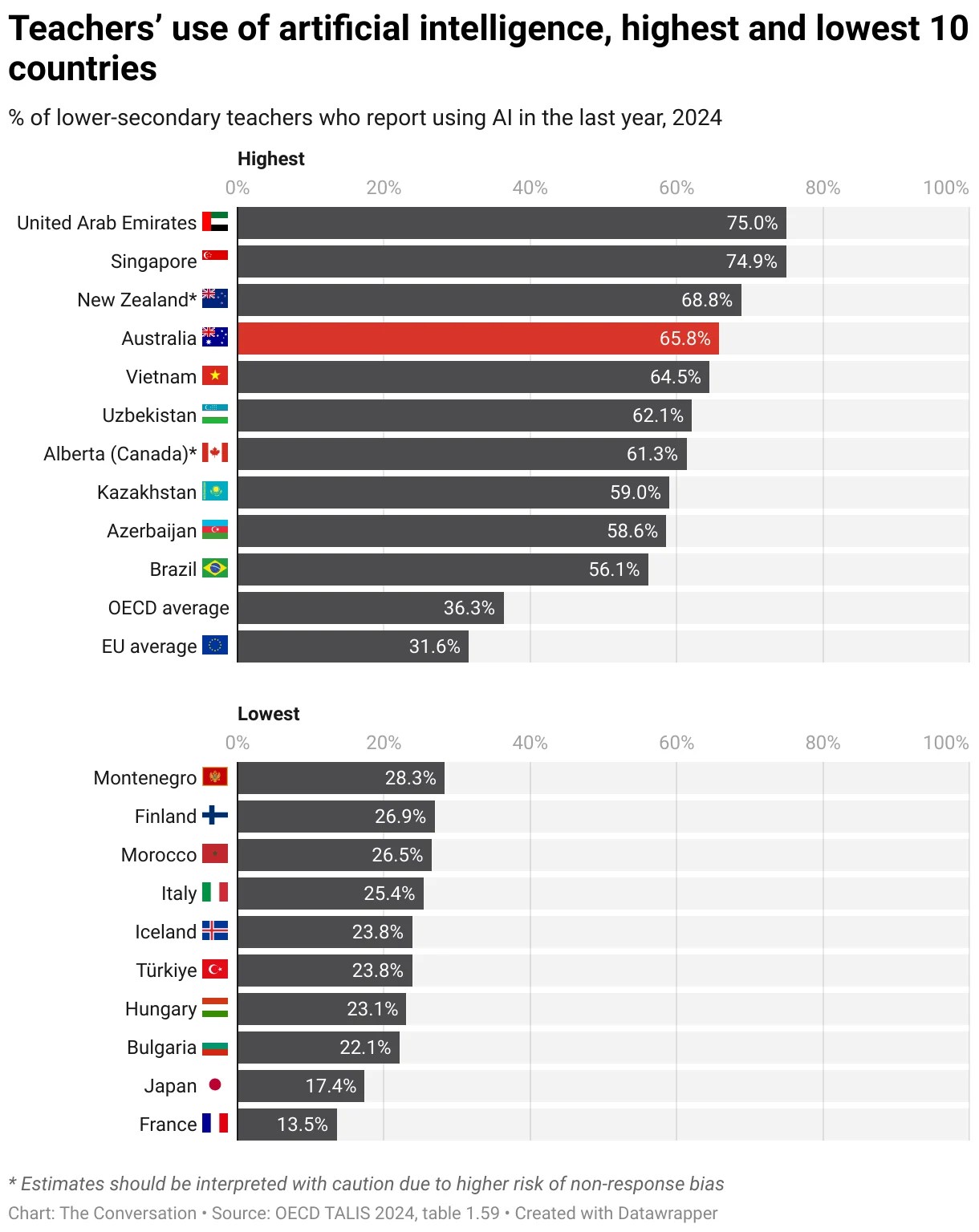
1 in 3 teachers, on average, report using AI in their work:

  • Roughly three-quarters of teachers in Singapore and the United Arab Emirates (UAE) use AI
  • Fewer than 20% of teachers in France and Japan use AI

Over 15% of teachers, on average, work in schools where at least one class was taught hybrid, but:

  • Over 80% of teachers in Singapore, and over 45% of teachers in Israel and the UAE report working schools where at least one class was taught hybrid or online

Next week: High satisfaction, high demands, and changing demographics: Scanning the headlines on the results of the TALIS 2024 (Part 2)

The De-Professionalized Teaching Profession: The Lead the Change Interview with Taylor Strickland

In this month’s Lead the Change (LtC) interview, Taylor Strickland reflects on her research into teachers’ workplace conditions and the professional status of teaching. Strickland is a 4th-year doctoral student and research assistant in the Learning, Leadership, and Education Policy Program at the University of Connecticut’s Neag School of Education Policy Analysis, Research, and Evaluation. Her research uses sociological and organizational theories to study teaching as a profession, the impacts of policy on teachers’ work, and how workplace conditions shape teacher attrition and equity in under-resourced schools. The LtC series is produced by Elizabeth Zumpe and colleagues from the Educational Change Special Interest Group of the American Educational Research Association. This year, the Ed Change SIG recognized Strickland’s work with their Graduate Student Award.A PDF of the fully formatted interview will be available on the LtC website.

Lead the Change (LtC): The 2026 AERA Annual Meeting theme is “Unforgetting Histories and Imagining Futures: Constructing a New Vision for Educational Research.” This theme calls us to consider how to leverage our diverse knowledge and experiences to engage in futuring for education and education research, involving looking back to remember our histories so that we can look forward to imagine better futures. What steps are you taking, or do you plan to take, to heed this call?

Taylor Strickland: My scholarship approaches schools foremost as workplaces and teachers as professionals, a perspective too often overlooked in education research and policy. This perspective is especially urgent amid mounting attacks at federal and state levels on the financial foundations of public schooling and waning student enrollment (Goldstein, 2025; Mervosh & Goldstein, 2025a; Mervosh & Goldstein, 2025b). This financial and enrollment crisis is occurring while the number of graduates entering a teaching career, and on-the -job satisfaction of teaching, are at a 50 year all time low (Kraft & Lyon, 2024). Since the 1980s, researchers have warned that the workplace conditions of teachers are not suitable to attract and retain the highly qualified teachers that our system demands (Ingersoll, 2001; Johnson, 2006; Rosenholtz, 1989). Quite sadly, it seems their warnings have come to bear their bitter fruit, and we are starting to taste the consequences on a scale that can no longer be ignored (Kraft & Lyon, 2024). 

Source: UConn Website

Heeding this year’s AERA call to look “back to remember our histories so that we can look forward to imagine better futures,” I reflect on the history of teaching as a profession (Simon & Johnson, 2015; Sorensen & Ladd, 2020). From the conception of public schooling in the United States, the notion of “teaching as a profession” ran against the grain of traditional ideas. The gold standard examples for professions have long been considered law and medicine (Evetts, 2011), whose occupational values include lengthy training and careers and autonomy over their practice (Evetts, 2011; Lortie, 1975). Public schools, by contrast, were first conceived as a public good designed to educate white working class and European immigrant children to be moral, democratic citizens and workers (Goldstein, 2015). The white, mostly female teachers who were put in charge of this endeavor were notably temporary—not expected to pursue life-long professions—and trained quickly with an emphasis on classroom management essentials (Goldstein, 2015). Female teachers were contractually required to leave their teaching posts if marrying and/or becoming pregnant (Apple, 1985; Goldstein, 2015). Unlike professional autonomy recognized in the ‘gold standard’ professions, teachers—as Ingersoll and Collins (2018) describe—function more as middle-women/men, “which may seem similar to professional-like autonomy, but in reality are “highly constrained by larger school-wide [, district, state, and federal] decisions, over which teachers have little control or influence” (p. 168). In sum, the job of teaching from its conception has been decidedly de-professionalized and transient, or what Lortie (1975) describes as a semi-profession.

When a job, such as teaching, is not treated as a profession (Evetts, 2011), where lengthy training, degrees, and resultant expertise do not translate to autonomy of practice and respect, it is societally de-professionalized and de-valued (Ingersoll & Collins, 2018), which has great implications for the workplace environments of its employees (Ingersoll & Collins, 2018; Milner, 2013). Susan Moore Johnson and colleagues (2012) developed a measurement framework for nine key elements of the workplace conditions of teachers. Notably, six of the nine elements are related to autonomy of practice, influence in school decision making, and trust/respect of teacher expertise. Unsurprisingly, researchers found that when workplace conditions improve from the lowest quartile, teachers’ transfer intentions drop sharply (Johnson et al., 2012). These findings are quite meaningful given national trends showing that teachers—who have historically had limited professional autonomy and influence—experienced further declines in decision-making power across all key school governance categories between 1993 and 2012 (Ingersoll & Collins, 2018), with more recent research suggesting a continuing downward trend (Kraft & Lyon, 2024). It is then no wonder that the prestige of teaching, interest in the profession, and teachers’ job satisfaction are at a 50-year low (Kraft & Lyon, 2024), given the continued erosion of teachers’ professional status and workplace conditions.

LtC: What are some key lessons that practitioners and scholars might take from your work to foster better educational systems for all students?

TS: In seeking to envision a better future for the professional status and workplace conditions of teachers, I interrogate how reform is implemented in schools and how it impacts the work and professional status of teachers. My qualifying paper and upcoming dissertation focus on the novel concept of “time cultures”—the normative patterns in how time is perceived, valued, and utilized within school teams. The research examines the influence of time cultures on teacher engagement in school improvement. In an era of growing teacher work intensification marked by increasing workload, time pressure, and task complexity for teachers (Creagh et al., 2023), understanding time as a cultural construct helps to reveal how teachers experience and respond to these pressures. Increased task complexity, time pressure, and policy churn—commonplace for the 21st century teacher—are often associated with burnout (Lawrence et al., 2019), declining workplace satisfaction (Creagh et al., 2023), and teacher shortages (Diliberti & Schwartz, 2023; Harbatkin et al., 2025; Martin et al., 2012; Redding & Nguyen, 2023). Notably, work intensification and its impacts on teacher satisfaction and retention are felt most severely by teachers in schools with larger populations of historically educationally underserved students, including English learners, low-income, lower academic achievement, and racially marginalized students – including Black, Hispanic, and Native American students (Creagh et al., 2023; Goldhaber et al., 2023; Simon & Johnson, 2015). At the same time that the demands on teachers have become increasingly complex and intense, the profession has become simultaneously de-skilled and de-professionalized. An era of accountability and neoliberalism—characterized by a constant cycle of reform initiatives and top-down control over teachers’ work (Creagh et al., 2023; Hargreaves, 1992; Hargreaves & Shirley, 2009)—has contributed to the de-professionalization of teaching, declining workplace satisfaction, and teacher shortages.

My work seeks to gain teachers’ firsthand experiences with constant reform cycles and their impact on their professional standing and work. I do this using a previously unused framework in the education literature—the sociology of work time (SWT) (Perlow, 1999). The SWT recognizes time cultures as multi-dimensional and aids in building a more complete picture of teachers’ construction of time cultures through the analysis of the reciprocal exchange between the temporal context (i.e., characteristic ordering, duration, and tempo of practice), the social context, and work-interaction patterns of teachers. This framework honors the expertise of teachers by seeking to understand how their leadership and policy reform experiences intersect with the cultural-time norms of their teams in their unique contexts. 

For instance, my qualifying paper shows how the time culture of a math team, tasked with imposed reforms, shaped its attitudes and willingness to implement policy. These findings further indicate that reduced influence in school decision-making may lead teacher teams to reinterpret policy directives to be in alignment with their time culture, thereby reducing the implementation fidelity. The lesson that I hope to share with my work is that education leaders at all levels need to involve teachers—the people who are actually tasked with implementing improvement initiatives – with policy design and implementation. And to better involve teachers, leaders need to understand how teachers use and value their time, so that initiated reforms are seen as useful and sustainable. This would not only better align policy to local realities but would also go a long way in repairing the professional status of teachers.

LtC: What do you see the field of Educational Change heading, and where do you find hope for this field for the future?

TS: Looking back at the history of the teaching “profession,” we see that fundamentally the teaching role was not designed to be an occupation with professional status. The lack of professional status values and practices within the teaching field has eroded the workplace conditions of teachers to the point that teacher shortages are at an unsustainable high and interest in this career pathway is at an all-time low (Kraft & Lyon, 2024; Nguyen et al., 2024). Given this dour assessment of the teaching field, where do I find hope and what can be done to look forward to and imagine a better future?

Quite honestly, I fear the direction in which the teaching field is heading—and has been heading for some time now. To find hope, I must imagine a future where there is a fundamental cultural shift in how our society, government, states, districts, and school leaders respect the professional status of teachers. For this type of transformational cultural change to occur we will need education researchers and leaders at every level—from academia to individual schools—to work together to dismantle the deep-seated structures that have driven down the prestige, appeal, and professional standing of teaching to historic lows. State departments of education should advocate for, and districts should move towards, “revers[ing] the trend of top-down control over teachers’ practices and develop meaningful career ladders” (Kraft & Lyon, 2024, p. 1227). They should also prioritize increasing teacher pay and lowering the cost of degrees in education. Big ships turn slowly—but time is of the essence. We need to attract, train, and retain the best quality educators for our children. Without meaningful changes to how we value and support teaching, we risk a future where too few choose to enter or remain in the classroom.

References

Apple, M. (1985). Teaching and “women’s work”: A comparative historical and ideological analysis. Teachers College Record, 86(3), 455–473.

Creagh, S., Thompson, G., Mockler, N., Stacey, M., & Hogan, A. (2023). Workload, work intensification and time poverty for teachers and school leaders: A systematic research synthesis. Educational Review, 1–20. https://doi.org/10.1080/00131911.2023.2196607

Goldhaber, D., Falken, G., & Theobald, R. (2023). What do teacher job postings tell us about school hiring needs and equity? (CALDER Working Paper No. 282-0323). CALDER Center.

Goldstein, D. (2025, August 5). Public Schools Try to Sell Themselves as More Students Use Vouchers. The New York Times. https://www.nytimes.com/2025/08/05/us/public-school-enrollment-decline-vouchers.html

Goldstein, D. (2015). The teacher wars: A history of America’s most embattled profession. Vintage.

Harbatkin, E., Nguyen, T. D., Strunk, K. O., Burns, J., & Moran, A. J. (2025). Should I Stay or Should I Go (Later)? Teacher Intentions and Turnover in Low-Performing Schools and Districts Before and During the COVID-19 Pandemic. Education Finance and Policy, 1–38. https://doi.org/10.1162/edfp_a_00447

Hargreaves, A. (1992). Time and teachers’ work: An analysis of the intensification thesis. Teachers College Record, 94(1), 87–108.

Hargreaves, A., & Shirley, D. (2009). The persistence of presentism. Teachers College Record, 111(11), 2505–2534. https://doi.org/10.1177/016146810911101108

Ingersoll, R. M. (2001). Teacher Turnover and Teacher Shortages: An Organizational Analysis. American Educational Research Journal, 38(3), 499–534. https://doi.org/10.3102/00028312038003499

Johnson, S. M., Kraft, M. A., & Papay, J. P. (2012). How Context Matters in High-Need Schools: The Effects of Teachers’ Working Conditions on Their Professional Satisfaction and Their Students’ Achievement. Teachers College Record, 114(10), 1–39. https://doi.org/10.1177/016146811211401004

Kraft, M. A., & Lyon, M. A. (2024). The Rise and Fall of the Teaching Profession: Prestige, Interest, Preparation, and Satisfaction Over the Last Half Century. American Educational Research Journal, 61(6), 1192–1236. https://doi.org/10.3102/00028312241276856

Lawrence, D. F., Loi, N. M., & Gudex, B. W. (2019). Understanding the relationship between work intensification and burnout in secondary teachers. Teachers and Teaching: Theory and Practice, 25(2), 189–199.https://doi.org/10.1080/13540602.2018.1544551

Lortie, D. C. (1975). Schoolteacher: A sociological study. Chicago, IL: University of Chicago Press.

Martin, N. K., Sass, D. A., & Schmitt, T. A. (2012). Teacher efficacy in student engagement, instructional management, student stressors, and burnout: A theoretical model using in-class variables to predict teachers’ intent-to-leave. Teaching and Teacher Education, 28(4), 546–559. https://doi.org/10.1016/j.tate.2011.12.003

Mervosh, S., & Goldstein, D. (2025a, April 17). A Legal Battle Over Trump’s Threats to Public School Funding Has Begun. The New York Times. https://www.nytimes.com/2025/04/17/us/dei-public-schools-trump-administration-lawsuit.html

Mervosh, S., & Goldstein, D. (2025b, July 3). Congress Passes a National School Voucher Program. The New York Times. https://www.nytimes.com/2025/07/03/us/federal-voucher-program-congress-private-school-tuition.html

Mehta, J. (2025, March 21). How the Education Department cuts could hurt low-income and rural schools. NPR. https://www.npr.org/2025/03/21/nx-s1-5330917/trump-schools-education-department-cuts-low-income

Milner, H. R. (2013). Policy Reforms and De-Professionalization of Teaching. National Education Policy Center. https://eric.ed.gov/?id=ED544286

Nguyen, T. D., Lam, C. B., & Bruno, P. (2024). What Do We Know About the Extent of Teacher Shortages Nationwide? A Systematic Examination of Reports of U.S. Teacher Shortages. AERA Open, 10, 23328584241276512. https://doi.org/10.1177/23328584241276512

Perlow, L. A. (1999). The time famine: Toward a sociology of work time. Administrative Science Quarterly, 44(1), 57–81. https://doi.org/10.2307/2667031

Redding, C., & Nguyen, T. (2023). Teacher working conditions and dissatisfaction before and during the COVID-19 pandemic. EdWorkingPaper: 23-830. Annenberg Institute at Brown University. https://doi.org/10.26300/04xa-zz07

Rosenholtz, S. J. (1989). Teacher’s workplace: The social organization of schools. Longman.

Simon, N. S., & Johnson, S. M. (2015). Teacher Turnover in High-Poverty Schools: What We Know and Can Do. Teachers College Record, 117(3).

Sorensen, L. C., & Ladd, H. F. (2020). The Hidden Costs of Teacher Turnover. AERA Open, 6(1), 2332858420905812. https://doi.org/10.1177/2332858420905812

Collaboration, Professional Networks & Grassroots Change: The Lead the Change Interview with Kemi Oyewole

In the second part of this month’s Lead the Change (LtC) interview, Kemi A. Oyewole discusses her experiences researching institutional and organizational conditions that shape K-12 education policy. Oyewole is a Provost’s Postdoctoral Fellow at the University of Pennsylvania Graduate School of Education. Her research focuses on collaborative methods and civic education that can promote social justice. The LtC series is produced by Elizabeth Zumpe and colleagues from the Educational Change Special Interest Group (SIG) of the American Educational Research Association. This year, the Ed Change SIG recognized Oyewole’s work with their Graduate Student Award. A PDF of the fully formatted interview will be available on the LtC website.

Lead the Change (LtC): The 2026 AERA Annual Meeting theme is “Unforgetting Histories and Imagining Futures: Constructing a New Vision for Educational Research.” This theme calls us to consider how to leverage our diverse knowledge and experiences to engage in futuring for education and education research, involving looking back to remember our histories so that we can look forward to imagine better futures. What steps are you taking, or do you plan to take, to heed this call?

Kemi Oyewole: The current moment of political, anti-intellectual aggression towards the public sector has led many of us to see bleak immediate futures for education. Further, a flurry of executive orders from the Trump administration has been so overwhelming that it has distracted many of its opponents to the point of inaction. In the first 100 days of his second term (January 20, 2025 to April 29, 2025), the president issued directives that sought to limit educational, health, and sports opportunities for trans youth (EO 14168, 14187, 14201); prohibit policies that address racial disparities in school discipline (EO 14280); halt K-12 and higher education institutions’ diversity initiatives (EO 14173, 14190); and close the Department of Education (EO 14242). In the words of Toni Morrison (1975), “It’s important, therefore, to know who the real enemy is, and to know the function, the very serious function of racism is distraction. It keeps you from doing your work.” Beyond racism, other systems of oppression similarly seek to disrupt the advancement of marginalized people. However, powerful histories of resistance remind us that there are viable ways to move forward in the face of authoritarian pressure. 

Source: University of Pennsylvania Website

There are many examples of resistance across the globe, especially in the Global South where people have contended with colonialism and its vestiges. I draw upon my identity as a Black American to highlight ways the resistance of enslaved Black people speaks to their futuring. While disproportionate attention is paid to violent revolts, enslaved people resisted by many means. These include marronage (i.e., escape from slavery to form independent communities), emancipation certified by legal documents, military service, work refusal, and sabotage (Helg, 2019). Despite the brutality they experienced, these enslaved people dreamed of freedom and used many means to pursue it. Their many strategies suggest that there is immense room for futuring—there are innumerable paths to a more just educational system. We are called to dream expansively and make space for others to do so as well.

While there is value in pausing to make time for futuring (i.e., imagining or dreaming; Kelley, 2002; Oyewole et al., 2023), we must not stop there. A commitment to educational change suggests we must do the hard, often frustrating, work of bringing emancipatory futures to pass. Within my research, my futuring benefits from engaging educators. For example, teaching students through the COVID-19 pandemic offered teachers a different sense of the futures enabled by educational technology (and its limitations). Thus, I seek to incorporate practitioner insights through collaborative, participatory research methods (The Collaborative Education Research Collective, 2023). However, engaging in-service educators in research requires flexible research agendas, timelines, and design. These collaborative methods require a departure from the status quo, a worthwhile shift because valuing educators as co-inquirers allows my futuring to be informed by current educational conditions. Ideally, these methods also offer participants a humanizing, reflective, professional development experience.

ebonyjanice (2023) argues that Black women’s contribution to movement work includes dreaming, resting, playing, seeking bliss, and pursuing wholeness. She celebrates the hard-fought dreaming of enslaved Black people while offering a new vision:

“‘Dreaming’ is a form of radical resistance because it calls us to a conscious stillness, which manifests itself as ease in the body. Ease, in a Black body, is revolutionary because Black people have not, historically, as a result of chattel slavery, had access to ease in our bodies. Dreaming, however, subverts a global anti-Black unease that actively works to commodify Black bodies. Plainly, dreaming is radical resistance because the fantastic hegemonic imagination (Townes, 2006) cannot function with Black bodies at rest.” (p. 8)

I embody her sentiment by allowing my futuring for education to come from a place of rest rather than frenzy. And to imagine educational systems that create conditions of peace and healing for Black girls—trusting that their wellness will benefit all learners (Guinier & Torres, 2002).

My vision of educational research is informed by the multifaceted resistance of enslaved Black Americans, my current practice of collaborative research, and Black women’s relentless pursuit of rest.

LtC: What are some key lessons that practitioners and scholars might take from your work to foster better educational systems for all students?

KO: My research emphasizes the value of collective action for stimulating educational change. Despite its promise, collaborative efforts can falter when there is a lack of consensus around their scope and goals. Further, attention is needed to ensure the routines embedded in collaborative endeavors do not perpetuate educational injustice (Diamond & Gomez, 2023; Hinnant-Crawford et al., 2023). My recent research examines these dynamics in professional learning networks (PLNs).

My dissertation project centered on a school district PLN of school-based instructional coaches. The network of 45 coaches met once a month in person (though meetings shifted online during the Covid-19 pandemic shift to distance learning). My social network analysis showed that coaches share advice on instructional strategies, data use practices, or workplace challenges with about five colleagues in the network. My interview and survey data suggests that coaches valued the space because it gave them an opportunity to connect with role-alike peers. These relationships were especially meaningful to participants because these coaches were normally the only person at their school in the liminal space of not being a classroom teacher, but also not being an administrator. These findings stress the value of routines that facilitate educators connecting with each other beyond their local communities of practice. A cross-school PLN can build participants’ pedagogical knowledge, strengthen their professional identity, and expand their professional network (Oddone et al., 2019). These benefits suggest that beyond-school collaboration is both a tool for developing educator skills and affirming their professional status. The warmth and enthusiasm I felt when observing this PLN made me appreciate the need to invest in rejuvenating spaces for educators.

Though PLNs have immense potential, much of their value stems from purposeful participation and strategic facilitation. It is powerful to create professional spaces that adaptably meet educator needs. However, PLNs have to find a balance between organic interpersonal engagement and directed professional exchange. For example, my longitudinal social network analysis found that coaches shared advice with peers who worked at similar schools, had similar self-efficacy appraisals, or joined the network at similar times. While these relationships provided coaches information that was applicable to their local context, it could come at the expense of being exposed to ideas from different environments. I also found that experienced coaches were less likely to share advice with others in the PLN.

Observation and interview data suggest that it is because after many years, these coaches were not getting as much value from the network. Their experiences point to the need for differentiation in coach professional development. Each finding highlights the challenges and opportunities of intentionally curating PLNs.

My emphasis on collaboration presents many promising research directions. First, I am excited about the ways that studying collaboration and PLNs avails itself to social network analysis (Rodway, 2018). Not only can this network analysis be done for research purposes, it can also be an active process that promotes educators reflecting on their own relationships and environments (Kothari et al., 2014). Second, there are opportunities to better identify the routines that support the resource sharing aims of in-person, or otherwise synchronous (e.g., a Zoom meeting), PLNs. Focusing research on these settings acknowledges that these meetings have different demands and opportunities than social media PLNs. Third, I highlight the need for more research on instructional coaching. While instructional coaching has exploded in prominence, it is heterogeneously enacted (Coburn & Woulfin, 2012; Kane & Rosenquist, 2019). Better understanding coach practices offers us a valuable perspective on educational change.

LtC: What do you see the field of Educational Change heading, and where do you find hope for this field for the future?

KO: As the United States government decreases the resources it devotes to public education, educational change will rely on more local actions. In the face of authoritarian surveillance and punishment, I expect that changes to promote just educational systems will become more covert. Though the loose coupling between dictated educational policy and enacted educational practice can prove challenging for progressive top-down reforms (Anderson & Colyvas, 2021), it can be an advantage when regressive policies are imposed. So, I expect that just educational change will not be codified, but spread in ways akin to grassroots activist and labor movements.

Another factor that will influence educational change is the United States’ projected 8% decline in K-12 enrollment from 2019 to 2030 (Irwin et al., 2024). These structural changes in the student population and fewer federal dollars devoted to education suggest that educational change efforts may have to be more focused in their scope and demands. Of course, there is also a need to strike a balance between what one feels is cynical, optimistic, or realistic. I am personally working to strike that balance—dreaming while being practical enough not to be dismayed whenever I see the news.

My hope is that researchers of educational change will support burgeoning grassroots efforts by conducting their scholarship in concert with students, teachers, families, community organizations, and others close to educational practice. Such research involves more participatory approaches, including design research that supports partners creating solutions to problems of practice while considering contemporary constraints. Collaborative approaches require research designs that are adaptable to rapidly changing conditions. Such flexibility is a departure from traditional research methods, but suggests implications beyond those that can be drawn from tightly controlled conditions.

I am incredibly grateful to be in community with researchers and practitioners passionate about educational change, even in a climate that is so hostile to improving schools for all children. While I can get discouraged that my locus of control is small, “small is good, small is all” (brown, 2017, p. 37).

References

Anderson, E. R., & Colyvas, J. A. (2021). What sticks and why? A MoRe institutional framework for education research. Teachers College Record: The Voice of Scholarship in Education, 123(7), 1–34. https://doi.org/10.1177/016146812112300705

brown,  adrienne maree. (2017). Emergent strategy: Shaping change, changing worlds. AK Press.

Coburn, C. E., & Woulfin, S. L. (2012). Reading coaches and the relationship between policy and practice. Reading Research Quarterly, 47(1), 5–30. https://doi.org/10.1002/RRQ.008

Diamond, J. B., & Gomez, L. M. (2023). Disrupting white supremacy and anti-Black racism in educational organizations. Educational Researcher, 0013189X2311610. https://doi.org/10.3102/0013189X231161054

ebonyjanice. (2023). All the Black girls are activists: A fourth wave womanist pursuit of dreams as radical resistance. Row House.

Guinier, L., & Torres, G. (2002). The miner’s canary: Enlisting race, resisting power, transforming democracy. Harvard University Press.

Helg, A. (2019). Slave no more: Self-liberation before abolitionism in the AMericas. University of North Carolina Press.

Hinnant-Crawford, B., Lett, E. L., & Cromartie, S. (2023). IMPROVECRIT: Using critical race theory to guide continuous improvement. In E. R. Anderson & S. D. Hayes (Eds.), Continuous improvement: A leadership process for school improvement (pp. 105–124). Information Age Publishing.

Irwin, V., Bailey, T. M., Panditharatna, R., & Sadeghi, A. (2024). Projections of education statistics to 2030 (NCES 2024-034). National Center for Education Statistics. https://nces.ed.gov/pubsearch/pubsinfo.asp?pubid=2024034

Kane, B. D., & Rosenquist, B. (2019). Relationships between instructional coaches’ time use and district- and school-level policies and expectations. American Educational Research Journal, 56(5), 1718–1768. https://doi.org/10.3102/0002831219826580

Kelley, R. D. G. (2002). Freedom dreams: The black radical imagination. Beacon Press.

Kothari, A., Hamel, N., MacDonald, J.-A., Meyer, M., Cohen, B., & Bonnenfant, D. (2014). Exploring community collaborations: Social network analysis as a reflective tool for public health. Systemic Practice and Action Research, 27(2), 123–137. https://doi.org/10.1007/s11213-012-9271-7

Morrison, T. (1975, May 30). Black Studies Center public dialogue. https://soundcloud.com/portland-state-library/portland-state-black-studies-1

Oddone, K., Hughes, H., & Lupton, M. (2019). Teachers as connected professionals. The International Review of Research in Open and Distributed Learning, 20(3). https://doi.org/10.19173/irrodl.v20i4.4082

Oyewole, K. A., Karn, S. K., Classen, J., & Yurkofsky, M. M. (2023). Equitable research-practice partnerships: A multilevel reimagining. The Assembly: A Journal for Public Scholarship on Education, 5(1), 40–59.

Rodway, J. (2018). Getting beneath the surface: Examining the social side of professional learning networks. In C. Brown & C. L. Poortman (Eds.), Networks for learning: Effective collaboration for teacher, school and system improvement (pp. 171–193). Routledge.

The Collaborative Education Research Collective. (2023). Towards a field for collaborative education research: Developing a framework for the complexity of necessary learning. The William and Flora Hewlett Foundation.

Townes, E. M. (2006). Womanist ethics and the cultural production of evil. Palgrave Macmillan.

Racialized Expertise as Change Capital: The Lead the Change Interview with Román Liera

In this month’s Lead the Change (LtC) interview, Román Liera designs his research program to study racial equity and organizational change in higher education. Liera is an Assistant Professor of Higher Education in the Department of Educational Leadership at Montclair State University. His current research projects focus on understanding how racism operates in doctoral student socialization, the academic job market, faculty hiring, reappointment, tenure and promotion, presidential hiring, and racial equity professional development. The LtC series is produced by Elizabeth Zumpe and colleagues from the Educational Change Special Interest Group of the American Educational Research Association. This year, the Ed Change SIG recognized Liera’s work with one of two Emerging Scholar Awards. A PDF of the fully formatted interview will be available on the LtC website.

Lead the Change (LtC): The 2026 AERA Annual Meeting theme is “Unforgetting Histories and Imagining Futures: Constructing a New Vision for Educational Research.” This theme calls us to consider how to leverage our diverse knowledge and experiences to engage in futuring for education and education research, involving looking back to remember our histories so that we can look forward to imagine better futures. What steps are you taking, or do you plan to take, to heed this call?

Source: Montclair State University

Román Liera: I appreciate the theme and the question because the current anti-DEI attacks are not new and have provided an opportunity to reflect on what has been done in the past and a gut check that what is being done has not been enough to advance racial equity and justice. In studying racial equity and organizational change, I have had several opportunities to collaborate and partner with administrators, faculty, and staff taking action to create more equitable hiring practices. I have also been collaborating with other scholars who have been creative and innovative in theorizing racial equity and organizational change.

In working with leaders and practitioners who are taking actions towards change, I have learned from and with change agents who are nearing retirement or beginning their higher education careers. Listening to those who have been in higher education for decades and referring to similar instances regarding attacks on DEI in the past (e.g., the Civil Rights era) has helped me affirm that my work not only matters but also makes a difference in the face of attacks on race-focused change efforts. At the same time, working with those newer to the field has helped me slow down to acknowledge that what we have been doing has not been enough to create equitable and inclusive educational organizations.

In addition to collaborating with change agents from diverse identities and career trajectories, I am theorizing and studying how we can continue to disrupt deeply rooted forms of racism in educational organizations. An area that I have been investigating is the racial inequities in the professoriate (e.g., underrepresentation of faculty of color), particularly in recruiting, hiring, and tenure and promotion practices. For example, along with Drs. Heather McCambly and Aireale Rodgers, we designed a study on faculty cluster hiring at six research one universities. A goal was to understand how administrators, faculty, and staff leaders framed and implemented cluster hiring initiatives to disrupt how whiteness informed faculty recruitment and hiring routines, practices, decisions, and evaluations. We recently published a manuscript in the Journal of Higher Education titled “Analyzing the Purposes and Mechanisms of Faculty Cluster Hiring Initiatives to Promote Racial Equity.” In the paper, which is funded by the Alfred P. Sloan Foundation, we highlight how senior leaders, administrators, faculty, and staff leverage racialized expertise—expertise focused on addressing racial inequities and injustices—as hiring capital.

Our participants emphasized that faculty cluster hiring initiatives aimed to broaden the expertise of faculty across departments and the university, enabling them to address critical societal issues related to equity and justice. In doing so, they were also being intentional not to trigger racist stereotypes among administrators and faculty that the cluster hiring was code for hiring underqualified faculty of color. On the contrary, the faculty cluster hiring initiatives raised the criteria because the evaluation criteria included what departments typically sought and what the cluster was focused on. Moreover, these change agents also leveraged cluster hiring lines to challenge practices that perpetuate racial inequities, such as requiring academic departments to assess their retention practices to access a cluster faculty line. Our participants reflected AERA’s theme because they relied on the past of their organizations to make decisions about creating more equitable and inclusive campuses for People of Color.

LtC: What are some key lessons that practitioners and scholars might take from your work to foster better educational systems for all students?

RL: As we learned through the faculty cluster hiring study mentioned above, initiatives to promote racial equity must go beyond reallocating resources. That is, having systemic and deep-level change requires more than monetary support and changes to hiring criteria. Although we found that change agents were strategic and responsive to the racialized history of their campuses, they used their political capital to situate faculty cluster hiring as an initiative that promoted the status of their university’s intellectual enterprise. For example, to legitimize the cluster initiatives, they aligned them with university-level missions to address and, in many instances, lead the advancement of equity and justice. However, in many cases, they left intact how whiteness operated in departments that did not have the infrastructure and people to promote racial equity. That is, faculty with expertise in racial equity and justice, who often were faculty of color, were brought into departments that expected them to take on the load of racial equity issues in their departments, which went beyond their scholarly contributions to the field. I echo what we recommend in the paper: I sympathize with the precarity (e.g., having to work in organizations that hamper agency, especially agency to address racial equity issues) higher education faces, but also remind leaders that race-focused initiatives like faculty cluster hiring hold promise for promoting racial equity, and it is legally defensible because it is about transforming structures and cultures and not about hiring based on racial identities. As extensive research has convincingly found (Gonzales et al., 2025; Liera & Hernandez, 2021; White-Lewis, 2020), racial biases and ideologies are deeply embedded in recruitment, hiring, promotion, and tenure practices that, when left undisrupted, whiteness will continue to be the baseline for what and who we deem valuable in the academy. More so than ever, today is not the time to be neutral if we genuinely care about creating more equitable and just futures.

LtC: What do you see the field of Educational Change heading, and where do you find hope for this field for the future?

RL: I will draw on the AERA 2026 theme and AERA President Winn’s comments to describe the program theme. One of the questions she asked educators was to “take a long path approach by thinking and feeling beyond our individual life spans… to the impact we will have on future generations of students, educators, and education researchers” (Wallach, 2022, p. 10 as cited by Winn, 2025 paragraph 3). Admittedly, when I initially sat with this question, I had a hard time imagining the future outside my lifespan. However, I made sense of it by taking a step back and reflecting on my research approach, as well as my relationships with educational practitioners, leaders, and researchers, which helped me frame my response to the question. 

Educational change requires us to be comfortable with imagining the future beyond our lifespans. For example, in 2022, Dr. Steve Desir and I theorized about the equity-minded organization. Not long after we published our paper (Liera & Desir, 2023), Dr. Kevin McClure interviewed us about our collective work on organizational change and racial equity, as well as the equity-minded organization, for his now-published book, “The Caring University: Reimagining the Higher Education Workforce after the Great Resignation.” He asked us if there was a university or college that we would consider to be an equity-minded organization. We said no, but we have several examples of educational organizations that reflect aspects of an equity-minded organization, and we wanted to provide a framework for the possibilities of a more just and equitable future. As Dr. McClure did, based on extensive literature, original data collection, and expert interviews, Steve and I were able to theorize about a future possibility by leaning into our experiential, theoretical, and methodological differences to imagine what we want future generations to experience. 

In short, I am hopeful for the future of educational change because educators are leaning into community to imagine more equitable and just organizations for future generations (see Dr. Patricia Virella’s book Crisis as Catalyst as an example of hope and equity for the future).

References

Gonzales, L. D., Bhangal, N., Stokes, C., & Rosales, J. (2025). Faculty hiring: Exercising professional jurisdiction over epistemic matters. Journal of Higher Education, 96(1), 28–53. https://doi.org/10.1080/00221546.2024.2301915.

Liera, R., & Desir, S. (2023). Taking equity-mindedness to the next level: The equity-minded organization. Frontiers in Education, 8. https://doi.org/10.3389/feduc.2023.1199174. 

Liera, R., & Hernandez, T. E. (2021). Color-evasive racism in the final stage of faculty searches: Examining search committee hiring practices that jeopardize racial equity policy. The Review of Higher Education, 45(2), 181–209. https://doi.org/10.1353/rhe.2021.0020.

McCambly, H. N., Liera, R., Rodgers, A. J., & Park, B. M. (2025). Analyzing the purposes and mechanisms of faculty cluster hiring initiatives to promote racial equity. The Journal of Higher Education. https://doi.org/10.1080/00221546.2025.2546765.

McClure, K. R. (2025). The caring university: Reimagining the higher education workplace after the great resignation. John Hopkins Press. 

Virella, P. M. (2025). Crisis as catalyst: Equity-oriented school leadership during difficult times. Harvard Ed Press. White-Lewis, D. (2020). The facade of fit in faculty search processes. Journal of Higher Education, 91(6), 833–857. https://doi.org/10.1080/00221546.2020.1775058.

Unforgetting History, Change, and Equity: The Lead the Change Interview with Stephen MacGregor

In this month’s Lead the Change (LtC) interview, Stephen MacGregor draws from his experience researching knowledge mobilization as a mechanism for educational change, with an emphasis
on leadership practices within increasingly complex education systems. MacGregor is an Assistant Professor and Director of Experiential Learning at the University of Calgary’s Werklund School of Education. His research focuses on three interrelated strands of inquiry: (1) mapping relational networks between universities and K–12 schools, (2) exploring positive leadership in nurturing professional capital and community, and (3) co-producing knowledge to bridge education theory and practice. The LtC series is produced by Elizabeth Zumpe and colleagues from the Educational Change Special Interest Group of the American Educational Research Association. This year, the Ed Change SIG recognized MacGregor’s work with one of two Emerging Scholar Awards.
A PDF of the fully formatted interview will be available on the LtC website.

Lead the Change (LtC): The 2026 AERA Annual Meeting theme is “Unforgetting Histories and Imagining Futures: Constructing a New Vision for Educational Research.” This theme calls us to consider how to leverage our diverse knowledge and experiences to engage in futuring for education and education research, involving looking back to remember our histories so that we can look forward to imagine better futures. What steps are you taking, or do you plan to take, to heed this call?

Source: University of Calgary Website

Stephen MacGregor: I see the call to “unforget” as an imperative to intentionally surface the institutional, policy, and community narratives that have shaped current possibilities for teaching, learning, and leadership. Much of my research and leadership has been motivated by this orientation, particularly in projects that examine how educational systems respond to and often resist new ideas, and how practitioners navigate the attendant dynamics.

One step I am taking is to more deliberately position historical analysis alongside contemporary policy and practice studies in my research (e.g., MacGregor & Friesen, 2025; MacGregor et al., 2022, 2024). In my recent and ongoing research into multi-tiered systems of support (MTSS) and social-emotional learning implementation in Alberta schools, for example, my colleagues and I examine the present-day enactment of new initiatives as well as trace how prior reform cycles, funding shifts, and governance structures have left their imprint on current efforts. The historical grounding deepens our understanding of why certain approaches gain traction, why others fade, and what legacies of inequity persist beneath what can often be surface-level change.

Equally, my scholarship on knowledge mobilization in educational leadership has highlighted how selective memory (i.e., what is remembered, forgotten, or deemed irrelevant) shapes the evidence that informs decision-making. Through collaborative work with system leaders to design processes that make research use more transparent and inclusive, I aim to counteract tendencies to erase dissenting voices or inconvenient histories (e.g., experiences with failure and what can be learned from them). This has included creating tools and frameworks that explicitly prompt leaders to consider historical precedents and the perspectives of communities that have long envisioned and pursued their own futures for education, often outside formal institutional channels.

In my role as Director of Experiential Learning at the Werklund School of Education (University of Calgary), I am working to integrate a longer-term, historically grounded perspective into the design of learning experiences for undergraduate and graduate students. This means helping future and current practitioners see educational challenges as part of longer trajectories shaped by policy and shifting social priorities. To that end, I am building local and international partnerships that connect our students with varied educational histories and contexts (e.g., multiple international teaching placements through the Teaching Across Borders program). This work also involves embedding reflective and archival practices into experiential learning. I ask participants in our initiatives to document their experiences in ways that attend to historical influences (e.g., speaking with practitioners about prior reform efforts, exploring changes in governance or community engagement over time). My aim is for these experiences to leave participants better prepared to design and lead educational opportunities that are responsive to both the past they inherit and the future they help shape.

Looking ahead, I plan to expand my research on how system leaders and policymakers draw on history, explicitly or implicitly, when justifying decisions and setting priorities. I am especially interested in how prevailing narratives within leadership discourse and policy texts shape which forms of evidence are privileged and which innovations are recognized. Moreover, I aim to support leadership practices and research use that are historically informed and attentive to marginalized perspectives.

LtC: What are some key lessons that practitioners and scholars might take from your work to foster better educational systems for all students?

SM: A consistent lesson from my research is that fostering better school systems for all students requires a shift from viewing change as a series of isolated initiatives to understanding it as an
iterative, relational process. Educational change is seldom straightforward; it unfolds amid fluctuating policy landscapes, evolving priorities, and the complexities of daily practice. When leaders and practitioners treat each initiative as if it exists in a vacuum and without regard for prior efforts, contextual constraints, or the cumulative impact on educators and learners, they risk repeating past missteps and missing opportunities to build on existing strengths.

From my MTSS research, another lesson is that systems must attend to implementation drivers (Fixsen et al., 2015) as the key organizational and human supports that make new practices possible in schools and thus that enable change efforts to take root and grow. These include competency drivers such as targeted professional learning and coaching; organization drivers such as supportive policies, data systems, and resource alignment; and leadership drivers that guide decision making in response to challenges. Where these drivers are deliberately cultivated in concert, educators are better positioned to adapt initiatives for their own contexts and ensure they serve the needs of their students.

Another lesson relates to the role of failure in system improvement. Too often, unsuccessful reforms are quietly set aside without deliberate reflection, resulting in the same pitfalls being encountered repeatedly. My research points to the value of structured learning from failure, which means creating processes that allow for analysis of what went wrong or failed to produce the intended outcomes, identifying underlying mechanisms, and generating insights for future action (MacGregor & Friesen, 2025). This reframing of failure as a legitimate and even necessary part of improvement strengthens adaptive capacity. It also shifts organizational culture toward openness, candour, and a willingness to iterate rather than abandon promising work prematurely.

Finally, across my work in schools, international partnerships, and higher education settings, I have seen that strong, trust-based relationships are essential for the two previous lessons to function at their best. Competency, organization, and leadership drivers all depend on the mutual respect and shared ownership that develop when schools and broader systems engage as genuine partners. Moreover, relationships provide the foundation for honest conversations that allow people to name challenges directly and work together on responses that matter.

For practitioners, these lessons might spark reflection on ways to anchor new initiatives in an understanding of local context and history, strengthen the drivers that support implementation, build habits of learning from setbacks, and invest in relationships as a foundation for change. For scholars, they might prompt thinking about how to design research that examines the drivers of educational change in action and supports their development, which could offer knowledge that is attentive to the realities and contexts where change is being pursued.

LtC: What do you see the field of Educational Change heading, and where do you find hope for this field for the future?

SM: I see the field of educational change continuing to wrestle with complexity while becoming more deliberate in how it integrates various forms of knowledge and expertise. There is a growing recognition that meaningful change depends on aligning policy, practice, and community engagement in ways that are contextually grounded and historically informed. I am hopeful for continued attention to strengthening the foundational conditions (e.g., coherent governance structures, stable funding streams, and collaborative professional learning) that allow promising approaches to take root and adapt over time.

I also anticipate deeper commitments to equity-informed leadership, with systems increasingly
recognizing that meaningful change cannot happen without addressing the structural inequities that shape educational experiences. Among many approaches, this could involve more substantive power sharing with communities, particularly those whose knowledge has historically been overlooked or marginalized. It could also involve embedding processes for shared decision-making and transparency into the everyday work of schools and systems.

What gives me hope is the growing body of scholarship and practice that treats relationships as the core infrastructure of educational change. I see this in system leaders who intentionally create spaces for dialogue that can bridge ideological divides, in educators who invite students and families into co-design processes, in cross-sector partnerships that build locally relevant solutions, and in research-practice networks that enable long-term collaboration across institutions and jurisdictions (e.g., Hubers, 2020; Rechsteiner et al., 2024; van den Boom Muilenburg et al., 2022). I am also encouraged by how scholars and practitioners are integrating multiple ways of knowing and thus valuing both rigorous research and the lived experience of educators, students, and communities. I am hopeful that we are moving beyond asking “what works?” by appending that question with “for whom, under what conditions, and with what consequences?”(Boaz et al., 2019).

References

Boaz, A., Davies, H., Fraser, A., & Nutley, S. (Eds.). (2019). What works now? Evidence-in- formed policy and practice. Policy Press.

Fixsen, D., Blase, K., Naoom, S., & Duda, M. (2015). Implementation drivers: Assessing best practices. National Implementation Science Network.

Hubers, M. D. (2020). Paving the way for sustainable educational change: Reconceptualizing what it means to make educational changes that last. Teaching and Teacher Education, 93.
https://doi.org/10.1016/j.tate.2020.103083.

Rechsteiner, B., Kyndt, E., Compagnoni, M., Wullschleger, A., & Maag Merki, K. (2024). Bridging gaps: A systematic literature review of brokerage in educational change. Journal of Educational Change, 25(2), 305–339. https://doi.org/10.1007/s10833-023-09493-7.

van den Boom-Muilenburg, S. N., Poortman, C. L., Daly, A. J., Schildkamp, K., de Vries, S., Rodway, J., & van Veen, K. (2022). Key actors leading knowledge brokerage for sustainable school improvement with PLCs: Who brokers what? Teaching and Teacher Education, 110.
https://doi.org/10.1016/j.tate.2021.103577.

MacGregor, S., & Friesen, S. (2025). Reframing failure: Lessons from educational leaders
facilitating multi-tiered systems of support. Journal of Professional Capital and Community. Advance online publication. https://doi.org/10.1108/JPCC-09-2024-0168.

MacGregor, S., Friesen, S., Turner, J., Domene, J. F., McMorris, C., Allan, S., Mesner, B., &
Sumara, D. (2024). The side effects of universal school-based mental health supports: An integrative review. Review of Research in Education, 48, 28–57.

Supplies, Cellphones, and Fear: Scanning the Local Back-To-School Headlines in the US for 25-26 (Part 3)

The third part of IEN’s annual scan of the back-to-school headlines highlights some of the issues that states and cities in the US are facing as students have returned to school. The first part of the scan shared stories from outside the US, and the second part gathered stories about some of the many policy changes, demands, and cuts that schools in the US are having to respond to this year.

For back-to school headlines from Fall 24: Politics, Policies, and Polarization: Scanning the 2024-25 Back-To-School Headlines in the US (Part 1); Supplies, Shortages, and Other Disruptions? Scanning the Back-to-School Headlines for 2024-25 (Part 2); Banning Cell Phones Around the World? Scanning the Back-to-School Headlines for 2024-25 (Part 3); Fall 23: Crises and Concerns: Scanning the Back-to-School Headlines (Part 1), (Part 2), (Part 3). Fall 22: Hope and trepidation: Scanning the back-to-school headlines in 2022 (Part 1)(Part 2) (Part 3); Fall 21: Going back to school has never been quite like this (Part 1)(Part 2)(Part 3); Fall 20: What does it look like to go back to school? It’s different all around the world…; Fall 19: Headlines around the world: Back to school 2019 edition.

          The many funding cuts, executive orders, and other demands from Washington dominated the local school headlines in the US this year, including fears that students might be deported and ICE agents may target schools. But a few of the usual concerns were covered as well, including concerns about the economy, the costs of supplies, and growing concerns about cellphones, AI, and other technologies.


Fears & Deportations

Immigrant Families Fear Trump’s Deportations as Children Return to School, ABC News

For Mixed Status Families, Deportation Fears Cast Shadow Over New Academic YearNPR

An 8-year-old second grade student, born in the U.S. to an undocumented family, stands holding a sign in her graduation cap and gown after her school ceremony outside the Federal Building, source NPR

‘So Many Threats to Kids’: ICE Fear Grips Los Angeles at Start of New School Year, The74

What Mass. Schools are Saying About Immigration Enforcement as Students Return, NBC Boston 

Federal Surge has Taken a Toll on Children of Immigrants in Washington, PBS


Costs & Supplies

Survey: Inflation Less Impactful this Year; Still, Nearly 1 in 3 Back-to-School Shoppers are Making Changes to Save, Bankrate

Back-to-School Prices are a Mixed Bag this Year, NBC News

Parents Say Back-to-School Feels Pricier than Ever, with Many Spending $500+ on Supplies and Activities, Yahoo News

Teachers are Spending More and More on School Supplies. Here’s Why, Indiana Capitol Chronicle

3,000 Teachers Beg for Donations for Basic Classroom Supplies — Despite NYC’s Record-Breaking per-Pupil Spending, New York Post

“There’s no other profession where you’re expected to provide literally the basics that you need to do your job on your own” Source: New York Post

School Lunches Are Costing Families More Than Ever: Here’s Why, Daily Voice


Cellphones, AI & EdTech

Most Students Now Face Cellphone Limits at School. What Happens Next? Education Week

More Students Head Back to Class Without One Crucial Thing: Their Phones, NPR

Students Turn Back to Books as More School Districts Implement Phone Bans, Newsweek

6 Ways Administrators are Handling Cellphone Bans in the New School Year, K-12 Dive

From ‘Bring It On’ to ‘This Policy Is Crazy,’ NYC Parents React to Cellphone Ban, The74

‘The New Encyclopedia’: How Some Kids Will Use AI at School this Year, CNN

ChatGPT Usage Skyrockets as Kids Return to School, Newsweek

Back to School: AI in the Classroom, the Negative Side, WNEP

Major Partnerships are Expanding K-12 AI Literacy, EdTech

Back-to-School Season Brings Spike in Cyberattacks, EdTech

Driver Shortage: Dozens of School Bus Route Cancellations Hit Mat-Su Students, KTUU

Source: KTUU

Arkansas

Arkansas School District Responses to Ten Commandments Law Mixed, Arkansas Advocate

California

California Schools Brace for Fallout from U.S. Supreme Court Decision on Religious Rights, EdSource

California Bill Requires Schools to Alert Families of Immigration Agents on Campuses, The Guardian

Colorado

Denver Schools Chief: Trump Administration is Weaponizing Title IX and Pushing ‘Anti-Trans Agenda’, Chalkbeat

Illinois

Chicago Public Schools Prepare for National Guard Threat, Chicago Tribune

About 200 Students with Disabilities Still Need a Classroom in Chicago, Chalk Beat

Florida

In the Name of Parental Rights, New Law Requires Sign-Off for Corporal Punishment in Florida Schools, Florida Phoenix

Florida Schools Will Test Armed Drones this Fall to Thwart Shooters , K-12 Dive

Massachusetts

What Massachusetts Parents Should Know this Back-to-School Season, Boston Globe

Boston Mayor Wu Expects Deportation Fears to Affect Boston School Attendance, WBUR

Michigan

Michigan Schools will have New Requirements for Teaching English Learners this School Year, Chalk Beat

Minnesota

 Minnesota Schools Adjust Breakfast Menus to Abide by New Federal Sugar Restrictions, Minnesota Star Tribune

Nebraska

Nebraska Students Adapt to Cellphone Ban in Schools, KETV

New Jersey

Newark Students Head Back to School. What’s New this School Year? Chalk Beat

New York

Adirondack Educators Contend with Dwindling Resources as Enrollment Dips, Times Union

New Year, New Rules in New York City: First Day of School Starts with Joy, Jitters, and a Cellphone Ban

Thousands of New Teachers to Start as NYC Pushes Historically Large Hiring Spree to Shrink Classes, Chalk Beat

What to Know About Vaccines in NY as Students go Back to SchoolGothamist

New N.Y.C. Food Standards Could Spell Doom for Chicken Nuggets, New York Times

Free Haircuts for NYC Kids Ahead of First Day of SchoolPIX11

Ohio

Ohio Students Face New Cellphone Ban as School Year Begins, WBNS

Oregon

Families, Staff Return to School Across Oregon, Some Under Fear of ICE Arrests, OPB

“Woodburn School Board urging board members to pass the original ‘Safe and Welcoming Schools’ resolution. The resolution reaffirms protections for students, regardless of immigration status.” Source: OPB

What to Know About Cellphones and Artificial Intelligence as Oregon Students Return to School, OPB

Pennsylvania

As Classes Begin, Pennsylvania School Districts Feel Pinch of Budget Impasse, York Dispatch

Two Susquehanna Township (PA) Schools Cancel Classes Due to Lack of Bus Drivers, WGAL

South Carolina

‘Why Don’t I See my Friends Anymore?’ Parents Fear Deportations are Coming to SC Schools, The Post and Courier

Tennessee

Gun safety classes required, starting in kindergarten, in Tennessee this year, Washington Post

Texas

‘A No-Win Situation’: How Houston School Districts are Responding to the Ten Commandments Classroom Law, Houston Chronicle

Trump’s Immigration Crackdown Upends Life at Austin Elementary School, Austin American-Statesman

Washington D.C.

‘Leave Our Kids Alone’: DC School Year Starts Amid Armed National Guard Patrols, NBC 4 Washington

Parents Mobilize to Protect School Commutes Amid Trump Deployment in DC, Bloomberg

“Members of the National Guard patrol near the Washington Monument on the National Mall in Washington, DC” Source: Bloomberg

Schools Reopen in D.C. With Parents on Edge Over Trump’s Armed Patrols, Education Week

Washington

Washington State District Finally Opens School After Support Staff Strike, The 74

Wisconsin

As Costs Rise, Wisconsin Teachers and Families Pay the Price on Back-to-School Supplies, The Wisconsin Independent

Economics, AI, Cellphones and More: Scanning the International Back-To-School Headlines for 25-26 (Part 1)

AI concerns, cellphone policies, economic worries, and questions about new schedules, new curricula and other changes fill up the back-to-school headlines this year. IEN’s annual scan of the sources of education news and research around the world begins with a look at the Northern Hemisphere headlines from outside the US. Next week, we’ll review the national and local headlines in the US along with some of the biggest changes in federal policy and funding that schools are dealing with this year. 

For back-to school headlines from Fall 23; Crises and Concerns: Scanning the Back-to-School Headlines (Part 1), (Part 2), (Part 3). Fall 22: Hope and trepidation: Scanning the back-to-school headlines in 2022 (Part 1), (Part 2) , (Part 3); Fall 21: Going back to school has never been quite like this (Part 1), (Part 2), (Part 3); Fall 20: What does it look like to go back to school? It’s different all around the world…; Fall 19: Headlines around the world: Back to school 2019 edition.

Africa


Asia & the Pacific

As the new semester approaches, study supplies are experiencing strong sales. Photo: VCG

Europe

Teacher collects pupils’ mobile phones at a school in Espoo. Photo: Vesa Moilanen / Lehtikuva

Middle East


The Americas

Abri, 9, Ecuador, by Chris DeBode for The Guardian

Mel Ainscow on reforming education systems for inclusion and equity

This week, Mel Ainscow discusses some of the key insights from his new book Reforming Education Systems for Inclusion and Equity. Ainscow is Emeritus Professor, University of Manchester, Professor of Education, University of Glasgow, and Adjunct Professor at Queensland University of Technology.

What’s the greatest challenge facing education systems around the world? Finding ways of including and ensuring the progress of all children in schools. In economically poorer countries this is mainly about the millions of children who are not able to attend formal education. Meanwhile, in wealthier countries many young people leave school with no worthwhile qualifications, whilst others are placed in special provision away from mainstream education and some choose to drop out since the lessons seem irrelevant. Faced with these challenges, there is evidence of an increased interest internationally in the idea of making education more inclusive and equitable. However, the field remains confused as to the actions needed in order to move policy and practice forward. 

Reforming Education Systems for Inclusion and Equity book cover

Reforming education systems

Over the last thirty years or so I have had the privilege of working on projects aimed at the promotion of inclusion and equity within education systems, in my own country and internationally. This leads me to propose a radical way of addressing this important policy challenge. This thinking calls for coordinated and sustained efforts within schools and across education systems, recognising that improving outcomes for vulnerable learners is unlikely to be achieved unless there are changes in the attitudes, beliefs and actions of adults. All of this echoes the views of Michael Fullan, an internationally recognised expert on educational change, who argues: “If you want system change you have to change the system!”

In Reforming Education Systems for Inclusion and Equity, I suggest six key ideas that can be used to guide reform efforts:

  1. Inclusion and equity should be seen as principles that inform educational policies. These principles should influence all educational policies, particularly those that are concerned with the curriculum, assessment processes, teacher education, accountability and funding.
  2. Barriers to the presence, participation and achievement of learners should be identified and addressed. Progress in relation to inclusion and equity requires a move away from explanations of educational failure that focus on the characteristics of individual children and their families, towards an analysis of contextual barriers to participation and learning experienced by learners within schools. In this way, those students who do not respond to existing arrangements come to be regarded as ‘hidden voices’ who can encourage the improvement of schools. 
  3. Schools should become learning communities where the development of all members is encouraged and supported. Reforming education systems in relation to inclusion and equity requires coordinated and sustained efforts within schools. Therefore, the starting point must be with practitioners: enlarging their capacity to imagine what might be achieved and increasing their sense of accountability for bringing this about. The role of school leaders is to create the organisational conditions where all of this can happen.
  4. Partnerships between schools should be developed in order to provide mutual challenge and support. School-to-school collaboration can strengthen improvement processes by adding to the range of expertise made available. In particular, partnerships between schools have an enormous potential for fostering the capacity of education systems to respond to learner diversity. More specifically, they can help to reduce the polarisation of schools, to the particular benefit of those students who are marginalised at the edges of the system, and whose progress and attitudes are a cause for concern. 
  5. Families and other community partners should be encouraged to support the work of schools. The development of education systems that are effective for all children will only happen when what happens outside as well as inside a school changes. Area-based partnerships are a means of facilitating these forms of cooperation. School leaders have a crucial role in coordinating such arrangements, although other agencies can have important leadership roles. 
  6. Locally coordinated support and challenge should be provided based on the principles of inclusion and equity. The presence of experienced advisers who can support and challenge school-led improvement is crucial. There is an important role for governments in creating the conditions for making such locally led improvements happen and providing the political mandate for ensuring their implementation. This also means that those who administer local education systems have to adjust their priorities and ways of working in response to improvement efforts that are led from within schools.
Mel Ainscow, Source: Alchetron

Using evidence

Evidence is the life-blood of inclusive educational development. Therefore, deciding what kinds of evidence to collect and how to use it requires considerable care, since, within education systems, what gets measured gets done. This trend is widely recognised as a double-edged sword precisely because it is such a potent lever for change. On the one hand, data are required in order to monitor the progress of children, evaluate the impact of interventions, review the effectiveness of policies, plan new initiatives, and so on. On the other hand, if effectiveness is evaluated on the basis of narrow, even inappropriate, performance indicators, then the impact can be deeply damaging. 

The challenge, therefore, is to harness the potential of evidence as a lever for change, whilst avoiding these potential problems. This means that the starting point for making decisions about the evidence to collect should be with agreed definitions of inclusion and equity. In other words, we must measure what we value, rather than valuing what can more easily be measured. Therefore, evidence collected within the education system needs to relate to the presence, participation and achievement of all students.

Implications

These ideas are guided by a belief that inclusion and equity should not be seen as a separate policy. Rather, they should be viewed as principles that inform all national policies, particularly those that deal with the curriculum, assessment, school evaluation, teacher education and budgets. They must also inform all stages of education, from early years through to higher education. In this way inclusion and equity must not be seen as somebody’s job. Rather, it is reform agenda that must be the responsibility of everyone involved in providing education.