Author Archives: internationalednews

Online Sources for Policies, News and Public Opinion on Chinese Education

In this our second post on educational issues in China, Shengyuan Lu, who just received the Master’s Degree at Teachers College in International Educational Development Program, provides an overview of a few of the most prominent sources of information that those in China turn to for information on and discussions of education policies and public opinion on education in China. These include official government and news sources as well more popular social media platforms (in Chinese unless otherwise noted). Links are also provided to some of the educational issues and topics in the news recently.


Xinhua Net – Education

http://www.xinhuanet.com/english/list/cultureedu-education.htm

Xinhua News Agency is the Chinese national news agency, and Xinhua Net is the official website. The education section of Xinhua Net English edition features reports about national educational policies and trials, as most subjects of the articles start with “China.”

Sample Article: China to review mobile apps for students


China Education Daily

http://www.jyb.cn/

China Education Daily is supervised by the Ministry of Education in China. It is the only national-level education newspaper and one of the most influential education media. Here, you will find first-hand announcements of official policies of Chinese education. It is a site for, among other readers, education administrative leaders, school principals and teachers both from public schools and private education organizations.

Sample Article:

Chinese People’s Political Consultative Conference members offer suggestions to protect campus safety


Sixth Tone – Education

http://www.sixthtone.com/topics/10138//education

This is an English website featuring news about China. It is based in Shanghai, belongs to Shanghai United Media Group, and shares the office with The Paper, one of the most influential news websites in China. In the education section of the Sixth Tone, it covers a wide range of topics, including migrant children, college entrance, school safety, education quality, and more.

Sample Article: Why More Chinese Parents Are Timing Their Due Dates for the Fall


Jiemodui

https://www.jiemodui.com/

Jiemodui is a website focusing exclusively on education. It focuses on the development of the education industry and reports rising educational products and companies. It also offers analyses of the education policy and market. It is claimed to be the top education-focused website in China. Its readers consist of people in educational companies, investors dedicated to education, and other users including principals, teachers, NGOs, and education media.

Sample Article: Education tutoring companies escape Beijing, Shanghai, and Guangzhou


Sogou WeChat Search

https://weixin.sogou.com/

This is the only search engine that can search the personal blog posts published on WeChat. WeChat is the most used chat/social app in China. You may think it as Messenger where you can receive individual chatting messages and information feeds from different bloggers. Because most of the personal blogs are published within WeChat, it is only possible to search and read the articles within the app or specific search engine. Although this search engine is not built only for education articles, most websites, corporations, and individual bloggers have their own accounts on WeChat to publish articles. All the websites listed in this article have their own WeChat accounts. The handle for Chinese MOE Information Office is jybxwb.


New Gaokao in Zhejiang China: Carrying on with Challenges

Here in the U.S., it can often be difficult be difficult to find information on educational changes in China. Helping offer insight and resources, we are welcoming two new corresponding editors for China to International Ed New. This week, we feature a post from Aidi Bian on changes in the National College Entrance exam in China. Aidi is a master’s student studying Learning Analytics at Teachers College, Columbia University.  In the future, we will occasionally feature posts from Aidi and others on educational issues in China.

Gaokao

China’s education system has had a well-known focus on tests and exams.  However, with Shanghai’s high performance in Programme for International Student Assessment (PISA) tests, Chinese educators and policymakers have expressed concerns that the emphasis on standardized tests limits the development of the skills Chinese citizens will need to compete in a globalized world. As a result, over the past 5 years, policymakers in China have been making a series of changes in the National College Entrance Examination (referred as “gaokao” in Chinese), which guides elementary and secondary education.

The State Council published the official document for guiding the Gaokao reform in 2014 and required provinces to adapt the reform based on local context. According to the schedule, the first steps were to be taken by Zhejiang and Shanghai in 2014, with Beijing, Tianjin, Shandong and Hainan following in 2017. So far, the reform has become the most significant change in the Exam since 1977. Yet, these changes are not without challenges and problems. Among 18 originally scheduled provinces, only 8 had started the new policy by 2018.

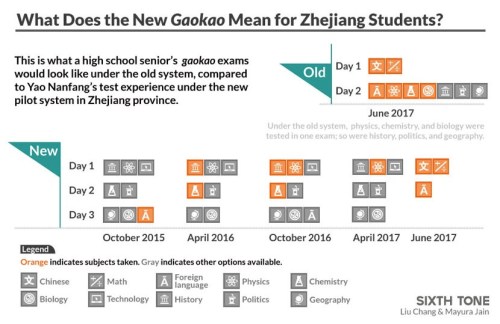
Zhejiang was one of the first provinces carried out the reform. Major changes in Zhejiang gaokao include:

  • Student choice: Instead having to choose between two sets of exams – either arts or science – students now can choose 3 elective subjects (a choice among physics, chemistry, biology, geography, politics, history, and general technology).
  • Timing: Students now have more opportunities to take the exams. Previously, students took all the subject tests within two days in June. Now only the compulsory subject tests take place in June. Students can take the elective subject tests starting in the second year of high school (in October and March). They can also take each elective subject test and English twice and use the highest grade for their college. These changes were intended to reduce the pressure so that students will not be too nervous about the last “two days” setting the course for their lives.
  • Scoring: The scoring method has changed so that now absolute scores are translated into ranking scores. For example, if a student ranks the top 1% among all students taking a particular subject test, she will get a 100 for a grade no matter the actual score; if a student ranks in the top 2% among all students taking the same subject test, she will get a 97 for grade.

Gaokao 2

Although these changes were designed to give students more flexibility in selecting subjects that match their interests and to reduce pressure, schools have found the new changes have led to some unanticipated developments:

  • Before the reform, all students took the same courses during all three years of high school. Groups of students took the same courses together. Now, since students are choosing elective subjects, it is much harder for school leaders to anticipate how many students will take each subject, creating challenges for both scheduling and staffing. As a result, some schools found they have too many physics teachers while not enough geography teachers and some schools were not able to offer every elective subject.
  • Some students and parents are choosing subjects that top students are less likely to take. For example, in Zhejiang, fewer and fewer students chose to take physics in high school due to the difficulty of getting high rank. and university teachers complained that engineering students from Zhejiang did worse in basic college physics than their peers from other provinces.
  • Although top students may benefit from the chance to take some tests early, the prolonged gaokao schedule exerts more pressure on many others. Students have to be prepared for the elective subjects test earlier, and they face the stress of taking high-stakes tests throughout high school

In Zhejiang, the response to these concerns has already begun.  After the first 3-years of implementation,the Zhejiang government issued new guidelines revising key aspects of the original gaokao reform. For example, to encourage more students to take physics, the Zhejiang established a new policy giving students taking physics a better chance to get a high ranking score. Other provinces are also working on better preparing and implementing the reform based on experiences and problems learned from the pioneer cases, including organizing visits and trips to schools that are successfully responding to the reform.


Main Sources:

国务院关于深化考试招生制度改革的实施意见http://www.gov.cn/zhengce/content/2014-09/04/content_9065.htm

坚定方向 不断深化 浙江深化高考改革试点意见出台 http://jyt.zj.gov.cn/art/2017/11/29/art_1532992_21468594.html

【报告】2018教育行业蓝皮书:中高考招生制度的改革之路https://www.jiemodui.com/N/101461

浙江高考改革是场闹剧?新高考方案改变了什么?http://edu.people.com.cn/GB/n1/2016/1130/c1053-28911744.html

高中生选课自由了,“避难就易”现象已露头 https://www.thepaper.cn/newsDetail_forward_1648268

告别一考定终生,机会增多也让“战线”拉长 https://www.thepaper.cn/newsDetail_forward_1648273

“走班制”十字路口的冷思考

http://www.jyb.cn/basc/sd/201511/t20151112_642828.html

北青报:暂缓高考改革省份应该有“准备任务清单”

http://opinion.people.com.cn/n1/2018/1123/c1003-30416936.html

尴尬的物理:浙江新高考下的学科失衡与制度改进

http://www.sohu.com/a/191876025_187643

LEAD THE CHANGE SERIES Q & A with Michael T. O’Connor

Michael T. O’Connor is the director of the Providence Alliance for Catholic Teachers (PACT) program at Providence College in Providence, Rhode Island, USA. In this role, Michael coordinates a Master’s secondary track, teaches Master’s level courses, provides supervision and instructional coaching to the program’s teachers, and offers support to the program’s partner Catholic schools in the New England region. A former middle school English Language Arts (ELA) teacher and instructional coach, Michael received his Ph.D. in Curriculum and Instruction from the Lynch School of Education at Boston
College. At Boston College, he worked with Andy Hargreaves and Dennis Shirley on the Northwest Rural Innovation and Student Engagement (NW RISE) network project. This project, and specifically his work with ELA teachers participating in the network, informed his dissertation work on examining secondary students’ language choices in authentic, community-based writing activities and the ways in which teachers collaborated to support student writing across rural contexts. His work with NW RISE also served as a key case for his work on collaborative professionalism, resulting in the publication of his book with Andy Hargreaves: Collaborative Professionalism: When Teaching Together Means Learning for All (Corwin Press).

In this interview, part of the Lead the Change Series of the American Educational Research Association Educational Change Special Interest Group, Dr. O’Connor  talks about, among other things, the role of collaboration in educational change. As Bray O’Connor puts it:

As someone who greatly values collaboration in education, I (perhaps to no surprise) find collaboration and collaborative professionalism to be an important issue in educational change. This past year, I am working with all K-12 Catholic school principals in the state of Rhode Island in a professional development series. When I met with the superintendent to discuss this work, he said that, in many ways, collaboration is at the heart of all educational change. If we seek to make changes to our individual schools and broader systems, it requires the will of the many, not just the will of one. This sentiment has stayed with me when thinking about the field of educational change. At the same time, I recognize that there is much beyond collaboration that impacts meaningful and transformative educational change and am grateful to the many researchers and practitioners in the
field who are doing important research and leading our field forward. As I mentioned in my previous response, issues of identity, diversity, equity, inclusion, and belonging are also
paramount. We must consider these issues for students, certainly, but also for teachers
and other educators. How are we considering teacher well-being, in addition to student well-being? How are we considering equity and diversity in school leadership opportunities? How do empirically-informed proposed educational change strategies impact schools and communities, especially those that have been historically or are currently marginalized? I have seen members of our field take up these issues in their work and I look forward to seeing how research evolves going forward. 

This Lead the Change interview appears as part of a series that features experts from around the globe, highlights promising research and practice, and offers expert insight on small- and large-scale educational change. Recently Lead the Change has also interviewed Kristin Kew and Thomas Hatch.

Puerto Rico Charter Sector to Take Off

This week, we share a cross-post from Sam Abrams, director of the National Center for the Study of Privatization in Education, which initially appeared on the Center’s website. Abrams was in San Juan last week to give a lecture on charter schools and vouchers at a symposium on governance hosted by the University of Puerto Rico Law School. While there, he learned about hearings for charter school proposals. The hearings, in fact, took place the same day as the symposium.

Puerto Rico is currently home to one charter school but may soon be home to 30 more, according to hearings held by the island’s Department of Education on Friday, February 8.

The island’s Education Reform Act, approved in March 2018 in the wake of Hurricane María, which wrought havoc the previous September, introduced charter schools as well as vouchers, with the stipulation that no more than 10 percent of schools could be charter schools and no more than 3 percent of students could attend private or non-district public schools with the use of vouchers.

In the first year following the Education Reform Act, one charter school opened: Vimenti, an elementary school in San Juan operated by the Boys and Girls Club of Puerto Rico.

According to an article published by Noticel,Vimenti started in August 2018 with a kindergarten and first grade, enrolling 58 students in total–31 of whom come from the neighborhood, 27 of whom come from nearby, and 13 of whom are classified for special education. The plan is to add one grade per year as students progress through school.

Supplementary funding for Vimenti, reported Noticel, comes from the Colibri Foundation, which donated $1 million, and the singer Marc Anthony, who gave $500,000.

In the hearings last week, the Department of Education considered proposals for four more charter schools in San Juan, five in Humacao, one in Bayamón, three in Caguas, six in Ponce, two in Arecibo, and nine in Mayaguez.

In contrast to Vimenti, these schools would not be new schools built one grade at a time but, rather, conversions from traditional schools to charter schools.

According to a school administrator with direct knowledge of the hearing process, it is expected that at least 13 of the proposed conversions will be approved for the 2019-2020 year while the remaining 17 will be approved for the 2020-2021 year.

For charter schools, the baseline for determining the 10 percent was the number of schools as of August 15, 2018, which means that if additional public schools across the island are closed, the proportion of charter schools could in time  exceed 10 percent. The government of Puerto Rico closed nearly 25 percent of the island’s schools following Hurricane María. Before the storm, there were 1,110 schools. A year later, according to a report by Education Week, there were 847.

Whether 14 schools or 31 in 2019-2020, the number of charter schools in Puerto Rico would mark striking growth.  By comparison, Minnesota, the state that introduced charter schools with legislation in 1991, opened one charter school in 1992 and six more in 1993. By 2017, there were 164 charter schools across the state, enrolling 6.5 percent of the state’s public school students.

Growth in New Orleans following Hurricane Katrina, however, sets the standard for the rapid increase in charter schools. Following the devastating storm in August 2005, charter schools replaced traditional public schools at a fast clip. Of the city’s 87 schools today, all but one, McDonogh 35 Senior High, is a charter school. According to an article published in December 2018 by The Times-Picayune, McDonogh 35 will also soon be a charter school. The school is slated to assume charter status for the 2019-2020 year, making New Orleans the nation’s first all-charter district.

While the response of New Orleans to Hurricane Katrina established a precedent for the response of Puerto Rico to Hurricane María, the impact on schools of Katrina and María differed substantially. María left Puerto Rico hobbled, but it did not leave an entire school system in ruins, as was the case in New Orleans, allowing the state to take over and dismiss all teachers to clear the way for the imposition of a largely charter system.

With the summary dismissal of all teachers in New Orleans, the teachers’ union had little if any countervailing power. Teachers in Puerto Rico retained their jobs after María, and the presence of their union remained strong, constituting a significant obstacle to plans for a transformation of the island’s school system akin to the overhaul in New Orleans.

Although charter schools and vouchers are new to Puerto Rico, the concept of alternative forms of public school management is not new. The island’s Instituto Nueva Escuela (INE), in fact, sets the international standard for running neighborhood public Montessori schools.

INE, celebrated in a recent story published by El Nuevo Dia, comprises 44 schools across the island enrolling 14,600 students. Like conventional neighborhood public schools, schools in the INE network require no application. Unlike conventional neighborhood public schools, the schools in this network all employ the Montessori child-centered curriculum and get significant supplementary funding from foundations.

According to Ana María García, the founder and director of INE, the network spends 10 percent more per pupil–or $6,600 compared to $6,000.

García was pressured by the Department of Education, she said in an interview in San Juan last week, to transform INE into a charter network, but she refused, contending that fundamental to INE was the idea that the network’s schools be open to all students in the neighborhood, without any application process. García prevailed.

In recognition of García’s work, as El Nuevo Dia reported in a separate story, the American Montessori Society will be presenting García with its highest honor, its Living Legacy Award, at its annual meeting in March.

– Samuel E. Abrams, Director, NCSPE, February 13, 2019

Can the “School Improvement Industry” support system-wide improvements in K-3 Reading Outcomes in New York City?

This week’s post features a podcast with IEN founder Thomas Hatch.  The podcast discusses a recently released report and research brief drawn from a study designed to identify all the external support providers working with New York City public schools to improve K-3 reading outcomes. 

In the latest podcast from CPRE’s Research Minutes, CPRE Senior Researcher Ryan Fink talks with Thomas Hatch about his latest study “Mapping the reading improvement sector in New York City.”  Among other issues Hatch discusses the nature of the school improvement industry in general, as well as some of the challenges that “external support providers” have faced in trying to work with schools in the US most productively.  He also highlights the longstanding nature of the problem – citing his own experiences while working at the ATLAS Communities Project and described in a 2002 article “When improvement programs collide.” Hatch goes on to discuss how difficult it is get any sense of the size, scope, growth, or effectiveness of this external support even in one area (reading), at one level (K-3), in one region (New York City).  As he put it, when the research started:

how many programs are trying to help New York City elementary schools improve reading outcomes? Nobody had any idea…So this work has been designed to get a sense of not just how many organizations and people are out there doing this work, but exactly what kind of work they’re doing, and then to figure out what we can do to try and make sure that all of this work adds up to more than the sum of its parts, and really has a much more powerful and catalytic effect on reading in New York City.”

When Fink asks Hatch about the implications, he responds that “we need to come to the realization that there’s not going to be an adequate supply of proven programs, and they’re still going to be demands” from schools for help. He concludes by outlining some of the key steps that he thinks can help to build coordination, coherence, and collective responsibility in the reading improvement sector.


LEAD THE CHANGE SERIES Q & A with Mark Bray

Mark Bray is Distinguished Chair Professor in Education at East China Normal University, Shanghai, and is also an Emeritus Professor at the University of Hong Kong. He began his career as a secondary school teacher in Kenya and Nigeria, and later joined universities in the United Kingdom and Papua New Guinea. He has long links with UNESCO, first as a consultant and then as Director of its International Institute for Educational Planning (IIEP). His decades of work at the University of Hong Kong commenced in 1986 (with four years of absence for the IIEP role), and in 2011 he was designated UNESCO Chair Professor in Comparative Education. Mark Bray has been President of the Comparative Education Society of Hong Kong (CESHK), the US-based Comparative & International Education Society (CIES), and the World Council of Comparative Education Societies (WCCES). He has also played a major leadership role in the Board of Directors of the Comparative Education Society of Asia (CESA). He can be reached at mbray@hku.hk.

In this interview, part of the Lead the Change Series of the American Educational Research Association Educational Change Special Interest Group, Dr. Bray talks about his work in international education with organizations such as UNESCO. As Bray puts it:

I have been privileged to work in and between multiple contexts and countries. Although born and educated in England, my first teaching jobs were in secondary schools in Kenya and Nigeria. They were culturally eye-opening, and provided additional exposure to neighboring Anglophone and Francophone Africa. I subsequently taught at the Universities of Edinburgh, Papua New Guinea and London, before moving in 1986 to the University of Hong Kong. From these bases, I undertook many consultancy assignments and research projects for such bodies as UNESCO, UNICEF, and the World Bank as well as for various non-governmental organizations and national governments. These arrangements have allowed me to operate “on both sides of the street”, crossing between the domains of academia and of practice in schools and policymaking. They have introduced me to cultures in rich, middle-income and lowincome countries, particularly in Africa, Asia, Europe, North America and the South Pacific, and to some extent, also in the Arab states and in Latin America and the Caribbean. Thus consultancies have been in
countries as diverse as Dubai, Malta, Myanmar, Sudan, and Solomon Islands.

This Lead the Change interview appears as part of a series that features experts from around the globe, highlights promising research and practice, and offers expert insight on small- and large-scale educational change. Recently Lead the Change has also interviewed Kristin Kew and Thomas Hatch.

Davos 2019: Education Headlines

The World Economic Forum meets in Davos-Klosters, Switzerland. Davos 2019’s theme was Globalization 4.0: Shaping a Global Architecture in the Age of the Fourth Industrial Revolution. Politicians and business people from around the world gathered to discuss issues such as the environment and global inequality.

Though the forum did not focus primarily on education, it was certainly an issue addressed throughout the conference. In this brief post, we offer various headlines that discuss Davos and education.

wef image

Education Stories

Reflections on Davos: The Global Reskilling Challenge (Forbes, January 27th)

Why AI Can’t be Education’s Cure-All (Forbes, January 28th)

More jobs, better education: What young people want from Davos leaders (Business Standard, January 21st)

Davos elites believe the answer to inequality is ‘upskilling’ (Union Leader, January 26th)

Davos 2019: The Young Want More Jobs, Better Education From Davos Leaders (Bloomberg, January 21st)

This is what matters in education according to the world’s best teacher (World Economic Forum, January 18th)

Teenage activist takes School Strikes 4 Climate Action to Davos (The Guardian, January 24th)

In Davos, JGU V-C calls for internationalisation of higher education (India Today, January 24th)

Davos 2019: Emerging markets have 20% youths without job, education or training, says Christine Lagarde (CNBC, January 24th)

JGU Vice-Chancellor speaks at the 2019 World Economic Forum in Davos (Edex, Indian Express, January 23rd)


In addition to these headlines, several reports and headlines offer stories about inequality that closely relate to education.

  • An Oxfam report that looks at how “Universal health, education and other public services reduce the gap between rich and poor, and between women and men. Fairer taxation of the wealthiest can help pay for them”
  • A Vox article that addresses the Oxfam report and other lessons from Davos 2019
  • A New York Times piece on “The Hidden Automation Agenda of the Davos Elite”

An Informal Education Program for Talking to “Racists”

After the election of Victor Orban in 2010, Hungary saw a sharp turn towards nationalism. For many people there was a distinct sense of fear as nationalists routinely marched through the streets, espousing anti-roma and anti-semitic rhetoric. This atmosphere echoed the notion that “wars do not start with bullets – they start with words.” Rather than retreat, there were those who started to reach out to talk to people with very different views from her own, asking them questions and striking up conversations. These conversations provided the foundation for what Maja Nenadović calls the Applied Debate program, an informal education workshop she developed, which aims to fight discrimination and depolarize communication.


A Method for Talking to “Racists”

These initial experiments began with a flexible approach, but broadly followed three basic aims. First, Applied Debate seeks to find a “lowest common denominator” between people engaged in a dialogue. Doing so allows them to see each other’s humanity. Second, the dialogue aims to confuse, to create some uncertainty in thinking, though not as a way to “win” or assert one’s own certainty. Instead, uncertainty acts as a productive point of engagement. Third, Applied Debate looks to understand, to see where people with such different views are coming from. Understanding does not mean accepting or compromising. Applied Debate views understanding as a way to both humanize and alleviate fear.

The program was first publically presented at the Qatar International Conference on Argumentation, Rhetoric, Debate and the Pedagogy of Empowerment. It was here that Nenadović outlined Applied Debate’s basic plan. From here, it grew into wider conversations and a more specifically structured program. It has so far been taught with NGO’s, student organizations, and at universities across over 20 countries.


Inside the Workshops

Though Applied Debate differs from place to place, in general, participants engage in a 3-day seminar that explores rhetorical self-defense, demystifies hate speech, exercises sharing definitions (many misunderstandings come about from simply having different ideas of what things mean). Throughout, the activities and discussion address the polarization that permeates so much of life and work today, including education. Applied Debate’s informal setting opens a unique space to depolarize discussions and confront issues like hate speech, which is rarely addressed in schools. At the same time, these programs are not educational workshops on how to win arguments or gain “rhetorical supremacy.” If understanding is an ultimate aim, one cannot enter with a goal of winning. Yet, depolarizing is not the same thing as neutralizing. Building on that idea, instead of teaching a method for “beating the opposition,” Applied Debate develops strategies for listening. In a similar vein, the workshops offer activities that interrogate stereotypes. Where common approaches to teaching about stereotypes is to shame or deny one’s thinking, the Applied Debate program suggests that we can educate by identifying and engaging these ideas. While talking with participants from international education foundations in Hungary, for example, many wanted to examine their own biases but admitted that they were afraid of fueling the fires of polarization. They wanted to spend the seminar distancing themselves from hate speech and rhetoric. Yet, this tension is exactly the point. Applied Debate offers the opportunity to productively move out of one’s echo chamber.


Talking to School Systems

In many of the places where the workshop has occurred (from Colombia to Bosnia and Herzegovina), Applied Debate could easily fit into a school’s curriculum. Yet, the program exclusively remains in informal education spaces. At issue is a broad conception that school is supposed to remain an apolitical, neutral space. Even in divisive political contexts, many people want to maintain the view school as a neutral space (often as a way of maintaining the current order). Meanwhile, Applied Debate directly takes on and brings up political beliefs. Of course, school is already a political space, and, what’s more, students constantly encounter divisive political issues around the globe, whether it be online and somewhere else.

At the same time that it focuses directly on issues often avoided in schools, the content of Applied Debate directly relates to the skills and knowledge teachers aim for in classrooms. Critical thinking and analysis as just two of the skills central to Applied Debate. In sessions, for instance, participants practice these skills by examining Facebook posts. Nenadović notes that “as they scratch below the surface of a post, they not only dismantle certain assumptions, they also develop new skills in critical engagement.”


Going Forward

As more take note of it, the Applied Debate program continues expanding. Its developers and practitioners keep introducing workshops and developing the concept with those who practice discriminatory behavior and those impacted by discrimination.  However, there have been a number of requests to expand the program or at least offer a manual so that others can run their own workshop. Although there are now plans to develop such a manual, this development raises the challenge of keeping the design highly localized. Education systems adhere to and reflect larger political structures, making it difficult to drop in this highly contextualized program. As a result, Applied Debate is intended to remain open and flexible, both to avoid creating a “script” that others have to follow and to encourage adaptions in both local languages and content. But, the enduring goal remains to create the conditions that support a renewed sense of agency in polarizing and isolating times.


Maja Nenadović developed the Applied Debate program. Nenadović is an experienced debate coach, public speaker, political consultant, researcher, human rights and advocacy trainer and identity de/construction educator. She holds a special affinity for challenging and transforming societal stereotypes through applied debate, “radical” empathy and dialogue as means of resolving miscommunication and conflicts – particularly amongst vulnerable and marginalized groups in society.  As a global trainer and consultant with 18years experience, she has taught in more than 40 countries worldwide.  Her recent work throughout Europe focuses on dealing with the rise of populism and extremism.  Maja is one of the initiators of the Model International Criminal Court Western Balkans (MICC WeB), the project that brings together high school students and teachers from all over Bosnia-Herzegovina, Croatia and Serbia to simulate war crime trials and learn about human rights and their violations, throughout history as well as in the 1990s breakup of Yugoslavia. She is currently also working as the Anne Frank House coordinator of the EU-funded project ‘Historija, Istorija, Povijest – Lessons for Today.’ She holds a PhD in Political Science from the University of Amsterdam.

2018 in International Ed News

Happy New Year to all our readers! Continuing an International Ed News tradition, we begin this year with a reflection on our posts and coverage of international education stories from the previous year. In 2018, our most popular posts included a two-part piece about the Luminos Fund’s accelerated learning program in Liberia and Ethiopia, an article on the education system and out-of-school education in Singapore, and a post on the beginnings of Sesame Workshop’s work with young children displaced by conflict in the Middle East.

On Twitter, our top Tweets covered stories ranging from Singapore abolishing school exam rankings to Macron’s attempts to “fix” France’s education system.

Looking at some of our statistics, IEN had visitors from 161 countries. Next to the United States, the majority of visitors came from Philippines, U.K., Singapore, and Australia. Other visitors came from Bahrain, South Africa, Turkey, and Canada. We covered stories on dozens of countries and five continents, focusing on everything from informal education programs to education policies.

In 2018, we continued our examination of educational improvement efforts in the U.S. with posts on ExpandED/TASC and Collective Impact.

Throughout the year, we scanned headlines around the world. Highlights of these roundups focused on examining the migrant caravan and a timeline of Trump’s war on immigrant families. Given current news, we will certainly revisit these stories on IEN in 2019.

We also continued posting work from our colleagues and partners. Each month, we featured interviews from AERA Education Change SIG’s Lead the Change series. Among other interviews, Lead the Change interviewed IEN co-founder Thomas Hatch. Additionally, we continued the Leading Futures series, including a post on Flip the System.

As we move into 2019, we look forward to continuing to share these ongoing pieces as well as many new posts from stories around the world.


Speculations on Education in the 2020’s…

My current work focuses on how to develop an education system that prepares us all for a future we can’t predict.  Nonetheless, rounding-up the year-end reviews from many of the education/news outlets I follow (see the links below) always inspires some reckless speculation. This year, as last year, issues related to educational technology and personalization/customization in the US, immediately came to mind:

Virtual reality will be the whiteboards of the 2020’s — Almost everywhere I travel I find whiteboards in classrooms, and almost everywhere I travel I find teachers (including me) who don’t use them.  These “hardware” innovations manage to scale because they make schools look like they are doing some “new”, but can be plugged-into conventional structures and practices without really challenging the status quo. Furthermore, new hardware can be difficult to maintain, the basic technology changes so fast that it can be difficult for schools and educators to keep up, and, ultimately, effectiveness depends on the expertise of individual teachers.  As long as educators have to rely on evolving hardware to take advantage of virtual reality, there will be some amazing and powerful uses, but it will remain limited in wide-scale effectiveness. (As a corollary, I also predict that whenever I see another innovation that is not working out as intended, I will soon find out that Larry Cuban has already pointed this out in a succinct and enlightening way)

AI will do for education in the 21st Century what standardized tests have done in the 20th – Artificial intelligence is already flowing into many classrooms in “smart” assessments, “intelligent” tutoring systems, online services and the phones and social media accounts of teachers and students, and the costs and benefits need to be carefully considered. These carriers may increase efficiency, particularly on routine and standardized tasks, by providing individualized feedback and guidance.  On the positive side, these developments can create opportunities for students and educators to spend more time on activities involving deeper learning, social emotional development and other worthwhile pursuits; and just as standardized tests had some benefits – by making inequities in educational opportunities and outcomes visible for example – AI could help historically underserved students get access to more effective feedback and customized support.  At the same time, the most sophisticated uses of AI to support “deeper learning” and support more complex tasks will likely remain out of reach for many schools and educators for some time.  As a result, using AI in education may well reinforce the same narrow set of academic skills and abilities – and may reflect the same biases and systemic racism – as standardized and high-stakes tests.

Personalization in classrooms will be as successful as project-based learning – This year, the blowback and concerns about personalization seemed to get as much attention as the efforts to promote it.  Given the ease of saying education is personalized and the difficulties of actually carrying out any kind of individualized instruction in conventional classrooms, personalization may well remain a niche reform.  It will continue to have adherents, particularly among those who seek an alternative to traditional schooling, but many will continue to be skeptical and to resist large-scale efforts to adopt it without considerable community input and support.

Customization of educational pathways will be the new frontier for “choice.” Even as it remains difficult to individualize instruction in classrooms, the rapidly multiplying opportunities to support learning outside of traditional education institutions will create opportunities for individuals to get “just-in-time” learning when they want and need it.  Employers, new providers as well as traditional schools, colleges, and universities are already creating badges, micro-credentials, new degree programs, and other targeted learning opportunities.  As a result, students will have more and more opportunities to choose providers (online and off) to help them develop abilities and expertise that support their academic, personal, and professional development.  In the process, institutions focused on preparation may face more competition from organizations and individuals that offer professional development and ongoing support.  Again, although students from different backgrounds may find new educational opportunities that better meet their needs and interests, there is no reason – yet – to think that the resources and support needed to find those opportunities will be equitably distributed.

These reflections rely primarily on wild extrapolation, mixed with a small dose of my own experiences with the challenges of making rapid and wide-scale changes in schooling.  However, I have more confidence in saying that changes in work and the workforce and related uses of time are more likely to change schools than any particular reform effort, policy change, new technology or other “innovation.”  As long as parents have to continue to rely on schools to house their children from 8 AM to 3 PM or so – in buildings that separate them from the surrounding community; in isolated classrooms with one adult and a relatively small group of peers; with limited funds and resources – there is no reason to expect that schools will look substantially different from the teacher-centered, age-graded, academically oriented, standardized test based form that has developed over the past century all over the world.

Under these circumstances, what will change?  The most significant changes may come in the experiences, perceptions, and treatment of childhood. The rise of industrialization came along with decreases in child labor (though by no means it’s elimination).  Those developments also created space and time for a different kind of childhood for some. Today, the advent of new technologies and social media can make childhood more public in ways that may lead children to become “young adults” much more quickly.  With personas and histories that are widely visible through social media, serious debates about the abuses and uses of children’s work, images, and perceptions by their parents and others have already begun.  I’ve experienced this in my own work as I’ve struggled with how and when to draw on and represent my children’s experiences in schools in Norway and Finland as well as on my social media accounts.  But the publication of everyday life affects us all, as we find our actions and identities subject to much wider interpretation and critique.  But at the same time that the pervasiveness of social media opens children up to inspection, monitoring, and new forms of profiteering, it can also create opportunities for transparency, making visible young people’s experiences in ways that reveal – and address – inequality and injustice. What’s more, the changing times also afford opportunities for young people to become artists, entrepreneurs, and activists who can have a much wider impact on the world around us than they ever have before.

— Thomas Hatch


An (unsystematic) scan of 2018 year-end reviews education stories, issues,   and predictions for 2019

Education in 2018 seems to have been distilled into a series of sub-topics as sources like Education Week, the74, and EdSurge all offered multiple reviews in areas like Higher Education, Politics, EdTech, EdBusiness and others.

Year in Review: Our Top Edtech Business Stories of 2018, Edsurge

EdSurge’s Year in Review: The Top 10 K-12 Stories of 2018, Ed Surge

EdSurge HigherEd Year in Review: Our Top Higher Education Stories of 2018, Ed Surge

2018 in Research: How Principals Lead, Gates Faltered, and Teens Balk at ‘Growth Mindset’, Education week

U.S. Education in 2018 in 10 Charts, Education Week

Top Posts of 2018 Focus on Big Education Companies and Popularity of Digital Tools, EdWeek Market Brief

The Hottest Stories in the Ed. Market in 2018, and What It Means for the New Year, EdWeek Market Brief

Education Week’s Biggest K-12 Technology Stories of 2018, Education Week

Our 2018 Education Journalism Jealousy List: 22 Important Articles About Schools We Wish We Had Published This Year, the 74

The Top 2019 Priorities Inside America’s 15 Biggest School Districts: Teacher Strikes, Integration Fights, Sexual Misconduct Claims & More, the 74

Best Education Articles of the Year: Our 18 Most Popular Stories About Students and Schools From 2018, the 74

How School Policy Changed in 2018: The Year’s 7 Biggest Federal Storylines, From Unforgettable Student Advocacy to an Already Forgotten White House Proposal, the 74

6 Education Predictions for the New Split Congress: From School Infrastructure to Student Discipline to ‘Groundhog Day’ on Higher Ed?, the 74

2018 in charts:

11 Charts That Changed the Way We Think About Schools in 2018, the 74

U.S. Education in 2018 in 10 Charts, Education Week

In New York City

What happened in New York City education this year — and what to expect in 2019, Chalkbeat

In California

California education in 2018; A look back at EdSource’s top stories, EdSource

California education issues to watch in 2019 — and predictions of what will happen, EdSource

Philanthropy & Social Innovation

Crystal Ball Check-In: How Did We Do at Forecasting 2018 Philanthropy?, Inside Philanthropy

Philanthropy Awards 2018, Inside Philanthropy

Top 10 Most-Read CEP Blog Posts of 2018, The Center for Effective Philanthropy

Looking Back and Looking Ahead

What worked (and didn’t) this year: 10 lessons from education research to take into 2019, Chalkbeat

Ten Education Stories We’ll Be Reading in 2019, Education Week

The Year of Thinking Forward, CRPE

Reflections from education reporter Jenny Abamu on Twitter

Some of the “favorite development papers of 2018” from the World Bank, including three from economist David Evans who highlighted three papers related to education in the developing world: