Category Archives: About K-12 International Education News

Introducing the Journal of Professional Capital and Community

The Journal of Professional Capital and Community is an international, professionally refereed, scholarly journal, reflecting the most important ideas and evidence of the nature and impact of interactions and relationships in the education profession, especially in the school sector. As described on the journal’s website, its launch comes at a time when, on a global scale, the quality of teaching and leadership in the education profession has never been more prominent as a policy priority.

In his introduction to the inaugural issue, Editor-in-Chief Andy Hargreaves argues that “at present, and for the foreseeable future, the most significant in-school factor affecting the quality of students’ learning and achievement will continue to be the quality of teachers.” Hargreaves continues:

The impact of professional effectiveness is not only individual but also collective. Teachers make a difference or not to students’ learning, achievement and development by the impact they exert from working together, not just by the impact each may have on their own. This is the power of social capital in addition to human capital. Social capital encompasses the significant impact teachers have on their students through the accumulated effects of their professional practice. Social capital includes, among other activities, collaborative working; shared decision-making; joint teaching; collective responsibility for all students’ success across grades, schools and classrooms; mutual trust and assistance; distributed leadership; data teams; professional learning communities; professional networks and federations; and many kinds of collaborative inquiry. Some researchers have compellingly argued that social capital has an even greater effect than human capital on teacher quality (Leana, 2011). Others point to how only some kinds of collaboration and social capital have positive implications for students’ results (Chapman and Muijs, 2014). Until now, in this journal, there has been no one place where these issues of professional collaboration and their implications for pedagogy, policy and leadership can be concentrated in one intellectual space. The paper in this issue by Priestley and Drew emphasizes the way that collaborative enquiry among teachers has and has not contributed to the implementation of the Scottish Curriculum for Excellence. Rincón-Gallardo and Fullan ’s paper in this volume draws on the authors’ international research and policy development to examine how social capital operates across schools as well as within them, through professional networks for improvement and innovation.

The journal’s first issue is now available for free online. For updates, follow the journal on Twitter@JPCCJournal


Testing and Assessment in Norway

In order to learn about what’s happened with testing and assessment in Norway in recent years, we had a conversation with Sverre Tveit. Tveit is a Ph.D. candidate at the Department of Education at the University of Oslo. He will join the University of Agder in southern Norway as University Lecturer in August. In addition to his comparative research related to assessment policy, Tveit has also worked on education and assessment issues at the municipal level (the equivalent of the district level in the US) and was a board member of the Norwegian School Student Union (which organized protests against the initial implementation of the national tests in 2005). He talked with us about how the national tests seem to have been integrated into the Norwegian education system but also pointed to the ways in which local and national politics reflect continuing debates over issues and tensions of testing, assessment, and accountability.

In Norway over the past fifteen years, as in many other countries, there have been numerous debates over the extent to which tests should be used for accountability and/or diagnostic purposes. The “shock” of the 2001 PISA results sparked a reform of the entire primary and secondary education system that included new testing and accountability policies developed by the right-wing government and endorsed by a unanimous parliament. However, as Tveit portrays in Educational Assessment in Norway, in 2004-2005 protests erupted against the right-wing government’s plans to publish schools’ test results, open up more non-public schools and facilitate more school choice. Those protests died down as a more left-wing coalition government went ahead with the implementation of national tests, yet with more emphasis put on formative and diagnostic purposes. Since that time, students in Norway have regularly taken national tests in the fall of 5th and 8th grade in reading, numeracy, and English instead of at the conclusion of 4th and 7th grade (as was originally proposed). Part of the reason for changing the timing of the tests was to shift the focus from ensuring that students have reached proficiency by the end of middle and lower secondary school, to providing teachers and schools with information they can use to inform their instruction moving forward.

While the tests themselves no longer seem to be as controversial, there are still concerns from educators that the tests do not yield the kind of specific information that can help them improve instruction. As Tveit explained “if you talk to teachers, many complain that the testing takes time that could have been used better for working with students.” On the other hand, he pointed out, many others feel that the tests have become a crucial part of the government’s effort to improve the quality of education across schools.  These tensions between the use of the tests for governing and accountability purposes versus formative and diagnostic purposes are central in Tveit’s investigation of how policymakers’ rationalize and legitimate the national tests. He has found, for example, that policymakers’ efforts to satisfy the demands of both those who want to use tests for accountability purposes and those who want to use the tests for formative purposes lead to methodological compromises that can be problematic. To shed some light on these debates, an ongoing research project Practices of Data Use in Education (PraDa) looks specifically at how teachers and schools in different municipalities are using the data from the national tests, the lower secondary school graduation exams, and other sources.

The use of test data for ranking was also a matter of considerable controversy initially. The right-wing government that implemented the testing program envisioned the tests as a source for rankings and comparisons among schools that could spur school choice. But when the tests were introduced, the more left-wing coalition that took over the government discouraged the production of rankings and “league tables” that might be used to “name and shame” poorly performing schools. The current government’s recent move to make schools’ tests results more widely available through a “user-friendly” online format has generated relatively little public discussion. The compromise makes it possible to see how an individual school compares to municipal and national averages, although schools cannot be ranked or compared directly.

Different perspectives on testing and assessment are also reflected at the local level. In fact, even though there have been limits on the use of testing at the national level, the municipality of Oslo, led up until recently by a more right-wing local government, has developed an elaborate system of annual tests that includes tests at a number of different subjects and ages in primary school. Ironically, however, while the right-wing government that is now in place at the national level could pilot the use of grading in primary schools, Oslo, which would have been a logical place for such pilots has now elected a more left-wing government. The new Oslo government seems more likely to curtail any expansion or use of testing than it is to participate in such a pilot.

Looking ahead, a committee created to help imagine Norway’s “schools of tomorrow” has proposed that Norwegian schools, teachers, and students need the freedom to go deeper into some content areas rather than being required to cover a wide range of topics. Similar to recent changes proposed for the Core Curriculum in Finland, the report also encourages a shift to a more interdisciplinary curriculum. Of course, such shifts would have important implications for testing and assessment as well. Exactly what will come of the report and exactly how much interest there is in Norway for another set of reforms, however, remains to be seen.




Lead the Change interview with John Hattie

Dr. John Hattie

Dr. John Hattie

John Hattie is Professor and Director of the Melbourne Education Research Institute at the University of Melbourne, Australia and chair of the Australian Institute for Teaching and School Leadership. He is the author of Visible Learning, Visible Learning for Teachers, Visible Learning and the Science of How We Learn, and Visible Learning into Action. He is also co-editor of the International Guide to Student Achievement.

John Hattie’s influential 2008 book Visible Learning: A synthesis of over 800 Meta-Analyses Relating to Achievement is believed to be the world’s largest evidence-based study into the factors which improve student learning. Involving more than 80 million students from around the world and bringing together 50,000 smaller studies, the study found positive teacher-student interaction is the most important factor in effective teaching.

In this interview, which is part of the Lead the Change Series of the American Educational Research Association Educational Change Special Interest Group, Hattie shares his thoughts on the most important issues in educational change today:

The most important issue is scalability. There is a rich source of educational research, there are so many excellent educators in our schools and universities, and there is so much we know about what this success looks like. The missing ingredient is how to scale this success.

This Lead the Change interview appears as part of a series that features experts from around the globe, highlights promising research and practice, and offers expert insight on small- and large-scale educational change. Recently Lead the Change has also published interviews with Diane Ravitch, and the contributors to Leading Educational Change: Global Issues, Challenges, and Lessons on Whole-System Reform (Teachers College Press, 2013) edited by Helen Janc Malone, have participated in a series of blogs from Education Week.

Digital Tools for Civic Engagement: A Conversation with Joe Kahne

Here at International Ed News, we have been engaged in a series of conversations with researchers working with educational issues in innovative ways on the margins of formal schooling. We previously spoke with Mary Helen Immordino-Yang and John Seely Brown. Recently, we spoke with Dr. Joe Kahne about his work in democracy and education, urban education, and Youth and Participatory Politics. He particularly focuses on digital media and online components of civic engagement. Dr. Kahne is Professor of Education at Mills College as well as Chair of the MacArthur Foundation Research Network on Youth and Participatory Politics, which is part of the Connected Learning Alliance.
While Dr. Kahne’s work has always focused on urban education (stretching back to his days as a teacher in NYC) and innovation, his recent work with institutions such as the Connected Learning Alliance emerged from his recognition of an increasingly digital component to youth civic engagement. As he put it, in the digital world “some of the core acts of civic and political life such as finding information, mobilizing others, and sharing perspectives” occur through social media and other spaces. These spaces enable “individuals to comment on, engage in, and influence civic and political life… and youth are often given such opportunities when online to a greater degree than when engaged in with institutional politics.” Through the affordances of digital media, “those who would otherwise remain marginal gain voice” and gain agency through action such as creating groups and social networks. As an example, Dr. Kahne points to ways that the Black Lives Matter movement has been aided by youth engagement with digital media. While people do not typically buy smart phones to photograph the police, for instance, he points out that these tools have been used to help shift public consciousness and mobilize for reform.
While his work is primarily centered on the U.S., Dr. Kahne sees this line of research as being possible as part of promoting and questioning narratives on citizenship in general and as operating beyond national boundaries. For example, he uses the DREAMers to point to the ways that online spaces are being used to debate the very question of who gets to be a citizen. Additionally, he points to online spaces where non-citizens can play increasingly participatory roles in discourses on national issues such as elections. The Youth and Participatory Politics initiative in which he is involved has also undertaken a Global Dimensions link, which explores the composition and dynamics of activism on a global scale in the digital age.
Much of Dr. Kahne’s research focuses on the Youth and Participatory Politics (YPP) research network. His group “defines YPP as something that is socially networked and peer driven rather than institutionally dictated and driven by elites.” With YPP, Dr. Kahne is currently working on a MacArthur Foundation funded project called Educating for Participatory Politics. In this project, Dr. Kahne and others are working with educators and students in Oakland, Chicago and LA to merge digital tools and classrooms spaces in order to increase civic engagement. Using Web 2.0 and other digital media tools, they are “investigating the opportunities for educators to support youth participation in civic and political life.”
This line of work on civic engagement is not always easily integrated into schools. Though he recognizes that many individual teachers and students have already been deeply involved in civic engagement as individuals, specifically through digital media, Dr. Kahne sees a “tension between institutional actors and other participatory modes of action.” This type of innovation (i.e. networked civic engagement through digital media) is not something he believes that educational institutions have prioritized thus far. He asked is “there a way through [this project] to create institutional commitments that would support those teachers and bring others in to a greater degree?” This project is thus an innovative approach to link and cultivate what had already been present in spaces outside of school with school’s daily life.

Professional Learning in Top Performing Systems, part 2

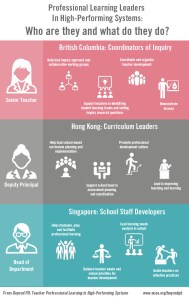
PDinfographicv2The National Center on Education and the Economy’s (NCEE) Center on International Education Benchmarking has released two reports on professional learning environments in top performing systems: Beyond PD: Teacher Professional Learning in High-Performing Systems and Developing Shanghai’s TeachersTo explore and share the findings of these reports, the NCEE held a conference last week featuring presentations and panel conversations with the leading voices in education from around the world. This conference was also streamed live and can be viewed online. Moderated by Marc Tucker, president and CEO of NCEE, speakers included Ben Jensen (author of Beyond PD) and Minxuan Zhang (author of Developing Shanghai’s Teachers).

Ben Jensen began his presentation with the questions, “What is at the core of high performing professional learning systems? What is the strategy to ensure effectiveness?”

Jensen argued that we need to move past the idea that there is a single answer. Instead, we need to understand the fundamentals behind effective professional learning. We need to think about an overall strategy for change, rather than specifics, such as how many hours should be required, or the regulatory environment. According to Jensen, high performing education systems around the world all have one thing in common. They are all really clear in their belief that school improvement = professional learning.

While countries such as Australia and the United States set high expectations for outcomes and leave it up to schools and teachers to meet those expectations in any way they see fit, top performing systems such as Shanghai and Singapore don’t take the same approach. Instead they look for broad policies that will make sure organizations have great professional learning, and talk about accountability as being a cornerstone of good practice for professional learning. While Australia and the U.S. see a dichotomy between development and accountability, higher performing education systems look at the two as interconnected, with several individuals directly accountable for the quality of professional learning.

Jensen explained that assessment of student learning is at the heart of professional learning in high performing education systems. These systems recognize how difficult it is to assess student learning well, and yet how fundamental it is to good teaching. They start by identifying student learning needs, and then how to change instruction. They look at evidence, try new things, work together, and evaluate impact. This inquiry approach has different names in different countries. For example, Singapore has Professional Learning Communities, while Shanghai has Learning Groups. Yet, these approaches are all focused on teacher learning and aligned with accountability (not focused solely on outcomes). Responsibility is shared, and individuals are held accountable for how well they collaborate with each other.

To read the full report: Beyond PD

Deirdre Faughey

Lead the Change interview with Dr. Juana M. Sanhco-Gil

Dr.Juana M. Sancho-Gil

Dr. Juana M. Sancho-Gil

Dr. Juana M. Sancho-Gil is Full Professor of Educational Technologies at the University of Barcelona. Dr. Sancho-Gil has a longstanding and steady experience in promoting research policy at institutional level, advising research programs and projects, and assessing and managing research projects. At the moment she is coordinating the European project DIYLab-Do It Yourself in Education: Expanding Digital Competence to Foster Student Agency and Collaborative Learning. Dr. Sancho-Gil won the national educational research award, first in 1987 and again in 2003.

In this interview, which is part of the Lead the Change Series of the American Educational Research Association Educational Change Special Interest Group, Leithwood shares thoughts on the field of educational change, and provides details of her current work in Spain:

In the context of Spain, where a ruling party has approved and is implementing a regressive educational law, I take part in what is called the Foro de Sevilla. In 2012, the Spanish Minister of Education promoted a new educational law (Ley orgánica de mejora de la calidad educative–LOMCE). Because it was a majority government, the proposal was developed in an authoritarian manner and was highly confronted by diverse political parties, and civic and public entities. A group of university professors, teachers, union members, and representatives of parent associations, concerned about the clear educational and democratic recoil of the proposed law, met in Seville and wrote a manifesto. Since then, we have been discussing the different challenges to be met by education, involving more and more groups in the discussion and engaging in the development of proposals.

This Lead the Change interview appears as part of a series that features experts from around the globe, highlights promising research and practice, and offers expert insight on small- and large-scale educational change. Recently Lead the Change has also published interviews with Diane Ravitch, and the contributors to Leading Educational Change: Global Issues, Challenges, and Lessons on Whole-System Reform (Teachers College Press, 2013) edited by Helen Janc Malone, have participated in a series of blogs from Education Week.

Educating a new population of refugees in Europe

Our review of education news this week focuses on European countries adapting to a surging refugee population, mostly from Syria.

As The Guardian reported, Germany expects the number of refugees entering the country to surpass the million mark. About 196,000 children will enter the German school system this year, and 8,264 “special classes” have been created to help the new students catch up with their peers. Language is a primary concern, and the government has recruited 8,500 people to teach child refugees the German language. Education authorities describe the population change as a challenge, but one that “will become the norm for a long time to come.” In all, Germany will need up to 20,000 teachers by next summer.

Similarly, The Helsinki Times reported that Finland will have to recruit hundreds of teachers as well. As Heljä Misukka, an education director at the Trade Union of Education (OAJ), explained, “The number of unaccompanied minors who have arrived in Finland this year is 2,000. A child is entitled to basic education immediately.” Teachers are needed to teach, for example, preparatory classes for immigrants, integrated classes for special-needs learners and classes for learners studying Finnish as a second language.

While finding teachers for the new students is a necessity, a recent Economist article also argued that distribution of the immigrant students will also be important to their success. As the article explained, the biggest problem is that refugee children tend to be concentrated together. “In Norway, Denmark and Sweden about 70% go to schools where at least half of the pupils are immigrants. This means they are partially segregated and less likely to learn the local language.”

However, a new United Nations Refugee Agency survey has shown that the Syrian refugee population entering Greece is largely highly-skilled and well-educated. The majority is under the age of 35; 86% say they have secondary school or university education. Since, as the Economist argued, parents’ level of education is “the most important predictor of pupils’ school results,” with proper integration, these students might adapt quickly.

Deirdre Faughey

2015 in review

The WordPress.com stats helper monkeys prepared a 2015 annual report for this blog.

Here’s an excerpt:

The concert hall at the Sydney Opera House holds 2,700 people. This blog was viewed about 30,000 times in 2015. If it were a concert at Sydney Opera House, it would take about 11 sold-out performances for that many people to see it.

Click here to see the complete report.

Lead the Change Interview with Ken Leithwood

rsz_leithwood_ken

Ken Leithwood

Dr. Ken Leithwood is Emeritus Professor at OISE/University of Toronto and recent advisor to the Leadership Development Branch of Ontario’s Ministry of Education. His research and writing is about school leadership, educational policy and organizational change. His most recent books include Linking Leadership to Student Learning (2012, Jossey Bass), Leading School Turnaround (2010, Jossey Bass), Distributed leadership: The state of the evidence (2009, Routledge), Leading With Teachers’ Emotions In Mind (2008, Corwin), Making Schools Smarter (Corwin, 3rd edition, 2006) and Teaching for Deep Understanding (Corwin, 2006). With colleagues, he completed in 2013 one of the largest studies of its kind about how state, district and school-level leadership influences student learning. Professor Leithwood is the inaugural recipient of the University of Toronto’s Impact on Public Policy award, AERA’s 2011 Outstanding Leadership Researcher Award, and the 2012 Roald F. Campbell Lifetime Achievement Award from the University Council for Educational Administration. Dr. Leithwood is a Fellow of the Royal Society of Canada.

In this interview, which is part of the Lead the Change Series of the American Educational Research Association Educational Change Special Interest Group, Leithwood shares thoughts on the field of educational change.

This Lead the Change interview appears as part of a series that features experts from around the globe, highlights promising research and practice, and offers expert insight on small- and large-scale educational change. Recently, Lead the Change has also published interviews with Diane Ravitch, and the contributors to Leading Educational Change: Global Issues, Challenges, and Lessons on Whole-System Reform (Teachers College Press, 2013) edited by Helen Janc Malone, have participated in a series of blogs from Education Week.

How to scale John Dewey: A Conversation about innovation from the margins with John Seely Brown

We recently spoke to John Seely Brown of the Center for the Edge. Over an expansive career, Dr. Seely Brown cofounded the Institute for Research on Learning, worked as the Chief Scientist of Xerox, and acted as the director of Xerox’s famous Palo Alto Research Center (PARC). Additionally, he is a prolific speaker and writer, having published numerous books and articles on an array of topics. He is also featured in a number of popular YouTube videos. While his work spans many themes and disciplines, Dr. Brown’s work in books like A New Culture of Learning has particular relevance for efforts to rethink and reimagine education around the world.

Our conversation primarily focused on his concern with innovative ecosystems of learning in the rapidly transforming contexts and demands of the 21st century. This work explores spaces where learning takes place and examines how these spaces operate within the demands of areas like the job market. In our conversation, Dr. Seely Brown suggested a number of examples of innovative learning ecologies such as online communities and the creative spaces of Silicon Valley like PARC. A learning ecology, he believes, accounts for and uses a new kind of learning, where we “step back and loo[k] at the forces and trends underlying” these learning spaces and communities. Learning ecologies, Dr. Seely Brown believes, cultivate innovation and deep learning. Moreover, they are increasingly necessary in modern educational landscapes. If it once took an entire village to raise a child, Dr. Seely Brown believes that it now “takes an entire ecosystem to educate a child.”

One of Dr. Seely Brown’s objectives is to “attack the core,” meaning attack dominant approaches to learning. While he does not specifically disregard mass schooling, he suggests that we “look to the edge,” where the activities of communities and collectives provide a contrast to rote and outcome-based approaches to learning. He believes that these often informal learning environments can provide a “beautiful compliment to formal schooling.” Dr. Brown finds great value in learning that takes place in these marginal space. For example, he spoke of the creativity, collaboration, and innovation present in virtual communities such as players of the video game World of Warcraft. The learning community and the collective indwelling produced in World of Warcraft comes from collective participation in the game, one’s role while playing the game with other players, and the social life that functions around the game. Referring to Jean Lave’s work, he refers to games like World of Warcraft as having the qualities of “virtual communities of practice.” Dr. Seely Brown uses this example as a case for the productive, educative value in activities that Mimi Ito refers to as “hanging out, messing around, geeking out.” These playful and self-directed activities, he asserts, allow learners to creatively tinker or play with their learning and imagination

In moving away from dominant or centered approaches to learning, Dr. Seely Brown suggests that researchers and educators can examine the “broader context of learning.” Again, this line of inquiry does not discount the value of schooling. Instead, it opens up where and how learning takes place and looks for ways to “transform learning into a deep adventure.” To do so, Dr. Seely Brown promotes a heavy role of “deep play,” where learners thoroughly engage problems, tasks, or activities. Within this deep play, whether it is in formal school or elsewhere, he asks “how do you honor” imagination? Regardless of the context, learning runs the risk of becoming rote if it does not value creativity and imagination. Finally, he believes that deep play, and learning more generally, should be driven by curiosity, connection, and an overall intrinsic drive to learn. From his perspective, education should provide opportunities to “help kids navigate through the web of possibilities to explore things they’re interested in.”

Turning our conversation toward “learning in action,” as he put it, Dr. Seely Brown spoke of the problems, needs, and purpose of the types of learning he outlines. A central problem, as he frames it, is “how do you scale John Dewey?” In other words, Dr. Seely Brown writes and talks about many examples of communities and places that embrace and embody a pragmatist approach or a constructivist approach to learning. At issue is how to move these marginal spaces toward the center. Or, to use Dr. Seely Brown’s terms, how do we make more room for the edge?

As learners cultivate higher degrees of imagination, Dr. Seely Brown also proposes the need for them to be adaptable. While he sees many of these places of learning working through an apprenticeship model, where new users progressively learn skills through different forms of participation, he states that, “in a world changing so rapidly, there are very few masters.” So, if those who master a craft are those who have practiced and engaged for extensive, dedicated periods of time, mastery becomes much more difficult when nature of learners’ interactions changes so quickly. Both the notion of adaptability and that of cultivating imagination are reasons why Dr. Seely Brown highlights teachers as another need for this type of learning. “The skillful teacher,” he says, “is a gift to mankind.”

Finally, we discussed the purpose in considering and promoting learning in these way. Dr. Brown sees a playful, creative, and flexible approach to learning as necessary for rapidly changing demands in the job market. Where previous generations dedicated full decades to mastering and practicing singular jobs, Dr. Seely Brown believes that those entering the job market now and in the near future will have to adapt and shift their focus and skills on a rapid basis. The ability to adapt relies greatly on an intrinsic desire to move through certain learning landscapes. This approach to learning instigates a “shift from push to pull” for learners. By allowing learners to guide their learning through their imagination and interests, we invite opportunities for learning and work that is both deeper and more open.