Category Archives: education reform

Transforming the Educational Landscape Through Challenging Eurocentric Norms: Lead the Change Interview with Taeyeon Kim

In this month’s Lead the Change (LtC) interview, Taeyeon Kim shares her work in raising the voices of marginalized Asian American and Pacific Islander (AAPI) scholars in the field of educational leadership. Her research places emphasis on the intersection of leadership and policy. Before serving as an Assistant Professor of Educational Administration at the University of Nebraska-Lincoln, she completed her Ph.D. in Educational Administration at Michigan State University. The LtC series is produced by Alex Lamb and colleagues from the Educational Change Special Interest Group of the American Educational Research Association. A pdf of the fully formatted interview is available on the LtC website.

Teayeon Kim

Lead the Change (LtC): The 2024 AERA theme is “Dismantling Racial Injustice and Constructing Educational Possibilities: A Call to Action.” This theme charges researchers and practitioners with confronting racial injustice directly while imagining new possibilities for liberation. The call urges scholars to look critically at our global past and look with hope and radicalism towards the future of education. What specific responsibility do educational change scholars have in this space? What steps are you taking to heed this call?

Taeyeon Kim (TK): When I think about the 2024 AERA theme in the context of educational change, it’s all about asking ourselves, “What kind of changes are we striving for and how do we get there?” This year’s AERA theme strongly encourages us to focus on transforming the educational landscape, which has long been marred by racism and White supremacy, into a more humane and liberating space.

In response, it’s crucial for scholars in the field of educational change to take responsibility for harnessing our collective knowledge to create more equitable education systems. Traditional approaches to change, usually labeled as “reform” and “improvement” in education, have often been driven by accountability policies rooted in neoliberal thinking (See critique from Au, 2022; Lipman, 2007; Tuck, 2013). Many educational change scholars have pushed back against this trend, exploring system perspectives (Fullan, 2015), professional capital (Hargreaves & Fullan, 2012), social justice (Flórez Petour & Rozas Assael, 2020; Rincón-Gallardo, 2018), and organizational learning (Mulford, 2005) as valuable tools for driving change. At the same time, it is essential to reevaluate these approaches through a critical lens and align them with more recent scholarship on disrupting institutional racism and Whiteness (Diamond & Gomez, 2023; Irby, 2022; Ishimaru & Galloway, 2021; Pailey, 2020; Ray, 2019).

As a leadership scholar, I see my role through three interconnected strands in my scholarship. First, my research focuses on reexamining policy through the lens of equity-centered leadership practices. This work closely aligns with my role as an educator, where I frequently emphasize the concept of the “administrative posture of neutrality” (Khalifa, 2020, p. 47). This concept underscores how administrators often concentrate solely on quantifiable factors and Khalifa (2020) warns that this tendency allows leaders “to avoid and deny racialized claims held against them by focusing on indisputable factors and maintain full control of the discourse around the school” (pp. 46-48). Through my research, I shed light on how policy mandates and rules shape administrators’ actions and how these,
sometimes inadvertently, perpetuate racism and White supremacy. This perspective informs my teaching as many of my students are aspiring educators looking to take on administrative roles. I take seriously my
responsibility of supporting them to critically analyze the system, imagine new possibilities for liberation, and empower marginalized students.

My research also amplifies the voices of racialized communities. For instance, in a recent collaborative inquiry (Kim et al., 2023), I had the opportunity to revisit and make sense of my own experiences as a racialized individual in the U.S. My co-authors and I challenged systemic racism and White supremacy by
collectively sharing counter narratives from Asian American communities. Another example is that I’ve been working closely with other Asian American and Pacific Islander (AAPI) scholars, to convene AAPI-focused sessions the University Council of Educational Administration (UCEA) convention meetings. Despite being one of the fastest-growing populations in the U.S. (Budiman & Ruiz, 2021), research on this topic in P-12 leadership has been limited. Throughout these efforts, I aim to normalize and center the voices of marginalized AAPI communities in the field of educational leadership while challenging White and Eurocentric norms in research and practice.

Furthermore, as a transnational immigrant scholar, I bring a global perspective to understanding racism. I acknowledge that racism operates differently in various parts of the world, often intertwined with imperialism, colonization, and capitalism in the global history. These historical factors have left a
lasting impact on many countries that were colonized and Global South. This transnational view enables me to explore multiple dimensions in shaping social construction of race and racism. While in the United States, racialized groups are often categorized as people of color, in other places like East Asian
countries, nationality and ethnicity play a significant role in shaping perceptions of race (See N.Y. Kim 2008, 2015; Yu, 2022). Consequently, I’m committed to promoting cross-cultural dialogues about racial injustice and “equity grammar” (Kim et al., 2023, p. 9).

LtC: In your work, you apply critical lenses and interrogate commonly used educational terms and
narratives to examine how educational leaders navigate accountability landscapes. What are some of the major lessons the field of Educational Change can learn from your work and experience?

TK: In my research on the intersection of leadership and policy, I’ve delved into the concept of “accountability.” While typically associated with responsibility, the term has taken on various meanings across different fields, leading to an expansive operational definition. Within education policy, accountability serves both as a means and an end goal (Suspitsyna, 2010). However, I’ve observed that the prevailing discourse on accountability, shaped by large policy initiatives like Every Student Succeed Act (ESSA), tends to emphasize high-stakes policies, at the expense of relational aspects of accountability working in P-12 schools. This led me to investigate how leaders in practice perceive and enact accountability in their day-to-day roles.

My research in this area urges Educational Change scholars to consider whose viewpoints are driving transformative changes. Drawing from my background as a former elementary school teacher in South Korea and a current leadership scholar, I focus on equity-driven leaders’ perspectives. Recognizing the power dynamics between policymakers at the top and practitioners implementing accountability
efforts for diverse stakeholders, I frame accountability based on how policies are enacted and how these professionals operate within their contexts. Informed by policy sociology (Ball, 1993, 2015) and the idea of street-level bureaucracy (Lipsky, 2010), my research resists confining accountability within predefined policy scripts (See Kim, 2022, 2023). My framing of policy from the viewpoints of leaders also aligns with my methodological approaches to understand accountability. I use qualitative methods inspired by portraiture (Lawrence-Lightfoot & Davis, 1997), which blends elements of phenomenology and ethnography. This approach enables me to reveal rich, contextualized narratives that shed light on the
intricate challenges of accountability enactment in school settings. These examples underline the importance not only of the nature of changes being pursued, but also whose interpretations hold significance. Recent trends in the field of Educational Change emphasize the importance of including voices from communities and students, providing deeper insights into fundamental questions about change and its implementation through policies.

Moreover, my research accentuates the human facet of leading change. In my Harvard Educational Review paper, I theorize the “human side of accountability” (Kim, 2023, p. 313). This concept spotlights the leadership space where school principals grapple with the dual pressures of meeting student needs and adhering to policy mandates while minimizing inadvertent harm to marginalized students. This might involve complying with the law and policy mandates they disagree with for job continuity. Navigating such complexities necessitates ethical decision-making and a dedication to rebuilding trust and prioritizing underserved students. Given the unpredictable and multifaceted nature of implementing
changes, I argue that leaders must adopt a multidimensional comprehension of the change process, grounded in values of equity and social justice, to ensure sustainable and meaningful changes. With COVID-19 and rapid technological advancement, our educational landscapes have become infused with AI and technology-induced transformations. Within this context, my research also prompts
questions to educational change scholars: How can we incorporate these non-human (or posthuman) elements into the endeavor of “humanizing” leadership for driving change?

LtC: In some of your recent work, you use AsianCrit to examine your experiences as a Korean woman living in the racialized context of the United States. This deeply personal and incredibly important piece shares the narratives of fellow early career scholars in higher ed as well. How might your insights help us realize inclusion and justice in higher education and K-12?

TK: In light of the profound impacts of COVID-19 on Asian American communities and the surge of Asian Hate crimes, my inquiry team of five early career Korean American faculty members explored our racialized experiences in the U.S. We approached this inquiry through the lens of AsianCrit (Iftikar & Museus, 2018; Museus & Iftikar, 2014), which is a subgroup of critical race theory (CRT) (See Kim et al., 2023). We initially formed a reading group to deepen our understanding of AsianCrit. Over time, this group organically transformed into an identity-informed peer-mentoring space, where we came to recognize the immense value of collaborative inquiry and collective storytelling. There are two significant
contributions our research makes in the pursuit of inclusion and justice.

First, our research underscores the utility of CRT, particularly AsianCrit, in empowering Asian-immigrant or international students as they navigate the process of “Asianization.” This term refers to the process of racially marginalized individuals in the U.S. becoming “Asian” due to the influence of Whit supremacy and nativist racism that shape our daily lives (Iftikar & Museus, 2018; Museus & Iftikar, 2014). Our study shows that AsianCrit can be a valuable tool for Asian Americans and Asians living in the U.S. to challenge the multiple labels placed upon Asian Americans through discourses like the model minority myth, yellow peril, and perpetual foreigner. Additionally, our stories provide insight for other racial groups to understand the systemic racism and biases that affect Asian communities in the U.S.

Our work also extends the AsianCrit scholarship by adding a layer of transnationality to AsianCrit, emphasizing an intersectional understanding of identities. As we found the images of Asian Americans being constructed by Western gaze, we argue that the existing AsianCrit scholarship does not fully address experiences and voices of the first-generation Asian immigrants and/or newcomers in the U.S. (Kim et al., 2023). In this way, our research aligns with decolonial efforts to challenge the prevailing Black-White framing of racialized experiences in building coalition for social justice and solidarity (See
Liou & Boveda, 2022). We urge leaders in K-12 and higher education to acknowledge the hybridity and complexities within the umbrella terms created to categorize racialized groups, such as Asian American, AAPI, and BIPOC.

Second, in fostering a sense of belonging and inclusion, my research suggests that higher education systems should recognize the value of identity-based communities where scholars can establish their scholarly positions, challenge multiple layers of marginalization, and foster solidarity and healing (hooks,
2003). We noticed that opportunities for discussing our racial identities were scarce during our graduate school experiences. Even though we often collaborate in academia, the support from the system often prioritizes research quantification and “funding” (Yoon & Templeton, 2019). Contrary to university Diversity Equity Inclusion (DEI) statements, international students, especially non-native English speakers, are sometimes viewed through a deficit lens (Wang & Sun, 2021) and seen merely as revenue
sources (Yao & Mwangi, 2022). Our research prompts essential questions: What does “diversity” truly mean? For whom? How can we create genuine support networks? In navigating these questions, it’s worth noting that peer-mentoring can provide enhanced chances for collaboratively building knowledge and fostering relationality. Unlike traditional mentoring, peer mentoring fosters equitable partnerships and creates a “third space” (Gutiérrez, 2008) where members can feel safe to share and revisit themselves. This ultimately can contribute to racial identity development toward solidarity.

LtC: Educational Change expects those engaged in and with schools, schooling, and school systems to spearhead deep and often difficult transformation. How might those in the field of Educational Change best support these individuals and groups through these processes?

TK: There are various approaches to consider, and one valuable insight I’d like to share is rooted in the scholarship that views leadership as organizing, moving away from the traditional heroic and individualistic approaches that still dominate the field of educational leadership, even within discussions of social justice leadership (Kim & Mauldin, 2022). To shift this mindset and challenge the status quo, as
highlighted by Ethan Chang in the Lead the Change issue of February 2022, it’s crucial to reconceptualize leadership as a praxis of organizing (Ishimaru, 2013). This means building systems and partnerships that prioritize equity and solidarity with those who are most affected by the changes we seek to implement. Embracing power “with” approaches (Loomer, 1976) to lead change is instrumental in creating a space for a more nuanced perspective on the challenges we face and the potential solutions. By adopting these power “with” approaches to leadership, I think the field can foster discussions about the types of systems that can be most effective and how these systems can be utilized to promote more
equitable educational experiences. This shift in perspective has the potential to open up new avenues for dialogue and action, ultimately contributing to a more just and inclusive educational landscape.

LtC: Where do you perceive the field of Educational Change is going? What excites you about Educational Change now and in the future?

TK: To answer this question, let me start by reflecting on some key moments in my life that resonate with the field of Educational Change. One standout memory goes back over a decade when I first delved into the second edition of the Handbook of Educational Change. I was captivated by the interdisciplinary nature of the theories and their application to empirical evidence across various educational contexts. This experience had a profound impact on me, leading me to choose the analysis of professional capital as the topic for my Masters’ thesis. Another significant moment occurred at the art museum in Toronto during the Educational Change SIG meeting at the 2019 AERA conference. I found myself surrounded by scholars from different regions and with diverse disciplinary backgrounds. We sat together, engaging in dynamic conversations about the essence of change in education – not just the “how” but also the
“why.” During this meeting, I had the privilege of connecting with both established leaders and enthusiastic students based in Toronto, further enhancing my perspective on educational change. More recently, the COVID-19 pandemic has prompted Educational Change scholars to generate knowledge and innovative ideas, challenging the conventional grammar of schooling. This collective effort was exemplified in the special issue titled “The Changes We Need: Education Post COVID-19,” in which I had the opportunity to contribute an essay informed by a project in Korea.

Reflecting on these moments, it becomes evident that Educational Change is a field that thrives on partnerships and foundational knowledge. It is open to embracing diverse perspectives and has strong capacities to organize and foster changes that prioritize equity and justice, transcending geographical
and epistemological boundaries. In fact, the Journal of Educational Change has published papers that delve into racism in global settings (e.g., Arber, 2003; Rizvi, 2003; Tomlinson, 2003) and critical examinations of biases within educational practices and policies (e.g., Gatimu, 2009; Giroux & Schmidt, 2004). I envision Educational Change as a field that should revisit these foundational principles and actively engage with the latest theoretical advancements in the realm of racial equity to
advance knowledge and practice. By embracing an equity- and justice-oriented mindset with a
sense of urgency, Educational Change can become a catalyst for critical hope (Freire, 2021) in driving meaningful and transformative changes in education.

References

Arber, R. E. (2003). The Presence of an-other: The prescience of racism in post-modern times. Journal of Educational Change, 4(3), 249–268. https://doi.org/10.1023/b:jedu.0000006163.10946.13

Au, W. (2022). Unequal by design: High-stakes testing and the standardization of inequality. Routledge.

Ball, S. J. (1993). What is policy? Texts, trajectories and toolboxes. The Australian Journal of Education Studies13(2), 10-17. https://doi.org/10.1080/0159630930130203

Ball, S. J. (2015). What is policy? 21 years later: Reflections on the possibilities of policy research. Discourse: Studies in the cultural politics of education36(3), 306-313. https://doi.org/10.1080/01596306.2015.1015279

Budiman, A. & Ruiz, N. G. (2021). Asian Americans are the fastest-growing racial or ethnic group in the U. S. Retrieved from https://pewrsr.ch/3tbjILO

Chang, E. (2022, Feb). Lead the Change Series Q & A with Ethan Chang. Lead the Change Series, 126, 1-9. Retrieved from https://www.aera.net/Portals/38/docs/SIGs/SIG155/Lead%20the%20Change_EC_Feb%202022.pdf?ver=ExiALXp7L6gxlYoYk-NIOg%3d%3d

Diamond, J. B., & Gomez, L. M. (2023). Disrupting White supremacy and anti-Black racism in educational organizations. Educational Researcher, https://doi.org/10.3102/0013189×231161054 

Flórez Petour, M. T., & Rozas Assael, T. (2020). Accountability from a social justice perspective: Criticism and proposals. Journal of Educational Change, 21(1), 157–182. https://doi.org/10.1007/s10833-019-09361-3

Freire, P. (2021). Pedagogy of hope: Reliving pedagogy of the oppressed. Bloomsbury Publishing.

Fullan, M. (2015). The new meaning of educational change. Teachers College Press.

Gatimu, M. W. (2009). Undermining critical consciousness unconsciously: Restoring hope in the multicultural education idea. Journal of Educational Change, 10(1), 47–61. https://doi.org/10.1007/s10833-008-9087-5

Giroux, H. A., & Schmidt, M. (2004). Closing the Achievement Gap: A Metaphor for Children Left Behind. Journal of Educational Change, 5(3), 213–228. https://doi.org/10.1023/b:jedu.0000041041.71525.67

Gutiérrez, K. D. (2008). Developing a sociocritical literacy in the third space. Reading Research Quarterly, 43(2), 148–164. https://doi.org/10 .1598/RRQ.43.2.3

hooks, b. (2003). Rock my soul: Black people and self-esteem. Washington Square Press.

Iftikar, J. S., & Museus, S. D. (2018). On the utility of Asian critical (AsianCrit) theory in the field of education. International Journal of Qualitative Studies in Education, 31(10), 935–949. https://doi.org/10 .1080/09518398.2018.1522008

Irby, D. (2022). Stuck improving: Racial equity and school leadership. Harvard Education Press

Ishimaru, A. (2013). From heroes to organizers: Principals and education organizing in urban school reform. Educational Administration Quarterly, 49(1), 3-51. https://doi.org/10.1177/0013161X12448250

Ishimaru, A. M., & Galloway, M. K. (2021). Hearts and minds first: Institutional logics in pursuit of educational equity. Educational Administration

Quarterly57(3), 470-502. https://doi.org/10.1177/0013161X20947459

Khalifa, M. (2020). Culturally responsive school leadership. Harvard Education Press.

Kim, N. Y. 2008. Imperial citizens: Koreans and race from Seoul to LA. Stanford, CA: Stanford University Press.

Kim, N. Y. 2015. The United States arrives: Racialization and racism in post-1945 South Korea. In Race and Racism in Modern East Asia (Vol. II): Interactions, Nationalism, Gender and Lineage, edited by R. Kowner, W. Demel, 274–295. Boston/the Netherlands: Brill

Kim, T. (2022). Reimagining accountability through educational leadership: Applying the metaphors of “agora” and “bazaar”. Educational Management Administration & Leadership. Online Advanced. https://doi.org/10.1177/17411432221132100 

Kim, T. (2023). The human side of accountability: Dilemmas of reaching all learners. Harvard Educational Review93(3), 313-341. https://doi.org/10.17763/1943-5045-93.3.313

Kim, T., & Mauldin, C. (2022). Troubling unintended harm of heroic discourses in social justice leadership. Frontiers in Education.  https://doi.org/10.3389/feduc.2022.796200

Lawrence-Lightfoot, S., & Davis, J. H. (1997). The art and science of portraiture. Jossey-Bass.

Lipman, P., & Haines, N. (2007). From accountability to privatization and African American exclusion: Chicago’s “Renaissance 2010”. Educational policy21(3), 471-502. https://doi.org/10.1177/0895904806297734

Liou, D. D., & Boveda, M. (2022). The coloniality of false racial binaries: Intersectional consciousness as antiracist expectations for multiracial coalition-building. Educational Studies – AESA, 58(3), 368–385. https://doi.org/10.1080/00131946.2022.2033751

Lipsky, M. (2010). Street-level bureaucracy: Dilemmas of the individual in public service. Russell Sage Foundation.

Loomer, B. (1976). Two conceptions of power. Process Studies, 6(1), 5–32.

Mulford, B. (2005). Organizational learning and educational change. In Extending educational change: International handbook of educational change (pp. 336-361). Dordrecht: Springer Netherlands.

Museus, S. D., & Iftikar, J. (2014). An Asian critical theory (AsianCrit). In M. Y. Danico (Ed.), Asian American society: An encyclopedia (pp. 95–98). SAGE Publications and Association for Asian American Studies. 

Pailey, R. N. (2020). De‐centring the ‘white gaze’of development. Development and Change51(3), 729-745. https://doi.org/10.1111/dech.12550

Ray, V. (2019). A theory of racialized organizations. American Sociological Review84(1), 26-53. https://doi.org/10.1177/0003122418822335

Rincón-Gallardo, S. (2018). Social Justice: Section Introduction. In Future Directions of Educational Change (pp. 11-15). Routledge.

Rincón-Gallardo, S. (2020). Educational change as social movement: An emerging paradigm from the global south. Journal of Educational Change21(3), 467-477.

Rizvi, F. (2003). Globalization and the cultural politics of race and educational reform. Journal of Educational Change4(3), 209.-2011. https://doi.org/10.1023/B:JEDU.0000006274.28470.68

Suspitsyna, T. (2010). Accountability in American education as a rhetoric and a technology of governmentality. Journal of Education Policy25(5), 567-586. https://doi.org/10.1080/02680930903548411

Tomlinson, S. (2003). Globalization, race and Education: Continuity and Change. Journal of Educational Change, 4(3), 213–230. https://doi.org/10.1023/b:jedu.0000006161.69737

Tuck, E. (2013). Neoliberalism as nihilism? A commentary on educational accountability, teacher education, and school reform. Journal for Critical Education Policy Studies11(2), 324-347. https://doi.org/http://dx.doi.org/10.1177/117718011300900407

Wang, X., & Sun, W. (2021). Unidirectional or inclusive international education? An analysis of discourses from U.S. international student services office websites. Journal ofDiversity in Higher Education, 15(5), 617–629. https://doi.org/10.1037/dhe000035

Yao, C. W., & Mwangi, C. A. G. (2022). Yellow Peril and cash cows: The social positioning of Asian international students in the USA. Higher Education, 1-18. https://doi.org/10.1007/s10734-022-00814-y

Yoon, H. S., & Templeton, T. N. (2019). The practice of listening to children: The challenges of hearing children out in an adult-regulated world. Harvard Educational Review, 89(1), 55–84. https://doi.org/10 .17763/1943-5045-89.1.55

Yu, J. (2022). The racial learning of Chinese international students in the US: a transnational perspective. Race Ethnicity and Education, Online Advanced. https://doi.org/10.1080/13613324.2022.2106878

Relationship Building for Educational Advocacy: Lead the Change Interview with Nicole Patterson

In this month’s Lead the Change (LtC) interview Nicole Patterson shares her experiences as a principal working to create equitable opportunities and sustain educational change for her students. Patterson recently completed her Doctoral degree in Educational Leadership at Saint Joseph’s University. She has worked as a teacher, instructional coach, assistant principal, and is currently a principal — all within inner-city communities.The LtC series is produced by Alex Lamb and colleagues from the Educational Change Special Interest Group of the American Educational Research Association. A pdf of the fully formatted interview is available on the LtC website.

Nicole Patterson: Educational change scholars have a responsibility to ensure they operate with a sense of urgency as they advocate for sustainable change for those entrusted in our care. In short, this looks like educational scholars staying updated on the latest research on racial injustices, applying these findings to their everyday work, committing to the feeling of discomfort, and understanding change is often on the other side of this feeling. 

Nicole Patterson

My latest research titled, Taking a Knee (Patterson, 2022) is connected to the 2024 AERA theme of “Dismantling Racial Injustice and Constructing Educational Possibilities: A Call to Action” by examining the level of cultural competence and awareness of structural inequities educators used in their daily teaching practice of Black and Brown students. 

“Taking a Knee” is a phrase with various meanings. To some, taking a knee was perceived as a disrespectful act to the flag of the United States of America. To some, taking a knee was a stand against an American history of oppression and injustice. Forothers, the phrase represents the lack of regard for human life evidenced by the Minneapolis police officer’s murder of George Floyd. The difference between these aforementioned perspectivesis that oftentimes when Black and Brown people take a stand to uplift and overcome the plight and oppression that they’ve experienced for over 400 years by promoting their natural given birth right to live without oppression and within a life full of joy, opportunities, and advancement, the intent is misconstrued. Individuals without awareness of the plight of Black and Brown people, in turn, can intentionally or unintentionally use the same behavior of continuous oppression to crucify the dreams and ambitions of Black and Brown people, and this process can be defined as cognitive dissonance.

“Overt and covert acts of violence and disservice represent the need for increased levels of cultural competence for all educators.”

For me “Taking a Knee” represents the consistent murder of Black and Brown people through police brutality and how such events mirror the treatment of Black and Brown children in the United States’ educational system. We are currently amid two global pandemics, the COVID-19 pandemic and the pandemic of Social Injustice. The pandemic of Social Injustice in America begins in 1619 when chains were worn instead of masks and the only viable vaccine was the risk of traveling the underground railroad with Harriet Tubman. We see evidence of this pandemic in the field of education when educators unintentionally and intentionally “kneel” on the necks of Black and Brown students, sucking the breath of air, knowledge, passion, and opportunity from Black and Brown youth. These overt and covert acts of violence and disservice represent the need for increased levels of cultural competence for all educators including educators who mean well but show levels of cognitive dissonance by participating in actions they previously stated they would not. Educators need to engage in reflectionand engage in the process of unlearning and relearning or dismantling and constructing a system full of possibilities. 

NP: It is truly a blessing to serve in the capacity as school principal and scholar. I truly did not understand the blessing until I was within my dissertation work. I felt such liberation in the access to relevant information to inform my practice as an educator.  Lessons I have acquired along the way are: 

●      Power of relationships

●      Advocacy

●      Consistent Action 

Relationships have been the greatest lesson in this sphere. Meeting like-minded individuals and others that challenge perspectives has been an asset to my overall paradigm in education. These relationships have afforded me the privilege to get into the spaces and places of those who came before me. These relationships have also allowed me to lift those up that come after me to bring them into the same spaces and places as I was. I often say, “relationships are worth more than money.” The power of a relationship can take you so much further than any dollar amount. My professional and personal relationships have allowed me to develop into the scholar- practitioner that I am today. I will continue to reach back and support those as was done for me. 

Each day as scholar-practitioners we are either moving closer to a more equitable system or further away.

As a scholar-practitioner I have found my voice as an advocate in my field. Understanding and having the level of discernment on when and what to advocate for is paramount. This season and growth in advocacy that did not occur until I realized the power and privilege I have as a Black female educator. In other words, although I have intersections of race and gender, I still have a privilege regarding access to educational advancement and financial means to attain schooling. Understanding this, I use my education to empower and educate others. On a daily basis, the power of advocacy is a lesson learned and utilized to ensure I continue to pave the way for the students and families that are so deserving of an educational and life experience that is oftentimes not equitable. 

Last, consistent action! One of my favorite quotes is, “What you do every day matters more than what you do every once in a while.” This quote applies to all areas of life, and while I typically reference this regarding my health and fitness journey, these words hold true in service in the educational field. Each day as scholar-practitioners we are either moving closer to a more equitable system or further away; I do not believe that anything stays the same. With this mindset, I am committed to ensuring consistency in all that I do for educational advancement. I am also cognizant of those who are constantly watching what I do and say. I need to model leadership to empower those in my care.

“Each day as scholar- practitioners we are either moving closer to a more equitable system or further away.”

NP: My research allowed the space for educators to evaluate their sense of cultural competency on a pre-existing Cultural Competence Self-Assessment for Teachers (Adapted from Lindsey, Robins & Terrell [2009] Cultural Proficiency: A Manual for School Leaders). This survey paired teacher voices to the interpretation of their score to their daily instructional pedagogy. Once the teacher was provided their numerical cultural competence score, the teacher was able to answer a series of questions to bring life to that number. Their responses were able to transition a number to words and experience of current teaching practice based upon their belief systems and lived experiences. The findings and lived experiences display that there is a clear need for educators to be aware of their level of cultural competence and differences with those they interact with. My recent work reviewed cultural competence in the context of three structural inequities: healthcare, housing, and education and all three of these structural inequities show the need for cultural competence of educators and individuals.  

The implications for practice of school leaders and classroom teachers are as follows:

  1. use cultural competence as an umbrella for the development of teachers,
  2. provide consistent relationship building opportunities,
  3. fund programs focused on financial literacy and entrepreneurship to reach diverse populations of post-secondary student interest
  4. use embedded/required instructional materials that reflect student cultures and address current/future structural inequities that will mutate from current ones
  5. stay up to date on the digital world and provide students with needed resources
  6. mentor teachers in the field to address and develop understanding of their bias/feelings,
  7. codify a process to continue the work of educators self-assessing their cultural competence and awareness of structural inequities. 

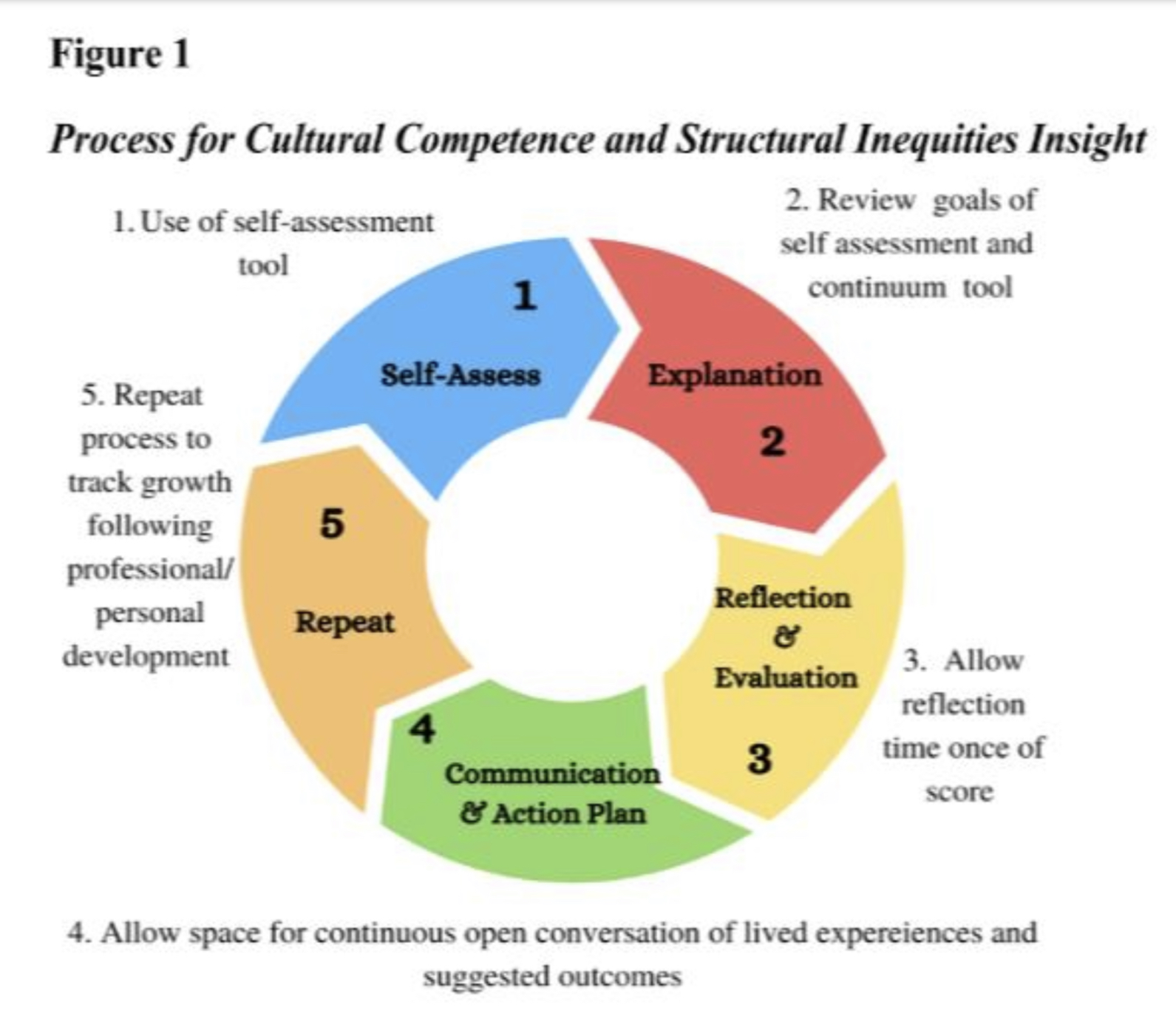
Through the findings of this work, a new process emerged that will assist educators, researchers, and students to gain an understanding of their cultural competence level and awareness of structural inequities.

This process of authentic self-assessment must takeplace for sustainable change within the educational system. This process allows educators to self-assess where they currently stand with cultural competence and structural inequities and where they think they can continue to grow and develop to make a difference through their instructional practice.

From Patterson 2022

NP: Prior to supporting those who are in our care, we have to first understand and evaluate the change we are asked to spearhead and transform. Individuals in our care are in an organizational structure. It is important that teachers use this self-assessment on a continuous basis and that reflection take place at all levels to enact sustainable change. Connected to self-assessment, there must be collaboration and support systems for leaders facilitating these transformation efforts. Leaders are chameleons, and we must adapt to the needs of those we support but also use wisdom in the supports we are in need of. At times, support for leaders can be as simple and impactful as a listening ear, mentorship, and self-care,to name a few examples. 

Expectations, accountability, and support are the key ingredients to needed educational change of academic and life outcomes for marginalized communities. Additionally, in order to evoke change we must include those whom the change will impact in the conversation. I often think of the saying, “nothing for me, without me.” Courageous conversations must happen at the individual and group level to ensure we are uplifting the voices of those who are involved in the change process. Everyone wants to be heard. Everyone also wants to be a part of something bigger than themselves. This can be achieved through transparency, consistent communication, and partnership during the transformational process. 

NP: Hope is amazing and the strongest thing to hold on to! I hope that with the rise of advocacy for cultural competence and access to relevant research, the field of education will truly become a space that benefits all the children we are blessed to serve. I am excited and encouraged by the youth! Working with such brilliant, bold, and brave students on a daily basis excites and inspires me to continue to work for educational change. The innovation, creativity, and relentlessness of our youth is a joy to experience as an educator and leader. I am encouraged by the advocacy I see young people engage in, by the multiple ways success is defined for them, and the no fear mindset that allows them to go for the goals they desire without a fear of failure. I am encouraged that as current scholar-practitioners we can contribute to the future success of students by keeping an open mind and holding onto hope. Hope is one of the most powerful things this world has to offer. Maintaining a growth mindset is needed to experience the true value of hope and dealing this hope to others. 

I foresee continuous growth in the areas of educational technology. I am curious to see how artificial intelligence will continue to influence education. Currently, there are several systems that are being used by scholar-practitioners and students regarding artificial intelligence. I can only hope that as the times continue to change, schools will be ahead of the curve by providing opportunities and spaces to educate students and educators on how to best use these various technologies. I hope to see a major change in the mandates regarding curriculum and instruction to focus on financial literacy requirements, fostering entrepreneurship, courses in social emotional well-being, and courses that teach conflict resolution/self-regulation. These courses are especially imperative in Black and Brown communities where we see and experience tragedy due to gun violence on a daily basis. 

Last, at the policy level, I hope to see change connected to continuous efforts to encourage and uplift the Black vote. These are the views of the silent majority and reflect the importance of the future of elections for us and our children. I am fully aware that this process is not an immediate one and will take strategic and intentional advocacy, collaboration, and resistance. I am also fully aware that the students, families, and individuals for whom we continue this heart work, will bring about a promising future for those that come after them.

References: 

Guerra, P. L., & Wubbena, Z. C. (2017). Teacher beliefs and classroom practices cognitive dissonance in high stakes test-influenced environments. Issues in Teacher Education, 26(1), 35-51.

Lindsey, R. B., Robins, K. N., & Terrell, R. D. (2009). Cultural proficiency: A manual for school leaders (3rd ed.). Corwin Press

McGrath, A. (2020). Bringing cognitive dissonance theory into the scholarship of teaching and learning: Topics and questions in need of investigation. Scholarship of Teaching and Learning in Psychology, 6(1), 84-90. 10.1037/stl0000168

Patterson, N. (2022). Taking a knee: A mixed methods study evaluating awareness of structural inequities and levels of cultural competence of middle school in-service teachers of Black and Brown students (Publication No. 28967538) [Doctoral dissertation, Saint Joseph’s University]. Saint Joseph’s University ProQuest Dissertations Publishing

Coherence and Alignment: Reflecting on Two Decades of Research on Educational Reform

This week, Elizabeth Leisy Stosich discusses her interview with IEN’s Thomas Hatch, published in the new Cornerstone Series from the CPRE Research Minutes podcast.  This will be our last post of 2019, as we will be on hiatus until January 7th. Happy New Year!

Last week, I had the chance to speak with Thomas Hatch from Teachers College about  two articles that I have drawn on in my own work on coherence and standards-based reform. In the interview Hatch discusses his 2002 article “When Improvement Programs Collide” and his co-authored 2004 study, led by Meredith Honig, “Crafting Coherence: How Schools Strategically Manage Multiple, External Demands.”

I was interested in doing this interview to share it with the students in my course, Leading Educational Policy and Reform, for experienced educational leaders in Fordham’s Ed.D. program. Often, when discussing policy, we only consider one policy at a time rather than examining it in the complex policy environment that educational leaders must navigate on a daily basis. In the interview, we discuss how Hatch’s work on coherence has evolved, our common interests in the social process of interpreting and making sense of policy, and connections to the work of other scholars in the field including Richard Elmore and Karen Seashore Louis.

In our conversation, Hatch describes the challenge of policy alignment as “a technical issue”; whereas, policy coherence is an issue of meaning. He was motivated to pursue this line of research when working to support educational reform in the 1990s. As he explains, “Even if all of the efforts of systemic reform in the 1990s were successful and we produced all these aligned policies, there could be so much work and so many demands on people that they’d still feel overwhelmed and fragmented. And it’s that sense of overwhelmingness and fragmentation that we were trying to address, particularly in thinking about that article around crafting coherence where I think we really emphasize that this is an issue of learning and meaning making that people and organizations like schools are engaged in.” Over time, his work has reinforced the importance of understanding the challenge of “crafting coherence” among external policies and internal goals from a collective perspective, one that takes into account the fact that educators are engaged in this meaning making process simultaneously but from their own unique perspectives.

In the interview, Hatch also shares practical advice for educational leaders at the school- and district-level who face the difficult task of leading policy implementation. As he explains, educational leaders should “recognize this is a part of the job. It’s not a sign that you’re not doing well if you’re feeling overwhelmed. It’s a reality of the circumstances in which the work is done, and you have to recognize that you’re facing conflicting incentives.” My recent article, “Principals and Teachers ‘Craft Coherence’ Among Accountability Policies,” examines how educators respond to the demands of the Common Core and a new teacher evaluation policy and reinforces how challenging maintaining this balance can be in the face of high-stakes accountability policies. In fact, the pressure from standards-based accountability policies can lead some leaders to abandon their local school goals to focus on external demands. To be successful in the long run, leaders must both respond to the requirements imposed by external mandates but also maintain a focus on the goals that matter most to the community they serve.

Leading Futures: Alternative Perspectives on Education Reform and Policy

In this latest post in the Leading Futures Series, edited by Alma Harris and Michelle Jones, Jenny Gore and Geoff Whitty describe an alternative approach to improving teaching that challenges predominant forms of accountability. Drawing from their public lecture at Bath Spa University on May 17, 2017, with a focus on the potential of Gore’s work in Australia on Quality Teaching Rounds, they suggest that the approach should now be trialed elsewhere.  Jenny Gore is Professor of Education and Geoff Whitty holds a Global Innovation Chair at the University of Newcastle, Australia. 

Improving teaching: some lessons from Australia

Jenny Gore and Geoff Whitty

Why on earth would we look to Australia for lessons about education? After all, its PISA scores have dropped down the rankings where they now sit alongside those of many other OECD nations. What does Australia have to offer that differs from the apparently more successful countries in Scandinavia and East Asia that have often been the focus of policy tourism?

One answer is, of course, that PISA is not the be-all and end-all of educational assessment. But another reason is that other factors have overridden ‘PISA envy’ for countries like the US and UK, which are much more similar to each other than they are to either Finland or Shanghai-China. Their continuing mutual interest in each other’s reforms probably lies with shared social and political networks and assumptive worlds – and, of course, a common language with which to describe reforms.

Indeed, readers in the US and UK, and many others influenced by Anglo-Saxon policies, will readily recognize the major challenges identified by Bentley and Savage in a recent book on policies changes in Australia in recent years. These include:

  • a national curriculum
  • standardised national assessments in literacy and numeracy (NAPLAN)
  • national reporting on schools (through the My School website)
  • professional standards for teachers and school principals
  • a universally accessible year of pre-school
  • partial implementation of needs-based funding reforms (Gonski).

But they also point out that, despite these reforms, there is unfortunately very little sign of positive impacts or outcomes. For example:

  • The percentage of Australian students successfully completing Year 12 is not improving.
  • State and federal school funding policies are still reproducing a status quo that entrenches sectoral division and elitism.
  • New evidence-informed methods, such as clinical and targeted teaching models, are being taken up very slowly in teacher education degrees and schools.
  • The status and efficacy of vocational learning have shown little meaningful improvement.
  • NAPLAN and My School have not led to improvements in literacy and numeracy, with 2016 data showing either stagnation or decline.
  • The performance of Australian students in international assessments of maths, science and literacy skills has steadily declined.

Depressingly familiar stuff to many of us, isn’t it?  Similarly, take this recent statement by Geoff Masters, CEO of the Australian Council for Educational Research.

There is no shortage of challenges in school education. Some of the biggest challenges we face can appear frustratingly intractable. Despite reform efforts, regular government reviews and ongoing calls for change, progress in addressing our most significant challenges is often slow and solutions continue to elude us.

Equally familiar are the five key challenges he identifies as facing Australian education:

  1. Equipping students for the 21st Century, including by increasing reading, mathematical and scientific literacy levels.
  2. Reducing disparities between…schools, particularly along socioeconomic lines, by ensuring that every student has access to an excellent school and excellent teaching.
  3. Reducing the ‘long tail’ of underachieving students who fall behind year-level curriculum expectations and thus fail to meet minimum international standards.
  4. Getting all children off to a good start, by reducing the number of children who begin school with low levels of school readiness and so are at risk of ongoing low achievement.
  5. Raising the professional status of teaching, by increasing the number of highly able school leavers entering teaching.

While this last challenge resonates with the aspirations of many countries, and policy direction of initiatives like Teach for America, Gore et al. have demonstrated that the solution identified here by Masters may be misleading. Rather, the sort of approach we describe below may be a better way to enhance professionalism in teaching.

Bentley and Savage say of Australia, over the past decade ‘the policy landscape has become riddled with reform “solutions” that subject students, teachers, administrators and policymakers to mounting levels of pressure and stress’ and that ‘the short-term cyclical churn of today’s politics and media clearly exacerbates these problems.’

Although the policy context of other countries differs in detail, their actual policies have much in common. In many countries, regulation and accountability have taken a hold on government attitudes towards the teaching profession, alongside (though in different degrees) a belief in market forces as providing a way forward. Education academics (ourselves included) have been rather better at critique of such developments than in pointing to an alternative way forward. What we want to argue is that widely sought-after improvements in teaching will remain elusive unless teachers are afforded more respect, trust and, especially, professional support.

One tested example of such an approach lies in work conducted at the University of Newcastle, Australia, which puts down a challenge to policy makers who seek genuine improvement in teaching. The approach, known Quality Teaching Rounds (QTR), has produced measurable impact on the quality of teaching while simultaneously enhancing teachers’ morale and confidence.

QTR is a form of teacher professional development designed by Bowe and Gore to bring together the benefits of professional learning communities (PLCs), instructional ‘rounds’, and the Quality Teaching (QT) pedagogical framework (NSW Department of Education and Training [NSW DET], 2003). The framework centres on the three dimensions of Intellectual Quality, Quality Learning Environment, and Significance. QTR involves teachers working in PLCs of three or more teachers to observe and analyse each other’s teaching, using the QT framework, followed by extended conversation about their collective practice. QTR is a distinctive form of professional development which: is applicable across stages and subject areas; addresses teaching comprehensively; requires minimal external input; and is adaptable to the specific teaching context. This is in contrast to professional development that: is stage or subject-specific; addresses a part of teaching practice only; requires ongoing provision of external expertise; and is highly prescriptive of practice.

In a recent randomised controlled trial, 24 NSW public schools participated in an investigation of the impact of QTR. Eight teachers at each of the schools were involved in the study, with lesson observations carried out by researchers, who were blinded to group allocation, at three time points – baseline, post-intervention (6-months), and follow up (12- months). There were two intervention groups (QTR-Set and QTR-Choice) and a wait-list control group.

Participating in QTR was found to significantly impact on the quality of teaching (d =0.4-0.5) within the relatively short timeframe of this intervention (most teachers were involved for four days or less) across a diverse range of schools. Moderators of intervention effects were explored for: type of school, SES, location, teaching experience, and gender of teacher.

The key findings were that the quality of teaching improved for both intervention groups and these effects were sustained six months later, signaling the sustainability of impact into a new school year. Effects were independent of school type (primary/secondary) and location (urban/rural) and years of teaching experience. Effects on teacher morale and sense of recognition and appraisal yielded similar results for the two intervention groups, relative to control group. In interviews, teachers reported positive impacts on their own and their colleagues’ teaching and professional confidence, on collegiality and school culture, and on their students. The next study in this programme of work is another RCT designed to investigate further the impact of QTR on student learning outcomes.

The findings from the earlier study demonstrate the value of QTR in not only improving the quality of teaching but simultaneously enhancing teacher morale and teaching cultures across a range of schools and classroom settings in diverse communities. QTR was found to be an effective form of professional development, improving the quality of teaching in primary and secondary schools across subject areas and for teachers at different stages of their careers. The positive effects of QTR are thus highly generalisable across school contexts.

The approach not only builds on widely accepted ‘principles of effective PD,’ but can be implemented at scale and at a relatively low cost. It supports teachers in improving their practice while also developing their efficacy, well-being and professional engagement. This is in stark contrast to approaches that subject teachers to greater levels of accountability, evaluation, and performance review.

This Australian approach simultaneously, and ambitiously, provides evidence of a kind that is persuasive to governments and education systems that want to be sure their investments have pay-off and empower teachers. Such an approach is part of the jigsaw of educational improvement that has somehow been missing in many contexts. We argue that improving teaching in order to improve pupils’ learning depends, in large part, on teachers’ confidence in themselves and each other. This differs from prevailing approaches that seek to improve teaching through forms of accountability premised on a lack of confidence in and respect for teachers. In short, QTR is an alternative that can build public confidence in teachers from the ground up.

Bringing Effective Instructional Practice to Scale

10833The Journal of Educational Change publishes important ideas and evidence of educational change. Contributions represent a range of disciplines, including history, psychology, political science, sociology, anthropology, philosophy, and administrative and organizational theory. The journal also draws attention to a broad spectrum of methodologies, including quantitative and qualitative approaches, documentary study, action research, and conceptual development.

The journal’s most recent special issue, edited by Santiago Rincón-Gallardo and Brahm Fleisch, brings together articles by reform leaders and scholars who have developed and/or studied education change efforts in various contexts: Escuela Nueva in Colombia, the Learning Community Project in Mexico, the Gauteng Language and Mathematics Strategy in South Africa, Pratham’s Literacy Strategy in India, the Ontario Literacy Strategy in Canada, and Long Beach Unified School District’s system-wide instructional strategy in California, United States.

The editors also share two commentary papers by Richard Elmore and Michael Fullan. As the editors explain in their introduction to the special issue, “The two concluding essays pull together common and divergent threads across the six cases, derive key lessons, and articulate critical perspectives for the future of improvement in the education sector. While Elmore raises fundamental questions about the very project of policy-driven improvement, Fullan argues that, though elusive, whole system improvement centered around deep learning is doable.”

To read the complete introduction, click here:“Bringing effective instructional practice to scale: An introduction.”

To find the complete special issue, click here: The Journal of Educational Change.

To read IEN posts focusing on these reforms, click on the following links:

Attempting Change from Within: Student-Centered Change in Mexico

Bringing Effective Instructional Innovation to Scale through Social Movement in Mexico and Colombia

An interview with Vicky Colbert, co-founder of Escuela Nueva (Lead the Change)

Brahm Fleisch on building a new infrastructure for learning in Gauteng, South Africa

Learning from successful education reforms in Ontario

Learning from successful education reforms in Ontario: Part II

Life after levels: Is the new Year 6 Maths test changing the way teachers teach?

This week we share a blog post written by Melanie Ehren and Nick Wollaston. Originally published on the IOE London Blog, of University College London, this blog is part of a Nuffield foundation funded research project Dr. Ehren coordinates. The research looks at the Key Stage 2 test in mathematics in England and how the test affects teaching of primary mathematics. The test is administered in year 6 (end of Primary school) and is considered to be high stakes as schools performing below the floor standard are monitored by Ofsted (the Inspectorate of Education), face potential forced academization, and test outcomes are used in (teachers’ and head teacher’s) performance management reviews. The test has undergone changes this year to reflect the new national curriculum, and the researchers have asked teachers (after the administration of the new test) how they are changing their teaching in response to the changes in the test. More info on the project (and a broader introduction) is on the website: www.highstakestesting.co.uk

Here we share the blog post in full. To read the post on the IOE London Blog, click here.


Life after levels: is the new Year 6 maths test changing the way teachers teach?

Earlier this month (5 July), the Department for Education published the results of the Key Stage 2 test for 10 and 11-year-olds. The publication was awaited with more anxiety than usual as this year’s test was the first one on the new national curriculum. One of the major changes in the test is the removal of the ‘old’ national curriculum levels 3, 4 and 5, where children were expected to reach at least a level 4. The level 6 paper for the most able children has also gone and results are now reported as ‘scaled scores[1]’. Each pupil now has to achieve at least a score of 100 to reach the expected standard. It seems like a minor change with little impact on how teachers teach mathematics and prepare children for the test, but recent findings from our Nuffield-funded study suggest otherwise.

We interviewed 30 Year 6 teachers in schools performing both below and above the floor standard in Mathematics. Interviews took place prior to the changes in the test in May/June 2015, and again after the changes in the test in May/June 2016. In the interviews in 2015, levels were one of the key topics teachers talked about when we asked them about notable features of the test that would inform their teaching. They explained how each of the two written Maths test papers would start with easy level 3 questions, have level 4 questions in the middle and finish with the difficult level 5 items at the end. This order of questions according to difficulty level would allow the lower attaining children to access the test, according to these teachers, and would build their confidence in answering the questions and their motivation to do well on the test. Teachers tell us in the second round of interviews, how all the questions are now ‘at level 5’ and how some of their lower attaining children stared at them in horror when opening their test booklet, asking them where the easy questions had gone.

Not only does the abolition of levels seem to have an impact on children’s motivation and confidence in test taking, it also appears to have a profound impact on how teachers come to understand and teach mathematics. Prior to the introduction of scaled scores, teachers would talk about gradually building up the level of difficulty when teaching specific mathematical content areas, such as ‘number sense and calculation’, ‘data handling’ or ‘shape and space’. Level 3, 4 and 5 test items on past Key Stage 2 test papers would help them understand the hierarchical nature of mathematics and how to introduce children to, for example, increasingly more difficult calculations (e.g. moving from one step to multistep problems, or from adding and subtracting whole numbers to adding and subtracting decimals). Resources such as Test Base would allow them to access available questions according to content area and difficulty level and they could simply download relevant questions when teaching a specific skill. Now that the levels have been removed, some of the teachers tell us that they just focus on getting all students to perform at level 5 in number and calculation as this is where most of the marks on the test are given and some hardly teach shape and space at all. These teachers also talk about moving towards a more ‘mastery style’ of teaching where they ensure that all students master the basics before they move on to teach more complex skills or other (more complex) content domains, such as algebra or geometry.

It is too early to know how widespread these changes are and the effect they will have on children’s understanding of mathematics. Our study, however, indicates that we need to keep a close eye on the breadth and depth of what our children are learning as some of these changes may be masked by an average single test score.


[1] A pupil’s scaled score is based on their raw score. The raw score is the total number of marks a pupil scores in a test, based on the number of questions they answered correctly. The Standard and Testing Agency develops tests each year to the same specification, but because the questions must be different, the difficulty of tests may vary slightly each year. This means that the raw scores pupils get in the tests need to be converted into a scaled score to be able make accurate comparisons of pupil performance over time. Every scaled score will represent the same level of attainment for a pupil each year, so a pupil who scores 103, for example, in 2016 will have demonstrated the same attainment as a pupil who scores 103 in 2017. A scaled score of 100 will always represent the expected standard on the test. Pupils scoring 100 or more will have met the expected standard on the test. In 2016, panels of teachers set the raw score required to meet the expected standard on each test.

Learning from successful education reforms in Ontario: Part II

imagesIn 2003, the Ontario government began to focus on issues of educational improvement. The government instituted a series of reforms that have proven incredibly successful, with elementary achievement results rising from 54% in 2003 to 72% in 2014, and high school graduation rates rising from 68% to 84% in the same amount of time. This past summer I spoke with Mary Jean Gallagher, Ontario’s Chief Student Achievement Officer and Assistant Deputy Minister of the Student Achievement Division, and Richard Franz, Ontario’s Director of Research, Evaluation & Capacity Building, to learn more about their experiences with this reform effort thus far, and their plans for the future. As this conversation was so informative, we have decided to post it in two parts. In part one we focused on aspects of the reform that have been key to its success thus far. Here, in part two, we explore Ontario’s approach to moving forward with an expanded reform agenda.

Planning the Future:

In 2013, Ontario’s Ministry of Education (MOE) set a renewed vision for the education system. This process allowed them to identify critical information about what they have achieved, and share this information with parents, business leaders, community members, teachers and students. As Gallagher explained, as a result of Ontario’s success over the past decade, “we have a newfound respect for our ability to set goals and measure progress and achieve them, so we are more careful about goals we set.” By engaging in a broadly based, 7-month collaborative consultation process, they engaged both qualitative and quantitative research methods to determine their next steps.

This process culminated in the production of their “Achieving Excellence” report. This report identifies four new, interconnecting goals for the education system. As they are described in the report:

  • Achieving Excellence: Children and students of all ages will achieve high levels of academic performance, acquire valuable skills and demonstrate good citizenship. Educators will be supported in learning continuously and will be recognized as among the best in the world.
  • Ensuring Equity: All children and students will be inspired to reach their full potential, with access to rich learning experiences that begin at birth and continue into adulthood.
  • Promoting Well-Being: All children and students will develop enhanced mental and physical health, a positive sense of self and belonging, and the skills to make positive choices.
  • Enhancing Public Confidence: Ontarians will continue to have confidence in a publicly funded education system that helps develop new generations of confident, capable and caring citizens.

As Gallagher and Franz explained, the process of determining these goals helped them to understand that in the future they need to “heighten the relevance of what people are learning, increase experiential learning, and use the community more broadly.” By engaging community members in the process they were able to learn that those members felt they had valuable information and experiences to offer the educational system, and were being underutilized. As a result, the MOE is now thinking of better ways to reach out.

Another key aspect that emerged is the importance of student voice. Since the consultation process included school-age students, the MOE was able to learn more about what the students felt needed to be changed about their own education. The MOE, for example, developed a program called “Students as Researchers,” which invites students to formulate questions about how to make their schools better places and trains them in research skills and ethics so that they can design and implement their own research projects, which are then shared with the MOE.

Challenges of new goals:

Looking ahead, Gallagher and Franz explained that there is some tension around the notion that good teaching and learning must be measured. New challenges include thinking about ways in which the system might be able to broaden the measures of success, and what counts as success, so that the emphasis is not only on test scores. This is particularly relevant since one of their new goals is to improve student well-being. In setting the goal, the MOE also must consider how to measure something that has no history of measurement or policy focus.

Another concern is the additional demands of the bureaucracy that might be added once new goals, and new measurement systems for those goals, are implemented. As Gallagher and Franz noted, one of the reasons for the success of the education reforms so far has been attributed to the narrow focus on a small number of goals. With a focus on the renewed four goals, how can they be incorporated into a successful system without overburdening it? As Franz explained, the new tension is about how to do it all is such a way that gets you the insight and information needed to guide the practices of all involved in the system in addressing the new goals, while continuing to build coherence such that actions in the name of one goal also support achievement of the other goals.

For more information:

Ontario Ministry of Education

Deirdre Faughey

Creative Commons License
This work is licensed under a Creative Commons Attribution-NonCommercial-NoDerivatives 4.0 International License.

Brahm Fleisch on building a new infrastructure for learning in Gauteng, South Africa

Twenty Years of Transformation in Education,” published in May by the Gauteng Department of Education in South Africa, illustrates the challenges and possibilities in pursuing systemic instructional reform. In a recent conversation, Brahm Fleisch, outlined central aspects of the strategy in Gauteng, highlighting the important role of the development of what David Cohen and others have called an “infrastructure” for instruction.

As Fleisch has described it, before the first democratic elections in South Africa in 1994, the routines and rhythms of schooling in most urban working class communities in Gauteng had been ruptured. As one recent media report explained, there may have been over 4 million “learner days” in Gauteng lost each year due to protests and other serious disruptions (out of over 11 million lost in South Africa as a whole). Since 1994, however, the government of Gauteng sought to restructure racially segregated administrative systems, address resource inequalities, institutionalize democratic school governance and transform the official curriculum. Although disruptions to education began to subside, substantial improvements in teaching and learning still had to be made. In fact, in 2006, South African 4th and 5th graders scored 45th out of 45 countries on the PIRLS test of reading skills (with 87% of 4th grade students and 78% of 5th grade students in South Africa unable to achieve the lowest standard of performance).

From Fleisch’s perspective, a key weakness of the initial reforms was a failure to reach the “instructional core” and an inability to transform and strengthen the instruction students experienced in classrooms throughout the province. As Fleisch explained, students experienced two different kinds of instruction depending on where they lived. Students in primary classrooms serving working class, poor and rural communities experienced choral recitation, copying from the blackboard into workbooks, incomplete coverage of the curriculum, and low expectations. In contrast, students in primary classrooms serving middle-class communities (both white and black) experienced higher expectations, more advanced reading materials, guided reading and writing, and tasks more aligned to those measured in standardized tests.

In order to create a more consistent and effective approach to instruction for all, the province developed and began implementing the Gauteng Primary Language and Mathematics Strategy (GPLMS) in 2010. Drawing on some aspects of England’s National Literacy and Numeracy Strategies (NLNS) (which a team from the Ontario Institute of Studies in Education evaluated initially in Watching and Learning), the GPLMS provided what Fleisch termed a “triple cocktail” of scripted lesson plans, aligned texts and instructional materials, and coaching for teachers. As in England, the prescriptive nature of some of the reforms in South Africa were particularly controversial. However, building on the work of Barber and colleagues at McKinsey & Co., the strategy designers argued that a highly structured, aligned curriculum needed to be put in place to establish a foundation for more ambitious instructional improvement in the future.

Beyond the high level of prescription and structure, the GPLMS strategy was particularly noticeable for its attention to increasing the quality and consistency of instructional materials available to all students. As Fleisch pointed out, before GPLMS, teachers had to rely on a hodge podge of materials that varied widely in quality. As he put it, there was no coherent theory of instruction to support teachers in selecting and using the materials in productive ways. Further, few of those materials were produced in African languages (particularly the languages of the poorest students) because under apartheid, educational publishers had no market for such materials.   Thus, from Fleisch’s point of view, the development of a coherent sequence of materials aligned to common goals was a particularly crucial step in strengthening the instructional core.

Based on his own case studies and reports from colleagues and the teachers he has met in the field, Fleisch has found that many teachers welcomed the clarity and consistency the materials brought to their work. Reminiscent of the discussion of teacher autonomy in a previous post about South Korea, Fleisch argues that by providing teachers with support, the structured, aligned materials can help teachers to feel more effective and to develop a sense of professionalism. In fact, he’s even found that the teachers in Gauteng have copied and shared the materials with teachers in other provinces.

Fleisch stressed, however, that aligned materials alone are far from sufficient. In turn, he credited the individualized coaching with helping many teachers to develop their knowledge and skills. Fleisch also noted that the coaching had the added benefit of providing many teachers with social and emotional support to help them deal with the massive changes that were undertaken. In particular, the use of the materials and the work with the coaches helped to connect teachers, especially those isolated in poorer and more rural communities, with others who were all engaged in a systemic, coordinated improvement effort. Notably, the “triple cocktail” in Gauteng placed relatively little emphasis on the development of principals or other educational leaders, choosing instead to focus more directly on the content and means of instruction.

To date, the results of the GPLMS strategy are unclear. Twenty Years of Transformation in Education provides an account of some of the advances and challenges experienced in Gauteng overall and in the GPLMS approach in particular. While primary school students in Gauteng have shown steady improvements on South Africa’s national tests, Fleisch also points out that the tests have changed each year, making comparisons difficult. Further, critics continue to point high levels of dysfunction in South African schools overall.

In order to assess the impact of the “triple cocktail,” Fleisch is currently engaged in a set of studies including randomized controlled trials to examine the effects of several different aspects of the strategy. Further, Fleisch cautions that even with a highly-structured intervention like GPLMS, adaptations may need to be made in order for the strategy to succeed in different contexts. In one instance, a nearby province sought to develop a GPLMS-like instructional strategy. In that instance, however, several aspects of the context made implementation more difficult. In particular, students spoke a different variety of languages and the initial materials were pitched at too high a level. The mismatch between students’ readiness for learning and the level of the materials and instruction made it difficult to establish a strong foundation for improvement. As a consequence, Fleisch argues that even prescriptive and structured materials and approaches have to be adapted and updated constantly to ensure that they turn what Nic Spaull has called South Africa’s “zone of improbable progress” into a spiral of concrete and appropriate supports – a “zone of proximal development” – that facilitates steady improvement.

Thomas Hatch

Creative Commons License
This work is licensed under a Creative Commons Attribution-NonCommercial-NoDerivatives 4.0 International License.